The Rank She Refused
Part I — The Man in the Aisle
Captain Mara Voss saw the civilian before anyone else understood he was a problem.
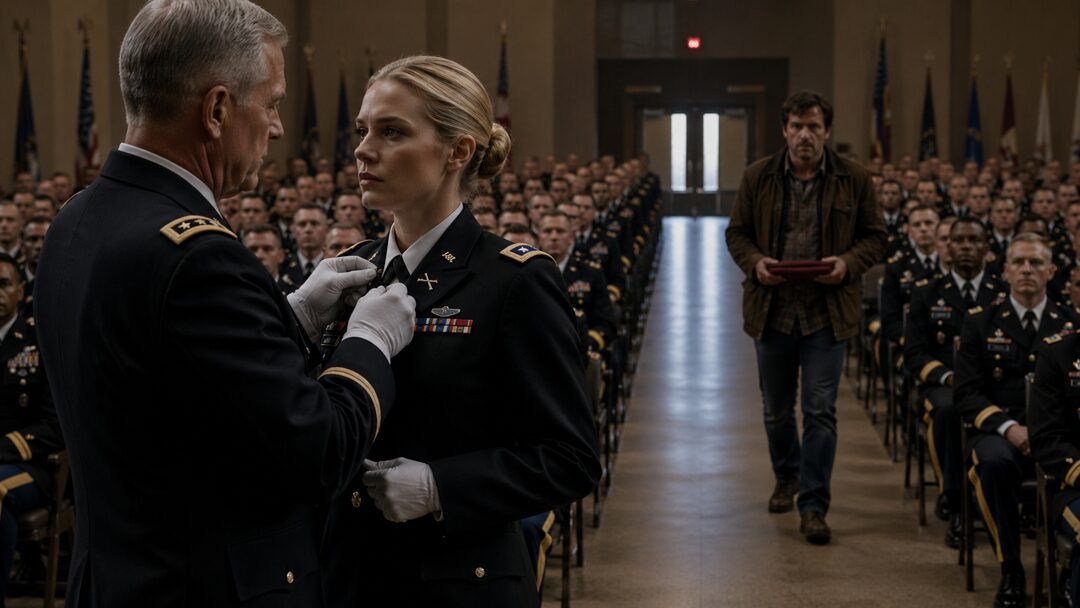
He was halfway down the center aisle of Victory Hall, moving against the polished order of the ceremony in scuffed brown boots and a weathered jacket, while six hundred uniforms faced forward and Brigadier General Harlan Vale held the silver rank near Mara’s collar.
For one clean second, nobody stopped him.
The hall had been built for moments like this. High balcony. Brass railings. Flags hanging heavy and bright from the rafters. Rows of academy cadets seated with their backs straight enough to ache. Families pressed shoulder to shoulder behind them. Officers in dress blues lined the front rows, their medals catching the lights like small, obedient fires.
Mara stood at attention in the middle of it all.
Her blonde hair was pinned so tightly beneath regulation standards that her scalp hurt. Her white gloves were spotless. Her uniform had been inspected twice. Inside her breast pocket, folded into a square so exact it looked machined, was the promotion speech she had been ordered to keep brief.
Thank the command.
Honor the fallen.
Look forward.
General Vale lifted the silver insignia toward her shoulder.
“Captain Voss,” he began, his voice carrying through the hall, calm and practiced, “your conduct during Operation Ash Lintel—”
Then Mara saw the man.
He was not in uniform.
That alone made him wrong.
He wore jeans faded white at the knees, a plaid shirt under his jacket, and the kind of tired face that did not belong under the ceremonial lights. His hair needed cutting. His jaw was rough with days of stubble. His right hand was closed around something tucked close to his chest.
Two junior officers near the aisle noticed him at the same time. One rose halfway from his seat. Another stepped out from the wall.
The man kept walking.
Mara’s throat closed.
General Vale’s hand froze a few inches from her uniform. To the audience it might have looked like ceremony. To Mara, it looked like warning.
“Captain,” he said quietly, without moving his mouth much. “Eyes front.”
Her hand dropped toward the inside of her jacket before she could stop it.
Not to a weapon. There was no weapon.
To the strip of fabric hidden beneath the stiff fold of her uniform.
The civilian saw the movement. His face changed, just slightly.
He knew.
“Mara,” he said.
Her first name struck harder than a shout.
The hall shifted. Not loudly at first. A murmur moved through the seats like wind crossing dry grass. The cadets in the balcony leaned forward. Someone’s chair scraped. One of the junior officers stepped into the aisle and raised a hand.
“Sir, you need to return to your seat.”
The civilian did not look at him.
He looked only at Mara.
General Vale lowered the insignia by half an inch.
“Remove him,” he said.
The command was soft. That made it worse.
Two security officers moved fast now, one from each side. The civilian stopped only when they were close enough to grab him. He lifted both hands.
“I’m unarmed,” he said.
His voice was hoarse, but steady.
In his left hand was a clear evidence sleeve.
Inside it, folded badly, was a dark red field scarf.
Mara felt the floor tilt beneath her.
The color should not have been so bright after all this time. It should have dried into brown. It should have become something dead, something historical, something that belonged in a sealed box with a case number and a signature across the tape.
But under the hall lights, the scarf still looked red.
For a moment, the auditorium vanished.
Dust. Heat. The sour sting of smoke. June Rusk’s hand on Mara’s vest, shoving hard enough to bruise.
Move.
Mara blinked and Victory Hall returned in pieces.
The general’s polished shoes. The silver rank between his fingers. The civilian in the aisle. Six hundred people watching her face.
The scarf.
General Vale saw it too.
His expression did not break. That was his gift. That was why men followed him, why rooms trusted him, why reports passed through his hands and came out clean.
But Mara was close enough to see the tiny tightening at the corner of his mouth.
He recognized the scarf.
And he hid it faster than she did.
Part II — The Wrong Survivor
“Take him out,” General Vale said.
This time the order carried.
One officer seized the civilian’s arm. Another reached for the evidence sleeve.
The man pulled it back against his chest. Not violently. Carefully. As if the thing inside could still feel pain.
“Don’t touch it,” he said.
“Sir,” the officer warned.
The man finally looked at him.
“My wife died in that sector.”
The room lost its murmur.
Mara heard one woman in the family section inhale sharply. Somewhere behind her, a cadet whispered, “Who is he?”
General Vale’s voice remained level.
“This is not the place.”
The man laughed once, without humor.
“That’s what every office told me.”
Mara could not move.
Her body remembered parade rest. Attention. Salute. Forward march. Her body remembered how to stand still under inspection, under gunfire, under command.
But it had forgotten how to stand still under June’s scarf.
The civilian turned back to her.
“You know why I’m here.”
Mara’s lips parted.
Nothing came out.
The general stepped closer, his body blocking part of the audience’s view of her face.
“Captain Voss,” he said, low enough that the microphone would not catch it, “you will allow security to handle this.”
Will.
Not should. Not may.
Will.
The word settled over her like a hand.
She had obeyed that voice in dust storms, in command tents, in briefings where maps showed abandoned blocks as gray shapes and not as rooms full of breathing people. She had obeyed it after Ash Lintel, when the report came back with the civilians removed from the timeline.
Operationally irrelevant.
That was the phrase someone had used.
June had not found them irrelevant.
A child with one shoe. An old man bleeding through his sleeve. A young mother trying to keep two boys quiet while the walls shook.
Mara’s hand went again to the inside of her jacket.
The hidden fabric was warm from her body.
The officer holding the civilian’s arm tightened his grip.
“Sir, last warning.”
The civilian did not resist.
He lifted the evidence sleeve higher so the whole hall could see it.
“You pinned the wrong survivor,” he said.
This time the room reacted.
Not applause. Not anger. Something messier. A collective flinch. A few soldiers stood. A few families turned to one another. Someone near the back said, “Sit down,” but nobody knew who it was meant for.
Mara’s knees loosened.
General Vale looked out at the room with the cold patience of a man waiting for weather to pass.
“Ladies and gentlemen,” he said, voice filling the hall again, “we apologize for the interruption. Captain Voss has served this nation with distinction. We will continue in an orderly manner.”
Orderly.
Mara almost smiled.
June would have hated that word right now.
June Rusk had once cleaned blood from under her nails with bottled water and told Mara, “The Army loves order until order needs a conscience.”
Mara had told her to stop saying things like that over comms.
June had grinned through the dust. “Then stop making me right.”
The memory hit so cleanly that Mara swayed.
General Vale saw.
His eyes sharpened.
“Captain,” he said. “Eyes front.”
There it was again.
The old command.
The easy command.
Look where we tell you. Stand how we trained you. Let the room see what it came to see.
The officers began pulling the civilian back up the aisle.
His boots dragged once on the polished floor.
Mara heard it.
One ugly sound in a perfect room.
“Wait,” she said.
The word was not loud, but the microphone caught it.
The officers froze.
The general turned his head slowly toward her.
Mara swallowed. Her tongue felt numb.
“Let him stay.”
For the first time since she had entered Victory Hall, General Vale looked at her not as a decorated officer, not as a survivor, not as proof that Ash Lintel had produced something worth honoring.
He looked at her as a problem.
The civilian stopped fighting the hands on him.
The evidence sleeve shook once in his grip.
General Vale smiled. It was the smallest possible smile, meant for the audience, not for her.
“Captain Voss,” he said, “this ceremony is not a forum.”
“No, sir,” Mara said.
Her voice held.
Barely.
“It’s a witness.”
The silence after that was so complete she could hear her own glove creak as her fingers curled.
Part III — The Scarf
The general turned away from the microphone.
“You are not well,” he said.
Mara almost laughed at that too.
Not well.
A neat phrase. A usable phrase. A phrase that could be written into an incident report and folded over the truth like clean linen.
Captain experienced stress response during public ceremony.
Civilian disturbance contained.
Promotion rescheduled.
No further action required.
The officer nearest the civilian glanced toward the general, waiting.
Mara looked at the man in the aisle.
His eyes were red-rimmed. Not wild. Not drunk. Not unstable in the way security had been trained to name and remove.
Just tired.
Eli Rusk had been wearing a black suit the first time Mara saw him.
Not at the funeral. She had missed the funeral. She had still been in a field hospital then, ribs taped, left ear ringing, June’s blood dried into the seams of gear that someone had cut away from her body.
The first time she saw Eli had been three months later in a conference room with no windows, where a casualty liaison officer gave him a folder and General Vale said his wife had acted with courage under hostile conditions.
Eli had asked one question.
“Was she alone?”
No one answered quickly enough.
Mara had looked down at her hands.
Eli had known then.
Maybe not all of it. But enough.
Now he stood in Victory Hall with the scarf his wife had worn under her medic vest, the scarf command had returned to him in a plastic bag with the rest of June’s personal effects.
He should never have had to bring it here.
But Mara understood why he had.
Some truths had no door until someone broke a wall.
General Vale stepped back into position. He lifted the silver rank again.
The audience watched, uncertain whether to trust the uniform or the interruption.
Mara tried to breathe.
The general’s hand approached her shoulder.
“Captain Mara Voss,” he said, each word clipped clean, “for gallantry, composure under fire, and devotion to duty—”
Duty.
June’s voice: Three civilians, northeast laundry room. I can get them.
Mara’s voice: Negative. Pull back.
June: They’re twenty meters from us.
Mara: We have orders.
June: Then the orders are wrong.
The silver rank touched Mara’s collar.
Her chest locked.
The hall stretched far away. The flags blurred. The general’s face thinned into light and shadow.
Then Eli moved.
Not toward her. Not enough to touch her.
Just one step.
“Mara,” he said again.
The sound broke something.
Her body folded before her mind understood she had fallen.
A white glove struck the floor. The speech slid from her pocket. The silver insignia bounced once, bright against the dark polish, and spun near her cheek.
Someone screamed.
The room exploded.
Chairs slammed back. Boots hammered. The balcony rose in waves. A cadet shouted for a medic. Security lunged at Eli as if the collapse proved he had done something.
He ripped his arm free.
“I didn’t touch her!”
Three soldiers moved between him and Mara anyway.
Mara lay on her side, unable to pull enough air into her lungs. Her body had become the road out of Ash Lintel. Her mouth tasted like copper. Her ribs remembered pressure. Her ears rang with the last sound the armored vehicle made before the door slammed shut.
June’s hand on her vest.
June’s face close to hers.
Dark curls loose under a cracked helmet.
“You’re going to live,” June had said.
Mara had tried to grab her.
June shoved her harder.
“Don’t waste it.”
The door closed.
Mara hit the floor of the vehicle.
Through the rear slit, she saw June turn back toward the laundry room.
Then smoke took her.
“Mara.”
Not June.
Eli.
He was crouched several feet away now, held back by a lieutenant with one arm across his chest. His face had gone gray.
A medic knelt beside Mara. “Captain, can you hear me?”
General Vale was there too, lowering himself with the stiffness of a man unused to kneeling.
“Clear the area,” he ordered.
Mara’s hand scraped across the floor.
Her fingers found the fallen insignia.
It was smaller than she expected. Lighter.
A thing that could fit in a palm and still crush a life.
The medic reached for her pulse. “Captain, we need to move you.”
“No,” Mara whispered.
“Ma’am—”
“No.”
General Vale leaned closer.
His face filled her vision: silver hair, controlled eyes, the calm of command polished into something almost kind.
“Do not do this here,” he said.
Only she heard it.
Maybe Eli did too. His head lifted.
Mara stared at the general.
And there it was. Not concern. Not for her. Not really.
Fear.
Not fear of chaos. He knew chaos. He had sent people into it.
Fear of words.
Fear of a dead woman’s name entering the room before he could approve the wording.
Mara closed her fist around the insignia until its edges bit into her glove.
The ceremony had never been only a ceremony.
It had been a seal.
And she had almost let him press it shut.
Part IV — What the Report Removed
The crowd would not settle.
A colonel near the front called for everyone to remain seated. Half the room ignored him. The families in the back stood on tiptoe. Cadets whispered in sharp bursts. Phones appeared, then disappeared when officers snapped at them. The air filled with the dangerous sound of people realizing they were witnessing something they were not supposed to understand.
General Vale stood.
“Ladies and gentlemen,” he said into the microphone, “we will pause briefly while Captain Voss receives medical attention. Please remain calm.”
Medical attention.
Mara pushed herself up on one elbow.
The medic tried to stop her. “Captain, stay down.”
“I’m staying here.”
Her voice was rough, but the microphone caught enough of it for the first rows to hear.
Eli was being pulled backward again.
“Get him out,” Vale said.
Mara lifted her head.
“Eli.”
He stopped.
So did the officers holding him.
The name moved through the room.
Eli.
Not intruder. Not civilian. Not threat.
Someone she knew.
Mara forced herself to her knees. Pain and panic flashed white behind her eyes. The hidden strip of fabric inside her jacket seemed to burn against her ribs.
She looked at Eli.
“I tried,” she said.
The words were too small for the room, but they were the first true ones she had spoken all morning.
Eli’s face broke in a way anger had hidden until then.
“I know,” he said. “That’s why I came.”
It was the worst mercy he could have given her.
Mara lowered her head.
For years, she had imagined his accusation. She had built whole nights around it. Eli saying she left June. Eli saying she followed orders. Eli saying she came home with medals because June came home in a sealed case.
She had not prepared for him to know she had tried.
She had not prepared for forgiveness that refused to excuse the lie.
General Vale’s voice cut in, low and close.
“Captain, you are compromised. Let us preserve your dignity.”
Mara looked up at him.
There were sentences that sounded like kindness until you understood who they served.
“My dignity?” she asked.
His expression hardened.
“You are on the floor in front of six hundred people.”
“Yes, sir,” she said. “I noticed.”
A ripple moved through the hall. Not laughter. Not approval. Recognition, maybe. The room feeling the first crack widen.
Vale crouched again, keeping his voice low.
“You are about to say things you cannot take back.”
Mara looked at the insignia in her palm.
“No,” she said. “I already took them back once.”
The general went still.
There it was between them. Ash Lintel. The gray sector. The civilians erased into silence.
The official report said Sergeant June Rusk was killed while administering emergency aid during the withdrawal phase of a hostile engagement.
That was not false.
It was worse than false.
It was incomplete in the exact place where truth mattered.
It did not say June had heard the civilians after the withdrawal order came.
It did not say Mara had requested permission to hold position for extraction.
It did not say the answer came back negative because the sector had been marked abandoned.
It did not say June had gone anyway.
It did not say Mara followed her.
It did not say the armored vehicle was already reversing when June shoved Mara inside and turned back for a mother and two children hiding under broken shelves in a laundry room.
It did not say command later removed the civilians from the after-action account because admitting they were there meant admitting the sector had not been empty.
The report honored June for courage.
It just removed what she had been courageous for.
That was the part that killed Mara every morning.
Not that June died.
That the Army made her death obedient.
Mara reached inside her jacket.
The whole front row tensed.
General Vale’s hand moved sharply.
“Captain.”
But Mara was not reaching for anything that could hurt him.
She pulled out a narrow strip of dark red fabric.
The room saw it.
Eli saw it.
His mouth opened once, then closed.
The strip had been cut from June’s scarf before the rest was returned to him. Mara had done it in the field hospital with trauma scissors, shaking so badly she sliced her own thumb. Nobody knew. Or maybe somebody knew and chose silence because silence was easier than asking why a half-conscious lieutenant was crying into a dead medic’s scarf.
Mara had worn that strip under every uniform since.
Not as honor.
As sentence.
She held it up.
“I have carried this because I thought silence was respect,” she said.
Her voice trembled, then steadied.
“I was wrong.”
General Vale stood fully now.
“Captain Voss, stand down.”
There it was.
The command.
The old shape of her life.
Stand down.
Eyes front.
Move out.
Withdraw.
Leave them.
Mara looked past him to Eli.
“Bring it forward,” she said.
Eli understood.
The officers did not move at first.
Then one of them, a young lieutenant with a face too open for the moment, released his arm.
Eli walked the rest of the way down the aisle.
No one stopped him.
Every bootstep sounded like a verdict.
Part V — The Name That Would Not Stay Buried
Eli stopped three feet from Mara and held out the evidence sleeve.
Up close, he looked less like anger and more like exhaustion held together by stubbornness. There were deep lines beside his mouth. His hands were scarred with small burns and machine cuts. A mechanic’s hands. June had once shown Mara a photo of those hands holding a chipped coffee mug and said, “He fixes engines like he’s apologizing to them.”
Mara had laughed then.
She almost could not remember the sound of herself laughing.
Now Eli held June’s scarf between them.
Mara did not take it.
“Open it,” she said.
His eyes moved to the general.
“Are you asking me,” Eli said, “or is he going to have me arrested before I do?”
Mara turned toward Vale.
The hall waited.
The general looked at the crowd, then at the officers, then at the microphone standing a few steps away like an accusation.
His silence gave permission because refusing would look worse.
Eli opened the sleeve.
The scarf unfolded in his hands, stiff in places where old blood had dried into the fibers. Dark red cloth. A field thing. Practical. Personal. Too small to carry the weight it had carried.
Mara touched the matching strip in her palm.
The room had gone so quiet that when someone in the balcony began to cry, everyone heard.
Mara rose.
Not gracefully.
The medic tried to help. She shook her head. Then accepted the medic’s arm anyway, because pride had already cost too much in that room.
She stood in front of the microphone with one glove dirty from the floor and the silver insignia still caught in her other hand.
General Vale’s jaw worked once.
Mara looked at the audience.
Faces blurred. Uniforms. Families. Cadets. Officers who had read reports and officers who had signed them and young soldiers who still believed reports were where truth went to be preserved.
She had no speech now.
The folded square was on the floor behind her.
Good.
That speech belonged to the version of her that had planned to survive the morning by disappearing inside gratitude.
Mara placed the silver insignia on the podium.
The small sound carried.
“I was told to keep my remarks brief,” she said.
A few people shifted.
“So I will.”
Her breath caught. She waited until it passed.
“Sergeant June Rusk died during Operation Ash Lintel. That is in the report.”
Eli stared at the floor.
Mara continued.
“She died after refusing to leave three civilians in a sector we had been ordered to abandon. That is not in the report.”
The room changed.
Not loudly. Deeper than that. Like a foundation taking a crack.
General Vale said, “Captain.”
Mara did not look at him.
“Sergeant Rusk found them. A mother. Two children. An elderly man wounded badly enough he could not walk. We were under withdrawal order.”
Her mouth went dry.
“I requested time.”
She heard the radio again. Static. Vale’s voice through another officer. Negative. Sector marked clear. Withdraw.
“I was denied.”
General Vale’s face gave away nothing now.
Mara’s hand tightened around the strip of cloth.
“June went anyway.”
No rank. No title. Just June.
The name landed harder than any accusation.
“I followed her. She reached them first. When the vehicle came back under fire, she shoved me inside.”
Mara stopped.
The hall waited with her.
She could still feel June’s palm against her chest. Still hear the ugly metal slam of the door. Still see June turning away from rescue because someone behind her was still breathing.
“She said, ‘Don’t waste it.’”
Eli closed his eyes.
Mara almost stopped there.
That would have been enough for some people. A moving tribute. A painful memory. A way to honor June without naming the machinery that had cleaned her death.
But June had not died for half a truth.
Mara looked at General Vale.
“The civilians were removed from the official timeline because the sector had been reported clear before we withdrew.”
A sound rose from the officers’ rows. Not a word. A collective intake.
Mara faced the room again.
“I signed the amended report.”
That was the part that cost.
Not June’s bravery. Not command’s failure. Hers.
“I told myself it would not bring her back to fight it. I told myself silence would protect the unit. I told myself her husband had already lost enough.”
Eli’s grip tightened on the scarf.
Mara’s voice dropped.
“What I protected was my place in the story.”
No one moved.
“I cannot accept this rank today.”
General Vale stepped toward her.
“Captain Voss—”
She picked up the insignia and held it out to him.
“Not until Sergeant June Rusk’s record says what she did.”
The general did not take it.
For a moment, the rank hung between them, silver and small and impossible.
Mara lowered it onto the podium again.
“I survived because she chose conscience over order,” she said. “If this Army cannot write that down, then it has no business pinning anything on me for surviving it.”
The first person to stand was not Eli.
It was the young lieutenant who had let him go.
He rose in the aisle, face pale, hands at his sides.
Then an older sergeant stood near the back.
Then a woman in civilian clothes with a child asleep against her shoulder.
Then three cadets in the balcony.
Not everyone.
That mattered.
Some officers remained seated with stone faces. Some families looked confused, even angry, as if Mara had broken something they had come to trust. General Vale stood beside the podium, unpinned rank gleaming under the lights, his silence no longer powerful enough to hold the room together.
The ceremony did not become applause.
It became fracture.
That was truer.
Eli folded June’s scarf carefully. His hands shook only at the end.
He held the evidence sleeve out to Mara.
She looked at it for a long second.
Then she shook her head.
“It belongs with her name,” Mara said. “Not mine.”
Eli’s face folded inward.
For a moment she thought he might hate her for saying it.
Instead, he nodded.
Just once.
Not forgiveness.
Something harder to earn.
Witness.
Part VI — No New Rank
The hearing took place twenty-three days later in a room too small for ceremony.
No balcony. No flags from the rafters. No polished floor wide enough to make one person’s collapse look like a national event. Just a long table, a recorder, a legal officer, two representatives from the command review board, and a row of chairs along the wall.
Mara wore her dress uniform.
No new rank.
The empty space on her collar felt louder than metal.
Eli sat three chairs away at first. Brown jacket again. Same boots. He held a folder on his knees with both hands. The scarf was inside, sealed properly now, tagged for the corrected record.
General Vale did not attend.
He sent a statement.
It used words like complexity and operational pressure and incomplete visibility.
Mara read none of it after the first paragraph.
She had learned the shape of language that protected itself.
The legal officer read the amended citation aloud near the end.
“Sergeant June Rusk distinguished herself by extraordinary courage during Operation Ash Lintel, when she voluntarily re-entered an unsecured area to render aid to noncombatant civilians after withdrawal orders had been issued…”
Mara looked down.
Her hands were steady.
That surprised her.
“…saving three civilian lives before sustaining fatal injuries during the final extraction phase.”
Across the room, Eli made a sound so quiet it might have been breath leaving him after years of holding it.
Mara did not look at him.
Some grief deserved privacy even in public.
The officer continued.
“Her actions reflected exceptional moral courage, devotion to human life, and the highest traditions of service.”
Highest traditions.
Mara almost flinched.
Then she imagined June rolling her eyes.
About time, she would have said.
Not reverent. Never reverent when reverence got in the way of work.
Just tired, sharp, alive in the only place she could still be.
When the reading ended, no one applauded. The room did not need it.
Paper slid across the table. Signatures followed. The machinery moved, late but moving.
Afterward, Mara stepped into the hallway and found Eli standing by a window overlooking the parking lot. Outside, rain tapped at the glass. Ordinary rain. Not ash. Not dust. Not smoke.
He did not turn when she approached.
“Her mother will like the wording,” he said.
Mara nodded.
“I’m glad.”
“She’ll hate that it took this long.”
“She should.”
Eli looked at her then.
For the first time, Mara saw what anger had been protecting. Not just grief. Not just resentment.
Loneliness.
He had been the only person carrying June as she truly was. Mara had carried her too, but hidden. Under wool. Under silence. Under orders.
That was not the same as carrying.
“I thought I wanted them to take your promotion away,” he said.
Mara looked through the window at the rain.
“They might still.”
“Do you care?”
She answered too quickly.
“No.”
Eli saw it.
Mara corrected herself.
“Yes.”
That was the truth. Not the prettiest version of it.
“I care,” she said. “I just don’t care enough to buy it with her.”
Eli turned the folder in his hands.
“June liked you.”
Mara’s throat tightened.
“She liked everyone.”
“No,” he said. “She treated everyone. She didn’t like everyone.”
A laugh broke out of Mara before she could stop it. Small. Painful. Real.
Eli looked startled by it.
Then, after a second, he smiled.
Barely.
It vanished almost immediately, but it had been there.
They stood without speaking while people passed at the far end of the hall. Officers. Clerks. Someone carrying coffee. The Army continuing, because institutions always continued. That was their strength and their sin.
Mara reached into her jacket.
Not for the red strip.
She had placed it with the scarf that morning.
For the first time in years, nothing lay hidden over her heart but her own pulse.
Eli noticed the movement.
“You gave it back,” he said.
Mara nodded.
“I was using it wrong.”
He did not ask what she meant.
He knew.
At the door to the hearing room, the legal officer called Eli’s name. More signatures. More copies. More proof that someone had finally written what should never have been removed.
Eli stepped away, then stopped.
“Mara.”
She looked at him.
He seemed to search for the right thing to say, and maybe there was no right thing, only something less false than silence.
“She told me once,” he said, “that if she died doing something stupid, I should be mad forever.”
Mara’s eyes burned.
“Was it stupid?”
Eli looked back toward the room where June’s name had just been restored.
“No,” he said. “That’s the problem.”
Then he went inside.
Mara remained by the window.
On the other side of the glass, the rain blurred the parking lot into gray. Somewhere in the building, a printer started. A door closed. A phone rang.
Small sounds.
Living sounds.
Mara stood upright and let them come.
Weeks later, there would be questions. Reviews. Delays. Men in clean offices asking why she had not used proper channels, as if proper channels had not been the walls she bled against for two years. Her promotion would remain suspended pending administrative consideration. General Vale would retire earlier than expected, with language generous enough to leave most of his dignity intact.
None of that happened in the hallway yet.
In the hallway, there was only the open door behind her and June’s corrected name on the table inside.
Mara touched her empty collar.
No new rank.
No hidden cloth.
No clean absolution.
But when the legal officer began reading the citation again for the final recording, Mara turned from the rain and walked back into the room.
Eli had taken the chair beside hers.
Not across.
Beside.
Mara sat down.
The officer started over.
“Sergeant June Rusk distinguished herself…”
This time, Mara did not lower her eyes.
She listened as June’s name filled the room, not as rumor, not as omission, not as a wound folded under someone else’s uniform.
As truth.
And for the first time since the door of the armored vehicle slammed shut, Mara did not feel June shoving her away from death.
She felt her pushing her toward the life she had been ordered not to waste.