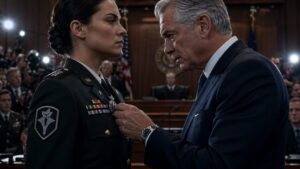
The Stain That Stayed
Part I — The Room That Didn’t Move
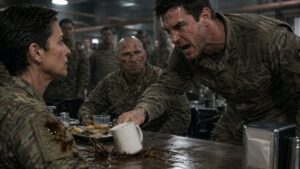
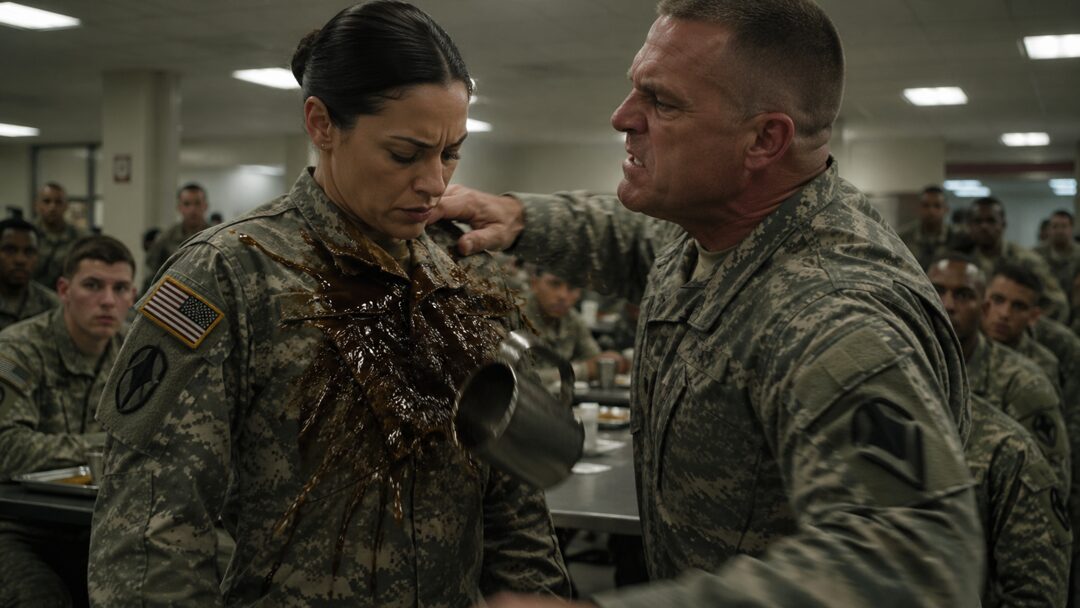
The metal cup hit the mess hall floor before anyone admitted they had seen his hand.
Coffee burst across Sergeant Mara Vance’s uniform in a hot, dark splash, spreading from her collarbone to the center of her blouse. The room went silent so quickly the fluorescent lights seemed louder. Forty soldiers stopped eating. Forks hovered. Boots froze under metal tables. Somewhere, a chair leg scraped once, then stopped.
Staff Sergeant Cole Rusk stood close enough that Mara could smell tobacco on his breath.
One of his hands was still near her collar, fingers curled as if he had only just decided not to grab harder. The other hand hung half-raised between them.
Not a fist.
Not yet.
“Problem, Sergeant?” he said.
Mara looked down at the coffee running into the seams of her uniform. It had soaked through fast. Heat pressed against her skin, sharp and humiliating.
Then she looked back at him.
Rusk smiled because he thought she was measuring pain.
He was wrong.
She was counting witnesses.
No one moved.
That was the first thing that mattered.
A young private at the second table shifted like he might stand. Thin face, nervous hands, brown eyes fixed on the coffee spreading across the floor. He had one knee out from under the bench when the soldier beside him caught his sleeve and pulled him down.
Mara saw it.
Rusk saw it too.
His smile widened.
“Sit down, Torres,” he said without looking away from Mara. “Before you hurt yourself trying to be brave.”
Private Eli Torres sank back onto the bench. His jaw worked once, but no sound came out.
Rusk finally stepped back, giving the room permission to breathe, though no one took it.
“You new people,” he said, loud enough for every table. “Walk in here like you belong. Touch what isn’t yours. Sit where you weren’t invited. Then act surprised when somebody corrects you.”
Mara said nothing.
She had been on the base for two days under the paperwork of a logistics sergeant sent to audit missing equipment. Low visibility. Dull purpose. Safe enough to be ignored.
Or tested.
Rusk leaned closer again. He was a broad man, built like a door someone had taught to shout. His sleeves pulled tight over thick forearms. His combat patch was faded, but he wore it like a weapon.
“You disrespect my table,” he said, “you disrespect my soldiers.”
Mara glanced at the table behind him.
No one at it looked at her.
That was the second thing that mattered.
Rusk’s raised hand lowered slowly, theatrically, as if he deserved credit for mercy. “Clean yourself up.”
The coffee dripped from the hem of Mara’s blouse.
She bent, picked up the dented metal cup, and set it upright on the nearest table.
The sound was small.
In that room, it landed like a challenge.
Rusk’s eyes narrowed.
Mara looked at the stain again, then at him.
“That’s the second mistake you’ve made today.”
The mess hall went even quieter.
Rusk laughed once. Not because it was funny. Because the room expected him to decide whether it was.
“The second?”
“Yes.”
His smile flattened.
Mara did not touch the small dark object clipped beneath the fold of her stained blouse. She did not look toward the private who had almost stood. She did not correct Rusk’s rank assumption or tell him why she had really come to Camp Arden.
She only stood there, coffee cooling against her skin, and watched a man mistake silence for fear.
Rusk turned his head at last and looked at Eli Torres.
“You hear that?” he said. “She counts mistakes.”
A few soldiers forced thin laughs.
Eli did not.
Rusk pointed at him. “Maybe she can count yours too.”
Eli’s face closed.
Mara saw the change. Not guilt exactly. Not only fear.
Recognition.
Rusk turned back to Mara. “Private Torres here knows what happens when people forget their place.”
At the far end of the hall, someone set a fork down too carefully.
Rusk’s voice softened.
“The last kid who forgot ended up learning from the ground.”
Mara let that sentence stay in the air.
No one corrected him.
No one asked which kid.
No one had to.
Mara had read the name in a medical file before she ever stepped into that mess hall.
Private Nathan Bell.
Age nineteen.
Official injury: fall during night movement training.
Unofficial reason for inquiry: conflicting statements, missing witness signatures, permanent damage below the left knee, and a mother who had called every office number she could find until someone finally listened.
Rusk did not know that.
Not yet.
He only knew Mara was still standing in front of him with coffee on her chest and no fear in her face.
That bothered him more than if she had shoved him back.
“Dismissed,” he said.
Mara walked out with every eye on her back.
Nobody followed.
But as the mess hall door swung closed behind her, she heard Rusk’s voice again, low and satisfied.
“Remember that, boys. The room teaches better when everybody watches.”
Mara stopped just long enough to let the words settle.
Then she kept walking.
Part II — Clean It Quietly
Captain Adrian Hayes had an office so orderly it felt staged for inspection.
Two framed commendations. One unit photo. One flag folded into a triangle behind glass. A readiness chart on the wall with green blocks where the truth should have been.
Hayes stood when Mara entered, not because he respected her, but because he had been raised by regulation to perform respect when uncertain.
His eyes flicked to the stain.
Then away.
“Sergeant Vance,” he said. “I understand there was an incident.”
“Is that what Staff Sergeant Rusk called it?”
Hayes’s mouth tightened. He was younger than Rusk but carried command like a man holding a tray too full to spill. Immaculate uniform. Smooth voice. Dark crescents under his eyes.
“I’m asking what happened.”
“Rusk put his hands on me in the mess hall. Coffee went with it.”
Hayes folded his hands behind his back. “Did he strike you?”
Mara looked at him.
It was a commander’s question, not a moral one.
“No.”
“Did he intend to?”
“You should ask the forty soldiers who watched him decide.”
That landed. Hayes looked toward the closed door.
For a moment, Mara saw the exhaustion behind his polish. Then the commander came back.
“Staff Sergeant Rusk is rough,” Hayes said. “No one denies that. But he is effective. This unit has been through a difficult cycle. Arden takes broken recruits and makes them deployable soldiers.”
“Is that what happened to Private Bell?”
Hayes did not blink.
That was how Mara knew the name had hit exactly where it needed to.
“Bell’s case is under review,” he said.
“His leg is under review too?”
Hayes’s jaw shifted. “You’re here for equipment discrepancies.”
“Among other things.”
Silence moved between them.
Hayes’s eyes sharpened. “Who sent you?”
Mara said nothing.
He understood enough not to ask again.
Instead, he lowered his voice. “Sergeant, I don’t know what you think you’ve walked into, but this company has a readiness inspection in nine days. We have a commander above me looking for reasons to cut resources. We have soldiers who have buried friends and come back expected to train children for the same war. You cannot understand this place by reading injury logs.”
Mara had heard words like that before.
Different office. Different commander. Different dead soldier.
Same careful tone.
Years ago, there had been a medic named Sloane who trusted orders more than weather reports. Mara had watched a captain send a patrol across a flooded route because changing course would make the operation late. She had told herself rank saw more than she did. Then she had stood in rain while they recovered Sloane’s body from a ditch full of brown water.
The report had said unavoidable conditions.
Mara had signed her statement.
Three words had followed her for years.
I was there.
Hayes moved around the desk. “Rusk saved lives overseas.”
“Whose?”
“Mine, for one.”
There it was.
Not corruption. Debt.
More dangerous.
Hayes lowered his voice further. “There are ways to correct a hard leader without destroying a unit.”
Mara looked at the green blocks on the readiness chart.
“That sentence has buried a lot of people.”
Hayes’s face changed, just slightly. “You’re out of line.”
“No,” Mara said. “I’m finally in the right one.”
He stared at her.
Then his gaze dropped again to the stain.
“You should change.”
“I will.”
“Leave the blouse with laundry. I’ll have a replacement issued.”
Mara nodded.
She did not tell him she had already planned to leave it where someone with a conscience might touch it.
Outside the office, the hallway smelled of wax and old paper. Soldiers passed Mara without looking directly at her. Not one laughed now. News traveled fast in units like this, but shame traveled faster.
At the laundry room, she took off the stained blouse in a side changing stall and pulled on a spare from her duffel. She folded the ruined one carefully, coffee side out, and left it on the counter beside the sink.
Then she walked away and waited to see who thought a stain should be cleaned before anyone saw it.
Part III — The Boy Who Didn’t Fall
The medical annex was too bright.
That was the thing Mara hated about military clinics. The lights tried to make every injury administrative. A limp became a code. Pain became a number. A ruined future became a line for “mechanism of injury.”
The medic at the desk gave her the injury logs after she showed the authorization Hayes had not known she carried.
Mara read them standing.
Private Nathan Bell had been admitted at 0213.
Severe swelling. Ligament damage. Nerve involvement. Dehydration. Elevated muscle enzymes. Bruising on both shoulders consistent with load-bearing straps.
Official statement: slipped during night movement training over uneven ground.
Mara turned the page.
Witness statement one: Bell lost footing.
Witness statement two: Bell fell behind.
Witness statement three: [missing].
Witness statement four: [not collected].
She looked at the medic. “Who treated him first?”
The medic’s eyes moved toward the hall before answering. “Specialist Nader.”
“Where is he?”
“Transferred.”
“Convenient.”
The medic said nothing.
Mara tapped the bruising note. “A fall doesn’t bruise both shoulders like this.”
“No, Sergeant.”
His answer came too fast.
Mara looked up.
The medic swallowed. “I mean, not usually.”
“What does?”
He lowered his voice. “Weight. Repetition. Someone carrying more than they should after they’re already compromised.”
“How long?”
“I can’t know that from the file.”
“You can guess.”
He stared at the desk.
Mara waited.
“Too long,” he said finally.
That was enough for now.
Outside, Camp Arden stretched flat and sun-baked under a white sky. The old motor pool sat beyond the barracks, fenced on three sides, its cracked asphalt patched in dull squares. Mara stood at the edge of it and saw the shape of what had happened without needing anyone to tell her.
Young soldiers in a line.
Loaded packs.
Rusk’s voice.
The room watching, even outside.
Some people only learn when the room watches.
A sound came from behind her.
Mara turned.
Eli Torres stood beside the laundry building, holding her stained blouse under running water in an outdoor utility sink. He froze when he saw her.
Coffee-brown water streamed over his hands.
“I wasn’t stealing it,” he said.
“I didn’t say you were.”
He looked down. “It was going to set.”
“It already did.”
He rubbed harder anyway.
Mara walked closer. Eli’s shoulders tightened. Up close, he looked even younger than twenty-one. There was still softness in his face that training had not managed to beat out, though it was trying.
“You tried to stand,” Mara said.
“I shifted.”
“You tried.”
He shut off the water.
The silence that followed was not empty. It was crowded.
“Bell was your friend,” Mara said.
Eli’s fingers curled into the wet fabric. “Everybody liked Bell.”
“That’s not what I asked.”
His mouth pressed into a line.
Mara softened her voice by half. “He didn’t fall, did he?”
Eli stared at the stain.
“Staff Sergeant Rusk says training saves lives,” he said. “He says weak links get people killed. He says overseas you find out too late who should’ve been broken earlier.”
“Do you believe him?”
Eli gave a small, bitter laugh. “Belief doesn’t matter here.”
“It matters everywhere.”
“No, Sergeant.” His eyes lifted. “Not if you’re the one under him.”
Mara let that stand.
Then she made the mistake.
“How many of you watched Bell collapse?”
Eli’s face closed so fast she almost regretted the question before it finished leaving her mouth.
“I didn’t say that.”
“You didn’t have to.”
“You don’t know what you’re asking.”
“I know exactly what I’m asking.”
“No,” he said, suddenly sharp. “You know what you need. That’s different.”
The words hit harder than they should have because they were true.
Mara had come for proof. Names. Statements. A pattern that could survive command interference.
She had not come to rescue Eli Torres from the memory of standing still.
Eli shoved the blouse toward her.
“I’m sorry about your uniform,” he said.
“Eli.”
He flinched at his first name.
“Was Bell ordered to keep standing after his legs failed?”
His eyes shone, but his voice stayed flat. “Bell was weak.”
It sounded memorized.
Mara hated Rusk for putting the sentence in his mouth.
“And did he deserve what happened?”
Eli looked away.
“No.”
The word was barely there.
Then he stepped back, leaving the blouse dripping between them.
“Rusk saved Sergeant Hale in Kandahar,” he said. “Pulled him out under fire when everybody else thought he was dead. Captain Hayes was there. Half the old guys were. You think that doesn’t matter?”
“It matters.”
“Then you don’t understand.”
“I understand debt.”
“No,” Eli said. “You understand files.”
He walked away before she could answer.
Mara stayed by the sink, holding the wet blouse, watching coffee water run into the drain.
For a moment she saw another stain: mud up to Sloane’s neck, rain on her own hands, a report typed so cleanly it erased the sound of drowning.
She had told herself she would never again confuse silence with survival.
But Eli was right about one thing.
Evidence was easier than people.
Part IV — The Recorder
Rusk found her near the equipment cages after evening formation.
The supply corridor ran behind the armory, narrow and dim, lined with wire partitions and locked shelves. Outside, the base loudspeakers crackled with an announcement no one listened to.
Mara had just finished photographing a set of missing pack frames when the door at the end of the corridor opened.
Rusk stepped in alone.
He closed it behind him.
“No escort?” Mara asked.
“You lost?”
“No.”
“Funny. You keep ending up where you don’t belong.”
Mara slipped her phone into her pocket. “People keep saying that.”
Rusk walked toward her slowly. He did not rush because men like him enjoyed giving fear time to arrive.
It didn’t.
That irritated him.
“I asked around,” he said. “Nobody knows you. Logistics at division says you’re temporary. Hayes gets quiet when your name comes up.”
“Sounds like you’ve been busy.”
“I’m responsible for my soldiers.”
“You mean your witnesses.”
His face darkened.
There he was.
The man from the mess hall without an audience to impress, which made him less loud and more dangerous.
“You think because you’ve got some paper behind you, you can come in here and poison my unit?” he said.
“I think your unit is already sick.”
Rusk moved closer. “You ever been outside a wire, Sergeant?”
Mara did not answer.
“You ever watched a kid freeze because nobody taught him fear hurts less than failure? You ever carried a man with no legs and wished somebody had been cruel enough to make him harder before the world got to him?”
“I’ve carried people.”
“Not like me.”
The words were almost quiet.
For a second, Mara saw the shape of the story he told himself. Rusk the survivor. Rusk the hard teacher. Rusk the man willing to be hated so boys lived.
It might even have started true.
That was the ugliest part.
Then he smiled, and whatever pity had almost formed in her disappeared.
“Bell was going to get somebody killed,” he said. “Soft feet. Soft eyes. Always looking for permission to quit.”
“He was nineteen.”
“Nineteen gets you dead just fine.”
“He’s permanently injured.”
“He’s alive.”
Mara felt anger move through her, clean and cold. “That’s your standard?”
Rusk leaned in. “My standard is they learn before the enemy teaches them.”
“And coffee in the mess hall?”
“That was me being polite.”
He let the threat sit there.
Then he said, “You need to stop talking to Torres.”
“Why?”
“Because that boy is barely holding himself together, and you’re going to make him think guilt is courage.”
Mara studied him.
He knew Eli was the crack.
Rusk continued. “You put him in a chair, ask your little questions, make him say things he can’t take back, and what happens? He loses the only family he’s got. Bell still limps. Unit still deploys. You go home feeling clean.”
Mara said nothing.
“You people always think truth is free.”
The sentence touched something in her old enough to ache.
Truth had never been free.
That was why men like Rusk kept overcharging for silence.
He stepped even closer. “Let me explain how this works. Hayes will protect the company. The company will protect the mission. Soldiers will protect each other. And you?”
His eyes dropped to the front of her blouse.
The replacement uniform was clean, but beneath the left fold, clipped inside and hidden against the undershirt, was the small dark recorder he had not noticed in the mess hall.
“You’ll be remembered as some bitter investigator who didn’t understand what it takes,” he said.
Mara waited.
Rusk smiled. “Some people only learn when the room watches.”
There it was.
The phrase from the mess hall.
The phrase from Bell’s night in the motor pool.
Mara reached slowly beneath the fold of her blouse.
Rusk’s eyes sharpened. His hand twitched.
She brought out the recorder.
Small. Black. Plain.
Not dramatic.
Just enough.
For the first time since he entered the corridor, Rusk stopped moving.
Mara held it between them.
“Authorized inquiry recording,” she said. “Continuous capture. Mess hall. Corridor. This conversation.”
Rusk’s face did not collapse all at once.
It changed in pieces.
First the mouth, still trying to hold the smile.
Then the eyes, calculating distance to the door, names, ranks, damage.
Then the skin around his jaw, tightening with the recognition that his own voice had walked ahead of him into evidence.
Mara did not smile.
That mattered.
“You should’ve hit me,” she said quietly. “It would have been simpler.”
His breathing changed.
“You think that saves you?” he said.
“No.”
She clipped the recorder back beneath her blouse.
“It just means paperwork finally heard you.”
Rusk stared at her, and for one second Mara saw fear break through the anger.
Not fear of punishment.
Fear of being seen without the story that made him noble.
Then the door opened behind him.
Captain Hayes stood there.
He looked from Rusk to Mara.
Then to the place beneath Mara’s blouse where the recorder had disappeared.
Nobody spoke.
This time, the room was only three people.
It was still watching.
Part V — The Offer
Hayes did not shout.
That would have been easier to respect.
He sat behind his desk with the posture of a man trying to hold a collapsing bridge in place by keeping his hands folded.
Rusk had been ordered to quarters. Not confined. Not yet.
Mara stood across from Hayes and refused the chair.
The recorder lay on the desk between them.
Hayes had listened to enough.
Not all of it.
Enough.
“Staff Sergeant Rusk will be reassigned pending review,” Hayes said. “Bell’s file will be amended to reflect training misconduct. Medical classification will be corrected. His family will receive updated documentation.”
Mara stared at him.
“That’s the quiet version.”
“That’s the version that prevents this company from imploding.”
“This company already imploded. It just did it silently.”
Hayes’s hand tightened.
“You want a public inquiry,” he said. “Fine. You may get one. And when you do, soldiers who panicked will be treated like co-conspirators. Young men who were afraid will be called liars. Careers will end that maybe shouldn’t. Rusk will hire counsel and turn every witness into a coward under oath.”
“Is that a reason to bury it?”
“It’s a reason to be careful.”
“No,” Mara said. “It’s the word people use when they’re choosing comfort.”
Hayes stood.
His control cracked just enough to show grief underneath.
“You think I don’t know what he is?”
Mara said nothing.
Hayes looked toward the unit photo on the wall. Rusk stood at the edge of it, one hand on a younger soldier’s shoulder. Hayes stood in the center. Bell was not in the picture. Too new, maybe. Too easy to erase.
“Rusk pulled me from a burning truck,” Hayes said. “He went back under fire when I ordered him not to. He brought Hale out. He brought Meyers out. He carried what was left of a kid named Alvarez in his own jacket.”
His voice thinned.
“Then we came home, and the Army handed him recruits who complained about blisters.”
“Pain doesn’t give you ownership of other people.”
Hayes looked at her then.
For once, he had no polished answer.
Mara picked up the recorder.
“There will be a hearing.”
“That is not your decision alone.”
“No,” she said. “But it won’t be yours alone either.”
She turned to leave.
Hayes stopped her with one sentence.
“Torres signed a statement.”
Mara paused.
Hayes opened a folder and slid one page across the desk.
Eli’s name sat at the bottom in cramped black ink.
The statement admitted “confusion during training,” “limited visibility,” and “no direct knowledge of misconduct by Staff Sergeant Rusk.”
It protected everyone.
Which meant it protected Rusk most.
Mara read it once.
Then again.
She imagined Eli holding the pen. Someone watching. Someone reminding him that loyalty was the only thing standing between him and exile.
“You ordered this?”
Hayes did not answer quickly enough.
Mara looked up.
“You ordered this.”
“I gave him a chance to avoid being destroyed by something he cannot fix.”
“You gave him another room to be silent in.”
Hayes’s face hardened. “You are very good at judging from the outside.”
The words should have slid off.
They did not.
Because Mara had once been inside. She had been in the wet dark with Sloane’s name in her mouth and a pen in her hand. She had signed a statement that did not lie exactly. That was the genius of bad paperwork. It did not need falsehood when omission could do the work.
Outside Hayes’s office, Mara found Eli sitting on the floor beneath a trophy case full of old battalion plaques.
He looked up as if he had been expecting her and dreading her equally.
“I signed it,” he said.
“I know.”
“I’m sorry.”
Mara sat beside him.
He looked startled by that. Maybe he expected anger. Maybe he deserved some.
For a while they watched two soldiers pass at the end of the hall. Neither looked their way.
Eli whispered, “Bell kept saying he couldn’t feel his foot.”
Mara did not move.
“He said it three times. Rusk told him numb was fear leaving the body.” Eli swallowed. “We laughed the first time. Not because it was funny. Because Rusk looked at us like we were supposed to.”
Mara closed her eyes briefly.
Eli’s voice shook now, but it did not stop.
“Then Bell fell. Not all the way. One knee. Rusk made him get up. Hale and Denny lifted him by the pack straps. I was holding the light.”
The hallway seemed to shrink around them.
“I was holding the light,” Eli said again.
Mara’s voice stayed low. “That doesn’t make you Rusk.”
“No. It makes me useful to him.”
There was nothing easy to say.
So Mara did not insult him with easy.
Instead, she said, “Tomorrow, there will be a room.”
Eli laughed under his breath. “There’s always a room.”
“Yes.”
“And if I tell the truth?”
“People will be angry.”
“If I don’t?”
Mara looked at him.
“You already know.”
His eyes filled, but no tears fell.
Mara stood.
For the first time since she came to Camp Arden, she did not ask him for a statement.
She only said, “Fear is allowed. Letting it speak for you is optional.”
Then she left him with the sentence.
Not because it was enough.
Because enough was not something one person could hand another.
Part VI — What the Room Heard
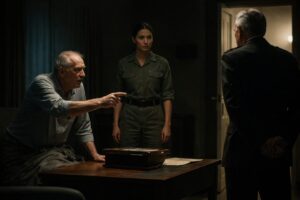
The inquiry room had no windows.
It had a long table, six chairs, a recorder of its own, and walls painted the color of old bone. It was supposed to make everything feel neutral.
It failed.
Rusk entered first with his jaw set and his uniform perfect. He did not look at Mara. He looked at the officers seated at the end of the table, then at Hayes, then at the empty chairs along the wall where soldiers would wait to be called.
He still believed in rooms.
He still believed he knew how to own them.
Hayes came in next. His face looked older than it had the day before.
Mara carried a folder, the black recorder, and the coffee-stained blouse sealed in a clear evidence bag.
Eli sat against the wall with his hands clasped so tightly his knuckles were white.
Mara did not look at him for long.
Pressure could become another kind of command.
The presiding major asked for preliminary evidence.
Hayes expected the recorder first. Mara saw it in his face. Rusk expected a fight over authorization. She saw that too.
Instead, Mara placed the evidence bag on the table.
The blouse lay inside, clean in places, ruined in the center. The coffee stain had faded from dark brown to a dull, stubborn shadow.
Rusk glanced at it and looked away.
Mara pressed play.
His voice filled the room.
You disrespect my table, you disrespect my soldiers.
Then Eli’s name.
Then Rusk’s laugh.
Then the line.
The last kid who forgot ended up learning from the ground.
The major’s pen stopped moving.
Mara stopped the recording before it could become theater.
“Staff Sergeant Rusk used similar language during the training event involving Private Nathan Bell,” she said.
Rusk leaned forward. “Allegedly.”
His voice was controlled.
Almost.
Mara looked at him. “Yes. That’s why we’re here.”
The major turned to Hayes. “Captain?”
Hayes looked at the blouse. Then at Rusk.
For one second, Mara thought he might still choose the unit photo on his wall over the living people inside it.
Then he said, “There were irregularities in the initial report.”
Rusk’s head turned slowly toward him.
Betrayal moved across his face before he could hide it.
Mara did not feel triumph.
Triumph would have been too simple.
The major called Eli Torres.
Eli stood too fast. His chair scraped behind him, loud in the small room. He sat at the table like a man entering water he knew was cold.
The major began with routine questions. Name. Rank. Assignment.
Eli answered each one.
Then the room reached the edge.
Mara could have let the major handle it. She could have kept herself clean. She could have let procedure do what procedure did: ask wide questions and accept narrow answers.
Instead, she leaned forward.
“Private Torres,” she said.
His eyes came to hers.
Not pleading.
Not ready.
Present.
“Did Private Bell fall,” Mara asked, “or was he ordered to keep standing after his legs failed?”
Rusk’s chair creaked.
Hayes closed his eyes.
Eli stared at the table.
The room held its breath the way the mess hall had.
Mara waited.
Not pushing.
Not rescuing.
Waiting.
Eli’s lips parted once, but no sound came out.
Rusk spoke softly. “Careful, Torres.”
The major’s head snapped toward him. “Staff Sergeant.”
Rusk leaned back, but the damage was done.
Eli looked at him.
Something changed then. Not courage arriving like a flag. Nothing that clean.
It was exhaustion.
A young man finally too tired to keep carrying another man’s lie.
“He was ordered,” Eli said.
The words came out rough.
Nobody moved.
Eli swallowed. “Private Bell said he couldn’t feel his foot. Staff Sergeant Rusk told him to keep moving. When Bell went down, Hale and Denny lifted him by the pack. I held the light.”
Rusk’s face reddened. “That is not—”
“Did he fall?” Mara asked again, not louder.
Eli’s eyes stayed on the table.
“No.”
The room changed.
That was the only way Mara could think of it.
The walls stayed the same. The table stayed the same. The ranks stayed sewn to the same chests.
But the room changed.
A place built to contain truth had become a place where truth had entered and refused to leave.
Another soldier was called.
Then another.
No one gave the whole story. No one had to.
One remembered Bell saying his foot was numb.
One remembered Rusk saying weakness spread faster than infection.
One remembered Eli holding the light.
One remembered Hayes arriving after the ambulance and telling them to wait before writing anything down.
Hayes did not deny it.
By the fourth statement, Rusk was no longer leaning back.
By the fifth, his hands were flat on the table.
By the sixth, he looked at Mara.
There it was again.
The face from the equipment corridor.
The face from the mess hall, stripped of its audience.
He had thought fear belonged to him because he knew how to give it away.
Now it had returned.
Not as panic.
As recognition.
His own room had turned.
The major ordered Rusk removed pending formal charges and command review. Two military police officers stepped in. Rusk stood slowly.
For a moment, his eyes went to Hayes.
Whatever passed between them had history in it. Fire. Debt. Old war. Bad forgiveness.
Then Rusk looked at Eli.
Eli flinched, but he did not look away.
That was enough.
Rusk was escorted out.
No one clapped.
No one sighed with relief.
The silence after him was not victory.
It was cleanup after impact.
Mara gathered the recorder and the blouse.
As she passed Eli, he whispered, “I was afraid.”
Mara stopped.
“So was he,” she said.
Eli looked toward the door Rusk had disappeared through.
Mara shook her head slightly.
“No. Bell.”
Eli’s face broke in a way he could still survive.
That mattered too.
Part VII — The Stain
Mara left Camp Arden before dawn.
The base looked gentler in the blue hour, which felt dishonest. The motor pool sat quiet behind its fence. The mess hall windows glowed faintly. Somewhere, a formation was being called by a voice that was not Rusk’s.
Rusk had been removed pending charges.
Captain Hayes had been relieved during review.
Private Nathan Bell’s official file would be amended, though no correction could return sensation to a damaged foot or give his mother back the version of her son who had arrived at Arden believing pain always meant progress.
The Army would write new sentences.
Some would even be true.
Mara put her duffel into the back of the government sedan.
She was about to close the trunk when she heard footsteps behind her.
Eli Torres stood at the edge of the motor pool, holding a folded blouse in both hands.
For a second, neither of them spoke.
He looked smaller without the room around him.
Or maybe he looked more like himself.
“I tried again,” he said.
Mara looked at the blouse.
“You didn’t have to.”
“I know.”
He offered it to her.
The fabric was clean at the sleeves, clean at the collar, clean along the back. But across the front, where the coffee had hit hardest, a pale brown shadow remained. Faint, but undeniable.
Eli stared at it as if ashamed laundry had not done what confession had begun.
“It wouldn’t come out,” he said.
Mara took the blouse.
The stain looked different in morning light. Less like humiliation. More like a map of where heat had touched and stayed.
“Some stains are supposed to remain visible,” she said.
Eli’s eyes lifted.
He nodded once, but his mouth trembled.
“What happens now?” he asked.
Mara folded the blouse over her arm. “Now you tell the truth again when someone asks you to make it smaller.”
He looked toward the barracks.
“They’re going to hate me.”
“Some will.”
“That’s supposed to help?”
“No.”
For the first time, something like a smile touched his face. It did not last, but it had existed.
Mara opened the trunk and set the blouse carefully inside her bag. The black recorder lay at the bottom, plain and quiet beside a folder of statements.
She did not put the blouse on top to display it.
She did not hide it beneath everything else.
She laid it where it fit.
Eli stepped back.
At the barracks, soldiers began moving toward morning formation. Their boots struck pavement in uneven rhythm. A unit learning how to walk after a fracture.
Mara got into the car.
Before she closed the door, Eli said, “Sergeant Vance?”
She looked up.
“In the mess hall,” he said. “When he spilled the coffee. Why didn’t you move?”
Mara thought of Rusk’s hand near her collar. Forty soldiers frozen. Sloane in the rain. Bell on the asphalt. Eli holding the light.
Then she thought of a cup hitting the floor and a room teaching itself what it could survive watching.
“I did,” she said.
Eli frowned.
Mara closed the car door.
The driver pulled away from the motor pool, past the mess hall, past the clinic, past the flag lifting slowly into the morning.
In the rearview mirror, Camp Arden shrank behind her.
Inside her bag, the recorder held Rusk’s voice.
The blouse held the stain.
And for once, the official record would hold what the room had heard.