The Last Name on the Manifest
Part I — The Safe Path
The path looked clean.
That was what made Elias stop.
Not him, exactly. Mercy.
She froze so hard the leash went taut in his hand. No bark. No panic. Just that sudden locked stillness that had saved men before they even knew they were about to die.
The jungle before dawn was a wet black wall. The three infantrymen behind Elias were breathing too loudly, young enough to think fear only counted if you admitted it. Somewhere far off, artillery rolled like weather. Closer, water dripped from leaves and hit the dirt with a patience that made everything else feel worse.
“Move, Sarge,” one of the boys whispered. “We’re exposed out here.”
Mercy’s ears tipped forward. A low growl vibrated through her chest.
Elias crouched beside her and looked again.
The path curved left between roots and a mound of wet earth. It looked ordinary. Too ordinary. No broken brush. No disturbed mud. No sign anyone had touched it.
That was the problem.
Mercy took one step backward, then angled right, toward a patch of ground choked with ferns.
Elias felt the old scar on his wrist pull when he tightened his grip on the flashlight. Years ago, under another patch of earth, a tunnel roof had folded over him like a fist. He still remembered the weight, the dirt in his mouth, the second he knew no one would reach him in time.
Mercy had reached him.
He clicked the flashlight once and shielded it low. There. A thin line under the leaves, too straight to be root, too deliberate to be chance.
Buried wire.
He let out a breath that wasn’t relief so much as delayed terror.
“Back,” he said quietly.
The youngest private frowned. “I don’t see—”
“You don’t have to.”
Elias pointed with two fingers. They leaned, saw the wire, then saw where it disappeared toward the mound. The mound wasn’t a mound. It was a reinforced tunnel mouth, packed and disguised. One more step down the clean path and they would have triggered the charge, then taken fire from the hole while half-blind and bleeding.
Mercy turned her head toward Elias as if asking whether he was finished doubting her.
He put a hand against the scarred side of her neck. “Good girl.”
He almost never used the words in front of other men. They made something private sound simple.
The oldest of the infantrymen, a corporal named Reeves, swallowed hard. “She just saved us again.”
Mercy had saved Reeves once already, two weeks earlier, by sitting down in the middle of a rice dike and refusing to move. They had found punji stakes under the mud where his next step would have gone.
Elias signaled them off the trail. They circled wide through brush dense enough to soak them all to the bone. Mercy led, silent and exact, head low, body taut, taking them around the tunnel entrance and past a second trap Elias would never have found in the dark.
By the time they reached the ridge line, dawn was beginning to dilute the black sky into a dirty gray.
Reeves crouched beside him, breathing hard. “How many you think she’s saved?”
Elias watched Mercy scan the trees. “Enough that nobody should ever have to ask.”
But the question stayed with him as they started back.
At the base, the world had changed while they were gone.
Not the heat. Not the mud. Those stayed. But the air around the command tents had tightened. Men were carrying crates instead of sleeping. Radios snapped faster. Forklifts moved under camo netting. Someone had posted a new departure board beside operations, and soldiers were gathered around it in a silence that meant nobody liked what they were reading.
Mercy trotted beside Elias, mud up her legs, torn ear slick with rainwater. Heads turned when they passed. Men always looked at her twice. Some with affection. Some with the uneasy respect reserved for things that worked too well near death.
Inside the supply corridor, Elias stopped when he heard it.
“…assets pending disposition,” a clerk said, not bothering to lower his voice. “Personnel priority remains first-wave evac, then documents, then technical material.”
Another voice answered, bored and irritated. “Kennel units fall under material until otherwise directed.”
Elias stood very still.
Mercy leaned lightly against his knee.
The word hit harder than it should have. Asset. Material. A pile of radios, a fuel drum, a box of code sheets. Something useful until it wasn’t.
He stepped into the office doorway.
The clerk looked up. Young lieutenant, clean hands, not enough field time to know when language became a confession. His gaze flicked to Mercy, then away.
“You need something, Sergeant?”
Elias kept his voice even. “I need to know what ‘disposition’ means.”
The lieutenant gave him the smile officers used when they wanted trouble to stay in its lane. “It means final assignment. Administrative category.”
“For dogs?”
“For all non-personnel items pending withdrawal.”
Mercy sat when Elias stopped moving. Perfect posture. Alert. Waiting.
The lieutenant glanced down at her and then back up, already regretting the look. “You’ll be informed through your chain.”
“She’s not a crate.”
“No one said she was.”
“You did worse than that.”
The lieutenant’s mouth tightened. “Sergeant, I’d advise you to focus on your present orders. Withdrawal priorities are above my pay grade and yours.”
That was the first time Elias felt it clearly—not fear, not yet, but the shape of it. The sense that something had already been decided elsewhere, in air-conditioned rooms or under neat tent light, and men like him were only being allowed to approach it one euphemism at a time.
Mercy nudged his hand.
He looked down at her scarred muzzle, the torn edge of her ear, the mud dried in the fur above one paw where she had knelt at a tunnel mouth last month until he understood the ceiling was unstable.
Assets pending disposition.
Behind him, someone called his name. Lan Bui was crossing the yard fast, satchel clutched tight against her side, eyes already measuring his expression before she reached him.
“That face means either somebody died or somebody used the wrong word,” she said.
He looked back into the office once more. The lieutenant had already turned away, which somehow made it worse.
“The wrong word,” Elias said.
Lan followed his gaze to Mercy, then to the departure board beyond the tent flap, where names were already being read like verdicts.
Her mouth flattened.
“That board?” she asked.
Elias nodded.
Lan gave a dry, humorless exhale. “Then it may be both.”
And that was the moment he understood the war was ending in the ugliest way possible: not with a single last battle, but with sorting.
Part II — What Still Counts
By noon the base sounded like it was trying to leave before the bodies inside it did.
Helicopters beat the air overhead. Trucks ground through ruts loaded with fuel drums, records, field radios, men. Smoke drifted from a burn pit where clerks were feeding crates of paper into oil-black flame. Somewhere an officer was shouting about manifests. Somewhere else, a soldier was vomiting behind a wall because his transfer slot had disappeared overnight.
Mercy slept for twenty-three minutes under Elias’s cot, then woke before he did and nudged him once with her nose.
The runner waiting outside the tent looked embarrassed.
“Recon detail,” he said. “Second sweep of the western approach. Orders from operations.”
Elias stared at him. “We’re pulling out.”
The runner shrugged with the blank fatalism of enlisted men delivering someone else’s insanity. “Apparently not fast enough.”
On the way to the perimeter, Reeves caught up with him, rifle slung loose, face drawn. “You heard anything official?”
“About withdrawal?”
“About the dogs.”
That word carried differently in the field. Not sentimental. Not soft. Everyone in the base knew what the tunnel teams were worth.
“Nothing official,” Elias said.
Reeves looked at Mercy. “That usually means it’s bad.”
They went anyway.
Because orders still existed, and because disobeying them too early got you removed from the part of the machine where you might still do any good.
The second mission felt cursed from the start. The jungle had the wrong kind of quiet, the kind that meant somebody else was listening. Mercy kept pulling Elias off the obvious route, forcing the squad through heavier growth. Twice she halted so sharply that even the men who did not understand dogs understood danger.
The ambush came late and sideways.
First the crack of a rifle. Then two more. Leaves burst above them. Reeves went down behind a stump, cursing. Elias dropped flat, Mercy already twisting toward him, body over his shoulder before he could order it.
“Right!” he shouted. “Fall right!”
Mercy lunged, not at the gunfire, but toward a narrow break in bamboo.
Elias trusted her before he trusted the map. He always had.
They moved where she led. A burst of fire tore up the spot they would have taken if they had gone left. The squad spilled into a gully barely deep enough to hide them. Mercy planted herself at the edge, teeth bared toward movement Elias still couldn’t see.
Private Nolan was two seconds behind.
Two seconds was long enough.
A shot caught him high in the throat before he made the drop. He folded without a sound. Reeves grabbed for him, then stopped when the blood came too fast.
There were return shots. Smoke. A scream in the brush that might have been one of theirs or not. Then, somehow, the shooting thinned. The enemy had wanted delay, not occupation. Pain, not a stand.
They got out with five men breathing and one not.
On the walk back, nobody spoke.
Nolan had been nineteen. He had a sister in Kansas who kept sending him cookies that arrived as powder. Last week Mercy had stolen one from his cargo pocket and eaten it whole while he pretended to be offended.
At the triage station, while they unloaded the dead and the almost-dead, Captain Wilkes from operations clapped Elias once on the shoulder and said, “Fine work out there. That dog is worth a platoon.”
Elias looked at him until the captain’s hand fell away.
“Then put her on a helicopter,” Elias said.
Wilkes blinked, annoyed at being forced to understand. “That isn’t my lane.”
“No,” Elias said. “Just my dead.”
He walked away before the captain could answer.
That afternoon he started asking questions the right way.
That was his mistake.
The kennel sergeant, a hard woman named Danner who had spent the last year fighting fleas, fever, and men who treated working dogs like mascots until the first firefight, shut the tent flap behind him and spoke without looking up from a clipboard.
“I’ve heard rumors,” she said.
“What kind?”
“The kind people repeat when they already know the truth but still want permission to call it a rumor.”
Elias waited.
Danner finally met his eyes. “No return orders. No animal transport manifests. No vaccine prep for stateside quarantine. Nothing you’d expect if anybody intended to bring them home.”
Mercy stood against Elias’s leg, still as carved wood.
“Who made the call?”
Danner laughed once. Not because it was funny. “Calls like that come from so high they arrive as weather.”
From there Elias went to transport.
The clerk there, an exhausted sergeant with ink on his sleeve and nicotine-stained fingers, flipped through papers and didn’t bother pretending. “No animals listed. Not first wave, not second, not reserve.”
“What about handler-team exceptions?”
The clerk looked up. “You got a child on your hands, Voss? A wounded colonel? A crate full of codes? No? Then you got nothing I can put in this column.”
Later, at the veterinary station, Major Ruiz lowered her voice the moment he asked.
“Stop asking in open air,” she said.
“Why?”
“Because if the wrong officer decides you’re too attached, they can separate you before the flights begin.”
Elias felt something cold move through him. “They’d do that?”
Ruiz looked at Mercy, and the answer was in her face before she spoke. “You think this is the first time a useful thing has become inconvenient?”
Outside, the sky had gone the color of old tin. Lan was waiting by a stack of ration crates with a folded paper in one hand and fury tucked neatly behind both eyes.
“You look worse,” she said.
“I was aiming for impossible.”
She held up the paper. “My cousin’s transit endorsement disappeared. Yesterday she existed. Today she does not.”
Elias took the form, read nothing useful, handed it back.
Lan tucked it away again. “The impressive thing,” she said, “is that they make abandonment sound clerical.”
He almost laughed. It came out as breath. “They called Mercy material.”
Lan’s gaze shifted to the dog. Mercy sat under the edge of a broken shade cloth, watching the yard with that severe patience she had with everyone except Elias.
“Then they’re practicing,” Lan said.
Toward evening, Major Daniel Hollis addressed the yard from the steps of operations.
He was clean in a way no one else was clean anymore. Shirt pressed. Hair clipped close. Voice measured enough to calm panic without ever sounding kind. Men listened when Hollis spoke because he made disorder sound temporary.
“We are in a compressed timetable,” he said. “That does not release anyone from discipline. We leave in order, or we do not leave at all.”
His gaze moved over the handlers, landed for a beat on Mercy, then shifted on.
“Every asset that has served this command,” he continued, “has done so with honor. We will proceed according to necessity, not emotion.”
There it was again.
Asset. Necessity. The soft vocabulary of men who wanted bloodless hands.
After the briefing, Elias waited until the crowd thinned.
“Sir,” he said.
Hollis turned. Up close, there were lines at the corners of his eyes that the distance hid. “Sergeant Voss.”
“I’m requesting clarification on evacuation status for working dog teams.”
“Requests are being reviewed.”
“That isn’t an answer.”
“It is the only one I have at present.”
Mercy moved closer, pressing the scarred side of her body against Elias’s boot.
Hollis looked at her longer this time. His face gave nothing away, but something in the quiet changed.
“She performed well this morning,” Hollis said.
“She kept five men alive.”
“Yes.”
“Then put her on a manifest.”
For just a second, Hollis seemed tired enough to tell the truth. Then the expression closed.
“Your duty,” he said, “is to remain mission-focused until further notice.”
“Mission-focused,” Elias repeated. “While you decide whether she counts.”
Hollis’s voice stayed even. “Be careful, Sergeant.”
“With what?”
“With confusing what you feel with what can be done.”
Elias held his gaze. “Sometimes that’s just another way of saying no before you have to say it.”
He expected a reprimand. Instead Hollis only looked at Mercy once more, then said, “Get some rest while you still can.”
That was worse.
Because it sounded less like dismissal than warning.
Part III — The Holding Area
The truth did not arrive in a file.
It arrived at night behind the fuel dump, where no one was meant to look.
Lan found him first.
“You want bad news or useful news?” she asked.
Elias had been cleaning mud from Mercy’s paw under a hanging lantern. He didn’t look up. “Useful.”
“Then pretend I said something kind.”
She crouched beside him. Her satchel was bulging with papers, half of them forged, the other half stolen from offices that deserved it. “There’s a fenced service pen beyond the old motor pool. Guards changed tonight. New ones don’t know me yet.”
“What’s in it?”
Lan held his gaze. “You tell me.”
He went after midnight.
Mercy moved without sound. Lan led by memory through broken pallets and stacked fuel drums, cutting between tents where men slept in their boots. The service pen sat behind a corrugated shed, half-hidden by camouflage netting. From outside it looked like storage.
Then Mercy stopped.
Not danger. Recognition.
Inside the fence, under low yellow bulbs, were six dogs.
Two lay on their sides, sedated or nearly so. One whined softly through a muzzle. Another stood with a tag wired to its collar and a shaved patch on its flank. A handler Elias knew—Mack Tully, thrown off tomorrow’s flight roster after punching a captain—sat on an overturned bucket outside the pen with a cigarette burning down between his fingers.
He didn’t look surprised to see Elias.
“Took you long enough,” Tully said.
Elias stepped closer to the wire. “What is this?”
Tully stared into the pen. “This is what happens when the war gets tired of what helped it.”
Mercy pressed near the fence, ears up, tail still. One of the sedated dogs lifted its head weakly and let it fall again.
Elias saw the tags then. Not names. Inventory numbers.
“What are they doing?”
“Separating teams. Sedating some for transfer. Putting down some before dawn.” Tully took a drag, exhaled toward nothing. “Depends who’s healthy, who’s troublesome, who’s worth the paperwork, and who isn’t.”
Elias turned on him. “Who told you that?”
“My flight seat disappeared when I asked the same question too loud.” Tully gave a hollow smile. “That’s how I got promoted to witness.”
Lan stayed just outside the spill of light, watching the yard behind them.
Elias gripped the fence until the metal bit into his palm. “This can’t be command policy.”
Tully finally looked at him. His eyes were bloodshot and strangely calm. “That’s exactly what makes it command policy.”
A veterinarian’s assistant came out of the shed carrying a syringe tray. He froze when he saw Elias.
“Sergeant, you can’t be here.”
“What are those tags for?”
The assistant’s mouth opened, then closed. He was twenty at most. He looked like he might be sick.
“For reassignment.”
“Don’t lie to me.”
The young man swallowed. “Non-returnable property designation,” he said, almost too quietly to hear. “Disposition pending local transfer or termination according to theater directive.”
The sentence was so clean it barely sounded human.
Mercy stood beside Elias, alive and warm and watching him, while somewhere in the same sentence she had become property.
Lan touched his sleeve once, a warning not to explode before it mattered.
The assistant retreated into the shed. Tully crushed out his cigarette under his heel.
“There’s a river run,” he said.
Elias looked at him.
“Local scouts use it when the roads lock up. Small craft, south bend, maybe enough to reach the coast or a fishing lane if hell gets distracted.” He shrugged. “Could be rumor. Could be your only rumor left.”
“Why tell me?”
Tully laughed once. “Because I’m not getting my seat back. Because your dog saved Reeves and Nolan and half this rotten camp. Because if I have to stand here while they number collars, somebody else should at least try something stupid.”
Elias turned back to the fence.
One of the dogs in the pen was an older lab from explosives detection. He had a white muzzle now, cloudy eyes, and a stitched scar along his ribs. Elias remembered him dragging a wounded man by the harness strap during the rains. Remembered the cheering afterward. Remembered men feeding him pieces of sausage like medals.
Now he had a number.
Behind them, the base shuddered with distant impacts. Not incoming yet. Far enough away that men could pretend.
Lan spoke softly. “You still have a line somewhere?”
“What line?”
“The one where this becomes bigger than one dog.”
He looked at her. “You think I don’t know that?”
“I think you do,” she said. “That’s why your face looks like this.”
She was right. That was the trap. Mercy was not the only one being sorted by utility. Lan’s cousin had vanished from the lists as neatly as if she’d never lived. Civilian drivers were being told to wait. Interpreters were being thanked in tones that meant goodbye. The same machine that could call Mercy property could call Lan regrettable.
He knew all of that.
And still, when Mercy leaned against his leg, all his principles narrowed into fur and breath and the memory of dark ground refusing to kill him because she had smelled it first.
He crouched and touched the scar across his wrist.
Mercy lifted her head and pressed her nose once against the inside of his arm.
That was how she had found him the first time. He remembered it now in a flash sharp enough to hurt: dirt packed over his chest, one arm trapped, the whole tunnel smelling of roots and clay and his own blood. Men shouting above. Then scratching. Snuffling. A small determined weight at his side. She had kept digging where others had almost given up.
That was the moment she stopped being military issue.
He stood.
“When do they post the final first-wave board?”
“By dawn,” Lan said.
Tully nodded toward the southern dark. “River path starts behind the old signal trench. If you take it, don’t take it alone.”
Elias looked at him. “You’d come?”
Tully flicked his eyes toward the fenced dogs. “I’m already not leaving the right way.”
Mercy turned her head suddenly, eyes fixed toward the west.
A second later the first mortar hit.
It landed beyond the mess tents, hard enough to shake the fence. Then came shouting, sirens, and a second blast closer in. The old lab in the pen barked once, confused and frantic.
“Move,” Lan snapped.
They broke for the trench line as the base came apart around them.
A third round landed somewhere near communications. Heat slapped across the yard. Men ran in every direction, some purposeful, some not. A truck caught fire. Somebody screamed for a medic.
Elias heard the whistle before impact and shoved Mercy down.
The blast threw him sideways into mud and gravel. For a second he lost sound completely. Then it came back in a rush: ringing, engines, shouting, the frantic percussion of debris.
Mercy was on top of him.
Not by accident. Shielding him with her body as fragments pattered down.
He rolled and saw the blood on her flank.
Too much for a scrape. Not enough to kill immediately. Jagged metal had torn across her side and back leg. She tried to rise at once, because of course she did, but the hind leg buckled and she caught herself with a snarl of pain so brief it was almost manners.
Something inside Elias went silent.
Lan dropped beside them. “Can she move?”
Mercy was already trying.
“Yes,” Elias said, because no other word existed yet.
But when he put a hand near the wound, his fingers came away slick and dark.
The base alarms kept screaming.
And all at once the rumor of a river route stopped being rumor and became time.
Part IV — The Man Who Knew
By dawn the departure board was up.
Mercy’s name was not on it because there had never been a place for it to be.
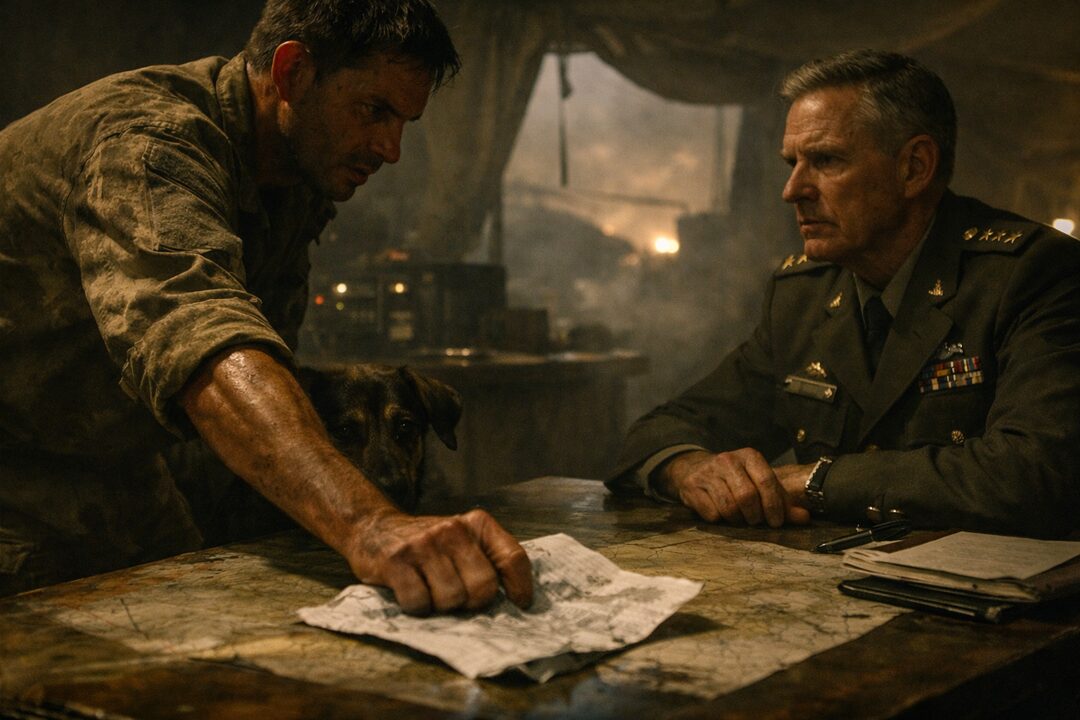
Elias found Major Hollis in operations, standing over a map while smoke from the burn pits threaded through the tent seams. Outside, men were lining up according to papers that no longer guaranteed anything. Inside, clerks moved like people afraid that if they slowed down, conscience would catch them.
“Sir,” Elias said.
Hollis looked up once, took in Elias’s face, the blood dried on Mercy’s flank, and said to the room, “Clear us.”
The clerks did not question him. They gathered their folders and left.
Mercy lowered herself beside Elias but did not fully lie down. Even hurt, she was ready if he moved.
Hollis’s gaze went to the wound. “Veterinary station?”
“Busy.”
“With what?”
“You know.”
The silence that followed was not long, but it was complete.
Elias stepped forward and put a paper on the table between them. He had taken it from the holding area shed during the mortar confusion. It was only a carbon copy, smudged at the edges.
NON-RETURNABLE PROPERTY
DISPOSITION PENDING
Hollis looked at it.
Then he closed his eyes for one beat too long.
That was when Elias knew.
Not suspected. Knew.
“You signed this category,” Elias said.
“Yes.”
The word landed like a shot because it contained no defense.
“You stood out there yesterday and talked about honor.”
“I did.”
“You let them number collars.”
“Yes.”
Mercy’s breathing was shallow now. Controlled, but wrong. Elias could feel each breath as if it were happening under his own ribs.
He had come in expecting evasion. He had prepared for language. Instead Hollis was standing there with the terrible decency of a man who was too tired to lie well.
“Why?” Elias asked.
Hollis’s eyes moved to Mercy. When he spoke, his voice was level, but something underneath it had gone thin.
“In another theater,” he said, “a long time ago, I had a dog named Ash.”
Elias did not move.
Hollis kept looking at Mercy, not at Elias. “Tracker. Smarter than I was. Mean to everyone else. Slept with his head against my boots whenever the shelling started.” A small, ruined smile touched his mouth and vanished. “He saved six men in six months. Maybe more. Hard to count the ones who only nearly died.”
The room seemed to narrow.
Elias said, “Then you know what this is.”
“I do.”
“Then stop it.”
Hollis’s face changed—not into indifference, which Elias could have hated cleanly, but into something worse. Strain. Shame pressed flat until it looked like discipline.
“If I break manifests for one exception,” Hollis said, “I will have fifty by noon. Handlers. interpreters. drivers. men with brothers, wives, children, secrets, debts. Every one of them with a reason that is real. Every one of them certain theirs should count first.”
“So you chose the ones who can fill out forms.”
“I chose what can still move.”
“You chose what can still be defended on paper.”
Hollis did not deny it.
Outside, rotors thundered low. The first wave.
Elias felt something hot and steady rise through the cold inside him.
“She kept your men alive,” he said. “You know she did.”
“Yes.”
“And you still signed.”
Hollis met his eyes then. “You think what I’m protecting here is righteousness. It isn’t. It’s collapse. Once collapse begins, mercy becomes random. And random mercy is just another way of choosing who gets buried.”
The line might have impressed another man. It might even have been true.
That was what made Elias hate it.
“Don’t use that word for this,” he said. “Not her name.”
For the first time, Hollis flinched.
Only a little. But enough.
The radio on the table crackled with loading calls. Window numbers. Weight limits. Delays measured in names.
Elias saw it all at once then: Hollis wasn’t a man who failed to understand loyalty. He understood it so well he had built armor out of refusal. He had once loved a dog and survived by turning that grief into policy. That was the real obscenity of the thing.
The system did not misunderstand devotion.
It counted on it.
Hollis took up his pen. Not hurried. Not theatrical. Just a movement of the hand across the page beside the disposition order.
He signed.
Not because the signature changed anything. Because the change had happened long before either of them entered the room, and he needed Elias to see that he would still align himself with it.
“There,” Hollis said quietly. “Now you can hate the right man.”
Elias looked at the signature. Then at Mercy, who had lifted her head at the scratch of pen on paper, trusting as ever that paper meant orders and orders meant purpose.
He folded the carbon copy and put it in his pocket.
“What I hate,” he said, “is that you knew better.”
Then he turned and walked out.
Lan was waiting beyond the tent line, a child of about eight clinging to her hand. The girl’s face was stiff with the kind of fear that had already burned through tears. Lan looked at Elias, then at Mercy, and read the answer before he spoke.
“No,” she said flatly.
“No.”
She nodded once, as if confirming an arithmetic she had suspected all along. “I can get my cousin and this girl’s mother onto a truck to the eastern strip. Not safe. Better than standing still.”
“You should go.”
Lan’s eyes sharpened. “And you?”
He looked south, toward the broken line of palms beyond the signal trench.
Tully emerged from behind a sandbag wall carrying a field pack and a canteen. “River,” he said. “Or the line.”
Mercy struggled to stand. Elias helped her. The moment she found her feet, she leaned her shoulder into his leg, ready.
Lan glanced at the departure queue. Then at the child beside her. Then at Elias.
“This is the last smart decision you can still make,” she said.
“I know.”
“And?”
He looked down at Mercy.
She had followed him into tunnels, mines, mud, gunfire, collapse. She had never once asked whether he was worth the risk.
“There’s a difference,” Elias said, “between failing to save someone and leaving them on purpose.”
Lan closed her eyes briefly. When she opened them, the answer was there.
“I can take you to the trench,” she said.
“Lan—”
“Don’t make me kinder than I am. I’m charging you in guilt.”
Tully snorted once. “Fair rate.”
The child pulled at Lan’s hand. “Are we leaving?”
Lan looked at her, then at Elias again. “Yes,” she said to both of them. “All of us are.”
The helicopters were already lifting.
Part V — The River That Would Not Carry Them
The base behind them sounded like steel being torn apart by weather.
They cut through the old signal trench in single file—Tully first, then Lan, then Elias with Mercy braced against his hip. The child and her mother turned east at the drainage fork, where Lan gave them a sheaf of papers and three rapid instructions in her own language. The mother bowed once, desperate and formal, then disappeared into the trees with the girl.
Lan stayed.
Elias almost told her not to.
But Mercy stumbled then, and the sentence died before it was born.
The trench opened into scrubland and then to a narrow path half-swallowed by reeds. The river smell reached them before the water did: mud, rot, green things breaking down in the heat. Once or twice Mercy stopped and lifted her head, reading distances Elias couldn’t. Each time he waited.
“Come on,” Tully murmured. “A little further.”
They reached the bank near sunset.
There was a boat. That part had been true. A long, narrow skiff hidden under cut branches, with an outboard motor that looked older than the war.
Lan crouched to clear the prop while Tully pushed the hull free.
Elias brought Mercy to the edge.
She planted her front paws in the mud and would not step.
At first he thought she sensed danger in the water. Then he saw the tremor in her shoulders. The way her wounded hind leg quivered under the effort of simply holding her up.
She wasn’t refusing the boat.
She was holding herself together.
He knelt beside her. “Mercy.”
She turned her head and looked at him. Her eyes were bright, steady, unbearably present.
Not fear. Not confusion.
A fact.
The motor coughed once as Tully tested it.
Lan looked up sharply. “Elias.”
He touched Mercy’s wound again. The bleeding had slowed. That was not comfort. Slow bleeding could mean there was not much left to lose. The flesh around the fragment tear was hot now. Swollen. Infection had already started its invisible work.
“We can carry her,” Tully said.
Mercy tried to step toward Elias when he shifted his weight.
The leg folded.
That was the moment.
Not dramatic. Not loud. Just the body finally saying what love had refused to hear.
Elias sat back in the mud.
Behind them, far away, helicopters crossed the darkening sky in thudding waves. Leaving. Always leaving.
Lan stood very still. “If we stay,” she said quietly, “we may lose the boat.”
He knew.
Tully looked at him with the raw, stripped expression of a man who had already had one truth too many in a week. “We can still try.”
Yes, Elias thought. We can drag her through pain for a map in our heads. We can call it hope because we are afraid of the other word.
Mercy rested her head against his shoulder.
He remembered the tunnel collapse again—not the dirt this time, but the second after the rescuers pulled him clear. He had been blind with coughing, half-crushed, reaching for air, and the first thing he had felt was Mercy’s nose against his throat, checking that he was still there.
You don’t leave the one who found you.
That had been true underground.
It was true here too.
Elias looked at Lan. “Take the boat.”
Her eyes widened in anger. “No.”
“You have a chance.”
“So do you.”
He shook his head.
Tully understood before Lan did. Elias saw it happen in his face, the collapse of argument into witness.
“Damn you,” Lan whispered.
“Go.”
She took one step toward him as if she might drag him bodily into the skiff. Then she saw Mercy leaning into him, saw the wound, saw the impossible arithmetic settle.
Lan crouched and put one hand briefly on Mercy’s head. Not tender. Respectful.
“To be useful is a dangerous thing,” she said.
Then she rose, pressed a folded packet into Elias’s shirt pocket—papers, money, maybe both—and said, “If anyone asks later, I never liked you.”
“I know.”
“That dog has more discipline than your whole command.”
“That too.”
For one second her face broke. Not into tears. Into something worse—recognition.
What was happening to Mercy was not separate from the rest of it. It was the same sorting, the same ledger, the same clean violence of deciding who could be carried and who had already done enough.
Lan stepped into the boat. Tully followed, gripping the side like a man boarding his own unfinished guilt.
The motor caught on the third pull.
Elias sat in the reeds with Mercy against him and watched them push into the darkening river. Lan turned once, lifting a hand. Not goodbye. Something harder.
Then the boat slid into shadow and was gone.
The night thickened slowly.
Mercy’s breathing grew rougher. Elias gave her water from his canteen, wet his hand, touched it to her tongue when she could not lift her head enough. He took off his field jacket and laid it under her. The ground stayed damp. The air stayed hot. Frogs began their brutal, ordinary song.
He spoke to her only a little.
Not because he had no words. Because words had stopped being the right payment.
Once, close to midnight, she struggled to rise when a helicopter passed overhead.
He held her gently down. “No more orders,” he said.
Her body trembled, then eased.
The hours thinned.
Near dawn, the eastern sky turned from black to charcoal. Mercy lifted her head once more and looked toward the river. Then toward him.
He touched the scar on his wrist with one hand and the fur between her eyes with the other.
“You kept all of us alive,” he said.
The sentence felt too small.
He tried again.
“You were never what they said.”
Her breathing hitched. Settled. Hitched again.
He stayed with her through each one.
When the moment came, it was quiet. So quiet he almost missed it. One last breath under his palm. Then none.
The world did not mark it.
No siren. No trumpet. No officer with a clean voice speaking of service and necessity. Only dawn opening over a river that would not carry them, and one man kneeling in mud beside the only creature in that war who had never lied to him.
He bowed his head until it touched hers.
The last aircraft thundered overhead a few minutes later, bound for somewhere that would call itself home.
He did not look up.
Part VI — The Only Ledger Left
Three months later, in Virginia, the envelope arrived with a commendation inside.
For exemplary operational conduct under hostile withdrawal conditions.
For discipline under pressure.
For honorable service to command objectives.
Mercy’s name was nowhere on the page.
Elias read it once in the kitchen of the rented house where the windows stuck in humid weather. Then he folded it and set it beside an empty coffee cup.
Outside, a lawnmower passed. Somewhere down the street, children yelled at each other over a baseball game. The sound of ordinary life still came to him as if through glass.
He touched the scar on his wrist.
Then he opened a yellow legal pad and began to write.
Not a report. Not an appeal. He was done offering the truth to people who measured worth by what fit a column.
He wrote the date of the western approach patrol. He wrote Reeves’s name, Nolan’s name, the names of the men Mercy had warned clear of wires, pits, concealed tunnel mouths, the names he could remember and the near-deaths he could not number. He wrote how she had found him in the collapse two years earlier when the digging stopped making sense to everyone else. He wrote where she died: south river bend, dawn, after the withdrawal. He wrote that she died with her head against him and no tag on her collar except the name he had used from the beginning.
He copied the pages by hand.
One set went to Reeves in Ohio.
One to Ruiz at the veterinary station, because she had looked ashamed in the right way.
One to Tully, care of a bar outside Corpus Christi, the only address Lan had managed to send through a chain of improbable names.
And one he kept.
At the bottom of the last page, after he had crossed out three versions that sounded too formal, then too angry, then too small, he wrote the line that stayed:
She was the only mercy we were shown, and the one we failed to return.
He stared at it for a long time.
Then he folded the pages carefully, slid them into envelopes, and sealed each one with his thumb pressed hard across the flap, as if pressure could make testimony hold.
Weeks later, Reeves wrote back first.
I tell people I’m alive because of her, the letter said. Most of them don’t know what to do with that sentence. I keep saying it anyway.
Tully’s reply came after that, written on hotel stationery in a hand made jagged by drink or memory.
You were right not to put her on their boat, he wrote. Don’t ask me how I know. I just do.
Lan never wrote directly. A package arrived instead. No return address. Inside was Mercy’s collar, the wire number tag removed. Elias turned it over in his hands for a full minute before he understood what he was holding: not recovery, not justice, just one more refusal to let the wrong words win.
He hung the collar by the window above his desk.
In the evening light, the leather looked almost black.
Sometimes, when the room was quiet enough, he could still feel the shape of her leaning against his leg, ready to move when he moved. Ready before he was.
The commendation stayed in a drawer.
The letters stayed on the desk.
When he thought of Major Hollis—and he did, more often than he wanted—he no longer imagined shouting. He imagined the tiny flinch when Elias had said Mercy’s name. The fracture in a man who had once known better and chosen structure over love because structure had given him somewhere to bury his grief.
That knowledge did not forgive him.
It only made the truth larger.
The final cruelty had not been ignorance. It had been understanding without courage.
Elias stood by the window until the light thinned and the collar became silhouette.
Then he touched the scar on his wrist once, like taking attendance, and looked out at a world that had kept moving.
“Comrade,” he said softly, to the empty room or the memory inside it.
No one answered.
But for the first time since the river, the silence did not feel like abandonment.
It felt like witness.