The Answer the Sea Gave Back
Part I — Sirens Before Dawn
The sirens began before the light did.
They rolled over the harbor in long, metallic waves, thin at first, then sharp enough to wake the gulls and the drunks and the old men who had taught themselves not to wake for much. Elias Voss was already standing by the window when the second alarm hit. He had one hand on the sill and the other pressed hard under his own ribs, as if something inside him had turned and jammed.
Outside, the dark water of the inlet shivered with reflected searchlights.
Then came the distant thud of shelling across the channel.
Not close. Worse than close. Close enough to be true.
A truck rattled over the quay road. Men were shouting. Another siren answered the first. Somewhere below, someone pounded on a brass bell and kept pounding.
Elias crossed the room, dragged on his old navy sweater, and stepped into the cold.
The Sundering waited at the edge of the dock like an old horse that had been asked to do too much for too long. Forty-two feet, shallow draft, patched hull, one engine that behaved when it felt respected. She had a cracked rail on port side and fresh tar in the seams where Tomas had worked by lantern light the night before. In the gray before dawn, the boat looked both stubborn and tired.
Elias stepped down onto the pier, crouched, and put his hand under the curve of her hull.
He did it before he knew he was doing it.
His palm met damp wood. Cold. Solid. Upside down in his mind.
He shut his eyes.
Not here, he thought.
“Uncle.”
Tomas came down the pier fastening his coat, boots unlaced, hair flattened on one side from sleep. He saw Elias with his hand against the underside of the boat and stopped.
“That bad?”
Elias straightened too quickly. “What have you heard?”
“That they’re taking everything that floats.” Tomas looked toward the town, jaw tight. “Fishing skiffs. ferries. two river launches. The navy’s run out of things it trusts.”
“That’s not new.”
“No.” Tomas looked at him carefully. “Sending boys where ships can’t go is new.”
Voices carried from the quay. Boots on planks. Command voice, clipped and young.
Tomas muttered, “And there they are.”
Three sailors came onto the dock with a lieutenant behind them. The lieutenant moved like a man who had been taught that the right pace could solve almost anything. He was tall, clean-featured, dark coat buttoned all the way up despite the wind, collar insignia bright even in the thin light. He did not look old enough to have learned the difference between command and luck.
He stopped in front of Elias and consulted a clipboard already damp from spray.
“Mr. Voss?”
“Depends who’s asking.”
“Lieutenant Adrian Vale, Naval Transport Command.” The young man glanced at the Sundering, then back at Elias with polite skepticism. “Your vessel has been marked for emergency requisition.”
“She has an engine that coughs in crosswind and a stern that takes water if you insult it,” Elias said. “Mark a better vessel.”
“We’ve marked all the better vessels.”
The lieutenant’s eyes passed over him once. Elias knew the look. The quiet filing-away of age, posture, scar, diminished use.
“We need shallow runners,” Adrian said. “Harbor mouths are blocked. Larger ships can’t clear the shoals. Men are trapped on the far side.”
“How many?”
“Enough.”
“That’s not a number.”
“It’s the one I have.”
Tomas stepped closer. “He’s not taking her.”
Adrian ignored him. “Your service record indicates familiarity with coastal extraction and damaged-water maneuvering.”
Elias laughed once, without sound. “My service record indicates the navy ran out of places to put me with dignity.”
The lieutenant’s expression barely moved. “This is not a ceremonial request.”
“Then take her,” Elias said. “If you can start her. If you can keep her from rolling in cross-current. If you can find the cut between the western shoals in blackout smoke. Be my guest.”
He turned as if to leave. The move was part truth, part test. He wanted the young man to either flinch or harden.
Adrian hardened.
“We are evacuating what remains of the Fourth Coastal Division,” he said. “Destroyers can’t reach the inner harbor. Barges are burning. If smaller boats do not make the run, those men stay there.”
The words struck cleanly. Not because of their patriotism. Because of the plainness. Those men stay there.
Elias looked out across the black water.
From the road above the quay came the groan of brakes. A military truck stopped. Canvas flaps pulled back. Shapes inside. Soldiers, packed shoulder to shoulder. Young faces, gray with sleeplessness and salt. One of them climbed down badly, stumbling when his boots hit stone. Another caught him by a rope line running along the tailgate.
A private. Barely grown. Mud on his cheeks. Knuckles white on the rope.
White in exactly the wrong way.
Elias saw, not the boy, but another hand in another dark. Frozen. Locked. Refusing to unclench because unclenching meant water.
He was standing again under stars that had looked like ice splinters. Hearing men in the black begging without words because their mouths no longer worked properly. Feeling the upside-down belly of a rescue craft over his back as he clung to it and counted, and kept not counting, the voices that stopped.
His hand twitched.
Not here, he thought again. But the harbor had already opened the door.
“Uncle,” Tomas said quietly.
Elias inhaled once, slow and hard enough to hurt.
Then he looked at Lieutenant Vale.
“I’ll take her,” he said.
Tomas turned on him. “No.”
Elias did not look at him. “One condition.”
Adrian’s gaze sharpened.
“Once we leave this dock,” Elias said, “that boat answers to me. You can keep your papers, your rank, your polished boots. But on water like this, I give the orders.”
“That is not standard—”
“Then find a standard boat.”
The two men stood facing each other while the sirens kept calling the town awake.
Finally Adrian said, “Very well.”
Tomas made a disgusted sound. “They took everything from you once. Now they come back for the scraps.”
Elias turned to him then. His nephew’s face was flushed with anger and old helplessness.
“They’re not asking for me,” Elias said.
“No?”
Elias looked toward the truck again. The private was still gripping the rope as if his hands had forgotten there were other ways to hold on.
“No,” Elias said. “They’re asking for the boat.”
It was a lie neither of them believed.
Part II — The Crossing
They cast off in a rain of shouted orders and gull cries.
Tomas handled the engine with both hands and half a curse. The Sundering shuddered, coughed black smoke, then caught with a grinding thrum that Elias felt up through the soles of his boots. Adrian stepped aboard last, ducking the boom and almost slipping on the wet planks. Elias noticed and said nothing.
The harbor mouth was already chaos.
Fishing boats with civilian crews. A tug dragging a string of skiffs. One paddle ferry painted over in fresh gray. Men on decks pretending not to be afraid because there wasn’t room left for public fear. Above them, aircraft passed high and invisible, the sound coming in waves through low cloud.
Elias took the wheel. Tomas crouched near the engine housing, listening. Adrian stood where junior officers always stood when they had not yet learned how much they were in everyone’s way.
“Sit or hold something,” Elias said.
“I’m fine.”
“The sea doesn’t care.”
Adrian said nothing, but a second later he braced himself against the cabin frame.
The channel widened. Smoke thickened ahead. The eastern horizon had started to pale, but the light did not improve anything. It only made the wreckage visible. A half-sunk trawler. A launch listing with no one aboard. Splintered crates and a body of floating rope. Every few minutes they passed another small craft heading the opposite direction, overloaded with soldiers, some lying flat in the bottom, some staring ahead with the emptied-out look of men who had gone beyond panic and found only function.
Elias kept them west of a sandbar hidden under the dark chop. The Sundering rode low but true.
Adrian watched him work the wheel with tiny corrections.
“You’ve done this route before?”
“Before your time.”
“That could mean anything.”
“It usually does.”
The lieutenant almost smiled, then didn’t.
A whistle shrieked from somewhere in the fog of smoke. Men were waving from a cutter off their starboard side. Elias ignored them. Adrian opened his mouth, then stopped when he saw the line Elias was threading between two dark patches of water that looked identical to him and entirely different to the man at the wheel.
Tomas muttered, “Shoal.”
Adrian glanced down. “I didn’t see it.”
“You weren’t meant to,” Elias said.
Another burst of distant shelling rippled over the water. The boat shivered in the wake of something larger passing unseen to the north.
For a while no one spoke.
Then Adrian said, “Black Aster.”
Elias did not turn.
“I read the transport lists,” Adrian went on. “Your name was attached to the Black Aster inquiry.”
Tomas’s hands slowed on the toolbox latch.
“That inquiry was buried,” he said.
“Most things are buried eventually,” Adrian said. “That doesn’t mean they vanished.”
The name moved through the boat like a drop in cold blood.
Black Aster.
Not a sentence. Not a story. Just the shape of one.
Elias kept his eyes on the water.
“You survived that sinking,” Adrian said. “Didn’t you?”
The question was clean. The answer was not.
“Yes,” Elias said.
“How?”
Elias saw it in pieces. Never all at once. Wood. Men. White breath. A lantern gone under. The slap of freezing water against his face and the underside of an overturned craft above him, so close he could smell pitch through seawater. And the voices. Always the voices until there weren’t any.
He adjusted the wheel a quarter turn.
“The sea got bored of me,” he said.
Adrian looked dissatisfied. Good, Elias thought. Let him be.
A shape loomed ahead out of haze and nearly made Adrian duck—a lifeboat drifting upside down, black with wet, a broken oar trapped under one side.
Elias’s hand went rigid on the wheel.
The hull. The scrape of wood. The impossible wrongness of a boat showing its belly to the sky.
Adrian saw it. Saw, too, something happen to Elias’s face. Not fear exactly. Something tighter, older, more private.
“Mr. Voss?”
“I see it.”
The Sundering slid past with feet to spare.
When Elias exhaled, Tomas kept his eyes on the engine and asked softly, “You all right?”
“No.”
It was the first honest thing he had said since dawn.
Smoke parted enough for them to see the far coast at last. Not a harbor, not really. A wound.
Fires burned along the seawall. Two cranes leaned at broken angles over the docks. Men swarmed the beach below in shifting lines that dissolved each time a shell hit nearby. Trucks, abandoned. Horses, one down and thrashing. Officers trying to impose geometry on collapse.
Adrian straightened.
“That’s worse than the reports.”
“It usually is,” Elias said.
As they drew closer, a signal lamp flashed from the shore station. Adrian took the code sheet from inside his coat and translated under his breath. Elias heard only fragments.
Priority. Staff officers. Dispatches. Immediate return.
He did not need the rest.
When they came within hailing distance, the sound hit them fully. Men calling for medics. Engines screaming under strain. A wounded soldier laughing too loudly from shock. A corporal vomiting into the surf and then standing back in line as if nothing had happened.
On the shingle above the waterline, one figure stood out not because of rank but because everyone around her obeyed.
Sergeant Mara Dain had mud to her knees and blood dried black on the torn bandage around her left arm. She was holding a cluster of younger soldiers together by force of voice and eye contact alone. A leather satchel was strapped crosswise over her chest, darkened by saltwater.
When she saw the Sundering push in through the surf, she did not wave in relief.
She started pointing.
Part III — The Beach of Orders
“Ambulatory wounded first,” Mara shouted the moment Elias jumped down into the shallows. “Two officers to the stern. No one crowds the rails. If anyone panics, I put them back in the water myself.”
She was not loud by temperament. She was loud because the beach demanded it.
Elias took in the scene in fast, cutting glances. Not one battalion. Fragments of many. Men without units. Men carrying men. A radio smashed open in the sand. A doctor working under a torn signal flag because it was the only cloth big enough to shade the eyes of the dying.
“This your beach?” Elias asked.
“For the next ten minutes.” She jerked her chin toward the harbor mouth. “Then maybe no one’s.”
Adrian stepped in behind him with the signal sheet. “Priority extraction has changed. Staff carriers first. Strategic dispatches—”
She cut her eyes to him. “You can read, Lieutenant. Congratulations.”
Then she slapped the satchel at her ribs.
“This is what they want.”
Elias looked at it. Then at the boys clustered behind her, faces hollow with waiting.
“How many left?”
“Too many.”
“That’s not a number either.”
Something like humor almost touched her mouth. “Must be contagious.”
A shell landed somewhere behind the seawall. Sand kicked up. Men flinched and did not move.
Adrian opened the sheet. “We have direct orders.”
“And I have direct bodies,” Mara said.
One of the young privates near her lost whatever fragile control had been holding him together.
“My brother was on the last boat,” he said to no one and everyone. “They said the next one. They keep saying the next one.”
Mara turned, gripped his shoulder once, hard enough to ground him. “Then make sure you’re standing when it comes.”
It worked. Not because it soothed him. Because it gave him a task.
Elias saw at once why she was still alive.
They loaded the first group under fire.
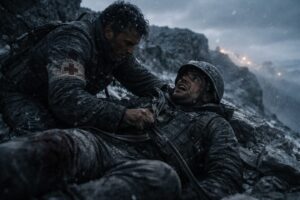
Not the neat embarkation Adrian’s paper had imagined. Men limped, slipped, shoved, apologized, bled. Tomas and Elias hauled the worst of them aboard while Adrian enforced what order he could. Twice Elias barked, “Not there. Forward. Balance, damn you,” and men obeyed because his voice carried the authority of someone who knew exactly how boats killed.
The satchel remained on Mara.
“You’re not boarding?” Adrian asked.
“When they stop sending boys younger than me,” she said.
“Those dispatches may decide the next line of defense.”
“And these men may die before the next line exists.”
Adrian’s jaw tightened. “You think I don’t know that?”
“No,” she said. “I think you know too many things at once.”
That landed harder than a shout.
Elias looked between them and understood the actual shape of the argument. Not orders versus compassion. Future lives versus present ones. The kind of decision armies loved pretending could be made cleanly.
Mara met his eyes.
“They need what’s in this satchel,” she said more quietly. “And I need these boys breathing long enough for it to matter.”
There it was. Not ideology. Arithmetic with blood still wet on it.
Elias nodded once.
“Get aboard,” he said.
She hesitated half a second too long. He saw then how tired she truly was.
“What about the rest?”
“We come back.”
Adrian said immediately, “If the channel closes, that may not be possible.”
Elias rounded on him. “Then pray it doesn’t.”
The Sundering shoved off under a rain of shouted names from men left onshore.
Some were calling for units. Some for friends. A few for their mothers, though not loudly. The private who had broken earlier stood in the surf to his knees, not trying to board, only holding another man upright until the water forced them apart.
Elias saw him. Remembered him. The white grip. The wrong grip.
He looked away before the shape completed itself.
They were fifty yards out when the next signal reached them from shore station by lamp.
Adrian read it once, then again.
“What?”
He swallowed. “Confirmed priority on documents and commissioned personnel. Civilian craft to conserve fuel. Minimum runs.”
“Say it plain,” Tomas snapped.
Adrian’s face had gone very still. “They expect most of the enlisted still on the beach to be abandoned.”
The word sat in the air like a charge.
Abandoned.
Mara closed her eyes once. Only once. When she opened them, she looked older.
Elias kept both hands on the wheel so no one would see the first tremor.
“I won’t do it,” he said.
Adrian answered too fast. “You may not get a choice.”
“That’s the only thing men like you ever say when the choice is ugly.”
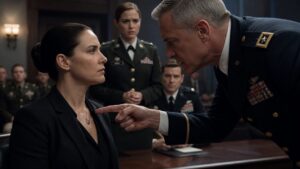
Adrian turned on him then, some of his polished control finally splitting.
“Men like me? I have two sheets of coded orders, a beach full of dying soldiers, and one damaged civilian boat being run by a man who refuses to answer a direct question. So yes, Mr. Voss, choices are ugly.”
For a moment even the engine seemed to go quieter.
Mara broke it.
“If you two are going to measure your souls, do it later,” she said. Then she looked at Adrian. “Secure the papers.”
At Elias. “Bring me back.”
She said it like an order to the sea itself.
He dipped his chin once.
Then the aircraft came.
Part IV — What He Lived Through
The first scream of the dive-bombers came down through the cloud like torn metal.
“Down!” Adrian shouted.
There was nowhere to go but lower.
The blast hit the water off port side and lifted the Sundering hard enough to throw two wounded men against the rail. Tomas swore and lunged for the engine housing. Another explosion followed, closer, then another. Spray and smoke and a rain of wood splinters from something that had not been them and could just as easily be them next.
Men started shouting at once. Too many voices. Too much weight shifting.
“Stay where you are!” Elias roared.
No one ever stayed where they were when death got loud.
A panicked soldier lurched to starboard. Another grabbed him. The boat rolled. A wounded officer slammed into Adrian. The satchel strap snapped half loose from Mara’s shoulder and Adrian caught it by reflex even as he lost his footing.
Then the Sundering tipped far enough that Elias saw, all at once, the dark undercurve of the hull and three men spilling toward it.
The sound that came next was not from the present.
It was wood scraping under bodies.
It was fingers losing purchase.
It was voices turning into water.
For one instant the years vanished. He was back under the overturned craft, legs numb, chest half crushed against timber, hearing an officer above him scream an order through frozen teeth.
Cut them loose. She’ll roll. Cut them loose.
His own hands had obeyed because rank had a shape you wore inside your bones. Rope in his palms. Men on the other side of it. A knife. One sawing pull. Then another. Then the sudden lightness, the terrible lightness, as weight left the craft and did not come back.
He had lived through the next roll.
Other men had not.
“Voss!”
Adrian’s voice hit him like a slap.
The present snapped back in pieces. Tomas hanging on the engine housing with one hand. Mara on her knees, dragging a soldier inward by his webbing. Two men already in the water, one still clinging to the rail.
And Elias frozen.
Adrian grabbed his shoulder and shook him once, furious and frightened at the same time.
“Move!”
Shame did what fear could not.
Elias lunged. “Weight to port! Port, damn you!” He seized one soldier by the collar and flung him bodily toward center. Tomas cut the engine for half a breath, then kicked it back as the stern threatened to swing broadside. Adrian hauled the satchel clear and shoved the staggering officer flat with his other arm. Mara reached past Elias and caught the wrist of the man slipping over.
Not all of them made it.
One of the men in the water vanished under the churn and did not come back.
The other got a hand on the ladder and was dragged aboard coughing blood and seawater.
When the attack passed, no one spoke for several seconds. The engine knocked unevenly. Someone wept quietly, without trying to hide it.
Adrian let go of Elias’s shoulder as if the contact itself offended him.
“You froze.”
It was not accusation. Not yet. It was worse. Statement.
Elias wiped salt from his eyes and said nothing.
“You brought us out here,” Adrian said. His voice had gone dangerously calm. “You insisted on command. And you froze.”
Mara looked between them, breathing hard. Tomas kept his head down, but Elias could feel the anger coming off him like heat.
“Enough,” Tomas said.
“No,” Adrian snapped. “Not enough. Not even close.” He stepped toward Elias. “What aren’t you telling us?”
The wounded groaned around them. The sea slapped the hull. Somewhere behind them, the harbor continued collapsing.
Elias could have lied again. He had practice.
Instead he looked at the dark water sliding past the side of the Sundering and understood, with a tired clarity, that silence was only another form of obedience.
“The Black Aster rolled in winter,” he said.
No one moved.
“There were too many on the rescue craft. Too many in the water. Men climbing over each other. Weight on one side. Then both.” His voice stayed level because if it cracked, he would stop. “An officer ordered the lines cut. Men were hanging off them. If we kept them, the craft would turn. We were told to cut and survive the roll.”
Adrian’s face changed, not softer, only more human.
Mara had gone still as iron.
“I cut them,” Elias said.
The engine kept knocking.
Tomas looked up sharply, as if some old family ghost had finally spoken its own name.
“I cut them,” Elias repeated. “And then I spent a night under the hull listening to whatever was left of them.”
The words were plain. They needed to be. Anything more polished would have been cowardice.
Adrian said, “You followed an order.”
“Yes.”
“And you think that makes it better?”
“No.”
A shell burst far off their stern. None of them flinched this time.
Mara reached down and retied the satchel strap around her body.
“So that’s what this is,” she said.
Elias met her eyes. “This is what’s in the boat with you.”
She considered him for one long second, then nodded once—not in forgiveness, not in judgment. In comprehension.
Adrian looked away first.
The radio operator on the aft bench, half conscious until now, lifted his handset and managed to get a fragment of signal through the static. Adrian snatched the message, listened, answered, listened again.
When he turned back, there was color high in his cheeks.
“Final order,” he said. “Return immediately with the dispatches and surviving officers. Channel under increasing fire. Further civilian runs not authorized.”
Not authorized.
Tomas gave a short, bitter laugh. “There. The navy found its spine.”
Mara was already looking back toward the beach. Through smoke, they could still make out movement near a broken stretch of seawall. Men. A cluster of them pinned against the burning breakwater, too far from the organized embarkation point, too scattered to matter to anyone using a map.
“Those are mine,” she said.
Elias followed her gaze. The channel between them and the beach was narrowing with wreckage. One more pass, maybe. Maybe not.
Tomas said, “Engine won’t like it.”
“The engine can complain later,” Elias said.
“It may not get a later.”
Adrian’s hand tightened around the coded sheet. “If we lose the satchel, we may cost lives far beyond that beach.”
Mara said, “If we don’t go back, those men are dead in front of our eyes.”
No one was wrong.
That was the cruelty of it.
The sea ahead was full of smoke and choices.
Part V — The Shape of the Same Choice
For a few seconds nothing moved but the water.
Then Elias held out his hand to Adrian.
“The satchel.”
Adrian did not release it. “You’re disobeying direct command.”
“Yes.”
“You may condemn the next line.”
“I may save the one in front of me.”
“That is not how war works.”
Elias looked at him with a weariness too old for contempt. “It is exactly how war works. It just hates being seen.”
Adrian stared at him. Then at the beach. Then at the men on deck who had survived because this boat had come once already.
“Secure it to yourself,” Elias said. “If we go over, that bag does not leave your body.”
A muscle jumped in Adrian’s jaw.
Then he looped the satchel strap across his chest and tied it off.
Tomas swore under his breath and put both hands back into the engine. “If we die, I’m haunting all of you.”
Mara let out something close to a laugh, rough and exhausted. “Take a number.”
The Sundering turned.
Everything in Elias’s body knew the line they were crossing. Not on a chart. Somewhere older. Somewhere under the breastbone where memory and instinct had fused into one hard knot. The boat jolted through wreckage and shallows that would have stranded a deeper vessel. Smoke blew low over the water. Twice Elias steered by feeling more than sight, reading the drag beneath the hull, the invisible push of current against scarred planks.
“Thirty yards,” Tomas called.
“I know.”
“You can’t see through smoke.”
“I don’t need to.”
That was almost true.
They hit the surf line hard enough to throw spray over the bow.
The men behind the breakwater saw them and began moving before Elias could shout. Not in order. In desperation. Eight, twelve, fifteen—then more, emerging out of the gray like the beach itself had been hiding them. One of them was carrying another over his shoulders. One was so young his helmet looked borrowed.
“Fast!” Mara shouted, jumping into the water before the keel had settled. “No heroes, just move!”
Heroes, Elias thought, were usually men caught too late between order and guilt.
He held the Sundering steady while they loaded. The boat sank lower. Tomas’s face turned murderous at the draft line.
“We’re too full.”
“Not yet.”
“We are now.”
A burst of gunfire stitched the water beyond them. Then an explosion from the breakwater itself showered them with stone and burning timber. The boat lurched sideways. A scream rose from beneath the rail.
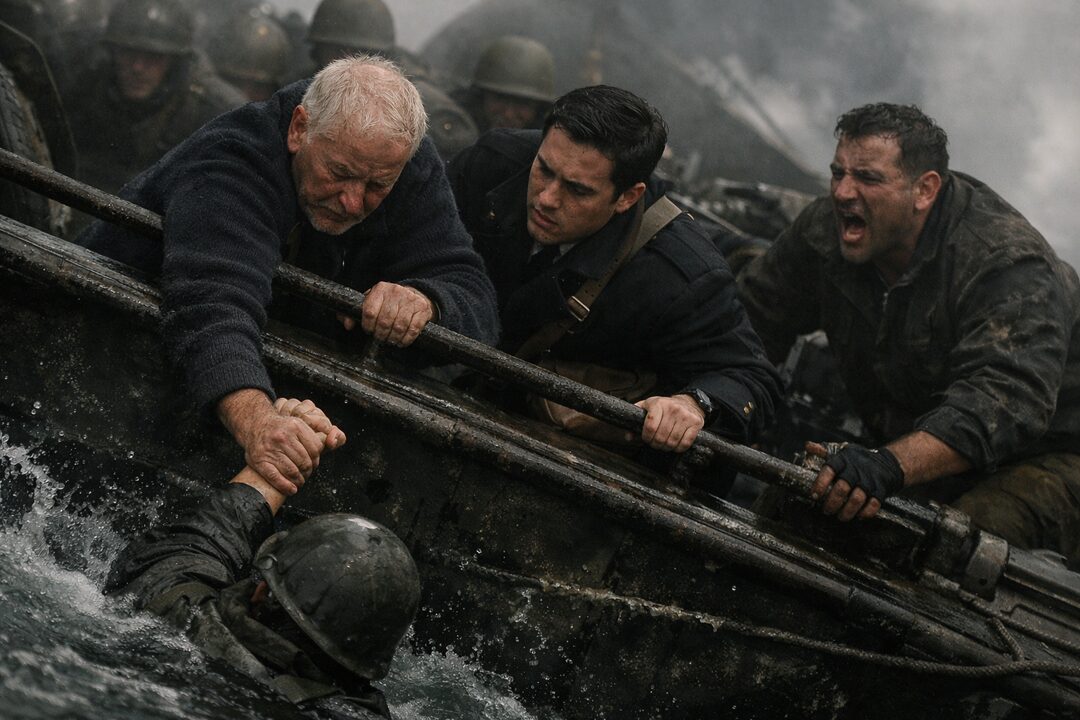
One of the youngest privates had missed his footing and gone over the side. He did not fall clean. He hung half in the water, both arms wrapped under the rail, boots kicking against the hull as the overloaded Sundering began to tilt toward him.
The angle changed. Fast.
Men shifted away from the side instinctively, making it worse.
“Hold your places!” Adrian shouted.
No one listened.
The private looked up.
His hands were white on the wood.
White in exactly the old way.
The world narrowed.
Rail. Weight. Water. Hull.
There it is, Elias thought. The same shape. The same demand. Cut loose the extra weight. Save what can still float. Choose survival cleanly and quickly and let the rest sink into reason.
He was already moving before the thought finished.
“Adrian! Port side, take them in by twos!” he shouted. “Mara, center weight! Tomas, keep her nose to the surge!”
Then he dropped to his knees at the rail.
The private was barely more than a boy. Sea in his mouth. Terror so absolute it had stripped language from him.
Elias reached down and caught his wrist.
The boy slipped.
Elias grabbed higher, fingers locking into wet sleeve.
Behind him Tomas yelled, “Let him go or we all roll!”
The words hit like history coming back for its answer.
Elias braced one boot under the rail. Felt the drag on his own shoulder, the old injury burning alive. Felt the boat tilt another fraction.
“No,” he said.
It was not loud. It did not need to be.
Adrian was suddenly there beside him, flat on his stomach, satchel digging into his ribs as he reached down with both hands.
“On three,” he said.
Elias heard the change in him then. Not obedience. Choice.
“One—”
The private’s fingers slipped again. Elias lunged farther than balance allowed and nearly went over himself.
“Two—”
Mara threw two soldiers bodily toward port, redistributing weight with curses sharp as blade work.
“Three!”
They hauled.
The boy came over the rail with a tearing sound of cloth and a burst of seawater. He landed against Elias hard enough to knock the air out of them both.
Another man slipped toward the side. Adrian caught him by the back of his webbing and dragged him inward.
No one was cut loose.
Not one.
For three terrible seconds Elias thought the boat would punish them for that and roll anyway.
Instead the Sundering shuddered, dipped, found her line, and lifted on the next swell like an old animal deciding, with reluctance, to keep going.
“Go!” Tomas shouted from the engine. “If she dies, let it be moving!”
Elias staggered to the wheel. His hands were shaking now, not from fear alone but from the force of something loosening that had been clenched inside him for nearly thirty years.
The run back was half blur, half knife-edge clarity.
Smoke parted and closed. Men bled into each other on the deck. Adrian moved through them with stripped-down efficiency, no longer barking rank for its own sake but putting bodies where the boat could carry them. Mara held pressure on a wound with one hand and the rail with the other, still somehow counting heads. Tomas coaxed impossible life out of the engine through threats, prayer, and violence.
Elias kept them between wrecks and over shoals by instinct and memory.
When the harbor mouth finally opened in front of them, lined with signal lamps and men waving from the quay, the sound that rose from shore was not triumph.
It was disbelief.
Part VI — What Stayed Above Water
They tied up at dusk, though Elias would later remember it as a color rather than an hour. Iron gray water. Smoke turned violet. Faces on the dock blurring in and out of significance.
Hands reached for the wounded first, then for the walking. Medics swarmed. Clerks began counting aloud and then had to begin again because no one trusted numbers earned in chaos.
Adrian climbed down last with the satchel still tied across his chest.
A senior commander came striding toward him, red-braided cap damp with spray and outrage prepared in advance.
“You were ordered to return immediately—”
Adrian handed him the satchel before the sentence was finished.
“Dispatches secured, sir,” he said. “Harbor conditions prevented compliance with ideal sequencing. Civilian vessel suffered combat damage while completing recovery of priority personnel and stranded infantry elements.”
It was a masterful piece of truth bent into shelter.
The commander opened his mouth, shut it, and snatched the satchel away.
Tomas, watching, muttered, “He does know one decent trick.”
Mara came off the boat under her own power and nearly fell only once, catching herself against the rail before anyone could make it kindness. She looked for Elias through the moving bodies until she found him still standing by the wheel, one hand braced there as if he had forgotten what came after arrival.
She did not say thank you.
She was too exact for that.
Instead she said, “One hundred and twenty-seven.”
He looked at her.
“That’s the count so far,” she said. “From both runs. Might climb. Might not.”
The number entered him strangely. Not as glory. As weight. Visible now. Countable. Men who would go on having mornings because an old boat had turned back once more.
Adrian joined them, coat torn, face drawn harder than it had been at dawn.
“The official version,” he said to Elias without preamble, “is that you followed my tactical recommendation under evolving battlefield conditions.”
Tomas barked a laugh.
Adrian ignored him. “I would advise you not to contradict the official version.”
Elias studied him. “Will you?”
“No.”
“Why?”
Adrian glanced toward the stretchers, toward the men being lifted down, toward the private who had hung under the rail and was now alive enough to be shivering.
Then he said, very quietly, “Because I know the difference now.”
He left before Elias could answer.
That, too, was its own kind of respect.
Night settled. The harbor kept moving. The war did not pause because one boat had returned.
Tomas stayed long enough to make sure the Sundering was tied fast and the engine had not torn itself apart beyond repair. He stood with both grease-black hands on the rail, looking at Elias with a tenderness he would have denied if named.
“You should sleep,” Tomas said.
“So should you.”
“I wasn’t the one trying to fight thirty years in a single afternoon.”
Elias looked out at the dark water.
“No,” he said. “You were the one who stayed.”
Tomas swallowed. There were many things between them that neither man liked to touch directly.
Finally Tomas said, “You went back for them.”
“Yes.”
Tomas nodded once, abrupt, almost angry. “Good.”
Then he climbed off the boat and went to help at the triage station because feeling too much in one place had never suited him.
It was nearly dawn again when Elias found the note.
It had been tucked under the compass box, folded twice, the paper stiff with salt. Mara’s hand was compact and severe.
They crossed because you came back.
Nothing else.
No signature. No flourish. No absolution offered where none had been requested.
He read it once and slid it into his coat.
The quay had gone quiet in the thin hour before full morning. A few gulls called. Somewhere a hammer struck metal. The fires across the channel were only smears now.
Elias stepped down from the deck to the pier.
The Sundering rested against her ropes, scarred, low, alive.
He crouched the same way he had before dawn the day before. Or what felt like the day before. Age did strange things to time under pressure.
Then he reached under and put his hand against the hull.
Cold wood met his palm.
Not a grave this time.
Not innocence, either.
The sea had not forgiven him. The dead had not risen to make clean lines through all that had happened. The order on the Black Aster still lived where it had always lived, in the place that woke with him and went to sleep with him and never asked permission to return.
But something had changed shape.
Once, he had held on because there was nothing else to do.
Yesterday, he had gone back because there was.
He left his hand there a moment longer, feeling the curve of the planks, the patched seams, the damage that had not kept the boat from carrying men home.
Then he stood.
The harbor light touched the water, and for the first time in many years Elias Voss looked at the sea without waiting for it to accuse him.