The Places With No Holes
Part I — Under Floodlights
The bomber came in crooked.
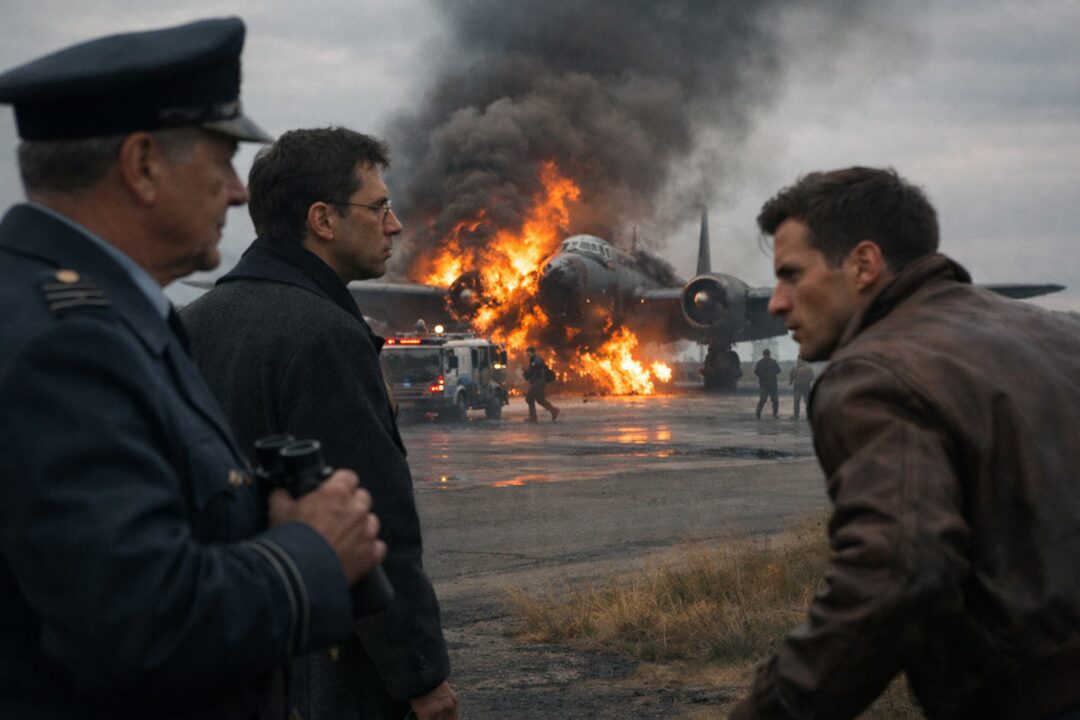
Even before its wheels touched the runway, everyone watching could see something was wrong with the port wing. It sagged as if the metal had gone soft in the dark. One engine coughed black smoke. The landing lights cut across torn aluminum, and for a second the aircraft looked less like a machine than an animal trying to drag itself home.
By the time it rolled to a stop under the floodlights, the ground crew were already running.
Dr. Elias Vale stood back in his dark overcoat, collar turned up against the January wind, and watched men gather around the plane with the hard, fast reverence of medics around a wounded body. The fuselage was peppered with holes. The outer skin near the tail looked chewed. One section of the right wing was so shredded the moonlight showed through it.
“Study that,” said the voice beside him. “And tell me where to put the armor.”
Elias turned. Group Captain Thomas Mercer had come up without sound. He was broad in the shoulders, his uniform immaculate even at this hour, his face lined in a way that made fatigue look permanent rather than temporary.
Mercer nodded toward the plane. “We’re losing too many before they get back over the Channel. London wants a recommendation. Quickly.”
The crew hatch opened. Two men climbed down. A third was helped. Their faces were gray with cold and exhaustion, and none of them looked at the damage behind them. Elias noticed that, too.
He took off his gloves and stepped closer.
Sergeant Miriam Kaye was already beneath the wing with a torch, a clipboard tucked under one arm. She glanced up at him once, taking in the glasses, the city shoes, the wrongness of him in that light, then went back to work.
“Wings,” Mercer said. “Tail. Outer fuselage. That’s where Jerry’s chewing us to pieces. If we reinforce those sections, maybe more of my boys come home.”
It sounded obvious. Elias knew that was the danger.
He moved his hand over the torn metal without touching it. Holes clustered in the outer skin. Long stitched lines of damage near the tail. Splintering around the wing edge. But around the cockpit there was less. Around the engine housing, less. Around the center body, where men sat shoulder to shoulder over enemy territory, less.
He frowned.
Mercer saw it. “Something amusing?”
“No.”
“Good.”
Elias leaned closer to a patch near the nose. The metal smelled scorched. Fresh paint had bubbled around one impact point. He counted under his breath.
Behind him, Mercer said, “We haven’t brought you here to admire the workmanship, Doctor.”
“No,” Elias said quietly. “You brought me here to tell you where the dead are speaking from.”
Mercer’s face did not change. “What?”
Elias straightened. “Nothing yet.”
Miriam stood and wiped her hand on her sleeve. “This one only looks lucky,” she said.
Mercer looked at the aircraft. “It made it back.”
Miriam’s eyes stayed on the damaged wing. “That’s not the same thing.”
For a moment nobody answered.
Then Mercer said, “You have forty-eight hours before Hart’s crew goes up again. High command wants one armor configuration approved before then. I don’t care how you reach it. I care whether the next aircraft returns.”
His gaze shifted toward the shadows beyond the floodlights.
A young pilot stood there smoking with hands that were too steady to be natural. Lean, hollow-cheeked, leather jacket unzipped despite the cold. He looked toward the plane the way men look at a coffin that might still have their name on it.
“Flight Lieutenant Owen Hart,” Mercer said. “His aircraft is next in line for retrofit. Make the wrong recommendation, and the consequences won’t stay theoretical.”
Owen crushed the cigarette under his boot and came closer.
“That my aircraft?” he asked, nodding toward the wounded bomber.
“No,” Mercer said.
“Good. I’m sentimental about mine.”
It was almost a joke. It died as soon as it was spoken.
Elias looked again at the clustered holes, the ragged wing, the metal that had suffered and survived. The answer was standing in front of him already, wearing the shape of certainty.
That was what made him afraid of it.
Because obvious things were often true.
And when they weren’t, men died believing them.
Part II — Red Marks
By noon, Elias had three walls covered in aircraft diagrams.
Every returned bomber from the last six weeks had been reduced to outline and impact marks. Red pencil for bullet strikes. Blue for flak. Black circles for structural failures. The office they’d given him had once belonged to an adjutant and still smelled faintly of stale tobacco and damp paper. Now it smelled like graphite, wool, and the cold metal tang that seemed to follow every man in from the runway.
Mercer came in without knocking.
He stood before the nearest chart with his hands behind his back. “There,” he said after a moment, tapping the tail section. “And there. Along the wings. Same story as last night.”
Elias did not answer.
Mercer glanced at him. “You’ve been here fourteen hours, Doctor. Has all that looking improved your eyesight?”
“It has made your conclusion look popular,” Elias said.
“Popular with facts is a good place for a conclusion to be.”
Elias set down his pencil. “Popular with survivors.”
Mercer’s jaw tightened. “We can only examine the planes that return.”
“Yes.”
“Then those are the facts available.”
“No,” Elias said. “Those are the facts visible.”
Mercer stared at him for a beat, then gave a short, humorless smile. “London promised me a statistician. They didn’t say they were sending a philosopher.”
When he left, Elias stood very still.
That was the real pressure, not Mercer’s sarcasm. It was the seduction of the charts themselves. Every red mark looked persuasive. Enough of them together could make any falsehood seem earned.
A knock sounded on the open doorframe. Miriam entered carrying two engine reports and a mug of tea she looked reluctant to surrender.
“You missed dinner,” she said.
“I hadn’t noticed.”
“That’s because you don’t work with your hands.”
She set the tea down anyway and came to the wall. Her blunt gaze moved across the diagrams.
“You’ve marked the holes,” she said.
“Yes.”
She pointed at one aircraft outline. “This one took a worse spread in the wing root than the others.”
“It returned.”
“Barely. The spar was a prayer.” She moved her finger to another outline. “This one—almost no visible damage, just a line here.” She tapped near the inner engine mount. “Pilot said the controls went soft over Belgium.”
“And it returned,” Elias said.
“Only because his engineer shut down the engine before the whole side caught.”
He looked at her. “You remember all of them.”
“I repair them.”
She lifted the mug, realized it wasn’t hers, and set it back down.
“Everybody keeps staring at the ugly parts,” she said. “Some planes only look lucky.”
That line stayed with him after she left.
Late that evening Owen Hart appeared in the doorway with two enamel cups and a bottle that was not supposed to be on base.
“I was told civilian geniuses drink,” he said.
Elias almost smiled. “I was told pilots exaggerate.”
“Only when we survive.”
He poured. They stood among the charts.
Owen took it in with the weary interest of a man walking through his own future. “Looks bad.”
“It is bad.”
“Mercer wants more armor on the wings.”
“Yes.”
“And you don’t.”
“I haven’t said that.”
“You didn’t have to.”
Owen drank, then looked at one diagram longer than the others. “That one’s mine.”
Elias followed his gaze. The aircraft outline carried moderate damage along the fuselage, scattered punctures in the tail, nothing extraordinary.
“You flew it last month?”
“Twice with damage. Three times if you count a cracked hydraulic line and a radio operator who cried after we landed.” Owen said it without cruelty. “He was nineteen. I think he believed surviving once meant something.”
“And you?”
Owen looked at the chart and said, “I think people keep trying to make survival sound less random than it is.”
There it was. Not bravado. Fatigue shaped like philosophy.
Elias said, “You’re flying again in forty-eight hours.”
“Unless your pencils save me first.”
“I wouldn’t trust pencils that much.”
Owen’s smile appeared too late again. “Neither would I.”
He set down the cup and pointed at the center of one aircraft diagram, where there were fewer marks. “Funny, isn’t it?”
“What is?”
“All the places men sit. Not much there.”
Elias said nothing.
Owen’s finger dropped. “My brother disappeared in May. Same route we’re flying next. No wreckage. No body. My mother still says missing as if it’s a temporary condition.” He swallowed. “I’ve spent eight months looking at returned aircraft, trying to imagine where his might have broken. What failed. What happened first.”
He turned away from the wall.
“If you find an answer,” he said, “don’t make it gentle on my account.”
After he left, Elias pulled the records of the missing aircraft toward him.
Partial manifests. Vanished serial numbers. Times of last contact. Curt phrases: believed lost over coast. failed to return. no further communication.
He laid them beside the red-marked charts of the planes that had made it home.
For the first time, the room felt crowded.
Part III — The Briefing Room
Mercer gave him the floor because high command was on the telephone line and because there was still time, barely, to change course.
The briefing room smelled of wet wool and cigarette smoke. Pilots stood along the wall. Mechanics clustered near the back. Miriam was there with grease still under one thumbnail. Owen sat in the second row, elbows on knees, looking like a man trying not to move too much inside his own skin.
Elias stood before the easel.
On it was the simplest chart he had made.
Outlines of bombers. Red clusters on wings, tail, and outer fuselage. Sparse marks near engines, cockpit, and central body.
Mercer introduced him with clipped impatience. “Doctor Vale believes he has found a pattern.”
Elias could feel the room waiting to dislike him.
He said, “You have been studying where enemy fire appears most often on aircraft that return.”
A few nods. One pilot folded his arms.
“That seems sensible,” Elias went on. “If many returned planes are damaged in the wings and tail, it appears those are the sections being hit most often and therefore most in need of reinforcement.”
Mercer said, “Get to it, Doctor.”
Elias looked at the chart once, then at the men.
“I do not recommend reinforcing the wings and tail first.”
Silence.
He continued before they could fill it.
“I recommend reinforcing the areas that show less recorded damage. The engines. The cockpit. The inner body. The places your returned aircraft are not often hit.”
The room broke.
Not loudly at first. A laugh from the back. A curse. Someone said, “That’s insane.” Another, “Then why are the wings shredded?”
Mercer did not raise his voice, but when he spoke the room quieted at once.
“Explain yourself.”
Elias heard his own pulse once in his ears.
“These charts are made from planes that survived long enough to be examined,” he said. “So the damage they display is survivable damage. The wings, tail, and outer fuselage are clearly vulnerable to enemy fire—but not necessarily fatally vulnerable. We know this because these aircraft came home.”
No one moved.
“If a plane is hit in a place that prevents it from returning, that damage does not appear here.” He touched the blanker zones on the diagram. “So the areas with fewer marks may not be safer. They may be deadlier.”
Mercer’s expression hardened. “May be.”
“Yes.”
“On your wall of guesses, perhaps. In my squadron, men require more than perhaps.”
At the back, Miriam said, “Every kite that came home ugly still came home.”
All eyes shifted to her. She did not flinch.
Elias seized it. “Exactly. Severe damage to outer sections correlates with survival. But when engines are compromised, when control systems near the cockpit fail, when central structural integrity is lost, those planes often do not return to be counted.”
“Do not return,” Mercer repeated. “So we are meant to reinforce ghosts?”
Something in the room changed on that word.
Owen spoke without standing. “My brother was one of your ghosts.”
No one answered him.
He looked at the chart, not at Mercer. “No plane came back to explain where he was hit. That doesn’t mean there was no pattern. It means he died inside it.”
The silence that followed was worse than shouting.
Mercer’s face gave away almost nothing, but something in it had gone rigid. “This is a recommendation based on absence.”
“It is a recommendation based on incomplete evidence,” Elias said. “Which is not the same as no evidence.”
“You’re asking me to strip armor from places I can point to and put it where I cannot prove it belongs.”
“I’m asking you to stop mistaking what survived for what matters most.”
That landed too hard. Elias knew it the moment he said it.
Mercer stepped toward him. “Careful.”
Elias held his ground, though his throat had gone dry. “Sir—”
“No. You listen to me.” Mercer’s voice was low now. That was worse. “I have signed letters to mothers and wives every month for three years. I have watched boys burn on runways. I have dragged men from wreckage with my own hands. Do not come into my briefing room and imply I don’t know what matters.”
The room seemed to contract around them.
Elias said, more quietly, “I am implying only that grief can make obvious things feel safer than true things.”
Mercer stared at him as if deciding whether to throw him out.
Then he said, “Until I see better proof than a clever inversion, nothing changes.”
He turned to the room. “Dismissed.”
Chairs scraped back. Men stood. Nobody spoke above a murmur.
Owen paused beside Elias on his way out.
“You’re either right,” he said, “or the bravest fool I’ve met.”
“Those conditions are not exclusive.”
For the first time, Owen’s smile came on time.
It lasted less than a second.
Part IV — The Plane That Almost Burned
That afternoon the proof arrived screaming over the runway.
The returning bomber looked almost clean.
After days of seeing aircraft stitched with damage, the sight was almost soothing: minimal tearing, only a few visible punctures along the fuselage, no ragged wing edge, no shredded tail. Even Mercer, standing with binoculars, seemed to ease half an inch.
Then the port engine erupted.
Not in the air. On the ground, as the wheels hit and bounced and hit again. Flame sheeted backward. The aircraft veered. Men shouted. A truck lurched into motion before the plane had fully stopped. Elias heard Owen curse beside him and start running with everyone else.
By the time Elias reached the aircraft, the fire crew had foam across the wing root and half the runway smelled of fuel and burned oil.
The pilot stumbled from the hatch coughing, face blackened but alive.
Mercer grabbed him by the shoulder. “What happened?”
“Nothing, sir,” the pilot choked out, then laughed once because the answer was absurd. “That’s the trouble. Nothing much. Bit of noise over the coast. Instruments soft. Thought we’d made it.”
Miriam was already climbing the engine housing.
Elias stood below while she leaned in with her torch.
For a long moment she said nothing.
Then: “Get Captain Mercer up here.”
Mercer climbed with less grace than he would have accepted from anyone else.
Miriam pointed.
Elias could not see it at first. That was the point. Then the torch caught a narrow line of damage running along a critical section near the inner engine mount and into the protected structure beyond. Not a shredded panel. Not a dramatic ruin. Just a small, ugly wound in the wrong place.
Mercer went still.
“This wasn’t low-priority damage,” Miriam said. “This was death arriving discreetly.”
The line sat there between them, smaller than many of the wounds on planes that returned full of men joking too loudly after landing. Smaller than the ragged tears Mercer had trusted.
Elias felt no triumph. Only a terrible, cold relief.
Mercer climbed down without speaking.
On the tarmac, Owen stood waiting. “Well?”
Mercer looked at the nearly intact bomber, then at the foam spreading around its wheel.
“It nearly burned with half the sky still behind it,” Owen said.
“Yes.”
Owen’s voice sharpened. “And tomorrow you sign me into one configuration or another.”
Mercer rounded on him. “You think I need reminding?”
“I think you need deciding.”
That was the wrong line to use on any other day. On this day Mercer let it stand.
He looked at Elias instead. “My office. Both of you.”
Miriam called after them, “Take the inspection report.”
Mercer did not answer, but he took it.
In the office, the air felt too small for three men and the truth.
The report lay on the desk between them. That narrow line of damage had translated into dry language: critical vulnerability near inner mount. probable loss if fire initiated airborne.
Mercer read it twice.
Then he set it down.
“I can fight the Air Ministry,” he said. “I can fight shortages. I can even fight fools. But if I sign the wrong thing now, I will know I signed it.”
No one answered.
Mercer looked up at Owen. “How many on your crew?”
“Seven.”
“Any married?”
“One. Wireless operator’s got a daughter.”
Mercer nodded as if adding weight to a scale already overloaded.
Then his gaze shifted to Elias. “Tell me plainly. No performance. No theory for theory’s sake. What do I sign?”
Elias felt the room narrow to the edge of the desk.
He said, “You sign the armor toward the places that leave no witnesses.”
Mercer closed his eyes briefly.
When he opened them, the weather in his face had changed. Not softened. Broken open.
“Visible damage was easier,” he said.
It was not addressed to either of them.
“Visible damage meant I could tell myself the dead were lost in chaos. Bad luck. A bad flak burst. Wrong place, wrong second.” He looked at the report again. “If I do what you’re asking, I admit they were telling us something from the start. And I chose the parts I could bear to look at.”
Owen’s voice, when it came, was quiet. “Sir… maybe everyone did.”
Mercer gave a short, bitter breath that was not a laugh.
“No,” he said. “Command doesn’t get everyone.”
He pulled the directive toward him.
His pen hovered once over the paper. Elias watched his hand. This, not the briefing, not the charts, not any elegant argument, was the story’s real center: a tired man in command deciding whether to trust a truth that accused him.
Mercer signed.
The sound of the nib scratching the page was almost nothing.
It felt like a door giving way.
He pushed the paper toward Elias. “Take it to engineering.”
Then to Owen: “Your aircraft gets the revised armor.”
Owen did not thank him. That would have cheapened it.
He only nodded once.
Mercer leaned back in his chair and looked suddenly older than any of them. “If this is wrong,” he said, “I’ll carry it.”
Elias folded the directive carefully. “If it’s right, you’ll carry that too.”
Mercer gave him a long look.
“Yes,” he said. “That is the trouble.”
Part V — What the Missing Left Behind
They worked through the night.
Miriam’s team stripped, fitted, riveted, reinforced. Men moved under Owen’s bomber in the hard yellow light, faces pale with fatigue. The new armor went into places that did not look dramatic. Inner engine protection. Critical structural zones. The sections a casual eye would have overlooked in favor of the more wounded-looking skin farther out.
At dawn Owen came to watch.
He ran his fingers along the outer wing, where the old instinct still wanted more metal, then followed Miriam as she showed him where the weight had gone instead.
“Doesn’t look like much,” he said.
“That’s because you’re looking for scars,” Miriam said.
He glanced at her. “You always this cheerful?”
“Only around officers and men who survive by accident.”
Owen let that pass. His hand moved to the newly reinforced section near the inner body. He did not touch it long. Just enough.
Elias had not slept. He stood a little apart with the revised charts in his arms.
During the night he had done one more thing.
He had taken the red-marked diagrams of the returned aircraft and, beside the blanker zones, begun writing names.
Not all of them. There were too many. But enough. Missing crews. Vanished serials. Owen’s brother among them.
When Mercer entered the hangar and saw the charts resting against a crate, he stopped.
For a second Elias thought the commander might object. That he might call it sentiment, theatrics, trespass.
Instead Mercer walked to the nearest sheet and read the names in silence.
Then, without removing his gloves, he took Elias’s pencil and added three more serial numbers beneath a blank section near the cockpit.
He handed the pencil back.
No one spoke.
The new configuration was approved base-wide by noon.
It did not save everyone. That would have made the war feel like a story written by someone dishonest.
Planes still failed to return. Letters still had to be signed. The runway still collected wreckage and silence. But over the following weeks, aircraft began landing with damage that would once have been fatal. Engines hit without immediate loss. Control systems damaged without instant disappearance. Men came back shaken, limping, burned, sick with luck—but back.
The language changed first among the ground crew.
Not “clean zone.” Not “safe section.”
Just quieter phrases.
“Critical there.”
“Watch the blank patch.”
“Don’t trust what looks minor.”
Mercer changed too, though only those near him could see it. He listened longer. Interrupted less. When a bomber returned badly scarred, he no longer spoke about where the enemy had hit hardest. He asked instead, “What nearly kept it from returning?”
It was a small change in wording.
It felt like a confession.
One month later, on a pale morning with frost still silver on the edge of the tarmac, Owen Hart’s aircraft came home.
Not untouched. No one expected that anymore. There was damage along the outer fuselage, a mean puncture near the tail, and a blackened groove under the wing that looked uglier than it was. But the engines held. The crew climbed out alive.
Owen was the last to descend.
He saw Elias near the hangar and gave a tired nod, then turned back to the aircraft before anyone could call him away.
His hand rose to the newly armored section near the inner body.
He touched it once, very lightly, as if testing whether metal could carry memory.
Elias thought of the opening night, of the bomber under floodlights, of the wrong answer disguised as common sense. He thought of all the empty spaces on the chart that had not been empty at all.
Mercer came to stand beside him.
For a while they watched in silence as the ground crew moved around the aircraft.
At last Mercer said, “We were reading only the men who made it back.”
Elias looked at Owen’s hand still resting against the metal.
“Yes.”
Mercer’s voice was rougher than usual. “The others were in the room all along.”
Neither man said more.
They did not have to.
Across the tarmac, Owen lowered his hand and stepped back. The cold wind pressed at his jacket. Behind him the aircraft stood marked, altered, and alive. In front of him the war waited with its old appetite.
But for one suspended moment he seemed to be standing between the living and the missing, carrying both.
Then Miriam called for him to stop brooding and clear the path if he wasn’t planning to fix the machine himself.
Owen laughed.
It was brief. Real enough.
He turned and went toward the voices.
Elias looked once more at the chart inside the hangar—the red marks, the blank spaces, the names written where no damage had been recorded.
The most important parts of the story had never announced themselves.
They had waited in silence.
And now that silence had weight.