The Man Who Kept Moving
Part I — The Number
“At twenty-three they wrote down two hundred beats a minute and assumed I was dying.”
Rowan Vale said it flatly, like he was answering a question about the weather.
The technician paused with one hand on the monitor. He was young enough to still find small talk useful. “Two hundred?”
Rowan lay still beneath the paper-thin hospital blanket, silver hair pressed flat against the pillow, his left hand trembling once before going quiet again. “That’s what they told me.”
The technician gave a short laugh, waiting for the punch line.
There wasn’t one.
In the black glass of the scan room, Rowan saw white trees rushing past him.
Not reflected. Returned.
A corridor of snow. A line of dark trunks. A patch of sky so cold it looked metallic. For a second the machine under him became the hard curve of frozen ground beneath his spine, and his chest tightened with an old memory that was less memory than impact.
“You all right, Mr. Vale?”
Rowan blinked. The room came back in layers: fluorescent light, antiseptic air, a cart of labeled syringes, the technician’s polite concern. His heart gave one ugly thud against his ribs, then settled into its usual bad manners.
“I’m fine,” he said.
He wasn’t, but men his age learned the economy of that answer.
By the time he got home to Montana, there was a letter waiting inside the front screen door. Not a bill. Not a flyer. Heavy cream paper, his full name written in a firm hand he didn’t know.
He stood in the kitchen without taking off his coat and slit it open with a pocketknife.
Mr. Rowan Vale,
My name is Elise Mercer. I am writing in my capacity as a curator with the Western Military Archive, and also as the daughter of Captain Daniel Mercer.
He stopped reading.
Outside, the wind dragged loose snow along the porch boards.
He read the line again, slower this time, and then the rest.
The archive was preparing a commemorative feature on Operation Winter Cinder. A public ceremony would accompany the piece. The draft article described Rowan as the man who crossed eighty miles on pure instinct.
Elise Mercer believed the article was wrong.
She had found her father’s unfinished field notebook among uncatalogued materials from a private donor collection. She thought Rowan should see it before the archive printed another version of the story that could not be taken back.
At the bottom she had written, in the same careful hand:
I know what your survival meant to people. I also know what it cost mine.
Rowan folded the letter once. Then again.
For forty years people had tried to hand him his own story in cleaner language than he remembered it. Heroic. Miraculous. Unbreakable. Men at reunions slapped him on the shoulder and asked him to tell the part about the march. Journalists wanted the number—the weight, the heart rate, the miles. Schoolkids liked the idea of a young soldier too stubborn to die.
No one ever asked what happened after the body was found.
They assumed rescue ended it.
Rowan set the letter on the table, then turned it over as if there might be something else underneath. There wasn’t. Just the wood grain and his own reflection in the window: a lean old man in a winter coat, still standing like he might be inspected.
The phone rang before dusk.
Only one person used the landline anymore.
Martin Keane didn’t bother with hello. “You heard from the archive?”
Rowan looked at the letter. “You have too.”
“They sent me the ceremony notice. Big write-up. Our brave frozen idiot finally getting polished bronze.”
Rowan almost smiled. Martin had been calling him that since 1989. Not because he knew the whole truth. Because he suspected there was one.
“You going?” Rowan asked.
Martin snorted. “At my age I go wherever there’s decent coffee and someone else is paying for lunch.” Then his voice changed. “Listen to me. Whatever they print, let them print it.”
Rowan said nothing.
“You hear me?”
“I hear you.”
“Some stories hold men together,” Martin said. “Don’t go taking tools to one unless you know what you’re doing.”
After he hung up, Rowan stood in his darkening kitchen with Elise’s letter in one hand and the dead line humming in the other. He could still see those white trees in the hospital glass.
He knew before he admitted it that he would meet her.
He also knew the worst part was not that she might be wrong.
It was that she might not be.
They met three days later in the archive reading room in Helena.
Elise Mercer was waiting when he arrived, seated at a long oak table beneath soft yellow lamps. She rose when she saw him, not rushed, not timid. She had dark hair pulled back at the nape of her neck and wore a charcoal coat sharp enough to look almost military. She didn’t resemble Daniel Mercer much in the face. But the posture was his. Straight-backed, quiet, composed as if feeling was something to be handled privately.
“Mr. Vale.”
“Rowan is fine.”
“Then I’m Elise.”
She did not offer condolences for the years. He appreciated that.
On the table between them sat a slim gray archive box.
For a moment neither of them touched it.
“You wrote that the article was wrong,” Rowan said.
“It is.”
“That’s a strong word for a curator.”
“It’s a useful one.” She slid a folder toward him. “This is the draft.”
He read enough to feel the old public version settling over his skin like borrowed clothing.
Separated from his unit after enemy contact, Private First Class Rowan Vale traversed approximately eighty miles of frozen forest in subzero conditions… delivered critical patrol intelligence… discovered at ninety-four pounds with a pulse of nearly two hundred beats per minute… survival instinct beyond reason…
Beyond reason, he thought. That at least was true.
Elise watched him read. “My father’s notebook doesn’t support that account.”
Rowan looked up.
“It doesn’t contain extraction coordinates,” she said. “It contains a drafted order.”
The room seemed to tighten around the words.
“A drafted order for what?”
Her fingers touched the archive box once, then withdrew. “If the patrol was compromised, you were to be sedated and sent back with an escort. My father wrote that your exhaustion had become a liability.”
For a second Rowan only stared at her.
The sentence did not land cleanly. It hit him in fragments. Sedated. Sent back. Liability.
“No,” he said.
“I thought that too.”
“No.” He heard the edge in his own voice and lowered it. “I had the notebook. I was carrying—”
“You were carrying it, yes.” Elise’s tone stayed level. “But not for the reason you believed.”
That old white corridor opened under him again.
He saw a gloved hand shoving a tube of pills into his palm. Mercer’s voice through wind. The raw burn behind his eyes from three sleepless nights. The irrational terror of closing them, just for a second, and opening them to everyone dead.
Rowan put the folder down carefully. “Show me the notebook.”
She did.
The field book was smaller than he remembered. Damp-warped, darkened at the corners, the cloth cover frayed. When Elise opened it, Rowan smelled paper, dust, and something older than both. Weather. Time. The dead flattened into fiber.
The pages were cramped with Mercer’s handwriting: bearings, observations, clipped fragments of command notes. Then one page, unfinished.
Vale unstable from fatigue. If contact intensifies, sedate and pull him from line. No more than—
The sentence broke off.
The rest of the page was stained and unreadable.
Rowan stared until the words blurred.
“All these years,” he said softly, “I thought I was carrying the thing that mattered.”
Elise’s face did something then—small, almost unwilling. Not kindness exactly. Recognition.
“That’s why I wrote you,” she said. “Because if they print this article, the story hardens again.”
He looked at her. “Again?”
“My father died blamed for losing control of that patrol.” Her eyes did not leave his. “You lived long enough to become a legend. Those are not the same thing.”
The box sat between them like a charge waiting to go off.
Rowan closed the notebook.
He had come expecting correction, maybe embarrassment, maybe one more institution wanting to tidy the past.
He had not expected to feel the ground move.
And the worst part was that some buried corner of him had already known.
Part II — The White Line
Three nights before the mine blast, Rowan had started losing words.
Not all of them. Just the soft ones. Things without immediate use. By the second night he could still read a map, field-strip a rifle, answer to his name, but language had narrowed into weather, bearings, orders, distance. Everything else felt expensive.
It was late winter of 1989, in the kind of border country men could die in without anyone far away learning how. Their patrol had been out longer than planned, moving along a frozen ceasefire line that existed mostly on paper and threat. Snow lay hip-deep off the trail, and the sky had the low iron look that meant more weather coming.
Captain Daniel Mercer carried his fatigue like he carried everything else—squarely, with no visible complaint. Broad shoulders. Frost in his beard. One gloved thumb brushing the brass rim of the compass clipped to his jacket whenever he paused to think.
Rowan noticed that because exhaustion made a person notice odd things. Habits. Tics. The angle of another man’s head when he listened for artillery.
“You’re drifting,” Mercer said quietly on the third morning.
They were moving single file through birch and pine, white ground glaring beneath them.
“I’m awake,” Rowan muttered.
“That wasn’t the question.”
Mercer did not say it cruelly. That made it worse.
Rowan was twenty-three and too proud to admit that his body had already started to betray him. He had slept in scraps, if sleep counted when every sound entered the body like a blade. His thoughts were beginning to come apart at the edges. Once, half an hour earlier, he had looked at the back of the man ahead of him and not immediately remembered his name.
Mercer fell into step beside him. From his breast pocket he pulled a small green tube no bigger than a cigar case and held it out.
“Emergency stimulants,” he said. “One. Only if I tell you.”
Rowan looked at the tube.
“Put it away,” Mercer said. “That is not a gift. That is an argument against collapse.”
Rowan slid it into his jacket.
If Mercer suspected he was closer to collapse than he looked, he didn’t say so. Maybe because command sometimes required pretending a man had not reached his edge until he was already over it.
By that evening the weather had turned. Snow came sidewise and thick. Visibility shrank until the world was only the next tree, the next boot print, the next breath freezing inside the scarf over Rowan’s mouth.
Then came the waiting.
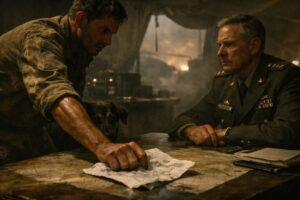
An intercepted movement. A changed route. Enemy activity somewhere ahead or parallel or close enough to matter. Mercer crouched with two sergeants over the map case while the rest of them huddled in a cut of ground and tried not to burn all their strength shivering.
Hours passed.
Dark came and still they waited.
Rowan’s eyes would not stay open. He knew it. Felt it. His head jerking once, twice. Shame hotter than the cold.
If I sleep, he thought, someone dies.
That was all exhaustion needed. One stupid clean sentence.
His fingers found the green tube.
He told himself he only wanted one pill, same as ordered. But his gloves were clumsy and the snow was blowing and someone hissed that there was movement in the trees, and suddenly patience felt like drowning.
He bit the cap free.
Pills spilled into his palm. Tiny. White.
He swallowed them all.
Not bravely. Not defiantly. In panic.
The taste was chalk and metal. He choked one halfway down, coughed into his sleeve, then forced the rest with melted snow from his canteen lid. By the time he realized what he had done, the tube was empty.
He stared at it.
Then shoved it deep into his pocket as if hiding the evidence could reverse the fact.
For a while nothing happened.
Then everything did.
His fatigue did not lift so much as detonate. His heart surged so hard it hurt. Sound sharpened until snow against fabric seemed violent. The dark no longer looked dark; it looked full. Full of motion. Full of intention. Every branch a signal. Every shifting shape a body.
Mercer turned, said something, and Rowan understood only the command in it.
Move.
The patrol broke from cover.
They went through the trees at a low, urgent pace, Mercer ahead, two men flanking, boots punching through crusted snow. Rowan tried to keep formation, but his body had begun outrunning instruction. He felt fast, too fast, as if his bones had been lit from inside. He could hear his pulse over the wind. He could feel his own teeth.
Someone to his left shouted.
A flare burst somewhere distant, washing the forest in a blue-white pulse.
Mercer threw up a hand.
And the ground exploded.
There was no sequence to it. No noble understanding. One step. Then light from below, a pressure like the world hitting back, and Rowan was in the air with snow and dirt and heat all mixed together.
When he woke, the first thing he knew was cold.
The second was that he couldn’t hear properly.
A high metallic ringing filled his skull. Snow drifted into his mouth. He spat and tried to move and found pain laid through his left leg like hot wire.
He was in a shallow crater half full of churned earth and white powder. Trees leaned around him, black and torn. His map case was gone. His rifle lay three feet away, half buried. The front of his trousers was wet, and for one raw second he thought his leg was gone. Then he touched it and almost blacked out from relief and pain.
Still there.
Shredded, burned, bleeding through wool and skin, but there.
He rolled onto an elbow and saw the notebook strap under his jacket.
Mercer’s field book.
Somewhere beyond the ringing, he thought he heard men shouting. Or maybe he remembered it.
Then a shape moved at the lip of the crater.
Mercer.
Not standing. Crawling.
His beard was white with snow and red at the mouth. One sleeve dark. Eyes still clear. Too clear.
Rowan tried to speak but the world tilted.
Mercer gripped the front of his coat with one hard hand.
What came next would live inside Rowan for forty years, changing shape each time he needed it.
He remembered Mercer’s face close to his.
He remembered breath steaming between them.
He remembered words.
But memory did not preserve them cleanly.
Hide.
Wait for dark.
Keep—
The rest broke apart.
Mercer shoved something into Rowan’s palm. Metal. Round-edged. Then the captain’s hand slipped free and the snow kept falling.
Rowan lay there with his heart trying to break out of his chest and one thought burning brighter than pain:
Keep moving.
Whether Mercer had said it or Rowan had built it from pieces no longer mattered in that instant. The words locked into him like an order from God.
He dragged himself out of the crater.
Part III — Pine and Iron
The first night he moved mostly because stopping felt impossible.
The stimulants were still raging through him, turning fear into propulsion. His hearing came and went in strange bands. Sometimes the forest was dead silent. Sometimes every branch snapped at once. Light behaved badly. Distances lied.
He tied a strip of undershirt around his leg and started south because south was the direction he believed salvation lived in.
He did not know then that believing something with your whole body can keep you alive long after the mind has stopped being reliable.
He moved in fragments.
Tree.
Breath.
Step.
Pain.
Again.
At one point he dropped flat in the snow because he saw a sweep of radio light through the pines—a clear beam, pale and narrow, pulsing between trunks. He crawled toward it for ten full minutes before realizing he was following moonlight through blowing snow.
Another time he heard Mercer behind him, calm as ever.
“Vale.”
Rowan turned so fast he fell.
There was no one there.
By dawn the stimulant high had changed character. It no longer felt like speed. It felt like damage. His heart slammed wildly. His hands shook so hard he could barely uncork his canteen. His thoughts skittered and returned in the wrong order.
He found the shelter of a shell crater overgrown with low pine and spent a day hidden there, chewing strips of inner bark and cracking pine seeds between his back teeth because hunger had become more terrifying than disgust.
The bark tasted bitter and green. The seeds were so small they seemed insulting. He ate them anyway.
Snowmelt ran cold down his wrist. He licked it off.
He slept in pieces no longer than panic allowed.
At dusk flares rose somewhere to the east, bleaching the sky. Rowan pressed himself into the dirt and held his own mouth shut with a blood-streaked glove as if the dark itself might hear him breathing.
He kept one hand inside his jacket, touching the notebook.
Deliver it, he told himself.
Make it count.
By the third day he had stopped knowing which way his body was failing first.
His leg was swollen and hot. The ringing in his ears had sunk into something duller, thicker. His lips were split. His chest hurt with every breath. The pills were long out of his system, yet some raw mechanical drive remained, as if the body had mistaken that chemical violence for instruction and never properly shut it off.
Once he crossed a frozen marsh where the ice moaned under him like something alive. He was certain—absolutely certain—he was following a field transmitter signal. He could almost see the pulse in the air ahead of him, a place where rescue narrowed into shape.
There was no signal.
Only distance.
Only snow.
Only a young man too damaged to stop.
Years later, newspapers would compress that march into one line. He crossed eighty miles through enemy territory.
What they never understood was how little of it felt like a march.
It felt like falling in a direction.
On the fifth day, maybe the sixth, Rowan found an abandoned logging shed split nearly in half by old shellfire. Inside there were rusted nails, a broken lantern, and mouse droppings. He sat against the wall and laughed once, because he had begun to understand that if the body was willing to live, it would do so in humiliating ways.
He scraped lichen off wood and ate that too.
He checked the notebook again.
Still there.
He did not open it. He was afraid if he saw the pages he might discover he had died already and was hauling nonsense toward no one.
When he moved again, he found a road.
Not paved. Not safe. But a scar of packed ice and old tire ruts through the trees.
He followed it until dawn and collapsed face-first in a ditch.
He woke to voices.
Real ones this time.
American.
Hands on his shoulders. A medic cursing softly. Someone saying his weight. Someone else asking how long he’d been out there. Rowan tried to answer and instead said, “Notebook.”
The medic peeled back his coat and found it strapped against his ribs.
Then someone checked his pulse and went silent.
Another voice, farther away: “Jesus Christ.”
At the field hospital they cut his clothes off and wrote numbers over him as if numbers could contain what had happened.
Weight: ninety-four pounds.
Pulse: nearly two hundred.
Shrapnel wound, left leg.
Severe malnutrition.
Exposure.
Probable stimulant overdose.
He lay beneath bright lights feeling less like a survivor than evidence.
A colonel came once. Then a photographer. Then a chaplain. Then a man with too-white teeth and a notebook who asked if he remembered making a conscious decision to keep moving despite impossible odds.
Rowan turned his face to the wall.
No one asked the right question.
Not then.
The right question was not how he had survived.
It was what he had built inside himself afterward in order to survive being the one who did.
The first time Elise asked him about the march in direct terms, she did it without ceremony.
They met again the day after the reading room, this time in a small coffee shop across from the archive. Snow ticked at the windows. Rowan hadn’t slept.
“Did you know my father blamed himself for what happened to you?” she asked.
Rowan looked up from untouched coffee.
“No.”
“He wrote in two different briefings that fatigue was becoming the greater enemy.” Her fingers rested on her cup but did not warm to it. “He was trying to keep command from extending the patrol.”
“He didn’t win.”
“No.”
That one word carried more than agreement. It carried institution, failure, old decisions made far away by men who never saw the snow.
Rowan said, “You think I took his place in the story.”
“I think the story made room for one survivor and one dead officer, and it preferred the survivor.” Elise held his gaze. “That doesn’t mean you chose it. But you lived inside it.”
He could have gotten angry. It would have been easier.
Instead he said, “So did you.”
Her face changed then, just slightly.
“My father was reduced to a command failure,” she said. “You were reduced to a miracle. Neither of those is a person.”
For the first time since her letter arrived, Rowan saw not a prosecutor but a daughter.
That made it worse.
“Why not bury the notebook?” he asked. “If it hurts everyone.”
“Because I’m tired of inheriting a clean lie.” She looked down once, then back at him. “And because I’m afraid that if I don’t, all I’ll have left of him is the lie.”
There it was. The contradiction she had dressed in archive language.
He understood it too well to answer.
Before they parted, Elise slid an envelope across the table.
Inside was a copy of the article proof and the program for the ceremony.
His name first.
Then Mercer’s.
The old order, preserved in cream paper.
“Say nothing,” Elise said quietly, “and I can still make this disappear.”
Rowan folded the program and put it in his pocket.
He did not tell her yet that silence had already begun to feel like another kind of cowardice.
Part IV — The Box
The relic box was in the back of a hall closet under an army blanket and two dead flashlights.
Rowan had not opened it in eighteen years.
He carried it to the kitchen table and stood over it for a long time before lifting the lid.
Inside, everything was smaller than memory had made it.
The flattened green stimulant tube.
The compass Mercer always touched before giving an order.
His own discharge summary, crisp with hospital bureaucracy and brutal in its simplicity.
A strip of cloth cut from his winter undershirt, still brown at one edge.
And at the bottom, wrapped in wax paper, a pine cone gone brittle with age.
He sat down hard.
For years he had kept the box not as a shrine but as a border. Open it, and the white country returned.
He picked up the stimulant tube first.
The metal was soft from being crushed in his fist. He remembered that now too: lying in the crater, fingers locked around the empty thing as if he needed to hold the shape of the mistake.
Not bravery. Not accident.
Fear.
He had swallowed the whole tube because he was terrified of failing asleep.
The truth had always been that plain.
His chest tightened. Not from the heart this time.
He unfolded the discharge paper.
Pulse approximately 198-204 bpm on intake.
Weight 94 lbs.
The article had turned those lines into spectacle. He had let it. Let people recite them like proof of something noble, when all they really proved was how close a human body could come to breaking without permission.
Then he picked up the compass.
Cold brass. Scratched face. Mercer’s initials etched on the back.
The contact came in a flash so sharp Rowan made a sound in his throat.
Crater. Snow blowing in. Mercer dragging himself closer on one arm. The captain’s breath wet and rough. Shoving the compass into Rowan’s hand, not as a blessing, not as a symbolic transfer, but because he needed Rowan to orient if he could still move at all.
And the words.
At last, the words.
Not keep moving.
Not cleanly. Not first.
“Hide,” Mercer had said.
“Wait for dark.”
Then something else. A fragment. Maybe if you can.
Maybe south.
Maybe only Rowan’s own pulse filling the gap and turning uncertainty into command.
He saw it now with sickening clarity: he had lurched to his feet too soon, too wild, already running ahead of sense. Mercer had reached for him once and missed.
The march that made Rowan famous had begun in disobedience.
Not treachery. Not cowardice exactly. But not duty either. Fear and stimulants and injury and training had fused into motion, and motion had later been renamed honor because honor was easier to live beside.
He sat in the kitchen until dark with the compass in one hand and the green tube in the other.
The phone rang just after six.
Martin.
“You sound like hell,” Martin said after Rowan answered.
“I’ve had better evenings.”
A pause. “You opened the box.”
Rowan said nothing.
Martin exhaled. “Damn you.”
“You always did know too much.”
“No. I knew enough.” Martin’s voice roughened. “I knew no man comes back from something like that with a face that closed unless the story everybody loves is missing its teeth.”
Rowan stared at the dark window. “If I say it out loud, I change what it meant to everyone.”
“You don’t know that.”
“Yes, I do.”
Martin was quiet.
Then: “Maybe men need one clean thing from a dirty war.”
“That’s the lie talking.”
“That’s survival talking.”
The words landed because they were true.
At length Martin said, “What do you want from me?”
Rowan looked at the box. At the paper. At the compass. At the old tube flattened by fear.
“I don’t know yet.”
“That’s not good enough. Ceremony’s in two days.”
Rowan thought of Elise saying she could bury it. Thought of Mercer in the crater still trying to think of procedure while dying. Thought of the article giving instinct the credit because instinct was easier to admire than compulsion.
Then he said, “I want to stop carrying it alone.”
Martin breathed once into the receiver. When he spoke again, the fight had gone out of him, or maybe only changed shape.
“If you do this,” he said, “do it clean. Don’t make yourself a villain because you’re tired of being a hero.”
“I wasn’t planning to.”
“Good.” Another pause. “I’ll be there.”
After the call, Rowan put the compass back in the box and left the stimulant tube on the table.
For the first time in forty years, he did not put the lid back on.
Part V — The Smaller Truth
The ceremony was held in a modest auditorium at the archive, the kind of room built to make history feel orderly.
Framed campaign maps lined the walls. There were flags at the stage corners and a podium under a banner that read Winter Cinder: Service and Survival.
Rowan stood backstage in a suit that fit him poorly and listened to his own name being introduced as if it belonged to a stranger.
Elise stood near the wings with the field notebook in a flat archival sleeve. Martin sat in the third row, broad and weathered and unsmiling. There were veterans in jackets heavy with pins. Reporters. Local officials. Two cadets trying hard to look solemn.
The article’s language had already begun to circulate. The miraculous march. The impossible will to live.
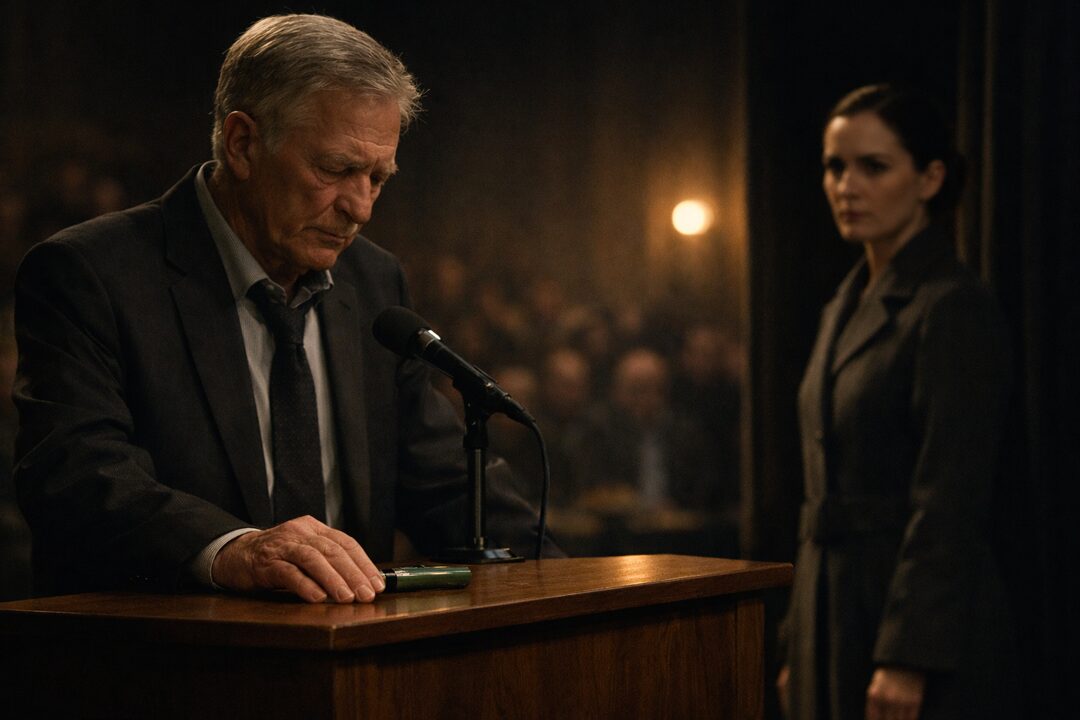
Rowan stepped to the podium when they called him.
For a second he saw only lights.
Then faces.
Then Elise, still as a blade.
He had spent most of his adult life avoiding microphones, not because he lacked words, but because he feared what might happen if he stopped choosing them carefully.
He looked down at the prepared remarks someone had set out for him.
He did not touch them.
“When I was twenty-three,” he said, “army doctors recorded my pulse at around two hundred beats a minute.”
A rustle moved through the room. Recognition. The number had arrived before the man again.
“They also recorded that I weighed ninety-four pounds when they found me.” Rowan’s voice stayed even. “Over the years, those numbers became part of a story people liked to tell about endurance.”
He let that sit.
“The numbers are real. The march was real. The wound was real. The winter was real.” He paused once. “What was not real was the meaning we made too simple.”
No one moved.
Rowan could feel the room leaning in without sound.
He reached into his inner pocket and set the flattened stimulant tube on the podium.
A tiny object. Enough to alter the air.
“I swallowed this entire tube in the field,” he said. “Not because I was brave. Because I was afraid.”
Somewhere in the audience, a chair creaked.
“We’d been awake too long. I was losing ground. Captain Mercer knew it before I admitted it. He was trying to keep that patrol together while some of us were already past our limits.”
Rowan glanced once toward Elise. Not for permission. For witness.
“When the mine took me out, I believed I had been ordered to keep moving south with his field notebook. I believed that for a long time. Long enough to build a life around it.”
He could hear his own heartbeat now, not wild like before, but insistent.
“Captain Mercer did give me direction.” Rowan’s hand rested beside the little green tube. “What I can no longer swear is that I heard it correctly by the end. I was injured. I was overdosed. I was terrified. He may have told me to hide and wait for dark. He may have told me more than one thing. What I know now is that the story I told myself afterward made my movement cleaner than it was.”
He let the shame come through but not take over.
“I did survive. But survival is not always noble in the moment. Sometimes it is confusion and damage and fear with just enough training left inside it to keep the body pointed one direction.”
The room was utterly still.
Rowan went on, more quietly now. “For a long time I thought telling the story that way would dishonor the dead. What I understand now is that silence did that too.”
Then he turned and held out a hand.
Elise came to the stage.
She carried the notebook in both hands as if it weighed much more than paper should. When she reached him, Rowan took the archival sleeve, lifted the field book free, and for a moment the room saw it plainly: the small weather-dark object around which decades had hardened into myth.
“This belongs,” he said, and handed it to her, “first to Captain Mercer’s daughter.”
It was a simple gesture.
It changed everything.
“He remained lucid enough to think about the men under him while everything was failing,” Rowan said, still looking at Elise. “That should be part of the record too.”
Elise accepted the notebook. Her expression did not break. But something in her eyes did—something tight, old, carefully guarded.
When Rowan stepped back from the microphone, he did not feel absolved.
He felt lighter in one specific place.
That was enough.
The applause, when it came, was uncertain at first. Not because the room rejected him. Because it had to learn what exactly it was honoring now.
Martin rose before most of the others did.
He did not clap harder than anyone else. He simply stood.
Later, in the reception room, a reporter approached Rowan with a recorder in hand and stopped short at the look on his face. Rowan almost laughed. Forty years and the first useful expression he’d learned was the one that kept people from asking for a cleaner quote.
Elise found him by the coffee urn.
“I can still pull the article,” she said.
“No.”
She studied him. “You’re sure?”
“No more burying.”
Something eased in her mouth—almost a smile, but too tired for one.
“My father would have hated the ceremony,” she said.
“Probably.”
“He also would have hated being simplified.”
“That makes two of you.”
This time she did smile, briefly.
Then Martin came up beside them, smelling of wool and cold and old aftershave.
“You made a mess,” he told Rowan.
Rowan nodded. “I know.”
Martin looked at Elise, then back at him. “Might be a better one.”
That was as close as he would come to blessing.
It was enough too.
Part VI — Winter Light
The revised article arrived three months later.
Rowan read it at his kitchen table in morning sun with his glasses low on his nose and his coffee going cold.
It was shorter than the first draft. Better too.
No mythic instinct. No lone legend language. No polish.
It recorded the stimulant overdose plainly. The mine injury. The isolation. The starvation. The field hospital numbers. It also included Captain Daniel Mercer’s attempts to pull exhausted men back from the edge, and the unfinished order in the notebook.
It did not solve the past.
It made room inside it.
Rowan folded the article and set it beside the sugar jar.
That afternoon Elise drove out from Helena and met him at a pine grove a mile from his house. It was late winter again, but softer than the one he had crossed as a young man. The light held. The air bit without trying to kill anyone.
They walked without hurry.
Neither of them spoke about closure. People used that word when they wanted a door to behave like a wall.
At the edge of the grove Rowan stopped and bent stiffly, pressing fingers into the litter beneath the snow crust. When he straightened, there were pine seeds in his palm.
Elise noticed.
She did not ask why.
She didn’t have to.
He slipped them into his coat pocket with the absent care of a man putting away a habit older than speech.
For a while they stood looking through the trees where winter light lay thin and silver on the ground.
“My heart still acts stupid sometimes,” Rowan said.
Elise glanced at him. “That’s one way to describe it.”
“Doctors have longer words.”
“Are they more helpful?”
“No.”
That almost-smile came back.
The cold moved gently between the trunks. Not kind. Not cruel. Just there.
Rowan thought of the old article, of the ceremony, of the box now closed again but no longer sealed. He thought of Mercer’s hand in the crater, of the command he could never fully reconstruct, of the life that had followed anyway.
He had once believed surviving meant justifying it.
Now he suspected surviving meant something smaller and harder.
Telling it true where you could.
Carrying what stayed uncertain without turning it into theater.
Letting the legend shrink enough for the life to fit around it.
Elise brushed snow from a low branch with one gloved hand. “Do you ever stop hearing it?” she asked.
“The winter?”
She nodded.
Rowan looked out through the trees.
“No,” he said. Then, after a moment: “But it’s quieter now.”
She accepted that.
They stood there a little longer, two people joined by a man neither of them could return and a story neither of them could keep in its old shape.
When they finally turned back toward the road, Rowan’s chest gave one uneven beat, then another.
Still troublesome.
Still alive.
He kept walking.