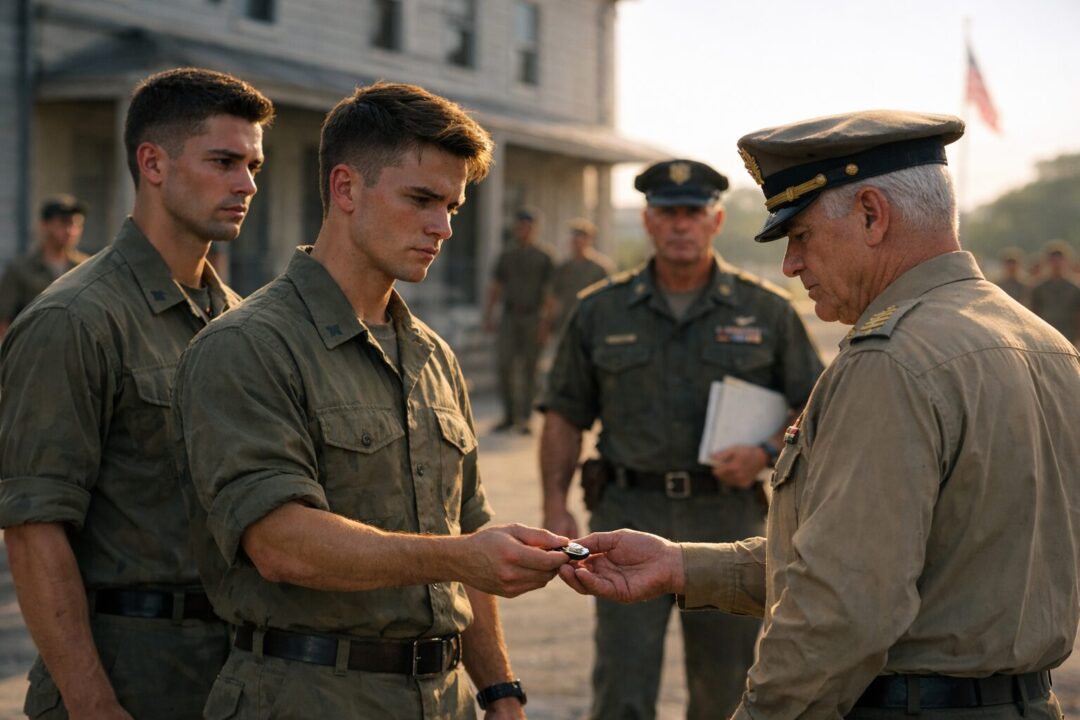
The Badge He Was Told to Surrender
The Badge He Was Told to Surrender
Part I — The Order
“Remove your badge.”
The words landed with such quiet force that Rowan Mercer thought, for one disorienting second, that he had misheard them.
The late afternoon sun poured across the concrete walkway outside Barracks C, bleaching the world into hard edges and sharp light. The building behind him was the same dull, pale structure it had always been, its walls baked warm by the day, its windows blank and watchful. The air smelled faintly of cut grass, dust, and metal. Nothing in the scene looked dramatic. Nothing moved except the shadows.
But the white-haired officer standing in front of him made the entire yard feel like a courtroom.
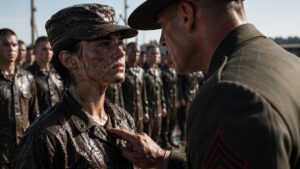
Rowan kept his chin up because that was what he had been taught to do. Beside him, Ellis Boone stood just as straight, shoulders squared, hands folded neatly behind his back. The two of them had walked out together after final formation, expecting nothing more than another inspection, another correction, another reminder that at North Ridge Training Base no one was ever truly off duty.
Instead, Captain Hollis had stopped directly in front of Rowan and fixed him with a stare as cold and clean as glass.
“Now,” Hollis said.
Rowan felt every eye in the yard before he even turned his head. A pair of recruits farther down the walkway had slowed without meaning to. Another stood near the steps with a duffel bag hanging from one hand, no longer pretending not to watch. Nobody spoke. Nobody ever spoke when an officer’s tone turned ceremonial.
Or cruel.
Rowan swallowed. His fingers moved, slowly, to the small badge pinned above his chest pocket. It was not much to look at—standard issue, plain, earned by every recruit who survived the first brutal phase of training—but in the last ten months it had come to mean more than metal. It meant he had lasted. It meant he belonged. It meant the homesick seventeen-year-old who had arrived at the gates with shaking hands had turned into someone stronger than the boy his father had tried to talk out of enlisting.
“Sir,” Rowan said carefully, “have I done something wrong?”
Captain Hollis did not answer.
That was worse than anger. Anger at least admitted emotion. Silence turned judgment into stone.
Out of the corner of his eye, Rowan saw Ellis glance at him once, then forward again. Ellis had the unnerving stillness of someone who could hide almost any feeling if he chose to. Broad-shouldered, older by a year, with a face that looked built for composure, he had become Rowan’s closest thing to a friend at the base without either of them ever saying so aloud. They had shared blisters, punishments, stale midnight jokes, and the kind of exhaustion that stripped people down to their truest selves. Rowan trusted him in the way men in hard places sometimes came to trust each other—without speeches, without promises.
But Ellis said nothing.
Captain Hollis extended his hand.
“Give it to me, Mercer.”
The yard went even quieter. Rowan could hear, absurdly, the faint rattle of a flag rope against its pole somewhere behind the administrative building.
His fingertips slipped under the metal clasp. For a moment, he could not get it loose. A pulse of heat rushed to his face. Public failure was its own humiliation; fumbling while being stripped of rank or standing felt unbearable.
At last the badge came free.
He placed it in Captain Hollis’s palm.
The officer looked at it once, then closed his fingers around it as if sealing something final.
Rowan felt hollow from the ribs down.
Part II — The Line He Crossed
By the time he arrived at North Ridge, Rowan had already learned what it felt like to disappoint people.
He had disappointed his father by not staying home to work at the garage. He had disappointed his mother by leaving the week after her surgery, pretending her brave smile made it easier. He had disappointed teachers who said he was bright enough for college if only he would sit still long enough to imagine a life larger than the county he had grown up in.
So when training began and the place set about grinding every recruit into something cleaner, harder, more obedient, Rowan took to it with the stubbornness of someone who believed suffering might become proof. He was not the strongest in his class. Not the fastest. Not the most naturally disciplined. What he had was endurance. He could absorb humiliation, pain, repetition, and silence longer than most people expected.
That was why Ellis Boone had noticed him.
Ellis had come from a family where service was spoken of the way other people spoke of weather—constant, inherited, expected. He moved through drills with an ease that irritated half the class and impressed the other half. The first words he ever said to Rowan had come after a six-mile run in cold rain, when Rowan had bent over the gravel trying not to vomit.
“If you’re gonna fall apart,” Ellis had murmured, not unkindly, “at least do it after dismissal.”
Rowan had laughed despite himself, and from that moment on something between them settled into place.
They were not alike. Ellis was measured where Rowan was restless, deliberate where Rowan was impulsive. Ellis spoke only when he had something worth saying. Rowan talked more, smiled faster, and got in trouble for both. Yet over the months they became a pair people expected to see together: at breakfast before dawn, in line outside the armory, in the laundry room arguing over whose socks had disappeared into the industrial dryers this time.
They also became, quietly, each other’s witnesses.
Ellis saw Rowan re-read the same folded letter from home until the paper softened at the creases. Rowan saw Ellis stand motionless after lights-out with his forehead against the cold window glass, staring out toward the road that led off base. Neither man asked the other for confessions. They offered presence instead. In a place that prized control, that felt dangerously close to tenderness.
There were rumors, of course, about the final month. There were always rumors.
One recruit whispered that a single trainee from each cycle would be selected for an accelerated leadership track. Another claimed the honor went only to cadets with family connections. Someone else swore the recommendation process was a myth invented to keep everyone clawing for approval. Rowan never put much stock in the talk. North Ridge thrived on uncertainty because uncertainty made men easier to shape.
Still, he noticed things.
Captain Hollis watching during drills with unusual interest.
His name appearing, then disappearing, from temporary duty lists.
An evaluation interview rescheduled twice for no reason anyone explained.
Ellis noticed too, though he said very little. One night, after an especially punishing field exercise, they sat on overturned crates behind the mess hall, drinking lukewarm water from dented bottles.
“You ever think,” Rowan said, staring at the dark yard, “that they keep people guessing just to see what doubt does to them?”
Ellis leaned back, bottle balanced between his palms. “Doubt does plenty.”
“To you?”
“To everyone.”
Rowan glanced at him. “That sounds like a yes.”
Ellis’s mouth twitched, almost a smile. “It sounds like you ask too many questions.”
But before they went back inside, Ellis added, “Whatever happens next month, don’t let them decide what you think you’re worth.”
Rowan had carried that line with him longer than he realized.
Now, standing badge-less in the sunlight with Captain Hollis’s hand still closed around the small piece of metal, he thought with a sharp rush of panic that perhaps Ellis had known something all along.
Perhaps everyone had.
Perhaps he had been the only fool in uniform.
Part III — The Folder
The sound of footsteps approached from down the path.
Rowan looked up.
Another officer was coming toward them from the direction of headquarters, moving at an unhurried, deliberate pace. Commander Vale was not a man who wasted motion. He was in his fifties, all hard lines and weathered composure, carrying a slim white folder under one arm. Nothing about his expression gave anything away.
The sight of that folder sent a strange current through the yard.
Paper meant orders. Evaluations. Transfers. Dismissals. Futures written down in language no one could argue with.
Captain Hollis waited until Vale reached them, then took the folder without ceremony.
For one suspended second, Rowan thought, This is it. This is the moment they tell me why.
He could feel the absence of the badge on his chest like exposed skin.
Ellis remained beside him, but the equality of their stance had already been broken. Rowan had been singled out. Seen. Separated. There was no returning to the simple safety of standing in line with everyone else.
Captain Hollis opened the folder and scanned the page inside. His face did not soften. If anything, his sternness deepened. Rowan’s stomach dropped.
Then Hollis looked at him and said, “Eyes front.”
Rowan obeyed.
A breeze crossed the yard and cooled the sweat at the back of his neck.
Hollis spoke in the clipped, formal tone officers used when reading something that mattered.
“By recommendation of command and approval of the review board, Recruit Rowan Mercer is hereby selected for provisional advancement to the Ridge Leadership Initiative, effective immediately.”
For a heartbeat, the words meant nothing.
They moved through Rowan like sound through water, clear and distorted at once.
Selected.
Advancement.
Leadership.
He stared straight ahead because he no longer trusted his own face.
Captain Hollis continued reading—commendations for endurance, composure under pressure, adaptability under stress, influence among peers. Rowan caught fragments, each one stranger than the last. Influence among peers? He nearly laughed at that. He had spent half the year getting warned for speaking out of turn and the other half trying not to think too loudly.
But around him the silence had changed shape.
What had moments ago felt like the silence of public punishment now felt ceremonial, almost reverent. Rowan sensed the recruits at the far end of the walkway leaning forward, not away. He heard Ellis inhale sharply beside him.
Captain Hollis closed the folder.
Then Commander Vale reached inside and withdrew a second insignia.
It was small, polished, unmistakably different from the one Rowan had surrendered.
Not a replacement for failure.
A mark of separation.
Rowan’s throat tightened.
“Mercer,” Hollis said, and for the first time there was something in his voice besides iron. Not warmth, exactly. Something harder won than that. Respect, perhaps. “The standard badge is no longer appropriate.”
Shock moved through Rowan so fast it almost felt like pain.
All at once, the past three minutes rearranged themselves. The command. The silence. The removal. It had all been real, but not in the way he had believed. He had not been stripped. He had been transitioned.
Humiliated, yes—but perhaps not by cruelty. By design.
He still was not sure which made him angrier.
Commander Vale passed the insignia to Hollis, who stepped forward and pinned it above Rowan’s pocket with precise fingers. The metal clicked softly into place.
“There,” Hollis said.
Rowan finally looked down. The insignia gleamed in the sunlight.
Beside him, Ellis let out a breath that might have been the release of his own private tension.
“You got chosen,” he said quietly.
It was the first thing anyone had said to Rowan that sounded human.
Rowan turned his head a fraction. Ellis was looking at him fully now, and there was no bitterness in his face, no resentment—only something more complicated. Pride, maybe. Loss, too.
That was when Rowan understood the hidden cost inside the honor.
Nothing had happened between one second and the next except the changing of a badge, yet the world had shifted under his feet. He and Ellis were no longer simply two recruits who had survived together. A line had opened between them. Rowan had not asked for it, but there it was all the same.
Captain Hollis stepped back.
“Step forward, Mercer.”
Rowan did.
The simple movement felt like crossing a border.
Part IV — What Honor Costs
He was taken that evening to administrative offices he had only ever seen from outside. Papers were signed. Instructions were given. A new bunk assignment was mentioned. A separate schedule would follow. Evaluations would intensify. Expectations would rise. The language was polite and relentless. Every congratulation sounded faintly like a warning.
By the time Rowan was dismissed, dusk had settled over the base in layers of blue and gray. The yard that had witnessed his public undoing and reconstruction was nearly empty now.
Ellis was waiting on the steps of the barracks.
He stood when Rowan approached, hands in his pockets, the fading light softening the angles of his face. For a moment neither of them spoke. The day had given them too many meanings too quickly.
Rowan stopped a few feet away. “Did you know?”
Ellis looked out toward the flagpole before answering. “Not for sure.”
“That isn’t the same as no.”
“No,” Ellis agreed.
A small, humorless laugh escaped Rowan. “Great.”
Ellis accepted the edge in his voice without flinching. “Hollis asked me two weeks ago what kind of man you were.”
Rowan blinked. “He what?”
“He wanted to know how you acted when nobody was watching. Whether people listened to you. Whether you kept your head when things went bad.”
“And what did you say?”
Ellis met his gaze. “The truth.”
The answer hit harder than Rowan expected.
All day he had been trying to find stable ground inside the shock, something he could hold against the feeling that his life had been changed without his permission. But hearing that Ellis had been part of the machinery—however slightly—stirred a rawer emotion underneath it all.
“You could’ve told me.”
“And if I had been wrong?”
Rowan had no reply.
Ellis’s voice lowered. “You think I wanted to put hope in your hands and watch it fall through?”
That stopped him.
The base behind them hummed with distant routine—doors opening, boots on stairwells, the metallic clatter of trays from the mess hall cleanup. Ordinary sounds. The world stubbornly continuing.
Rowan looked down at the new insignia on his chest. “When he told me to take the badge off,” he said, “I thought I was done.”
“I know.”
“I hated him for about thirty seconds.”
Ellis’s mouth curved faintly. “Only thirty?”
Rowan laughed despite himself, and the laugh cracked halfway through into something closer to exhaustion. He sat down on the step. After a moment, Ellis sat beside him.
For a while they watched the darkening yard in silence.
“I’m moving barracks,” Rowan said eventually.
“I figured.”
“Different schedule. Different unit. Maybe different everything.”
Ellis nodded once.
It was strange, Rowan thought, how quickly a future could be divided into before and after. That afternoon he had still belonged wholly to one life. Now another had opened, bright with possibility and edged with distance.
“I don’t know if I even wanted this,” he admitted.
Ellis rested his forearms on his knees. “That doesn’t mean you didn’t earn it.”
The sentence settled gently, but it settled deep.
Rowan thought of his father at the garage, sleeves rolled up, grease on his wrists. His mother folding his letters too carefully after reading them. The boy he had been when he arrived. The man Captain Hollis and Commander Vale apparently believed he might become. None of those versions felt complete on their own. Maybe they never would.
“Why’d they do it like that?” Rowan asked after a while. “In front of everyone.”
Ellis considered. “Because pressure tells the truth fast.”
“That sounds like something Hollis would say.”
“Probably because he did say it once.”
Rowan shook his head. “I’m serious.”
“So am I.” Ellis looked at him. “They wanted to see who you’d be with everyone watching. Not who you’d be in an office with a closed door.”
The answer made uncomfortable sense.
Public shame had nearly broken something in him. Public honor had not erased that. It had merely transformed it into something he would carry differently.
Night gathered around the buildings. A few stars appeared above the drill field.
At last Ellis stood. “You should get some sleep. Tomorrow they’ll start acting like this means you’re supposed to know everything.”
Rowan looked up. “And you?”
“I’ll still be here,” Ellis said. Then, with a dry note that felt blessedly familiar: “Trying to keep lesser men from embarrassing the unit.”
Rowan smiled. “That include me?”
“Especially you.”
Ellis held out his hand.
It was such a normal gesture that Rowan almost missed its weight. He took it, and Ellis pulled him to his feet. For one brief second their shoulders knocked together in the easy, unceremonious way they always had.
Then they stepped apart.
Later, long after lights-out, Rowan stood alone by the window of his new room and looked down at the quiet path between the barracks and headquarters. The place where he had thought his worst moment was beginning now seemed suspended between meanings. A strip of concrete under moonlight. A stage. A threshold.
He touched the new insignia lightly, not with pride exactly, but with recognition.
The badge he had surrendered had told him he belonged.
The one now pinned over his heart told him belonging would never again be that simple.
And somewhere in the stillness of the sleeping base, that truth felt less like a loss than the first real cost of becoming someone new.