The Names on the Table
Part I — The Hand That Wouldn’t Fall
Captain Mara Vale had not been inside The Last Post for twelve years, but the first thing she did when she returned was put her hand in Wes Harlan’s.
Not gently.
Not as a greeting.
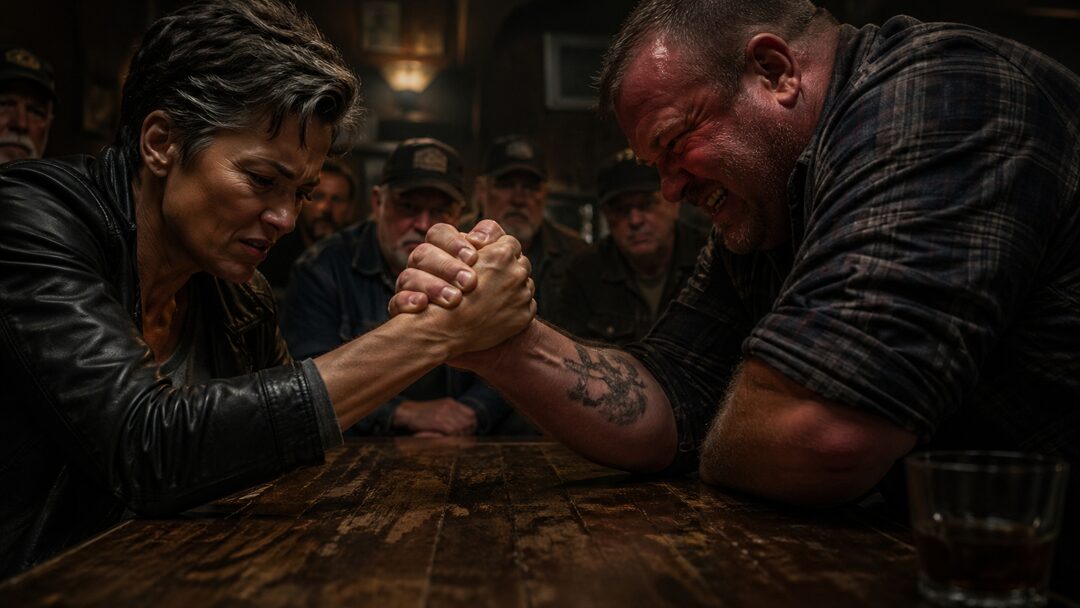
Their right elbows were planted on a scarred wooden table near the back wall, their fingers locked tight, his knuckles broad and red around hers. Wes grinned like the whole room had been built for this moment.
Mara did not smile.
She wore a black leather jacket over a gray shirt. Her hair was cut short, dark at the roots and silver near the temples. Her left hand rested flat on the table beside a small silver coin.
The bar had gone so quiet the ice machine sounded like distant gunfire.
“Look at that,” Wes said, loud enough for the old unit to hear. “Captain came home.”
Someone laughed.
Not hard. Not fully.
A few men at the bar turned their stools. A few leaned back as if distance could make them less involved. On the walls, old deployment photos hung beside cracked license plates, faded flags, and a framed newspaper article about the base closing. The jukebox kept playing a country song too soft to save anyone.
Wes flexed his fingers around Mara’s hand.
He had been a large man at twenty-eight. At forty-five, he had become broader, thicker, and more certain of himself. His faded unit tattoo stretched over one forearm: a black crane standing over a broken bridge.
The same emblem was stamped into Mara’s coin.
Wes noticed it. His smile stayed up, but his eyes shifted.
“Didn’t know you kept souvenirs,” he said.
Mara slid the coin an inch closer to him with her left hand.
The men nearest the table saw it then. The crane. The bridge. Operation Glass Orchard.
The room changed.
Not loudly. Rooms like that did not gasp. They tightened.
Behind the bar, June Arendt reached under the counter and turned the jukebox down until the singer’s voice became a murmur. Her sleeves were rolled above her elbows. A thin silver chain disappeared under her black shirt.
Wes glanced at June, then back at Mara.
“You want to do this?” he asked.
Mara’s face stayed still.
“You offered.”
“I offered because I thought you’d have more sense.”
“No,” Mara said. “You offered because there are witnesses.”
That killed the last loose laugh in the room.
Wes’s grin widened to cover it.
He leaned close enough that Mara could smell beer, chewing gum, and the peppermint he used to hide both.
“You always were good at sitting still while other people bled.”
The words hit the table harder than his hand had.
Two men laughed because Wes was laughing. One stopped when nobody joined him.
Mara looked down at their locked hands. Her wrist was straight. Wes’s forearm was already swollen with effort he had not admitted to using.
“Count it,” Wes called.
No one moved.
“June,” he said. “Count it.”
June did not answer. Her gaze was on the coin.
Wes rolled his eyes. “Fine. Three.”
Mara’s left hand remained flat beside the coin.
“Two.”
The old injury in her right shoulder had started burning the moment he squeezed. She had expected that. She had counted on it. Pain made the present difficult to escape.
“One.”
Wes drove her hand toward the table with everything he had.
The table creaked.
A bottle rattled near the edge.
Mara’s arm shook once, then held.
Wes’s smile stayed in place for half a second too long.
Then it changed.
He pushed harder.
Mara did not push back the way he expected. She absorbed him. She let his force meet something quiet and fixed.
The men around them leaned closer.
Wes lowered his voice.
“You been practicing, Captain?”
“No.”
“Then what’s this?”
Mara looked at him.
“Twelve years.”
Part II — The Names He Knew
Wes laughed, but it came out thin.
“Twelve years,” he repeated. “That how long it took you to walk back in here?”
Mara did not answer.
“That how long it took you to remember where the door was?”
Her hand stayed upright.
Wes shifted his elbow, hunting for leverage. His shoulder bunched under his shirt. He was using more weight now, more anger. The tendons in his neck stood out.
Mara’s wrist dipped an inch.
A low sound moved through the bar.
Wes heard it and fed on it.
“Everybody remembers Glass Orchard, Captain,” he said. “You don’t need the coin.”
Mara’s eyes flicked to the silver on the table.
The coin was old enough that the raised crane had worn smooth at the wing. It had been given to every member of Task Unit Crane after the campaign ended, though nobody called it a celebration. The official citation had used words like “difficult terrain,” “hostile conditions,” and “unrecoverable losses.”
Words could bury bodies if men in clean uniforms stacked them high enough.
Wes pressed again.
Mara’s hand lowered another fraction.
“You know what I remember?” he said. “I remember six of ours left behind while you called retreat.”
A man at the bar looked down into his drink.
Wes kept going.
“I remember Ruiz screaming over the radio. I remember Quinn and Bell not making the bridge. I remember Madsen with half a leg and a rifle he couldn’t hold. I remember you getting out.”
Mara watched him.
“Say their names if you’re going to use them.”
The room went still in a new way.
Wes blinked. “What?”
“Say their names.”
“I just did.”
“No,” Mara said. “You said the ones on the plaque.”
His jaw flexed.
“They’re the ones who died.”
June’s hand stopped on the towel she had been folding.
Mara’s voice stayed even.
“All of them?”
Wes’s grip tightened, but his eyes moved away first.
“Don’t do that,” he said.
“Do what?”
“Act like you care about names.”
Mara’s hand slipped lower.
The table waited.
“You gave the order,” Wes said, louder now. “That’s what matters. You gave the retreat order and six soldiers died because of it.”
“And two interpreters,” June said from behind the bar.
Everyone looked at her.
June did not raise her voice. She did not need to. Her brother’s photograph hung behind the register, half-shadowed by a neon beer sign. He was twenty-nine in the picture, dark-eyed, smiling, standing beside a younger June in a parking lot full of yellow dust.
Wes’s face tightened.
“That was different,” he said.
June’s mouth barely moved.
“It usually is.”
Mara’s eyes stayed on Wes.
“Say their names.”
Wes pushed harder. For a second, his anger looked like strength again.
“Don’t talk to me about names,” he said. “You lost the right.”
There it was. The room accepted it because it had accepted it for twelve years.
Captain Mara Vale had given the retreat order.
Captain Mara Vale had survived.
Captain Mara Vale had signed the report.
Those three facts had become a story simple enough to drink beside.
Mara had let them.
That was the part nobody knew how to forgive because nobody knew it needed forgiving.
Wes leaned closer. “You come in here after all this time, put that coin on my table, and think what? We’re all gonna cry because you finally feel bad?”
Mara’s hand trembled again. Not from fear.
From the shoulder.
From the memory of weight.
From a young radio man’s voice cracking in dust.
“Ruiz,” she said.
Wes froze for the smallest possible moment.
Mara saw it. So did June.
Wes recovered with a grin.
“What about him?”
“You tell that story a lot.”
“I earned that story.”
“No,” Mara said. “You kept it.”
His smile did not move, but something behind it did.
A stool scraped near the front door.
Cold air slipped into the room.
Then Colonel Aaron Pike walked in.
Part III — The Man Who Still Expected Obedience
No one called him Colonel anymore, not officially.
They did not have to.
Aaron Pike carried rank in the way other men carried a wallet. It showed in the polished shoes, the pressed civilian coat, the silver hair combed neatly back from a face that had learned how to express concern without surrendering authority.
Men stepped aside before he asked.
A few straightened.
Wes saw him and brightened with relief he would have denied under oath.
“Colonel,” he said. “You seeing this?”
Pike looked first at Wes’s arm, then Mara’s, then the coin.
Only then did he look at Mara.
“Captain Vale.”
“Colonel Pike.”
There was no warmth in either title.
Pike removed his gloves slowly, finger by finger. “Wes. Let it go.”
Wes gave a short laugh. “I’m trying to.”
Pike did not smile.
“I mean it.”
The room caught that too. The command under the sentence. The old habit of obeying it.
Mara looked at Pike for the first time since he entered.
Wes felt the shift and misunderstood it. He thought Pike had become the judge. He thought the room had been returned to order.
He pushed hard again.
Mara’s hand dipped, then held inches above the table.
“Hear that, Captain?” Wes said. “Even he thinks this is sad.”
Mara kept her eyes on Pike.
“I’m not here for him.”
Wes’s grin faltered.
Pike’s face did not.
But something in his eyes changed, fast and cold.
June saw it from behind the bar and stopped pretending to clean.
Pike stepped closer to the table. “This isn’t the place.”
“It’s exactly the place,” Mara said.
“No,” he said. “It’s a bar full of men who have already buried enough.”
“No one buried Nadir,” June said.
A few men looked away again.
Pike turned his head slightly. “Ms. Arendt.”
June’s lips tightened at the politeness.
“My brother had a name before your report made him local support.”
A muscle moved in Pike’s jaw.
Wes looked between them, slower now. He had come for humiliation, not this. He had expected Mara to shrink or snap. He had not expected Pike to look like a man watching a door unlock from the wrong side.
“What the hell is this?” Wes said.
Mara answered him without looking away from Pike.
“An old room.”
Wes barked a laugh. “No, this is you hiding behind rank again.”
Mara turned back to him.
The words struck him harder than anger would have.
“You think I hid behind rank?”
“You hid behind everything. Rank. Reports. Silence.”
He shoved her hand lower.
This time it almost touched.
A hiss moved through the room.
Mara’s shoulder screamed. In her head, for one second, the bar lights became white dust. The smell of old beer became hot concrete. The ice machine became static.
Ruiz was nineteen in memory, always nineteen, with blood on his teeth and a radio strap tangled under collapsed rebar.
Captain, convoy diverted.
Say again.
Convoy diverted.
By whose order?
Static.
Then Pike’s voice, clean through distance.
Hold position if feasible. Otherwise withdraw.
Feasible.
That word had lived in Mara’s bones longer than any prayer.
Wes’s voice dragged her back.
“This is what should’ve happened the first time somebody put weight on you.”
Mara looked at him.
“The first time somebody put weight on me,” she said, “I carried your radio man for nine hundred yards.”
The room did not breathe.
Wes’s grip loosened.
Not much. Enough.
His eyes narrowed. “Don’t.”
“Ruiz was pinned under the west stairwell.”
“Shut up.”
“You were twenty feet away.”
Wes’s face flushed darker. “I said shut up.”
Mara’s arm rose a fraction.
“I called for you.”
Wes’s eyes flicked to Pike as if the colonel could order the past back into place.
Pike’s voice cut in.
“That’s enough, Captain.”
Mara did not look at him.
“No, sir,” she said. “That’s what you said then.”
Part IV — The Weight of Silence
There had been a time when Mara believed obedience could save what courage could not.
She had believed it because she was young enough to think good soldiers were measured by what they endured after the worst choice was made.
Glass Orchard had been named by someone far from the valley. Someone in an office. Someone who had never seen the broken bridge, the half-collapsed school, the road out lined with burned cars, or the families waiting at the checkpoint because American promises sounded official until the last vehicle left.
Mara had asked for extraction twice.
The first request had been denied because the route was “under reassessment.”
The second had been denied because the last armored convoy had been diverted.
A contractor with the right connections had needed rescue from a compound six miles north.
Mara had not known that part until later.
In the moment, she knew only that men were bleeding, the interpreters were trapped with them, and Pike’s voice had arrived clear enough to be remembered forever.
Withdraw remaining personnel.
She had said no once.
Not bravely. Not dramatically. Just once.
Then the mortar fire shifted, the radio cracked, and Ruiz screamed.
Afterward, in a tent that smelled like bleach and dust, Pike had placed the report in front of her.
Sign, Captain.
She had asked about the families.
He had said clean benefits required clean paperwork.
She had asked about Nadir and Laleh.
He had said local casualties would be handled through separate channels.
She had signed because six soldiers needed burial, two interpreters needed some chance of recognition, and the truth looked, in that moment, like a luxury the dead could not afford.
Then she had lived long enough to understand what silence had purchased.
Not dignity.
Convenience.
At the table, Wes was breathing hard.
Mara’s hand was still half-lowered, still trapped beneath his strength. Her shoulder burned bright and deep. Pike stood close enough that she could smell his expensive wool coat, dry from the cold.
“You’ve had a difficult life since then,” Pike said quietly.
It sounded merciful.
That was what made it cruel.
Mara looked at him.
“You don’t get to diagnose what you caused.”
A few men shifted.
Pike’s eyes sharpened.
“I caused war?”
“No. You caused the lie after.”
Wes seized on it. “There it is. The lie. Always some conspiracy when you can’t live with what you did.”
Mara looked back at him.
“Then say the names.”
“I said them.”
“All of them.”
Wes’s mouth opened.
Nothing came out.
Mara waited.
His hand tightened until her fingers numbed. He could still break her physically. Maybe he needed to. Maybe the body was easier to defeat than a question.
“Quinn,” he said.
Mara nodded once.
“Bell.”
“Yes.”
“Madsen. Cole. Herrera.”
“And?”
His eyes darted to the bar.
No one helped him.
Not yet.
“Ruiz,” he said finally.
Mara’s voice stayed low. “And?”
Wes swallowed.
The word would not come.
June reached beneath her collar and drew out the silver chain. A dog tag slid into her palm. She held it for a second against her chest.
Then she said, “Nadir.”
The name was not loud.
It did not have to be.
It crossed the bar like a hand touching every photograph on the wall.
A man near the window, old before his time, whispered, “Laleh.”
No one looked at him. That was mercy.
Mara’s eyes closed once.
Wes stared at the table.
The coin sat between them.
The crane. The bridge.
A symbol made for men who survived the story.
Pike stepped forward.
“You’ve made your point.”
Mara opened her eyes.
“No, sir. I let you make yours for twelve years.”
That did it.
The room finally turned, not all the way, not cleanly, but enough. Men who had repeated Pike’s version over beers and memorial speeches now watched him instead of Mara.
Pike felt it.
His face changed by almost nothing.
But Mara had served under him. She knew what his fear looked like when it wore discipline.
Part V — The Dog Tag
Pike lowered his voice. That made the bar listen harder.
“Captain Vale has suffered,” he said. “No one here doubts that. Trauma changes memory. Guilt changes it more.”
Wes looked up.
There was the opening he needed.
Mara saw him take it.
His weight came down through his arm again, sudden and brutal. Her hand dropped so close to the table that her knuckles brushed damp wood.
Pain flared white through her shoulder.
For the first time, her face changed.
Wes saw it and mistook it for victory.
“There,” he breathed. “There you are.”
Pike stood beside them, almost kind.
“There’s no shame in letting go, Mara.”
Her first name in his mouth felt worse than rank.
The room held still.
Mara could let it happen.
She could let her hand fall. Wes would slap the table, someone would laugh too loudly, Pike would guide the room back toward its familiar version, and by morning the story would become simple again.
Crazy Mara came in with a coin.
Wes put her down.
Colonel handled it with grace.
She could return to her apartment three towns over, to the drawer where the prescriptions lived, to the sleep that never came clean, to the silence that at least belonged to her.
Her arm shook.
Wes pressed harder.
The table was one inch away.
Then June came around the bar.
No one stopped her.
She walked to the table carrying the dog tag in her fist. Her face looked empty in the way faces look when they are holding back too much.
She set the tag beside the coin.
The sound was tiny.
Metal on wood.
But Mara felt it through the table.
June did not look at Wes. She did not look at Pike. She looked only at Mara.
“My mother waited seven years for someone to spell his name right,” she said.
Mara’s throat tightened.
She had nothing useful to say to that.
Sorry was too small. Justice was too late. Memory was not enough.
So she did the only thing she had come to do.
She stopped fighting Wes’s force.
His eyes flashed.
He felt her give and smiled, relieved, almost joyful.
“That’s it,” he said. “Finally.”
Mara let him lower her hand another fraction.
The room prepared for the hit.
Pike exhaled.
Wes leaned in, teeth showing. “Should’ve done this years ago.”
Mara looked at him.
“Years ago,” she said, “you were under the stairwell with Ruiz screaming your name.”
His smile vanished.
She did not push yet.
She let the sentence work.
“You were close enough to reach him,” she said. “Then the mortar fire shifted.”
Wes’s hand tightened out of instinct, not strength.
“You froze.”
His face went pale under the red.
Mara’s arm was nearly down. She did not move it.
“I called for you twice.”
“No,” Wes said.
“You heard me.”
“No.”
“You looked right at him.”
His lips parted.
Behind his eyes, something old and sealed began to leak.
Mara’s voice stayed flat because if it broke, the room would make the break the story instead of the truth.
“Ruiz was pinned. Radio strap caught under rebar. He kept saying he couldn’t feel his legs. You were closest.”
Wes shook his head once, almost childlike.
“You dragged him out,” he said.
“No.”
“You said—”
“I said nothing.”
The room listened to that.
Mara looked around once, not long, just enough to include them all.
“I signed a report that let you believe it.”
Wes’s grip faltered.
His strength was still there. His arm was still thick, still heavy, still capable of forcing hers down.
But his story had been holding him up.
Not his muscle.
Mara began to lift.
Slowly.
No sudden triumph. No miracle.
Just one inch.
Then another.
Wes stared at their hands like he no longer understood what bodies were for.
Pike said, “Mara.”
This time she ignored him.
She raised Wes’s hand back to center.
His breathing had changed. The room could hear it.
Mara leaned forward.
“I carried Ruiz until my shoulder tore. I carried him until he stopped begging for his mother. I carried him because you could not move and because I could not leave him where he could see me leave.”
Wes’s eyes shone.
He tried to speak.
Nothing came.
“Later,” Mara said, “they needed someone brave who lived and someone guilty who outranked him. You took the first. I took the second.”
Her hand began moving his down.
Wes did not fight now.
Or maybe he did, somewhere inside. Maybe the part of him that needed the lie still strained with everything it had.
It was not enough.
Mara pressed his knuckles to the table.
Quietly.
No slam.
No cheer.
Just wood.
Just breath.
Just Wes Harlan staring at his own hand as if it had betrayed him by remembering.
Part VI — What Remained
For a moment, no one moved.
Then Mara released Wes’s hand.
Her fingers were stiff. Her shoulder had gone numb in a way that promised pain later. She reached inside her jacket with her left hand and removed a folded paper, creased so many times the edges had softened.
Pike’s eyes followed it.
He knew before anyone else did.
Mara placed it beside the coin and June’s dog tag.
Three objects on a bar table.
A coin for the unit.
A tag for the erased.
A radio log for the men who believed paperwork could outlive memory.
Pike’s voice was low. “Where did you get that?”
Mara’s answer was almost gentle.
“You taught me to keep copies.”
He looked at her then with something close to hatred.
Not rage. Rage would have been honest.
This was the cold anger of a man whose locked drawer had been opened in public.
Wes did not look at the paper. He was still staring at the spot where his hand had fallen.
June leaned over the table just enough to read the first lines. She did not touch it. Her face changed when she saw her brother’s name spelled correctly.
Nadir Arendt.
For twelve years, the official plaque had said Nadir A.
Separate channels.
Mara stood.
The room seemed surprised by her height. She was not tall. She had never needed to be. But when she rose, men stepped back the way they had stepped back for Pike.
Her shoulder caught. She hid most of it.
Not all.
June saw.
So did Wes.
Pike picked up his gloves from the table beside him. His hands were steady, but the room no longer steadied with them.
“This is not over,” he said.
“No,” Mara said. “It never was.”
He waited for someone to follow him with their eyes, their loyalty, their fear.
Some did.
Habit is hard to kill.
But not all.
That was enough.
Pike walked out of The Last Post without raising his voice, without confessing, without losing anything a court could measure. The door opened. Cold air entered. Then he was gone.
The room he left behind did not return to itself.
Wes sat with his elbow still planted on the table. His hand lay open now, palm up. The faded crane on his forearm looked less like a badge than a bird trapped under skin.
“I didn’t know,” he said.
No one answered.
Because some sentences are not lies, but they are not enough either.
Mara looked at him.
Wes raised his eyes to hers. He looked older than he had ten minutes before.
“I didn’t know,” he said again, smaller.
Mara’s face gave him nothing easy.
“You didn’t want to.”
That landed.
He flinched as if she had struck him. Maybe she had.
June reached for the dog tag. For a moment her fingers rested beside the radio log, near the place where her brother’s full name had finally entered the room without apology.
Then she lifted the chain and put it around her neck.
No one told her it was private.
No one told her to wait.
Mara looked once at the coin.
She had carried it for twelve years.
In jacket pockets. In drawers. In motel rooms when sleep failed. In hospitals where doctors asked if she felt safe. At memorials she watched from across the street because her name did not belong near the flowers.
It had been proof.
It had been punishment.
It had been the one hard thing she could hold when the story everyone else told made her feel unreal.
Now it sat on the table beside the paper.
She left it there.
June noticed first. “Mara.”
Mara shook her head.
“Not all of it is mine.”
She turned toward the door.
No one blocked her.
No one thanked her.
That was good. Gratitude would have made it too simple.
At the threshold, the cold waited. Beyond the parking lot, the old base lights were dark. The gate had been chained for years, but the outline of it remained, black against the low sky.
Behind her, a chair scraped.
Wes’s voice broke the silence.
“Nadir.”
Mara stopped.
She did not turn.
For one breath, the room held the name with him.
Then Wes said the other one.
“Laleh.”
June shut her eyes.
Mara’s hand curled once at her side, empty now.
The pain in her shoulder had begun to pulse. Tomorrow it would be worse. Tomorrow there might be calls, threats, questions, denials. Tomorrow Pike might find another room with better lighting and cleaner language.
But tonight, the table held what she would not carry alone anymore.
Mara opened the door and stepped outside.
The cold took her breath for a second.
Then she walked toward the dark shape of the closed base, not healed, not forgiven, not free.
Only lighter by the weight of two names.