The Weight of the Bag
Part I — The Wrong Room
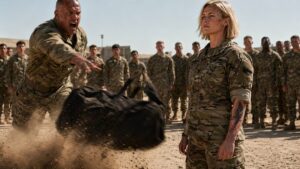
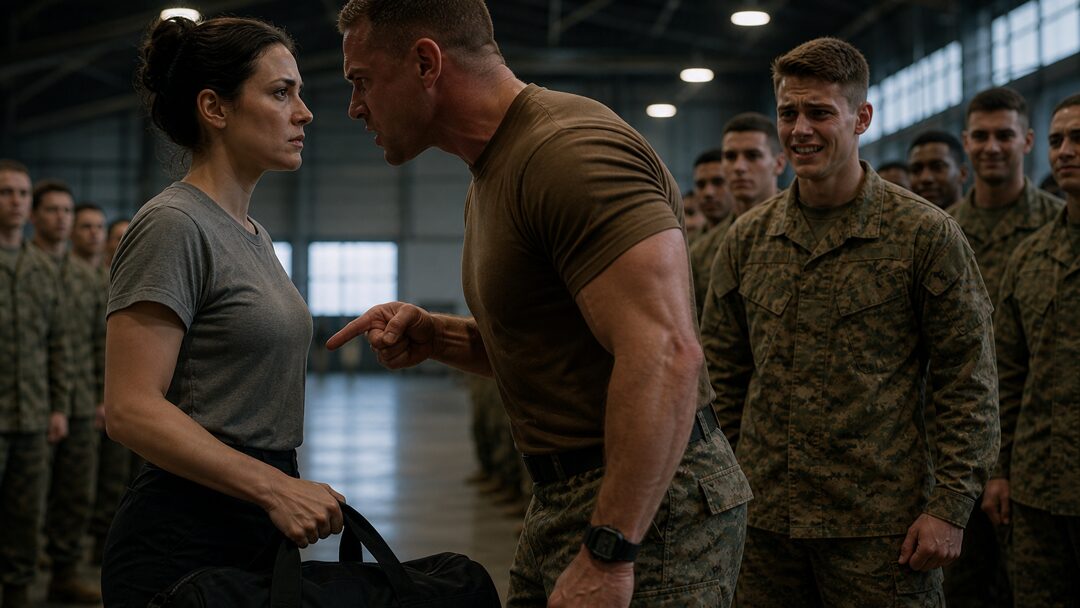
The first thing Staff Sergeant Caleb Rusk did when Mara Ellison stepped into Hangar Three was laugh at her bag.
Not her face. Not her clothes. The bag.
A black duffel hung from her right hand, faded at the seams, one strap repaired with ugly gray stitching. It looked too old for the spotless concrete floor, too personal for the hard military symmetry of the room. Rows of young soldiers stood in formation beneath the white hangar lights, their boots aligned, their shoulders square, their eyes trained forward until Rusk gave them permission to look.
And he gave it immediately.
“Well, well,” Rusk said, loud enough for the back wall to hear. “Somebody lose her way to the yoga studio?”
A few recruits laughed.
Mara stopped just inside the entrance. She wore a gray T-shirt, dark utility pants, and worn brown boots. No rank. No name tape. No badge clipped to her chest. Her hair was tied back without ceremony. She looked like she had come to fix a pipe, not enter one of Fort Calder’s toughest training rooms.
Rusk walked toward her slowly, enjoying the distance. He was built like the room had been designed around him: thick shoulders, close-cropped hair, brown training shirt stretched tight across his chest, camouflage pants tucked into boots polished hard enough to reflect light.
He stopped less than a foot from her.
“You lost?”
Mara looked at him.
The recruits waited.
Rusk tilted his head. “I asked you a question.”
“No,” Mara said.
Her voice was quiet. Not timid. Just quiet.
That seemed to annoy him more.
“No?” he repeated. “You sure? Because this room is for soldiers. Actual soldiers. People who sweat, bleed, carry weight, follow orders. Not whatever you are.”
Someone in the second row snorted.
Mara’s hand tightened once around the duffel handle, then relaxed.
Rusk noticed.
“Oh, she’s got luggage,” he said, turning slightly so the room could enjoy her with him. “Maybe she brought snacks. Maybe she brought feelings.”
The laughter spread this time.
A tall, narrow-shouldered recruit near the front pointed before he could stop himself. His name tape read REED. His grin was too big, too eager, the kind of grin young men wore when they were trying to prove they were not afraid.
Rusk saw him and smiled.
“That’s right, Reed. Look at her. Take a long look.” He turned back to Mara. “This is what hesitation looks like. This is what soft looks like. This is what happens when somebody hears the word pressure and thinks it means inconvenience.”
Mara did not look at Reed.
She did not look at the recruits laughing behind him.
She looked only at Rusk, not defiantly, not warmly, not even angrily. She looked at him like she was reading weather.
That was the first thing Rusk failed to understand.
He thought silence meant he had found the bruise.
“Name,” he barked.
“Mara Ellison.”
A tiny change passed through his face.
It was not enough for the recruits to catch. It was gone almost before it arrived. But Mara saw it. The blink. The small tightening at the corner of his mouth. The memory searching for a place to land.
Then Rusk recovered.
“Ellison,” he said. “Well, Miss Ellison, since you wandered into my training block, you can either leave through that door or stand with the recruits and learn what men do when nobody comes to save them.”
The room laughed again, but less cleanly this time.
Mara shifted the duffel to her left hand.
Then she walked past him.
Not fast. Not slow. She moved through the line of soldiers as if passing through rain.
Private Jonah Reed watched her come closer. Up close, he noticed things the first laugh had hidden from him. Her boots were old, but not civilian old. The skin across one knuckle was ridged with scar tissue. When she passed, she did not smell like perfume or fear. She smelled faintly of canvas, soap, and cold air.
She took her place at the end of the formation.
Rusk turned on the room with a smile.
“Good,” he said. “Now we train.”
Part II — Men Work
The exercise began with weight.
Sandbags. Stretchers. Timed carries. Controlled confusion. Rusk liked drills that made breath sound ugly. He liked turning ordinary bodies into evidence.
“Move,” he shouted. “You think the enemy waits because your hamstrings feel emotional?”
The recruits lifted, hauled, dropped, corrected, started again.
Mara stood where he had put her, duffel at her feet, hands loose at her sides. She watched without leaning, without fidgeting, without asking what she was allowed to see.
Rusk circled the recruits like a man stirring a fire.
“Reed, your grip is trash.”
Jonah tightened his hands around the stretcher pole.
“Matthews, stop looking at him. He can fail without your supervision.”
The row adjusted.
“Ellison,” Rusk called suddenly.
The hangar went still.
Mara looked over.
“You watching carefully?” he asked. “This is called work.”
“I see that,” she said.
A few recruits smiled.
Rusk’s face sharpened.
“No, you don’t. You see movement. You see noise. You see big scary men sweating, and you think that’s the hard part.” He stepped closer, pointing at the recruits. “The hard part is doing it when your head is screaming. When your knees shake. When the person beside you quits and you don’t get the luxury of quitting with him.”
He turned to Jonah.
“Reed. Again.”
Jonah bent over the sandbag. His shoulders were trembling. He had already run the carry twice.
Rusk stood over him. “Pick it up.”
Jonah tried. The bag shifted but did not rise.
“Pick. It. Up.”
Jonah’s mouth opened around a breath that sounded almost like a sob. He lifted again. The bag came up to his thighs and slipped.
It hit the floor with a dead slap.
Rusk moved in so fast Jonah flinched.
“There he is,” Rusk said softly. “There’s the truth.”
The room became very quiet.
Mara watched Jonah’s eyes. Not his hands. Not the failed lift. His eyes.
They were not lazy. They were not rebellious.
They were waiting to be hit, though no one had raised a hand.
Rusk turned sharply toward Mara.
“You see that? That’s weakness. It spreads if you let it. You pity it, you feed it. You excuse it, you bury somebody because of it.”
Mara’s gaze shifted past him.
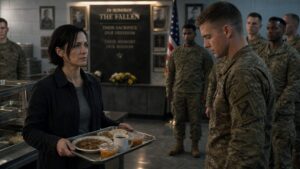
At the back of the hangar, mounted between two flags, was a memorial wall. Framed photos. Names beneath them. Dates. Unit patches. Clean glass over dead faces.
One photograph looked newer than the rest.
The young man in it had a nervous half-smile, as if someone had told him not to smile and he had almost obeyed. His name was printed beneath the frame.
CORPORAL ELI VANCE.
Mara looked at the photo for one second too long.
Rusk saw.
“You know him?” he asked.
“No.”
It was true in the narrowest way.
She had never heard Eli Vance laugh. Never seen him lace his boots. Never watched him write home or pretend not to be scared. But three nights earlier, in a kitchen smelling of old coffee and rain, Eli’s mother had placed a torn unit patch into Mara’s hand and said, Please don’t let them make him small.
Rusk followed her eyes to the wall.
“Vance,” he said. “Good kid. Not ready.”
Jonah Reed lowered his head.
Mara noticed that too.
Rusk clapped once. The sound cracked through the hangar.
“Again.”
The recruits moved.
Jonah bent.
Mara stood still.
And the black duffel sat at her feet like something waiting for the right room to become quiet.
Part III — The Name
Rusk kept them going for twenty more minutes.
By the end, even the laughter had sweat in it.
The recruits laughed when they were supposed to. They laughed when Rusk turned a phrase into a blade. They laughed when he made one of them repeat a mistake out loud. But the sound had changed. Mara could hear the calculation inside it now.
Laugh early. Laugh with him. Never be the last one silent.
Jonah Reed learned that rhythm better than anyone.
When Rusk insulted Mara again—“Still with us, Miss Ellison? Or has standing upright exhausted you?”—Jonah laughed first.
Too fast.
Mara glanced at him then.
Not with anger.
That was worse.
Jonah looked away.
Rusk noticed the exchange and stepped between them.
“You got something to say?” he demanded.
Mara looked back at him. “No.”
“No.” Rusk smiled, but it did not reach his eyes. “That your whole strategy?”
“When needed.”
The room held its breath.
Rusk came closer. Again, he used his body like a door. Big enough to block sight. Close enough to force response.
“Identify yourself properly.”
“I did.”
“Full name.”
“Mara Ellison.”
“Purpose.”
“I was told to report to Hangar Three.”
“By who?”
“Major Saye.”
This time the flicker in his face stayed longer.
Someone in the back row shifted.
Rusk’s voice dropped. “Major Saye send you here?”
“Yes.”
“And she didn’t think to inform me?”
“I can’t speak for Major Saye.”
“No,” he said. “I imagine you can’t.”
Then his eyes narrowed with the effort of memory.
Ellison.
Mara saw the moment the name found its file.
Operation Night Glass did not officially exist in the way tragedies often did not officially exist. There had been a convoy that never arrived where it was supposed to. A checkpoint that became flame. Six dead. Two wounded pulled through smoke by a medic whose radio had gone silent and whose left hand had been burned so badly she taped two fingers together and kept moving.
Some older soldiers knew the story in fragments.
A medic with no morphine left.
A woman carrying men heavier than herself.
A road lit orange.
A call sign repeated until dawn.
Rusk knew enough.
Not all. Enough.
His posture did not soften. Men like Rusk did not soften when surprised. They hardened over the crack.
The recruits saw only that their instructor had gone still.
Rusk stepped back half a pace.
“You’re observing,” he said.
Mara did not answer.
“You should have said so.”
“You didn’t ask.”
A breath moved through the formation. Not quite a laugh. Not quite approval.
Rusk heard it and hated it.
His voice rose again. “Reed.”
Jonah snapped straight. “Yes, Sergeant.”
“Take the stretcher. Alone.”
Jonah’s face drained.
“Sergeant—”
“Did I ask for negotiation?”
“No, Sergeant.”
“Then move.”
Mara’s eyes flicked to Rusk’s hands. He was calm again, but only on top. Underneath, humiliation had found him. He did not know what to do with it except pass it down.
Jonah dragged the stretcher into position. His arms shook before he lifted it.
Rusk leaned toward the room.
“See, Miss Ellison? This is why we train. Because out there, people die when the weak decide their feelings matter.”
Mara looked at Eli Vance’s photograph.
Then at Jonah.
Then at Rusk.
She said nothing.
But silence had changed shape.
Part IV — The Clean Paper
Major Helen Saye’s office was too neat for a woman who slept badly.
Every file stacked. Every pen aligned. A folded flag in a triangular case sat on a shelf behind her, its glass so clean it seemed untouched by air.
Saye did not offer Mara coffee.
Mara respected that.
“You saw enough?” Saye asked.
“I saw a performance.”
“That’s not an answer.”
“It’s the only honest one after one cycle.”
Saye leaned back. She was forty-eight, maybe older in the eyes. Silver threaded through her hair, pulled tight at the nape of her neck. Her uniform looked perfect. Her face did not.
“Corporal Eli Vance died during remedial navigation work,” Saye said. “Logged as voluntary.”
Mara waited.
“It followed a failed land-nav block two nights before graduation. Rusk says Vance asked for extra time. Wanted to prove he could pass clean.”
“And the recruits?”
“They repeat the report.”
“Because it’s true?”
Saye looked down at the folder.
That was answer enough.
“The paperwork is clean,” she said.
“Paperwork is easy to clean.”
Saye’s jaw tightened. “That’s why I called you.”
Mara glanced toward the window. From there, she could see a strip of the hangar roof and hear, faintly, Rusk’s voice hitting metal walls.
“You called me because I’m useful,” Mara said. “Woman. Veteran. Medic. Survivor. Enough decoration to make command look serious. Enough distance that if this goes badly, I don’t stain the unit.”
Saye took the hit without blinking.
“Yes,” she said.
Mara looked back at her.
Saye’s honesty did not make the thing cleaner. It only made it harder to refuse.
“Eli’s mother gave you something,” Saye said.
Mara’s hand moved toward the duffel beside her chair, then stopped. “She gave me what he sent her.”
“A letter?”
Mara said nothing.
Saye’s voice lowered. “If there’s evidence—”
“There’s grief,” Mara said. “Be careful what you call evidence.”
For the first time, Saye looked away.
Outside, a whistle blew. Boots struck concrete. Young voices answered in unison.
Saye closed the folder.
“I need one more cycle,” she said. “If Rusk is hard, that’s not enough. Hard is allowed. Ugly is allowed. War is uglier.”
Mara stood.
“War doesn’t need us to make boys afraid of rooms before they ever reach one.”
Saye did not respond.
Mara picked up the black duffel.
At the door, Saye said, “Night Glass.”
Mara stopped.
“I read the restricted summary,” Saye said. “What you did.”
Mara’s fingers tightened around the strap. “Then you read the least important version.”
“What’s the important one?”
For a moment, Mara saw the checkpoint again: smoke pressed low to the ground, a man screaming for his brother, her own voice gone hoarse from saying, Keep moving, keep moving, keep moving.
She opened the door.
“The important one is that six didn’t come back.”
Part V — Say He Was Weak
The second cycle began after lunch.
Rusk had changed nothing about the room except the target.
He did not look at Mara when she entered this time. That was deliberate. A man like Rusk could make ignoring someone feel like another kind of assault.
The recruits stood sharper than before.
Jonah Reed looked as if he had not eaten.
Mara took the same place at the edge of the formation. The black duffel rested against her boot.
Rusk walked the line slowly.
“Today,” he said, “we address failure.”
No one moved.
“Failure is not a tragedy. Failure is not a poem. Failure is information. It tells you who should carry weight and who should be carried.”
His eyes landed on Jonah.
“Reed. Front.”
Jonah stepped out.
Rusk circled him. “Corporal Vance was in your class track before reassignment, wasn’t he?”
Jonah swallowed. “Yes, Sergeant.”
“You knew him?”
“Yes, Sergeant.”
“Good soldier?”
“Yes, Sergeant.”
“Then why is he on the wall?”
The question hit the room wrong.
Even the air seemed to resist it.
Jonah looked at Eli’s photograph. “Sergeant, I—”
“Why is he on the wall?”
Jonah’s mouth worked.
Rusk stepped closer. “Because he failed to prepare. Because pressure found the crack. Because out there, weak doesn’t stay private. Weak gets people killed.”
Mara’s face did not change.
But her hand moved to the duffel.
Rusk saw it.
He smiled.
“Say it, Reed.”
Jonah stared at him.
“Say Corporal Vance died because he was weak.”
The room went silent in a new way.
This was not discipline. This was a cliff.
Jonah’s eyes shone. He blinked hard. His nervous grin tried to appear and failed.
“Sergeant—”
“Say it.”
Jonah looked at the recruits behind him. No one helped him. Not because they agreed. Because everyone had learned the same rule.
Do not become the center.
Rusk’s voice sharpened. “You laughed this morning, Reed. Had plenty of sound in you then.”
Jonah’s face flushed.
Mara looked at him. This time he did not look away.
Rusk turned to Mara.
“And you,” he said. “Still observing? Still standing there with your bag full of whatever civilians carry when they visit soldiers?”
Mara bent down.
The movement was small. But the whole room followed it.
She unzipped the black duffel.
The sound was soft, almost harmless.
Inside were no official binders. No weapon. No dramatic evidence sealed in plastic.
There was a pair of field-worn medical gloves, stiff with age despite having been cleaned. A folded cloth. A bundle of letters tied with string. And on top, a torn unit patch, its edge blackened as if kissed by fire.
Rusk’s face hardened.
Mara lifted the patch first.
Jonah stared at it.
“Eli Vance mailed this home three days before he died,” Mara said. Her voice stayed level. “His mother gave it to me because she was tired of being told her son was not ready.”
Rusk’s nostrils flared. “You don’t get to use a grieving mother to undermine training.”
Mara looked at him. “No. You used a grieving mother to protect it.”
The words landed cleanly.
Saye had entered at the rear of the hangar without announcement. Two senior personnel stood with her. Rusk saw them and understood, too late, that the room had widened beyond his control.
Mara unfolded one letter.
She did not read all of it. She did not need to.
“‘Mom,’” she read, “‘they call it extra training when the sergeant wants to make an example out of you. Everybody knows not to argue. Everybody knows to laugh when he laughs. That way he keeps walking.’”
Jonah closed his eyes.
Mara lowered the paper.
“Is that true?” she asked the room.
No one answered.
Rusk stepped forward. “This is emotional manipulation.”
Mara ignored him.
“Is it true?”
The recruits stared at the floor.
Then Jonah whispered, “Yes.”
Rusk turned on him. “Speak up.”
Jonah flinched.
Then something in him, small and terrified, stayed standing.
“Yes,” he said louder. “It’s true.”
The room shifted.
Not much.
Enough.
Jonah looked at Mara, shame naked on his face. “I laughed because if I laughed first, he usually picked somebody else.”
No one mocked him.
No one even breathed loudly.
Mara folded Eli’s letter along its original creases.
She had seen men confess under morphine, under fire, under the pressure of losing too much blood. But Jonah’s confession was its own kind of battlefield. No smoke. No bullets. Just a young man choosing to be seen.
Rusk’s voice dropped dangerously.
“You think this makes you brave?”
Jonah did not answer.
Mara did.
“No,” she said. “It makes him honest.”
Part VI — Still One Here
Rusk walked toward Mara until the old shape returned.
His face close to hers. His body blocking the room. Soldiers behind him, watching. The same white lights. The same polished floor. The same black duffel at her feet.
Only the laughter was gone.
“You came here to destroy my unit,” he said.
Mara looked at him for a long moment.
He wanted anger. She could feel that. Anger would let him understand her. Anger would let him turn her into an enemy, a threat, a woman with a vendetta and a bag of dead men.
She would not give him something that easy.
“No,” Mara said. “I came to see whether there was still one here.”
The line stopped him.
It stopped the room more.
Rusk’s mouth opened, but nothing useful came out. For the first time since Mara had entered Hangar Three, his silence did not belong to him.
Major Saye moved forward.
“Staff Sergeant Rusk,” she said, “you are relieved from the training floor pending review.”
Rusk did not look at her at first. He kept looking at Mara, as if she had struck him.
But she had not.
That was the part he could not bear.
No shouting. No threat. No revenge. Just a sentence he could not order away.
“Major,” he said, “you’re making a mistake.”
Saye’s face was controlled, but her eyes were tired enough to tell the truth. “I already did.”
The words were quiet. They carried farther than Rusk’s shouting ever had.
Two senior personnel approached him. Rusk looked once at the recruits, searching for the old room—the one that laughed when he needed it, stiffened when he demanded it, gave him back the reflection of power.
The old room did not return.
Jonah Reed stared at the floor, but he did not laugh.
No one did.
Rusk walked out under his own power. That mattered to him. Mara let it matter. Some men needed to leave as if leaving had been their choice.
When the hangar doors closed behind him, the sound rolled through the space and faded.
No one cheered.
Mara was grateful.
Cheers would have made it smaller.
Saye looked at the recruits. “Clean the floor. Reset the equipment. Then write what happened. Separately.”
No one argued.
The young soldiers moved with an awkward silence, lifting sandbags, stacking stretchers, coiling ropes. Without Rusk’s voice, the room sounded larger. Boots scuffed. Breath slowed. Metal clicked against metal.
Mara knelt by the duffel and placed the gloves back inside. Her hands paused over Eli’s letter.
Jonah approached like every step required permission.
“Ma’am?”
Mara looked up.
His face had lost the desperate grin. Without it, he looked younger.
“I’m sorry,” he said.
She nodded once.
It was not absolution. It was acknowledgment.
He seemed to understand the difference.
“I laughed at you,” he said.
“Yes.”
“I thought…” He stopped. There was no good ending to the sentence.
Mara saved him from inventing one.
“You were afraid.”
Jonah’s eyes filled again, and this time he did not hide it fast enough. “Was Eli?”
Mara picked up the torn patch.
For a moment, she saw Eli’s mother’s hands smoothing it flat on the kitchen table. The woman had not cried when she gave it over. That had hurt more.
Mara looked toward the memorial wall.
“Yes,” she said. “And he still kept moving.”
Jonah looked at the photograph.
Something in his shoulders broke. Not dramatically. Just enough to let him breathe differently.
Mara stood and crossed the hangar.
The memorial wall reflected the room in faint shapes: recruits cleaning, Saye speaking quietly with another officer, Jonah standing alone with his hands at his sides.
Eli Vance smiled from behind glass, still almost obeying whoever had told him not to.
Mara placed the torn patch beneath his photograph.
She did not straighten it twice. She did not make ceremony out of it. She pressed two fingers to the edge, then let go.
Saye came to stand beside her.
“I’ll have to ask for a statement,” Saye said.
“I know.”
“And the letter.”
“I know.”
Saye watched the wall. “His mother should hear from us before she hears rumors.”
Mara nodded. “She should hear the truth before she hears procedure.”
Saye absorbed that.
Behind them, Jonah lifted a sandbag onto the rack. Another recruit stepped beside him and helped without being asked.
It was a small thing.
Small things were not nothing.
Mara picked up the black duffel. It felt lighter now, but not empty. It would never be empty. Not with Night Glass folded somewhere inside her. Not with Eli’s letter soon to be copied, filed, questioned, and handled by people who would never know the sound of his mother’s kitchen clock.
At the hangar doors, Jonah called after her.
“Ma’am?”
She turned.
He stood beside the rack, shoulders still narrow, face still ashamed, but his eyes steady.
“What do we do now?”
Mara looked at the room that had laughed at her, then stopped laughing. The room that had mistaken fear for loyalty because someone had taught it to. The room that might still become something else, if enough people refused to pass the damage down.
“You train,” she said. “And when someone falls behind, you don’t make him carry shame too.”
No one answered.
They did not need to.
Mara stepped outside into the late afternoon air.
Behind her, the hangar stayed open. Not healed. Not clean. Not forgiven.
Open.
She walked toward the parking lot with the duffel at her side, the strap rough against her palm, the weight familiar enough to hurt and lighter enough to carry.
For the first time all day, no one laughed.