The Man With the Broken Compass
Part I — The Tattoo at the Booth
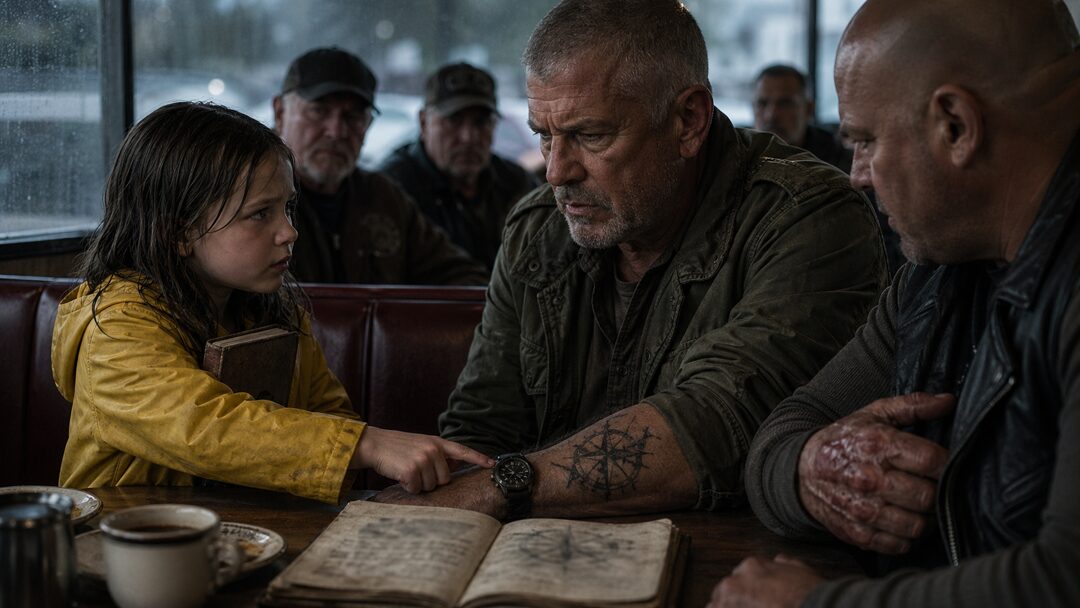
The little girl touched the tattoo before Elias Rourke could pull his arm away.
Her finger landed on the black compass inked into his forearm, faded at the edges now, one arrow pointing home and the other pointing nowhere. Around him, the booth went silent. Four coffee cups cooled. A fork stopped halfway to Cal Moreno’s mouth. Across the table, Ruth Bell looked up so sharply that her chair gave a soft scrape against the diner floor.
The girl was maybe nine.
She wore a yellow raincoat too bright for the dim roadside diner, and rainwater clung to the ends of her hair. In her other hand, she held a small, battered notebook against her chest like it was the only thing in the room she trusted.
“My dad had that in his notebook,” she said.
Elias stared at her hand on his arm.
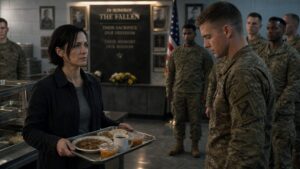
The room had old wood walls, blinds half-closed against the gray morning, and a framed flag near the register. Outside, beyond the wet windows, the memorial hall sat across the road with bunting on its railings and folding chairs already arranged under the awning.
Inside, the girl did not blink.
“He said the man wearing it would know why he never came home.”
Nobody moved.
For twelve years, Elias had sat in this same booth on the morning of the Lantern Gate memorial. He had ordered black coffee, listened to Cal complain about the eggs, let Jonah Voss sit where he could see the door, let Ruth refuse breakfast and stir sugar into coffee she never drank.
For twelve years, no one had said Sam Vale’s name before noon.
Now a child had said it without even knowing she had.
Elias slowly withdrew his arm.
“Who are you?” he asked.
His voice came out calm. That was the first thing command taught you—never let the room hear the break.
The girl placed the notebook on the table.
Not gently.
The cups jumped a little.
Cal’s jaw tightened. Jonah went pale. Ruth’s eyes dropped to the cover, where someone had written in black marker: S. VALE — FIELD NOTES.
The girl opened to a folded page and smoothed it with both hands. The paper was soft from being touched too many times. In the center, drawn with a hard, dark line, was the same broken compass that lived under Elias’s skin.
Under it were three words.
Rourke knows why.
Elias felt the diner tilt.
Rain tapped the window. Somewhere behind the counter, a waitress set down a plate and forgot to call the order.
Cal leaned forward first.
“You need to go back to your mother,” he said.
The girl looked at him. “She’s dead.”
The words were simple enough to fit in a child’s mouth. That made them worse.
Cal looked away.
Ruth’s face changed, not softened exactly, but opened at the edges.
“What’s your name, honey?” she asked.
“Nora Vale.”
Jonah shut his eyes.
The name moved through the booth like a live wire.
Nora looked from face to face, trying to read the damage she had caused. She did not look frightened. She looked like someone who had run out of people to ask.
“My mom said my father left,” she said. “Other people said worse things. At school, a boy said deserters don’t get flags.”
Cal’s damaged left hand curled on the table, but the fingers would not close all the way.
“He shouldn’t have said that,” Ruth said.
“But was he right?”
No one answered.
Nora looked back at Elias. “Were you Captain Rourke?”
Elias could still hear Sam’s voice in the rain.
Not this rain. Another one. Dirt rain. Smoke rain. Metal rain. A radio cracking and dying in his palm.
“Yes,” he said.
Nora pushed the page closer to him.
“Then why did my dad write your name?”
Elias looked at the drawing.
The compass had been Sam’s idea. Of course it had. Sam had always found a way to make a joke out of fear before fear could take offense.
One arrow home, one arrow lost.
A soldier’s whole life in two lines.
Elias folded his hand over the tattoo, but it was too late. The girl had already seen it. The booth had already remembered.
“Some things,” he said, “are complicated.”
Nora’s mouth tightened. For the first time, she looked exactly her age.
“Complicated is what grown-ups call lying when they’re tired.”
Ruth looked down into her coffee.
Jonah whispered, “Jesus.”
Cal said, “That’s enough.”
But it wasn’t.
They all knew it wasn’t.
Across the road, a bell rang once from the memorial hall, calling volunteers to set up the podium where Elias was supposed to give the same speech he gave every year.
Honor. Sacrifice. Brotherhood. The fallen.
Never Sam.
Not once.
Nora kept her hand on the notebook.
“I came because one of his letters said you ate here before the ceremony,” she said. “He wrote that you all ordered pancakes like nothing bad could happen after pancakes.”
A sound almost came from Jonah. It died before becoming a laugh.
Nora looked at Elias.
“I don’t want pancakes,” she said. “I want to know if my father left me.”
Elias had faced ambushes, burning roads, broken men calling for mothers they had not seen in years.
He had never faced anything as dangerous as that question.
Part II — The Name Nobody Used
Cal reached for the notebook.
Ruth caught his wrist before he touched it.
Her grip was light. Her look was not.
“Don’t,” she said.
Cal’s face went red under his gray stubble. “She’s a kid. She shouldn’t be carrying this.”
“She is carrying it,” Ruth said. “That’s the point.”
Nora watched them with the terrible stillness of a child learning which adults are safe.
Elias turned the notebook toward himself. The pages smelled faintly of dust and cardboard, like they had been stored in a closet for years. Sam’s handwriting covered the margins in tight, slanted lines. Weather notes. Coordinates. Lists of supply counts. A sketch of a dog with only three legs. A joke written upside down.
Then, on three separate pages, the broken compass.
Not once.
Three times.
Elias touched the edge of the paper and felt the old world reach back for him.
“Where did you get this?” he asked.
“My mom kept it in a plastic box with his letters and a medal they sent back after they said he was gone,” Nora said. “She told me not to read it until I was older.”
“Why did you?”
“She died six months ago.”
The booth went quiet again.
Nora swallowed. “My aunt was going to throw out the box. She said it was time to stop letting ghosts take up space.”
Ruth’s eyes glistened, but no tear fell.
“So I took it,” Nora said. “It was mine.”
Elias closed the notebook.
He could feel the others waiting for him to command the room. That had always been his job. Give orders. Settle fear. Make the next hard thing look survivable.
But command did not work on a child with a dead mother and a dead father whose file had been poisoned.
“Your father was Lieutenant Samuel Vale,” Elias said.
“I know that.”
“He served with us.”
“I know that too.”
Cal muttered, “Not like this.”
Elias ignored him.
“He was brave,” Elias said.
Nora leaned forward. “Then why did the report say he abandoned his post?”
There it was.
The official sentence. The phrase folded into the file like a blade.
Absent under unstable conditions.
It was cleaner than deserter. Softer. More bureaucratic.
Meaner, somehow.
Jonah rubbed both hands over his face. He had been the youngest back then, a skinny radio operator with a prayer card taped inside his helmet. Now he looked older than Elias on bad mornings.
“There were hearings,” Jonah said. “Statements. Orders.”
Nora looked at him. “Did my dad leave?”
Jonah opened his mouth.
Nothing came out.
Cal leaned across the table. “Listen to me, kid. There are things that happen in war that don’t fit in little notebooks.”
“My dad fit in this one,” Nora said.
Cal flinched.
Elias saw it.
Cal had loved Sam. That was the cruelty of it. The men who defended the lie were not the ones who hated him. They were the ones who had needed the lie to mean they could keep breathing.
Ruth set her coffee aside.
“Nora,” she said, “what do you remember about him?”
The girl looked down.
“I remember his hands,” she said. “He tied my shoes too tight. My mom always had to redo them. I remember he sang badly in the car. I remember he smelled like soap and the garage.”
Her voice became smaller.
“I remember waiting at the window because Mom said his plane was coming in that week.”
Nobody at the booth looked at the window.
“She took down the calendar after three days,” Nora said. “Then she stopped saying plane.”
Elias felt something inside his chest pull tight.
Across the road, people were gathering beneath the memorial hall awning. Men in pressed jackets. Women holding paper programs. Children dragged along by parents who wanted them to understand sacrifice before they understood loss.
Elias’s speech was in his inside pocket.
Folded twice.
The same speech as last year, with one changed date.
Nora pointed at the notebook.
“My mom cried when people said he ran. She never yelled. She just got quiet. I hate quiet.”
Ruth whispered, “So do I.”
Elias looked at her.
For years, Ruth had been the only one who almost said it. At Christmas calls. At hospital fundraisers. After Jonah’s second divorce. Once in Elias’s garage, standing beside a stack of old campaign boxes, she had said, “You know what silence does to families?”
He had answered, “It keeps some people alive.”
She had never forgiven him for that.
Maybe she shouldn’t have.
Nora lifted her chin.
“I want the truth.”
Cal gave a bitter laugh. “People always say that before they know what it costs.”
Nora looked at his ruined hand.
“What did it cost you?”
The question was not cruel.
That made it unbearable.
Cal pulled his hand off the table and tucked it beneath his arm.
Elias finally said, “Operation Lantern Gate was supposed to be an evacuation support mission.”
Cal swore under his breath.
Ruth did not stop Elias.
Nora went still.
“The ceasefire had broken along the northern road,” Elias said. “Our team was sent ahead to mark safe passage for a convoy. We were told enemy fighters were using the village road to move weapons.”
“Were they?” Nora asked.
Elias saw the road again.
White dust. A broken cart. A blue scarf tied to a pole. Children crouched beneath a truck bed while artillery thudded behind the hills.
“No,” he said.
Nora’s eyes did not leave his face.
“They were civilians,” Elias said. “Families trying to get out before the valley closed.”
“And my dad knew?”
“Your father saw it first.”
Jonah’s breath shook.
Cal stood suddenly, the booth creaking under the release of his weight.
“This is not the place,” he said.
Elias looked up at him. “There was never going to be a place.”
Cal stared at him for a long second.
Then he sat back down.
The waitress came by with a pot of coffee, saw their faces, and walked away without speaking.
Nora touched the drawn compass again.
“What did he do?” she asked.
Elias closed his eyes.
The answer had waited twelve years.
It still felt too heavy to lift.
Part III — The Road He Chose
“Sam refused the marker order,” Elias said.
Nora frowned. “What does that mean?”
“It means we were supposed to confirm the road for military clearance,” Ruth said quietly. “Your father would not confirm it.”
“Because of the families?”
“Yes.”
Cal stared at the tabletop.
“He argued with me,” Elias said. “On the radio, at first. Then in person, when we reached the relay point. He said if we marked that road the way command wanted, people would die and no one would write their names down.”
Nora listened as if each word had to be placed carefully inside her.
“What did you say?”
Elias almost lied from habit.
Then he looked at the yellow raincoat, the wet hair, the notebook under her hands.
“I told him we had orders.”
Nora’s face changed.
Not anger yet.
Worse.
Disappointment.
Elias took it because he deserved it.
“Your father said orders were not a place to hide,” he continued. “I told him he was endangering the unit. He told me the unit was not worth saving if we became the reason civilians needed rescue.”
Ruth looked toward the window.
Jonah’s fingers trembled against his cup.
“The strike corridor was being confirmed through radio relay,” Elias said. “Sam stayed behind at the relay station. He fed command false coordinates long enough for the civilian convoy to move east and for us to pull back through the orchard road.”
Nora’s lips parted.
“He stayed?”
“Yes.”
“But the report—”
“The report said he became unstable under pressure and abandoned his post.”
“But he didn’t.”
“No.”
“Say it.”
Elias looked at her.
Nora’s eyes were shining now, but her voice held.
“Say he didn’t leave.”
Elias had said many things at podiums. He had received medals he wanted to throw into rivers. He had told mothers their sons died bravely when he did not know whether bravery had anything to do with being nineteen and unlucky.
He had never said the sentence that mattered.
“Your father did not leave,” he said. “He stayed.”
Nora shut her eyes.
Her shoulders dropped as if a rope had been cut.
For one breath, she looked relieved.
Then relief became something sharper.
“If you knew,” she asked, “why did everyone say he ran?”
Cal slammed his palm lightly on the table. Not enough to frighten her. Enough to stop himself from breaking.
“Because command needed the operation clean,” he said. “Because dead men don’t argue in review rooms. Because the rest of us came home with medals and injuries and stories people wanted to clap for.”
Ruth looked at him. “Cal.”
“No,” he said, voice rough. “She wants truth. There it is.”
He turned to Nora, eyes bright and angry.
“Your dad saved people. He saved us. Then the men above us buried him because admitting what he did meant admitting what they almost ordered. And we—”
He stopped.
His mouth twisted.
Nora finished softly, “And you let them.”
Cal looked like she had struck him.
Elias said, “I signed the statement.”
Ruth closed her eyes.
Jonah whispered, “We all did.”
Nora looked at each of them.
Her small face had gone pale.
“Why?”
Nobody answered quickly.
That was the honest part.
Because fear had rank.
Because exhaustion had a signature line.
Because after three days with no sleep and two dead men and one missing, a clean report looked like a door out of hell.
Because Elias had believed he could fix it later.
Because later had become twelve years.
“I told myself I was protecting the team,” Elias said.
“From what?”
“Inquiry. Discharge. Prison, maybe. Public disgrace. The whole thing would have been turned inside out.”
Nora blinked once. A tear fell, and she wiped it away angrily.
“So you protected everybody except him.”
The sentence landed harder than shouting.
Cal’s face folded for half a second before he forced it back into its old shape.
Jonah reached into the inner pocket of his coat and withdrew a small canvas pouch.
Ruth stared at it.
“Jonah,” she said.
He placed it on the table.
“I kept it,” he said.
Elias went cold.
Inside the pouch was an old field recorder, scratched along one side, its rubber buttons worn gray. Elias had last seen it clipped to Jonah’s vest at the relay station, just before the smoke swallowed the road.
Cal looked horrified.
“You said you destroyed that.”
Jonah shook his head. “I said I took care of it.”
“That thing could ruin us.”
Jonah looked at Nora. “It already did.”
Nora stared at the recorder. “Is my dad on it?”
Jonah swallowed.
“Yes.”
The diner seemed to shrink.
Even the rain sounded distant.
Ruth leaned back as if the recorder gave off heat.
Elias did not touch it.
He could still hear Sam through static.
Rourke, they’re moving. Give me two more minutes.
Then gunfire.
Then Elias, screaming his name into a dead channel.
Nora’s hand moved toward the pouch, then stopped.
“Can I hear it?”
Jonah looked at Elias.
That old instinct again. Permission. Command. Chain.
Ruth saw it and her face hardened.
“You still waiting for him to tell you what courage sounds like?” she asked.
Jonah flinched.
Elias pushed the recorder gently toward Nora.
“Not here,” he said. “Not unless you want to.”
Nora stared at it for a long moment.
Then she shook her head.
“Not yet.”
Cal let out a breath that was almost gratitude.
Nora opened the notebook again with careful fingers.
“There’s one more page,” she said.
Elias knew before she turned it that the morning was not done with him.
Part IV — What the Dead Man Left
The last page had been folded twice and tucked into the back cover.
Nora pulled it free as if it might tear under the weight of being seen.
“This was in an envelope,” she said. “It had your name on it too.”
Elias did not reach for it.
He could not.
So Ruth took it from Nora and unfolded it.
Her eyes moved across the page.
Then she stopped breathing.
“What?” Cal demanded.
Ruth handed it to Elias.
For a moment, the handwriting was just black marks.
Then Sam Vale’s voice rose through the lines.
Rourke—
If my girl ever finds you, don’t make her hate the uniform. Tell her I chose the road. Tell her I heard you calling.
The words blurred.
Elias gripped the paper so hard it trembled.
He had spent twelve years believing Sam died alone in rage. Believing the last thing Sam heard was his captain ordering him back, then failing to reach him. Believing Sam’s final thought had been that Elias chose the mission, the men, the report—everything except him.
But Sam had heard him calling.
Sam had known.
Sam had chosen anyway.
Nora watched Elias read.
“What does it mean?” she asked.
Elias tried to answer.
Nothing came.
For the first time that morning, his command voice was gone.
Cal took the page from him roughly, read it, and dropped back against the booth like someone had opened a wound under his ribs.
Jonah covered his mouth.
Ruth looked at Elias with an expression that was not mercy.
It was expectation.
“He left you a way to tell her,” she said.
Elias shook his head once.
“He left me a duty.”
Ruth leaned forward.
“You made us carry the silence like it was discipline,” she said. “It was just fear with rank on it.”
Cal’s head snapped up. “That’s easy to say now.”
“No,” Ruth said. “It was easy to say nothing. We proved that.”
Cal’s damaged hand shook under the table.
“You think I don’t see him?” he said. “You think I don’t hear him? Every time someone thanks me for my service, I see Sam at that relay point waving us through like he wasn’t the one getting left.”
Nora’s face twisted.
“He waved?”
Cal looked at her and immediately regretted speaking.
Elias answered because silence had done enough.
“Yes,” he said. “He waved us through.”
“Was he scared?”
The question was small.
No war room, no hearing, no medal ceremony had ever asked the only thing that mattered.
Elias folded the page carefully.
“Yes,” he said. “He was scared.”
Nora looked down.
“But he stayed.”
“Yes.”
“Why didn’t you go back for him?”
Cal stood again, but this time there was no anger in it. Only pain.
“We tried,” he said.
Elias did not let that stand alone.
“I called for him,” he said. “I ordered him back. Then the channel broke. The ridge came down behind us. We had wounded. Civilians on the orchard road. I made the call to move.”
He looked at Nora.
“And after that, I made worse calls.”
Nora’s fingers pressed into the notebook cover.
“You mean the paper.”
“Yes.”
“The lie.”
“Yes.”
That word changed the booth.
Not report. Not complication. Not official version.
Lie.
Across the road, the bell rang again. Louder this time.
The memorial was starting soon.
Elias reached into his jacket pocket and felt the folded speech there, smooth from being handled. He had practiced it in the mirror that morning.
Today we gather to honor the courage of those who gave everything at Lantern Gate.
He wanted to laugh.
He might have, if the sound would not have broken him.
Cal saw his hand in his pocket.
“Don’t,” he said.
Elias looked up.
Cal’s face had gone gray. “You say it in there, and it doesn’t stop with us. There’ll be inquiries. Papers. People digging. They’ll turn Sam into a headline and us into cowards.”
Ruth said, “Disgrace already happened. It just landed on the wrong family.”
Cal looked at Nora.
Something in him cracked then. Not wide. Not enough to make him gentle. Just enough to let truth through.
“I loved your father,” he said.
Nora did not answer.
Cal’s eyes filled. He looked furious about it.
“I loved him,” he said again, quieter. “And I let them print that word beside his name.”
Nora looked at the old recorder.
“Can the tape fix it?”
Jonah wiped his face with his sleeve.
“It can start.”
“Will they believe it?”
Nobody lied to her.
Not this time.
“Maybe not at first,” Ruth said.
“Then what good is it?”
Elias looked at the tattoo on his arm.
The compass had faded with him. The black lines were not as sharp now. Skin had loosened around the arrow that pointed home.
He had worn it like a punishment.
Sam had meant it as a promise.
“It’s good,” Elias said, “because the truth should not have to win before someone says it.”
Nora watched him.
“What are you going to do?”
The bell rang a third time.
The question followed them out of the booth.
Part V — The Speech He Didn’t Give
The memorial hall smelled like wet coats, floor wax, and coffee from a silver urn in the back.
People turned when Elias entered.
They always did.
Former Captain Elias Rourke, the man who had brought most of his team home from Lantern Gate. The man with the steady voice. The man who could make loss sound clean enough to survive a ceremony.
Cal walked behind him, jaw clenched. Jonah carried the canvas pouch in both hands. Ruth stayed beside Nora, not touching her, close enough that the girl would not stand alone.
Programs rustled.
A woman near the front smiled at Elias with the soft gratitude people offered when they thought they knew what a man had sacrificed.
Elias nodded because his body remembered manners even when his soul refused them.
On the wall behind the podium hung a framed list of names.
The honored dead.
Sam Vale was not there.
Of course he wasn’t.
Elias had looked at that wall for twelve years and told himself absence was not the same as erasure.
It was worse.
Nora sat in the back row with the notebook on her lap. Her yellow raincoat glowed against the brown folding chairs.
She did not look like a witness.
She looked like the only judge in the room.
The mayor introduced Elias with the usual words. Valor. Service. Unimaginable conditions. Debt of gratitude.
Elias stood.
His knees hurt. His old shoulder injury burned under the jacket. His mouth was dry.
At the podium, he unfolded the speech.
He saw the first line.
Today we gather…
He looked at the room. Veterans. Families. Children bored and squirming. Widows with perfect posture. Men who had never served but loved ceremonies because ceremonies made sacrifice look orderly.
Then he saw Nora.
She was not crying.
That somehow made it harder.
Elias folded the speech again.
A small murmur moved through the hall.
“For twelve years,” he began, “I have stood here and told you a version of Operation Lantern Gate.”
The room settled.
Cal lowered his head.
Ruth’s eyes never left Elias.
“That version was not complete.”
The mayor shifted behind him.
Elias placed both hands on the podium.
“There was a man missing from this room before today. Not because he gave less. Because we gave him less.”
The air changed.
People could feel it before they understood it.
Elias unbuttoned his cuff and rolled up his sleeve.
The broken compass showed under the hall lights.
“This tattoo was first drawn by Lieutenant Samuel Vale,” he said. “He drew it as a joke, mostly. One arrow home, one arrow lost. He said that was every soldier’s map.”
A few people smiled uncertainly.
No one moved.
“We took it as our mark after Lantern Gate,” Elias continued. “We said it meant we would bring each other home.”
His voice caught.
He let it.
“We failed one man in death. Then we failed his daughter afterward.”
A sound came from the back of the hall. Nora had gripped the notebook hard enough to bend the cover.
Elias looked at her, then back at the room.
“Lieutenant Samuel Vale did not abandon his post. He did not desert his unit. He remained at the relay point to redirect a civilian convoy and to give our team time to withdraw. The official report is wrong.”
The mayor stood halfway. “Captain Rourke—”
Elias did not look at him.
“I signed that report,” he said. “I signed it because I was ordered, because I was exhausted, because I was afraid, and because I told myself protecting the living mattered more than defending the dead.”
Silence.
Not empty silence.
The kind that listens.
“That was not honor,” Elias said. “That was fear wearing my rank.”
Ruth closed her eyes.
Jonah stepped forward and placed the canvas pouch on a chair beside the aisle.
“We have the original radio log,” Elias said. “We have witness statements. The surviving members of the unit will submit them today to correct Lieutenant Vale’s record.”
Cal looked up.
For a moment, Elias thought Cal might walk out.
Instead, Cal rose slowly.
His damaged hand hung at his side.
He faced the room, not Elias.
“He saved us,” Cal said.
It was not loud.
It did not need to be.
Jonah stood too.
Then Ruth.
Three survivors, standing under the weight they had mistaken for survival.
Nora remained seated.
Her face had crumpled now, but still she made no sound.
Elias gripped the podium.
“There are names we honor because it is easy,” he said. “And there are names we owe because we waited too long.”
He turned toward the framed list on the wall.
“Samuel Vale is one of those names.”
No applause came.
Good.
Applause would have been too cheap.
Instead, the hall held the truth like something fragile and dangerous, something that might cut the hands of anyone who tried to pass it along.
Then Nora stood.
Every adult head turned.
She walked up the center aisle, the notebook pressed to her chest. Ruth moved as if to help her, then stopped. Nora did not need help walking.
She stopped in front of Elias.
He stepped down from the podium.
For a moment, they faced each other the way they had in the diner: the decorated man and the child with the notebook.
Only now the room knew which one had carried the braver thing.
Nora looked at the tattoo.
“My dad drew that?”
Elias nodded.
“He drew the first one.”
“Did he know you’d keep it?”
Elias swallowed.
“I think he hoped we’d remember what it meant.”
Nora looked at the wall of names.
“Then put him where people can see.”
No one spoke.
No one corrected her.
No one told her it was complicated.
Part VI — Spell His Name Right
After the ceremony, the rain stopped but the sky did not clear.
People lingered in uneasy clusters outside the hall, speaking softly in the way people do after they have witnessed something they cannot decide whether to call brave or shameful.
Elias did not wait for them.
In a small side room behind the stage, he sat at a folding table with Nora, Ruth, Jonah, and Cal. The room smelled of paper, dust, and old hymnals stacked in a corner.
Jonah set the recorder on the table.
Beside it, Ruth laid out three sheets of paper from the memorial office printer: a formal request for correction of service record, a witness statement cover sheet, and a blank page for additional testimony.
Cal stared at the pen like it was a weapon.
Nora sat across from Elias with the notebook open before her.
She had not thanked him.
He was grateful for that.
Thanks would have felt like theft.
Elias reached into the inside pocket of his field jacket and removed a small cloth patch wrapped in wax paper.
“I should have sent this to your mother,” he said.
Nora watched him unwrap it.
The patch was frayed around the edges, its colors faded by sun and sweat. A compass had once been stitched at the center, but someone had drawn over it in black marker, changing the clean military symbol into the broken one now inked on Elias’s arm.
“Your father did that,” Elias said. “He said real soldiers never know where home is until they lose it.”
Nora touched the patch with one finger.
The same way she had touched the tattoo.
But this time Elias did not pull away.
“Can I keep it?”
“It was his,” Elias said. “It should have been yours.”
She took it carefully and placed it inside the notebook.
For a while, nobody spoke.
Then Nora asked, “Was he scared the whole time?”
Elias leaned back.
He could have protected her from the answer. He had done enough protecting.
“No,” he said. “Not the whole time.”
Nora waited.
“He was scared when he understood he might not get out,” Elias said. “But after that, his voice got steady. He kept talking so everyone could follow him. Civilians. Us. Me.”
“What did he say?”
Elias looked at Jonah.
Jonah pressed his thumb to the recorder but did not play it. Not yet. He understood.
Elias answered from memory.
“He said, ‘Keep moving. The road is still there.’”
Nora looked down at the notebook.
Her tears fell silently now, darkening the page.
“He knew about me?”
Elias nodded. “He talked about you whenever he could.”
“What did he say?”
“That you hated peas. That you hid toy animals in his boots. That you laughed when he pretended not to find them.”
Nora gave a tiny sound that almost became a laugh.
Then it broke.
Ruth reached across the table and placed a tissue beside her. Not in her hand. Beside it.
Nora took it after a moment.
Cal picked up the pen.
His damaged hand made the motion awkward. The first attempt failed. The pen slipped sideways.
He cursed under his breath.
Nora watched him.
Cal tried again.
This time, he trapped the pen between his fingers and wrote slowly at the bottom of the witness page.
Caleb Moreno.
His full name, careful and ugly and real.
He pushed the page to Ruth.
She signed next.
Then Jonah.
Then all three looked at Elias.
He read the statement header.
Regarding Lieutenant Samuel Vale and Operation Lantern Gate.
The name looked almost strange in official print, like a man stepping out of a locked room into daylight.
Elias signed last.
His hand did not shake until after the pen left the paper.
Nora looked at the signatures.
“Will they fix it now?”
Ruth inhaled softly.
Elias did not lie.
“They may fight it.”
Nora’s mouth tightened.
“They already did.”
Cal looked away.
Elias folded the signed pages and placed them with the recorder in the canvas pouch.
“We’ll send copies today,” he said. “Not tomorrow. Not after we think about it. Today.”
Nora nodded once.
Then she looked at the framed list through the open door of the side room.
“They spelled his name wrong in one letter,” she said.
Elias followed her gaze.
On an old program displayed under glass, a small line near the bottom mentioned disciplinary findings related to Samuel Vail.
Vail.
Not Vale.
Not even the lie had cared enough to spell him correctly.
Nora closed the notebook over the patch.
“Then I want them to spell his name right.”
No one answered at first.
There was nothing to add.
Elias stood, took the old program carefully from its display, and carried it back to the table. He did not ask permission. Some rules had become smaller to him in the last hour.
He placed it in front of Nora.
“Write it,” he said.
She looked up.
“Me?”
“You know how.”
Nora picked up the pen Cal had used.
In the white margin beside the printed error, she wrote carefully in a child’s uneven hand:
VALE.
Then, underneath it:
He stayed.
Ruth turned away and covered her mouth.
Jonah bowed his head.
Cal’s eyes went wet again, and this time he did not look angry about it.
Elias looked at the correction, at the patch hidden in the notebook, at the girl who had walked into a diner with nothing but a dead man’s handwriting and enough courage to shame the living.
He wanted to tell her he was sorry.
He had already said it in the only language that mattered now.
The papers were signed.
The recorder was on the table.
The lie had started moving out of the room.
Nora zipped her yellow raincoat and held the notebook against her chest.
At the door, she stopped and looked back at Elias.
“You should keep showing people the tattoo,” she said.
Elias looked down at his forearm.
The broken compass seemed darker than it had that morning.
“Why?”
“So they ask.”
Then she stepped into the gray afternoon with Ruth beside her and the notebook in her arms.
Elias remained in the side room until the hall emptied.
Across the table, Cal sat with his damaged hand open beside the signed statement. Jonah packed the recorder carefully into the pouch. Ruth returned after walking Nora to her aunt’s car and stood by the doorway, watching the men as if making sure they did not vanish back into silence.
No one spoke of forgiveness.
No one deserved it yet.
Outside, the memorial bunting stirred in the wet wind.
Elias rolled his sleeve down, then stopped.
Slowly, he rolled it back up.
The compass stayed visible.
One arrow home.
One arrow nowhere.
For twelve years, he had worn it as proof of what he had lost.
Now, for the first time, it felt like an order.