What He Left Behind
Part I — The Finger
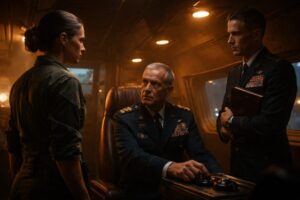
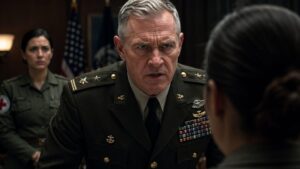
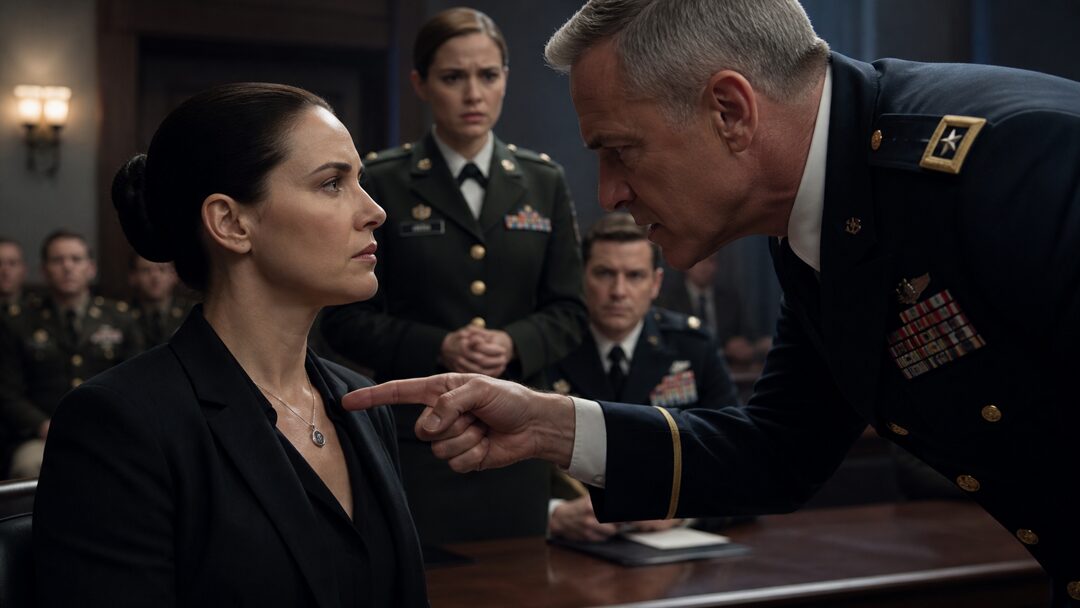
Colonel Robert Hayes pointed at the silver pendant on Captain Sarah Mitchell’s chest and said, “You don’t get to wear a dead man’s memory after betraying his unit.”
The room went so quiet Sarah could hear the old ventilation system ticking above the chandeliers.
Hayes stood close enough for her to smell the coffee on his breath. His dress uniform was perfect, every ribbon squared, every crease sharp enough to cut. His finger hovered less than an inch from the small oval of silver resting against her black blouse.
Sarah did not step back.
That was the first thing everyone noticed.
Not the accusation. Not the pendant. Not even the fact that a colonel had leaned across the end of a polished conference table as if rank gave him ownership of the air around her body.
They noticed that she stood still.
The officers seated along the table watched with the careful faces people wore when they wanted to remember nothing later. Two investigators sat near the windows with folders closed in front of them. A few junior officers lined the back wall. One of them, half-hidden behind a taller captain, lifted a phone just high enough to record.
Major Daniel Carter, the hearing officer, looked up from the file in front of him.
“Colonel Hayes,” he said quietly.
Hayes did not lower his hand.
“She accessed mission audio,” Hayes said. “She copied restricted after-action files. She went through Staff Sergeant Miller’s storage locker three days before the first leak reached civilian media.”
Sarah’s eyes moved once at the name.
James Miller.
Not Staff Sergeant Miller. Not casualty three of Operation Glass Ridge. Not a line item in a corrected casualty brief.
James.
Hayes saw the flicker.
“There it is,” he said. “There’s the grief act.”
Sarah’s attorney, Captain Paul Bennett, shifted beside her. “Sir, I object to—”
“Object all you want,” Hayes snapped. “She turned classified material into a weapon. She humiliated this command, endangered active personnel, and then walked into this room wearing his crest like she earned it.”
Sarah’s fingers did not touch the pendant.
Not yet.
Major Carter’s face remained composed, but the muscles at his jaw tightened. “Colonel, you’ll return to your seat.”
For a second, Hayes looked as if he would refuse.
Then he straightened. He lowered his hand slowly, making a show of obedience, and stepped back from Sarah with a disgust that landed harder than shouting.
Sarah breathed once.
Across the room, Lieutenant Emily Reed stood behind Hayes’s chair with her hands locked behind her back. She was young, pale, and too still. She had the drained look of someone who had not slept but had ironed her uniform anyway because fear could not be allowed wrinkles.
Sarah did not look at her for long.
Looking too long would expose her.
Major Carter turned a page in the file. “This administrative hearing concerns whether Captain Mitchell improperly accessed, copied, transmitted, or otherwise disclosed classified materials related to Operation Glass Ridge.”
The name crossed the room like a draft.
No one moved.
Operation Glass Ridge had been reported as a failed border extraction in hostile territory. Three American soldiers killed. Several local civilians dead. Weather failure. Enemy interference. Bad ground intelligence. A tragic sequence of conditions, no single point of fault.
That was what the families had been told.
That was what the unit had repeated.
That was what Hayes needed to survive.
Carter looked at Sarah. “Captain Mitchell, you understand the scope of today’s proceeding?”
“Yes, sir.”
Her voice was steady enough to make the room lean toward it.
Bennett put a hand lightly near her folder, a silent warning. Deny clearly. Say no. Do not complicate this.
Carter asked, “Did you leak classified files related to Operation Glass Ridge?”
Sarah looked at the file in front of him. Then at Hayes. Then at the pendant Hayes had tried to turn into evidence.
“No, sir,” she said.
Bennett almost relaxed.
Then Sarah added, “The record is incomplete.”
The room changed.
Not loudly. No one gasped. No one spoke over her.
But the air tightened.
Hayes smiled, and it was worse than anger.
“There,” he said. “That’s how it starts. Not with guilt. With language.”
Sarah looked at him.
He wanted heat from her. Tears. Panic. Anything messy enough to file under instability.
She gave him nothing.
Major Carter’s pen stopped moving. “Captain Mitchell, you’ll explain what you mean by that when called to testify.”
“Yes, sir.”
Hayes took his seat at last. The leather chair creaked under him.
Emily Reed lowered her eyes to the floor.
Sarah saw it.
So did Hayes.
And in that brief flicker of attention, Sarah understood something she had not let herself hope until that morning.
She was not the only person in the room carrying the lie.
Part II — The Clean Report
Colonel Hayes began with the official story because official stories always sounded cleanest before anyone touched them.
He stood at the far side of the conference table and spoke without notes.
“Operation Glass Ridge was an emergency extraction conducted under deteriorating weather conditions near the Ardan border. The team on the ground—Staff Sergeant James Miller, Sergeant Andrew Cole, Specialist David Park—was pinned near Checkpoint Voss after a convoy delay and hostile engagement. Command attempted to redirect assets. Communication degraded. By the time recovery was feasible, the team was dead.”
He paused exactly where a commander should pause.
Enough respect to look human. Not enough grief to lose control.
Sarah watched his hands.
Hayes had excellent hands for command. Large, clean, disciplined. Hands that looked like they had signed orders more often than lifted bodies. Hands that had pointed at maps, at men, at doors. Hands that could turn distance into decision.
“Captain Mitchell,” Hayes continued, “served as intelligence support for Glass Ridge. She had access to classified radio logs, drone fragments, route analysis, and internal command assessments. After the mission, she developed what I can only describe as an unhealthy fixation on one casualty in particular.”
Bennett rose halfway. “Major Carter—”
“I’ll allow limited characterization,” Carter said, though his eyes stayed on Hayes. “Keep it factual, Colonel.”
Hayes turned a folder toward the room as if facts obeyed him.
“Captain Mitchell accessed mission audio outside normal review hours six times in two weeks. She copied internal notes to an unauthorized drive. She entered Staff Sergeant Miller’s storage locker after his effects had been cataloged.”
Sarah felt the pendant warm against her skin.
Not because silver could warm that quickly.
Because memory could.
A narrow supply tent. Wind throwing dust against canvas. James Miller grinning with a broken chain in his palm.
“Can you fix this before I get back?”
“You think intelligence means jewelry repair?”
“I think intelligence means you know which drawer has the good pliers.”
“You’ll be back in thirty-six hours.”
“Then you’ve got thirty-six hours.”
He had said it like a joke.
People made jokes when they trusted the future.
Hayes’s voice pulled her back.
“The first external inquiry into Glass Ridge reached the press nine days later,” he said. “It referenced details not contained in the public report. Shortly after, the mother of Staff Sergeant Miller contacted the command demanding answers no family member had been authorized to possess.”
Sarah looked down once.
Not in shame.
In recognition.
Mary Miller’s email had contained only one sentence.
Tell me my son did not die the way they said.
Hayes glanced toward the back wall. Several junior officers straightened.
“Grief makes people reckless,” Hayes said. “I understand that. We all do. But grief does not excuse betrayal.”
Sarah’s fingers moved.
Barely.
The pendant was a small oval crest, dented along one edge. The clasp had been broken so long it could not rest properly; she had threaded it on a plain silver chain because the original had snapped in James’s hand.
Hayes saw her touch it.
His mouth tightened.
“That object,” he said, pointing again, though this time from a distance, “was removed from Staff Sergeant Miller’s personal effects before formal release to his next of kin.”
Sarah’s attorney whispered, “Do not answer unless asked.”
But Hayes wanted her to answer. That was the trap. Turn the pendant into theft. Turn grief into instability. Turn witness into obsession.
Major Carter looked at Sarah. “Captain Mitchell, did you remove that item from Staff Sergeant Miller’s effects?”
“No, sir.”
Hayes gave a short laugh. “Then how did you get it?”
Sarah’s thumb pressed the back of the pendant once.
“He gave it to me before deployment.”
“Convenient.”
“It was broken.”
“Everything becomes convenient when the other person is dead.”
The room felt that.
Even Hayes seemed to hear the cruelty after it left him, but he did not take it back.
Emily Reed’s face went whiter.
Sarah remained still, but the stillness changed. It was no longer only restraint. It was effort. A deliberate act of not letting the room see where the words had landed.
Major Carter’s voice hardened. “Colonel Hayes.”
Hayes spread his hands. “Sir, I apologize for the phrasing. Not the point.”
“Then make the point carefully.”
Hayes nodded once. “The point is that Captain Mitchell turned a soldier’s death into leverage. She had access. She had motive. She had possession of personal property tied to the deceased. And now she sits here suggesting the record is incomplete without providing lawful evidence.”
Bennett leaned close to Sarah. “We deny access and intent. Nothing more.”
Sarah kept her eyes on Hayes.
He had said James died following lawful orders.
That was the phrase in the report.
Lawful orders.
Not waiting.
Not requesting extraction.
Not asking whether command understood who was being left behind.
Not James saying, very calmly, because he had always gone calm when other people were afraid:
“Confirm, actual. You are ordering us to hold while convoy diverts away from our position.”
And Hayes, from a room with lights and maps and coffee:
“The mission priority has changed.”
Sarah had listened to that line thirteen times before she stopped shaking.
Thirteen.
On the fourteenth, she started writing down what the report had removed.
Major Carter turned to her. “Captain Mitchell, you’ll have the opportunity to respond. For now, I want a direct answer to one matter. Did you transmit any portion of the classified after-action report to unauthorized recipients?”
Bennett’s whisper was urgent now. “No. Just say no.”
Sarah felt every eye in the room.
Hayes waiting.
Emily barely breathing.
The phone at the back still raised, still recording the wrong thing and maybe the right thing.
Sarah said, “No, sir.”
Hayes leaned back, triumphant too soon.
Then she added, “I transmitted a correction to a false summary after every official channel refused to amend it.”
Bennett closed his eyes.
Major Carter’s pen stilled again.
Hayes rose so fast his chair struck the wall behind him.
“You see?” he said. “You see what she’s doing? She calls a leak a correction and expects the uniform to applaud.”
Sarah looked at him.
“No,” she said. “I expect the uniform to survive the truth.”
That was the first line someone in the back of the room would later screenshot from the recording.
At the time, no one moved.
Part III — The Missing Voice
Major Carter ordered a ten-minute recess.
No one used it like a recess.
Hayes stepped into the hallway with two investigators and spoke in a voice too low to hear, though his anger carried through the frosted glass. Bennett turned on Sarah the moment the door closed.
“What are you doing?”
“What I said I would.”
“You said you wanted the record corrected. You did not say you were going to confess to unauthorized disclosure in front of a hearing officer.”
“I sent a summary to Mary Miller.”
“You sent classified information to a civilian.”
“I sent a mother the part of the truth that belonged to her.”
Bennett rubbed a hand over his face. “That line will not save your career.”
Sarah looked at the pendant.
“I know.”
That stopped him for half a second.
He had been assigned to her case three days earlier, too late to understand that saving her career had never been the full mission. He was good at rules. She did not resent him for that. Rules were useful until someone used them as a burial cloth.
Across the room, Emily Reed stood alone beside the wall, hands still locked behind her. Her eyes flicked toward Sarah, then away.
Sarah did not approach.
Emily had been in the debrief room after Glass Ridge. Sarah remembered her sitting behind Hayes with a laptop open, typing whatever language command decided would become history. At the time, Emily had looked like every young aide near power: eager, careful, proud to be trusted.
Then James Miller’s final call played through the internal review system, and Emily’s fingers stopped moving.
Sarah had seen that too.
Some people broke loudly.
Some people simply stopped typing.
The door opened. Hayes came back in first.
He had recovered himself.
That worried Sarah more than his anger.
Major Carter returned last, carrying an additional sealed envelope that had not been on the table before recess. He placed it beside his folder without comment.
Hayes noticed immediately.
“What is that?”
Carter sat. “We’ll resume.”
“What is that, Major?”
“We’ll resume,” Carter repeated.
The room settled.
Sarah saw Emily’s throat move as she swallowed.
Hayes saw it too.
Carter looked at Sarah. “Captain Mitchell, you stated that the record is incomplete. You also stated that you transmitted what you called a correction to a false summary. The hearing will now address the basis for that claim.”
Hayes stepped forward. “Sir, unless Captain Mitchell is prepared to produce lawful, authenticated evidence—”
Carter raised one hand.
Hayes stopped, but only barely.
Sarah felt Bennett shift beside her. He had not expected this either.
Carter opened his folder. “Captain Mitchell, what material do you believe was omitted from the official summary provided to the families?”
“The final radio call from Checkpoint Voss.”
Hayes said, “Classified operational audio.”
“Which was summarized falsely,” Sarah said.
“It was summarized appropriately for next-of-kin notification and operational security.”
Sarah’s voice stayed level. “The families were told Miller’s team refused extraction to pursue hostile contact.”
“That is not the phrasing.”
“It is the meaning.”
Hayes’s face hardened. “They were told their sons died following lawful orders.”
Sarah finally turned fully toward him.
“Did they?”
A sound moved through the room. Not speech. Not shock. The small involuntary shift of bodies realizing the question had teeth.
Hayes smiled without warmth. “Command decisions are not judged by analysts who have never sat in the command chair.”
“No,” Sarah said. “They’re judged by what those decisions cost.”
“You think I don’t know cost?”
“I think you renamed it.”
Hayes came around the table again.
Bennett stood. “Colonel—”
Hayes ignored him. “You think that because you sat in a dark room with headphones on, you understand what happened on the ground?”
Sarah did not move.
He was close now. Not as close as before, but close enough for the old pressure to return.
“I had a political delegation exposed on Route Seven,” Hayes said. “I had weather collapsing visibility. I had a hostile element moving faster than projected. I had civilians flooding a checkpoint no one could secure. I had one convoy and six bad choices.”
Sarah said nothing.
Hayes’s voice lowered. “You had audio.”
There it was.
The closest he would come to honesty.
Major Carter watched them both.
Sarah said, “Miller had children at his feet and two wounded Americans still breathing.”
Hayes’s eyes flashed. “Do not use his name like you’re the only one who remembers him.”
“I’m using his name because the report didn’t.”
Hayes’s hand twitched.
Emily Reed closed her eyes.
Carter saw that. For the first time, his gaze lingered on her.
Then he touched the sealed envelope.
“Before this hearing began,” he said, “an attachment was submitted to this office through protected channel.”
Hayes froze.
Sarah did not.
She had not known for certain.
But she had hoped.
Carter continued, “The attachment appears to include mission debrief notes and a chain-of-custody reference for audio omitted from the family summary.”
Hayes turned on Sarah. “You submitted additional classified material after being placed under review?”
“No, sir,” Sarah said.
“Don’t lie to this room.”
“I didn’t submit it.”
His eyes narrowed.
Slowly, the room understood before Hayes let himself.
He turned.
Lieutenant Emily Reed stood behind his empty chair with her hands shaking at her sides now, no longer clasped.
“Lieutenant,” Hayes said.
Her title sounded like a threat.
Emily looked at Major Carter. Then at Sarah. Then finally at Hayes.
“I submitted the attachment, sir.”
The room did not breathe.
Hayes stared at her as if she had stepped out of a uniform and become a stranger.
“You did what?”
Emily’s voice was thin, but it held. “I submitted the attachment.”
“You had no authority.”
“No, sir.”
“You had no right.”
“No, sir.”
“Then why?”
Emily’s eyes filled, but she did not cry.
“Because I typed the lie.”
That was the second line people would remember.
Not because it was loud.
Because it was not.
Hayes looked almost wounded.
For one brief second, Sarah saw the man under the command: tired, older than his posture allowed, terrified that one night’s decision would become the only story anyone told about him.
Then he buried that man.
“You have been manipulated,” Hayes said.
Emily shook her head once. “No, sir. I was obedient.”
The words landed harder than defiance.
Major Carter opened the sealed envelope.
Hayes moved toward him. “Major, I strongly advise you not to enter unlawfully submitted classified material into this proceeding.”
Carter looked up.
For a long moment, he was not a judge or an officer. He was a man staring at the line between order and concealment.
Then he said, “Your objection is noted.”
Hayes went still.
Carter reached for the audio device.
Sarah’s hand closed around the pendant.
Part IV — What the Room Heard
Before the recording played, Hayes tried one more time.
He did not shout.
That made it worse.
“Major Carter,” he said, each word measured, “if you open that file in this room, you will do damage you cannot contain. You will invite review of an active command decision made under operational pressure. You will expose classified routing, political movement, allied coordination, and response limitations. You will hand enemies a map of our hesitation.”
Carter’s fingers rested beside the device.
Hayes stepped closer. “And for what? To satisfy the grief of an analyst who could not accept that war does not give clean endings?”
Sarah looked at him then.
“I accepted that he died,” she said. “You’re the one who needed him to die differently.”
Hayes flinched.
Only a little.
But enough.
He rounded on her again, anger returning because anger was easier than being seen.
“Staff Sergeant Miller was a soldier,” he said. “Not your personal cause. Not your slogan. Not your weapon against this unit.”
He came closer with every sentence.
Bennett moved between them, but Hayes angled past him.
“You think wearing that makes you loyal?” Hayes’s finger rose again. “You think putting his crest around your neck gives you permission to tear apart what he served?”
Sarah stood at the end of the table.
The pendant rested against her chest.
Hayes’s finger jabbed toward it.
“He served the mission,” Hayes said. “He served the chain of command. He served something larger than your grief.”
His finger brushed the chain.
It was barely contact.
Metal shifted against fabric.
A small, bright sound.
Sarah caught his wrist.
Not hard. Not violently. Her fingers closed around the cuff of his immaculate sleeve with a steadiness that made the whole room freeze.
Hayes stared at her hand as if no subordinate had ever touched him before.
Sarah looked him in the eyes.
“You don’t get to touch what he left behind.”
No one spoke.
The phone in the back kept recording.
Hayes could have pulled away. Could have barked an order. Could have demanded restraint.
Instead, for one second, his face emptied.
Sarah released him.
His hand dropped.
Major Carter pressed play.
Static filled the room first.
Then wind.
Then a burst of broken radio chatter.
A voice came through, low and controlled beneath the interference.
“Checkpoint Voss to actual. We have civilians inside the outer wall. Multiple wounded. Two U.S. personnel ambulatory, one critical. Requesting extraction window.”
Sarah closed her eyes for half a second.
James.
Not memory now.
Voice.
The room changed around it.
No one was watching Sarah anymore. They were listening to a dead man ask to be brought home.
Another voice answered, distorted but recognizable.
Hayes.
“Actual to Voss. Convoy diverted. Hold position.”
Miller’s voice returned after a crackle. “Confirm convoy diverted from Voss?”
“Affirmative.”
“Actual, we have children here. We have Cole losing blood. Park can move if supported. We can mark with IR. Request any alternate.”
The recording hissed.
Someone in the room exhaled too sharply.
Hayes stared at the table.
The past kept speaking.
“Negative, Voss. Mission priority has changed.”
Miller did not respond immediately.
That silence hurt more than the words.
When he came back, his voice was still calm.
“Actual, confirm you understand. You are ordering us to hold while convoy moves away from Americans and civilians at my position.”
Hayes’s recorded voice said, “You are ordered to hold.”
“Copy.”
Then softer, as if Miller had turned away from the radio but not far enough:
“Tell them to stay low. Nobody stands unless I say.”
A child cried in the background.
Then gunfire, distant at first.
Major Carter’s face had gone gray.
Emily Reed pressed her fist against her mouth.
Sarah kept standing.
There was more. Carter let it play.
Miller came back once, breathing harder. “Voss to actual. Outer wall compromised. Cole is down. Park still moving. Civilians in inner room. Request immediate—”
Static swallowed him.
Then one last fragment.
“Sarah, if this logs—”
The audio broke.
Sarah’s chest tightened so sharply she almost bent.
She had never heard that fragment in the official extract.
She had listened to the internal file thirteen times. The fourteenth had been from a cleaned copy, clipped where command said relevant communication ended.
This fragment had been buried deeper.
Or withheld.
Or saved by someone who had typed the lie.
The room waited for more.
There was no more.
Major Carter stopped the recording.
The silence afterward was not empty. It was full of everyone deciding who they had been before hearing it and who they were now.
Hayes lifted his head.
His face was rigid.
“I made a command decision.”
No one answered.
“I had a delegation exposed. If that convoy was hit, if those officials died, if the coalition collapsed—”
His voice cracked on the word if.
Then he recovered.
“I made a command decision.”
Sarah opened her eyes.
“Yes,” she said. “And then you made a report.”
That was different.
Everyone knew it.
Command decisions could be argued forever. Reports were where men chose what they could live with.
Major Carter looked at Sarah. “Captain Mitchell. The pendant.”
It was not a question. Not quite.
Sarah touched the silver oval.
For the first time since entering the room, her hand trembled.
“Staff Sergeant Miller gave it to me before he left,” she said. “The clasp was broken. He asked me to fix it before he got back.”
Her thumb moved over the dented crest.
“I didn’t.”
No one interrupted.
Not even Hayes.
Sarah looked down at the pendant, and for a moment she was back in that narrow tent with dust at the seams and James smiling like thirty-six hours was a promise.
“He said if he didn’t come back, I should give it to his mother. Then he laughed because neither of us wanted to be the kind of people who said things like that seriously.”
A painful sound moved through the room.
Not from Sarah.
From Emily.
Sarah continued, “I wore it today because every official sentence turned him into someone easier to abandon. Someone reckless. Someone disobedient. Someone who died because he chose wrong.”
Her voice thinned, but did not break.
“He did not choose wrong.”
Hayes looked away.
Sarah lifted the pendant once, not as evidence, not as decoration, but as proof that a human being had existed before paperwork touched him.
“I wore it because somebody in this room had to carry the version of him that hadn’t been edited.”
Major Carter lowered his eyes.
Then he opened the official record folder and wrote by hand.
The scratch of his pen sounded enormous.
When he finished, he said, “The record will be corrected.”
Sarah’s breath left her.
Not relief.
Not victory.
Something smaller.
Something that hurt on the way out.
Part V — The Cost of Correction
Colonel Hayes was escorted out by two officers who did not touch him until he refused the first request.
He did not look at Sarah when he passed.
He looked at the pendant.
For a moment, she thought he might say something. Not apology. She did not expect that. Maybe recognition. Maybe anger. Maybe one final command to hold the shape of himself together.
Instead, he walked out silent.
That was his last control.
The door closed behind him.
No one clapped. No one spoke. No one turned truth into celebration, because the recording had left no room for that kind of cheapness.
Major Carter called another recess, but no one stood.
Emily Reed remained near Hayes’s empty chair.
Now that he was gone, she looked even younger.
Sarah crossed the room.
Bennett started to say her name, then stopped.
Emily watched Sarah approach with the expression of someone expecting punishment from every direction.
“I should have done it earlier,” Emily said.
Sarah stopped in front of her.
“Yes,” she said.
Emily flinched.
Then Sarah added, “So should I.”
That broke something careful in Emily’s face.
Not enough to cry.
Enough to become human again.
“I was scared,” Emily whispered.
Sarah nodded.
“I know.”
Emily looked toward the closed door. “He said we had to protect the mission.”
“He believed that.”
“Did he?”
Sarah thought of Hayes’s face when the recording played. The way he had said command decision like a man pressing both hands against a wound.
“I think he needed to.”
Emily absorbed that.
It would not save Hayes. It would not save her either. But it mattered, somehow, that the story not become cleaner than the people inside it.
Major Carter called them back to order fifteen minutes later.
His voice had changed. Not softened. Sharpened.
“The material submitted through protected channel will be entered into sealed review. The official Glass Ridge summary will be amended pending classification guidance and family notification protocol.”
He paused.
Then he looked at Sarah.
“Captain Mitchell, your admission regarding unauthorized transmission to Mrs. Mary Miller remains a disciplinary matter.”
Bennett stood quickly. “Major Carter, given the evidence now entered—”
Sarah touched his sleeve.
He stopped.
She did not want him to fight this part.
Not because she wanted punishment.
Because the truth had to be clean where Hayes had made it dirty.
“I understand, sir,” Sarah said.
Carter studied her.
“You understand that correction of the record does not erase the breach?”
“Yes, sir.”
“And you understand that the breach may affect your clearance, position, and continued service?”
“Yes, sir.”
Bennett looked sick.
Emily looked stricken.
Sarah felt strangely calm.
This was the cost she had known was waiting.
The truth was not a door you opened and walked through untouched. It took something with it. Sometimes rank. Sometimes future. Sometimes the last excuse you had for silence.
Carter’s gaze moved to the pendant.
Then back to her face.
“Captain Mitchell,” he said, “why send anything to Mrs. Miller before this hearing?”
The room waited again.
Sarah could have said the official channels failed. She could have said the family had a right to know. She could have said grief should not have to file requests through men who had edited it.
All true.
None enough.
“She asked me if her son died refusing rescue,” Sarah said. “I could not let a mother sleep beside that sentence.”
Major Carter’s eyes lowered for a moment.
Then he nodded once.
Not forgiveness.
Acknowledgment.
The hearing ended without the kind of ending people imagine hearings should have. There was no gavel. No dramatic declaration. No sudden clearing of Sarah’s name.
There were instructions. Sealed procedures. Temporary relief of command. Further review. Restricted circulation. Counsel advisement.
Words that mattered and did not matter.
Sarah signed three documents.
Emily signed two.
Major Carter initialed the amended entry by hand before an aide could type it.
The person in the back lowered the phone at last.
Sarah did not ask who they would send the recording to.
For once, she did not want to control the route truth took after leaving the room.
When the doors opened, the hallway outside seemed too bright.
Mary Miller stood near the far window.
No one had told Sarah she would be there.
She was smaller than Sarah expected. Late fifties, maybe. Gray hair cut just below her chin. A dark coat folded over one arm. She held a paper cup of coffee she had not drunk.
Sarah stopped.
Mary turned.
For a second, neither woman moved.
Then Mary looked at the pendant.
Her face changed before she spoke.
Not surprise.
Recognition.
Sarah walked toward her slowly, because speed would have made the moment unbearable.
“I’m sorry,” Sarah said.
Mary’s hand tightened around the cup. “Did they play it?”
Sarah nodded.
“All of it?”
Sarah swallowed. “Enough.”
Mary closed her eyes.
The hallway continued around them. Officers passed at a distance, suddenly fascinated by walls and doors and the shine on their shoes.
Mary opened her eyes again.
“Did he sound afraid?”
That question almost undid her.
Sarah had prepared for anger. Gratitude. Blame. Even the terrible hunger of a mother asking for every detail.
But not that.
She looked at Mary and told the truth carefully.
“He sounded busy.”
Mary’s mouth trembled.
Sarah continued, “He sounded like he was taking care of everyone else.”
Mary pressed the heel of her hand to her lips.
For a moment, Sarah saw James in her. Not in the face exactly. In the effort to hold herself upright while something inside gave way.
Sarah reached behind her neck.
The clasp resisted.
Of course it did.
Broken things had a way of holding on when they were supposed to release.
She worked it loose and drew the chain forward. The silver oval lay in her palm, warm from her skin.
“I should have fixed it,” Sarah said.
Mary looked at the pendant but did not take it yet.
“He gave it to you?”
“Before he left.”
“Why?”
Sarah almost smiled.
The pain of it surprised her.
“Because he trusted I’d find the right tool.”
Mary let out a breath that might have been a laugh if grief had not caught it first.
Sarah placed the pendant in her palm.
Mary’s fingers closed around it.
The transfer took less than a second.
The loss arrived late.
Sarah had thought handing it over would feel like finishing a task. Instead it felt like setting down the last weight that had kept her standing.
Mary looked at the crest in her hand.
Then she looked at Sarah.
“He said your name,” Mary said.
Sarah went still.
Mary reached into her coat pocket and took out a folded sheet of paper. “In his last letter. The one they gave me with his things. He said, ‘If Sarah gives you grief about the clasp, tell her I was right about the pliers.’”
Sarah covered her mouth.
It was the first time all day her body disobeyed her.
Mary stepped forward and touched Sarah’s arm.
Not a salute.
Not absolution.
Just one grieving person steadying another.
Behind them, the hearing room door opened again. Major Carter came out holding a folder. Emily followed, eyes red but dry. Neither interrupted.
Sarah lowered her hand.
Mary looked down at the pendant once more.
“What happens to you now?” she asked.
Sarah glanced toward the corridor where Hayes had disappeared, toward Carter’s folder, toward Emily’s pale face, toward the bright exit doors at the end of the hall.
“I don’t know.”
Mary nodded as if that was the only honest answer left.
Then she slipped the broken pendant into her pocket, close to her heart.
Sarah felt the absence immediately.
The chain no longer rested against her throat. There was no small weight against her chest. Nothing for Hayes to point at. Nothing to hold when someone said lawful orders as if language could bury the dead.
For the first time in months, she stood without it.
It made her feel lighter.
It made her feel less protected.
Major Carter approached, stopping a respectful distance away.
“Captain Mitchell,” he said.
Sarah turned.
His face was still official, but something had shifted behind it. He held out a copy of the amended entry, stamped provisional, sealed, real.
“The record will reflect the call,” he said. “And the correction.”
Sarah took the paper.
It was not enough.
It was more than she had had that morning.
“Thank you, sir,” she said.
Carter nodded once. “That does not end the matter.”
“No, sir.”
“It does change it.”
Sarah looked at the paper in her hand, then at Mary Miller standing beside her with the pendant hidden in her pocket.
“Yes,” she said. “It does.”
Outside, the afternoon sun hit the steps in hard white squares. Cars moved beyond the gate. Somewhere on base, a bugle call rose thin and clear, marking time as if time had behaved honorably.
Sarah walked Mary to the door.
They did not speak.
At the top of the steps, Mary paused and looked back at the building.
“Did he know?” she asked.
Sarah did not need to ask who.
She thought of James’s last clear words. Tell them to stay low. Nobody stands unless I say.
She thought of the broken fragment. Sarah, if this logs—
She thought of all the things the dead almost got to say.
“Yes,” Sarah said.
Mary’s eyes filled again.
Sarah’s voice stayed soft.
“He knew someone would listen.”
Mary nodded.
Then she descended the steps with the pendant in her pocket.
Sarah remained at the doorway until Mary reached the car.
Only then did she look down at her own hands.
They were empty.
For months, she had mistaken carrying the truth for keeping faith.
Now the truth was in the record. The pendant was with his mother. The recording existed beyond the room that had tried to control it.
And James Miller was still dead.
That was the part no correction could touch.
Sarah folded the amended entry once and held it against her chest where the pendant had been.
Then she stepped into the light, not cleared, not saved, not whole.
Just no longer silent.