The Choice She Refused to Make
Part I — The Line of Fire
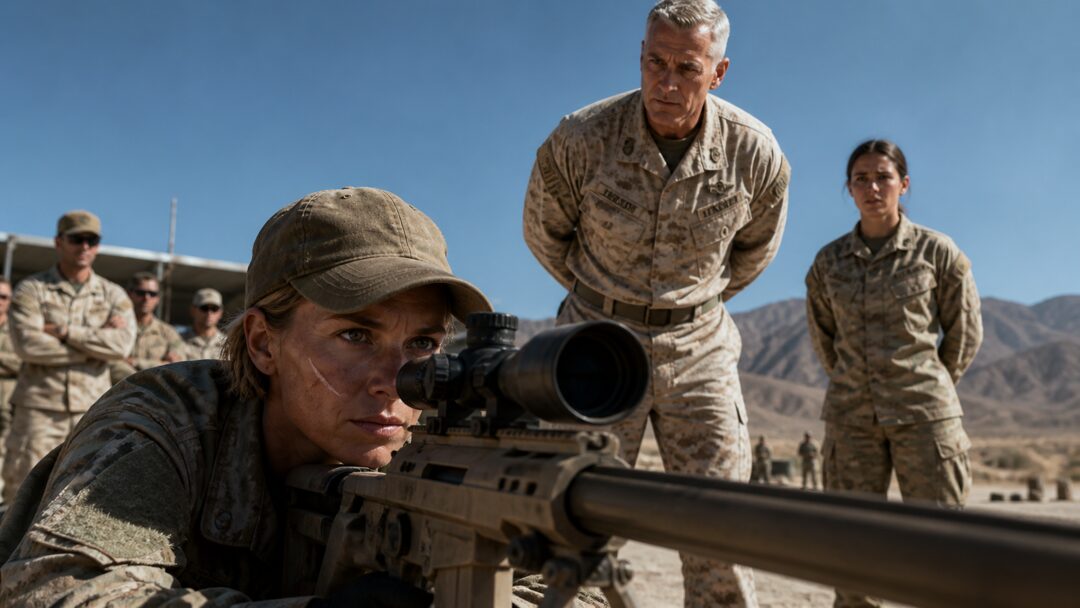
Emily Carter had been lying behind the rifle for eleven seconds too long, and everyone behind her knew it.
The desert range had gone so quiet she could hear dust ticking against the metal bipod.
Nine hundred yards downrange, a target waited in the heat shimmer. Twelve people stood behind her in a careful military line: officers, instructors, evaluators, young soldiers pretending not to stare. They had all come to watch the famous marksman either recover or fail in public.
Major Mark Reynolds stood closest.
“Send it when ready,” he said.
Emily did not move.
Her cheek stayed pressed to the rifle stock. Her right eye stayed open. Her left hand was locked beneath the rear bag, fingers still, wrist steady. Sweat slid from under the brim of her faded cap and cut a clean track through the dust on her cheek.
She had made longer shots than this with a cracked scope, a fever, and sand in her teeth.
This was not a hard shot.
That was the problem.
Behind her, someone shifted their boots in the gravel.
Someone whispered, “Is that her?”
Another voice answered, lower, “Glass Road.”
Emily let the word pass through her without flinching.
Glass Road. The name had followed her for nineteen months. It had been printed in reports, buried in commendations, muttered in briefing rooms, sharpened in barracks gossip. Sometimes it was a mission. Sometimes it was a failure. Sometimes it was a way for people who had never been there to decide what kind of woman she was.
The rifle smelled of oil and hot metal. The range smelled of burnt powder, dry brush, and the kind of sun that made every breath feel borrowed.
Major Reynolds glanced at his watch.
He looked the same as he had in the convoy briefings overseas: tall, controlled, uniform immaculate despite the heat, silver hair cut close, eyes flat with purpose. Men like him did not sweat in public. They absorbed discomfort and called it discipline.
“Sergeant Carter,” he said, his voice carrying enough for the line behind her. “This is a live qualification demonstration for the advanced field selection program. Take your time, but don’t leave the range waiting.”
The line behind her tightened.
Emily knew the shape of that silence.
It was not patience.
It was judgment trying to look professional.
She inhaled once. Let half of it out. Settled the crosshairs.
The target came into focus.
It should have been a standard human silhouette. Torso. Head. Scoring zones. Clean geometry for clean instruction.
It was not.
The painted figure stood half behind a narrow barricade, one shoulder exposed, head canted at an angle. Beside the barricade, almost swallowed by white glare, was a smaller shape.
Just a sliver.
Just enough.
Emily’s finger rested near the trigger.
Then moved away.
The dust kept ticking against the bipod.
Major Reynolds’ voice softened.
“Problem with the sight picture?”
Emily did not answer.
Downrange, the small white shape flickered in the heat.
For a moment, it was only painted board.
Then it was a child’s shirt.
Part II — The Demonstration
The Army had not invited Emily back as a soldier.
It had invited her back as proof.
That was how Reynolds had phrased it in the briefing tent that morning, standing beside a projection screen and a row of folded flags from units that were not present.
“Recovery of elite capability after combat stress,” he had said, pointing to a slide with her name on it. “Sergeant Carter’s participation gives this program weight.”
Participation.
Not consent.
The new selection course was supposed to identify soldiers who could operate under pressure without hesitation. Command wanted a demonstration. The instructors wanted a case study. The young shooters wanted a legend they could measure themselves against.
Emily had almost laughed when she saw her own photo on the slide. It had been taken before Glass Road, before her cheekbone scar faded from red to white, before she learned that a medal could feel like a gag.
In the photo, Captain Sarah Miller stood beside her with rolled sleeves and a grin full of dust.
Sarah had tied a red bandanna to her pack strap because she said every convoy needed one stupid lucky thing.
Emily had looked at that photo for less than a second.
Then Reynolds clicked past it.
Now, on the range, he stepped closer until his shadow fell near Emily’s boot.
“Pause,” he called.
The safety officer repeated the command. The line behind them loosened just enough to breathe.
Emily stayed prone.
Reynolds crouched near her right side. Not close enough to violate protocol. Close enough that his voice could become private.
“You’re over-reading the target,” he said.
Emily kept her eye near the scope. “Who built it?”
“It’s a training array.”
“That’s not what I asked.”
His jaw moved once.
Behind him, a young sergeant watched from the line with her hands clenched behind her back. Ashley Brooks. Emily remembered the name from the morning roster. Compact frame, dark hair pulled tight, uniform too new in the places experience usually softened. She had the alert, hungry look of someone trying to be seen as ready before she was certain she was.
Ashley had looked at Emily during the briefing like she was looking at a warning and a door at the same time.
Reynolds followed Emily’s gaze and noticed Ashley watching.
Then he smiled without warmth.
“It came from an after-action package,” he said. “Modified for training.”
Emily turned her face from the scope for the first time.
The movement was small, but the line noticed.
After-action package.
There were phrases designed to make blood sound administrative.
Emily looked at Reynolds. “From Glass Road?”
No one behind them spoke.
Reynolds stood slowly. “Yes.”
The heat pressed down.
Emily felt the rifle under her hands, long and heavy and perfectly built for distant decisions. She had once loved the honesty of a rifle. The math of it. The discipline. Wind, breath, pressure, patience. A shot did not care about rank or rumor. You either understood the moment or you didn’t.
Then Glass Road taught her that understanding did not save you.
Reynolds lifted his voice again, addressing the group.
“Today’s demonstration is not about punishment,” he said. “It is about restoration. Sergeant Carter is here because the Army believes performance can be recovered after acute operational stress.”
There it was.
Recovered.
As if she were misplaced equipment.
Ashley’s eyes flicked to Emily, then away.
One of the instructors muttered something into a clipboard. Emily caught only the last part.
“Failure to engage.”
The words entered her cleanly, like cold water through fabric.
She had seen those words before.
In the report, the child was not a child.
The child was “visual obstruction.”
Her hesitation was not hesitation.
It was “failure to engage hostile actor.”
Sarah Miller was not Sarah with a red bandanna and a laugh that could cut fear in half.
She was “friendly casualty, KIA.”
Emily lowered her face back to the rifle.
Reynolds crouched again. His voice dropped.
“You can end this today.”
Emily stared through the scope at the painted figure.
“I know what you’re doing,” she said.
“No,” Reynolds said. “You know what you did.”
The line behind them went very still.
He let the sentence hang there because he knew what it weighed.
Then he added, softer, “Three seconds, Carter.”
Emily’s hand tightened beneath the stock.
“Three seconds,” he repeated. “That was the window.”
The scope blurred.
Sand. Heat. A wall the color of bone. Radio chatter broken by static. Sarah’s voice in her ear, low and steady.
Take only what’s true, Em.
That had been Sarah’s way. In briefing rooms. In convoys. In grief. Take only what’s true, and leave the rest for men who need speeches.
Emily blinked once.
The target sharpened.
The small white shape remained.
Part III — Glass Road
Nineteen months earlier, Operation Glass Road had begun as a convoy movement through a dead district and ended as a story everyone needed simplified.
Emily had been on overwatch from a broken second-floor room above a bakery that smelled of old flour and fuel. Her scope watched the road. Sarah’s convoy crawled below in armored vehicles dusted pale by the morning.
Reynolds commanded from the tactical channel. Calm. Precise. Certain.
The first explosion had not been the worst one.
The worst thing was the quiet after.
Then Sarah’s voice came through, breath rough but controlled.
“Carter, we’ve got eyes calling movement west wall?”
Emily found him three seconds later.
A man at the edge of a courtyard. Thin. Dark shirt. One hand near a radio. He was watching the convoy with the stillness of someone waiting for timing.
A spotter.
Emily put the crosshairs over his chest.
Then the child moved.
Small. Maybe six. Maybe younger. White shirt. Bare knees. Pressed against the man’s body so tightly Emily could see the man’s fingers twisted in the fabric at the back of the child’s neck.
The man knew what he was doing.
So did Emily.
“Carter,” Reynolds said over the channel. “Engage.”
Emily shifted half an inch, looking for a lane that was not there.
The man turned his shoulder.
The child’s face appeared in the edge of the scope.
Wide eyes. Dust on one cheek. Mouth open but not crying.
“Carter. Engage.”
Sarah’s convoy was stopped below. One vehicle angled wrong. Soldiers moved around it, trying to create a perimeter where there was no cover.
Emily’s finger touched the trigger.
The man’s radio hand twitched.
“Engage now,” Reynolds said.
Emily could not make the bullet choose only the guilty.
Three seconds.
That was all the time in the report.
Three seconds was nothing unless you lived inside them.
In the first second, Emily waited for the child to twist away.
In the second, Sarah said, “Em?”
Not angry. Not afraid.
Just her name.
In the third, the road opened.
A flash under the lead vehicle. Then the sound, huge and metallic, breaking the air into pieces.
Emily lost the target in smoke.
When she found the courtyard again, the man was gone.
The child was gone.
Sarah’s channel stayed open.
For a while there was only static.
Later, they gave Emily a medal for actions taken after the blast. She had dragged a wounded radio operator across a doorway under fire. She had marked two shooters. She had stayed until the extraction bird came low enough to kick sand into the blood.
They did not put the child in the citation.
They did not put Sarah’s last joke either, the one she made before they rolled out that morning, holding up the red bandanna and saying, “If this thing works, I’m promoting it.”
Emily kept that bandanna folded in a drawer for eight months.
Then she burned it in a coffee can behind the rehabilitation barracks because she could not stand owning the only thing from Sarah that had survived clean.
Now, on the desert range, Reynolds stood above her again.
“Sergeant Carter.”
The present returned in hard pieces.
Sun. Rifle. Dust. Target. Witnesses.
Ashley Brooks had moved closer with the other evaluators, not enough to break formation, enough to hear if she wanted to.
Emily stayed prone.
Reynolds said, “This program exists because hesitation costs lives.”
Emily’s laugh came out once, dry and almost soundless.
Reynolds’ face tightened.
“You disagree?”
Emily did not look up. “I think you cut the child out of the lesson.”
No one behind them moved.
Reynolds said, “Careful.”
The word landed sharper than a shout.
Emily turned her head enough to see him.
“You put the wall in,” she said. “You put the angle in. You put his shoulder exactly where it was. But you made the child a white shape tucked behind plywood so nobody has to call it a child.”
Reynolds’ eyes hardened.
“It is a target array.”
“It is a confession you painted badly.”
For the first time all morning, Major Reynolds looked less certain.
Only for a breath.
Then command returned to his face.
“You were ordered to engage a hostile actor directing fire on a convoy.”
“And I had a noncombatant in the line.”
“You had a shot.”
“I had a child.”
The words came out flat. Not loud. That made them worse.
Behind Reynolds, Ashley’s mouth parted slightly.
The officers behind her did not look at each other. That was how Emily knew they had not all known. Or had known enough not to want more.
Reynolds stepped closer.
“You want to litigate the past on a live range?”
“No,” Emily said.
“Good.”
“I want you to stop teaching it wrong.”
The silence after that had weight.
Far downrange, the target shimmered.
The painted man waited with his hidden white shape, patient as memory.
Part IV — The Next Shooter
The pause lasted long enough for the range staff to become uncomfortable.
Then Reynolds made a choice.
He turned toward the line and spoke in his cleanest command voice.
“Sergeant Carter is experiencing a stress response linked to the historical scenario. That is precisely why this course matters. The objective is to separate emotional interference from operational necessity.”
There it was again.
The conversion.
Pain into data. Doubt into defect. Conscience into interference.
Ashley’s gaze dropped to the ground.
Emily saw it and understood something she should have seen earlier.
This demonstration had never been for Emily alone.
Reynolds had not staged the target to heal her. He had staged it to use her. If she fired, she would become living proof that the Army’s version was correct. The frozen sniper restored. The hesitation cured. The lesson clean enough to print.
If she failed, she would become a warning.
Either way, the course would get what it needed.
Ashley shifted, then stepped forward before she seemed to know she was doing it.
“Major Reynolds?”
He turned.
Her shoulders straightened. “Am I still scheduled after Sergeant Carter?”
The question was small.
Its effect was not.
Emily looked at her.
Reynolds’ expression did not change, but something in him closed.
“You are,” he said.
Ashley swallowed. “Same lane?”
“Modified to your evaluation standard.”
“That means yes,” Emily said.
Reynolds looked back at her. “It means Sergeant Brooks is ready to be evaluated without theatrics.”
Ashley’s face flushed, but she did not step back.
Emily saw the girl beneath the uniform then. Not weak. Not childish. Just young enough to believe that if she obeyed perfectly, no one could ever call her afraid.
Emily had been that young once.
She had mistaken hardness for safety too.
Reynolds moved to block the line of sight between them, but Emily had already seen enough.
“Ashley,” Emily said.
The younger sergeant looked startled at being addressed by her first name.
Emily kept her voice low. “When you get behind the rifle, what do you think they’re testing?”
Ashley glanced at Reynolds.
He said, “Sergeant Brooks, return to position.”
Ashley stayed where she was.
Emily waited.
Ashley’s hands flexed once at her sides.
“Whether I can take the shot,” she said.
“No,” Emily said. “Whether you’ll stop asking what the shot is.”
Reynolds snapped, “That is enough.”
The words cracked across the range.
A few soldiers straightened instinctively.
Emily did not.
She had heard Reynolds angry before. Overseas, anger had made him colder. Here, under the desert sun, it made him look almost human.
Almost.
“You are under evaluation,” he said. “Not command.”
“I know.”
“Then act like it.”
Emily looked back through the scope.
The painted figure swayed in the shimmer.
The small white shape beside it came and went.
She thought of Sarah’s red bandanna burning black in the coffee can. Thought of the child’s face in the edge of the scope. Thought of three soldiers dead because she had not fired. Thought of one child alive because she had not fired. Thought of how everyone wanted one of those facts to erase the other.
Nothing erased anything.
That was the part they hated.
Reynolds crouched beside her one last time.
His voice dropped so low it belonged only to the two of them.
“I carried them too, Carter.”
Emily did not answer.
“You think I slept through Glass Road? You think I don’t know every name?”
At that, she looked at him.
For a moment, his face was not a commander’s face. It was older than it had been that morning. Tired in the places discipline could not smooth out.
“Sarah trusted you,” he said.
The name struck harder than the rank ever had.
Emily’s throat tightened.
Reynolds saw it and pressed.
“She trusted you to do your job.”
Emily’s hand shifted on the rear bag.
Sarah had trusted her.
That was the wound under all the others.
Not that Sarah would have blamed her. Not that Sarah would have forgiven her. Those were fantasies for people who needed endings.
The truth was worse.
Sarah was dead, so Emily had spent nineteen months arguing with a woman who could never answer.
Reynolds stood.
His voice rose for everyone.
“Sergeant Carter, you will complete this lane or step off the firing line and be removed from consideration for instructional reinstatement.”
There was no wind for a second.
Only heat.
Only twelve witnesses waiting to see what kind of story she would become.
Emily lowered her mouth close to the rifle stock.
She heard Sarah again, not from the radio this time, but from some old morning before the convoy, when they had eaten chalky protein bars on the hood of a vehicle and watched the sun come up through dust.
Take only what’s true, Em.
Emily closed her eyes once.
Then opened them.
Part V — The Bracket
The range disappeared until there was only the line between her eye and the target.
Not Reynolds.
Not Ashley.
Not the officers with clipboards.
Not the rumor of Glass Road moving from mouth to mouth behind her.
Her breathing slowed.
In.
Half out.
Hold.
The crosshairs found the exposed chest of the painted figure.
A perfect lane.
An easy report.
A restored soldier.
Emily moved past it.
The scope drifted to the head.
Past that too.
To the barricade.
To the pale sliver.
To the thin metal bracket bolted behind the frame, barely visible where the target assembly met the rail.
It was not the scoring zone.
It was not what she had been ordered to hit.
It was the only honest point on the range.
Her finger took up the slack.
Behind her, Reynolds said, “Send it.”
Emily thought of the child’s shirt.
Sarah’s bandanna.
Ashley’s nervous hands.
Three seconds.
This time she used them.
First second: she saw what they wanted.
Second second: she saw what they had hidden.
Third second: she chose.
The rifle fired.
The muzzle flash cracked open the silence. Dust jumped from the ground. The recoil drove back into her shoulder, familiar as a heartbeat she had not trusted in nineteen months.
Downrange, the bullet struck metal.
The bracket snapped.
The target assembly lurched sideways, twisted, and dropped hard enough to kick up pale dirt around its base.
For half a second, nobody understood.
Then the silhouette fell away from the barricade, and the smaller white shape behind it stood exposed.
A child-sized figure.
Painted flat. Tucked into the blind edge. Hidden from the observers unless the target moved.
The range went silent in a different way.
Not waiting now.
Witnessing.
Emily lifted her finger from the trigger and set the rifle safe with careful, visible movements.
No one spoke.
The instructors stared downrange.
One officer lowered his clipboard.
Ashley took one step forward, eyes fixed on the exposed shape.
Reynolds’ face had gone still.
Emily could feel him deciding how to regain control.
He did it quickly.
“Unauthorized point of aim,” he said. “Deliberate failure to follow lane instruction.”
His voice was sharp enough to cut the spell.
A few heads turned back toward him.
That was how institutions survived. They renamed the thing before anyone could feel it.
Emily began clearing the rifle.
Reynolds stepped closer.
“Sergeant Carter has demonstrated exactly why emotional substitution compromises operational—”
“There was a noncombatant in the target array,” Ashley said.
Her voice was not loud.
It carried anyway.
Reynolds turned.
Ashley’s face had gone pale, but she did not look down.
“What did you say, Sergeant?”
Ashley pointed downrange.
“There was a noncombatant in the target array,” she repeated. “Sergeant Carter identified it.”
The line behind her shifted.
One of the younger soldiers raised binoculars. Another followed. The safety officer stared through his range glass and said nothing, which said enough.
Reynolds looked at Ashley as if she had stepped over a line she could never step back from.
“You are not part of this evaluation.”
Ashley’s hands trembled once.
Then stopped.
“I think I am, sir.”
That sentence changed the range more than the gunshot had.
Emily looked at her then.
Really looked.
Ashley Brooks stood in the dust, young and afraid and refusing to let fear make her useful.
Reynolds’ voice lowered. “Be careful, Sergeant.”
Ashley nodded once, swallowing hard.
“Yes, sir.”
But she did not withdraw the words.
Emily finished clearing the rifle. Every movement was exact. Magazine out. Chamber checked. Bolt open. Weapon safe.
Then she pushed herself up from the ground.
Her knees protested. Her shoulder ached. Dust clung to the sweat on her face and neck. For a moment she was simply a woman standing after being pressed too long against the earth.
Reynolds stood in front of her.
“You understand what this means,” he said.
Emily met his eyes.
“Yes.”
“You will not turn this into a spectacle.”
She glanced past him at the fallen target.
“I didn’t build the spectacle.”
His mouth tightened.
For one second, Emily thought he might say Sarah’s name again.
He did not.
Maybe even he knew he had used it once too many times.
The officers began murmuring behind him. Not rebellion. Not justice. Just discomfort, the first crack in a polished surface. It would not save Emily from reports. It would not rewrite Glass Road by sunset. It would not bring Sarah back or tell the child, wherever that child was, that an American soldier still saw their face in every white shape near a wall.
But it was something.
A crack was not freedom.
It was where air entered.
Ashley approached slowly, as if Emily might vanish if she moved too fast.
Up close, she looked younger.
“I thought you froze,” Ashley said.
The words came out before she could soften them.
Emily appreciated that. Softness could be another kind of lie.
“So did I,” Emily said.
Ashley looked downrange. The target lay crooked in the dust, the painted man folded away from the child-sized shape he had been hiding.
“Did you know that would happen?”
“I knew where the bracket was.”
“That’s not what I meant.”
Emily almost smiled.
No, she thought. It never was.
Reynolds was speaking with two officers now, his hands folded behind his back, posture perfect. Already the machine was moving. Already the words were forming: deviation, emotional response, insubordination, review.
Emily should have felt afraid.
She did, a little.
But fear was no longer the largest thing in her.
Ashley said, “What happens to you now?”
Emily looked at the rifle on the mat.
For nineteen months she had believed the Army held the answer to that. Whether she was fit. Whether she was broken. Whether she had failed Sarah. Whether three seconds made her a coward.
Now the rifle was quiet.
The target was down.
And the answer, whatever it was, did not belong only to them anymore.
“I don’t know,” Emily said.
Ashley nodded, as if that was the first honest thing anyone had said all day.
Emily picked up her cap from the mat and brushed dust from the brim. Her hand passed over the pale scar on her cheek without meaning to.
Ashley was still watching the fallen target.
Emily stopped beside her.
“A clean shot isn’t always a clean choice,” she said.
Ashley looked at her.
This time there was no admiration in her face.
There was something better.
Understanding, still painful enough to be useful.
Emily walked off the firing line with dust on her uniform and heat on the back of her neck. No one saluted. No one stopped her. Behind her, the range remained quiet around the broken target.
She did not look back until she reached the gravel path.
Downrange, the white shape was still visible beside the fallen silhouette.
Small.
Unscored.
Impossible to erase now that everyone had seen it.
Emily stood there for one breath longer.
Then she kept walking.