The Man with the Mop
Part I — The Spill
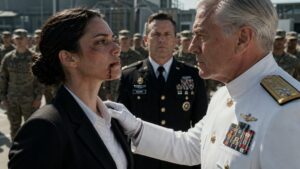
Commander Mark Reynolds stepped close enough for Robert Miller to smell the coffee on his breath and said, “Are you deaf, or just stupid?”
The hearing room went quiet in the way rooms go quiet when everyone hears cruelty and decides, very quickly, not to be the first person to object.
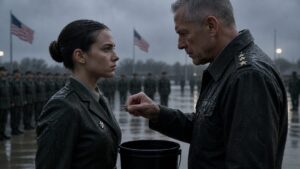
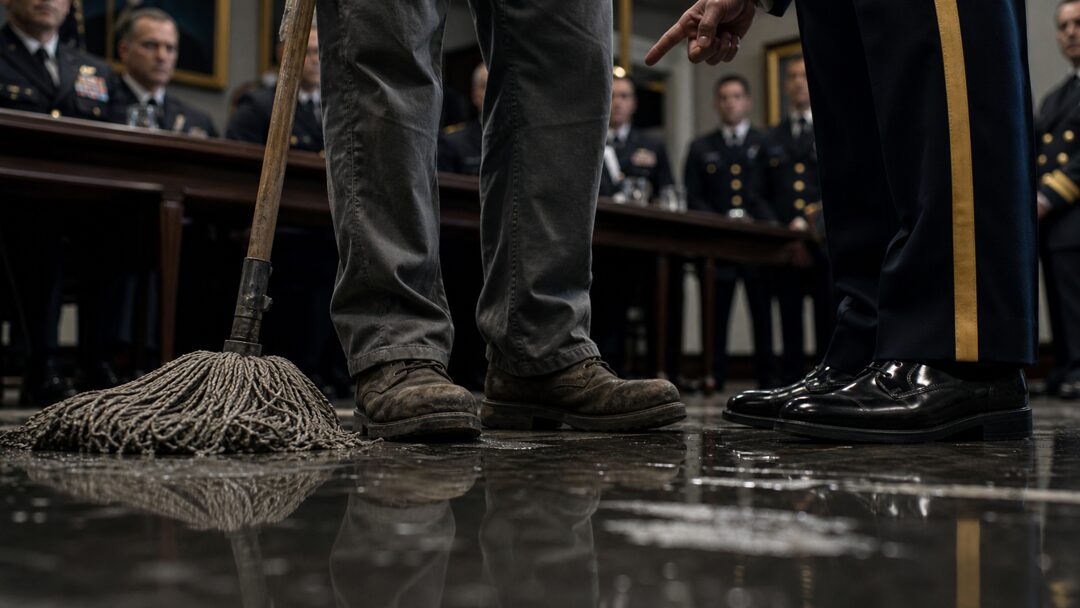
Robert stood in the center of the polished floor with a wet mop in his right hand.
Twelve officers in dress blues watched him.
Their ribbons shone. Their shoes reflected the overhead lights. Behind them, framed portraits of admirals stared down from paneled walls, solemn and permanent, as if judgment had always belonged to men in uniform.
Robert wore a gray work jumpsuit with a faded patch over the breast pocket that read: FACILITIES.
No rank.
No ribbons.
No cover tucked under his arm.
Just old boots, a yellow mop bucket, and a strand of gray hair fallen across his forehead.
Reynolds looked at the bucket, then at Robert’s face.
“Well?” he said. “I asked you a question.”
Robert lowered his eyes.
He had learned, over a long life, that some men only heard silence as permission.
A few officers shifted in their chairs. Someone near the back cleared his throat, then stopped as soon as Reynolds glanced in his direction.
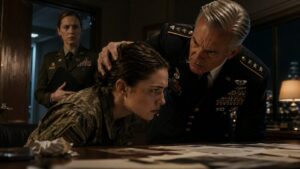
Lieutenant Emily Carter sat at the far side of the long conference table, a stack of review packets squared in front of her. She was young enough that her uniform still looked newly earned, though she wore it with care. Her dark hair was pinned so tightly it seemed to pull seriousness into her face.
She looked at Robert longer than anyone else did.
Not with pity.
With attention.
That was worse, somehow.
Robert gripped the mop handle and said nothing.
Reynolds gave a short laugh.
“He wanders into a restricted review with a mop, then stares at us like we interrupted him.”
“It was a spill, sir,” Emily said before she seemed to decide whether she was allowed to speak. “Outside the east door. Facilities was called before the meeting.”
Reynolds did not turn toward her.
“I’m sure Facilities can finish after the adults are done.”
Robert moved toward the bucket.
The mop strings dragged a dark crescent of water over the floor. He had been halfway through wiping up coffee someone had dropped near the sideboard when the officers arrived early, fast and tense, filling the room before he could leave.
He had kept his head down then, too.
He knew rooms like this. He knew which silences meant business and which ones meant burial.
He was almost to the door when he saw the diagram.
It was projected on the front screen in blue and white: a simplified deck layout, ventilation routes marked in red, watertight hatches numbered in black.
The shape of it stopped him cold.
Not the same ship.
Not the same year.
But close enough that his hand tightened around the mop until the wood bit into the old scar across his palm.
Compartment 3A.
Auxiliary passage.
Ventilation override.
Delayed hatch release.
There were some pictures memory did not store as pictures. It stored them as smoke in the throat.
Reynolds noticed him staring.
That was when the commander smiled.
“Studying strategy now?” Reynolds said. “With a mop in your hand?”
A few officers gave the kind of laughter that was more obedience than amusement.
Robert did not answer.
He looked at the diagram one second longer.
Then he looked down again.
Reynolds stepped aside and swept one hand toward the floor beneath the conference table.
“Go on, then. Since you’re here. Clean around the chairs. Quietly. We have real sailors to discuss.”
The word real landed harder than stupid.
Robert bent.
His knees gave a small, familiar protest. He pushed the mop beneath the table between rows of polished shoes and trouser legs pressed sharp enough to cut paper.
Above him, Reynolds resumed the meeting.
“As I was saying,” the commander said, “the preliminary recommendation remains unchanged. The fatalities aboard the USS Colton during the training simulation resulted from failure to execute established emergency procedure under pressure.”
Robert’s hand paused.
Failure to execute.
Established procedure.
Under pressure.
Old words, wearing new uniforms.
Emily Carter looked down at her packet.
Robert saw it because he was close to the table now, bent low enough that no one thought to guard their faces.
She had one finger pressed to the page. Her other hand rested on a tabbed appendix she had not opened.
Reynolds said, “Lieutenant Carter, read the summary finding.”
Emily’s mouth tightened.
Then she read.
“Two junior sailors entered Compartment 3A after alarm initiation. They failed to secure their route before smoke saturation. They failed to respond to withdrawal orders in the designated window. Contributing factors include panic response, lack of discipline under emergency conditions, and—”
Robert shut his eyes.
For half a second, the hearing room disappeared.
He heard a different room. A different officer. A different file.
Panic response.
Lack of discipline.
Failure to obey.
He smelled melted insulation.
He heard Brian at seventeen, laughing in the garage, trying to spin an old Navy challenge coin across the workbench.
“Dad,” Brian had asked, “does fear ever go away?”
Robert had told him the truth.
“No. You just learn where to put it.”
The mop dripped onto the floor.
Reynolds saw the wet spot spreading beside Robert’s boot.
He smiled again.
“Careful,” he said. “Wouldn’t want you making a bigger mess than you came in to clean.”
This time, no one laughed.
Part II — Real Sailors
The dead sailors’ names were Seaman Paul Avery and Fireman Joseph Kline.
Robert learned that from the packet Emily had set near the table edge. He did not mean to read it. He saw the names because grief had made his eyes good at finding the dead in official documents.
Avery was twenty.
Kline was nineteen.
Both had been assigned to a controlled shipboard fire simulation that should never have reached lethal conditions.
That was how the summary phrased it: lethal conditions.
The Navy had beautiful language for ugly things.
Reynolds stood at the front of the room with a laser pointer in his hand.
“Training environments depend on discipline,” he said. “If junior personnel improvise or hesitate, even a controlled evolution can turn dangerous. The issue here is not equipment. It is response.”
Emily’s gaze flicked up.
Robert saw it.
So did Reynolds.
“Lieutenant,” he said, without raising his voice.
Emily straightened. “Yes, sir.”
“You have something to add?”
“No, sir.”
The lie sat on her face like heat.
Robert pushed the mop in slow, even strokes.
He had spent fifteen years learning how to be invisible in rooms full of men who believed floors cleaned themselves. He cleaned around promotion boards, disciplinary panels, memorial receptions, retirement luncheons. He emptied trash cans filled with drafts of speeches about honor. He wiped fingerprints from glass cases displaying medals.
Once, a young ensign had handed him a half-empty coffee cup without looking away from his phone.
Robert had taken it.
That was the bargain he had made with himself. Stay close. Stay quiet. Keep moving. Do not give the building any more of you than it already took.
But the diagram on the wall kept dragging him backward.
Fifteen years earlier, Brian Miller had died aboard the USS Osprey during an emergency drill that became a real fire because a ventilation fault was ignored, then hidden, then explained away.
Brian had been twenty-two.
He had Robert’s hands and his mother’s eyes.
The report said Brian failed to withdraw when ordered.
The Navy sent Robert a folded flag, a letter from a rear admiral, and language sharp enough to skin a father alive.
Robert had read the sentence until the paper softened at the crease.
Failure to obey evacuation instruction.
As if Brian had chosen smoke.
As if discipline could open a jammed hatch.
At the head of the table, Reynolds turned to the next slide.
“Compartment 3A lost primary visibility at 0817. The withdrawal order was issued at 0819. Exit route remained available until 0821.”
Emily looked down again.
This time, Robert saw her thumb shift to the appendix.
Reynolds saw that too.
“Lieutenant Carter,” he said, “the approved summary.”
She hesitated.
Only a breath.
But in a room built on hierarchy, a breath could sound like mutiny.
“Yes, sir,” she said.
Robert rinsed the mop.
The water in the bucket had turned gray.
Captain James Harris sat at the table’s far end, his hands folded, his face unreadable. He was older than Reynolds, broader, with silver at his temples and tiredness in the corners of his eyes. Unlike Reynolds, he did not wear his authority like armor. He wore it like weight.
He had not laughed.
He had not intervened either.
Robert knew that kind of man.
Most rooms were held together by men who disliked cruelty but feared disorder more.
Reynolds continued.
“The recommendation will emphasize stricter compliance training, faster command response acknowledgment, and discipline reinforcement for junior damage-control teams.”
Damage-control teams.
Robert almost smiled.
Once, those words had meant something solid to him. Heat, steel, trust. A line of sailors moving through smoke because the man in front of them believed the man behind them would not let go.
Now the words sounded laminated.
Emily turned a page.
A loose sheet slipped from her packet and skated under the table.
It landed near Robert’s boot.
He bent to pick it up.
Before Emily could reach for it, Robert saw the line stamped halfway down the page.
MAINTENANCE WARNING: AUXILIARY VENTILATION OVERRIDE UNRESPONSIVE DURING PRE-DRILL CHECK.
His breath stopped.
There it was.
Not memory.
Not suspicion.
Not an old man hearing ghosts.
A warning.
Logged before the drill.
Downplayed after the deaths.
Emily’s hand hovered near the paper.
Robert handed it to her.
For one second, their eyes met.
She knew.
Not all of it. Not Brian. Not the Osprey. Not the folded flag in a drawer Robert had not opened in eleven months.
But she knew the packet in front of her was not the whole truth.
Reynolds snapped his fingers once.
“Janitor.”
Robert turned.
Reynolds pointed at a water mark beside the commander’s chair.
“You missed a spot.”
Robert looked at the floor.
Then at the diagram.
Then back down.
“Yes, sir,” he said quietly.
It was the first thing he had said all morning.
Reynolds’s smile sharpened.
“There he is.”
Robert bent again.
And somewhere behind him, Emily stopped pretending to read.
Part III — The Name
The hearing should have ended in twenty minutes.
Reynolds tried to make sure it did.
He moved faster now, sliding past questions, summarizing objections before anyone made them, treating hesitation as incompetence. His voice stayed smooth. That was the danger of him. He could humiliate a man and sound like he was maintaining order.
“Command cannot function,” Reynolds said, “if every adverse outcome becomes an excuse to undermine authority.”
Captain Harris finally spoke.
“No one is suggesting that, Commander.”
“No, sir,” Reynolds said. “Of course not.”
But he glanced at Emily when he said it.
She lowered her eyes.
Robert saw shame pass across her face and disappear beneath training.
He knew that too. The military did not only teach people how to stand straight. It taught them how to swallow what rose in them.
Reynolds turned as Robert moved behind him with the mop.
“Still here?”
Robert stopped.
“You told me to clean the floor, sir.”
“And now I’m telling you to finish somewhere else.”
Robert nodded.
He should have left.
He had left rooms before. He had left when officers joked about enlisted men. He had left when memorial plaques were hung crooked. He had left when someone called Brian’s generation soft.
Leaving was how he stayed alive.
Then Reynolds leaned close behind him.
Not loud. Not quite private.
Just enough for everyone to hear if they wanted to.
“You people are always near the Navy,” Reynolds said, “and never part of it.”
The room changed before Robert moved.
A chair creaked.
Emily looked up.
Captain Harris’s hands tightened.
Robert turned slowly.
For the first time, he lifted his eyes fully to Reynolds’s face.
The commander’s expression did not change, but something in his jaw shifted.
Robert’s voice came out low.
“I was part of it before you learned how to salute.”
No one breathed.
Then Reynolds laughed.
It was too quick.
Too bright.
“Is that right?”
Robert did not answer.
Reynolds looked around the room, inviting others back into his control.
“We have a philosopher in Facilities.”
Emily stood.
The movement surprised even her. Her chair legs scraped softly against the floor.
“Sir,” she said, “may I ask his name?”
Reynolds turned. “Lieutenant—”
“His name,” Emily said, quieter now, but not sitting.
Robert looked at her.
He could still leave.
He could push the bucket out, clock his hours, eat soup from a microwave container in the maintenance office, take the late bus home, and let the dead belong to paper again.
Instead, he said, “Robert Miller.”
Emily’s face searched his.
Captain Harris’s did not.
His face went still in a different way.
“Miller?” Harris said.
Robert looked toward him.
The captain leaned forward. “Chief Robert Miller?”
Reynolds stopped smiling.
Robert said nothing.
That was answer enough.
Harris pushed his chair back a few inches.
“USS Hartwell,” he said, as if the name had come out of a locked drawer.
Several officers turned toward him.
Emily looked from Harris to Robert.
Reynolds’s eyes narrowed.
Robert stared at the floor between them. The mop head lay across the shine like something dead and pulled from water.
Harris spoke more carefully now.
“There was a commendation. Sealed for years. Fire in the aft engineering spaces. Seven sailors pulled out.”
Robert’s thumb moved against his pocket.
Inside it, the challenge coin pressed against his leg.
Brian’s coin.
Smooth at the edges from fifteen years of being touched instead of spoken to.
Reynolds said, “With respect, Captain, old service history has no relevance to this review.”
Robert looked at him again.
This time Reynolds did not laugh.
“No,” Robert said. “It usually doesn’t.”
The words were mild.
But the room heard the blade in them.
Harris studied Robert for a long moment. “Chief, were you reviewing the diagram?”
“I was looking at it.”
“And?”
Robert swallowed.
Smoke again.
A red light blinking through gray.
A young man coughing somewhere out of sight.
Not Brian. Not yet. Another ship. Another fire. Another life before the one that broke.
“The route you’re calling available,” Robert said, “wasn’t available if the auxiliary override failed.”
Emily closed her eyes briefly.
Reynolds stepped forward.
“That is speculation.”
Robert looked at the projected diagram.
“No,” he said. “That’s steel.”
Part IV — The Warning
Reynolds ordered a five-minute recess he did not need.
No one moved at first.
Then the officers stood in clusters, speaking too softly. The room, which had moments earlier treated Robert like furniture, now arranged itself around avoiding him.
That was almost funny.
Robert pushed the mop bucket toward the side door.
Emily followed him into the corridor.
“Mr. Miller,” she said.
He kept walking.
“Chief,” she corrected.
That stopped him.
Not because he liked hearing it.
Because he had not heard it spoken that way in years.
Robert turned.
Emily held the loose sheet in both hands. Her fingers were tight around the paper.
“I saw the warning,” she said.
Robert looked at the page, then down the hall.
There were security cameras in the corners. Flags in stands. A framed photograph of sailors smiling on a ship none of them had died on yet.
“Then you saw it,” he said.
“It was logged before the drill. The override failed during pre-check. The final packet says the system was functional at start time.”
“Was it?”
Her lips parted.
That was enough.
Robert nodded once. “Don’t answer me if you can’t answer in there.”
Emily looked younger then. Not weak. Just aware of the edge under her feet.
“Commander Reynolds signed off on the exercise,” she said. “He said the issue was intermittent and not mission-critical. After the fire, the language changed.”
Robert felt something old and cold move through him.
Not surprise.
Confirmation.
The cruelest truths rarely arrived as strangers.
Emily lowered her voice. “If I push it into the record without command support, it follows me. Every board. Every evaluation. Every captain who thinks I can’t be trusted not to embarrass the chain.”
Robert almost told her to let it go.
The words came easily to his mouth because he had fed himself with them for fifteen years.
Let it go.
Stay alive.
The dead do not come back because you make the living uncomfortable.
But behind Emily’s shoulder, through the open door, he could see the diagram still glowing on the wall.
Avery.
Kline.
Brian.
Names became easier to bury when they were separated by years.
Robert reached into his pocket and touched the coin.
Brian had brought it home after graduation from basic, grinning like the world had finally given him proof.
“First one,” Brian had said, dropping it into Robert’s palm.
The coin had been bright then. Edges crisp. Anchor raised clean.
Robert had pretended not to be moved.
He had closed his fist around it and said, “Don’t lose it.”
Brian had laughed. “You lose things. I keep them.”
Robert looked at Emily.
“Why did you join?” he asked.
She blinked.
The question struck harder than comfort would have.
“My grandfather,” she said after a moment. “He served. He used to say command meant being responsible for what your people survived and what they didn’t.”
Robert nodded.
“Sounds like he knew something.”
Emily’s eyes shone, but she did not let tears form. “I thought I did too.”
“You still can.”
Before she could answer, Reynolds appeared in the doorway.
His face was calm again. That was how Robert knew the next part would be worse.
“Lieutenant,” Reynolds said, “return to the room.”
Emily folded the warning sheet back into the packet.
Reynolds watched the movement.
Then he looked at Robert.
For the first time that day, there was recognition in his eyes. Not full recognition. Not memory of a face.
A name, placed where he did not want it.
“Miller,” Reynolds said.
Robert waited.
The commander stepped closer.
“I wondered why that name bothered me.”
Emily looked between them.
Reynolds’s voice softened. “Brian Miller was your son.”
The corridor seemed to empty of air.
Emily’s face changed.
Robert did not move.
Reynolds continued, still quiet. “I was a junior officer under Captain Weller during the Osprey inquiry.”
The name Weller entered Robert like smoke under a door.
Reynolds watched him carefully.
“That report was closed for a reason,” Reynolds said. “Digging up old failures does not honor the dead. It teaches sailors not to trust command.”
Robert looked at him.
“No,” he said. “It teaches command not to lie.”
Reynolds’s mouth tightened.
“You think the Navy survives if every grieving father gets to rewrite history?”
Robert’s hand closed around the mop handle.
“I think men like you survive that way.”
For a second, Reynolds’s polish cracked.
Then it sealed again.
“You have no idea what command requires.”
Robert stepped close enough that Emily stopped breathing.
“I know what it costs below decks.”
The hearing room door opened wider.
Captain Harris stood inside, watching them all.
“Back in,” he said.
It was not a request.
Part V — Standing
Reynolds tried to end it before anyone sat down.
“The presence of civilian maintenance personnel has compromised the order of this review,” he said. “I recommend we suspend discussion of irrelevant technical speculation and finalize the prepared language.”
Emily did not sit.
Robert remained near the door with the bucket.
Captain Harris returned to the head of the table, but he did not pick up his pen.
“Lieutenant Carter,” he said, “is there a document we have not discussed?”
Reynolds turned sharply.
Emily’s face went pale.
The room watched her now.
This was how institutions tested conscience: not in private moments where courage could imagine itself clean, but in bright rooms where every witness could become a future enemy.
Emily opened the packet.
Her fingers shook once.
Then steadied.
“Yes, sir,” she said.
Reynolds’s voice cut across the room.
“Lieutenant, you are advised to remain within the approved summary.”
Emily swallowed.
“I request that the maintenance warning for the auxiliary ventilation override be entered into the review record.”
The sentence was not loud.
It did not need to be.
Reynolds stared at her. “Think carefully about your next words.”
She did.
Everyone saw her doing it.
Then she said, “I have.”
Something passed over Harris’s face. It was not approval. Not yet.
Maybe memory.
Maybe shame.
Reynolds stepped toward Emily. “Your fitness report is not written by good intentions, Lieutenant.”
Robert’s grip tightened on the mop.
The wood fit his palm the way another handle once had.
Fire axe.
Hartwell.
Smoke chewing through the passageway.
A sailor named Thomas begging for his mother.
Robert dragging him by the collar because there had not been time for gentleness.
His own legs giving out after the third trip.
The axe handle under his arm, not as a weapon, but as a crutch.
Fear never goes away.
You learn where to put it.
Emily stood alone with a sheet of paper.
Robert looked at Brian’s coin in his mind, bright on a garage workbench.
Then he pushed the mop bucket aside.
The wheels squeaked once.
Every head turned.
Robert walked to the front of the room.
Not fast.
Not dramatic.
A man his age did not need drama. He had enough truth to slow the room by simply entering it.
Reynolds blocked him.
“You have no standing here.”
Robert stopped.
For fifteen years, those words had lived in different forms.
You are not part of the inquiry.
The report is final.
The conclusion is based on available evidence.
Your son failed to obey.
Robert looked at the twelve officers, at Emily, at Harris, at the diagram glowing on the wall.
Then he looked at Reynolds.
“I have exactly the standing the Navy gave me,” Robert said. “Thirty-two years below decks. Seven men carried out alive from the Hartwell. One son carried out under a flag. Fifteen years cleaning the floors where officers decide what the dead are allowed to mean.”
No one interrupted him.
Even Reynolds seemed, for a moment, unable to find the right shape of command.
Robert pointed to the diagram.
“If the auxiliary override failed before the drill, smoke would have moved faster than the timeline says. If the alarm lagged two minutes, those boys didn’t hesitate. They waited for an order that came after the route was already gone. And if they were told to withdraw through that passage—”
He stopped.
The word boys had surprised him.
Avery and Kline had names.
Brian had a name.
Robert corrected himself.
“Those sailors were ordered toward smoke.”
Reynolds snapped back into himself.
“This is emotional conjecture.”
Robert nodded.
Maybe it was.
Everything human looked emotional to men who preferred clean paper.
Emily lifted the warning sheet.
“The maintenance log supports his statement, sir.”
Reynolds turned on her. “You are not qualified to reinterpret command sequence.”
“No, sir,” she said. “But I am qualified to read a timestamp.”
A breath went through the room.
Small.
Dangerous.
Harris extended his hand.
“Lieutenant. The full log.”
Emily walked the packet to him.
Reynolds moved as if to stop her, then caught himself. Too many eyes. Too much room.
Harris read.
The paper made a soft sound as he turned the page.
Robert stood with both hands around the mop handle.
It would have been easy, then, to hate Reynolds with everything in him. Easy to want him shattered in front of the room.
But looking at him, Robert saw something uglier than arrogance.
Fear.
Not of Robert.
Of the floor opening beneath a whole career.
Reynolds had built himself on reports that held. On language that polished what should have bled. If one old lie cracked, others might follow.
Reynolds looked at Harris.
“Captain, allowing this to proceed on the word of a grieving father and a junior lieutenant will compromise confidence in command.”
Robert reached into his pocket.
The coin came out warm from his hand.
He crossed to the table and placed it in front of Harris.
It landed softly.
No grand sound.
Just metal touching wood.
The anchor on its face was worn nearly smooth.
Robert looked at Reynolds.
“Then read the logs,” he said. “Don’t take a janitor’s word for it.”
Harris stared at the coin.
Then at Robert.
Then at Emily.
Finally, he closed the packet.
“This review is suspended,” Harris said.
Reynolds’s face hardened.
“Sir—”
“An independent review will be convened. All maintenance logs, drill authorizations, and communications records will be preserved. Lieutenant Carter, you will submit the unedited packet directly to my office.”
Emily nodded once.
“Yes, sir.”
Reynolds stood very still.
His command presence remained, but something inside it had gone hollow.
The room did not applaud.
That would have been cheap.
No one apologized either.
That would have been too easy.
The officers simply sat in the silence Robert had carried into the room.
For once, they had to carry it too.
Part VI — The Floor Afterward
Robert made it to the hallway before his hands started shaking.
He hated that.
Not the shaking itself. He had shaken after fires, after funerals, after opening letters with official seals. Bodies had their own chain of command, and sometimes they ignored rank altogether.
He hated that it happened where someone might see.
He parked the mop bucket beside the wall and wrung out the mop with slow, careful turns. Gray water twisted down through the press.
Inside the hearing room, voices rose and fell.
Reynolds’s voice did not rise. Men like him rarely made that mistake. But Robert could hear the clipped edges of it, the sound of authority discovering it had limits.
Emily came out carrying the packet against her chest.
She stopped a few feet away.
For a moment, neither of them spoke.
Then she held out the challenge coin.
Robert looked at it in her palm.
Brian’s coin looked smaller there.
Or maybe Robert’s grief had made it larger all these years.
“Chief,” Emily said.
The word struck him softer this time.
Robert dried his hands on his jumpsuit.
“Robert is fine.”
Emily nodded, but she did not withdraw the coin. “I’m sorry.”
He almost told her not to be.
People said sorry because there was no other bridge to cross. He had learned not to burn it just because it could not hold much weight.
Instead, he said, “He was twenty-two.”
Emily’s eyes lowered to the coin.
“Brian?”
Robert nodded.
“He wanted to be better than me,” he said. “Most sons do, I guess.”
Emily’s mouth trembled, but she kept herself together.
“He deserved the truth.”
Robert looked down the hallway, where the flags stood motionless in brass holders.
“They all do.”
He reached toward the coin.
Then stopped.
The old instinct rose in him: take it back, close his fist, keep Brian where no one could touch him.
But the report was not finished.
The room had opened, but only a crack.
Robert folded Emily’s fingers gently over the coin.
“Keep it,” he said.
Her eyes lifted.
“Until the review is done.”
Emily held the coin as if it were heavier than it looked.
“I don’t know what this will cost,” she said.
Robert thought of Brian at seventeen. Fearless in the way young people were when they had not yet learned the world could be careless with their courage.
He thought of himself, telling the boy fear never left.
He thought of all the years he had put his fear into silence and called it survival.
“No,” Robert said. “You don’t.”
Emily nodded.
Not bravely.
Honestly.
That mattered more.
Captain Harris stepped into the hallway a minute later. He looked older than he had during the hearing.
He stopped in front of Robert.
For a long moment, he seemed to search for the correct official sentence.
Then he gave up.
“I should have asked your name before today,” Harris said.
Robert looked at him.
There were many things he could have said.
Yes, you should have.
A lot of men should have.
The dead should not have to wait for paperwork to become believable.
Instead, Robert said, “You know it now.”
Harris accepted that like the punishment it was.
“Yes,” he said. “I do.”
He turned to Emily. “Lieutenant, my office. Ten minutes.”
“Yes, sir.”
Harris looked once more at Robert, then returned to the room.
Emily followed, the coin hidden in her closed fist.
Robert stood alone in the corridor with the mop bucket.
For the first time all day, no one was telling him where to stand.
He waited until the room emptied.
Officers left in twos and threes, quieter than when they had arrived. Some avoided looking at him. One young lieutenant met his eyes and gave the smallest nod, ashamed of how little it was.
Reynolds came last.
He paused beside Robert.
His uniform was still perfect. His ribbons still caught the light. Nothing visible had been taken from him yet.
That was the way consequences often began.
Invisible.
Reynolds looked as if he wanted to say something final.
Something sharp enough to restore the shape of the morning.
But there was no audience left that belonged wholly to him.
Robert picked up the mop.
Reynolds walked away.
After he was gone, Robert pushed the bucket back into the hearing room.
The place looked almost unchanged.
The long table.
The framed portraits.
The flags.
The diagram still projected on the wall until Robert found the remote and turned it off.
The screen went blank.
He cleaned the water marks first.
Then the place where his mop had dripped.
Then the faint circle on the table where Brian’s coin had rested.
He did not hurry.
Outside, somewhere beyond the building, a training whistle blew. Young sailors would be marching, sweating, laughing too loudly, pretending they were not scared of whatever came next.
Robert leaned on the mop and listened.
For fifteen years, he had cleaned that room with his eyes down.
It had seemed respectful at first.
Then necessary.
Then permanent.
Now he stood at the head of the table and looked across the empty chairs.
Nothing had been fixed.
Brian was still gone.
Avery and Kline were still gone.
The Navy would still protect itself tomorrow, and men like Reynolds would still know how to sound reasonable while doing it.
But the log was no longer buried.
Emily had the coin.
And Robert Miller, in a gray work jumpsuit with wet cuffs and old boots, stood in the room where officers decided what the dead were allowed to mean.
This time, he did not lower his eyes.