The Photograph Stays
Part I — The Floor
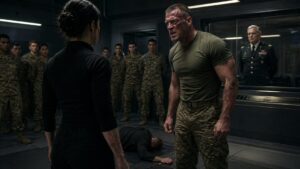
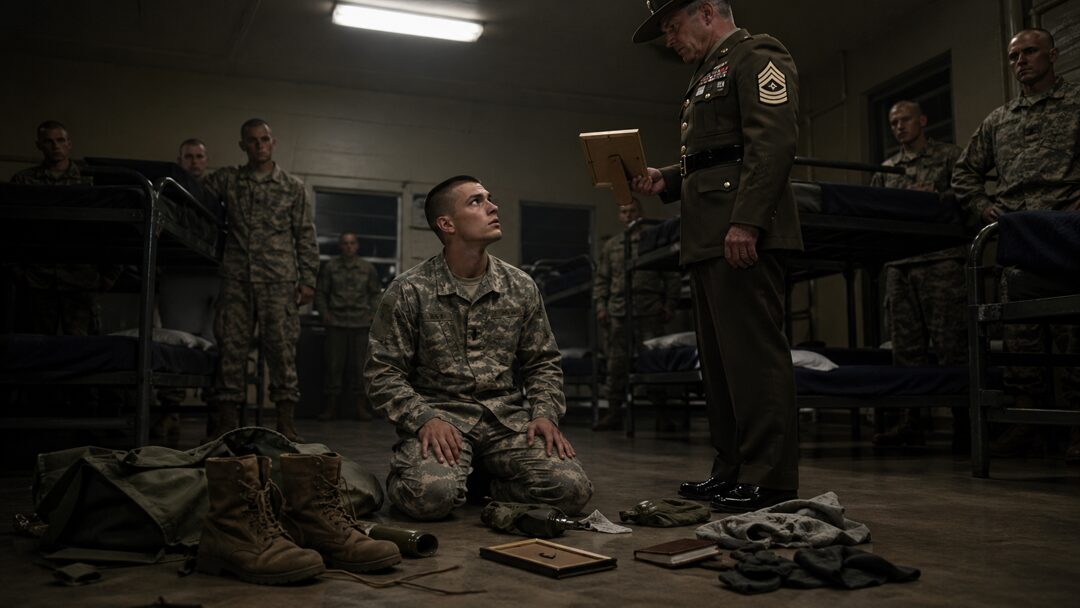
Private Eli Mercer was already on his knees when the barracks went quiet.
His boots sat to his left, heels aligned by habit even after Staff Sergeant Caleb Hale had thrown them there. His folded undershirts lay open like white flags. His canteen rolled once, tapped the leg of a bunk, and stopped. Spare laces. Gloves. A field notebook with a cracked black cover. A small wooden frame turned face-down on the polished concrete.
Twenty recruits stood beside their bunks and pretended not to breathe.
Hale stood over Eli with the frame in one hand.
He did not shout. He never had to.
“Private Mercer,” he said, “why did you lie to me?”
Eli kept his eyes on the floor. He could see the reflection of Hale’s boots in the waxed concrete, dark and doubled, planted just inches from his knees.
“I didn’t lie, Sergeant.”
Hale lowered the frame until it hung in Eli’s line of sight.
“You were asked if every item in your locker was authorized.”
“Yes, Sergeant.”
“You said yes.”
“Yes, Sergeant.”
“This was hidden inside your field notebook.” Hale’s voice sharpened only at the edges. “So I’ll ask again. Why did you lie?”
Eli’s jaw worked once.
Across the bay, someone shifted weight. A bedframe gave a small metallic creak. No one looked at him directly, which somehow made it worse. They were all looking through him, around him, beside him, pretending not to watch the new private get peeled apart in the middle of the room.
Eli had been at basic training for sixteen days.
That was long enough to know the rules.
Long enough to know Hale noticed everything.
Long enough to understand that humiliation was not an accident here. It was a tool. A room could be turned into a blade if a sergeant knew where to stand.
Hale turned the frame over.
Eli moved before he could stop himself.
His right hand came off his thigh and reached up, fast and desperate, like the photograph had been a living thing falling from a roof.
The entire platoon saw it.
Hale caught the movement. His eyes narrowed.
“There it is,” he said softly. “There’s the thing you care about.”
Eli pulled his hand back.
“Hands on your thighs.”
Eli obeyed.
The photograph faced outward now.
A woman in an Army dress uniform stood beside a teenage boy at what looked like a county fair. There were blurred lights behind them, a paper cup in the boy’s hand, and dust on the lower corner of the glass. The woman’s face had faded slightly from years of sunlight, but her half-smile remained clear. She had one hand resting on the boy’s shoulder, not gripping, not posing. Holding him in place just enough to remind him he belonged somewhere.
Hale stared at it.
For the first time since Eli had arrived at Fort Gray, the staff sergeant did not look certain of what came next.
Then his thumb moved.
He turned the frame over and read the strip of tape on the back.
Capt. Nora Vale — Kandahar Province, 2009.
Something passed across Hale’s face so quickly that Eli might have missed it if he had not spent years watching adults decide what truths children were allowed to keep.
Recognition.
Then anger, arriving too fast.
Hale looked down at him.
“Who gave this to you?”
Eli said nothing.
The room seemed to tighten.
Hale crouched, bringing his face close enough that Eli could see the gray at his temples, the small white scar beneath his left eye, the careful stillness of a man holding a door shut from the inside.
“I asked you a question, Private.”
Eli swallowed.
“No one, Sergeant.”
Hale’s mouth hardened.
“No one gave you a framed photograph with a dead captain’s name taped to the back?”
Eli’s hands pressed flat against his thighs.
“No, Sergeant.”
Hale stood.
“On your feet.”
Eli started to rise.
“Not you.”
Eli stopped halfway, then settled back onto his knees.
Hale turned to the platoon.
“Since Private Mercer believes regulations are a suggestion, every one of you will listen while he educates us on personal effects.”
Nobody moved.
Hale looked down again.
“Begin.”
Eli knew the regulation. They all did. Authorized personal items. Religious materials. Letters. Photographs permitted only within guidelines, not displayed, not carried during field exercises unless approved, not hidden in issued training materials.
But his mouth had gone dry.
Hale waited.
The silence grew teeth.
“Private,” Hale said, “you wanted the photograph badly enough to reach for it. You can speak badly enough to explain it.”
Eli looked at the frame in Hale’s hand.
The boy in the picture was almost unrecognizable now. Fuller in the cheeks. Longer hair. Civilian clothes. Eyes not yet trained to look straight ahead while everything inside him ran.
“She taught me how to stand up straight,” Eli said.
A few recruits glanced at one another.
Hale did not move.
“That’s not an answer.”
“It’s the only one I have, Sergeant.”
The words landed harder than Eli meant them to.
Hale’s face closed.
“Then we’ll start with what you do have.”
He pointed at the floor.
“Identify your gear.”
Eli looked at the half circle of his life.
“My boots, Sergeant.”
“Again.”
“My boots, Sergeant.”
“What are they for?”
“Movement, Sergeant.”
“Not decoration?”
“No, Sergeant.”
“Not sentiment?”
“No, Sergeant.”
Hale pointed.
“Undershirts.”
“My undershirts, Sergeant.”
“What are they for?”
“Wear, Sergeant.”
“Canteen.”
“My canteen, Sergeant.”
“What is it for?”
“Water, Sergeant.”
“Gloves.”
“My gloves, Sergeant.”
“What are they for?”
Eli paused.
Hale caught it.
“What are they for, Private?”
“Readiness, Sergeant.”
The word changed the air.
Not much. Just enough.
Hale’s eyes flicked to the photograph again.
“Field notebook.”
“My field notebook, Sergeant.”
“What is it for?”
“Notes, Sergeant.”
“Orders?”
“Yes, Sergeant.”
“Maps?”
“Yes, Sergeant.”
“Training instruction?”
“Yes, Sergeant.”
“Dead women?”
Eli’s head lifted before he could stop it.
The barracks went very still.
Hale had wanted a reaction. He got one.
Eli’s eyes were not angry. That was worse. They were afraid of what anger might cost.
Hale leaned down until his shadow covered the photograph, the notebook, the gloves, and both of Eli’s knees.
“What was she to you?”
Eli said nothing.
Hale’s voice lowered.
“Was she your mother?”
“No, Sergeant.”
“Sister?”
“No, Sergeant.”
“Aunt?”
“No, Sergeant.”
“Then why is a recruit in my bay hiding a dead officer inside government property?”
Eli’s throat tightened.
Because the first time he had seen her, smoke had covered the road.
Because his little brother had stopped crying in a way that scared him more than screaming.
Because Nora Vale had knelt in front of two boys behind the open door of a burned truck and said, in a voice steady enough to stand on, Look at me. If you can look at me, you can breathe.
Because three days later, at a county fair arranged for families attached to the base, she had bought him lemonade he was too proud to ask for and told him not to fold himself in half just because the world had scared him.
Because she had placed one hand on his shoulder for a photograph and said, Stand up straight, Eli. Nobody gets to make you smaller than you are.
But all of that was too much for the room.
So Eli said nothing.
Hale stared down at him.
Then he turned his head slightly.
“Platoon. Far wall. Face out.”
The recruits moved at once.
Boots struck concrete in a hurried rhythm. Bodies shifted away. The room did not become private, not really. Shame had already entered it. But the circle widened.
Hale waited until their backs were turned.
Then he lowered the photograph to his side.
“Where did you get this?”
Eli looked at the floor again.
“She gave it to me.”
Hale’s breathing changed.
“That’s not possible.”
“It was before.”
“Before what?”
Eli looked up.
“Before she died under your command.”
Part II — The Name on the Back
Hale did not strike him.
He did not move at all.
That was what frightened Eli most.
For a second, the sergeant’s face became less like a face than a closed door with light burning under it.
“Say that again,” Hale said.
Eli should have stopped. Every instinct training had beaten into him told him to stop. Rank stood above him. His knees hurt. The photograph was still in Hale’s hand. Major consequences began with small acts of honesty in rooms like this.
But Nora Vale’s name had already been spoken like contraband.
And Eli was tired of letting silence protect everyone except the dead.
“I learned later,” he said. “I didn’t know your name back then. Not until I looked her up. Captain Nora Vale. Kandahar Province. Your unit.”
“My unit had a lot of officers.”
“She pulled me and my brother out of a checkpoint attack.”
Hale’s hand tightened around the frame.
“She was there for a convoy security rotation,” Eli said. “I don’t know what the mission was. I was a kid. I remember heat. I remember glass. I remember my brother bleeding through my shirt. I remember her telling me not to look at the truck.”
Hale looked away.
Only for a second.
But Eli saw it.
“She carried him?” Hale asked.
Eli shook his head. “She carried me. I couldn’t stand.”
Hale’s jaw flexed.
“You were the older one.”
“Yes, Sergeant.”
“And she carried you?”
“Yes, Sergeant.”
That seemed to cut deeper than Eli expected.
Hale crouched again, slower this time. The old aggression was still there, but it had lost its clean edge.
“What was your brother’s name?”
Eli felt the room tilt a little.
“Daniel.”
“Did he live?”
The question was too direct.
That was Hale’s way. He did not step around wounds. He stepped on them and watched what came out.
“Yes,” Eli said.
Hale nodded once, as if some private calculation had changed.
The photograph was still turned backward. Eli could see the tape. He had replaced it twice over the years, carefully copying the words in the same block letters because he had been afraid that changing them would mean losing something.
Hale noticed him looking.
“You carried this through processing?”
“Yes, Sergeant.”
“Through reception?”
“Yes, Sergeant.”
“Through sixteen days of inspections?”
“Yes, Sergeant.”
“Why hide it?”
“Because people ask questions.”
“This is the Army. People ask questions.”
“No,” Eli said before he could soften it. “They ask what she was. Not who.”
Hale’s eyes sharpened.
That line found him.
Outside the barracks, somewhere beyond the long windows, a truck backed up with three flat beeps. Life kept moving with cruel normalcy.
Hale set the photograph on the nearest bunk, face-up.
Eli followed it with his eyes.
“Captain Vale died because she broke formation,” Hale said.
The words were even. Practiced.
Eli looked at him.
Hale continued, “She moved without authorization. She exposed her position. She put other soldiers at risk.”
Eli’s fingers curled against his thighs.
“She saved civilians.”
“She disobeyed an order.”
“That’s the only reason I’m alive.”
“That may be true.”
“It is true.”
“And it may also be true that two soldiers died trying to recover the perimeter she opened.”
Eli had no answer for that.
It was the first time Hale had given him something sharp enough to make his gratitude bleed.
The silence between them changed again.
Hale stood and turned slightly, looking at the rows of bunks, the turned backs of recruits, the stripped order of the bay. His voice dropped.
“You think a photograph makes her simple.”
“No, Sergeant.”
“You carry her around like a saint.”
“No, Sergeant.”
“You hide her inside a notebook meant for orders. You bring her into training. You kneel there like I’m supposed to look at that frame and understand some private religion.”
Eli’s face burned.
“She isn’t religion.”
“Then what is she?”
The answer came before he could stop it.
“The reason I enlisted.”
Hale stared at him.
Eli had never said it out loud. Not at the recruiter’s office. Not to Daniel. Not to the woman who ran the group home after their aunt disappeared for three months and returned like a ghost who forgot where she had died. Not even to himself in those exact words.
But there it was.
Bare on the concrete with everything else.
Hale’s voice was quieter when he answered.
“That’s a dangerous reason.”
“It’s the only one that worked.”
“Grief makes men hesitate.”
“Maybe.”
“No maybe.”
Eli looked at the photograph. Nora’s half-smile had survived dust, moves, rain through a broken bedroom window, one foster house with mold in the vents, and sixteen days hidden under training notes. It had survived because Eli made sure it did.
He looked back at Hale.
“Forgetting makes men obey anything.”
For a moment, Hale looked like he might throw the frame across the barracks.
Instead, he stepped closer.
“You are nineteen years old,” he said. “You don’t know what obedience costs.”
Eli held his gaze.
“No, Sergeant. I know what being forgotten costs.”
The sentence did not echo. The barracks swallowed it.
But it stayed there.
Hale turned away first.
That was when Major Thomas Danton appeared in the doorway.
He had not rushed. Men like him never did. He stood in the entrance in a pressed uniform with silver hair combed neatly back, his expression fixed in the calm shape officers used when anger would look undisciplined.
“What is this?” Danton asked.
The recruits at the far wall stiffened.
Hale turned.
“Inspection issue, sir.”
Danton’s eyes moved from Hale to Eli, then to the gear on the floor, then to the photograph on the bunk.
He knew before he touched it.
Eli saw the recognition arrive and refuse to leave a trace.
Danton walked across the barracks. His boots made no wasted sound.
He picked up the photograph.
For one unbearable second, Nora Vale was held between all three of them.
Danton looked at the picture, then at the tape on the back.
His mouth tightened.
“Where did this come from?”
Hale answered before Eli could.
“Private Mercer’s personal effects, sir.”
Danton looked down at Eli.
“Stand up when addressed by an officer.”
Eli started to rise.
Hale spoke.
“Private Mercer is under corrective instruction, sir.”
Danton’s eyes flicked to him.
There it was.
The first reversal.
Hale, who had owned the room, was now inside someone else’s grip.
Danton held the photograph as if it were evidence in a case he had already decided.
“This is unauthorized,” he said. “Confiscate it.”
Eli’s hands went cold.
Hale did not move.
Danton looked at him.
“Staff Sergeant.”
“Yes, sir.”
“I said confiscate it.”
Part III — What Orders Keep
The platoon could not see Eli’s face from the far wall, but they could hear everything.
That was worse.
A private could survive being yelled at. Everyone got yelled at. He could survive push-ups, extra duty, the thousand small punishments that turned boys into soldiers or broke them in the attempt.
But he did not know if he could survive hearing Nora Vale dismissed in the same flat tone used for moldy socks and unsecured footlockers.
Danton held the photograph out to Hale.
Hale looked at it.
Then at Eli.
Then back at Danton.
“The private believed it fell within personal photograph allowance, sir,” Hale said.
Eli almost looked up.
Danton did not blink.
“Then the private believed incorrectly.”
“Yes, sir.”
“Correct him.”
Hale’s face gave nothing away.
Danton turned the frame so the photograph faced him again. His thumb covered part of Nora’s uniform.
“This woman has no place in a training barracks.”
Eli’s voice came out before judgment could stop it.
“She was a captain.”
Danton looked down.
“What did you say?”
Eli kept his eyes forward.
“She was a captain, sir.”
The room sharpened.
Danton took one step toward him.
“I know what she was.”
“No, sir,” Eli said, and felt the ground drop beneath the words. “You know what the report said.”
Hale’s head turned.
Danton’s face remained controlled, but something behind it went cold.
“Private,” Hale said, warning threaded into one word.
Eli stopped.
He had stepped too far. He knew it. But the photograph was still in Danton’s hand, and Nora’s name had been made smaller with every sentence.
Danton looked at Hale.
“Is this the standard of discipline in your bay?”
“No, sir.”
“Then fix it.”
Hale’s shoulders squared.
For a second, Eli thought he had lost him.
That made sense. Hale was a soldier before he was a witness. Danton outranked him. Regulations existed. Reports existed. Careers existed. The Army had a way of making truth stand at attention until it forgot how to speak.
Danton held out the frame again.
“Confiscate it. File the disciplinary report. I want the object secured before morning formation.”
Eli felt something in him go quiet.
Not peaceful.
Emptied.
He looked at the floor, at the scattered half circle of his belongings. Everything he owned had become evidence against him. Boots for movement. Canteen for water. Gloves for readiness. Notebook for orders.
Photograph for weakness.
He had been a child when Nora gave it to him.
The county fair had smelled like dust and frying oil. Daniel had eaten blue cotton candy until his tongue looked fake. Eli had stood stiff beside Captain Vale because he did not know what to do with kindness that did not ask anything back.
“You don’t have to join the Army,” she had told him when he asked whether soldiers were scared.
He had frowned. “But you did.”
She had looked toward the tents where her unit was laughing too loudly, trying to seem ordinary for families who needed them to be ordinary.
“I did,” she said. “But don’t ever mistake a uniform for a reason. Find the reason first.”
Then the photographer had lifted the camera.
Eli had slouched, embarrassed by his thin arms, by the attention, by wanting to stay near her for one more minute.
Nora had touched his shoulder.
“Stand up straight,” she said. “Nobody gets to make you smaller than you are.”
Now, years later, Eli was on his knees beneath fluorescent lights while a senior officer held that moment like contraband.
The irony was so perfect it almost felt planned.
He lifted his head.
“Sir,” he said.
Danton looked down at him with open irritation.
“I’ll accept punishment.”
Hale’s eyes moved to him.
Eli forced the words out.
“Extra duty. Report. Whatever is required. But after, I request the photograph be returned.”
Danton stared.
“You request?”
“Yes, sir.”
“You are in no position to request anything.”
“No, sir.”
“And yet?”
Eli’s voice did not rise.
“And yet I’m asking.”
The platoon at the far wall did not move.
Hale looked at the photograph.
It had dust on the lower edge from the floor. One corner of the frame had loosened again. Eli had meant to fix it Sunday if he earned personal time. He had saved a strip of tape in his hygiene kit.
Danton’s voice cut through the silence.
“Captain Vale died because she disobeyed orders. That is not inspiration. That is not mythology. That is not something a recruit gets to build a bedtime legend around.”
Eli flinched.
Not much.
Enough.
Hale saw it.
Danton continued, “The Army cannot function if every private carries a private shrine to every casualty he misunderstands.”
Hale’s expression changed.
It was small. Dangerous in its restraint.
“She pulled civilians out under fire,” he said.
Danton turned slowly toward him.
“What?”
Hale’s eyes remained on the photograph.
“Her service record includes civilian rescue under fire.”
Danton’s mouth flattened.
“Her service record includes unauthorized movement that compromised a formation.”
“Yes, sir.”
“Do not confuse the two.”
“I was there, sir.”
The barracks stopped breathing again.
Danton looked at him for a long moment.
“Yes,” he said. “You were.”
Hale accepted the hit without moving.
Eli heard what was inside those three words.
You were there, and she died.
You were there, and you did not stop her.
You were there, and you survived.
Hale’s hand opened at his side, then closed again.
Danton stepped closer, lowering his voice enough that only the center of the room could hear clearly.
“This is not the place.”
Hale answered in the same low register.
“It became the place when you ordered me to erase her in front of him.”
Danton’s eyes hardened.
“Careful, Staff Sergeant.”
Hale said nothing.
Danton lifted the frame slightly.
“Take it.”
For several seconds, no one moved.
Then Hale reached out.
Eli’s stomach clenched.
Danton placed the photograph in Hale’s hand.
The frame looked smaller there.
Hale turned toward Eli.
His face was unreadable again, but not empty. That was the terrible part. There was too much behind it.
He stepped closer.
Eli prepared himself for the loss.
Hale crouched.
The same position as before. The same shadow. The same boots inches from Eli’s knees.
But this time Hale did not hold the photograph above him.
He wiped the dust from the glass with the side of his thumb.
Once.
Carefully.
Then he handed it back.
Eli did not take it at first.
He did not trust the moment.
Hale’s voice was quiet.
“Take it, Private.”
Eli’s hands lifted.
The frame touched his palms.
He held it like it might disappear if he believed in it too quickly.
Danton’s voice cracked across the room.
“Staff Sergeant Hale.”
Hale stood.
“Private Mercer will store personal effects according to regulation,” he said. “The photograph stays.”
Danton stared at him.
“That was not a request.”
“No, sir.”
“Then you are refusing a direct instruction?”
Hale’s jaw tightened.
“I am clarifying the status of authorized personal effects.”
Danton’s face darkened.
“Do not play regulation games with me.”
“No, sir.”
“The object is tied to an officer whose conduct remains—”
“Captain Vale’s service record includes civilian rescue under fire,” Hale said.
The words were steady now.
“If a written statement is required, I’ll provide one.”
Danton looked at him with something close to contempt.
“You want to reopen that?”
Hale’s eyes did not move.
“No, sir.”
A pause.
“I want to stop closing it on the wrong people.”
No one spoke.
The line did not sound heroic.
It sounded costly.
That made it heavier.
Danton held Hale’s gaze for a long time. Then he looked down at Eli, who was still kneeling, still holding the photograph against his chest because he did not know where else to put it.
“Store it,” Danton said coldly. “Improperly again, and it will not be a discussion.”
“Yes, sir,” Eli said.
Danton turned toward the door.
At the threshold, he stopped.
“Staff Sergeant. My office. After lights-out.”
“Yes, sir.”
Danton left.
The barracks did not relax.
Hale remained still until the sound of Danton’s boots vanished down the hall.
Then he looked toward the far wall.
“Platoon. Face bunks.”
They turned.
No one’s eyes knew where to go.
Hale pointed at the scattered items on the floor.
“Private Mercer. Secure your gear.”
Eli began gathering the undershirts first because they were closest. His hands trembled once. He stopped them. He placed each item carefully into a stack.
Boots.
Canteen.
Spare laces.
Field notebook.
Gloves.
The photograph stayed in his left hand.
Hale watched him for a moment.
Then he said the words that changed the whole shape of the room.
“Private Mercer.”
Eli looked up.
“Stand.”
Part IV — The Man Who Survived
Eli rose too fast, and pain flashed through both knees.
He nearly swayed.
He did not.
The photograph pressed against his ribs. Hale saw him steady himself and said nothing.
Around them, twenty recruits stared at their lockers with the concentration of men trying not to witness something they would remember forever.
Hale’s voice returned to its usual command tone.
“Secure all personal effects. Lights-out in ten. If I find one sock unsecured, this entire bay will learn the difference between tired and corrected.”
“Yes, Sergeant,” the platoon answered.
The room moved again.
Metal lockers opened. Drawers slid. Mattresses shifted. Nobody spoke above a murmur. The humiliation had not vanished; it had changed owners. Eli could feel it no longer wrapped only around him. It had spread into the room as unease.
He placed his boots under the bunk. Folded the undershirts again. Slid the canteen into place. Returned the laces to the small pouch.
The field notebook lay on the mattress.
He opened it once.
There was a rectangular hollow in the back cover where the frame had worn an outline into the pages. For sixteen days he had carried Nora there between notes on formations and lists of mistakes he could not afford to repeat.
Hale stood near the center aisle.
Not looking at him.
Not looking away.
Eli closed the notebook.
He did not put the photograph back inside.
That felt like a decision he had not known he was allowed to make.
At lights-out, the barracks fell into military darkness: not true darkness, never that, but a dim blue hush broken by exit signs and the low mechanical breath of the building. Recruits lay rigid on bunks, exhausted and awake. Shame had a sound after lights-out. It was the refusal of men to turn over.
Eli sat on the edge of his bunk with the photograph on his knees.
He had wrapped it in a clean undershirt while he decided where it could go.
The regulation said personal photographs could be stored in assigned personal space if not displayed in a manner disruptive to training. He knew the language now like scripture. It did not say how to store a dead woman who had once told you to stand.
His locker opened with the smallest click he could manage.
He placed the wrapped frame on the upper shelf.
Then he took it down again.
Too visible.
He placed it beneath the folded shirts.
Too hidden.
He stood there in the dark with the frame in both hands, angry at himself for not knowing the proper distance between shame and worship.
A voice behind him said, “Top shelf. Back right corner.”
Eli turned.
Hale stood in the aisle.
He had removed his campaign hat. Without it, he looked older. Not weaker. Just more human, which was not the same thing.
“Sergeant,” Eli whispered.
“At ease. Quietly.”
Eli shifted, not fully at ease, not fully at attention.
Hale nodded toward the locker.
“Wrapped. Upright. Back right. Not displayed. Not hidden in issued material.”
Eli looked at the empty corner.
“Yes, Sergeant.”
He placed the photograph there.
The frame stood in the back right corner, mostly shadowed, visible only if someone opened the locker and looked with purpose. It did not announce itself. It did not vanish.
For a moment, neither of them spoke.
Hale looked at the photograph but did not touch it.
“She hated being photographed,” he said.
Eli turned slightly.
Hale’s eyes stayed on the locker.
“Captain Vale. She said cameras made people perform honesty instead of practice it.”
Eli did not know what to say to that.
So he said nothing.
That seemed to suit Hale.
“She used to tuck her gloves into her belt,” Hale continued. “Even indoors. Even at briefings. Drove the lieutenant colonel insane.”
A faint breath moved through Eli. Not a laugh. Too small for that. But something in him loosened by one stitch.
“Why?” he asked.
Hale looked at him.
“Said she hated looking unprepared.”
Eli’s eyes dropped to his own gloves on the lower shelf, still folded regulation-neat.
A memory rose before he could stop it: Nora kneeling in roadside dust, one glove torn, one hand bare and red at the knuckles. Nora lifting him though he was too old to be carried. Nora saying, Look at me. If you can look at me, you can breathe.
Hale must have seen something on his face.
“She wasn’t easy,” he said.
Eli looked back at him.
“She was kind.”
“She could be.”
“That matters.”
“Yes,” Hale said. “It does.”
The admission was quiet enough to disappear if either of them needed it to.
Eli waited for more. For an apology. For a confession. For the full story of Kandahar Province, 2009. For the part records did not say and officers did not want reopened.
Hale gave him none of it.
Instead he looked down at the gloves.
“Those yours?”
“Yes, Sergeant.”
“Then stop leaving readiness on the floor.”
Eli picked them up.
For a moment, he thought Hale meant to put them away with the rest of his gear.
But his own hand moved differently.
He placed the gloves on the top shelf, folded neatly beside the wrapped frame.
Not in front of it.
Not covering it.
Beside it.
Hale watched the gesture.
His face did not change much.
But something in his eyes did.
Eli closed the locker.
The small click seemed louder than it should have.
Hale turned to leave, then stopped.
“Private Mercer.”
“Yes, Sergeant.”
“You were wrong to hide it.”
“Yes, Sergeant.”
Hale paused.
“I was wrong about why.”
Eli held still.
It was not an apology.
It was closer to one than Eli had expected to receive.
“Yes, Sergeant,” he said.
Hale walked away.
At the end of the aisle, he put his campaign hat back on. The shape of him became official again.
But not entirely.
Eli climbed into his bunk.
The barracks remained quiet. Across the bay, someone shifted under a blanket. Someone else sniffed once and pretended not to. No one said Nora Vale’s name.
They did not need to.
Eli lay on his back and stared into the dim.
His knees still hurt. His report might still come. Hale still had to stand in Major Danton’s office after lights-out. Tomorrow would still begin before dawn with boots, orders, correction, and the thousand rules that made a body useful to something larger than itself.
Nothing had been fixed.
Nora was still dead.
Hale was still haunted.
Eli was still nineteen, still new, still afraid of becoming too small in rooms built to test the size of a man.
But the photograph was not hidden inside the notebook anymore.
It stood in the back right corner of his locker, wrapped and upright, with his gloves beside it.
Not a shrine.
Not evidence.
Not contraband.
A memory given a place to stand.
Eli closed his eyes.
For the first time since arriving at Fort Gray, he did not dream of the road, or the smoke, or the burned truck door opening against the dust.
He dreamed of a woman at a county fair, one hand on his shoulder, telling him the truth before he was old enough to carry it.
Stand up straight.
And somewhere down the hall, behind a closed office door, Staff Sergeant Caleb Hale stood at attention before a man who wanted old things buried.
This time, he did not kneel.