The Measure of Her
Part I — The Word at the Door
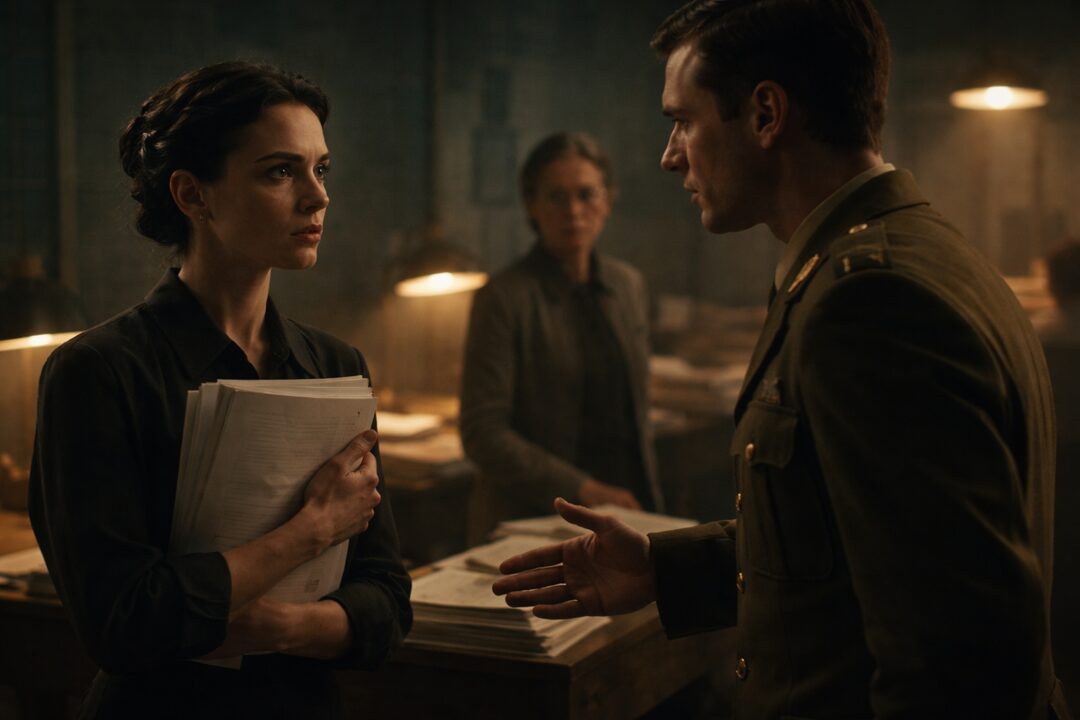
By the time the new stack of figures hit Ruth Vale’s desk, the room had already gone past tired and into something harder.
The siren test outside started its low metallic whine, the kind that made every glass pane tremble without quite rattling. Inside the computation room, no one looked up. Pencils scratched. Slide rules clicked. Pages turned with the dry, frantic sound of wings. A clock ticked above the blackboard as if it had no idea it was helping to decide whether men half a world away would live through morning.
Captain Harlan Price appeared in the doorway with a folder under one arm and a line between his brows that meant command had made a mistake and wanted the women downstairs to repair it before anyone upstairs had to say so aloud.
“We’re short half a kilogirl already,” he said to no one in particular.
No one answered him.
Ruth’s pencil stopped for a fraction of a second. Then it moved again.
Price crossed the room on polished shoes that never seemed to pick up dust, even in a building that shed plaster at every corner. He dropped the folder beside her elbow. URGENT was stamped across the top page in red.
“Targeting tables,” he said. “Repeated failures in field conditions. Drift assumptions are wrong, or incomplete. Command wants a full recomputation tonight.”
“Tonight,” Ruth repeated.
“They needed it yesterday.”
That almost passed for humor with him. Almost.
Ruth opened the folder. Wind profiles. Release altitude tables. Cross-reference sheets from prior runs. At the margin of one page she found a notation she knew because she had written its earlier version herself three weeks ago: lateral variance inconsistent under cold-pressure fronts. Flagged. Deferred.
Deferred meant ignored politely.
She did not let her face change.
“How many clusters?” she asked.
“Three. Mercer is dividing sections now.” His eyes flicked to the paper, then back to the room. “You’ll have a replacement. Collins collapsed two hours ago.”
At that, Ruth looked up.
Price seemed to realize only then that collapse was not an abstract logistical inconvenience when it happened to a woman whose desk still held a half-finished meal and a cardigan draped over the chair. He cleared his throat.
“She’s at the infirmary. Exhaustion, they said.”
He said it like weather.
Ruth’s gaze dropped back to the figures. She heard again the casual phrase from the doorway, ugly in a way she could not yet fully name.
“Kilogirl,” she said, and Price, already turning away, glanced back.
“Yes?”
“What does that mean?”
He seemed faintly surprised by the question. “A labor estimate.” Then, seeing her expression, he added, “Don’t get caught on the language, Miss Vale. We need speed.”
He left before she could answer.
Across the room, Edith Mercer was already reshaping the emergency with the cold discipline of a field surgeon. She stood by the blackboard in her steel-gray cardigan, spectacles low on her nose, assigning work in clipped syllables. She was not beautiful and never tried to be. She had the severe posture of a woman who had learned that one visible softness invited three fresh indignities.
“Vale, primary drift correction. Pierce, cross-check columns C through F. Romano, transfer sheets. Moreno—”
A young woman near the wall startled at her own name as if she had not expected to hear it yet.
Moreno. The replacement.
She looked too awake for this room, which Ruth distrusted immediately. Not cheerful—no one with sense was cheerful in a room like this—but visibly alive, with quick dark eyes and sleeves rolled unevenly past the wrist. Her hair was pinned up badly and already trying to escape.
Edith pointed to the desk beside Ruth’s. “You’re with Vale.”
The young woman came over with a pad, a pencil, and the expression of someone stepping into cold water on purpose.
“I’m Lena Moreno,” she said.
Ruth nodded once. “Sit.”
Lena sat. Ruth spread the pages between them and began assigning columns. Outside, the siren stopped. Inside, the room only got quieter.
For ten minutes they worked without speaking.
Ruth had always liked the moment when a crisis stopped being a shape in the air and became numbers. Numbers, at least, had rules. A headwind could be estimated wrongly. A release angle could be misjudged. A human being could decide that because a warning came from women at desks in a lower room, it could wait. But once the paper reached her hands, error left footprints. It had to.
Lena’s scratch work was fast. Too fast, Ruth thought at first. Then she looked over and saw that the girl—young woman, really—was not guessing. She was seeing patterns.
“Check that pressure adjustment,” Ruth said.
“I did.”
“Check it again.”
Lena checked it again. “It’s still wrong in the original table.”
Ruth looked. Lena was right.
Ruth turned another page. Same pattern.
Then another.
The room seemed to tilt, not from lack of sleep but from recognition. Not a single error. A habit of error. An assumption embedded high enough in command’s model that everything downstream had been made to behave around it.
They were not correcting a mistake tonight.
They were correcting a way of thinking.
From the front of the room, Edith called, “Status.”
Ruth stood. “The drift failure isn’t isolated. We may be looking at a faulty baseline.”
Edith’s face did not change, but her fingers tightened around the chalk. “Can you prove it?”
Ruth glanced at Lena, then back at the page.
“Yes,” she said.
The room went still enough to hear someone breathing through a cough at the far end.
Edith nodded once. “Then prove it quickly.”
Ruth sat down again.
Beside her, Lena lowered her voice. “What’s a kilogirl?”
Ruth stared at the paper.
“I don’t know yet,” she said.
That was not quite true.
She knew enough to hate it.
And before the night was over, she was going to learn how much.
Part II — The Girls Downstairs
An hour later the room smelled of graphite, damp wool, and the bitter coffee someone had burned on the hot plate.
The women worked in clusters because that was the only way to move fast without drowning in mistakes. One person recalculated. Another checked. A third checked the check. Sheets traveled hand to hand, not with chatter but with tiny sounds—there, here, wait, again. Ruth had once thought the room looked like a choir from above, if choirs bent over numbers instead of lifting their faces toward heaven.
Lena kept pace.
That unsettled Ruth more than incompetence would have.
“Where did they have you before this?” Ruth asked, eyes still on the page.
“Supply indexes. Fuel ratios twice a week when someone was out.”
“That’s not this.”
“No,” Lena said. “It isn’t.”
The answer held more than it said. Ruth recognized ambition in it and something sharper than ambition.
On the far wall, Edith had pinned up the section assignments. Ruth’s cluster had drift, cold-pressure variance, and release-angle correction—the uglier half of the problem. If command was wrong at the root, this was where it would show.
Lena slid a page toward her. “Here.”
Ruth scanned it, then frowned.
“What?”
Lena tapped a set of figures. “The correction starts helping only if you assume your flagged variable wasn’t noise.”
Ruth turned to her. “How do you know it was flagged?”
“It’s marked.”
“It was marked for internal review.”
Lena held her gaze. “And was it reviewed?”
Ruth looked away first.
At the front, Price returned. He stood beside Edith while she spoke in low clipped tones. Ruth watched his face go still in the way men’s faces sometimes did when they were being told women had found something inconveniently real.
A minute later he came to her desk.
“Mercer says you think the original model was compromised from the beginning.”
“I think it was incomplete.”
“Which means?”
“It means field failures were not random.”
Price’s expression tightened, not from panic but from annoyance at the shape of the problem. “Can you isolate the correction?”
“Yes.”
“How long?”
“If the assumptions upstairs stop changing every half hour, by dawn.”
He let that pass. “Do it.”
He started to turn away, then Lena said, “Who signs the results?”
Price looked at her as if she had spoken out of order in church.
“I’m sorry?”
“The corrected tables,” she said. “Who signs them?”
Ruth felt the air change.
Price’s gaze moved from Lena to Ruth, then back. “Command signs operational documents.”
“So the names on the work—”
“Are not the point.”
Lena’s mouth hardened. “They are if the work is wrong.”
Price gave her the kind of smile that was not a smile. “Then let’s be grateful your superiors exist to ensure it is not.”
When he walked away, Lena did not lower her eyes quickly enough. Ruth had a sick, immediate certainty that Price would remember that.
“You should not do that,” Ruth said softly.
“Ask a question?”
“Ask it like that.”
Lena bent back over the page. “If no one asks it at all, does that make it less true?”
Ruth said nothing.
Edith did, a few minutes later. She appeared at their desks with a fresh set of transfer sheets and laid them down with exact care.
“You are here to survive the night,” she said to Lena without looking directly at her. “Not educate the army in justice.”
Lena opened her mouth, then closed it.
Edith’s hands trembled once as she straightened a stack. Just once. Ruth noticed because Edith hated being noticed.
When Edith moved away, Lena whispered, “Did I say something wrong?”
Ruth wrote two more figures before answering.
“No,” she said. “That’s the trouble.”
They worked another hour. Then another.
At some point the world outside the room thinned to weather and darkness. The war became paper again.
Ruth found the old memorandum just after midnight, tucked between revised pressure tables and a routing slip. It was her note. Or rather, the formal version of the note she had once handed up through channels, stripped of her name and retyped by someone upstairs.
Observed variance under winter front conditions likely exceeds current drop model assumptions. Recommend review before next table issue.
Across the top, in pencil, someone had written: Women’s desk estimate. Await officer confirmation.
Await officer confirmation.
The phrase was so mild it almost disguised the insult. Almost.
Lena leaned in. “What is it?”
Ruth handed her the page.
Lena read it, then looked up slowly. “You found this before.”
“We found it.”
“And they ignored it.”
Ruth took the memorandum back. “Deferred.”
“That’s not better.”
“No.”
Lena stared toward the front of the room, where Price stood over Edith’s shoulder while she recalculated a transfer sequence by hand. “So they knew.”
“They knew women downstairs had noticed something. That is not always the same thing.”
Lena let out one short breath that might have become a laugh in a kinder story.
Then Price approached again, sleeves rolled now, tie loosened, as if physical proximity to labor granted moral equality with it.
“Status.”
Ruth showed him the memorandum.
He scanned it. “This wasn’t verified.”
“It was accurate.”
“That is not the same standard.”
“It should be if it keeps men alive.”
Something flickered across his face then—irritation, yes, but something closer to respect too. The kind of respect given to a tool performing above specifications.
He tapped the memorandum. “We need the correction, not the grievance.”
“It isn’t a grievance if it changes the outcome.”
“It’s still not tonight’s battle.”
Ruth looked at him. “Whose battle is it?”
He did not answer immediately.
Instead he said, with patient emphasis, “One kilogirl is a thousand hours of calculation. It’s simply a planning measure. We are all using abstractions tonight, Miss Vale. Tons of fuel. Probability curves. Casualty projections. Don’t make language heavier than the work itself.”
Then he walked away.
For a moment Ruth could not feel her hand.
A thousand hours of calculation.
Not women who had coughed blood into handkerchiefs and come back after lunch. Not women who memorized error patterns the way other people remembered hymns. Not Collins collapsing over a half-finished sandwich. Just hours. One thousand of them. Female, as a category of labor. Neatly countable. Conveniently faceless.
Lena said nothing.
Ruth was grateful for that.
At one in the morning, she found the pattern.
Not a clean number. Nothing so kind. A recurrence. Cold-pressure fronts had been treated as deviations instead of structure. The room had spent months quietly compensating, adjusting tables by instinct, experience, and local correction to make the official model behave as if it understood weather better than it did.
The women downstairs had not been assisting command.
They had been carrying part of its mind.
Ruth sat back hard enough to make her chair complain.
Lena looked up. “What?”
Ruth spread the pages between them. “It isn’t one mission.”
Lena followed her finger down the columns, and Ruth watched the realization reach her face in stages.
“Oh,” Lena said.
Then, quieter: “They’ve been using your corrections for months.”
“Our corrections.”
“And pretending the model held.”
Ruth nodded once.
Lena looked toward the ceiling, as if the briefing room upstairs existed less as a place than as a weight pressing down through plaster and pipe.
“So that’s why we aren’t allowed in there.”
Ruth almost said, Don’t.
Instead she said, “There are many reasons we aren’t allowed in there.”
“That’s the one that matters.”
Ruth did not answer.
Because for the first time, she thought Lena might be right.
Part III — What Silence Costs
By two in the morning the women had stopped pretending their bodies belonged to them.
Edith moved through the room with chalk dust on one sleeve and pain hidden badly at the base of her thumbs. Ruth’s own wrists felt packed with hot sand. Lena had taken out half the pins in her hair without seeming to notice; black curls had begun to break loose around her face.
Still the numbers came.
Still the pages moved.
Still the officers upstairs waited for certainty from a room they would not enter unless something failed.
When Ruth carried a corrected set to Edith, she found her standing alone by the blackboard, rubbing one cramped hand with the other.
“You should sit,” Ruth said.
Edith gave a dry sound. “In war?”
Ruth held out the pages. Edith scanned them, then looked up sharply.
“You’re certain.”
“Yes.”
Edith was quiet a moment. Then she said, “Do not say more than you have to when Price comes back.”
Ruth’s patience, already worn thin, pulled tighter. “Why?”
“Because being right and being allowed to remain useful are not the same event.”
Ruth glanced toward the room. “He already knows they ignored the warning.”
“He knows enough to use it. That is different from wanting it spoken aloud.”
Ruth set the pages down on the nearest desk. “You talk as if this has happened before.”
Edith’s face changed so little that the change itself felt enormous.
“It has.”
She moved past Ruth toward the side window and stood there without looking out. The glass reflected the room: women bent over figures, heads bowed like worshippers. Only then did Ruth understand that Edith had no intention of speaking unless forced to. Which was, perhaps, why Ruth forced her.
“What happened?”
Edith kept her eyes on the reflection.
“Three years ago there was a trajectory review. Not unlike this. I pointed out an error carried through by an officer who liked hearing himself reason at a board. I was correct. He was embarrassed. Afterward I found myself moved off the lead cluster for six months. No explanation. No accusation. Just fewer responsibilities and a reminder that I was fortunate to be there at all.”
Ruth said nothing.
Edith glanced at her. “Institutions do not argue with women like us when they can simply reduce our reach.”
At the desks behind them, someone coughed. Paper slid. Lena laughed once under her breath at something another girl whispered, and the sound was so brief it hurt.
Edith lowered her voice. “You think silence is shameful because you are still young enough to imagine speech is clean. It isn’t. It stains. Sometimes it stains only you.”
Ruth felt anger rise, then falter. Because Edith was not defending the system. She was naming the price of surviving inside it.
“And yet here we are,” Ruth said. “Still invisible.”
Edith’s mouth tightened. “Invisible women keep their desks.”
“That’s not dignity.”
“No,” Edith said. “But sometimes it is rent. Food. Work for the next girl. Enough authority to protect a room from worse men than Price.”
There it was. Not surrender. Strategy calcified into a kind of sorrow.
When Ruth returned to her desk, Lena took one look at her face and said, “She told you something.”
Ruth shook her head. “Work.”
Lena did not move her hand from the page. “That means yes.”
Ruth should have cut the conversation there. Instead she heard herself say, “She spoke up once. It cost her.”
Lena stared at her, then at Edith across the room. “And that’s the lesson?”
“The lesson is that consequences do not become noble because they are unfair.”
Lena leaned back. “No. The lesson is that they teach us to disappear and then call it wisdom.”
Ruth’s voice sharpened. “The lesson is that some of us cannot afford your kind of courage.”
Lena flinched, just enough for Ruth to regret it.
But Lena did not retreat. “My kind?”
“You’ve been here what, six months? You still think naming the insult is the same as defeating it.”
“No,” Lena said quietly. “I think pretending not to hear it is how it survives.”
Before Ruth could answer, Price returned.
He took the corrected packet from Ruth’s desk and read the first page standing there. Ruth watched his eyes move. Watched the moment the work became useful enough to make him careful.
“This changes the release assumptions substantially,” he said.
“It changes them correctly.”
“And you’re prepared to stand by that.”
“Yes.”
Price looked at Lena’s notations in the margin, then at Edith’s verification marks. “Good.”
Good.
Ruth had never hated the word more.
He gathered the pages. “I’m taking this upstairs.”
Lena said, “Under whose name?”
Price’s head came up.
The room, though still working, was listening now. Not openly. Nothing as foolish as that. But silence had a shape, and the shape had changed.
Price’s tone stayed even. “Under command review.”
“That isn’t what I asked.”
Ruth felt something cold move through her. This was not bravery anymore. It was exposure.
Price looked at Ruth instead of Lena. “Control your cluster.”
Lena half rose from her chair. “Why are we good enough to fix it but not good enough to exist in the room where it matters?”
Edith said sharply, “Moreno.”
But the damage was done.
Price’s face did not harden. That would have been easier. Instead it smoothed into the administrative calm that meant a file somewhere had just acquired a memory.
“You are here to support operational work,” he said. “Nothing more.”
Lena laughed once, incredulous and furious. “Support? We found the fault.”
“You found numbers. Don’t confuse that with command.”
Ruth heard herself say, “Captain—”
He held up one hand, not to silence her exactly, but to rank her beneath completion.
Then he took the pages upstairs.
No one in the room spoke for a full minute after the door shut.
Ruth sat down slowly.
Lena did not.
“You were going to let him,” she said.
Ruth kept her voice low. “Sit down.”
“You were.”
“Yes,” Ruth said, meeting her eyes now. “Because if the work reaches the target in time, men live through tomorrow.”
“And if it reaches them with his name on it?”
“That may still be true.”
Lena stared at her as if she had slapped her. “So that’s enough for you?”
No. It was not enough. It had never been enough.
But enough and possible were not neighboring words in Ruth’s life.
Edith came over then, carrying her own exhaustion like something ironed and folded.
“That will do,” she said.
Lena turned to her. “Will it?”
Edith’s hands were trembling again. “It will have to.”
Lena looked from one of them to the other, then sat. Not because she agreed. Because there was still work on the desk.
Sometimes that was the cruelest discipline in the room. The world insulted you, and the numbers still required carrying.
An hour later Price came back from upstairs.
He moved faster than before, which meant the correction had been accepted.
“Provisional launch tables are being revised,” he said. “Command recognizes the need for adjustment.”
Recognizes.
The word was almost elegant enough to disguise theft.
Ruth stood. “And the source of the correction?”
Price’s eyes touched hers briefly. “Command revisions will be issued immediately.”
Lena made a sound under her breath.
Price ignored it. “Miss Vale, your composure tonight has been appreciated. Miss Moreno”—now he looked at Lena—“wartime work requires discipline as well as intelligence. Emotion is not always service.”
He turned away before either of them could answer.
Ruth stood so still it felt like balance on a blade.
There it was. Not misunderstanding. Not oversight.
Acceptance without acknowledgment. Use without witness.
Lena said, very softly, “He just took it.”
Ruth’s throat felt lined with ash. “Yes.”
“And you still think silence protects us.”
Ruth had no answer to that.
Because now silence had changed shape too.
Now it looked like permission.
Part IV — The Room Upstairs
The final discrepancy arrived just before dawn.
A runner brought it down from command in a sealed envelope, and Edith broke it open with the air of someone opening a letter from debt. The revised launch tables had introduced a mismatch in altitude correction under the new drift model. Small enough to be missed by tired men. Large enough to kill men who trusted it.
“Vale,” Edith said.
Ruth was already on her feet.
The problem was narrow and vicious. The kind that belonged to her section alone because it sat at the seam between theory and the lived habits of the room. She bent over the figures. Lena came to her other side. Edith stood behind them.
No one suggested sleep. The room had moved beyond such sentimental categories.
“Here,” Lena said after a minute, pointing to a transfer line. “They carried the corrected pressure values but left one of the prior altitude assumptions intact.”
Ruth followed the chain.
“Yes.”
Edith leaned in. “Can it be corrected cleanly?”
“Yes,” Ruth said. Then, after another beat: “Not by someone who hasn’t seen the original structure.”
Edith understood first. Her eyes lifted.
“You don’t mean to send it up,” she said.
Ruth did not answer immediately.
Across the room, Price was waiting by the blackboard, expecting paper. Expecting obedience. Expecting the downstairs intelligence to remain downstairs.
Lena looked at Ruth and understood too.
“If you hand it to him now,” Lena said quietly, “he’ll carry your mind upstairs again and leave your name here.”
Ruth kept her eyes on the page.
Men live through tomorrow, she had told herself.
It was still true.
So was this: if she stayed silent now, she would help set the theft in place so neatly that even she might one day speak of it as necessity instead of choice.
Edith said, “Ruth.”
Not a warning exactly. Not permission either.
Just her name.
Ruth finished the correction.
Her hand was steady. That surprised her.
When she set the pencil down, the smudge of graphite on the side of her finger had darkened almost to black. She looked at it for one strange second, that tiny stain she never fully washed away. The mark of labor. The mark of being in the room.
Then she picked up the pages and walked toward Price.
He took one glance at her face and held out his hand automatically.
She did not give him the papers.
“There’s a structural explanation attached to this correction,” she said. “It needs to be delivered in person.”
Price blinked once. “Hand it here.”
“No.”
The word was quiet.
It still seemed to travel.
Price lowered his hand. “Miss Vale, this is not the time.”
“That is exactly why it is the time.”
A dozen women kept working with impossible concentration. None of them looked up. Every one of them was listening.
Price stepped closer. “You are exhausted.”
“Yes.”
“You are also very close to overestimating your position.”
Ruth could feel her pulse in her throat. “No, Captain. I know my position exactly. That is the problem.”
For the first time all night, something like alarm showed on his face. Not because she was wrong. Because she had become difficult in a way he could not file away as mood.
“This affects a live operation,” he said.
“It does. That is why the people using it need to hear where the prior assumptions failed, when we flagged the variance, and why this final correction only makes sense if they understand the work done in this room.”
Price’s voice dropped. “There are procedures.”
“And they have already failed.”
Behind Ruth, Lena said, “She’s right.”
Price looked past Ruth, ready perhaps to cut Lena down again, but Edith spoke first.
“Captain,” Edith said, each syllable exact, “the explanation belongs to the correction.”
He turned.
Edith stood by her desk, one hand resting on the edge to steady herself. The other, the one that had trembled all night, was still.
Price stared at her.
In that moment Ruth understood something she had not before: institutions were not unsettled by rebellion nearly as much as by calm witness. Not anger. Record.
Price exhaled through his nose. “Fine,” he said at last. “One minute. No theatrics.”
Ruth almost laughed at the word.
Instead she followed him to the staircase at the far end of the corridor, the staircase the women downstairs were not meant to use except when summoned to fix a problem no one upstairs wished to understand.
Lena came behind her.
“So did Mercer?”
Price asked sharply.
“Yes,” Edith said.
He might have refused then. Perhaps he nearly did. But time was thinner than authority, and he knew it.
Upstairs smelled different. Less graphite. More tobacco, leather, and coffee strong enough to be considered masculine. Maps covered the walls. Men in shirtsleeves moved around a table strewn with folders and acetate overlays. A colonel Ruth knew only by sight was speaking when they entered, and stopped when he saw who had come in behind Price.
His surprise lasted only a second. Long enough.
Price said, “Final correction on the launch discrepancy.”
“Then let’s have it.”
Ruth could feel every eye in the room touch her and recoil toward the paper, as if her presence were the least important fact about what she carried. Fear rose in her, clean and cold.
This is the moment, she thought.
This is the one you don’t get to redo.
She set the pages on the table.
“The discrepancy is corrected,” she said. Her voice held. “But the correction depends on the drift variance my unit flagged three weeks ago, which was not incorporated into the original model. Overnight recomputation confirmed that the existing cold-pressure assumptions were inadequate across multiple prior tables, not only this mission.”
No one spoke.
She went on.
“The revision you have now is not a fresh command insight. It is built on the work done in the computation room downstairs—initial warning, overnight recalculation, and this final adjustment. If you issue the table without understanding that structure, you will repeat the same error under new weather.”
The colonel’s face had gone unreadable.
Price said, too quickly, “The correction is incorporated now.”
Ruth turned to him.
“Yes,” she said. “By us.”
The room stayed quiet.
It was not triumph. Nothing that easy. It was worse and better than that: visibility.
Lena stepped forward half a pace. “We’ve been compensating for that model for months.”
Price shot her a look, but Edith spoke before he could.
“That is correct,” Edith said.
Her voice was not loud. It did not need to be.
The colonel looked from Ruth to Edith to the pages on the table. His expression held the unpleasantness of a man realizing a system had depended on knowledge it preferred not to name.
“How long have the downstairs teams been adjusting for this?” he asked.
Edith answered. “Long enough that this room should know it.”
No one moved for a breath.
Then the colonel picked up the pages.
“Very well,” he said. “The correction stands.”
That was all.
No apology.
No honor suddenly restored.
But no denial either.
Price stepped back from the table as if giving it room to become official. For one brief, exact minute, the women downstairs had not been abstractions. They had been present tense.
Ruth felt her knees threaten her only when it was over.
As they turned to leave, Price said quietly, not looking at her, “You could have made that more difficult.”
Ruth answered with equal quiet. “I know.”
It was the closest either of them would come to honesty.
Part V — Names in Pencil
The mission went ahead.
The building did not change.
No one came downstairs with gratitude folded in crisp official language. No memorandum appeared acknowledging that the women in the computation room had spent the night rescuing command from its own assumptions. Morning entered through the high windows in a colorless strip, and the desks looked exactly like desks again.
That, somehow, was the hardest part.
History rarely announced the moment it decided to forget you.
It often looked like routine.
Ruth washed her hands in the tiny lavatory off the corridor, but the graphite smudge on the side of her finger remained. It always did. She scrubbed once more anyway, then gave up and returned to the room.
Lena was asleep with her head tipped back against the wall, mouth slightly open, one hand still curled around a pencil. Edith sat at the central table with a requisition form and a sharpened pencil laid perfectly parallel beside it.
Ruth crossed the room softly.
Edith did not look up. “Collins is back from the infirmary. She’s angry we let her miss the interesting part.”
Ruth almost smiled. “That sounds like her.”
Edith slid the paper across the table.
It was a labor allocation form for the next round of revisions. Typed neat as a sermon.
Required estimate: 1.5 kilogirls.
Ruth stared at the line until the letters blurred.
Edith picked up the pencil.
With one clean stroke she crossed out kilogirls.
Then, in small severe handwriting, she wrote: computing hours.
The room seemed to become very quiet around that tiny act.
Edith set the pencil down. “Unofficial, of course.”
“Of course,” Ruth said.
Edith finally looked at her. There was no triumph in her face. Only fatigue, caution, and something like peace moving carefully under both.
“I was not wrong,” Edith said. “About the cost.”
“No.”
“But caution can become a kind of lie if you practice it too long.”
Ruth looked at the paper again.
Required estimate: 1.5 computing hours.
Still absurd in its own way. Still too thin for what the room actually held. But different.
She picked up the pencil.
Under the line, where the assigned unit was meant to be listed, she wrote the names.
Ruth Vale.
Edith Mercer.
Lena Moreno.
And below them, after a slight pause, Sarah Collins.
Her finger left a faint gray print near the margin.
When she finished, Lena’s voice came rough with sleep from the wall. “Did I miss a revolution?”
Neither of them jumped. The room had gone too far past surprise.
Ruth turned the paper so she could see it.
Lena stood, came over, and read the page. Her eyes moved first to the crossed-out word, then to the names beneath it.
For a second she said nothing.
Then she smiled, not brightly, not like victory, but like someone feeling a wound and finding it closed enough to bear.
“It’s a start,” she said.
Edith gave a dry little sound. “It is a pencil mark on a government form.”
Lena touched the paper lightly with one fingertip. “Yes.”
Ruth looked at the names again.
That was all they had done, in the end. One minute in the room upstairs. One crossed-out word. Four names written where a measure of labor had tried to stand in for human beings.
The war would go on counting what it needed.
The building would keep its floors and doors and sanctioned distances. Captain Price might remember the morning as a procedural interruption, or a useful correction delivered with unfortunate insistence, or not remember it at all except as proof that Miss Vale had become mildly troublesome under strain.
None of that could be helped.
But the names were there now.
Small. Unofficial. Almost certainly temporary.
Real anyway.
Lena went to the hot plate and poured what remained of the coffee into three mismatched cups. Edith took hers. Ruth took hers. No one toasted anything.
Outside, trucks moved in the yard. Somewhere above them, men were already turning corrected numbers into confident orders. Somewhere far away, those orders would become noise, fire, impact, absence.
Inside the room, morning gathered itself around desks, paper stacks, tired women, and one requisition form altered by hand.
Ruth wrapped both hands around the cup and felt the ache in her wrists, the weight in her shoulders, the grit under her nails. She thought of the phrase at the doorway the night before, half a kilogirl already, as careless as saying half a tank, half a mile, half a chance.
A thousand hours of female calculation.
No.
Not this morning.
This morning there were names.
She set the cup down beside the form and, for the first time in longer than she could say, did not feel like silence was the same thing as strength.
It might still be necessary. It might still be costly to break it. The world upstairs remained the world upstairs.
But some lines, once written, made erasure harder.
Ruth touched the edge of the paper with her ink-smudged finger and left the faintest mark beside her own name.
Then she let it stay there.