The Rifle Remembered
Part I — Dead Man’s Rifle
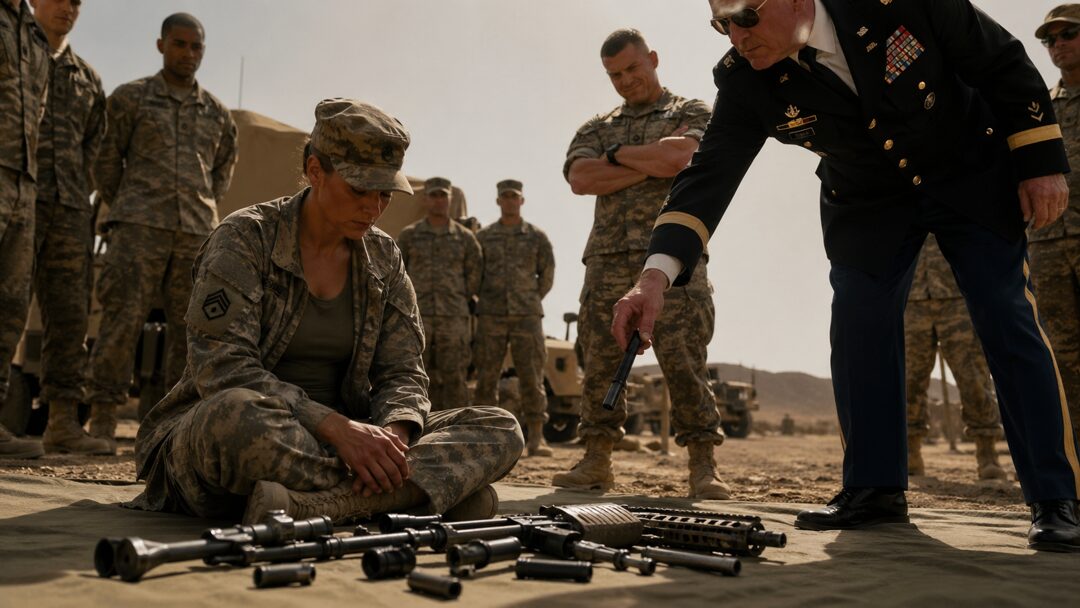
Sergeant Mara Vale was already sitting in the dirt when Colonel Harlan Crewe laid the broken rifle in front of her and said, “If you want to belong in my unit, start by putting a dead man’s rifle back together.”
No one laughed at first.
That was the part Mara noticed.
Eight soldiers stood around the sun-bleached tarp, their shadows cutting across the parts scattered at her knees. Barrel. Bolt. Scope. Magazine. A cracked mount. A sling stiff with old sweat and sand. The desert compound shimmered behind them in waves of heat, all tin roofs, tan walls, antennae, and dust.
Crewe wore his dark formal uniform as if the desert had been arranged around him. Silver hair. Sunglasses. Medals. Polished shoes that had no business near a firing range.
Mara sat cross-legged below him in standard fatigues, sleeves rolled, patrol cap pulled low over close-cropped dark hair. A pale scar crossed one eyebrow. Her face gave away nothing.
The soldiers watched her the way men watched a coin tossed into a well.
Waiting to hear if it hit bottom.
Corporal Dane Mercer stood closest, arms folded over a chest broad enough to make his rolled sleeves strain. His grin had the loose confidence of someone who had never been forced to prove pain quietly.
“Sir,” he said, eyes on the rifle, “that thing looks older than half the course.”
“It is,” Crewe said.
Dane’s grin widened. “No offense to Sergeant Vale, but you can’t zero junk with a cracked scope.”
Another soldier muttered, “Maybe command sent her here for the poster.”
This time, someone laughed.
Mara picked up the bolt and turned it in her hands.
The sound stopped.
Crewe tilted his head. “Nothing to say, Sergeant?”
Mara ran her thumb along the metal. The bolt had been wrapped in a strip of faded cloth, tied close to the handle. It was sun-brittle and gray with years of dust. No standard armorer would leave it there. No inspection table would pass it.
But a man who burned his fingers twice on a hot bolt in a dry riverbed might.
A man named Elias Rook.
Mara did not look up.
“No, sir.”
Crewe smiled faintly. “Good. Then work.”
The heat pressed down. The circle tightened without moving.
Mara placed the bolt on the tarp and reached for the scope mount. The screws were chewed. The housing was cracked along one edge. The rifle had been neglected just enough to look doomed, but not enough to hide the care it had once known.
She knew that kind of neglect.
It was how the Army buried things it could not admit it had broken.
Her fingertips brushed the underside of the scope rail.
She stopped.
Three diagonal cuts had been scratched into the metal, almost invisible beneath the dust.
Not damage.
A sign.
Mara’s breath did not change. Her face did not move. But inside, a dry riverbed opened under her feet.
Three cuts meant Viper Glass.
Three cuts meant move quiet.
Three cuts meant one of ours was here.
Three cuts meant Elias had marked the rifle himself.
Crewe’s reflection hung in the dark curve of the scope glass. Even with sunglasses hiding his eyes, Mara could feel him waiting for the flinch.
He had not chosen a dead man’s rifle.
He had chosen hers.
Part II — The Mark Beneath the Scope
Mara began cleaning the chamber with the corner of a cloth from her kit. Slow. Exact. No wasted motion.
The men around her grew restless because stillness made them uncomfortable.
Dane shifted his weight. “You used one of these before?”
Mara did not answer.
“Sergeant?”
“She heard you,” Crewe said.
Mara slid the cloth through again.
Dust came out in a dark crescent.
A rifle remembered the person who carried it. Not in a mystical way. In practical ways. Scratches where a sling hook bit too deep. Polish where fingers returned to the same place under stress. Tape residue from a field repair no manual would approve. A cloth tied around the bolt because Staff Sergeant Elias Rook believed pain was useful only once.
Heat over Wadi Harun.
Elias beside her, beard crusted with sand, whispering, “Wind’s lying today.”
Radio static.
A convoy marker beyond the dry wash.
A flare that was not supposed to rise.
Mara blinked once and returned to the chamber.
Dane crouched a little, trying to see what she was doing. “That scope’s busted.”
“The housing is cracked,” Mara said.
The first words she had given him.
Dane looked pleased, like he had won something. “That’s what I said.”
“No,” Mara said. “You said the scope was busted.”
One of the men made a low sound.
Dane’s jaw tightened.
Mara set the scope aside and reached for the firing assembly. Crewe’s shadow fell over her hands. He had not moved much, but he knew where to stand. Command was partly geography.
She disassembled the piece without hurry.
There it was.
Wrong weight. Wrong wear. Almost right to anyone trying to see if a weapon looked complete. Wrong enough to fail under pressure.
Mara held the firing pin between two fingers.
For half a second, she heard Elias laugh.
Not loud. He never laughed loud in the field.
“Almost right is how they kill you,” he had told her once, trading out a bent pin under a strip of camouflage net while the sun turned their helmets into ovens. “People survive obvious wrong. It’s almost right that gets buried with them.”
Mara looked at the pin.
Then at the kit.
The correct one lay there, half-hidden under a cleaning rag, as if placed by someone who wanted the failure available but deniable.
Her hands remained steady.
Crewe’s voice came down soft. “Problem, Sergeant?”
Mara rolled the wrong pin in her palm.
“No problem that can’t be seen, sir.”
A few soldiers glanced at each other.
Crewe’s smile did not move, but something beneath it tightened.
Dane leaned closer. “What’s wrong with it?”
Mara placed the pin beside the receiver. “Ask the person who put it there.”
The air changed.
Not loudly.
No one took a step back. No one accused anyone. But the dust between them seemed to hold its breath.
Crewe removed his sunglasses.
His eyes were pale and calm, the kind of calm men trusted until they were the ones under it.
“This is a test of composure,” he said. “Not theater.”
Mara looked down at the rifle parts.
“Yes, sir.”
“And if your first instinct is to imply sabotage in front of candidates who have earned their place here—”
“I didn’t imply sabotage.”
Dane’s eyes flicked from Mara to Crewe.
Crewe’s voice cooled. “Then what did you imply?”
Mara picked up the cloth around the bolt and rubbed its frayed edge between finger and thumb.
“That the rifle was handled by someone who didn’t respect it.”
A gust of wind pushed dust across the tarp. It settled on the barrel, the screws, Mara’s boots, the polished edges of Crewe’s shoes.
Crewe stared at her for a long moment.
Then he stepped closer.
Close enough that only Mara could hear the next words.
“Snakes don’t sing in daylight.”
The desert went silent inside her.
Not outside. Outside, someone coughed. A generator knocked against its housing. A flag snapped once in the heat.
But inside Mara, everything stopped.
That phrase had belonged to six people.
Six soldiers crouched under a torn tarp at Wadi Harun while the radio swallowed their calls.
Six soldiers who were never supposed to exist together on paper.
Six soldiers who had marked their gear with three diagonal cuts because names could be taken, patches removed, reports sealed.
Snakes don’t sing in daylight.
It meant stay unseen.
It meant don’t correct the lie if the lie keeps you breathing.
It meant ghosts survive by not making noise.
Mara lifted her eyes to Crewe’s.
He knew.
He had always known.
Part III — The Tattoo
For three years, Mara had kept the tattoo covered.
In barracks. In medical checks. In summer heat. On buses. In locker rooms where women laughed and traded stories about bad deployments and worse exes. She had learned to change with her back to walls.
The serpent started at the top of her shoulder blade, black ink faded toward blue now, its body coiled around the long shape of a rifle. Not a unit patch. Not official art. No motto written under it.
Names were hidden in the scales.
Elias. Noor. Bishop. Hale. Teague.
Five names for five dead.
The sixth place had been left blank.
Mara had hated that blank more than the needle.
Now sweat ran down her spine beneath the uniform jacket. The desert heat had become a hand around her throat. Crewe’s phrase sat between them like a loaded round.
Dane said, “Sergeant?”
Mara looked at the men around her.
They still saw a woman on a tarp. A selection candidate. A problem Crewe had allowed them to watch.
They did not know they were standing over a grave.
Mara set the firing assembly down.
Then she unbuttoned her jacket.
Crewe’s expression sharpened. “Sergeant Vale.”
She slid one sleeve off.
“Put it back on.”
She slid the other sleeve off.
The undershirt beneath was military green, darkened with sweat. Her arms were lean and hard, sun-browned, marked by small white scars that had not come from training.
The soldiers went quiet for the wrong reason first.
Then she turned slightly to reach for the receiver.
The tattoo showed.
No one spoke.
The serpent curved across her shoulder blade, head lifted, mouth closed, not striking but waiting. Its body wrapped around the rifle like it was guarding it. The ink had softened at the edges, but the design still held. Along the underside of the coil were the tiny names, nearly invisible unless you knew to look.
Dane’s grin disappeared.
One of the older candidates whispered, “No way.”
Another said, “That’s Viper Glass.”
Crewe’s face changed before he could stop it.
Only for a moment.
But Mara saw it.
The pale eyes widened. The jaw locked. The decorated colonel, the man who had stood above her like judgment itself, looked at her back as if a dead unit had reached out of the sand and touched his medals.
There it was.
The first crack.
Dane looked from the tattoo to the rifle to Crewe. “I thought Viper Glass was a rumor.”
Crewe put his sunglasses back on.
“That rumor got people killed,” he said.
Mara threaded the correct screw into the mount.
His voice rose just enough for everyone. “Viper Glass disobeyed a direct order during a classified operation. They broke concealment. They compromised a convoy verification mission. They died because discipline failed.”
The words were clean.
Too clean.
Mara heard the other words beneath them.
Hold position.
Confirm the second vehicle.
Do not move until I authorize extraction.
Then civilians in the wash.
A child in a red shirt walking too close to the road.
Elias whispering, “That’s not militia.”
Mara on the radio. “Command, confirm target status. Civilians present.”
Static.
Then Crewe’s voice, younger and colder through the headset: “Maintain eyes. Do not compromise the line.”
The flare rose seven minutes later.
Not theirs.
Wrong color.
Wrong direction.
The valley lit up. The convoy stopped. Gunfire came from the ridge where no enemy was supposed to be.
Elias shoved Mara down before the first round took the rock above her head apart.
In the present, Crewe said, “Some soldiers confuse survival with vindication.”
Mara tightened the scope mount.
Dane was staring now. Not at her body. At her hands.
“Sir,” he said carefully, “if she was Viper Glass—”
“She was attached to an element that no longer exists,” Crewe said. “And she has spent three years mistaking trauma for evidence.”
Mara picked up the wrong firing pin and held it to the light.
The desert reflected off its narrow body.
“Evidence is usually smaller than men like you want it to be,” she said.
No one laughed that time.
Crewe turned fully toward her. “You are finished, Sergeant.”
Mara placed the wrong pin on the tarp.
“I’m not.”
Part IV — Almost Right
Crewe’s command voice came out like a blade being drawn.
“Stand down.”
Mara did not stand.
“Sergeant Vale, you are relieved from this evaluation pending psychological review.”
The phrase hit exactly where he aimed it.
Not because it surprised her. Because he had practiced it. Because men like Crewe knew how to make a woman’s memory sound like illness and a survivor’s restraint sound like instability.
Dane’s eyes flicked toward her face.
For the first time, Mara’s hands trembled.
Not much.
Enough.
The wrong firing pin lay beside the correct space in the rifle like a tiny metal lie.
Wadi Harun came back in pieces.
Elias breathing hard beside her.
Noor screaming for a medic over a channel that had gone dead.
Bishop dragging himself behind the axle of a burning vehicle.
Teague saying, “Names, Vale. Carry names.”
And Elias, gray-eyed and calm even with blood soaking into the sand beneath him, pressing the rifle toward her.
“Don’t let them make us stupid,” he whispered.
Mara had said, “Save your breath.”
He had smiled like she had missed the point.
“Breath doesn’t save anything.”
The memory vanished.
Crewe was closer now. “You will put that weapon down. You will put your jacket on. You will report to medical by seventeen hundred. If you continue this performance, I will charge you with insubordination.”
Mara looked up at him.
His medals flashed in the sun.
For three years, she had watched men praise Crewe in dining halls, in briefings, in articles pinned to walls. Harlan Crewe, the architect of the Harun containment. Harlan Crewe, who saved a larger force by making hard decisions. Harlan Crewe, who understood the burden of command.
The burden had looked lighter on him than on the people buried under it.
Mara reached for the correct firing pin.
It was not where her fingers expected it.
Crewe saw the hesitation.
So did Dane.
The correct pin was half under the cleaning rag near Dane’s boot. Far enough that she would have to lean into Crewe’s space to reach it. Close enough for someone to pretend later that she had ignored it.
Dane stared down at it.
His face had lost the easy arrogance. The heat had reddened his neck. Sweat ran along his temple.
He looked at Crewe.
Then at Mara.
No speech passed between them. No apology. No sudden friendship.
Just a man realizing he had been invited to watch a rigged humiliation and had almost enjoyed it.
Dane bent as if adjusting his boot.
He picked up the correct firing pin.
For a second, Mara thought he would hand it to Crewe.
Instead, he placed it on the tarp within her reach.
A small sound moved through the ring of soldiers.
Crewe did not look at Dane. That was how Mara knew he had seen.
“Corporal Mercer,” Crewe said softly, “step back.”
Dane straightened.
He stepped back.
But he did not move away.
Mara picked up the pin.
It sat warm from Dane’s fingers.
That warmth mattered more than it should have.
Not rescue. Not absolution.
Witness.
Sometimes that was the first crack in a sealed room.
Mara installed the pin. Her hands steadied as she worked. Receiver. Bolt. Scope. Mount. Magazine. Each part returning to another until the rifle stopped being evidence and became itself again.
Crewe’s voice lowered. “Think carefully, Sergeant.”
Mara seated the bolt.
“I have.”
“You have no idea what you are inviting.”
She wrapped the old cloth once around the bolt handle, not because it needed to be there, but because Elias had put it there.
“Yes, sir,” she said. “I do.”
Part V — The One Elias Marked
The rifle came together with a final, quiet click.
No one moved.
Beyond the tarp, official targets stood at regulation distance: white boards, black centers, numbers painted cleanly above each lane. Safe targets. Measured targets. Targets built to prove what command already knew how to record.
Crewe pointed toward them.
“Lane four,” he said. “One round. Then you are done.”
Mara lifted the rifle, feeling its weight settle into the old place against her body.
Dane watched like he was afraid to blink.
The other soldiers had stopped looking at her like a spectacle. They looked at her the way men looked at a door they had not realized was locked from the inside.
Mara did not aim at lane four.
Crewe’s voice sharpened. “Sergeant.”
She kept the rifle low.
“Do you want the official target,” she asked, “or the one Elias was ordered to mark?”
Crewe’s reaction was not large.
That was what made it devastating.
His mouth opened. Closed. His face hardened around something that had escaped before he could cage it. Shock, anger, fear — all of it flashed and vanished, but not fast enough.
Dane saw.
So did the others.
Crewe said, “You do not have authorization to reference classified operational material.”
Mara looked toward the far edge of the range.
Past lane four.
Past the official markers.
Past a line of rusted scrap half-buried in sand where old training debris had been left to bleach.
There was a narrow metal post leaning at an angle near the dry wash beyond the range boundary. Most people would see junk. Mara had seen it the moment she sat down, because grief had its own field of vision.
Elias had marked it through dust and glass three years ago.
“Second vehicle pauses near crooked post,” he had whispered. “Paint under the rust. You see it?”
“I see it,” Mara had said.
“Good. If they ever call us liars, remember where the snake is.”
Then the radio had cracked.
Maintain eyes.
Do not compromise the line.
Crewe took one step toward her. “Lower the weapon.”
Mara raised it.
No one breathed loudly enough to be heard.
She did not think about the men. She did not think about Crewe’s career. She did not think about charges, review boards, sealed files, or the thousand ways an institution could punish a person without ever admitting why.
She thought about Elias’s hand on the rifle.
Noor’s laugh in the dark.
Bishop humming badly off-key because silence made him nervous.
Hale carving three diagonal cuts into a scope rail with a pocketknife.
Teague saying, “If nobody comes back, then nobody happened.”
Mara settled her cheek to the stock.
The cracked scope housing did not matter. The glass held enough.
The desert narrowed.
Wind, heat, breath.
Almost right was how they killed you.
So she made the moment exact.
The shot cracked across the compound.
The sound struck the metal post beyond the official lane. Rust jumped. Dust burst outward in a small brown cloud.
For one heartbeat, nothing happened.
Then the wind peeled the dust away.
Beneath the rust, beneath the sun-baked grit, a faded mark showed on the metal.
A serpent, painted in black, coiled around the long shape of a rifle.
The same serpent on Mara’s shoulder.
The same serpent that was never supposed to sing in daylight.
No one cheered.
That would have ruined it.
The silence did what applause could not.
It made everyone present decide what kind of witness they were willing to become.
Crewe stared at the marker.
His face had gone still in the way water goes still before it freezes.
Then he turned back to Mara.
For a moment, she saw the man under the medals. Not sorry. Not redeemed. Just afraid of a truth that had learned how to stand in sunlight.
“Formation dismissed,” he said.
His voice held. Barely.
No one moved.
Crewe looked at them, one by one, and the old command returned enough to make obedience easier than courage.
The soldiers began to break apart.
Slowly.
Not joking now.
Not looking at the ground either.
Crewe put his sunglasses back on and walked toward the compound. His shoes gathered dust at last.
Mara lowered the rifle.
Her shoulder ached from the shot. Her back was damp. The tattoo felt exposed to the heat, to the air, to every eye that had misunderstood her and would now misunderstand her differently.
Dane remained.
He stood a few feet away, no grin left, no challenge in his posture.
“What was Viper Glass?” he asked.
Mara knelt on the tarp.
She wiped dust from the rifle with the edge of the cloth. She cleaned the receiver, checked the bolt, then wrapped Elias’s old strip of fabric back where it belonged.
Only then did she answer.
“A unit that held the line longer than it should have.”
Dane swallowed.
“Sergeant—”
“Don’t apologize for what you didn’t know,” Mara said.
He looked toward the distant marker, where the serpent still showed through the dust.
“What about what I wanted to believe?”
Mara paused.
That was a better question.
She picked up her uniform jacket from the dirt and folded it over one arm instead of putting it on.
“Carry that,” she said.
Dane nodded once, as if she had handed him weight.
Mara stood.
For the first time that morning, no one stood over her.
The tarp lay at her feet. The circle was broken. The official targets waited untouched in their clean white rows, useless as excuses.
She shouldered the rifle.
Not triumphantly. Not like a trophy.
Like something borrowed from the dead and finally returned to its proper name.
At the edge of the compound, Colonel Crewe stopped beneath the shade of a tan awning. He did not turn around. But Mara knew he heard her boots in the dirt. Knew he felt the old story walking behind him now, no longer sealed, no longer seated, no longer willing to be mistaken for silence.
Mara passed the line of soldiers without lowering her eyes.
The desert wind moved over her uncovered shoulder.
For three years, she had carried the names where no one could see them.
Now the sun touched every one.