The Shot She Kept Missing
Part I — The White Line
The cigarette was the thinnest thing in the arena, and it held more power than every man shouting around it.
Mara Bell stood with the rifle steady against her shoulder and watched the prince smile as if danger were another servant sent to amuse him. The crowd had become a blur of hats and open mouths. The banners overhead snapped in the late wind. Brass somewhere behind her still trembled from the last triumphant note. None of it mattered now.
Only the cigarette mattered.
Its paper was bright against his mouth. His lips moved once around it, a careless adjustment, and half the men near him laughed. He enjoyed making people look twice. Even at this distance she could see that much. The young prince stood straight in his dark military coat, gloved hands behind his back, his posture saying what his face did not need to: that the world was safest when it revolved around him.
Mara lowered the rifle an inch.
“Hold still,” she called.
He spread his arms by an inch, as if insulted by the suggestion. More laughter from the platform. One of his escorts leaned in and said something at his shoulder, probably caution, probably etiquette. The prince did not move. His smile only sharpened.
He wanted the crowd to see that he was not afraid.
He wanted the crowd to remember that he had been the one standing there.
Mara knew men like that. Men who wanted danger, but only if it made them larger.
She raised the rifle again.
The white line of the cigarette narrowed. The whole arena narrowed with it. Her breathing disappeared. The roar became pressure, then silence. This was the mercy of her gift. It took the world, always too loud, too eager to own her, and reduced it to one honest task.
Ash.
Paper.
Breath.
Distance.
She squeezed.
The shot cracked through the afternoon like a split in the sky.
The cigarette jumped from the prince’s mouth. A bright fragment spun. Smoke broke apart. For one impossible instant nothing moved, as if even the crowd had to examine whether it had witnessed skill or accident.
Then the arena exploded.
Men shouted. Women stood on benches. Hats flew upward. Someone grabbed her arm and screamed in her ear. The prince threw back his head and laughed as if he himself had fired the shot, as if the performance had proved something splendid about his blood.
Mara lowered the rifle and let the sound wash over her.
She had done it cleanly. Cleaner than she had done it in practice. Cleaner than she had dared hope. The cigarette had vanished in a neat white burst, and the prince—still grinning, still intact—looked at her with delighted disbelief, like a child discovering that the tiger had bowed only to him.
For one breath she let herself feel it.
Not relief.
Not gratitude.
Pride.
It came hot and sharp and almost private, though thousands were shouting her name. All her life men had stared at her hands before they trusted them, or stared at her face and decided the hands were an accident. All her life she had been asked to smile before she was asked to shoot. But now there was no room left for doubt. She had taken a lit cigarette from the mouth of a royal man before half a continent of witnesses. There was no sweeter kind of silence than the silence after proof.
Her manager, Amos, was already pushing toward her through the crush, red-faced with triumph.
“Do you understand what you’ve done?” he shouted.
“Yes,” Mara said, though she still only half did.
“You’ve made yourself immortal.”
She gave him a look. “That seems excessive.”
“Not for this.” He seized her elbow and turned her toward the royal platform. “Smile. God help me, smile. They’ll be talking about this when we’re both dust.”
The prince had stepped down from his place. He moved through the attendants like a man entering his own applause. A fresh cigarette had appeared in one gloved hand. He held it up between two fingers and bowed to her with extravagant cheer.
“You see?” he called in careful English. “I lose only the smoke.”
More laughter. More cheers.
Mara tipped her head. “That was the arrangement.”
His eyes brightened. He liked being answered.
When he reached her, the noise around them shifted—not quieter, exactly, but more attentive. Men made space for him. Men always did. Up close he was younger than his bearing pretended, handsome in the polished way certain powerful men were handsome: all confidence and arrangement, his face composed by a lifetime of knowing the room would prefer him.
“Miss Bell,” he said, and took her hand without asking. “You are wasted on ordinary targets.”
His grip was cool and practiced. He did not shake hands. He received them.
Mara smiled because the crowd required it. “Your Highness was very brave.”
“Brave?” he said. “No. Merely curious. A life without risk is bad breeding.”
The men around him laughed again, too quickly.
Mara felt the first small edge of unease under her pride. He had not thanked her. He had not even truly looked at her hands, the hands that had just spared his face by less than an inch. He had taken the danger into himself and recast it as evidence of his own character.
But the arena was still ringing with her victory. Amos was shining. Reporters were already shoving notebooks out like begging bowls. She was not going to spoil the moment by resenting a prince for acting like one.
So she only said, “Then I’m glad my aim did not deprive Europe of its boldest man.”
He laughed hard at that. Hard enough that his escort glanced at him with alarm.
“Oh, I think Europe would survive me,” he said.
Years later, with newspapers open beneath her hands and names of the dead blackening page after page, Mara would remember that line with a chill so sudden it felt like a draft through bone.
But on that afternoon, the crowd cheered again, and the prince reached for another cigarette.
“Shall we try once more?” he asked.
For the first time, Mara looked at him and thought: this man has mistaken being near death for mastery over it.
“No,” she said lightly. “One miracle per performance.”
The answer delighted them all.
By dusk, the story had already outrun the truth. By midnight, it belonged to everyone.
By morning, it belonged least of all to her.
Part II — The Story They Wanted
There were photographs within a week.
In some of them Mara looked composed, almost severe, the rifle held close to her body like a second spine. In others the photographer had caught her smiling because someone off-frame had demanded it. The prince appeared in none of them beside her, but his name arrived before the ink dried. He became the gleam attached to the feat, the high-born mouth at the end of the cigarette, the royal flourish that made editors reach for larger type.
Amos pinned the clippings on the wall of her dressing room.
Mara pretended not to look at them and memorized every word anyway.
The greatest female shot in the world.
The princess of precision.
The American markswoman who made a prince trust his face to her aim.
That last one irritated her. The trust had not been the point. The shot had been the point. But the world had a greed for arrangements it understood: man with title, woman with talent, danger made elegant.
At a supper two nights later, arranged because every successful act became someone else’s social occasion, Mara found herself seated halfway down a long table while the prince held court near the center. Candles multiplied the shine of silver. Men who had never spent an hour hungry spoke admiringly of grit. Women leaned toward Mara with a fascination so bright it nearly counted as affection.
“Tell us,” one of them said, “were you frightened?”
“Of missing?” Mara asked.
“Of him.”
Mara glanced toward the prince. He was listening to three men at once and enjoying the difficulty he caused them.
“I’m not in the habit of being frightened by the people I shoot near,” she said.
That earned laughter. Not much else.
The prince raised his glass toward her from the far end. “Miss Bell believes in accuracy. It is a noble superstition.”
The table laughed again, louder because he had instructed it to.
Later, when the meal thinned into pockets of conversation, he drifted toward her with the same appetite he had shown on the field. He wanted the scene after the scene. He wanted every triumph to continue bending toward him.
“You were offended,” he said quietly, stopping beside her chair.
She looked up. “Was I?”
“By supper. By the idiots. By all of us.” He smiled. “I notice more than I’m credited for.”
“That must be tiring.”
“Only when I am surrounded by bores.”
He pulled out the chair opposite hers and sat without invitation. Two older men immediately found reasons to stand farther away, granting them a pocket of privacy that was really another form of surveillance. Powerful men were always most closely watched when they appeared most free.
“You dislike being admired incorrectly,” he said.
Mara set down her glass. “I dislike being turned into a trick after doing something difficult.”
“And yet tricks are how crowds understand difficulty.”
“I don’t shoot for crowds.”
He seemed amused by the lie she told and the lie she needed.
“No,” he said. “You shoot to defeat them.”
The sentence landed harder than she expected. For the first time that evening she saw not charm but appetite—his for dominance, hers for proof—and felt the faint, unpleasant recognition between them.
“You make everything sound theatrical,” she said.
“Everything is theatrical. Especially courage.”
He leaned back. “Do you know why I stood so still?”
“Vanity.”
That made him grin. “Partly. Also because I refused to give the room the pleasure of seeing me flinch.”
Mara studied him. In his face there was youth, yes, and arrogance, certainly, but also something leaner and more dangerous than either: a need to turn every witness into a mirror.
“Most people are not thinking about you as much as you hope,” she said.
His eyes flashed, not with anger but with delight at resistance. “That is why one must give them reasons.”
A footman appeared with a silver case of cigarettes. The prince took one, tapped it against the lid, and then paused.
“Would this make you uneasy now?” he asked, touching the unlit cigarette to his lower lip.
Mara’s spine stiffened.
He saw it. He liked seeing it.
“Not uneasy,” she said. “Bored.”
He laughed and set it down. “I knew you were ambitious, Miss Bell. I did not know you were cruel.”
“I’m accurate.”
He held her gaze for a second longer than politeness allowed. Then he inclined his head.
“And that,” he said softly, “is what makes you memorable.”
When he left, one of the women from earlier slid back into the empty chair and sighed as if she had witnessed romance.
“He is impossible,” she said.
“No,” Mara answered. “He is very possible.”
She meant dangerous in the way certain men were dangerous long before blood proved it. Not murderous. Not monstrous. Simply trained from youth to treat consequence as decoration.
But by the next month, the shot had become routine in retelling, and even her unease lost its edge. The prince faded into shorthand. The cigarette remained. The moment entered every introduction. Crowds came wanting to see the woman who had done it. Reporters came wanting the same three lines said in fresh language.
Did his hand tremble?
Did you aim at the ash or the paper?
Would you ever attempt such a feat again?
She learned to answer quickly. She learned where to pause for effect. She learned how to give them enough truth to keep the legend fat and enough deflection to keep something for herself.
Years went by that way.
The story followed her from city to city, then decade to decade, each retelling polishing it smooth. Admirers loved the danger of it because it had already ended well. Young men repeated it to impress women. Editors placed it beside lighter items when the world seemed in need of delight.
And each time Mara told it, she felt two things at once.
The old hot pride.
And a smaller feeling beneath it she could not name.
A sourness.
Not at the shot. Never at first. At the laughter after. At the way the prince had stood there not grateful but enlarged. At the way the world kept asking her about courage as if the bravest thing in the arena had been his mouth.
Once, years later, a bright young reporter named Ellis Ford arrived with a notebook and the kind of admiration that mistook access for intimacy.
“I grew up on that story,” he said, settling into the chair across from her. “My mother had your picture clipped in a recipe book.”
“That seems an unstable place to keep me.”
He laughed dutifully.
“I only want it in your own words,” he said. “Not the newspaper version.”
“There is no more dangerous request than that.”
He leaned in. “When you looked at him, what did you think?”
She almost told him the truth: that she thought he was pleased to be placed at the center of a risk he had not earned.
Instead she gave him the older, easier line.
“I thought if he moved, he’d lose his habit.”
He loved it. She could see the quote settle in his face before he wrote it down.
That was the problem with a good line. The world often preferred it to the truth that gave birth to it.
When he left, her companion Lena came in carrying tea and a disapproving expression.
“You fed that boy exactly what he wanted.”
“He came hungry.”
“And what did you get?”
Mara looked at the closed notebook-shaped absence he had left behind.
“Tired,” she said.
Lena set the tray down harder than necessary. “You are tired because they keep asking the wrong story and you keep answering it.”
Mara said nothing.
Outside, a paperboy shouted evening headlines from the street. One name, carried up through the window, made something in her chest tighten.
Not because it was new.
Because it had stopped sounding harmless.
Part III — The Name in the Paper
At first it was only that the name began appearing in different company.
Not beside anecdotes or society sketches. Beside disputes. Mobilizations. Speeches sharpened for newspapers. Editorials heavy with warning. Cartoonists started drawing the prince—no longer merely a prince now, but a ruler—with a harder jaw than he possessed in life, as if the page knew before the public did what sort of face history preferred on the eve of disaster.
Mara tried not to dwell on it.
She failed with discipline.
She saw his old photograph in print one rainy morning and was struck not by recognition but by rearrangement. The man in the picture had not changed, but the meaning of his expression had. Years earlier she had called it confidence. Now she saw appetite. Years earlier she had thought him theatrical. Now she wondered whether theater was simply the first honest language of men who liked command too much.
When war finally came, it did not arrive in her house as strategy or map. It arrived in lists.
Casualties.
Town names.
Regiments.
The dead reduced to columns that still somehow took more room on the page than the living.
Lena found her one afternoon in the parlor with newspapers spread across the table and both hands braced on the wood as if the floor had tilted.
“You’ve been standing there an hour,” Lena said.
Mara did not look up. “Listen to this.” Her voice sounded strange even to herself. “Boys. They are sending boys into mud and calling it civilization.”
Lena came nearer. “You have not eaten.”
“He used to laugh,” Mara said.
Lena went still. She knew at once which he.
“You are not starting this again.”
Mara lifted her head. “Again? It has not left me long enough to begin again.”
Lena’s face hardened, partly from concern, partly from exhaustion. She had been with Mara long enough to know the rhythms of obsession before Mara herself admitted them. “The man at the other end of your rifle did not become himself because you failed to shoot him.”
The words were blunt. Lena favored truth the way other people favored mercy.
Mara sat slowly. “I know that.”
“Do you?”
“Yes.” She folded the newspaper with more care than it deserved. “That is not what torments me.”
“Then what does?”
Mara looked at the paper. At the print. At the black rows that seemed to multiply every time she blinked.
“That I was close enough to history to smell the tobacco on its mouth,” she said, “and I turned it into applause.”
Lena exhaled, almost angrily. “There it is. You want a grand guilt because common grief isn’t sharp enough for you.”
Mara flinched.
Lena heard it and softened by only a degree. “I do not say you’re vain,” she said. “I say pain can become vain if you polish it too much.”
The line might have come from Mara herself in another mood. That made it worse.
Ellis Ford returned that winter for another interview, older by only a few years and somehow already more professional in his hunger.
The story was changing around all of them, but he still wanted the old version, only now with melancholy added for flavor.
“Readers love when the past darkens,” he said lightly, then saw Mara’s expression and corrected himself. “I mean—they want to understand how time changes what moments mean.”
“Do they?”
“Yes.”
“No,” Mara said. “They want pain only if it can be folded neatly.”
Ellis hesitated. “Miss Bell, is it true that you have come to regret that famous exhibition?”
Lena, mending near the fire, stopped moving her needle.
Mara looked at the young man’s notebook, at the clean page waiting to be wounded.
“Regret is a cheap word,” she said.
“What word would you use?”
She could have said shame. She could have said corrosion. She could have said that memory had become a room whose furniture changed shape after dark.
Instead she asked, “Do you know what they cheered for?”
Ellis blinked. “Your skill.”
“No. Not only that. They cheered because danger had come close enough to make them feel important and then passed them by. They cheered because nothing was lost. That is always the sweetest kind of danger for spectators.”
He wrote quickly, and she wanted to snatch the page from him.
“And now?” he asked.
Mara’s voice thinned. “Now I read the dead and think of the neat white burst at his mouth. I think of how proud I was. That is the part I cannot forgive.”
Lena set down the mending. “That is enough.”
Ellis looked between them, startled. For the first time since he had begun mining her life, he appeared to understand there was a living cost to the anecdote he admired.
“I don’t want to cause distress,” he said.
“Then stop wanting stories more than truth,” Lena replied.
After he left, Mara stood by the window until evening turned the glass into a dark mirror.
“Was I cruel?” she asked.
“To him?”
“To the boy.”
Lena snorted. “He’ll live. The young always think they’re handling memory when memory is handling them.”
Mara rested her fingertips against the cold pane. Far down the street someone was laughing. The sound reached her like an artifact from another species.
“I loved that shot,” she said quietly.
Lena did not answer.
“I have kept pretending the wound is that I missed a chance.” Mara swallowed. “It isn’t. The wound is that I admired myself afterward.”
There it was. At last, the sentence truer than regret.
Lena rose from her chair. “Mara.”
“No, let it stand.” She turned, eyes dry and fever-bright. “For years I thought my shame was historical. It is smaller and meaner than that. I was proud. Even now some part of me remembers that afternoon and straightens.”
“That is not a crime.”
“It feels like one.”
“It isn’t.” Lena came closer. “Listen to me. Skill is not sin. Pride is not murder. You are not responsible for what power did with the years you left it.”
Mara gave a bitter, exhausted smile. “No. But I am responsible for which of my own memories I let remain beautiful.”
The first draft of the letter began that night.
It was furious.
Sir, she wrote, though the title beneath it shifted three times.
I once relieved you of a cigarette and regret now that I did not take the breath with it.
She stared at the line.
Too theatrical.
Too pleased with itself.
She tore the page in half.
The second draft was colder. The third was all accusation and no truth. By morning there were scraps in the grate and ink on her fingers and a pounding behind her eyes that made the room pulse.
Lena found the pieces and held one up between two fingers.
“You cannot send this.”
“I know.”
“Then why are you writing it?”
Mara looked at the torn paper. “Because silence has started sounding dishonest.”
Part IV — Drafts in the Storm
The house grew crowded with pages.
They lay on the desk, under books, inside drawers, tucked beneath the sugar bowl, folded into coat pockets. Some were no more than a line. Some ran on for two pages before collapsing into self-disgust. Mara began each with purpose and ended each feeling she had wandered into performance again.
There was the version that was all poison.
There was the version that sounded like prayer.
There was the version that addressed him as if he were already a ghost.
Lena threatened to gather them all and burn them in the stove.
“I would thank you,” Mara said.
“You would hate me.”
“Yes.”
“Then I’ll wait.”
Rain came hard that week, boxing the house with sound. Mara’s joints hurt. Her vision blurred in the evenings if she read too long by lamplight. The war worsened somewhere beyond maps, and each fresh dispatch seemed only to confirm that numbers could become obscene faster than language could keep up.
One evening Lena entered with a telegram from a former troupe member whose son had died overseas. Mara read the few cramped lines and set the paper down very carefully.
Then she reached for the pen.
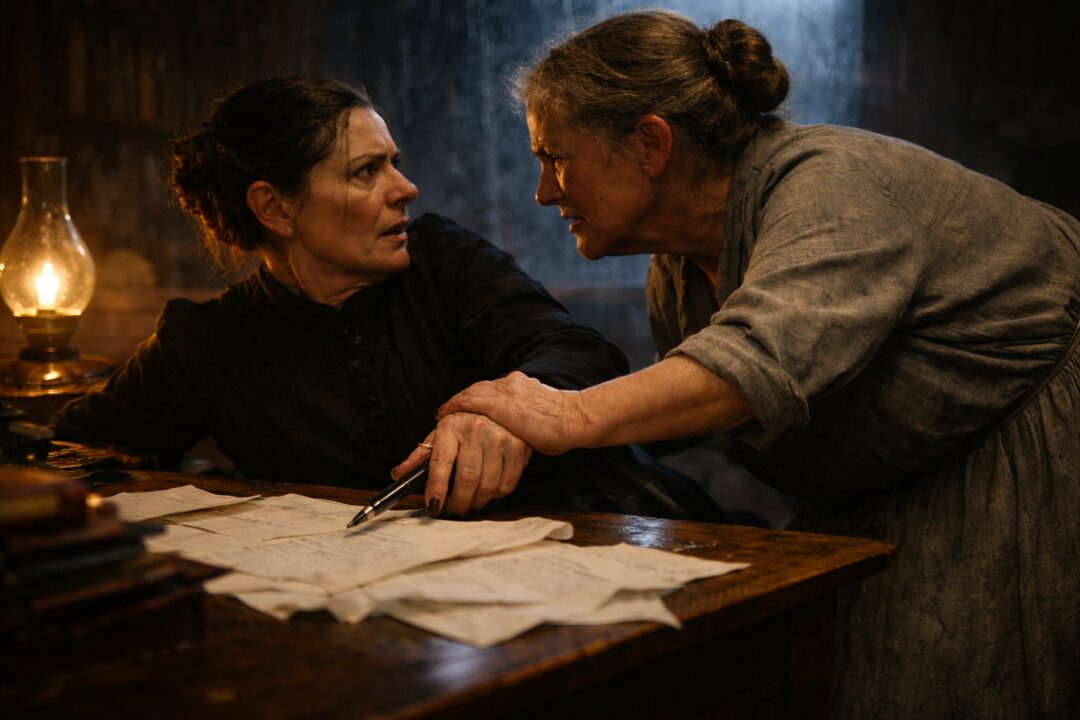
Lena caught her wrist.
“No.”
Mara did not pull away. “Let go.”
“No. Not until you decide whether you are writing to him or writing around your own wound.”
The room held still around them.
Mara looked at Lena’s hand over her wrist—broad-knuckled, work-roughened, familiar from years of buttons fastened and teacups set down and fever cloths wrung out in the night.
“Do you think I don’t know the difference?” Mara asked.
“I think you prefer not to.”
The words hit clean.
Lena released her and stepped back, but the force of it remained in the air.
“You want the letter to mean that once, in one sharp instant, the world placed a lever in your hand,” Lena said. “That if you had tilted it differently, boys would still be alive. Mothers would still be mothers. History would have obeyed you.”
Mara’s mouth trembled with anger. “And you think that is vanity.”
“I think it is grief dressed as power.”
Mara rose too quickly and had to catch the edge of the desk.
“It was my bullet,” she said.
“It was his life.”
“It was my aim.”
“It was his century.”
The rain hammered at the window.
For a moment they only stared at each other, two women held together by loyalty and separated by what loyalty could not solve.
Then Mara sat again, suddenly older inside her own body.
“I know I did not make him,” she said.
Lena’s face softened, but she stayed quiet.
Mara looked at the blank page before her. “I know it. But I was there at one of those awful narrow moments life almost never offers. A moment where consequence stood still. And what did I feel? Not horror. Not warning. Pride.”
Lena came around the desk and stood behind her chair.
“That is because you were young,” she said.
“No.” Mara shook her head. “Because I was excellent.”
The honesty of it broke something between them and healed something too.
Lena rested one hand on her shoulder. “Then write that.”
Mara laughed once, without humor. “Dear sir, the trouble is not that I spared you. The trouble is that I was magnificent.”
“That,” Lena said, “would at least be true.”
For the first time in weeks Mara almost smiled.
She took up the pen again.
This draft began differently.
Not with blame.
Not with fantasy.
With memory.
I remember the afternoon more clearly than I remember most people I have loved.
She stopped, then continued.
I remember the ash at the edge of the paper. I remember how still you stood because you wished the crowd to think you fearless. I remember that I despised that in you a little, even then. I remember that I admired myself more.
She read the lines back. They were dangerous. Not because they accused him, but because they removed the shelter of wit.
The storm thinned toward midnight. Lena fell asleep in the chair by the fire, mending slipped from her lap. Mara wrote and crossed out, wrote and crossed out, until language stopped posing and began to obey.
The final line did not come as a flourish.
It came as the plainest truth her anger could find.
Not that she wished history had given her another chance.
Not even that she wished she had taken the first one differently.
Only this: that the old performance had become unbearable in its completed form, and that every story ever told about it had stopped too soon.
She dipped the pen again.
When the last page was full, she did not move.
Lena woke to silence and saw Mara staring at the sheet as though she had just shot something invisible.
“Well?” Lena asked, voice rough with sleep.
Mara did not look up. “I think I’ve stopped lying.”
“Read it.”
“No.”
“Then let me.”
Mara’s hand tightened over the paper. “Not yet.”
Lena rose, came to her side, and studied her face instead. The pride was gone from it. So was the fever. What remained was harder to name and more difficult to comfort.
“You are going to send it?” Lena asked.
Mara folded the pages once. “I do not know.”
“That matters.”
“No,” Mara said. “The writing mattered.”
Lena stood beside her a moment longer. Then she nodded, not in agreement but in recognition.
There were some acts that changed nothing outside the room and everything within it.
Mara placed the letter in an envelope but did not seal it. The flap rested open like a mouth waiting to be told what it was for.
Part V — The Second Shot
In the morning the rain had cleared, and the world looked offensively clean.
Sunlight reached across the desk and lit the envelope, the newspapers, the ink bottle, the torn carcasses of earlier drafts. The room smelled of wet earth and old paper. Somewhere outside, wagon wheels grated over the street with the indifferent insistence of ordinary life.
Mara sat where she had been, the sealed rifle case across the room untouched, the unsealed letter under her hand.
Lena brought coffee and did not ask again whether it would be sent.
That mercy felt larger than argument.
After a time Mara slid the pages free and read them once more.
They did not sound noble. Thank God for that.
They sounded like a woman who had finally managed to write without trying to win the sentence.
She had named his vanity. She had named her own. She had refused the easy grandeur of pretending she had held the fate of nations between her fingers, and she had refused the easier lie that the moment meant nothing. She had written what she could bear.
Near the end, in a hand steadier than she felt, she had written:
I am told often of that afternoon as if it were the brightest proof of my life. Perhaps it was. That is the part that shames me most.
Then, below it, the line she knew would survive her whether the letter left the house or not:
If Your Majesty should ever place a cigarette between your lips again, I respectfully request a second shot.
She stared at it for a long time.
On another day, in another mood, the line might have pleased her too much. It might have sparkled with the same sharp theatricality she had spent the night trying to strip away.
Now it did not sparkle.
It hurt.
Not because it was cruel, though it was.
Not because it was impossible, though it was.
Because it was the cleanest shape her grief could take.
Lena set down her own cup and looked at the envelope. “Well?”
Mara leaned back. Age made the movement slower than thought. “Do you still think it obscene?”
Lena considered. “I think the world has earned a little obscenity.”
Mara let out a breath that might have been a laugh.
“And vain?”
“Yes,” Lena said. “But no more vain than silence would be.”
The answer pleased her because it did not excuse her.
She folded the pages again. The paper made a dry, small sound in the bright room.
“I used to think accuracy was the purest thing I had,” Mara said.
Lena waited.
“It isn’t.” Mara touched the edge of the letter. “Accuracy arrives too late half the time.”
Lena looked at her with that same plain, weathered steadiness that had held this house together for years. “Late truth is still truth.”
Mara nodded.
She reached for the envelope, then stopped.
Across the room the rifle case sat in shadow. Not a relic. Not a shrine. Simply an object that had once obeyed her better than most people had. She could see, as clearly as if the years had thinned to gauze, the old arena again—the bright banners, the prince’s lifted chin, the white line between his lips.
But the memory no longer opened into applause.
It opened into distance.
Into all the years after.
Into muddy fields she had never seen and mothers she had never met and boys reduced to print. Into interview rooms where young men wanted anecdotes and did not know they were asking her to keep a wound decorative. Into the ugly little pride she had cherished because it had been earned honestly, and the uglier knowledge that honest pride could still age into something unbearable.
She had spent years wanting the memory to choose one shape.
Glory.
Or guilt.
It refused.
It remained both.
That was the cruelty of it. That was the truth.
At last she slid the pages back into the envelope and pressed the flap down with her palm, though she did not reach for wax.
“Shall I post it?” Lena asked.
Mara looked at the sealed edge, then at the window, where the washed morning stood clear and unreadable beyond the glass.
“Not yet,” she said.
Lena did not argue.
Perhaps it would go out tomorrow. Perhaps next week. Perhaps never. Perhaps the letter had already reached its only necessary destination the moment the last line was written.
Mara rose and crossed the room to the window. The pane held her reflection faintly over the street outside: an older woman, upright still, her face carved by years that had not made her gentler so much as truer.
Behind that reflection, in the room she had not turned back to face, the envelope lay on the desk beside the papers of the dead.
For the first time in years, the famous shot no longer felt like a story she owed anyone.
It felt like something else.
A measure.
Of what a person could do.
Of what she could fail to understand while doing it.
Of how little applause could protect a memory once history had laid its hand on it.
Mara touched two fingers to the glass as if testing distance.
Then she lowered her hand.
Outside, life went on in its rude, unbroken way.
Inside, on the desk, the letter waited with the patience of a loaded thing.
And in her mind the cigarette burned once more—thin, white, almost nothing at all—until the image changed at last from triumph into the narrowest shape regret could take.