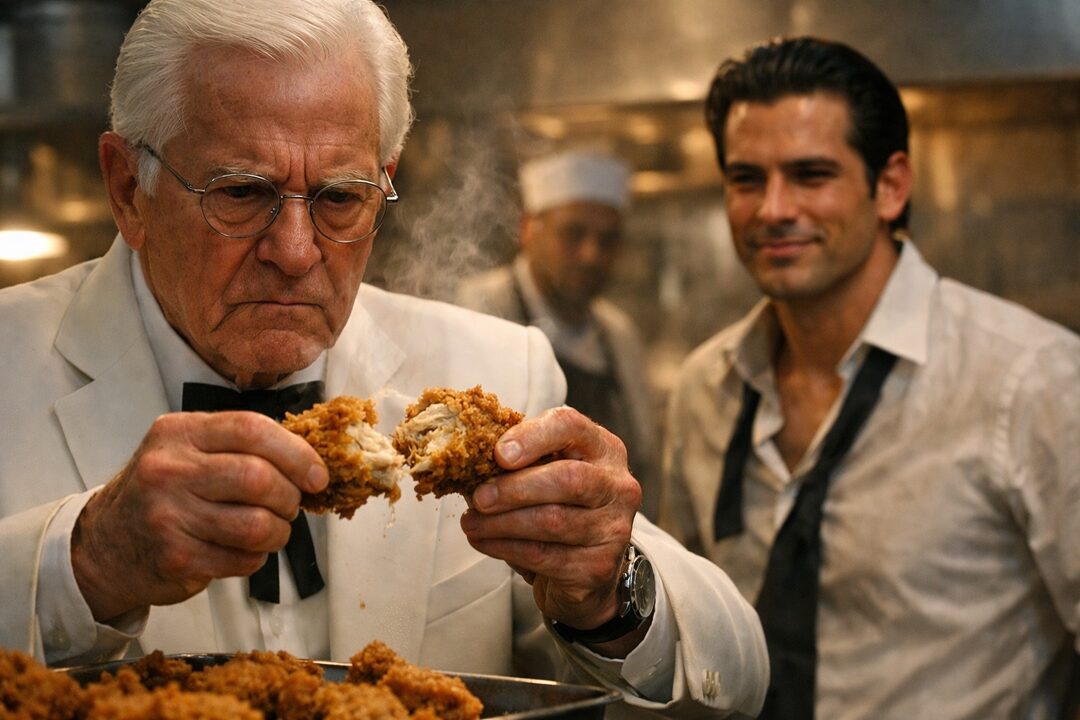
The Road That Left Him Behind
Part I — The White Suit
By dawn, the inside of the car had gone damp.
Harland Sanders woke with a cramp in his neck and a line pressed into his cheek from the steering wheel. For a few seconds he did not move. He only watched the fog on the windows and listened to the tick of the cooling engine, as if stillness might make the morning forget him.
His white suit jacket was hanging from the hook above the back door, protected as carefully as some men protected a wedding photograph. He reached back and touched the sleeve first.
Still dry enough.
Then he opened his wallet again, though he already knew what was in it. A few bills. Some coins. Not enough for pride and breakfast and gasoline at the same time.
He sat in the gray light and did the arithmetic of humiliation.
Coffee and eggs meant less road.
Gas meant another town.
He put the wallet away.
Outside, behind the abandoned filling station, the world was beginning without asking permission from him. A truck coughed awake somewhere on the interstate. Tires hissed far off, steady and indifferent. That sound used to belong to his road. Families used to stop because they were hungry, and men used to pull in because the sign out front promised hot food and a clean table and chicken worth waiting for.
Now the new highway had cut a clean line past his life.
Harland took off his wrinkled shirt and dressed slowly, with the kind of care that would have looked absurd to anyone watching. Fresh collar. String tie. Waistcoat. White jacket. He polished his glasses on a handkerchief gone thin at the edges. By the time he was done, the man in the rearview mirror looked almost respectable.
Almost.
He started the car and drove back to the old place because some wounds demanded inspection.
The restaurant sat where it had always sat, beside the old road, square and stubborn and nearly useless now. The paint had begun to peel at the trim. The gravel lot was mostly empty except for wind-blown paper and a truck whose driver had likely mistaken the building for something still alive. Beyond it, on the raised ribbon of interstate, a stream of cars moved fast enough to feel like insult.
Traffic had not slowed.
It had simply learned how to ignore him.
Harland parked and stepped out. The morning air carried the smell of dust, grease gone cold, and distance.
Inside, the diner windows reflected him back at himself: white suit, black tie, clipped goatee, the posture of a man trying to remain formal in a room already becoming memory. He stood there long enough to see how ridiculous that was.
“You still coming by to punish yourself?”
Harland turned. Vernon Hale, his old poultry supplier, was standing by the side entrance with a crate under one arm. Vernon had the embarrassed expression of a man who had delivered bad news so often it had become part of his face.
“I came to look,” Harland said.
“Looking won’t bring traffic back.”
“No,” Harland said. “But I’ve never trusted a thing without looking it in the eye.”
Vernon set the crate down and wiped his hand over his mouth. “I told you before. Folks aren’t passing through here anymore. They’re going over there.” He jerked his chin toward the interstate. “That road killed this one.”
“Road didn’t kill my food.”
“Didn’t have to.”
The words landed because they were true.
Vernon came closer, lowering his voice as if mercy required volume control. “You’ll have to sell, Harland. Fixtures, land, whatever you can still move. Maybe lease the place to somebody.”
“To do what?”
Vernon did not answer.
That was answer enough.
Harland walked inside. The dining room felt smaller than he remembered, which was another form of insult. The counter stools were still there. The big roadside windows still faced the road that no longer mattered. For one dangerous moment he could almost hear plates, forks, orders, the easy noise of people choosing him.
Then the silence rushed back in.
He put his hand on the counter and looked through the glass at nothing.
A business could die in private. That was one kind of pain.
This was worse.
This was being left in public.
Outside, Vernon waited until Harland reappeared. “You got family?”
Harland’s face changed by less than an inch. “I have relatives.”
“I mean somebody who can keep you awhile.”
Harland picked up the pressure cooker from his back seat as if to remind both of them that he still owned a useful thing.
“I’m not a dog looking for a porch,” he said.
Vernon sighed. “That’s not what I meant.”
“It is exactly what you meant.”
He got back into the car before Vernon could apologize. The apology would have hurt more.
As he pulled away, he did not look at the restaurant again.
He looked at the road.
Then he drove toward the world that had already decided he was finished.
Part II — Closed Doors
The first men he asked tried to insult him politely.
At a small bank in Corbin, a branch manager with slicked hair and a new wristwatch listened to Harland’s proposal with a smile that belonged on a younger man’s face and nowhere else.
“You’re asking for operating capital?” the manager said.
“I’m asking for a little runway.”
“For what enterprise?”
Harland laid out the facts with as much dignity as facts could still carry. A proven chicken method. Faster service. Better flavor. A royalty per bird. It was not begging, he told himself, if a man was offering value.
The manager laced his fingers. “Mr. Sanders, with respect, at your age—”
“Don’t start a sentence that way unless you intend to finish it honestly.”
The manager’s smile thinned. “At your age, a more modest plan might be wiser.”
“Retirement, you mean.”
“I mean security.”
Harland stood. “Security is a fine thing for men who still have any.”
At a diner outside London, Kentucky, a round-shouldered owner let him speak for ten minutes, nodding at all the right times, then asked, “Why don’t your children take care of you?”
Harland looked at him for so long the man shifted in his seat.
“I’m offering you a better chicken plate,” Harland said at last. “Not my bloodline.”
The owner laughed, uneasy now. “Didn’t mean offense.”
“You did. You just wanted it to sound domestic.”
The owner refused him after that.
A feed-store investor told him the country was “moving modern.”
A motel man asked whether customers would really trust food sold under terms dreamed up by “an old fellow in a fancy suit.”
A café owner in Somerset agreed to hear the pitch, then spent the entire conversation watching the white jacket as if it were evidence in a fraud case.
That one hurt in a way Harland could not quite forgive.
He was learning that a hungry man in work clothes might earn pity, but a hungry man dressed like a gentleman earned suspicion.
By the end of the week he stopped trying to explain his entire history. Nobody bought history. Nobody cared what road he had once commanded, what tables had once been full, how many travelers had once known his name.
So he bought a small pocket ledger instead.
He began writing down everything.
Town. Owner. Reaction.
Likes speed.
Distrusts royalty.
Wants lower labor.
Laughs too early.
Too proud of frozen food.
Underestimates hold time.
Words matter: crisp, fast, repeatable.
At first the ledger looked like a graveyard of refusals. Then, little by little, it became a map.
In Barbourville, one owner let him cook.
That felt like a miracle until the man bit into the chicken and said, “Good bird.”
Harland waited.
“But not give-away-my-profit good.”
He laughed after saying it, and his cook laughed too, and Harland stood there in the heat with grease on his cuff and realized the worst kind of humiliation was not anger.
It was being treated like a novelty.
In Williamsburg, a younger owner in shirtsleeves looked him over and said, “You selling chicken or yourself?”
Harland answered before he could stop himself. “At the moment, apparently both.”
The man smirked. “Then the chicken’s got a better chance.”
Harland should have left. Instead he walked the owner through timing, pressure-frying, moisture retention, turnover speed, seasoning balance, customer memory. By the end, the man’s expression had changed from mockery to caution.
Not belief.
But caution was movement.
“No offense,” the owner said. “It’s just hard to picture this scaling.”
Harland touched the pressure cooker beside him. “Men said the same thing about railroads.”
“Railroads had investors.”
“I have a recipe.”
“That’s not the same thing.”
Harland looked straight at him. “Not yet.”
He slept in the car again that night and spent one of his last coins on coffee instead of supper because hunger was easier to carry than shame with a dry throat.
He parked near the courthouse square and ate two crackers from the glove compartment.
Then he opened the ledger.
The pages smelled faintly of grease and dust.
He wrote: Not selling food. Selling trust. Food is only the proof.
The line steadied him more than the coffee had.
Over the next weeks, he refined the pitch. He stopped leading with his hardship. It made some people patronizing and others cautious. He stopped talking first about legacy. Legacy sounded like a dying man’s bargaining chip.
He learned to begin with numbers.
Minutes.
Yield.
Repeatability.
Customer return.
A plate that could become a habit.
He also learned that every doorway was a test of costume. The white suit opened some doors because it made him look official. It closed others because it made him look theatrical.
He wore it anyway.
There are ways a man starves before he misses a meal. One of them is by agreeing to become smaller than he is.
So he kept the jacket brushed. He kept the black tie neat. He kept his shoes polished with a rag in motel sinks and service station washrooms and, once, with a dab of cooking fat when nothing else was left.
One rainy afternoon, after a long drive on bad roads, he stood outside a roadside café in Tennessee and watched through the window before going in. A woman in an apron was clearing plates with quick, efficient hands. Two truckers were at the counter. A boy worked the grill badly. The woman corrected him without wasting a word.
Harland stayed by the door a moment longer than pride permitted.
Something in the place felt desperate in the right way.
He went in carrying the cooker.
The woman glanced up once. “Kitchen’s closed to salesmen.”
“I’m not selling appliances.”
“Then you’re carrying one for comfort.”
The truckers laughed.
Harland set the cooker down gently. “I’m selling chicken.”
She looked at the empty tables, then at him. “We already have chicken.”
“You have fried chicken,” he said. “That’s not the same thing.”
That got her attention.
Not belief.
But attention.
And by then Harland knew attention was where the real work began.
Part III — The First Yes
Her name was Evelyn Mercer, and she did not trust men who arrived with stories.
That became clear within five minutes.
She listened from behind the counter while he laid out the arrangement. She asked no questions until he was finished. Then she took a pencil from behind her ear and said, “How long from raw to plate?”
“Under ten minutes if your prep is right.”
“How many pieces per bird?”
He told her.
“How much oil loss?”
He told her that too.
“What’s the royalty?”
He named the number.
She did not flinch. That worried him more than if she had.
Instead she said, “If it’s real, I make money. If it’s not, I lose an afternoon.”
“You lose ingredients.”
“I lose them slower every day anyway.”
The sentence sat between them.
She was close to the edge. He could hear it.
Behind her, the young grill boy—her nephew, he later learned—watched Harland the way one watched a preacher no one had invited.
Evelyn tapped the pencil against the counter. “You can cook one batch.”
Harland held still. Too much relief would insult them both.
“One batch,” she repeated. “I judge cost, speed, labor, and customer reaction. If you turn my kitchen upside down, you pay for what you waste.”
“I don’t waste food.”
“Good,” she said. “Neither can I.”
The kitchen was narrow, hot, and alive in all the ways that mattered. Steam. Metal. Grease. Noise. An honest room. Harland felt himself straighten inside it.
He unpacked the pressure cooker with the care of ritual. Measured flour. Seasoning. Timing. Heat. He corrected the nephew’s grip on the tongs with a touch no rougher than necessary and earned a glare for it.
“Leave him be,” Evelyn said.
“He’s turning too soon.”
“He’s learning.”
“Then he ought to learn correctly.”
Evelyn’s eyes flicked to him. “You always this pleasant?”
“Only when standards are at risk.”
That almost made her smile.
Almost.
The first batch came out hot and crackling, the crust tight and golden, the smell filling the kitchen so fast even the nephew stopped looking offended. Evelyn cut a piece, checked the steam, checked the meat, checked the crust. She tasted without expression.
Harland hated her a little for taking so long to chew.
Then she took another bite.
Outside, one of the truckers called toward the kitchen, “What’s that smell?”
Evelyn did not answer him. She looked at Harland instead.
“Plate it,” she said.
They sold out of the batch in less than twenty minutes.
One trucker asked for another order to take on the road. A family at a side booth changed their order halfway through supper because they saw what had gone past them. The nephew, now moving faster, nearly forgot his irritation in the pace of it.
Evelyn stood by the pass-through counting tickets with the pencil still in her hand.
When the rush broke, she asked for the numbers again.
Harland gave them.
She did her arithmetic on the back of a supplier invoice, lips moving once, then flattening. She looked at labor. Repeat time. Margin. Waste. Customer speed. She did not care that it tasted excellent until the figures told her excellence could survive contact with money.
Finally she folded the invoice in half.
“It works,” she said.
The room shifted.
Not around him.
Inside him.
Harland felt the dangerous rising thing in his chest—relief, vindication, maybe even hope—and forced it back down before it could embarrass him.
“I told you.”
“That’s not the same as proving it.”
“No,” he said. “It isn’t.”
She leaned against the counter. “One café doesn’t make a business.”
“I’m aware.”
“But it makes a case.”
“It does.”
Evelyn studied him more closely now. Not as a salesman. As a man. She saw the tiredness at the edges, the stiffness in the way he rolled his shoulder, the care with which he folded the cloth beside the cooker.
“How long have you been doing this?” she asked.
“Long enough to know when somebody’s wasting my time.”
“That wasn’t what I asked.”
He hesitated. “Long enough to stop counting certain kinds of days.”
She nodded once, as if that answer satisfied some private test.
He left that evening with a signed agreement, a little cash, and something much more dangerous: proof.
For the first time, the plan felt real enough to fail on a larger scale.
A week later, Evelyn sent a letter to a post office box he had begun using. Short, practical, mostly numbers.
Customers asking for it by name.
Need written timing for second cook.
Your portion estimate was correct.
Also: stop talking so much before the first bite.
He laughed aloud in the post office, which startled the clerk.
He wrote back.
Then wrote again two towns later with a question about hold time under evening rush.
The letters became their own narrow road. No romance. No indulgence. Just figures, corrections, occasional hard sentences that landed cleaner because they had not been padded first.
You are selling certainty, not autobiography.
If they like you more than the product, the product is weak or your pitch is.
You keep talking like a man asking to be believed. Talk like a man with a method.
She was right often enough to annoy him.
That, too, was useful.
The next stage should have been easier.
It was not.
Proof in one kitchen only sharpened the insult of disbelief in the next.
Now that he knew the thing worked, every refusal seemed less like caution and more like blindness. Worse, he started wanting the owners to trust not just the chicken but him. That need slipped into his voice sometimes. The younger men heard it. They always heard it.
So he sharpened the performance.
Not falsehood. Packaging.
He kept the white suit cleaner.
He began introducing himself more deliberately, letting the title people liked to use—Colonel—do part of the work before the cooker ever touched a stove. He simplified his terms. Narrowed his pitch. Made the method sound less like an act of personal genius and more like a system another man could profit from.
It worked.
And every time it worked, he felt a small private theft.
He was saving himself by becoming easier to sell.
One evening, after another decent signing in a town that had not deserved him, he sat in his car with Evelyn’s latest letter open in his lap. The paper smelled faintly of diner grease and tobacco.
There was one line under her numbers.
A face people remember is useful. A man who mistakes usefulness for self will disappear the minute the market changes again.
He read it twice.
Then folded the letter with more care than it required.
Outside the windshield, another road unrolled into darkness.
He had thought the worst thing in the world was being left behind.
He was beginning to understand there was another danger.
Being accepted on terms that changed what part of you got to survive.
Part IV — A Bad Faith Man
Walter Boone came smiling.
That should have been warning enough.
He owned two restaurants and dressed like prosperity had arrived slightly ahead of time and he was trying to keep up. He wore his tie loose, his confidence looser, and he greeted Harland with the warmth of a man who loved bargains more than people.
“I’ve heard of you,” Boone said, shaking his hand too long. “Chicken colonel. Folks talk.”
“Depends which folks.”
“The useful kind.”
Boone let him cook. Better than that—he watched closely, asked smart questions, took notes without pretending not to. He spoke the language of margin and expansion and roadside appetite. For the first time in weeks, Harland felt the pleasurable edge of being understood by a man who could move faster than one café at a time.
It should have made him suspicious.
Instead it made him tired enough to hope.
They reached an agreement quickly. Boone wanted territory. Harland resisted. Boone pushed. Harland yielded less than Boone wanted and more than he should have.
That was how bad faith entered a life: not through grand betrayal, but through one exhausted compromise.
The first trouble came in a letter.
Then in another.
A cook in Bowling Green had heard Boone say the old man’s “secret” was mostly just self-promotion.
An owner in Nashville told Harland he was no longer interested in any arrangement that required paying royalties to a “traveling showman.”
At a lunch counter in Clarksville, a manager laughed when Harland came in.
“I already tried your miracle bird,” he said. “Dry as sawdust. If that’s your standard, I can fail cheaper on my own.”
Harland felt the room tilt.
“Where did you have it?”
The manager named Boone’s place.
Harland asked three precise questions in a row. Hold time. Oil heat. Breading rest. Pressure duration.
The manager blinked. “Hell if I know.”
“Exactly,” Harland said.
He drove two hours to Boone’s nearest restaurant and walked into the kitchen without waiting to be invited. What he saw made something cold move through him.
The chicken was being rushed.
The seasoning was imitated, not measured. The timing was sloppy. The oil was wrong. A cook was lifting pieces too early and letting them sit too long under heat lamps that turned the crust tired.
Boone appeared behind him with that same salesman’s smile.
“Now hold on,” Boone said. “You can’t storm in like—”
“You’re ruining it.”
Boone spread his hands. “We had to adapt.”
“You had to obey the method.”
“We had to run a business.”
Harland picked up a piece, broke it open, and looked at the meat as if it had been injured on purpose.
“This isn’t my chicken.”
Boone’s voice hardened a shade. “It’s good enough for the public.”
“No,” Harland said quietly. “It’s good enough for a man who thinks the public has no tongue.”
A few employees had gone still.
Boone saw it and smiled wider, which is what weak men do when they feel their audience shifting.
“You have very high standards for a fellow sleeping in his automobile.”
The room went silent in the exact way rooms do when cruelty arrives clean.
Harland set the chicken down.
“I may sleep in my car,” he said, “but I do not serve embarrassment on a plate.”
Boone laughed once. “This is why people call you difficult.”
“No. They call me difficult because incompetence prefers softer language.”
He tried to end the arrangement. Boone argued. Threatened. Suggested legal confusion Harland could not afford. Worst of all, he kept operating badly just long enough to muddy the water in nearby towns.
The damage spread faster than proof ever had.
That was the real lesson.
A good thing could travel slowly.
A bad version of it could outrun the truth.
In the weeks that followed, doors that had once opened a crack began staying shut. Some owners smiled with rehearsed sympathy. Others did not bother with courtesy.
One said, “I hear the recipe’s nothing but a costume.”
Another: “Why should I pay for your name if your own operators don’t follow you?”
That one stayed with him.
Because it was not insult.
It was architecture.
His whole future depended on something more fragile than taste. It depended on discipline surviving in hands that were not his.
He wrote to Evelyn from a motel with a leaking pipe and no patience left. Three pages. Anger. Boone’s shortcuts. The rumors. The stupidity of men who wanted gain without method. He ended the letter harder than he intended:
A recipe in the wrong hands becomes a lie about the man who made it.
Her reply came four days later.
Then stop chasing hands. Find one spine.
No sympathy. No reassurance.
Just that.
Below it, in smaller writing:
You are still trying to be irreplaceable. That is not the same as being valuable.
He read the line, folded the letter, opened it again, and hated her for being right.
Age had begun to collect interest on his body. Long drives stiffened his back. Nights in the car made his left hand ache by morning. Heat in kitchens now struck him like a debt collector. He still entered each place in the white suit, still set down the pressure cooker with ceremony, still pitched numbers and certainty and speed.
But something in him had changed.
Earlier, every rejection had felt like a blow to survival.
Now they felt personal in a more dangerous way.
He was no longer just trying to avoid hunger.
He was trying to force the world to admit it had judged him too early.
That kind of need can sharpen a man.
It can also ruin his aim.
So he changed strategy.
He stopped taking every meeting.
Stopped chasing every curious owner with a stove and a smile.
He began asking harder questions before he unpacked a single thing. About turnover. Training. kitchen discipline. Expansion plans. Waste tolerance. Standardization. He started looking for the kind of man Boone had not been: careful enough to learn, ambitious enough to spread.
That search led him, eventually, to Raymond Pike.
Three restaurants.
Regional growth.
No appetite for sentiment.
Exactly the sort of man who might say no for the right reasons.
Exactly the sort of man worth trying for anyway.
Part V — The Heat of Proof
Raymond Pike received him in shirtsleeves and caution.
His office sat above one of his restaurants, all practical wood and ledgers and nothing ornamental that did not earn its place. Pike was younger by decades and looked as if he trusted clocks more than people.
“I know who you are,” Pike said.
“That may help.”
“It may hurt.”
Harland almost smiled. “That depends whether you prefer rumor or measurement.”
Pike didn’t smile back. “I’ve heard both.”
“Then let the kitchen settle it.”
Pike leaned back in his chair. “My concern isn’t whether you can cook one good batch. A county fair can produce one good batch. My concern is whether what you have can travel beyond your hands.”
There it was.
The real question.
Not taste.
Transmission.
Harland felt, absurdly, the weight of every mile behind him, every closed door, every greasy counter, every time a younger man had glanced from his white suit to his age and decided the future had no room for both.
“When?” Pike asked.
“Now,” Harland said.
The kitchen downstairs was large enough to make failure visible.
Staff moved around them with the disciplined speed of a place that expected volume. Two managers watched from the edge of the prep area. A fry cook, arms folded, looked at Harland the way mechanics look at a salesman describing engines.
Good, Harland thought.
Let them.
He set down the pressure cooker.
Unlatched it.
Measured.
Mixed.
The room tightened around the ordinary acts.
Flour.
Seasoning.
Heat.
He could feel his fatigue like grit under the skin. His shoulder burned. Sweat gathered under the collar of his shirt. The white jacket was off now, hanging nearby, but even without it he could feel the image of himself in the room: old, formal, inconvenient, insisting on exactitudes younger men often called vanity.
Pike stood close enough to interrupt and did.
“How much variance can the method tolerate?”
“Less than lazy people want.”
“That isn’t an answer.”
“No,” Harland said. “It’s the reason answers matter.”
He kept working.
“Why royalties?” Pike asked.
“Because if you profit every day from a method I built, I ought not starve while you do it.”
“One operator said your terms are sentimental.”
“One operator ruined good chicken and called it adaptation.”
Pike watched him dredge, shake, load, seal. “And if I take this on at multiple locations?”
“Then you train it precisely.”
“And if managers drift?”
“Then your managers are costing you money.”
Pike’s expression changed slightly at that. Not softened. Sharpened.
Because now they were speaking the same language.
When the first batch came up, the kitchen seemed to breathe toward it. Harland opened the cooker. Steam rose fast and hot. The crust held tight. The smell did the rest.
One of Pike’s managers stepped closer despite himself.
Harland plated pieces and handed them out without flourish. Pike tasted first. Then again. Then looked not at Harland, but at the station, the timers, the workflow.
Good.
That was the right place to look.
“What’s your exact hold threshold?” Pike asked.
Harland answered.
“Oil turnover?”
He answered that too.
“Portion training?”
Harland paused.
This was the moment.
The old reflex in him—the proud, suspicious, hungry one—wanted to keep part of it back. Keep the method dependent on his presence. Keep mystery where vulnerability lived. Keep the thing his.
That instinct had slept in him for months, maybe years. It was not greed. It was fear dressed as standards.
If he gave too much away, what remained of him that could not be copied badly, repackaged, or outgrown?
If he held too much back, he would remain exactly what the world had already tried to make him:
A relic with a private excellence and nowhere to put it.
Pike waited.
The managers waited.
The fry cook waited.
Harland looked at the cooker, then at his own hands.
Then he began.
He explained the sequence cleanly. Timing, pressure, oil behavior, coating discipline, batch consistency, how to train a cook who thought instinct was enough, how to cost the plate without destroying quality, how to make the process survive a man who was in a hurry.
No myth.
No theatrical veil.
No protecting himself through mystique.
He gave them the system.
And in the giving, something in him hurt.
Something else unclenched.
Pike asked harder questions after that, the kind a serious man asks only when he is no longer pretending indifference.
Harland answered all of them.
By the end, the kitchen had changed sides.
Not in devotion.
In respect.
Pike wiped his fingers, stepped aside, and spoke low enough that the others could not fully hear.
“I don’t invest in legends,” he said.
“Then invest in discipline.”
Pike studied him one more long second. “You understand this won’t remain yours in the way it has been.”
Harland looked past him at the cooks, the counters, the movement of a room built to repeat what worked.
“Yes,” he said.
It was the hardest honest word he had spoken in months.
Pike extended his hand.
“This I can build,” he said.
Harland took it.
No speech arrived to save the moment. No grand declaration. Just a handshake in a hot kitchen, a piece of paper brought in by a manager, the scratch of signatures, and the knowledge that the thing he had carried like a private wound had finally crossed a threshold without him having to stand in it forever.
He picked up the white jacket when it was time to leave.
For a moment he only held it.
Then he put it on.
Part VI — What Remains
Later, there were more letters.
More agreements.
More roads.
More kitchens where younger men used his timing, his method, his discipline, and called it by the name he had almost lost before the world learned how to profit from it.
Checks began arriving with enough regularity to change the shape of fear. He slept in rooms with beds more often than in the car. He ate breakfast without doing arithmetic first. The old road no longer felt like the only place in America where his life had happened.
But success did not come in pure water.
It came carrying silt.
One winter afternoon, months after the Pike agreement, Harland stopped at Evelyn Mercer’s café on his way through. He had not warned her. He wanted, for once, to arrive somewhere without having to sell the right to be there.
The place was fuller than before. The nephew moved faster now, no longer a boy exactly. A family at the far booth was eating chicken without any idea they were participating in somebody else’s private revenge against disappearance.
Evelyn saw him from behind the counter and set down the pencil she was still carrying.
“You look less starved,” she said.
“You look more expensive.”
“That means I’m charging properly.”
He sat at the counter. She poured coffee without asking.
For a while neither of them said much. That was part of the ease between them. They had skipped the ornamental parts of acquaintance and gone straight to utility, then to respect, and from there to something narrower and cleaner than affection but warmer than mere recognition.
At last she asked, “How many now?”
He named the number.
Her eyebrows lifted, just once.
“That many?”
“That many.”
“And are they doing it right?”
He looked into his coffee.
“Enough of them.”
She nodded as if that answer, too, had been expected.
After a moment she said, “You were never really afraid of failing.”
Harland glanced up. “No?”
“No. You were afraid of being made irrelevant and having to watch it happen in public.”
He gave a short breath of laughter. “You improve with age.”
“I improve with evidence.”
He reached into his inside pocket and took out the old ledger. The cover was softer now, corners worn, pages crowded with names and towns and notes written in motel light, in parked cars, on counters sticky with other men’s dinners.
He laid it on the counter between them.
Evelyn touched it with two fingers. “You kept all of it.”
“A man ought to know the price of his own education.”
She opened a page, saw a list of rejections, and closed it again.
Then she looked at the white suit.
It was still immaculate.
Not because the shame had vanished.
Because he had learned how to wear it after shame.
“It fits you better now,” she said.
“The suit?”
“The man.”
He almost answered with something sharp. Habit.
Instead he let the line stand.
In the open kitchen beyond them, the nephew dropped a basket at the wrong angle and corrected it before Evelyn had to speak. At the window, two travelers ordered the chicken as casually as if it had always belonged to the country.
That was the strangest part.
Once, the method had been a last possession. A thing he carried from town to town because almost everything else had already been stripped away.
Now it was moving through rooms he had never seen, in hands that would never know how cold that car had been before dawn, how carefully he had folded the jacket to keep the cuffs dry, how many times he had stood on the wrong side of a kitchen door waiting for a younger man to decide whether he was worth the inconvenience.
The world had finally said yes.
It had not apologized first.
That, he thought, might be the only honest shape of victory.
Evelyn pushed the ledger back toward him. “You staying the night?”
“I have a room.”
“That wasn’t what I asked.”
He looked at her, then at the café, then at the road beyond the window where traffic still moved toward places neither of them controlled.
“No,” he said. “I think I’m still learning how not to.”
She accepted that. She always had a talent for accepting the truth of a thing without dressing it up.
When he rose to leave, she reached out and straightened the edge of his lapel with two brisk fingers, the gesture so brief it might have been practical if not for the silence around it.
“You know,” she said, “most men would tell this story like they won a war.”
Harland put on his hat.
“Most men,” he said, “weren’t sleeping in their car when it started.”
He stepped outside.
The evening air was cool. The highway sounded far off, steady as weather. He stood for a moment in the doorway, no longer outside in the same way he had once been. Not because the world had become kinder. Not because progress had turned around and come back for him.
But because he had found a way to cross into it without begging permission.
He touched the pressure cooker in the car before getting in, an old reflex by now.
Tool.
Weapon.
Proof.
Then he placed the ledger on the passenger seat beside him and looked once through the café window. Inside, workers moved. Plates crossed counters. Customers ate without ceremony. Life went on in the ordinary shape success always wanted for itself—as if it had not once required desperation to be born.
Harland started the engine.
He was no longer the man waking under fogged glass counting coins for gas.
But that man had not disappeared either.
He rode with him still, quiet and upright, dressed in white, refusing to be left behind again.