The Names She Carried
Part I — The Patch
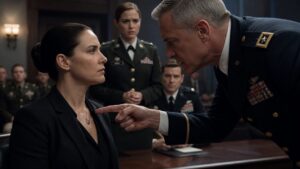
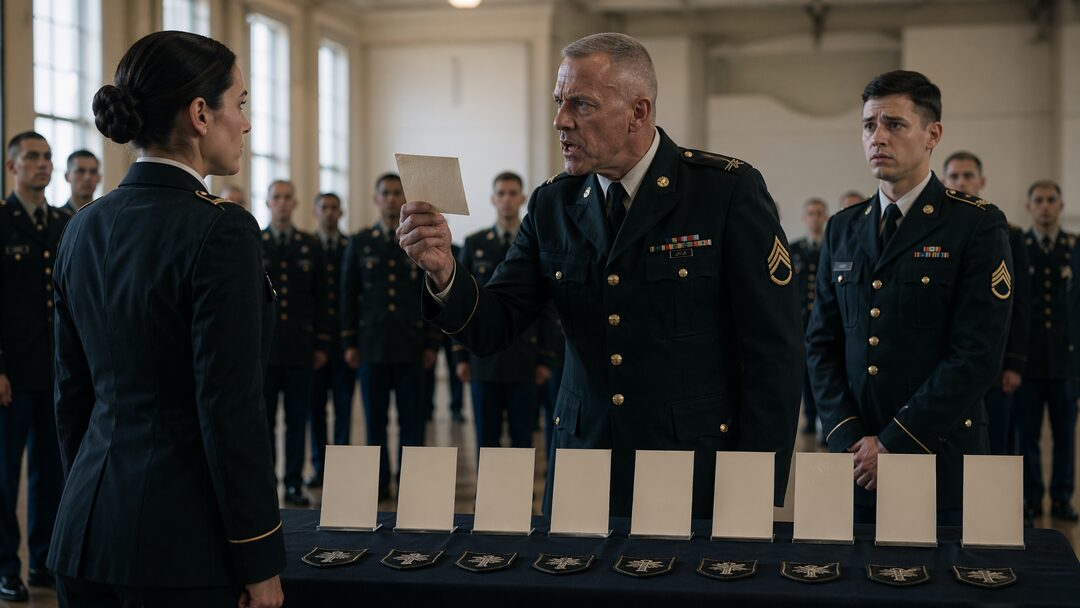
Platoon Sergeant Cole Mercer pointed at the empty square of Velcro on Mara Voss’s chest like it was a crime scene.
“Where is it?”
The drill hall went still.
Forty soldiers stood in formation under the dull white lights, boots aligned, shoulders squared, eyes forward except for the ones pretending not to stare. On every left sleeve, just below the flag, was the same commemorative patch: a red medical cross with silver wings.
Angel Aid.
Everyone had been issued one for the ceremony.
Everyone was wearing it except Staff Sergeant Mara Voss.
Mara stood at attention in the front rank, her uniform pressed so sharply it looked cut from metal. Her dark hair was pinned tight. Her face gave away nothing. Not irritation. Not fear. Not the kind of embarrassment that usually came when a senior NCO decided to make one person an example in front of the room.
Mercer stepped closer.
“I asked you a question, Staff Sergeant.”
Mara’s eyes stayed fixed past his shoulder. “I removed it, Sergeant.”
A few soldiers shifted before catching themselves. Specialist Eli Ramos felt the movement ripple down the line and forced his own boots harder into the floor.
Mercer’s jaw flexed.
“You removed a memorial patch from your uniform during memorial inspection.”
“Yes, Sergeant.”
“On purpose.”
“Yes, Sergeant.”
Mercer looked at the blank spot again, then at her face. He was broad and gray at the temples, the kind of man who seemed built out of rules that had survived fire. He had been with the unit only three weeks, but he already filled every room like a closed door.
“You want to explain why?”
Mara did not blink. “No, Sergeant.”
The silence after that was worse than a shout.
Eli stared straight ahead, but he saw Mara from the edge of his vision. Everyone knew something about her. Or thought they did. Staff Sergeant Voss, combat medic. Rasha Valley survivor. Two medals she never wore unless regulation forced her to. Quiet as locked steel. She corrected mistakes without raising her voice and could make a private feel six inches tall by simply waiting for him to fix his own answer.
People said she had “medal problems.” Not out loud around officers. Not too close to her. But in supply cages, outside the motor pool, over bad coffee.
Some soldiers collected praise like coins.
Mara Voss seemed to treat it like shrapnel.
Mercer took one more step until his finger was inches from her chest.
“Seven people died under that symbol,” he said. “You understand that?”
Mara’s throat moved once.
“Yes, Sergeant.”
“And you think you’re above wearing it?”
“No, Sergeant.”
“Then what are you doing?”
She said nothing.
Mercer’s voice dropped, which somehow made it sharper.
“You don’t get to hide behind silence in my platoon.”
The line hit the room like a slapped table.
Eli saw Corporal Jennings glance at him. Someone behind them breathed out through his nose, almost a laugh. Eli did the same before he could stop himself. A tiny sound. Cowardly. Shared. Gone in less than a second.
Mara heard it.
She did not turn.
That made it worse.
Mercer did not miss the sound either. His eyes swept the formation, pinning everyone back into stillness.
“This ceremony is tomorrow,” he said. “Fifteen years since the Rasha Valley Clinic Fire. The battalion commander will be here. Families will be here. Survivors will be here.” His gaze came back to Mara. “And you will stand in formation with the rest of this unit.”
Mara’s voice remained flat. “I won’t stand under that banner.”
A low current moved through the soldiers.
Mercer’s face hardened.
“What did you say?”
“I said I won’t stand under that banner, Sergeant.”
For the first time, Eli saw something change in Mercer. Not confusion. Not exactly anger. Something older. Something that looked like a door being kicked open in a house he had tried to keep locked.
Mercer turned toward the front of the hall, where the memorial display waited half-assembled beneath a folded flag. The Angel Aid banner hung above it, red cross, silver wings, seven gold stars.
Then he turned back.
“You will report here after final formation,” Mercer said. “You will prepare the memorial display. Every card. Every ribbon. Every photograph. And tomorrow you will wear that patch.”
Mara did not move.
“Yes, Sergeant.”
Mercer leaned close enough that only the front rank could hear him.
“If you’re ashamed of something, Staff Sergeant, save it for your own mirror.”
Mara’s eyes finally shifted to his.
Just for a second.
Not angry. Not wounded.
Older than both.
“Yes, Sergeant,” she said.
Eli looked away first.
Part II — Seven Gold Stars
The memorial display smelled like dust, old cardboard, and polished brass.
After final formation, Mara stood alone at the front of the drill hall with three storage bins open at her feet. The rest of the unit had been released, but Mercer had ordered Eli to stay and assist.
“Since you found the inspection amusing,” Mercer had said.
Eli had answered, “Yes, Sergeant,” because there was no safer word in the Army.
Now he stood beside Mara while she lifted history out of plastic containers.
A cracked medic’s case.
A folded Angel Aid flag.
A burned stretcher buckle sealed in a clear evidence sleeve.
Seven casualty cards printed on heavy cream paper.
Seven names.
Eli tried not to watch her hands, but he did anyway.
She handled everything with exact care, like the objects were not fragile but sleeping. When she lifted the medic’s case, her thumb paused on a blackened groove melted into the side. The pause lasted half a second. Maybe less.
Then it was gone.
Eli placed brass holders along the table. “Staff Sergeant?”
Mara did not look up. “What?”
He swallowed. “Did you know them?”
Her fingers tightened on the edge of a casualty card.
“Yes.”
All right, then. End of conversation.
He reached for the next stack and knocked a folder loose from beneath the flag. Photographs spilled onto the table.
The top one caught him before he could pretend he had not seen it.
A young woman in dusty body armor stood outside a sand-colored clinic with smoke in the background. Her face was streaked with blood, but her eyes were unmistakable. Mara, fifteen years younger. Beside her stood a young male medic grinning too wide, helmet pushed back, one hand raised as if the camera had caught him mid-joke.
Same eyes.
Same mouth.
The label taped below the photo read:
SSG MARA VOSS AND CPL JONAH VOSS — RASHA VALLEY AID STATION — 2009
Eli went cold in a small, private way.
Voss.
He looked from the photo to Mara.
She had gone still.
Not stiff. Not surprised.
Still, the way a person becomes still around a loaded weapon.
“I didn’t mean to—”
“Put it down,” she said.
He did.
Before either of them could speak again, Mercer’s boots crossed the hall behind them.
“What’s this?”
Eli straightened so fast his knee hit the table.
Mercer stopped beside them and looked at the scattered photographs, the half-placed casualty cards, the open folder. His eyes moved to Mara.
“You were told to prepare the display, not dig through it.”
“I was preparing it,” Mara said.
Mercer picked up the photo of the two Vosses. He studied it.
Something in his face tightened, but not enough to soften him.
“Corporal Jonah Voss,” he read. “One of the seven.”
Mara said nothing.
Mercer set the photo back down.
“You had a relative on the casualty list.”
Still nothing.
“That why you think this belongs to you?”
Mara’s gaze lifted.
“It doesn’t belong to anyone alive.”
Mercer’s nostrils flared.
Eli wished, suddenly and violently, that he had never laughed in formation.
Mercer pointed to the cards. “Finish the display. Both of you. And Staff Sergeant?”
“Yes, Sergeant.”
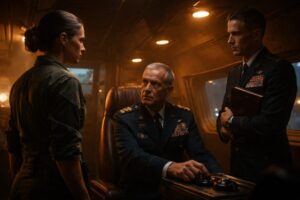
“Tomorrow morning, the colonel wants you available for the ceremony rehearsal. He’s considering asking you to speak.”
The room seemed to lose air.
Mara’s mouth opened just enough for breath.
“No.”
Mercer stared at her. “That wasn’t a request.”
“No, Sergeant.”
Eli had heard soldiers refuse stupid things before. Bad details. Weekend duty. A second plate of eggs at the DFAC when the eggs looked wet.
He had never heard someone refuse like this.
Not loud.
Final.
Mercer stepped around the table.
“The Army does not function if every soldier treats grief like a private kingdom.”
Mara looked at the Angel Aid banner above the display.
Seven gold stars.
Seven official dead.
“That’s not what I’m protecting,” she said.
Mercer’s hand curled once, then opened.
For a second, Eli saw the man behind the rank. Tired. Angry. Hurt in a place he did not allow anyone to name.
Then Mercer turned his face back into command.
“Finish it,” he said.
He left them there with the seven cards.
Mara returned to work.
Eli waited until Mercer’s footsteps were gone.
“Staff Sergeant,” he said quietly.
“No.”
“I just—”
“No, Ramos.”
He nodded, ashamed before he knew what for.
They worked in silence for another twenty minutes.
When Mara lifted the cracked medic’s case again, the sleeve of her uniform pulled tight across her shoulder. Eli saw, just below the collar at the back of her neck, the edge of red ink.
Only a curve.
Only a hint.
Then the fabric settled and hid it again.
Part III — The Eighth Name
The sealed folder was not hidden well enough to be secret.
That was what made Eli touch it.
It sat behind the framed photographs in a gray archive box marked RVCF — CEREMONY MATERIALS / OFFICIAL. A red strip of tape crossed the front. Not classified. Not forbidden. Just inconvenient-looking.
Mara had been called to the orderly room. Mercer had gone to meet with the command sergeant major. Eli had been told to align the display cards and replace the cracked plastic sleeves.
Instead, he opened the folder.
The first page was a ceremony script.
The second was a seating chart.
The third was a casualty summary.
Seven names appeared under OFFICIAL HONOREES.
Then, below a line marked ADMINISTRATIVE CORRECTION PENDING, there was an eighth.
AMINA DARZI — LOCAL INTERPRETER / ATTACHED PERSONNEL
No gold star beside her name.
No printed card.
No photograph mounted for the display.
Eli turned the page.
There she was.
A woman with a green scarf tucked beneath body armor, ink on her fingers, and a calm face that did not match the smoke-blurred chaos behind her. In one photo, she was helping two wounded soldiers down a hallway. In another, she stood beside Mara and Jonah Voss, holding a clipboard against her chest, half-smiling like someone who had learned to smile quickly before the next emergency.
A handwritten note was clipped to the photograph.
Led evac route through east corridor. Returned inside with SSG Voss. Status disputed. Contract category unresolved.
Eli read it twice.
Returned inside.
With SSG Voss.
“What are you doing?”
He dropped the page.
Mara stood at the end of the table.
Her face was blank, but her eyes had already seen everything.
“I found this,” Eli said, stupidly.
“Yes.”
“There were eight?”
Mara walked to the table and closed the folder. Not fast. Not dramatically. Just closed it.
“There were eight,” she said.
“Why isn’t she on the display?”
Mara picked up the folder and held it against her side.
“You should ask someone who likes answers.”
The shame in Eli sharpened into something else. “She helped them.”
Mara’s gaze cut to him.
He lowered his voice. “It says she helped them get out.”
“She did.”
“But she’s not—”
“No.”
“Why?”
Mara looked toward the banner again.
Seven gold stars.
Her voice was quiet enough that Eli had to lean forward to hear it.
“Because when people survive because of someone, they call her brave. When paperwork survives her, it calls her pending.”
Eli did not know what to say to that.
He hated that he had laughed earlier. Hated it in his bones now.
“Did you fight it?” he asked.
Mara’s expression did not change, but the air around her did.
“I did.”
The two words carried weight far beyond their size.
“What happened?”
She held the folder tighter.
“I learned what they call fighting when you’re the only survivor who remembers.”
Eli’s mouth went dry.
Before he could answer, Mercer came through the side door with a clipboard in hand. He saw the folder against Mara’s ribs. Saw Eli too close to it.
His eyes narrowed.
“Problem?”
Mara turned toward him. “No, Sergeant.”
Mercer looked at Eli.
Eli almost spoke.
He could have said: There’s another name.
He could have said: The display is wrong.
He could have said anything.
Instead he saw Mercer’s rank, Mara’s stillness, the empty drill hall, and his own career as a fragile thing he had not yet learned how to risk.
“No, Sergeant,” Eli said.
Mara did not look at him.
That was worse than if she had.
Mercer stepped closer to the display. “The colonel confirmed it. Staff Sergeant Voss will read a brief statement tomorrow.”
Mara’s face finally changed.
Not much.
Enough.
“No,” she said.
Mercer laughed once. No humor in it.
“You keep using that word like rank comes with personal veto power.”
Mara placed the folder back into the archive box.
“I won’t give them that speech.”
“Them?”
“The people who want the dead useful.”
Mercer’s clipboard lowered.
“You think that’s what this is?”
“I think you don’t know what this is.”
His face hardened.
“I know what it is to lose soldiers.”
The words stopped the room.
Eli had heard rumors about Mercer too. A convoy. Three names. A folded flag sent home in a box that should have carried equipment. He had heard Mercer visited one mother every year and never told anyone when he went.
Mercer stepped closer to Mara, and this time his voice was not just command. It was memory with its teeth showing.
“I know what happens when discipline slips. I know what happens when one person decides the rule doesn’t apply today because they hurt. So don’t stand there and tell me I don’t know grief.”
Mara looked at him for a long moment.
When she answered, there was no cruelty in it.
“That’s why you should be more careful with other people’s.”
Mercer flinched as if she had struck him.
Then the door opened behind him. Two junior soldiers entered carrying chairs and stopped immediately, sensing they had walked into something armed.
Mercer turned his head.
“Out.”
They disappeared.
He looked back at Mara.
“Tomorrow morning,” he said. “Inspection. Full uniform. Patch on.”
Mara said nothing.
Mercer pointed at the banner.
“And if you touch that display again without authorization, I will treat it as vandalism of a memorial.”
The word landed exactly where he meant it to.
Mara’s jaw tightened.
Eli saw it.
Mercer did not.
“Yes, Sergeant,” Mara said.
But her eyes had already moved to the casualty cards.
Seven cream rectangles.
Seven printed names.
One missing.
Part IV — Blank Cards
By 0600, the drill hall looked ready for grief.
Rows of chairs faced the memorial display. The Angel Aid banner hung from the back wall. The folded flag sat beneath it. The cracked medic’s case rested on a black cloth. Seven printed casualty cards stood in brass holders.
At least, that was how it had looked at 2200.
By morning, the seven cards were gone.
In their place stood eight blank cards.
No names.
No ranks.
No stars.
Just eight cream rectangles waiting to accuse the room.
Eli saw them first and stopped so suddenly Jennings ran into his back.
“What the hell?” Jennings whispered.
Mara stood near the side wall, fully uniformed, hands behind her back. The commemorative patch was still missing from her sleeve.
Mercer entered three minutes later.
He did not need anyone to tell him.
His eyes went from the blank cards to Mara. Slowly. Like the room had narrowed until only she remained in it.
“Formation,” he said.
The word cracked through the hall.
Soldiers moved fast. Boots struck floor. Chairs scraped. Nobody spoke now. Nobody laughed.
Mara took her place in the front rank.
Eli stood two soldiers away, his heart beating too high in his throat.
Mercer walked to the display, picked up one of the blank cards, and held it for the unit to see.
“What is this?”
No answer.
He turned to Mara.
“What is this?”
Mara stared forward.
Mercer crossed the space between them in long, clipped steps.
“You were given a direct order.”
“Yes, Sergeant.”
“You removed official memorial materials.”
“Yes, Sergeant.”
“You replaced the names of dead soldiers with blank cards.”
Mara’s voice remained even. “I replaced seven with eight.”
A murmur broke and died.
Mercer’s face darkened.
“You think this is clever?”
“No, Sergeant.”
“You think grief gives you permission to vandalize a memorial?”
Eli’s fingers twitched at his sides.
Say it.
The folder. The eighth name. Amina Darzi.
Say it.
But Mercer was in front of them, furious and certain, and the room had become the kind of place where truth felt like stepping in front of a weapon.
Mara said nothing.
Mercer lifted his hand, pointing so close to her chest that Eli saw the fabric move with the force of his breath.
“This patch is not optional. This ceremony is not optional. Remembering the dead is not optional.”
Mara’s eyes remained fixed ahead.
“You stand here with your empty sleeve and your sealed mouth and expect everyone to guess what makes you special.”
Her cheek moved once.
That was all.
Mercer’s voice got lower.
“You want to make this about you? Fine. Explain it. Explain to them why your private pain outranks seven dead soldiers.”
Eli felt heat flood his face.
Mara did not answer.
Mercer leaned closer.
“If you’ve got something to say, say it like a soldier.”
The room went silent in a way silence had not been before.
Not empty.
Waiting.
Eli looked at Mara.
For the first time, she looked tired.
Not weak. Not afraid.
Tired of holding a door shut while everyone on the other side called it pride.
Her fingers moved to the top button of her uniform jacket.
Mercer’s eyes narrowed. “Staff Sergeant.”
She unbuttoned it.
One button.
Then the next.
Nobody moved.
The sound of each button slipping free seemed impossibly loud.
Eli stopped breathing.
Mara removed the jacket with careful, deliberate hands and folded it once over her arm. Beneath it, she wore a tan undershirt. She reached behind her neck, gripped the collar, and pulled the fabric down from her shoulders.
A few soldiers looked away at first, embarrassed by the intimacy of it.
Then they looked back.
Because across Mara Voss’s back was a red medical cross.
Not small. Not decorative.
A deep red cross spread between her shoulder blades, its edges shaded dark as old blood. From it, silver-gray wings stretched outward, feather by feather, the tips disappearing beneath the straps of her undershirt. Beneath the cross was a date inked in black:
03-07-09
And hidden inside the feathers, worked so finely that the room had to lean toward them to see, were eight sets of initials.
Eli found them one by one.
J.V.
A.D.
Six more.
Eight.
Not seven.
Mara did not turn around.
She did not explain.
She stood with her back exposed to the room, shoulders still, head bowed just slightly, and let the silence do what words had failed to do for fifteen years.
Mercer’s hand was still raised.
But it no longer pointed.
His fingers had gone loose.
Eli watched his face change.
First anger.
Then confusion.
Then recognition, the brutal kind that arrives too late to save anyone from what they have already said.
Mercer looked at the tattoo, then at the eight blank cards behind him.
The Angel Aid patch on his own sleeve seemed suddenly too bright.
No one spoke.
No one had earned the right yet.
Mara pulled the shirt back into place and reached for her jacket.
Her hands were steady.
That was what broke Eli.
Not tears. Not trembling.
Steadiness.
He stepped out of formation.
Mercer turned his head, but the command never came.
Eli walked to the memorial display. His fingers found the edge of the Angel Aid patch on his sleeve. The Velcro tore free with a small, ugly sound.
He placed the patch beside the eighth blank card.
His hand shook after he let go.
“I’m sorry, Staff Sergeant,” he said.
Mara did not answer.
She did not need to.
For a moment, Eli thought Mercer would explode. Reassert order. Turn shame into discipline.
Instead, Mercer looked down at his own sleeve.
He stood there for a long second, fighting something no one else could see.
Then he removed his patch too.
Slowly.
Carefully.
He placed it beside Eli’s.
Not on top.
Beside.
One by one, the others followed.
The sound of Velcro filled the drill hall like small fabric doors being torn open.
Part V — Eight Names
The ceremony began on time because the Army almost always finds a way to be punctual around pain.
Families filled the front rows. Officers stood along the walls. The battalion commander spoke about sacrifice, service, courage, and the legacy of Rasha Valley. He used the words people expected. They were not false words.
They were just too clean.
Mara stood behind the podium with no patch on her sleeve.
The Angel Aid symbol was not on her uniform.
It was pinned to the memorial board beneath the banner, surrounded by dozens of removed patches from the unit. Beside it were eight casualty cards.
This time, they had names.
Mercer stood at the rear of the hall, hands clasped behind his back. His face was controlled, but not hard. Eli stood near him. Neither spoke.
The colonel introduced Mara as Staff Sergeant Voss, decorated combat medic and surviving member of the Rasha Valley aid team.
Mara stepped forward.
For one terrible second, Eli thought they had still asked her to give the hero speech.
She unfolded a single sheet of paper.
Her eyes moved over the room.
Not searching.
Measuring what it could hold.
Then she read the first name.
“Corporal Jonah Voss.”
A woman in the front row made a sound into her hand. Mara did not look toward her.
“Sergeant Daniel Price.”
The room went still.
“Private First Class Helen Akiyama.”
Mercer’s jaw tightened.
“Specialist Grant Keller.”
The names did not sound like ceremony when Mara said them. They sounded returned.
“Lieutenant Marcus Bell.”
No adjectives. No medals. No polished sentence between them.
“Sergeant Nathaniel Crowe.”
Eli watched several soldiers lower their heads.
“Private Owen Leary.”
Mara paused.
Only once.
Not long enough for the room to rescue her.
Then she read the last name.
“Amina Darzi.”
The hall did not know what to do with the eighth name.
That was its punishment.
That was its beginning.
Mara folded the paper.
She did not tell them what had happened on 03-07-09. She did not describe the smoke, the east corridor, the green scarf, the brother she could not carry far enough, or the woman whose hands were ink-stained from translating maps and blackened by the door she went back through anyway.
She did not say she had carried six wounded soldiers out of the clinic.
She did not say she had gone back for the seventh.
She did not say Jonah had smiled that morning with his helmet pushed back and told her the coffee tasted like punishment.
She did not say Amina had led them through smoke by touch, counting bodies in two languages so no one would be left behind.
She did not say the official story had learned how to salute seven names and step over the eighth.
She did not say that some wounds become tattoos because skin is the only archive no one can file away.
Mara only looked at the rows of soldiers and families and officers.
Then she said, “That is all.”
No one moved.
For a heartbeat, Eli thought the ceremony had broken.
Then, at the back of the hall, Mercer came to attention.
Not sharply.
Not theatrically.
With care.
Eli followed. So did Jennings. So did the soldiers near the wall, then the front rows, then the officers who understood too late and the families who understood enough.
The room rose around the eight names.
Mara did not look relieved.
That mattered.
Relief would have made it too easy for everyone else.
She stepped away from the podium and returned to the memorial board. Her fingers touched the Angel Aid patch once. Not on her sleeve. Not over her heart. On the board, below the names, where no living person had to wear it like proof.
Mercer waited until the hall began to empty before approaching her.
Eli stayed far enough away not to hear everything, close enough to see.
Mercer stopped beside the display. For once, he did not stand too close.
“Staff Sergeant,” he said.
Mara looked at him.
His apology sat between them, too small for the damage and too necessary to ignore.
He did not try to decorate it.
“I was wrong.”
Mara’s face did not change.
“Yes, Sergeant,” she said.
It was not forgiveness.
It was not cruelty.
It was the truth being allowed to stand without comfort.
Mercer accepted it with a single nod.
Then he turned to the memorial board and looked at the eighth card.
“Amina Darzi,” he said quietly.
Mara’s eyes lowered.
“Yes.”
Outside, people were already talking in hushed voices. Some would ask questions. Some would remember wrong. Some would want the full story because people always wanted the full story once the wound was visible.
But the room itself had changed.
Not healed.
Changed.
Eli approached after Mercer left. He held his patch in his hand, folded small.
“I should’ve said something yesterday,” he said.
Mara looked at the patch, then at him.
“Yes,” she said.
He nodded, swallowing hard.
Then she reached past him and adjusted Amina’s card. It had leaned a fraction to the left.
When it was straight, Mara stepped back.
The eight names stood evenly now beneath the red cross and wings.
Eli looked at them, then at the blank square on Mara’s sleeve.
“Do you want this back?” he asked, holding out the patch.
Mara did not take it.
After a moment, she lifted his hand gently and guided the patch toward the memorial board.
“Put it there,” she said.
He did.
The Velcro caught.
A small sound.
A final one.
Mara stood before the board for another breath, her uniform perfect again, her back covered, her face unreadable to anyone who did not know how much silence could weigh.
Then she turned and walked out of the drill hall without waiting to be thanked.
Behind her, the patch stayed where it belonged.
With the dead.