The Unopened Carton
Part I — The Room That Stopped Laughing
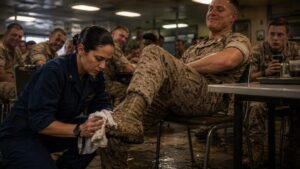
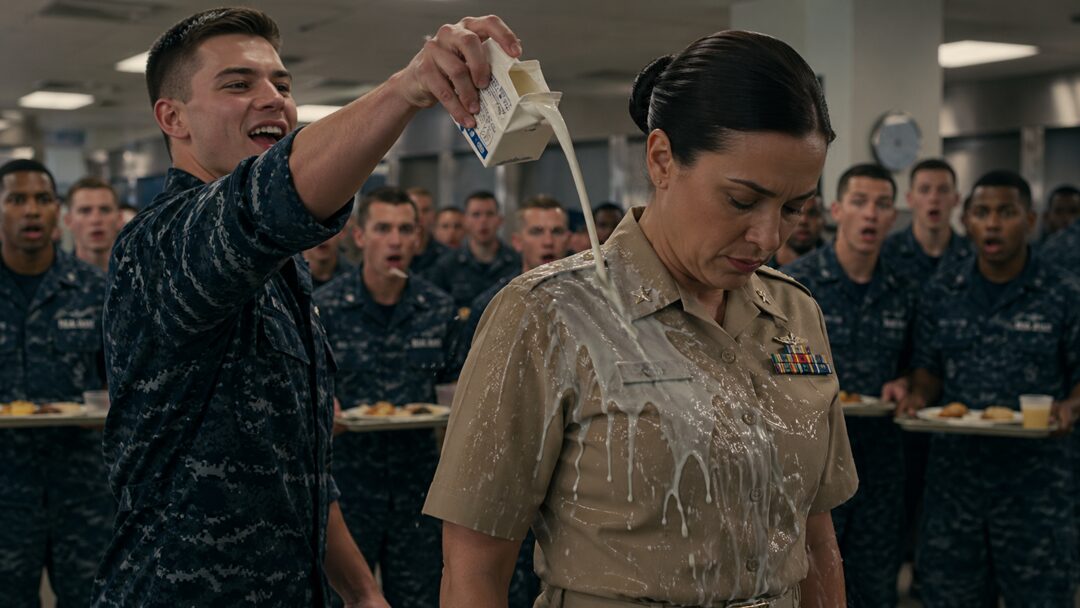
The milk hit Commander Mara Ellison’s chest before anyone in the mess hall understood that Seaman Caleb Voss was really going to do it.
It came out in a white, careless rush, spilling over her tan uniform, sliding across the row of ribbons above her heart, catching on the edge of her black nameplate, dripping from the hem of her jacket onto the polished floor.
Caleb laughed like the sound belonged to a better joke.
“Come on,” he said, turning to the room with the emptying carton in his hand. “That’s funny.”
No one moved.
Dozens of recruits sat frozen with trays in front of them, forks halfway raised, mouths slightly open. The breakfast noise that had filled the room a second earlier—plastic chairs, low voices, coffee urns, boots under tables—collapsed into a silence so complete the last drops of milk could be heard tapping against the floor.
Mara looked down at herself.
Not quickly. Not dramatically.
She looked at the milk on her uniform as if studying the shape of a weather front.
The white stain had soaked through the tan fabric and spread toward the sleeve where her wrist scar was hidden beneath a crisp cuff. It had darkened the jacket around the buttons. It had crossed her ribbons without respecting any of the things they stood for.
Caleb’s smile faltered only a little.
He was twenty-one, broad-shouldered, quick-eyed, with the kind of confidence other young men borrowed when they had none of their own. He wore his blue camouflage like it was a dare. He had spent three weeks making other recruits laugh at things they were too cautious to say.
Now he stood with one arm open to the mess hall, waiting for the room to save him.
It didn’t.
In the far corner, Chief Morales pushed his chair back so hard it scraped.
Mara lifted one hand.
The chief stopped.
That small gesture did more to quiet the room than a shout would have. Mara did not look angry. That was what made the silence tighten. Anger would have given everyone a place to stand. Anger would have made it ordinary.
She raised her eyes to Caleb.
He swallowed.
Then, because shame had not yet reached him, he smirked.
“Guess command doesn’t teach you how to dodge.”
A few recruits looked down at their trays. Someone’s fork clicked against a plate and stopped.
Mara’s gaze did not leave Caleb’s face.
“Stand at attention.”
The words were not loud.
Caleb’s smile thinned. “Ma’am?”
“Stand at attention.”
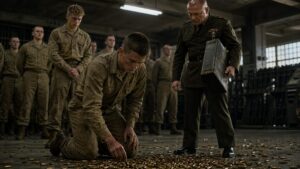
The room watched his body obey before his pride could stop it. His shoulders squared. His arms snapped down. The milk carton crumpled slightly in his fist.
Mara looked past him to the long rows of tables.
“No one leaves.”
Nobody tried.
She stepped closer. Milk slid from her jacket and struck the floor between them.
“You made a statement,” she said. “Repeat it.”
Caleb’s eyes flicked toward the room. He had wanted witnesses when he thought the moment belonged to him. Now every face felt like a light pointed at his skin.
“I said—”
“Clearly.”
His jaw tightened.
“I said command doesn’t teach you how to dodge.”
Mara held his stare.
“Again.”
Something changed in his face then. Not guilt. Not yet. But calculation. The first small awareness that the room had not become his audience. It had become her evidence.
“I said command doesn’t teach you how to dodge,” he repeated.
Mara nodded once.
“Thank you.”
The words landed harder than an insult.
She turned to Chief Morales. “Escort Seaman Voss to Captain Price. He will keep the carton.”
Caleb’s eyes dropped to his hand as if he had forgotten he was still holding it.
The carton was almost empty. Its corners were bent inward. A little milk ran over his fingers.
Chief Morales came up behind him.
Caleb did not resist, but as he turned, he looked once more at the room, searching for someone—anyone—to give him a grin, a shrug, a look that said he had not misjudged everything.
No one did.
Mara remained standing in the center aisle while the door closed behind him.
Only then did the mess hall breathe again.
A young recruit near the front table whispered, “Jesus.”
Mara heard it. She heard everything in rooms after they went silent.
She looked down at the milk gathering near her shoes.
Then she picked up a napkin from the closest table and pressed it once against the nameplate over her heart.
Not to clean it.
To hold it in place.
Part II — Damage Control
Captain Darnell Price had the kind of office designed to make problems shrink.
There were framed commendations on one wall, a base photograph on another, and a polished desk wide enough to keep emotion at a professional distance. Price himself stood behind it with his sleeves buttoned, silver at his temples, and his mouth set in the expression of a man who had handled worse things than a humiliated officer and a reckless sailor before breakfast.
Caleb stood beside Chief Morales, still holding the carton.
Mara entered last.
Price’s eyes moved first to her soaked uniform, then to the milk drying on Caleb’s hand. His face did not change, but one breath left him slowly.
“Commander Ellison,” he said.
“Captain.”
“I’ve been briefed.”
“I doubt that, sir.”
Caleb looked up.
Price’s gaze sharpened, but Mara did not soften the statement. She stood in front of the desk with milk cooling against her skin and kept her hands at her sides.
Price dismissed Chief Morales with a nod. When the door shut, the office felt smaller.
“Seaman Voss,” Price said, “do you understand the seriousness of what you did?”
“Yes, sir.”
It came too fast.
Mara looked at him.
Price heard it too. “Try again.”
Caleb’s throat moved. “I understand that I acted out of line, sir.”
“Out of line,” Mara repeated.
Caleb’s eyes flicked toward her. “I disrespected a superior officer.”
“That is closer.”
Price sat down. “You will be formally reprimanded. Additional action will be determined after review.”
Mara said, “That won’t be enough.”
Price leaned back. “Commander.”
“With respect, sir, if this is buried as one recruit’s poor judgment, the mess hall will decide the lesson for us.”
“The mess hall is not in command.”
“No,” Mara said. “But it is watching command.”
Price’s jaw worked once.
Outside the office window, a line of recruits crossed the yard in formation. Boots struck pavement. A cadence drifted faintly through the glass. Everything on the base seemed orderly from a distance.
Price lowered his voice. “Congressional observers arrive tomorrow morning. I won’t have a disciplinary circus on display.”
“That is exactly why it matters.”
Caleb shifted his weight.
Mara turned toward him. “Stand still.”
He did.
Price watched the exchange. He had known Mara Ellison for only six days, but her file had arrived ahead of her like weather. Decorated. Precise. Unavailable for comment on certain operations. Trusted in rooms where no one took notes. Recently returned from a deployment that officially had no name.
Unofficially, men spoke of Lantern Reef.
Not loudly.
Never in full.
Price folded his hands. “What do you recommend?”
“Keep him in tomorrow’s command simulation.”
Caleb’s eyes widened. “Sir—”
“Quiet,” Price said.
Mara continued. “If his conduct is isolated stupidity, the exercise will show it. If it reflects something deeper in the unit, the exercise will show that too.”
Price studied her. “You want him tested.”
“I want the room corrected.”
Caleb gave a short laugh before he could stop it.
Mara looked at him.
It died in his throat.
Price said, “Something amusing?”
“No, sir.”
Mara took one step closer to Caleb. The dried milk had stiffened her uniform. She could feel it pulling at the fabric when she moved.
“You thought the room would laugh,” she said.
Caleb stared straight ahead.
“You thought disrespect was contagious.”
His jaw tightened.
“You may be right.”
That made him look at her.
Mara’s eyes were flat and bright. “Tomorrow we find out what else is.”
Price’s gaze moved between them. For a moment, his office no longer felt like a place where problems shrank. It felt like a place where one had just been given shape.
He nodded once.
“Very well. Seaman Voss remains in the simulation. After that, I decide his disposition.”
Mara said, “Yes, sir.”
Price pointed at the carton. “Dispose of that.”
Mara spoke before Caleb could move.
“No. He keeps it until dismissed.”
Caleb’s fingers tightened around the damp cardboard.
Price looked irritated, but not enough to argue.
“Dismissed.”
Caleb turned toward the door.
“Seaman,” Mara said.
He stopped.
“When you leave this office, people will ask what happened.”
His shoulders rose slightly.
“You will tell them the truth.”
He looked back just enough for her to see the edge of his expression.
“The truth, ma’am?”
Mara held his gaze.
“Yes,” she said. “If you know how.”
Part III — Lantern Reef
By 0900 the next morning, Caleb had turned shame back into armor.
He stood at the rear of Simulation Room Three with six other recruits, a digital map glowing on the forward screen and three congressional observers seated behind Captain Price. Commander Ellison stood at the center console in a clean uniform.
Not the tan one.
Service khaki again, exact and immaculate, but not the same jacket. Caleb noticed that and hated himself for noticing. He had wanted the stain to last longer.
The exercise was simple on paper: a fictional coastal evacuation under conflicting reports, unstable communications, civilian risk, and limited extraction windows. The recruits were to advise, adapt, and follow command decisions as conditions changed.
Nothing about it should have felt personal.
Then the first scenario update came in.
“Flooding reported in lower compartments,” a lieutenant read from the feed. “Two teams unaccounted for. Communications degraded.”
Mara’s left wrist moved almost imperceptibly.
Caleb saw it.
A twitch. A tiny closing of the fingers.
Not fear, exactly. Recognition.
He leaned toward the recruit beside him and whispered, “Watch. This is where command starts counting bodies.”
The recruit’s face tightened. He did not laugh.
Mara did not turn around.
“Seaman Voss,” she said. “If you have an assessment, give it to the room.”
Caleb straightened.
The observers looked back.
For a second, he almost stopped. Then he remembered Aaron sitting in their mother’s kitchen at two in the morning, hands shaking around a glass he never drank from, saying one sentence before refusing to speak for three months.
She left men in the water.
Caleb lifted his chin.
“My assessment is that officers like clean options after enlisted sailors have already run out of them, ma’am.”
The room went still.
Price’s face hardened. “Seaman.”
Mara raised one hand.
Again, that hand.
Again, men stopped.
She turned at last. “Clarify.”
Caleb’s pulse kicked. The same dangerous thrill from the mess hall rose in him, but this time it had teeth under it.
“You want us to recommend delaying extraction until confirmation comes through,” he said. “But people die while command waits for clean information.”
“People die when command moves on bad information too.”
“Yes, ma’am. But it’s usually not command trapped below deck.”
The words struck something.
He saw it.
Not on her whole face. Mara Ellison did not give away that much. But something behind her eyes went still in a way that made Caleb feel, for the first time, that he had not thrown a stone into the dark.
He had hit a window.
Mara looked at the name tape on his uniform.
VOSS.
Her gaze stayed there one beat too long.
Caleb saw recognition.
His anger sharpened.
“You knew him,” he said.
Price stood. “This exercise is suspended.”
“No,” Mara said quietly.
Price looked at her.
Mara’s face had lost color, but her voice was steady. “Continue the feed.”
The lieutenant hesitated, then read, “Compartment pressure rising. External rescue window estimated at nine minutes. Command must choose whether to send recovery team back in or seal section.”
The room seemed to lean toward Mara.
Caleb felt suddenly cold.
Mara turned back to the screen. “Recommendation?”
No one spoke.
She looked at Caleb. “You had strong feelings about delay.”
He stared at the map. It was only a simulation, colored lines and blinking compartments, but his mouth had gone dry.
In the kitchen, Aaron’s knuckles had been white around the glass.
She left men in the water.
Caleb said, “Send the team back in.”
“Risk?”
“High.”
“Survival probability?”
He hated her for asking. “Low.”
“Then say it fully.”
He looked at her.
Mara’s voice remained even. “Say what you are recommending.”
Caleb’s answer came out rough. “Send more sailors into a compartment they probably won’t come out of.”
No one moved.
Mara nodded once. “That is command. Not the courage to accuse after the fact. The willingness to name the cost before the order.”
The simulation resumed, but Caleb heard little after that.
When it ended, the observers left murmuring to one another, Price remained silent, and the recruits emptied out fast, grateful for any door.
Caleb made it halfway down the corridor before Mara’s voice stopped him.
“Seaman Voss.”
He turned.
She stood outside the simulation room, alone now. The corridor lights made the scar near her wrist visible where her sleeve had shifted.
For the first time, Caleb saw it as more than a mark.
She said, “Your brother’s name is Aaron.”
It was not a question.
Caleb’s face hardened. “Petty Officer Aaron Voss.”
“I know his rank.”
“Do you?”
Mara accepted the hit without blinking.
Caleb stepped closer. “He came home with half a leg working, nightmares, and a medal he keeps in a drawer under old socks. He said you left men in the water.”
Mara’s eyes changed again.
Not guilt.
Something worse because it did not defend itself.
“I know what he said.”
“Then deny it.”
The corridor hummed around them.
Mara said nothing.
Caleb laughed once, but there was no humor in it now. “That’s what I thought.”
He turned to leave.
Her voice followed him, low and controlled.
“Your brother was unconscious when I dragged him through the breach.”
Caleb stopped.
“For twelve seconds,” Mara said, “his heart did not give me an answer.”
He looked back.
She did not move closer. She did not use the detail like a weapon. She spoke as if each word had to pass inspection before leaving her mouth.
“I will not give you the rest.”
“Because it makes you look bad?”
“Because it belongs to men who are not here to correct me.”
His eyes burned. “Convenient.”
“Yes,” she said. “Silence often is.”
That answer should have satisfied him.
It didn’t.
It followed him all the way to the barracks, sharper than any denial would have been.
Part IV — The Man Who Survived
Aaron Voss arrived at the base wearing civilian clothes that did not fit the place.
A gray jacket. Dark jeans. One hand in his pocket. The limp Caleb always pretended not to see. He stood near the veterans’ outreach banner outside the auditorium while officers and guests moved around him with careful respect, the kind that made distance look polite.
Caleb saw him from across the courtyard and felt the world tilt.
“Aaron?”
His brother turned.
For a second Caleb was twelve again, watching Aaron come home from boot camp taller than memory, sunburned and laughing, tossing a challenge coin across the room like it was treasure.
Then the second passed.
Aaron’s face was thinner now. Older than twenty-nine. His eyes found Caleb and softened, but not enough to hide the exhaustion behind them.
“What did you do?” Aaron asked.
No hello.
Caleb stopped three feet away. “You heard.”
“I heard enough.”
Caleb looked past him. “Did she call you?”
“No.”
“Then why are you here?”
Aaron’s mouth tightened. “Because I was already scheduled. Because apparently the Navy likes putting broken things behind podiums and calling it outreach.”
Caleb flinched.
Aaron saw it and looked away.
They stood in the courtyard while a group of recruits passed, whispering. Caleb caught one phrase.
Milk commander.
Heat crawled up his neck.
Aaron heard it too.
His eyes closed for half a second.
“Tell me you didn’t,” he said.
Caleb’s anger came back because it was easier than shame. “You told me she left them.”
Aaron looked at him then.
“I told Mom that once. At two in the morning. Half-drugged, half-drunk, and trying not to remember the sound.”
“You said she left men in the water.”
“I said a lot of things I couldn’t survive hearing.”
Caleb’s throat tightened.
Before he could answer, a young sailor came out of the mess hall doors carrying a tray. A small paper carton tipped on its side. Milk ran across the tray in a white sheet and spilled over the edge.
Aaron froze.
Not paused.
Froze.
His hand shot out and gripped Caleb’s sleeve so hard the fabric twisted. His breath stopped in his chest. His eyes locked on the milk as it spread across the tray, thin and white under the morning light.
“Aaron,” Caleb said.
His brother did not hear him.
The courtyard disappeared from Aaron’s face.
He was somewhere smaller. Darker. Somewhere with metal under his hands and water at his neck and white emergency foam blooming across black water like something alive.
“Aaron.”
Commander Ellison’s voice came from behind them.
Caleb turned.
Mara stood a few steps away, not in dress uniform now but still exact, still unreadable. Her gaze went first to Aaron’s hand on Caleb’s sleeve, then to the spilled milk, then to Aaron’s face.
She did not approach quickly.
“Aaron,” she said again, softer.
His eyes moved to her.
For one raw second, Caleb saw what his brother had been hiding for years.
Not hatred.
Recognition so painful it looked like fear.
Mara said, “You are topside. You are at North Island. Your brother is with you.”
Aaron’s fingers loosened.
His breathing returned in broken pieces.
Caleb stared at Mara.
She had not asked what was happening. She knew the shape of it. She knew where he had gone.
Aaron covered his face with one hand.
“Damn it,” he whispered.
Mara looked away to give him the only privacy available in a public courtyard.
That small mercy hit Caleb harder than a reprimand.
Aaron lowered his hand. “Caleb.”
“No.”
“You need to hear it.”
“No, I heard enough.” Caleb’s voice cracked. He hated that too. “I heard you. I heard what you said.”
“You heard the part I could say when I couldn’t say the rest.”
Mara turned as if to leave.
Aaron stopped her.
“Commander.”
She froze.
He swallowed. “Don’t.”
Mara looked at him.
“Don’t carry it away again,” he said.
For a moment, no one spoke.
Then Mara gave a small nod, not permission exactly, but surrender.
Aaron faced Caleb.
“She came back for us,” he said.
Caleb shook his head once.
“She was ordered to withdraw after the first breach. She didn’t. She came through the foam with blood down her arm and dragged me by my harness because I couldn’t move. I don’t remember all of it. I remember her voice.”
Caleb could not look at Mara.
Aaron continued, each sentence pulled from somewhere deep.
“She got me to the ladder. Then she went back. Twice. They ordered the compartment sealed. She still tried to go again.”
Mara’s jaw tightened.
Aaron looked at her, and something like apology moved across his face.
“They held her back,” he said. “Not because she wanted to leave them. Because there wasn’t enough ship left to disobey.”
Caleb’s mouth opened, but no sound came.
The courtyard noise rushed in around them—distant cadence, gulls, a truck backing up near the loading bay—but it all felt thin.
Caleb heard only his own breathing.
He had built a villain because grief needed somewhere to stand.
Now the villain stood in front of him with milk once dried on her uniform, a scar on her wrist, and nothing to say in her own defense.
“Why didn’t you tell me?” Caleb asked Aaron.
Aaron’s laugh broke in the middle. “Because if I said she saved me, I had to say they didn’t come home.”
Mara closed her eyes for one second.
Only one.
Caleb saw it anyway.
That was when shame finally reached him.
Not hot. Not loud.
Cold.
Precise.
It entered through his ribs and sat there.
“I poured milk on you,” he said, but it did not sound like a confession. It sounded like a man discovering the size of a room after the lights came on.
Mara looked at him.
“Yes.”
Aaron’s face twisted.
Caleb turned away because he could not stand his brother seeing him clearly.
But the base had already seen him.
And worse than that, it had learned from him.
Part V — The Unopened Carton
That afternoon, Captain Price decided to make Caleb disappear.
Not physically. Administratively.
A sealed reprimand. Immediate reassignment off the training rotation. No public proceeding. No spectacle. No more oxygen for rumor.
“It is clean,” Price said.
Mara stood in front of his desk again. Her uniform was clean this time. Her face was not softer.
“It is hidden,” she said.
Price removed his glasses and rubbed the bridge of his nose. “Commander, I allowed the simulation. I allowed this to go further than most base commanders would.”
“Yes, sir.”
“And now I am ending it.”
Mara said, “Then the last thing the recruits saw was a sailor humiliate an officer and vanish.”
“They will know he was disciplined.”
“They will know he was removed. That is not the same thing.”
Price’s eyes narrowed. “You want a public apology.”
“No.”
“What do you want?”
Mara paused.
That was rare enough to make Price wait.
“I want him to choose the truth in the room where he chose the lie.”
Price leaned back.
Outside his office, somewhere down the hall, recruits laughed.
Then a voice said, just loud enough to carry, “Careful, Commander, command doesn’t teach you how to dodge.”
Another laugh.
Smaller.
Meaner because it was borrowed.
Mara did not turn toward the door.
Price did.
Something shifted in his expression then. Not anger alone. Recognition.
Damage had traveled.
Caleb heard the same line from the other side of the corridor.
He had been standing outside Price’s office, waiting to be called in, but the words struck him harder than any order had. Two recruits rounded the corner, saw him, and stopped laughing.
One gave him a grin like they shared something.
Caleb looked at him and felt sick.
That grin had been his yesterday.
Borrowed courage. Cheap cruelty. A room poisoned one laugh at a time.
The recruit said, “Voss, man, I was just—”
“Don’t,” Caleb said.
The recruit blinked.
Caleb stepped closer. “Don’t use me to be small.”
The grin vanished.
The office door opened.
Mara stood there.
For a second, neither of them spoke.
Caleb looked at her, then at the floor.
“Ma’am,” he said, “permission to fix what I made worse.”
Price appeared behind her.
Mara studied Caleb’s face.
Whatever she saw there was not enough to forgive him.
But it was enough to test.
“Breakfast,” she said. “Tomorrow. Full mess.”
Caleb nodded.
He did not sleep much that night.
At 0540, he put on dress blues with hands that would not stay steady. He polished his shoes twice. He shaved over skin already raw. He stood in front of the mirror and tried to find the man who had laughed with a carton in his hand.
He found him.
That was the worst part.
The man was still there. Smaller now, but not gone.
Caleb opened his locker.
On the upper shelf sat a fresh carton of milk from the vending machine, sweating faintly in the cool air.
He stared at it until his stomach turned.
Then he picked it up and walked to the mess hall.
By the time he entered, the room was full.
It did not go silent all at once. Silence moved table by table as people noticed him. Dress blues. Pale face. Milk carton in his right hand.
Someone whispered, “No way.”
Commander Ellison sat at the front table with Chief Morales and two visiting observers. Captain Price stood near the side wall, arms folded.
Caleb walked down the center aisle.
The same aisle.
His shoes passed the place where milk had struck the floor. It looked exactly like every other polished section now, and somehow that made it worse.
Mara watched him come.
Her expression gave him nothing.
Good, he thought.
Do not rescue me.
He stopped at her table, set the unopened carton down in front of her, and stood at attention.
“Commander Ellison,” he said, voice tight but clear. “Permission to address the room.”
Mara looked at the carton.
Then at him.
“Granted.”
Caleb turned.
There were so many faces. Yesterday, he had wanted them all.
Today, he wanted none of them and needed every one.
“My name is Seaman Caleb Voss,” he said.
A chair creaked somewhere near the back.
“Yesterday morning, in this mess hall, I poured milk on Commander Ellison’s uniform.”
The room held still.
“I called it a joke because cowardice sounds better when people laugh.”
No one did.
His throat tightened, but he forced the next words out.
“It was not a joke. It was not courage. It was not loyalty to my brother. It was disrespect, and I dressed it up as truth because I didn’t want to know the truth.”
A recruit at the second table let out a nervous breath that almost became a snicker.
Caleb turned his head.
The recruit froze.
“You laugh because you don’t know what she carried,” Caleb said. “I laughed because I didn’t want to know.”
The line went through the room and left something behind.
Caleb faced forward again.
“I damaged more than a uniform. I gave people permission to repeat contempt they had not earned and did not understand. That is on me.”
His eyes found Aaron near the back wall.
Caleb had not known his brother would come.
Aaron stood half-hidden by the doorway, gray jacket zipped to his throat, one hand in his pocket. His face was pale, but he did not look away.
Caleb almost broke then.
He didn’t.
He turned back to Mara.
“Commander, I owe you an apology. Not because I got caught. Not because I was ordered to give one. Because you stood still when I tried to make you small, and I mistook your restraint for guilt.”
Mara’s eyes did not move from his face.
“I was wrong.”
The room waited for more.
There was no more.
That was the point.
Caleb stepped back from the table.
Mara rose.
Everyone else began to rise too, but she lifted one hand.
They stayed seated.
She looked at Caleb for a long moment.
Then she said, “Seaman Voss, you will clean the mess hall floors after every meal for thirty days.”
“Yes, ma’am.”
“You will also collect written statements from every sailor present yesterday morning and this morning.”
Caleb blinked. “Statements, ma’am?”
“Not apologies. Witness statements. What they saw. What they thought discipline looked like before. What they think it looks like now.”
“Yes, ma’am.”
Her voice stayed even.
“You will read every one.”
His throat moved. “Yes, ma’am.”
“And you will not ask me to make you feel better about any of them.”
Caleb absorbed that.
Then nodded.
“No, ma’am.”
Mara looked at the unopened carton on the table.
She did not touch it.
“Dismissed.”
Caleb saluted.
This time, no one had to tell him how.
Mara returned it.
The room did not applaud. Applause would have cheapened it. It would have turned consequence back into performance.
Instead, sailors lowered their eyes to their trays. A few sat straighter. One recruit near the back quietly pushed his milk carton away.
Caleb saw it.
So did Mara.
Neither of them said a word.
Part VI — What Remains Clean
That evening, Aaron and Mara sat near the seawall where the base lights trembled across the dark water.
They did not sit close.
There was a bench between them large enough for all the names they were not saying.
Aaron kept his hands in his jacket pockets. Mara sat with her forearms on her knees, sleeves buttoned, scar hidden again.
For several minutes, they listened to the water hit the rocks.
Finally Aaron said, “He should have known better.”
“Yes.”
“I should have told him better.”
Mara did not answer.
Aaron turned his face toward the water. “I let him hate you because it meant he wasn’t asking me questions.”
The words stayed between them.
Mara said, “You were allowed to survive in whatever way you could.”
“That sounds generous.”
“It isn’t.”
He glanced at her.
She looked tired now. Not weak. Just tired in a way command rooms did not permit.
Aaron swallowed.
“I never thanked you.”
“You don’t have to.”
“I’m not thanking you for saving me.”
That made her look at him.
His voice thinned, but it held.
“I’m thanking you for not turning me into proof.”
Mara looked back at the water.
A long time passed before she nodded.
Once.
It was not forgiveness. Not exactly. It was an acknowledgment of a burden set down for one breath, then lifted again.
Three weeks later, Commander Mara Ellison walked back into the mess hall in a clean tan uniform.
The room noticed her, but did not stop. That was its own kind of repair. Voices continued. Forks moved. Chairs scraped. The ordinary noise of people learning to behave without needing silence to remind them.
Near the far end, Caleb Voss knelt beside a yellow bucket, mopping the floor under the beverage station.
He had read twenty-seven witness statements by then.
Some were blunt. Some were ashamed. Some were useless. One simply said, I laughed inside because I was afraid not to.
He had read that one three times.
When Mara passed the spot where the milk had fallen, Caleb stood.
Not quickly. Not theatrically.
He set the mop against the bucket, squared his shoulders, and saluted.
No one told him to.
No one watched him into doing it.
Mara stopped.
For a heartbeat, they stood on opposite sides of a floor that looked clean and wasn’t innocent.
Then she returned the salute.
Caleb held his until she lowered hers.
She walked on.
Behind her, the mop slid through water again, steady and quiet, erasing footprints no one would remember by lunch.
Mara did not look back.
But when she reached the door, she paused just long enough to hear the work continue.