He Asked to Go Back
Part I — The Hand on Her Head
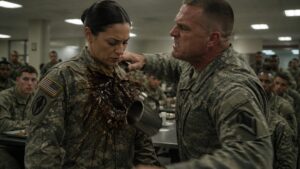
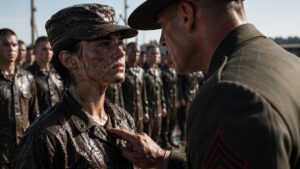
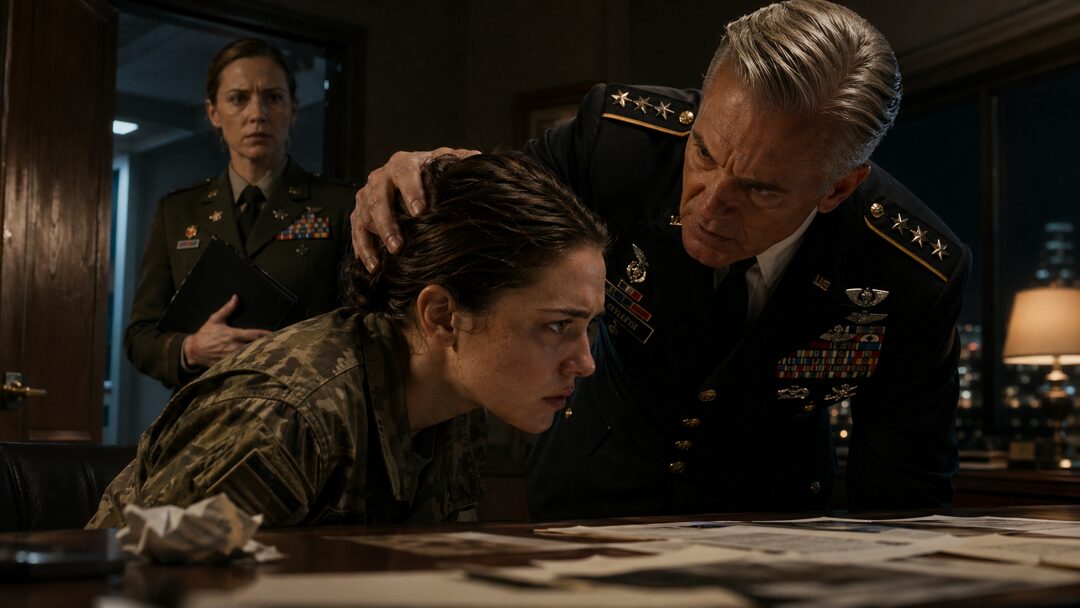
Specialist Lena Park tasted dust and paper when Brigadier General Marcus Vale forced her cheek against the edge of his desk.
His hand was in her hair.
Not on her shoulder. Not around her wrist. In her hair, fingers locked at the back of her skull, holding her bent over a spread of old mission photographs like she was another document he could press flat and file away.
“Careful, Specialist,” Vale said softly. “You have mistaken fragments for truth.”
His medals flashed in the desk lamp. Silver stars, campaign ribbons, a polished nameplate that read VALE in black letters. Everything about him looked clean except the grip.
Lena could see one photograph beneath her face. A desert road. A burned medical truck. Three soldiers blurred by smoke.
One of them might have been her father.
Her eyes watered, but she did not blink. The door to Vale’s office stood half open. Beyond it, the corridor of Fort Halden’s command building glowed a sick institutional yellow. Somewhere outside, boots moved across tile.
One person.
Maybe two.
Vale leaned closer. His breath touched the side of her face.
“Tell me who else heard it.”
Lena’s fingers curled against the desk. Her field notebook lay near her left hand, its cover crushed where Vale had slammed it down. Inside it was the transcript he thought mattered.
It did matter.
Just not the way he thought.
The boots came closer.
Vale heard them too. His grip tightened.
“Specialist Park,” he whispered, “this is your last chance to remain a soldier.”
Lena stared at the open door.
For the first time that night, she was not looking for escape.
She was looking for a witness.
Part II — The Voice in the Archive
Twelve hours earlier, Lena had been alone in the coldest room on base, listening to dead men breathe through static.
The intelligence archive sat two floors below Fort Halden’s administrative wing. No windows. No clocks. Just rows of sealed evidence containers, old servers, and the dry air of machines preserving things people hoped would stay forgotten.
Lena liked the archive because it did not ask questions.
Files had names. Dates. Timestamps. Chain-of-custody forms. If something was missing, a gap appeared. If a voice lied, the waveform trembled. The archive was the only place in the Army where silence still left fingerprints.
That morning, Captain Mara Ellis handed her a black storage case and said, “Lantern Ridge batch. Digitize, verify, log discrepancies. Nothing leaves the room.”
Lena’s hand stopped over the label.
OPERATION LANTERN RIDGE — RECOVERY / EXTRACTION / CLASSIFIED ADDENDUM
She knew the name before she knew multiplication tables.
Her father, Sergeant Daniel Park, had died on Lantern Ridge twelve years ago. Army medic. Squad sergeant. Thirty-five years old. Officially killed after breaking convoy formation during a compromised extraction. Unofficially, in the corners of base housing and folded sympathy letters, a man who had panicked.
Her mother never used that word.
The Army had.
Lena looked up at Ellis. “Captain.”
Ellis’s face did not move, but her eyes did. Tired eyes. Watchful. A small burn scar curved pale around her wrist.
“You’re cleared for the batch,” Ellis said.
“You knew my father was in it.”
“I knew.”
Lena waited for more.
Ellis gave her nothing.
That was how officers apologized when they could not afford to.
The first hour was routine. Damaged convoy maps. Medical status reports. After-action summaries written in clean passive language: contact occurred, assets were lost, evacuation delayed.
Nobody ever died in passive language. They were just lost.
Then Lena opened an audio file labeled LR-COMM-7B / CORRUPTED / PARTIAL.
The static came first.
Then gunfire, distant and flat.
Then a male voice, young and breathless: “Lantern Two has wounded. Repeat, we have wounded. Request permission to return.”
Lena froze.
She knew that voice from birthday videos, from an old voicemail her mother played only once a year, from the way he used to say her name like it had two syllables even when it didn’t.
“Command, this is Park,” the voice said. “We can still reach them.”
Lena stopped breathing.
Another voice cut through, calmer, older.
“Lantern Two, hold position.”
Lena checked the timestamp.
The official report said Daniel Park broke formation at 1842.
The audio said he was requesting permission at 1847.
Five minutes after he was supposedly already gone.
She replayed it.
“Command, wounded are still moving. I can see strobes.”
“Negative,” the older voice said. “Hold position.”
Lena turned the volume higher. Her hands stayed steady because her hands had learned discipline before the rest of her had.
A third transmission crackled under the first two. Intelligence relay. Route compromised. Secondary ridge line active. Extraction zone unstable.
Then Daniel again, sharper now.
“Sir, if we leave them, they burn.”
The older voice answered.
“Lantern Two, you will not return.”
Lena clicked the metadata.
The command signature was partially corrupted, but not gone.
M. VALE.
Her chair scraped back.
On the wall above the archive door, Brigadier General Marcus Vale’s portrait watched over the room in dress uniform. Hero of Lantern Ridge. The commander who had “saved half a convoy under impossible conditions.” The man whose speech about sacrifice was printed in leadership manuals.
Lena looked from the waveform to his framed face.
The archive hummed around her.
For twelve years, her father had been the man who panicked.
For twelve years, Vale had been the man who survived telling the story.
Lena copied nothing. Not at first.
She listened again.
This time, at the end, under the static, she heard her father say one more thing. Not loudly. Not dramatically. Almost like he knew no one would ever hear it.
“Then put it on me, sir. But I’m asking to go back.”
Lena pulled off her headphones.
The archive was silent.
Her father was not.
Part III — The Warning
Captain Ellis listened to only thirty-four seconds before she removed the headphones.
That scared Lena more than if she had listened to all of it.
Ellis closed the office blinds. Her office was smaller than Vale’s, with less polished wood and more paper. A black regulation folder sat open beside her coffee. The coffee had gone untouched long enough to form a skin.
“Where is the original?” Ellis asked.
“In the Lantern Ridge batch.”
“Copies?”
“None.”
Ellis looked at her.
Lena said, “Not digital copies.”
The captain’s jaw tightened. “What does that mean?”
Lena reached into her field notebook and showed her a handwritten transcript of six lines. No names. Just timestamps. Just enough to prove she had heard what she had heard.
Ellis did not touch the page.
“Put that away.”
“Captain—”
“Put it away, Specialist.”
Lena slid the page back into the notebook. Her heart had started hitting hard now, not from fear exactly, but from the insult of being told to hide the first honest thing she had ever heard about her father’s death.
Ellis lowered her voice.
“Do you understand who General Vale is?”
“I understand what I heard.”
“No. You understand thirty-four seconds of a damaged file tied to an operation with active intelligence overlays.”
“My father was blamed for disobeying an order he never disobeyed.”
Ellis flinched. Not enough for most people to notice. Enough for Lena.
“Vale is up for confirmation to the Defense Oversight Council,” Ellis said. “Every office in this building has been preparing his record for review. If you move wrong, this becomes theft of classified material before it becomes anything else.”
“So I do nothing.”
“You do exactly what I tell you.” Ellis leaned forward. “You copy nothing. You confront no one. You return to the archive, finish your assignment, and let me check the access chain quietly.”
Lena laughed once. It sounded nothing like her.
“Quietly.”
“That is how people survive long enough to tell the truth.”
“That is how the truth disappears.”
Ellis’s expression hardened, but her voice did not rise. “You are not the first soldier to discover something ugly in a clean file.”
“No,” Lena said. “But I might be the first one whose father got buried under it.”
The room changed.
For a second, Ellis was not a captain. She was a woman with a scar at her wrist and old exhaustion under her eyes.
Then she put the captain back on.
“Go back to the archive.”
Lena stood.
At the door, Ellis said, “Lena.”
It was the first time she had used her first name.
Lena turned.
Ellis looked like she wanted to say five things and had permission to say none.
“Do not confuse proof with protection.”
Lena nodded once and left.
In the stairwell, where there were no cameras, she removed the transcript from her notebook and folded it into the lining behind the back cover. Her fingers moved carefully. Clean crease. Flat edge. No bulge.
Then she went back downstairs and checked the access logs.
The Lantern Ridge files had been dormant for nine years.
Until three days ago.
Accessed by: Office of Brig. Gen. Marcus Vale.
Lena stared at the entry until the screen dimmed.
The archive did not ask questions.
But someone upstairs had heard the dead stirring.
Part IV — History Is Not Kind
The summons came at 2100.
Not through Ellis.
Directly from Vale’s aide.
Specialist Park is requested in General Vale’s office for administrative review.
Requested meant ordered when it came from a general.
The command building was quieter at night. The flags in the hall stood motionless. The framed portraits of former commanders seemed less ceremonial under after-hours lighting, more like witnesses who had learned not to speak.
Vale’s office door was open when Lena arrived.
“Specialist Park,” he said warmly. “Come in.”
He stood behind his desk in a dark dress uniform, silver hair combed back, ribbons arranged with mathematical precision. He looked like the version of command the Army put on brochures. Calm. Decorated. Certain.
On the wall behind him hung a photograph from Lantern Ridge: Vale stepping down from a helicopter, face streaked with dust, one hand around a wounded soldier’s shoulder.
Lena saluted.
Vale returned it.
“Sit.”
She sat.
He offered her water. She declined.
He smiled slightly. “Your father used to do that.”
Lena’s spine stiffened.
“Refuse comfort on principle,” Vale said. “Good medic. Stubborn man.”
“You knew him.”
“I knew many men under my command.”
“That isn’t what I asked, sir.”
The smile held for one beat too long.
Vale lowered himself into his chair. “I knew of him. I knew how he died. And I have carried every man from Lantern Ridge with me for twelve years.”
His hand touched the edge of a framed commendation on his desk. Not quite a caress. Not quite a habit he knew he had.
Lena kept her face still.
Vale opened a folder. Inside was her service record.
“Excellent evaluations. High pattern recognition. Disciplinary record clean. Captain Ellis speaks carefully of you, which from Ellis is praise.”
Lena said nothing.
Vale turned a page.
“It concerns me when a promising young soldier becomes emotionally entangled with sensitive material.”
There it was.
Not accusation. Concern.
The oldest uniform power had.
“My assignment was approved,” Lena said.
“Your assignment was routine. Your relationship to the material is not.”
“My relationship did not alter the file.”
Vale looked up.
For the first time, the warmth cooled.
“No,” he said. “But grief alters interpretation.”
Lena heard her father’s voice again. Sir, if we leave them, they burn.
She should have waited. Ellis had told her to wait. But there are lies that sit politely in the room until someone gives them a chair, and then they never leave.
“At 1847,” Lena said, “Sergeant Park requested permission to return for wounded personnel.”
Vale’s eyes did not widen.
That was worse.
He had known.
“At 1842,” he said, “Sergeant Park broke formation.”
“The audio says otherwise.”
“The audio is corrupted.”
“His voice isn’t.”
Vale closed the folder.
A soft sound. Final.
“History is not kind to people who read fragments as truth.”
“Then release the whole file.”
His face changed so slightly that only a person trained to read small shifts would have caught it.
Lena caught it.
He rose.
“You have no idea what you are touching.”
“I know my father was blamed for something he did not do.”
“You know nothing about command.”
“I know the difference between an order and a lie.”
The room went still.
Vale came around the desk slowly. He did not rush. He did not shout. That was the thing about men who had held power for a long time: they did not need volume to fill a room.
“Where is the drive?”
“I don’t have one.”
“Do not insult me.”
“I don’t have a drive, sir.”
He stopped in front of her.
Up close, she could see age under the polish. Broken red lines in his eyes. A faint tremor in one hand before he closed it.
“Lantern Ridge was not a story,” he said. “It was a collapsing field operation with bad maps, worse weather, compromised routes, and men bleeding in three directions at once.”
“Then why falsify the timeline?”
His jaw worked.
There it was. The door.
He had opened it himself.
“Because if we sent the convoy back,” Vale said, each word measured, “we risked losing all of them.”
Lena felt the floor shift under her.
Not because he denied it.
Because he didn’t.
“The ridge line was active,” he continued. “Our extraction route was compromised. Intelligence confirmed a secondary cell waiting for return movement. Your father saw wounded men. I saw the entire operation.”
“My father asked permission.”
“And I denied it.”
“But that is not what the report says.”
“No.”
One word.
Twelve years in one word.
Lena stood before she knew she had moved.
“You put it on him.”
Vale’s eyes sharpened.
“He was dead.”
“He had a wife.”
“So did others.”
“He had a daughter.”
“So did others.”
The line hit harder than shouting would have.
Lena’s hands shook once, then stopped.
Vale stepped closer. “You think this is simple because you have the luxury of arriving after the bodies are named.”
“You let him carry your shame because he couldn’t argue.”
“No,” Vale said. “I let one dead man absorb what would have broken the living.”
That was when Lena understood the shape of him. Not a monster who had never cared. Something worse. A man who had cared, then decided caring gave him permission to choose who got buried twice.
“Correct his record,” Lena said.
Vale’s expression softened again, but now she knew the softness was another weapon.
“I can.”
The room tilted.
“What?”
“I can amend your father’s file privately. Your mother can receive a corrected letter. His record can reflect valor under pressure rather than disciplinary failure.”
Lena stared at him.
He had found the exact wound and placed his hand over it gently.
“You can do that?”
“Yes.”
“And yours?”
His eyes cooled.
“Operational command review remains classified.”
“So he gets a cleaner grave, and you keep the statue.”
Vale’s voice lowered. “Your mother gets peace. You keep your career. The Army avoids exposing intelligence threads still connected to current ceasefire operations. No active sources are burned. No families are dragged through hearings. No dead men are reassembled for public consumption.”
It was a good offer.
That was the worst part.
For one unbearable second, Lena saw her mother at the kitchen table with a letter that did not contain the word unauthorized. Saw her father’s name without the shadow attached. Saw herself staying in uniform without every hallway turning hostile.
Private restoration.
Quiet mercy.
A lie with flowers on it.
Vale reached out.
“Give me the file.”
Lena looked at his hand.
Then at the photograph behind him.
Then back at his face.
“My father didn’t ask for quiet,” she said.
Vale’s hand closed.
The warmth vanished.
Part V — The Doorway
Vale searched her phone first.
Then her uniform pockets.
He did it with the brisk disgust of a man forced into work beneath his rank. Lena stood rigid while he placed her phone, access card, and archive pass on the desk.
Her field notebook came last.
His fingers paused on the worn cover.
“This?”
“Notes.”
He opened it. Flipped through pages of timestamps, inventory checks, file hashes, routine archive details. Nothing.
He looked up.
Lena held his gaze.
For three seconds, she thought he would miss it.
Then he bent the back cover.
The lining shifted.
He pulled out the folded transcript.
His face did not show triumph. It showed fear.
Real fear.
“You stupid girl,” he said.
The words landed colder than any shout.
Lena said, “That isn’t the file.”
He unfolded the page.
His eyes moved over the six lines.
1847 — PARK REQUESTS RETURN.
1848 — VALE DENIES.
1849 — PARK: IF WE LEAVE THEM, THEY BURN.
Vale looked at her.
“Who else has this?”
Lena said nothing.
He grabbed her notebook and slammed it against the desk. The cover bent. The hidden page crumpled under his palm.
“Who else?”
She should have been ready for the violence.
She had imagined arrest. Threats. Confinement. Charges. She had not imagined his hand in her hair.
He moved fast.
One second she was standing. The next, pain burst across her scalp and her body folded forward over the desk. Photographs slid under her cheek. Her breath knocked out of her. His medals clinked against the edge as he leaned over her.
That was how the night had begun in her memory, even though so much had come before it.
His hand. Her cheek. The old photographs.
“Tell me,” Vale said.
Lena tasted blood where her tooth had caught her lip.
The corridor outside was quiet.
Too quiet.
The scheduled transfer had four minutes left.
She had set it in the stairwell before coming upstairs. Not to the press. Not to a public drive. One encrypted packet to Captain Ellis. One sealed packet to the inspector general intake channel, delayed unless canceled by her access phrase.
Proof with brakes.
Truth with a fuse.
She had thought that made her careful.
She had not understood until Vale’s hand tightened that careful did not mean safe.
He bent lower. “Do you know what happens if this leaks?”
Lena forced air into her lungs.
“You lose your confirmation.”
“Children.”
The word stopped her.
Vale’s voice went flat. “There are informant families tied to Lantern Ridge routing still under protection. Names embedded in old operational overlays. If you throw that file into the world, you do not just hurt me.”
Lena closed her eyes.
Was he lying?
He had lied for twelve years.
But the best lies wore pieces of truth like stolen uniforms.
“You don’t care about them,” she said.
“I care enough not to burn them for your grief.”
Rage rose in her so fast she almost choked on it.
“My grief has a name.”
“Your grief has consequences.”
The boots sounded then.
At the far end of the hall.
Lena opened her eyes.
Vale heard them too. His fingers tightened at the back of her head, then loosened just enough for him to straighten. He dragged her upright by her hair. Pain flashed white. She swallowed a sound before it became one.
Captain Ellis appeared in the doorway.
She stopped.
For one second, nobody moved.
Ellis’s gaze went to Vale’s hand tangled in Lena’s hair. Then to Lena’s face. Then to the crushed notebook on the desk.
Vale released Lena so suddenly she stumbled against the chair.
“Captain Ellis,” he said, every inch the commander again. “Specialist Park is in unlawful possession of classified material. Detain her.”
Ellis did not answer.
The scar at her wrist stood pale against her clenched hand.
Vale’s voice sharpened. “Captain.”
Lena looked at her.
Not pleading.
She would not do that to either of them.
Ellis had warned her. Proof was not protection.
Now Ellis had to decide whether witness was.
Vale stepped toward the desk, reclaiming the space with his body. “This matter concerns active operational security. You will take Specialist Park into custody and surrender all materials to my office.”
Ellis’s eyes flicked once toward the wall panel near the door.
Official incident recorder.
Lena had seen it when she entered. Every command-level disciplinary meeting had one. Most were never used unless everyone in the room agreed to be honest.
Ellis walked inside.
Then she closed the door.
For half a heartbeat, Lena thought she had chosen him.
Vale thought so too. His shoulders eased.
Ellis reached for the wall panel and pressed the red switch.
A small light came alive.
Recording.
Her voice was calm when she spoke.
“If this is a lawful detention, sir, please repeat the order on record.”
Part VI — No One Left Behind
Vale stared at the red light as if it were a weapon pointed at his chest.
Then he smiled.
It was almost convincing.
“Captain, deactivate that.”
“I need the order recorded for chain-of-custody.”
“I gave you a direct command.”
“And I am preserving it.”
His eyes hardened. “You owe your career to my judgment.”
Ellis absorbed that without flinching, but Lena saw the hit land. Saw the old wound open behind her face.
“I know,” Ellis said.
Vale stepped closer to her. “When everyone else said you were unstable after Kandahar, I said you were recoverable.”
Ellis’s hand tightened around her black folder.
“You were,” he said softly. “Because I know how to recognize soldiers worth saving.”
The room seemed to shrink around that sentence.
Lena understood then. Not all debts were favors. Some were collars.
Ellis looked at the recorder light.
Then at Lena.
Then back at Vale.
“I mistook being saved for being owned,” she said.
Vale’s mouth flattened.
Lena felt something shift in the room. Not safety. Not yet.
But balance.
Ellis opened her folder and removed a blank incident form.
“Specialist Park,” she said, voice still official, “state the contested file identifier.”
Lena’s throat hurt. She spoke anyway.
“LR-COMM-7B. Operation Lantern Ridge. Corrupted partial command audio.”
Vale snapped, “You will stop.”
Ellis said, “State the timestamp.”
Lena closed her eyes for half a second and heard it again.
Gunfire.
Static.
Her father.
“Eighteen forty-seven. Sergeant Daniel Park requests permission to return for wounded personnel. Eighteen forty-eight. Command denies return. Eighteen forty-nine. Park states, ‘If we leave them, they burn.’”
Vale’s face went gray under the lamp.
Ellis wrote it down.
“General Vale,” she said, “under contested operational record protocol, potentially exculpatory material must be preserved outside the interested command office.”
“This file overlaps with active assets.”
“Then it goes protected channel, not your drawer.”
Lena’s phone vibrated on the desk.
All three of them looked at it.
The delay window.
Sixty seconds.
Vale moved first.
Lena lunged at the same time.
Ellis got there before both of them. She swept the phone off the desk and held it against her chest.
“Unlock it,” Vale ordered.
Lena looked at Ellis.
Ellis looked back.
There was no comfort in her face. Only consequence.
“Where is it going?” Ellis asked.
“Inspector general protected intake,” Lena said. “And to you. If I don’t cancel.”
Vale laughed once, sharp and ugly. “She admits it.”
Lena said, “There’s another path.”
The phone buzzed again.
Thirty seconds.
Her hands were shaking now. Not from fear alone. From the terrible weight of not doing the easiest thing.
She could let it go public through the emergency failover she had almost set up but didn’t. She could have burned him in every feed, every headline, every room where his name was still spoken with respect.
But if he was telling the truth about the assets, even partly, people who had never touched her father’s file could pay for it.
Her father had asked to go back for the wounded.
Not to create more.
“Give me the phone,” Lena said.
Ellis handed it to her.
Vale took one step. Ellis moved between them.
For the first time that night, no one told Lena to stand down.
She entered her access phrase with a thumb that barely obeyed her.
The screen showed two options.
CANCEL ALL TRANSFERS
ROUTE TO PROTECTED CHANNEL ONLY
Vale watched her.
“Choose carefully,” he said.
Lena looked at him. At the medals. At the portrait. At the crushed notebook. At everything polished over everything rotten.
Then she selected protected channel.
The phone processed.
Sent.
The silence afterward was not empty. It was full of doors closing.
Vale stared at the screen.
Lena lowered the phone.
“My father asked permission,” she said. “You denied it. That was command.”
Vale said nothing.
“You blamed him after he died. That was you.”
For a moment, the old general looked not defeated but exposed. Smaller, somehow, without losing any of his danger. A man standing in the wreckage of the story that had held him upright.
Ellis picked up Lena’s crushed notebook and the folded transcript from the desk.
“General Vale,” she said, “I am relieving Specialist Park from this office pending formal review.”
“You do not have that authority.”
“No,” Ellis said. “But now someone outside this room knows you said that.”
The red recorder light stayed on.
Vale did not move as they left.
In the hallway, Lena almost fell.
Ellis caught her by the elbow.
Not gently.
Firmly.
Like one soldier keeping another upright until they were out of sight.
Part VII — The Corrected Letter
They removed Vale’s portrait from the Hall of Commanders before sunrise three weeks later.
There was no announcement.
No formation.
No speech about accountability.
Two civilian workers arrived with a rolling ladder and lifted the frame from its hooks while the corridor lights were still warming up. Behind the portrait, the wall was a cleaner shade of white, a bright rectangle where dust had not reached.
Lena watched from the opposite side of the hall in uniform.
Her scalp had healed. Her lip had healed. The investigation had not.
People had become careful around her. Some avoided her. Some nodded too solemnly. Some looked at her like she had done something brave. Others looked at her like she had made the building less safe by proving what could be hidden inside it.
Captain Ellis stopped beside her with a black regulation folder under one arm.
Neither of them saluted the empty space.
“Temporary administrative removal,” Ellis said.
Lena nodded.
The workers carried the portrait away face-out. Vale’s painted eyes passed Lena without seeing her.
Ellis handed her a brown evidence envelope.
“Your notebook.”
Lena took it.
The cover was bent. One corner had split. Inside, the transcript page was still creased where Vale’s hand had crushed it. The words remained legible.
1847 — PARK REQUESTS RETURN.
1848 — VALE DENIES.
1849 — PARK: IF WE LEAVE THEM, THEY BURN.
Lena stared at the lines for a long time.
Then she took a pen from her pocket and wrote beneath them in small block letters:
He asked to go back.
Ellis watched her do it.
“I don’t know what happens next,” Ellis said.
“With Vale?”
“With any of us.”
Lena closed the notebook.
That was the first honest thing anyone had said to her since the file opened.
“Are you sorry?” Lena asked.
Ellis looked down the hall where the portrait had been.
“I’m sorry I needed proof of what I already knew about power.”
Lena did not forgive her.
But she understood the shape of the confession.
That afternoon, Lena drove to her mother’s house with the corrected letter in a plain envelope on the passenger seat.
Her mother, Grace Park, opened the door before Lena knocked twice. She was smaller than Lena remembered each time she came home, though Lena knew that was not true. Grief did not shrink people all at once. It took them by millimeters.
“Are you hurt?” Grace asked.
“No.”
A mother always knew where to look for the lie. Her eyes went to Lena’s mouth, then her hairline, then her hands.
Lena held out the envelope.
Grace did not take it right away.
“What is that?”
“Dad’s record.”
Her mother’s face closed, not from anger, but from habit. The old defense. The one she had built around a word the Army had mailed into their house and never removed.
“Lena.”
“It’s corrected.”
Grace’s hand rose to her chest.
Lena stepped inside and placed the envelope on the kitchen table where bills, tea, and old silence had lived for years.
Her mother sat slowly.
The letter was not long. The Army did not become poetic just because it had been wrong. It used formal language. Amended findings. Valor under pressure. No substantiated evidence of unauthorized movement prior to command denial. Sergeant Daniel Park’s actions consistent with duty to wounded personnel.
Grace read it once.
Then again.
On the third time, her hands began to shake.
Lena wanted to say everything. That he had not panicked. That he had asked. That his voice had been steady. That he had been thinking of wounded men when others were thinking of reports. That the truth had survived in static for twelve years waiting for someone to press play.
But her mother pressed the letter to her chest before Lena could speak.
The sound she made was not a sob.
It was smaller.
A breath finally allowed to leave.
Lena sat across from her.
Outside, late light moved across the kitchen floor. The house was quiet except for the refrigerator hum and the paper trembling against Grace Park’s uniform-blue sweater.
“Did he suffer?” her mother asked.
Lena looked at the table.
She could have lied gently.
She could have said no.
Instead, she chose the only mercy she trusted now.
“He was himself,” Lena said. “Until the end.”
Grace closed her eyes.
A tear slipped down, but her face did not break. She held the letter like it was not paper. Like it was weight being returned to the right grave.
Lena did not know whether she would stay in the Army.
She did not know whether the uniform would ever feel like inheritance again instead of evidence.
But that evening, sitting across from her mother, she knew one thing with a clarity that hurt and steadied her at the same time.
The institution her father had served had finally stopped using his name to protect another man.
And somewhere beneath the silence, beneath the corrected letter, beneath the years no one could return to them, Daniel Park was no longer the soldier who ran.
He was the one who asked to go back.