Every Thirty Seconds
Part I — The Clock on the Wall
The wall clock in Colonel Mara Vale’s operations room had no business sounding that loud.
It was an old metal thing, probably stolen from some railway office years before the war, and every second came off it like a hammer strike.
Tick.
Ninety thousand people in Vardim.
Tick.
The city’s last flour reserve gone by morning.
Tick.
The pediatric ward burning chair legs and broken cabinets because the coal bins were nearly empty.
Tick.
And in nineteen seconds, the first cargo aircraft would begin its descent into a runway so narrow with ice and bomb craters that one bad landing would turn Mara’s plan into wreckage.
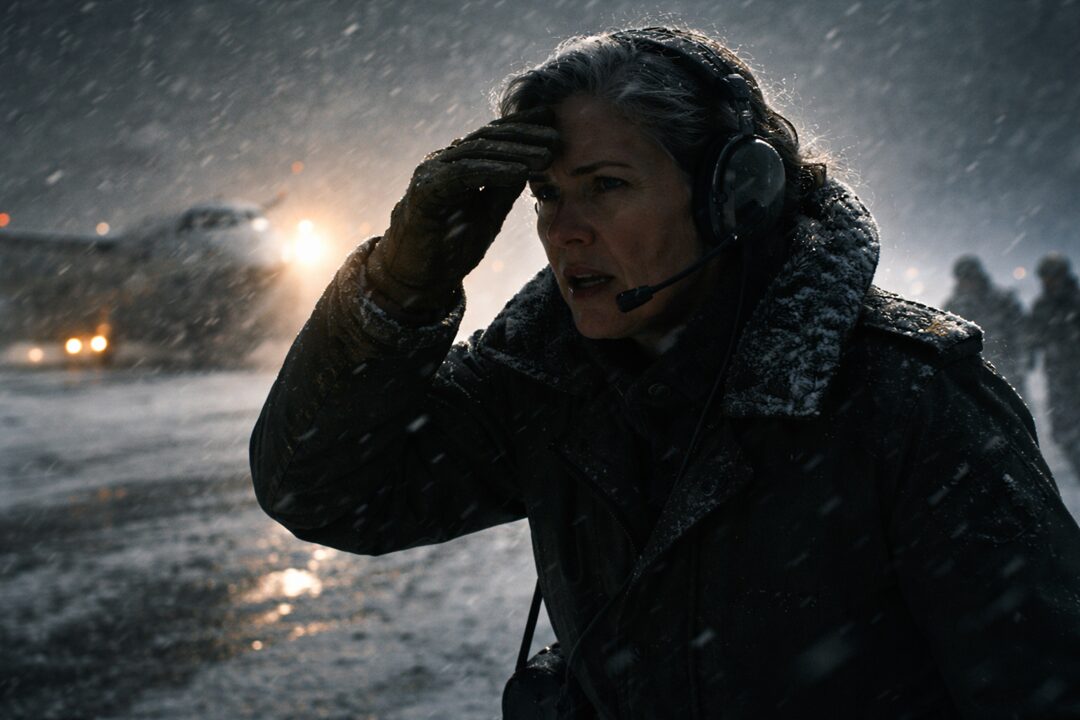
She stood with a grease pencil in one hand and a radio headset in the other, silver hair at her temples damp with melted snow. The air inside the room was so cold her breath showed when she exhaled. On the wall behind her, a map of the mountain corridor was marked with arcs, altitudes, spacing times, and landing windows so tight they looked less like strategy and more like a threat.
“Call signs in sequence,” she said.
Around her, officers repeated numbers, wind vectors, approach codes.
No one wasted words. No one had any left.
Vardim had been under blockade for twenty-one days. Roads mined. Rail severed. Fuel depots hit or abandoned. The ceasefire had not exactly ended; it had simply rotted in place. No formal declaration. No missile storm. Just strangulation with paperwork attached.
The blockade authority said food convoys would be allowed “pending review.”
Pending review, children had started sleeping in their coats.
Pending review, surgeons had begun choosing which wards deserved the last heat.
Pending review, a city had learned the difference between being alive and being allowed to stay that way.
Mara pressed two fingers to the headset. “Lead transport, confirm descent vector.”
A crackle.
Then the pilot’s voice, dry as burnt paper. “Lead transport confirming. If this runway gets any shorter, Colonel, I’ll have to fold the wings.”
A few men around her glanced up.
Captain Tomas Rusk.
Of course.
Mara did not smile. “Just land the aircraft, Captain.”
“I do my best work when warmly encouraged.”
He sounded half asleep, half amused, which was one of the reasons she disliked him. The other reason was that he was good enough to be irritating.
He had once been the most decorated pilot in the command. Then there had been an evacuation in the northern valleys, a storm, a field too small for the number of civilians waiting there, and afterward a board of inquiry and a reputation that never quite died, only curdled. Reckless. Unstable. Brilliant when contained. Dangerous when not.
Mara would have preferred a safer man.
But safe men had already failed this city on paper.
“Fifteen seconds,” said the approach officer.
Mara looked at the marked line on the map: one aircraft every thirty seconds.
If it worked, Vardim would live.
If it didn’t, people would still die, only now with witnesses.
“Tower to Vardim field, lights confirmed?” Mara asked.
Another burst of static. Then a different voice, harsher, tired, carrying the faint noise of shouting somewhere behind him.
“Lights confirmed,” said Dr. Elian Sava. “For the moment.”
Mara closed her eyes once.
He was a surgeon, not airfield command, but in Vardim titles had thinned into necessity. Elian coordinated the hospital district, the shelter blocks nearest the runway, and whatever passed for civilian reality. He had been on the radio with her for three days, and every exchange with him felt like being measured and found insufficient.
“You received my previous message?” he asked.
“I did.”
“And?”
“There will be medical pallets on the third and sixth wave.”
A pause.
“That’s not enough,” Elian said. “If coal takes priority for one full cycle, I lose the ICU by nightfall.”
“If coal does not take priority, the city loses heat.”
“The city is not an equation.”
“No,” Mara said. “It’s ninety thousand separate emergencies. That is exactly the problem.”
The silence that followed was not surrender. It was worse. It was understanding sharpened into contempt.
Then the approach officer said, “Ten seconds.”
Mara watched the wall clock. Watched the second hand drag itself forward like a blade.
Tick.
She imagined the corridor through the mountains: cloud banks, crosswinds, black ridges, searchlights from the blockade positions pretending not to be there. The corridor was open by legal fiction alone. No one had formally closed the sky. That was how everyone had agreed to keep lying.
Tick.
“Five.”
The radio cracked again. Tomas, now all business. “Field in sight.”
Tick.
The room held its breath.
Then came the sound—first distant, then enormous—the heavy descending thunder of a transport aircraft committing its weight to frozen ground.
The windows rattled.
Someone whispered, “God.”
Mara stepped to the glass.
Below, beyond the lit strip of runway, the first aircraft touched down in a spray of dirty ice. It was fast—too fast—coming in hotter than planned, nose low, engines roaring long after they should have eased.
“Too hot,” muttered the approach officer.
Mara saw it at once. Tomas was carrying too much speed.
The aircraft swerved, corrected, fishtailed once, and for one cold second its wingtip seemed to lean toward the next marked section of runway where the second landing would soon begin.
“Rusk,” Mara said into the radio, voice flat with fury. “Brake.”
“Trying not to die, Colonel.”
The transport finally bit into the ice, skidding, straightening, dragging itself clear by a margin so narrow the ground crew on the edge of the strip actually stumbled backward.
“Second approach in twenty-two seconds,” the officer shouted.
Tomas’s aircraft cleared just enough space.
Just enough.
Mara felt the room exhale.
Then the next engine noise arrived overhead.
The sequence had begun.
And because there was no room now for outrage, no room for fear, no room for anything except continuation, Mara only said, “Unload him fast. Then send him back up.”
That was how the city began to live again.
And how the cost began.
Part II — The Descent Pattern
By midday, Vardim had learned to look up.
The people on the streets, the people under blankets in basements, the children under the station arches, the nurses carrying slop buckets past freezing wards—they all paused when the engines came.
One plane. Then another. Then another.
Every thirty seconds, something out of the gray sky.
From the operations room, Mara watched the rhythm become visible. Aircraft descending over the city in measured sequence, their bellies dark against the clouds, so relentless it no longer looked like chance or courage. It looked like machinery. A heartbeat somebody had forced into the winter.
The first time the pattern held for a full hour, one of the young signal officers laughed out loud from sheer disbelief.
The second hour, the blockade positions on the eastern ridge turned searchlights toward the corridor. Not enough to count as an attack. Just enough to make the pilots squint and swear.
By the third hour, radio interference began. Voices clipped. Coordinates blurred. A woman from meteorology said anti-air batteries had been moved closer to the ridge road, though no one had yet fired.
They were not trying to shoot the airlift down.
They were trying to make it flinch.
“Keep the interval,” came the order from regional command. “No visible slowdown.”
Mara read the message twice and felt the change happen inside it.
The operation was no longer just a rescue. It had become a statement.
She hated statements. Statements never bled where the camera could see.
That evening, between landing cycles, she got Elian on the line.
“I’ve increased your medicine tonnage for night rotations,” she told him.
“And reduced coal again,” he said.
“Yes.”
“I just had to move six children from the north apartment blocks because the pipes froze. One of them survived because coal arrived six hours in time. Do you want me to thank your schedule for picking the right child?”
Mara leaned her knuckles against the desk.
“I want you to tell me where the next six hours matter most.”
“That is what I have been doing.”
His voice was rough, but controlled. She had the impression of a man who had run out of strength for theatrics long ago.
Behind him, through the radio hiss, she heard another voice calling for bandages. Metal striking metal. Someone crying once, sharply, then stopping.
Elian said, “You people are already being praised.”
“By whom?”
“By the same men who let this happen slowly enough to call it diplomacy.”
Mara stared at the map on the wall. “Doctor—”
“Elian.”
She said nothing.
“You’re deciding tonnage,” he went on. “I’m deciding temperatures. Which body gets the warmed bed, which body keeps the antibiotic, which mother I lie to first. So no, Colonel, I am not interested in the elegance of your corridor.”
Before Mara could answer, another voice came on the radio, careless and familiar.
“Speaking as one of the flying components of her elegance,” Tomas said, “I would like it noted that the corridor currently resembles a grave dug through cloud.”
Mara straightened. “Why are you on this channel?”
“Because nobody locks radios properly in wartime.”
“Return to your assigned frequency.”
“I’m six minutes from takeoff. Thought I’d save time and insult everyone at once.”
Elian gave a short, humorless breath that might have been the beginning of a laugh.
“Captain,” he said, “if you crash with my antibiotics on board, I’ll personally keep you alive just to make the conversation unpleasant.”
“Good,” Tomas replied. “I hate dying misunderstood.”
The line clicked dead.
Mara took off the headset and set it down carefully.
She should have hated him more than she did.
That night she went down to the field.
Aircraft landed, unloaded, refueled, lifted, vanished. Men ran with pallets. Forklifts shuddered. Snow blew sideways through floodlight beams. Every face looked the same after enough hours: pale, intent, reduced to function.
Tomas stepped down from his transport with frost in his eyelashes and that old ruined flight jacket zipped to his throat.
“You nearly killed the sequence this morning,” Mara said.
He glanced at the runway. “But I didn’t.”
“That is not a defense.”
“It is in aviation.”
She saw the scar at his jaw catch the light when he turned. A clean pale line like somebody had once tried to open him and then changed their mind.
“You came in too hot.”
“The third marker light was dead, the wind cut crosswise over the ridge, and your approach beacons are lying for patriotic reasons.”
“My beacons do not lie.”
“Then they’re optimists.”
He rubbed gloved hands once, more from habit than warmth. He looked older on the ground than in the air. More breakable. Which was absurd, because he flew like a man to whom breakage was merely administrative.
“You want to ground me,” he said.
“I want to trust the landing order.”
“You can’t have both.”
That answer angered her because it was not entirely false.
She watched crews pull medical crates from the belly of his aircraft. Two men slipped on the ice and nearly lost a pallet marked ANTIBIOTICS. Someone shouted. Someone else hauled it upright again.
Below the stencil letters, in black marker, a smaller hand had written FOR THE CHILDREN’S WARD.
“Who did that?” Mara asked.
Tomas followed her gaze. “Me.”
“That is not regulation.”
“No,” he said. “It’s reading.”
He started to turn away, then stopped.
“There were civilians in the valley during the Kestrin evacuation,” he said, still looking toward the aircraft instead of at her. “That’s the story they tell, yes? That I broke procedure trying to carry more than the plane could safely hold.”
Mara said nothing.
“They leave out the part where procedure changed three times in one hour because command couldn’t decide whether the valley still mattered. They leave out the part where we were ordered to cut capacity for military personnel first. They leave out the part where I obeyed.”
Snow hissed across the runway between them.
He finally looked at her.
“I’ve never been reckless because I don’t understand risk,” he said. “I’ve been reckless because I do.”
Then the ground crew chief yelled for him to remount. Another takeoff slot.
Tomas gave Mara the beginning of a salute, abandoned it halfway, and climbed back into the aircraft.
The engines came alive.
Thirty seconds later, another plane descended out of the night.
Part III — What the City Called Salvation
Inside Vardim, salvation arrived on splintered pallets.
Not all at once. Never enough. Sometimes in flour sacks that tore before they reached the depot. Sometimes in dented tins of powdered milk. Sometimes in coal so damp it smoked before it burned. Sometimes in antibiotics that turned one screaming ward into a quieter one.
The city still smelled like cold metal, wet plaster, and people trying not to panic.
When Elian crossed the hospital yard after dawn, a little girl in two mismatched boots was sleeping under a table while her mother held an empty kettle with both hands, as if waiting itself could warm water.
He checked the pediatric ward first.
Three children had pinker faces than the night before. One had died just before dawn. The nurse delivering that news did it while updating his temperature charts, because grief had been folded into procedure now.
On his way to the basement he passed two crates from the latest airlift. One marked HEATING FUEL. One marked PENICILLIN.
He stared at them with sudden, irrational anger.
As if the war had become honest enough to ask him to choose only once.
In the station tunnel below the western rail line, his sister Mira was teaching twenty-three children arithmetic with a piece of charcoal on a wall.
The sums were terrible. The children still answered like they believed numbers belonged to the old world, the one where mistakes cost marks instead of heat.
Mira’s bright scarf had been tied around a little boy’s wrist to keep a compress in place.
“You should be upstairs,” Elian said.
“You should be asleep,” she said without turning.
A girl of about eight looked up at him. “Doctor, are the planes real?”
He almost smiled. “I’ve been hit in the face with enough of their cargo to confirm it.”
The girl nodded, satisfied.
Mira finally faced him. Soot on her cuffs. Hair pinned badly. Eyes too alert.
“How many beds left?” she asked.
“Not enough.”
“How much coal?”
“Less than rumor suggests.”
She lowered her voice. “Then stop arguing for medicine.”
He stared at her.
She stepped farther into the tunnel where the children could not hear easily. “The north platform dropped below freezing before dawn. We moved the smallest ones near the stove, but the stove is done by tonight unless your miracle in the sky changes direction.”
“Infection kills too.”
“Cold kills faster.”
“That depends on the child.”
“That is exactly my point.”
She held his gaze, and he saw the thing he always feared in civilians during war: the speed with which they learned triage. Not from training. From repetition.
“These kids still think the planes are magic,” she said. “Don’t make me explain tonnage to them.”
Above them, faint through layers of stone, came the sound of another descending engine.
The children heard it too.
One little boy stopped shivering long enough to grin.
There it was again, Elian thought. The thing he did not want to credit. The symbolic force of the rhythm. Hope, arriving on schedule whether he respected it or not.
That afternoon, a woman from the north apartments came in carrying her son. He had been blue with cold before dawn, she said. Then coal reached the district and the building’s caretaker managed to heat one room. The child was alive because heat had arrived six hours before his body gave up.
Elian wrote the boy’s pulse down with one hand.
With the other he signed for a shipment of penicillin.
By dusk the weather turned.
White came down out of the mountains in a way that erased distance first and then shape. The field lights blurred. Engines sounded farther away than they were. Word spread that one of the transports was late on approach.
Mara felt it before the report came.
Not intuition. Rhythm. Once you lived inside a pattern long enough, you could hear its injury.
“Delayed on final,” the approach officer said.
“How delayed?”
“Forty-one seconds.”
Too long.
Mara went cold.
Then came the voice from Vardim field, broken by static and wind.
“Aircraft down in outer field. Repeat, one transport down in outer field.”
No one moved for a heartbeat.
Then everyone moved at once.
The aircraft had missed the runway in the whiteout and broken apart beyond the perimeter markers, half in snow, half in frozen mud. By the time Mara reached the crash site, ground crews were already pulling shattered crates from the drift.
Medical supplies. Bandages. Morphine. Surgical alcohol.
Scattered across the snow like offerings.
Someone had thrown a blanket over two bodies. A third crewman was trapped in the cockpit, visible only as a dark shape behind fractured glass.
Tomas landed seven minutes later, breaking protocol to do it, and came striding across the field before his engines had fully spun down.
“You should still be in the air,” Mara snapped.
“You needed another pair of hands.”
“I needed you in sequence.”
He looked at the bodies, then at the ruined crates half-buried in snow.
“No,” he said quietly. “You needed this seen.”
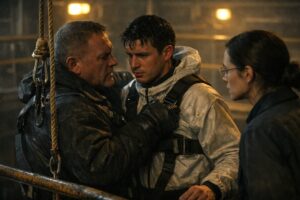
Elian arrived after midnight, brought out from the city by ambulance sled because the surviving load had to be triaged on site. He stood in the field with snow melting into his cracked glasses and looked at the dead crew and the medicine spread across the whiteness.
The wind drove ice against all three of them.
“This,” he said, “is what the city will remember too.”
Mara’s jaw tightened. “The city will remember that planes kept coming.”
“And that men were fed into the keeping.”
She wanted to tell him he was being cruel.
Instead she looked at the crates.
He was being exact.
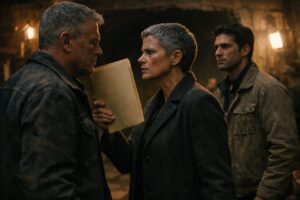
Regional command sent congratulations that same night. Praise for throughput. For discipline. For message value. One line in particular stayed in Mara’s head long after she read it:
The airlift is forcing the blockade authority into visible embarrassment.
Not saving the city.
Not protecting civilians.
Embarrassment.
She folded the paper once, then again, until the edges cut her glove.
That was the night the operation changed for her.
Not in its mechanics.
In its meaning.
Part IV — The Order Beneath the Order
By the fourth day, the rhythm had become law.
Pilots timed their breathing to it. Ground crews moved like the second hand on Mara’s wall clock had entered their blood. In Vardim, mothers began estimating hope in intervals. If the engines were still coming, the city had not been abandoned.
Which was why the rumor of a humanitarian road convoy spread panic faster than shellfire would have.
A convoy. Negotiated access. Ground relief within twenty-four hours.
It sounded like mercy. Which was exactly why Mara did not believe it.
The message came through command channels with diplomatic language and false caution. To support negotiations, airlift tempo should be reduced temporarily. Maintain symbolic presence only. Conserve aircraft. Avoid provocation.
She read the order standing in the same freezing room where the whole thing had begun.
Maintain symbolic presence only.
She almost laughed.
The corridor had become so useful politically that men who had never seen Vardim’s hospital basements now wanted to slow the one thing keeping those basements from turning into morgues.
Her deputy cleared his throat. “Colonel?”
“If we cut tempo,” Mara said, “the city will know before the diplomats finish congratulating themselves.”
“Regional command wants the road option protected.”
“There is no road option.”
“You don’t know that.”
“Yes,” she said, “I do.”
Because this was how strangulation worked now. Not with artillery. With interruption. With just enough pause to let fear regrow.
At the field, Tomas solved the problem of his own temper by nearly killing a mechanic.
Not directly. Only by bringing his aircraft in through a side wind so savage the ground crew chief dove into the snowbank as the port wing screamed over his head.
Mara met Tomas at the ladder before his boots hit the ground.
“You’re grounded.”
He looked almost amused. “By weather or by ego?”
“By me.”
“Then at least call it personal.”
“You disobeyed approach correction.”
“I corrected for survival.”
“You corrected for arrogance.”
Something hard moved in his face then, there and gone.
“Do you want obedient pilots,” he asked, “or living cargo?”
“I want both.”
“No, Colonel. You want a world that stopped existing before this airlift did.”
She could have argued.
She could have told him he mistook insubordination for honesty.
Instead she said, “You will remain off rotation until further notice.”
He stared at her.
For the first time since she’d met him, the tired irony left him completely.
“People will die while I sit on the ground.”
“People die while you’re in the air too.”
He took that like a blow because it was true.
Then he nodded once, very slightly, as if granting her the right to wound him, and walked away.
Mara almost called him back.
She did not.
That evening Elian radioed from the hospital.
The basement shelters were full. Fuel reserves below twelve hours. He had moved elderly patients from private wards into corridors because the corridors held heat better when packed with bodies.
“I have a question,” he said.
“Go on.”
“If the convoy exists, why are mothers still bribing porters for half-burned coal?”
Mara looked at the order on her desk.
“It doesn’t exist,” she said.
He was silent for a moment.
Then: “Are you reducing flights?”
She did not answer quickly enough.
“Oh,” Elian said.
It was only one syllable. It landed like accusation anyway.
From somewhere near him she heard Mira’s voice, not on the line but near it, saying, “Ask for coal. Don’t let them be noble about medicine again.”
Elian came back. “My sister says the school tunnel will freeze by dawn.”
Mara could picture the place though she had never seen it: stone arches, blankets pinned into walls, children sleeping in rows, Mira’s scarf bright in the dark like something refusing surrender.
“I know,” she said.
“Then what are you doing?”
What she had always done.
Following the order beneath the order.
Keeping the machine clean.
Protecting the chain.
Her hand tightened over the desk edge until the tendons hurt.
“I’m deciding,” she said.
That was not good enough for him.
It was no longer good enough for her either.
An hour later, she went down to the flight board herself.
She removed three names.
Then she put three back.
“Colonel?” said the operations clerk.
“These are weather repositioning flights,” Mara said.
He blinked. “To Vardim?”
“Yes.”
“That’s not what repositioning means.”
“Tonight it is.”
She signed the release before she could think better of it.
Not because she had suddenly become brave.
Because there came a point when obedience no longer felt like order.
It felt like hiding.
Tomas was outside the hangar when she found him, smoking a cigarette he had not lit. Snow had gathered on his shoulders. He had likely been there for an hour.
“You’re back on lead approach,” she said.
He looked at her hand, at the flight board tag she held.
“You changed your mind.”
“No.”
“What then?”
“I stopped borrowing someone else’s.”
For a moment, something almost human and unguarded crossed his face.
Then it was gone.
“The storm will close the corridor in less than two hours,” he said.
“I know.”
“The runway lights in Vardim are failing.”
“I know.”
He took the tag from her gloved hand.
“If I don’t clear the strip,” he said, “the whole chain collapses behind me.”
Mara met his eyes.
This time neither of them hid inside rank.
“Then clear it,” she said.
Part V — The Last Approach
The storm came down like a verdict.
Snow erased the ridge line. Wind shoved aircraft off their vectors. Ice glazed the runway faster than the crews could strip it. In Vardim, the hospital basement filled with families carrying blankets, kettles, children, old men who had stopped complaining and started shivering in silence.
Elian walked between cots counting heat the way other men counted ammunition.
Three beds left near the generator room.
Two.
One.
A nurse caught his sleeve. “If the fuel doesn’t arrive—”
“I know.”
Above them, the engines came again.
Still coming.
That was the terrible thing. Even in the storm, they were still coming.
At the field, the lead aircraft on the night sequence touched down, hit black ice, and slewed sideways across the far third of the runway.
Ground crews ran.
The pilot managed to keep the transport from rolling, but it stopped crooked, its tail cutting into the only safe clearance left for the aircraft already descending behind it.
“Blocked strip,” the tower shouted.
Mara was on the field before anyone could stop her, headset on, snow lashing her face.
“How long to clear?”
The ground chief looked at the jammed landing gear and shook his head once.
Too long.
Overhead, another engine roared through cloud.
“Wave off,” shouted her deputy.
But Mara knew what a break in the pattern meant now.
Not only delay.
Panic in the city. Proof to the blockade that the rhythm could be broken. Hours lost that bodies did not have.
“Tower,” Tomas said over the radio, voice astonishingly calm. “I can take the shortened line.”
“Negative,” Mara snapped. “Unsafe.”
“Everything tonight is unsafe.”
Another plane checked in behind him. Another behind that.
A chain in the dark.
Mara turned and saw the runway lights flicker once, twice.
In the hospital basement, Elian saw it too from the high slit windows.
The lights.
Failing.
He stared at them, then at the generator room door.
For one instant he thought of the heated beds. The old woman in the corner whose breathing had finally slowed. The infant under three blankets. The nurse asleep upright with a child against her chest.
Then he thought of the runway going dark.
He turned to the orderly beside him. “Take the portable batteries from every generator except surgical backup.”
The orderly froze. “Sir, people down here will lose heat.”
“They lose more than heat if the field goes black.”
He was already moving. “Now.”
In the tunnel school, Mira was tying blankets over cracked archways when the power dipped. The children murmured. One began to cry.
She looked up toward the ceiling as if she could see through stone to the sky.
“Don’t stop,” she whispered to nobody they could name.
On the field, Tomas came through cloud on a descent no sane manual would have authorized.
The blocked aircraft narrowed the runway into a strip of bad mathematics. Snow crossed the landing lights in white sheets. Mara could hear ground crews shouting but could not make out words anymore, only urgency.
“Tomas,” she said into the radio, and it came out not like an order but a warning.
His answer was almost gentle. “If I clear, keep them coming.”
He hit hard.
The transport bounced once, slammed back down, slewed, corrected. One wingtip passed the disabled aircraft by a distance that later no one would agree on because nobody wanted to measure it honestly.
He cleared.
The next aircraft came in.
Then the next.
The shortened pattern held.
Not smoothly. Not cleanly. But it held.
Fuel. Coal. Antibiotics. More fuel. More flour. One plane every thirty seconds, as if the storm were only another problem to be scheduled.
Mara stood in the snow with her heart battering her ribs and understood that discipline alone had not done this.
Discipline had built the pattern.
But now the pattern was being carried by people disobeying fear, disobeying orders, disobeying the small dead voice inside them that said enough.
On Tomas’s final rotation, his aircraft took damage on approach. A hard crosswind shoved him wide; the starboard gear hit rough ground before he corrected. The transport landed with a scream of metal that made Mara flinch even through the storm.
It rolled. Wobbled. Kept moving.
“Clear the strip,” somebody shouted.
But Tomas’s voice came through the radio first, frayed now.
“Hydraulics gone.”
Mara felt the world narrow.
“How bad?”
“Bad enough.”
Behind him, in the cloud, another engine was already descending.
If Tomas’s aircraft stopped on the runway now, the chain ended here.
Not for symbolism.
For bodies.
For heat.
For medicine.
For the children in the tunnel who still thought the planes were magic.
“Take the marsh,” Mara said before she knew she had decided.
A long silence.
The frozen marsh beyond the runway was black and flat and terrible. Maybe enough to absorb the aircraft. Maybe enough to kill him slower.
“Tomas,” she said again.
His answer came low, almost lost in the static.
“That was always the better part of the field.”
Then he veered.
The transport left the runway under full failing weight, skidding into the frozen marsh beyond the perimeter lights. Snow and dark water exploded upward. The aircraft vanished for one breathless second into white spray and black night.
The next plane landed thirty seconds later.
Because there was no other choice.
Because he had made sure of it.
Mara did not remember crossing the field. Only the cold. The impact of wind. Men with ropes. Someone yelling her rank at her as if rank still mattered here.
They reached the cockpit through twisted metal.
Tomas was alive long enough to look at her.
Blood at the edge of his mouth. One hand still on the controls like the aircraft might yet ask one more thing of him.
“You kept the interval,” he said.
“No,” Mara answered, voice breaking in spite of herself. “You did.”
Something like a smile touched his face.
Then it was gone.
Behind them, another engine descended out of the storm.
And another.
And another.
Part VI — The City That Stayed
Morning came pale and merciless.
The storm had dragged east. The runway was open again. The blocked aircraft had been hauled clear. Men moved like ghosts through steam and exhaust and wreckage.
Over Vardim, the planes were still descending in measured succession.
Not as miracle now.
As proof.
On the eastern ridge, the blockade authority broadcast a statement condemning the “unauthorized militarization of humanitarian airspace,” which was the nearest they could come to admitting they had lost the right to call starvation inevitable.
No one in Vardim bothered listening to the full message.
The people listened to the engines instead.
Mara walked the reopened interval between runway markers alone, counting thirty seconds without looking at a clock. She had grease on her gloves, ice in the seams of her boots, and a silence inside her that felt larger than exhaustion.
She stopped at the edge of the marsh.
The broken tail of Tomas’s aircraft still showed above the frozen reeds.
Nothing about it looked noble.
That helped.
Inside the hospital, Elian signed the intake for the last emergency crate from the storm sequence.
He expected the usual inventory—antibiotics, saline, heating tablets, sterile packs.
The lid came off with a splintering crack.
On top were the antibiotics.
Under them, bundled in waxed paper, were sticks of classroom chalk.
Under that, a packet of letters tied in twine, addressed to district schools and shelter blocks from outer villages the blockade had cut away weeks before.
Messages from teachers. Lists of names. One child’s drawing of a yellow house with smoke coming from the chimney.
Elian stood still for so long the orderly beside him finally asked, “Doctor?”
He reached into the crate and picked up one stick of chalk.
So white.
So absurd.
So necessary.
He thought of Tomas writing FOR THE CHILDREN’S WARD on a pallet in black marker because regulation was smaller than what the cargo meant.
He thought of Mara in the operations room, perhaps even now already calculating the next twelve hours because cities did not stay alive on grief alone.
He thought of the little girl in the tunnel asking if the planes were real.
Mira came in carrying a blanket bundle, saw the chalk in his hand, and understood before he spoke.
Her face changed slowly.
Not into tears.
Into something steadier and harder to survive.
“He remembered,” she said.
Elian looked down into the crate again.
No speech arrived. None was adequate.
Outside, another plane crossed above the hospital roof.
He carried the chalk himself to the rail station that afternoon.
The children had made a game of counting the engines. Mira had given up trying to stop them. On the wall, the old arithmetic had been smudged into gray dust.
Elian handed her the box.
She opened it and sat down very suddenly on an overturned crate, one hand over her mouth.
The children gathered near.
“What is it?” one asked.
Mira swallowed. Then she held up a white stick between finger and thumb as if showing them a relic from a lost religion.
“It means,” she said carefully, “that lessons are starting again tomorrow.”
The children stared at her.
Then one of them laughed.
Then two.
Then the whole tunnel changed shape around the sound.
Not healed.
Not safe.
But changed.
That evening, when the next sequence of planes came in over the city, people stepped out of doorways and shelters and station mouths to watch them descend.
One after another.
One every thirty seconds.
A rhythm carved out of fear, discipline, lies, courage, shame, disobedience, and the stubborn refusal to let a city become a message for somebody else.
Vardim was still hungry.
Still damaged.
Still counting its dead.
But the blockade had not decided its future.
In the tunnel school, Mira wrote the first clean word on the wall in white chalk while the engines passed overhead.
HOME.
And above the city, the planes kept coming.