Not Your Station
Part I — The Forbidden Deck
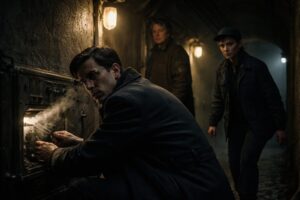
Before sunrise, the battleship still sounded like a machine pretending to sleep.
Metal ticked in the dark. Pipes sighed. Somewhere above, boots hit steel in a sharp repeating rhythm that did not belong to the galley or the mess deck. Gunnery drill. Doris Miller knew the sound the way some men knew hymn meter. He had learned it from the edges, carrying coffee where he was told, trays where he was needed, eyes lowered just enough to keep from being called insolent.
He came through a narrow passage with a silver urn in both hands and slowed, only for a second, near an open hatch.
Three white sailors were moving through a drill above him, quick and practiced around one of the anti-aircraft positions. Their hands knew where everything lived. Lever. Sight. Ammunition. Steel answered them like it belonged to them.
Doris looked too long.
“Keep moving,” Lieutenant Thomas Harlan said from the passageway behind him.
His voice was not loud. It did not have to be.
Doris turned. Harlan stood with his cap tucked under one arm, clean-faced, collar exact, every inch of him arranged by a system that had already chosen where he stood and where Doris did not.
“Yes, sir.”
Harlan’s glance flicked once toward the hatch, then back to Doris. “That’s not your station.”
He said it the way men said the weather. No meanness in it. No embarrassment either. Just order. Just fact.
Doris shifted the urn against his palm and kept walking.
At the next bend, Eli Boone was waiting with a stack of cups, lean shoulders against the bulkhead, eyes already amused in the bitter way they often were before dawn.
“You keep staring up there,” Eli murmured, falling into step beside him, “one day they gone to make you pay admission.”
Doris said nothing.
Eli gave him a sideways look. “I mean it. Best thing a colored sailor can be on a Sunday morning is forgettable.”
“Hard to forget a man carrying half the coffee on the Pacific.”
“That ain’t the kind of unforgettable I’m warning you about.”
They reached the mess. The silver had to shine. The coffee had to be hot. White uniforms had to stay white. That, at least, the Navy trusted to Black hands.
Doris set the urn down and began laying out cups in straight lines. His own sleeves were immaculate, the heavy white cloth stretched over thick forearms. He had the build of a man who belonged around engines or artillery or in a boxing ring. Instead, he polished spoons.
Eli dried plates beside him, moving fast.
“You ever think,” Eli said, keeping his voice low, “maybe the whole trick is to make it home before this country figures out what to do with us?”
Doris glanced over. “You planning to do that by washing officers’ cups?”
“I’m planning to do it by breathing.” Eli stacked another plate. “That’s a long-term plan.”
Doris almost smiled.
Almost.
The ship gave a small familiar groan beneath them. Harbor morning. Calm water outside. Sunday. Men half-awake. A routine so strong it could make a man believe routine was the same thing as safety.
Then there was a sound overhead that did not belong to the ship.
Not drill rhythm. Not boots. Not machinery.
A tearing roar came low and fast across the morning.
Both men froze.
“What was that?” Eli said.
The answer hit before the question was done.
The first explosion slammed through the battleship with such force that cups leaped off the table and burst across the floor. The bulkhead rang like a struck bell. Steam hissed from somewhere beyond the galley. A second impact followed hard enough to throw Doris sideways into the serving table.
For one stunned second, the whole ship forgot what it was.
Then the alarms began.
Men shouted all at once. Somewhere close, a pipe burst. Somewhere farther off, somebody screamed for a corpsman. The floor tipped beneath Doris’s feet, steadied, then rolled again.
Eli pushed himself up from one knee, face gone pale under brown skin. “That’s no accident.”
Above them, another roar passed over the ship.
Doris heard machine-gun fire.
Not drill. Not practice. Real rounds ripping air.
The silverware on the deck trembled in a bright useless pile.
Then the third blast came, and routine vanished for good.
Part II — Steel and Fire
The first thing Doris understood was smoke.
It came quick and thick through the passageway, carrying heat and the bitter smell of fuel. Men were already running in opposite directions, some toward stations, some away from things they could not fight. Somebody shoved past him with blood running from one ear. Another sailor stood with both hands pressed to his stomach like he was trying to hold himself closed.
“Stay low,” Eli snapped.
Doris was already moving.
Training told men where to go. Panic told them where not to. Doris had neither luxury. He followed the sounds that needed hands.
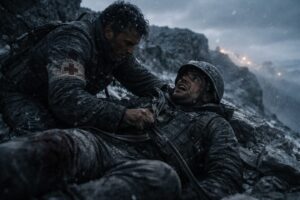
In the next compartment, a petty officer was trapped under a fallen section of piping. Doris dropped to one knee, got both hands under twisted metal, and heaved. The steel shifted just enough for another sailor to drag the man free. The petty officer’s leg bent wrong below the knee.
“Help him to the ladder!” someone shouted.
Doris got an arm under the man’s shoulders and hauled him up.
The ship shuddered again. Dust rained from overhead. Somewhere outside, a bomb landed with a heavy wet concussion that seemed to come through water itself.
By the time he reached the ladder well, there were wounded stacked into the narrow space like a traffic jam made of flesh and fear. Burns. Splinters. Blood. One man vomiting from shock. Another with eyebrows singed off and eyes too wide to blink.
Doris kept lifting.
He carried one sailor to safer cover, then another. He went back. Then again.
On the third trip, Eli caught his sleeve.
“That’s enough,” Eli said. “You keep running toward every fire on this ship, you ain’t making it off.”
“There are men still in there.”
“There’ll be dead men in there too. You can’t carry the whole damn Navy.”
Doris pulled free. “Then I’ll carry what I can.”
He left before Eli answered.
In a smoke-choked passage near the upper deck, he found Lieutenant Harlan trying to drag a wounded signalman by himself. The officer’s forehead was split open. Blood had dried into one eyebrow, and all the precise authority had gone out of him.
For a second Harlan looked at Doris as if he did not recognize him without coffee in his hands.
Then the compartment shook with another near hit, and recognition became a luxury too.
“Help me,” Harlan said.
Not an order. Not exactly.
Doris dropped beside him. The signalman was limp, one side of his uniform burned nearly black. Between them they got him moving, boots scraping, shoulders catching on the narrow metal frame of the hatch.
Outside, the sky over the harbor had turned into something from a fever dream—planes diving low enough to see the sun flash off wings, smoke rolling up from ships already burning, anti-aircraft guns hammering from some decks and silent on others.
The water itself looked wrong, disturbed by fire and oil and falling debris.
Harlan braced against the bulkhead, breathing hard. “Get him aft,” he said. “Corpsmen are setting a station there.”
Doris started to lift the signalman again.
Harlan grabbed his sleeve. “Miller.”
It was the first time he had used Doris’s name.
Doris turned.
Harlan looked at the wrecked sky, then back at him. “Watch yourself.”
It would have sounded almost human in any other world.
Doris took the wounded man and moved.
He kept moving because stopping meant looking.
Looking meant understanding.
The harbor was under attack. Pearl Harbor. Sunday morning. Real planes. Real fire. Men who had gone to breakfast now bleeding into the decks. Men who had believed themselves untouchable now calling out for mothers, for God, for water.
The ship rolled under him again.
He got the signalman to the makeshift station and turned back toward the deck.
A blast of heat met him halfway up the ladder.
At the top, smoke blew across the open space in black sheets. A gun crew lay where they had fallen near one of the anti-aircraft positions. One man twisted under the mount. Another on his back, eyes open, face gray with a surprise that had not had time to become fear.
Beyond them, more planes banked in.
The gun sat there.
Idle.
Loaded nearby. Men running for cover. Men trying to drag the wounded. And that weapon—one of the stations he had watched from the edges, one of the places the Navy had told him, politely and permanently, were not meant for him—stood empty under a sky full of enemy aircraft.
For one terrible beat, he heard Harlan’s morning voice inside his head.
That’s not your station.
It came back with the weight of every corridor, every tray, every silence swallowed just to keep the day moving.
Doris stood in the smoke, chest heaving.
Below him, a sailor shouted, “We need cover!”
Another plane dove lower.
And suddenly the question was not whether the station belonged to him.
It was whether he was going to let that sentence be the last true thing anybody ever said about him.
Part III — The Gun
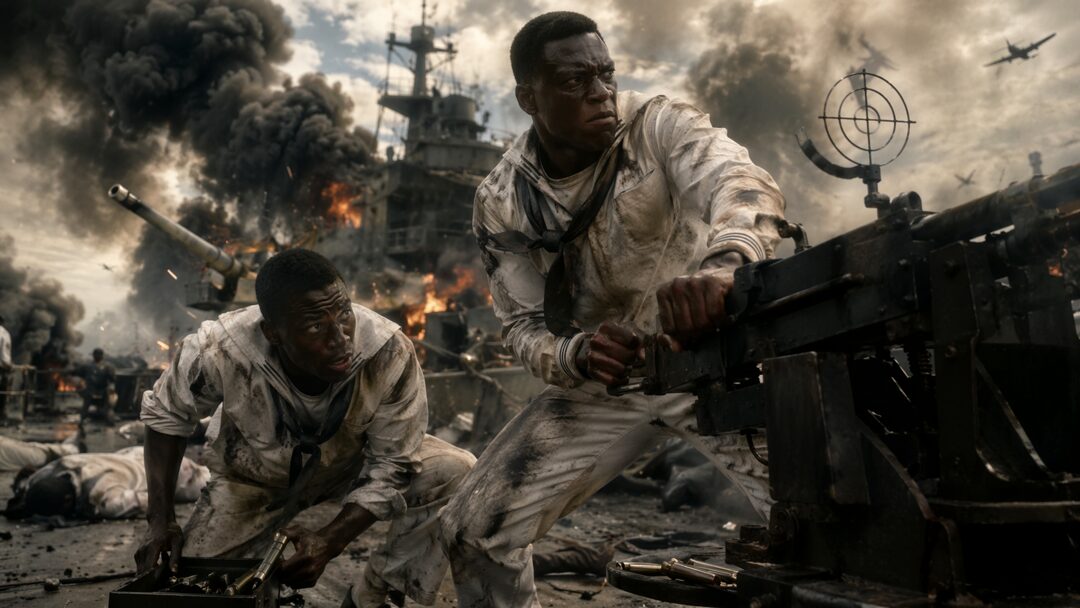
Doris ran for the mount.
A body lay half across the position, one arm bent under itself. Doris grabbed the dead man’s jacket and dragged him clear enough to get in. His fingers shook once when they hit the hot metal.
Not fear.
Heat. Shock. The knowledge of crossing a line that had been drawn long before he boarded the ship.
He knew the gun only by hunger and distance. By stolen seconds near drills. By watching hands that had been permitted to learn what his were not. Lever. Feed. Grip. Sight.
He moved through memory.
The first adjustment was clumsy. The gun kicked too hard, throwing the barrel off line. The burst went wide into empty sky.
“Damn it,” he heard himself say.
Not like a hero. Like a man fighting a machine while the world burned.
Ammunition. Sight again. Breathe. Grip tighter.
Another plane came in low.
Doris swung the mount, muscles straining against the weight and recoil. His shoulders felt like they might tear loose. He fired again. Shorter this time. Better.
Shell casings spat hot around his feet.
Somebody reached the position beside him—Eli, face blackened with smoke, hauling more ammunition.
For one second their eyes met.
Eli looked at the gun, at Doris behind it, at the harbor on fire around them.
“This is a bad idea,” Eli shouted over the noise.
Doris kept firing. “Then get lower.”
Eli barked out something that might have been a laugh if the sky had not been full of death. He slammed ammunition closer with both hands.
“You always did hate being told no.”
Another pass. Another burst.
Doris did not know if he hit anything. The point was not glory. The point was noise. Pressure. Time. The point was making the planes pay attention to something besides the men trying to move the wounded and abandon the dying sections of the ship.
The recoil hammered through his arms until his teeth clicked together. Powder smoke mixed with the smell of fuel and burning paint. Somewhere close, a man was yelling for his brother. Somewhere farther aft, something exploded and sent a shower of sparks across the deck.
Eli crouched low by the mount. “Ship’s taking on too much,” he shouted. “We may have to get off.”
Doris fired again.
The world narrowed into fragments—the arc of a diving plane, the brutal slam of the mechanism, Eli’s hands on ammunition, smoke cutting the harbor into jagged black pieces.
Then a blast hit so close it felt like the air itself punched him in the chest.
The gun lurched. Doris nearly lost his footing. One knee smashed into steel. For a second sound dropped out of the world, replaced by a high dead ringing.
When it came back, it came back ugly.
Fire spreading. Orders colliding. Men abandoning positions. Water surging somewhere it should not be.
The ship was going down.
Eli grabbed his shoulder hard. “Doris!”
Doris looked out over the harbor one more time. Burning ships. Burning water. Burning morning.
He released the grips.
His hands were blistered where the metal had burned through sweat and fabric. Powder streaked both sleeves. His spotless white uniform had disappeared under blood that was not all his, oil that was not his, smoke that belonged to everybody.
He climbed down from the mount and turned to help with the men still moving aft.
No one saluted him. No one made history out of it.
They were too busy trying to live.
Together he and Eli got two wounded sailors over the side into the water and back toward rescue boats.
As Doris lowered himself away from the listing ship, he looked back once.
The gun sat black against the smoke.
Not his station, they had told him.
Then the harbor swallowed the sentence.
Part IV — What They Needed Him To Be
By afternoon, Pearl Harbor looked less like a naval base than a ruin that had been caught trying to organize itself.
The survivors were sorted into clusters—wounded here, missing there, men wrapped in blankets, men staring at nothing, men talking too loud because silence had become unbearable. The smell of burned oil clung to skin and hair and cloth until it felt permanent.
Doris sat on an overturned crate with a bandage around one palm and dried blood at his collar.
A medic had cleaned the worst cuts and moved on. There were too many others.
Across from him, Eli leaned against a wall, cigarette untouched between his fingers.
“You know they’re saying your name,” Eli said.
Doris looked up.
“Not to you,” Eli added. “To each other. That’s different.”
Doris flexed his hand once. It hurt all the way to the wrist.
Nearby, two white sailors were talking in low voices. One glanced over, then away, then back again. The second one did not look at Doris at all.
Harlan approached from across the yard, still in a smoke-stained uniform, one arm in a sling. Up close he looked older than he had that morning. Less arranged. More expensive to himself.
He stopped in front of Doris.
“Miller.”
Doris stood automatically.
Harlan noticed the movement and something about his face tightened. “You don’t have to.”
Doris remained standing anyway.
For a moment Harlan seemed uncertain how to place his own hands. Officers were trained for command, not for debt.
“I gave a report,” he said at last. “About what I saw.”
Eli gave a soft, humorless sound from the wall but did not interrupt.
Harlan continued, “You carried men out. Multiple men. And the gun position—I saw you there.”
Doris waited.
“I thought it should be entered correctly.”
“Correctly,” Eli repeated.
Harlan glanced at him, then back to Doris. “Yes.”
Doris said, “All right, sir.”
Something like frustration crossed Harlan’s face. “That’s all you have to say?”
Doris held his eyes. “You wanted it entered correctly.”
Harlan absorbed that. Nodded once. “Yes.”
He left with the strange stiffness of a man who had just discovered gratitude did not restore the shape of the world.
Eli watched him go. “That man looks like somebody swapped out his Bible while he was sleeping.”
Doris sat again.
“You did a hell of a thing up there,” Eli said after a moment.
Doris looked at his burned hand.
Eli flicked ash onto the ground. “And now watch. They’ll either make you a miracle or pretend you were never near that gun. Both ways still belong to them.”
Doris did not answer.
Because Eli was not wrong.
In the days that followed, the language around him changed, but not cleanly.
Some men clapped his shoulder too hard, the way people touched horses they admired. Some called him brave. Some called him lucky. Some avoided speaking to him entirely, as if the fact of him had become uncomfortable.
One officer asked for a detailed account. Another, later, told him he could keep it simple. “No need to burden the statement with confusion.”
Confusion.
As if the problem was memory, not meaning.
Then came the return to routine, which was the cruelest part.
He was handed silver again.
Coffee again.
A tray balanced on the same hands that had gripped a hot anti-aircraft gun while the harbor burned.
The white uniform was newly cleaned, but he knew what had darkened it. He knew what the cloth had looked like with smoke buried in its seams.
In the mess, a spoon slipped from a stack and rang against the deck.
The sound brought back shell casings.
He stood still for too long.
A chief glanced over. “Miller?”
“Yes, sir.”
“Move with the line.”
Doris moved.
That night, Eli sat beside him on a crate behind the supply shed, both of them too tired to pretend they were there for the air.
“You know what I hate most?” Eli said.
Doris waited.
“That they can use a man’s courage without making room for the man.”
A long silence settled between them.
Finally Doris said, “I didn’t take that gun for them.”
Eli turned to look at him.
Doris’s voice stayed low. “Men were dying. The gun was there.”
“That all?”
Doris stared out into the dark, toward the harbor he could not see from there. “No.”
Eli waited longer.
When Doris did not continue, Eli nodded slowly. “That’s what I thought.”
He dropped the cigarette and ground it out under his heel.
“You better be careful,” he said. “Now they know what you are. That makes you useful in a new way.”
Part V — The Shape of the Story
By the time the ceremony was arranged, the story had reached rooms Doris had never been meant to enter.
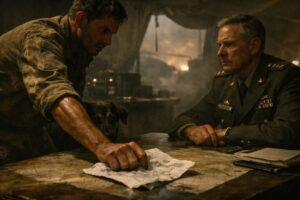
His name moved through offices. Through reports. Through the tidy language institutions used when they wanted courage on paper. He was measured for proper dress. Briefed on where to stand. Told when to step forward, when to stop, where to look.
Nobody asked him what he thought of any of it.
A petty officer straightened the line of Doris’s collar and said, “Just answer plain if you’re addressed.”
Doris looked at himself in the glass of a window before they called him out. The white uniform was perfect again. Buttons bright. Shoes polished. Cap tucked sharp under his arm.
He thought of the same cloth soaked in harbor smoke.
Eli found him two minutes before the ceremony began.
He leaned against the doorframe, uniform pressed but expression unchanged. “You look respectable enough to scare the country.”
Doris snorted once.
Eli stepped farther in. “Listen to me.”
Doris did.
“They’re going to want a version of you that fits easy in people’s mouths.”
“I know.”
“No.” Eli shook his head. “I mean a clean version. Helpful. Grateful. Safe. The kind a man can praise without having to ask what else he was wrong about.”
Doris looked down at the gloves in his hands.
Eli’s voice softened. “Don’t help them too much.”
Outside, they were calling people into place.
“Boone,” Doris said quietly, “I’m not going in there to fight them.”
“I know.” Eli’s jaw worked once. “Just don’t disappear for them either.”
Then he stepped back, and the moment was gone.
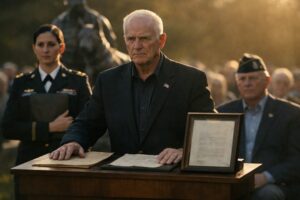
The ceremony took place under open sky, bright and formal and almost offensively calm.
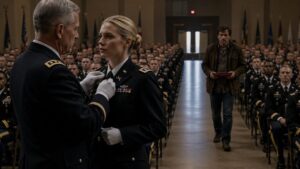
Officers stood in ordered lines. Medals flashed. Cameras waited. Men who had not been on that deck on that morning now carried themselves as witnesses to what the Navy chose to remember.
Harlan was there, arm mostly healed, face stern with the kind of discomfort rank could not protect against.
When Doris was called forward, the air seemed to narrow.
He felt eyes on him from every direction. Curious. Proud. Appraising. Uneasy.
Recognition was a strange thing. It did not arrive as justice. It arrived as posture. As scripts. As hands deciding how to present a man they had once barely noticed.
An officer read out his actions in careful language. Courage under fire. Assistance to the wounded. Manning an anti-aircraft position during the attack.
The words were true.
They were not the whole truth.
When the medal was placed on him, the metal was cool against cloth. Too light for what it was trying to carry.
There was applause.
Doris heard it like weather.
Then came the moment he had been warned about and prepared for—the public glance, the expectation of response, the institution pausing just long enough for him to become part of its own sentence.
The senior officer looked at him. “Do you have anything to say, Miller?”
A hundred possible answers were waiting in the silence.
Something grateful. Something neat. Something history could frame without discomfort.
Doris looked out past the lines of uniforms and saw, for one flicker of a second, the harbor again—black smoke, falling men, the empty gun.
He also saw Eli in the back, standing still as a nail.
And Harlan, watching him with the face of a man who finally understood that witnessing was not the same thing as repair.
Doris said, “Men were dying.”
The applause died instantly.
He went on, plain as weather.
“The gun was there. So I used it.”
Nothing moved.
No one could call it insolent. No one could call it eloquent either. It did not flatter anybody enough for that.
He did not thank the Navy for making him what it had spent years refusing to let him become. He did not forgive anyone. He did not accuse them in a way they could defend against.
He simply refused to lie about what the moment had been.
A necessity.
A choice.
A fact.
From the edge of the assembly, Eli’s shoulders loosened by one degree.
The officer nodded after a beat too long. “Very well.”
The ceremony resumed. Form returned. Cameras clicked.
But something had shifted.
Not the Navy. Not history itself. Something smaller and more final than that.
They could pin metal to his chest.
They could not take custody of the meaning.
Afterward, as the crowd thinned, Harlan approached him near the edge of the deck.
For a moment both men looked out at the water.
“I should have said more before,” Harlan said.
Doris kept his eyes ahead. “About what?”
Harlan gave a short breath that might have been a laugh in a kinder story. “About many things.”
The wind moved lightly across the harbor.
Finally Harlan said, “I was wrong about what I thought I understood.”
Doris turned then.
Harlan held the look. He did not ask to be absolved. To his credit, he seemed to know that would be another kind of theft.
After a second Doris said, “A lot of men were.”
Harlan nodded once.
It was not enough.
It was also, perhaps, the first honest thing either institution or rank had managed to place between them.
Part VI — The Name on the Hull
War did not end because one man had done something brave.
It kept going.
Ships moved. Orders followed. Men left port and did not come back. The ocean took names the way fire took oxygen—without apology and without pause.
Doris returned to service. Returned to duty. Returned, in the eyes of the Navy, to the usable shape of himself.
But not entirely.
Something had changed that no order could reverse.
He still carried trays when told. Still answered yes, sir when required. Still wore the same uniform.
Yet the sentence that had once confined him no longer held.
That’s not your station.
He had stood there anyway.
He had done what was needed in a place that was never meant to open for him.
That fact lived in him now beyond permission.
When he went back to sea, Eli found him before departure.
They stood by the rail with duffel bags at their feet, both of them pretending not to be men with too much unsaid inside them.
“You still planning that long-term breathing strategy?” Doris asked.
Eli smiled without much humor. “Every day.”
Then his face settled. “You be careful out there.”
Doris nodded.
Eli looked at him for a long second. “You know what your trouble is?”
“No.”
“You make a man want to believe decency might cost something less than it does.”
Doris huffed a laugh.
Eli shook his head. “Don’t laugh. That was almost a compliment.”
The horn sounded.
Men began to move.
Eli stuck out his hand. Doris took it. They held on one beat longer than either would have done in easier times.
“Come back,” Eli said.
Doris let go. “I’ll try.”
The sea kept its own counsel after that.
In 1943, it took him.
There was no ceremony large enough for the fact of a man being there and then not being there. Just a telegram. A silence. A widening space in the world where a body had once stood.
Eli heard the news in a yard crowded with noise and felt the day go soundless around him.
Harlan read it in an office and sat down harder than the chair deserved.
The war went on anyway, because war always does.
Years later, long after uniforms had changed and the men who gave orders that morning at Pearl Harbor had thinned into old photographs and older ghosts, steel bore his name.
A warship.
Not a tray. Not a cup. Not a polished piece of service silver carried carefully through somebody else’s corridor.
Steel.
A vessel vast enough to cross oceans.
A station no one could tell him to leave.
And if you stood on the deck of that ship in open water and looked out past the bow, you could almost feel the shape of the old sentence breaking at last.
A Black sailor once paused beneath a gun he was told was not his.
Then the sky caught fire, and he answered a different order.
Men were dying.
The gun was there.
He used it.
The rest took the country much longer.