The Biker In The Barn And The Legacy Of Wyatt Stone
CHAPTER 7: THE ROAR OF THE INDIAN
Two months later, the early October morning broke crisp, clear, and radiant over the Boston Mountains, painting the oak and hickory timber in breathtaking shades of scarlet, copper, and brilliant gold. The sweet scent of woodsmoke and dried pine needles drifted through the mountain air, carrying the crisp, exhilarating promise of autumn.
Outside the newly restored timber barn on the Stone family homestead, over two hundred local residents, timber workers, and veteran mechanics had gathered for the annual Ozark Heritage Festival. A long banquet table laden with homemade apple pies, smoked barbecue, and fresh cider stretched along the stone garden wall.
The Newton County courthouse had undergone a complete moral purge. Harrison Vance had entered a guilty plea to thirty-eight federal counts of racketeering, wire fraud, and grand extortion, receiving a sentence of thirty-five years without parole at the federal penitentiary in Marion. Former Judge Albright had resigned in disgrace and was awaiting trial for judicial bribery, while all four hundred thousand dollars of fraudulent estate liens had been officially expunged from the county books by executive order of the governor.
The five hundred acres of ancestral hardwood timber and Wyatt Stone’s defense patents had been placed under an irrevocable family trust, legally owned and protected in perpetuity by Evelyn and Caleb Stone.
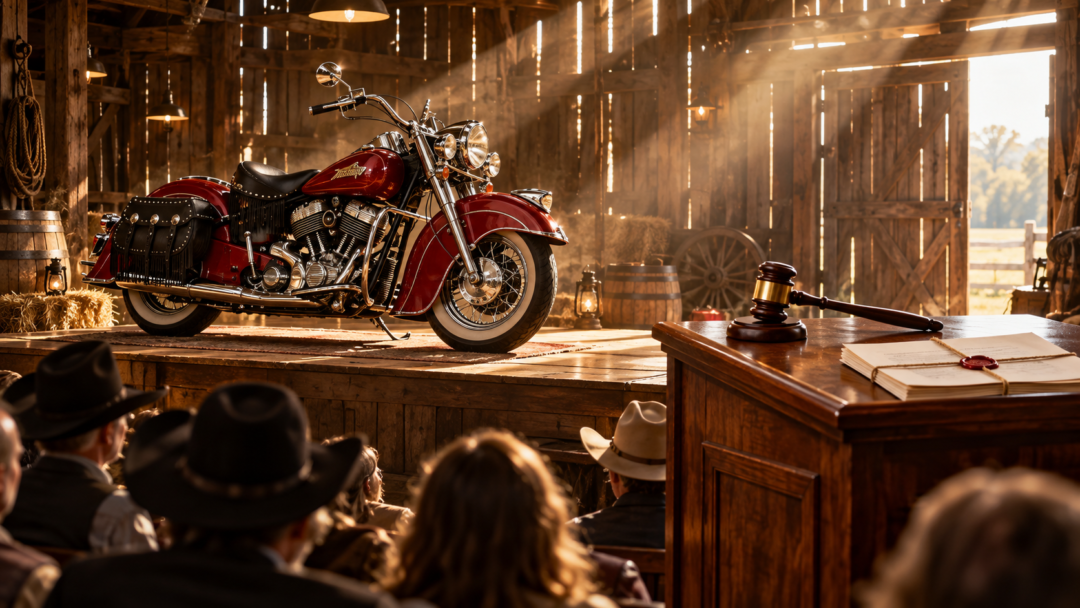
In the center of the barn’s sunny gravel turnaround, standing in all its crimson and chrome glory, was the 1947 Indian Chief. Its tank gleamed, its whitewall tires were scrubbed clean, and its hand-tooled leather saddle was soft with fresh neatsfoot oil.
Standing beside the rear fender, wearing a brand-new black leather riding jacket with a small embroidered cross patch over the heart, was eight-year-old Caleb Stone. He held his grandfather’s vintage black helmet tucked proudly beneath his left arm, his freckled face glowing with pure, radiant happiness.
Mac Callahan walked over from his own motorcycle, dressed in clean denim and a fresh leather vest. He reached into his pocket and pulled out a heavy brass ignition key attached to a small leather fob stamped with the initials W.S.
Mac knelt beside Caleb, placing the heavy key into the boy’s open palm.
“Your grandfather built this machine with his own sweat, Caleb,” Mac said, his deep voice thick with an emotion he no longer tried to conceal. “He built it to last. And he built it so you would always know who you are and where you come from. Are you ready to hear her sing?”
Caleb looked at his mother Evelyn, who stood on the farmhouse porch with a radiant, peaceful smile, nodding her blessing.
“I’m ready, Uncle Mac,” Caleb said, his voice ringing with pure confidence.
Caleb climbed onto the wide leather saddle, his boots resting squarely on the vintage rubber floorboards. With Mac’s steady, experienced hand guiding his fingers, Caleb inserted the brass key into the chrome ignition switch, turning it to the right with a crisp, mechanical click.
“Choke is set. Throttle cracked one quarter,” Mac instructed gently. “Now stand on that kick-starter with your right heel, son. Put your grandfather’s heart into it.”
Caleb rose on the floorboards, coiled his small body, and drove his heel down onto the heavy steel starter pedal with all the strength in his young frame.
The 1200cc flathead V-twin engine erupted into life with a deep, thunderous roar that echoed like rolling artillery across the timber hollows. The twin exhausts thrummed with a steady, unbreakable cadence—pure, clean, and full of American horsepower—turning heads and drawing a deafening cheer from the crowd of mountain neighbors gathered on the lawn.
Caleb twisted the throttle grip slightly, his eyes wide with triumphant joy as the big machine responded with a throaty, joyous growl that vibrated straight through his chest.
The sound of the 1947 Indian Chief was unlike any modern machine—it was an organic, muscular mechanical heartbeat that seemed to draw its power from the very bedrock of the Ozark mountains. Spectators cheered and applauded, neighboring farmers slapping each other on the back, while young Caleb revved the throttle in steady, rhythmic bursts, his freckled face shining with the pure, uninhibited joy of a child who had finally claimed his rightful place in the world.
Evelyn Stone walked down from the porch steps, tears of joy streaming down her cheeks, and wrapped her arms around Mac’s massive leather-clad torso. Mac looked down at her with a gentle, solemn smile, patting her shoulder with an enormous hand that had spent a lifetime turning wrenches and defending his own.
“He would have loved every single minute of this day, Mac,” Evelyn said, her voice shaking with gratitude. “Wyatt always said you were the only man on earth who had the backbone to stand in front of a freight train if it meant protecting family.”
“Wyatt gave me the compass thirty years ago, Evelyn,” Mac answered quietly, his rough voice carrying the warmth of shared history. “I just followed the road he paved.”
Mac turned and walked slowly toward the edge of the stone orchard wall, where the view opened out across fifty miles of rolling hardwood ridges, limestone bluffs, and crystal-clear mountain rivers. High overhead in the crystalline blue autumn sky, a lone bald eagle caught an updraft, soaring in wide, triumphant circles above the granite peaks.
Mac pulled a silver Zippo lighter from his vest pocket, turned the flint wheel with his thumb, and watched the steady yellow flame dance in the mountain breeze before snapping the lid shut with a clean, sharp click.
“Rest easy in the high country, Wyatt,” Mac whispered into the wind, looking toward the sunlit ridges where the timber stood proud and free. “Your iron is unbroken, your family is safe, and the boy is riding tall.”