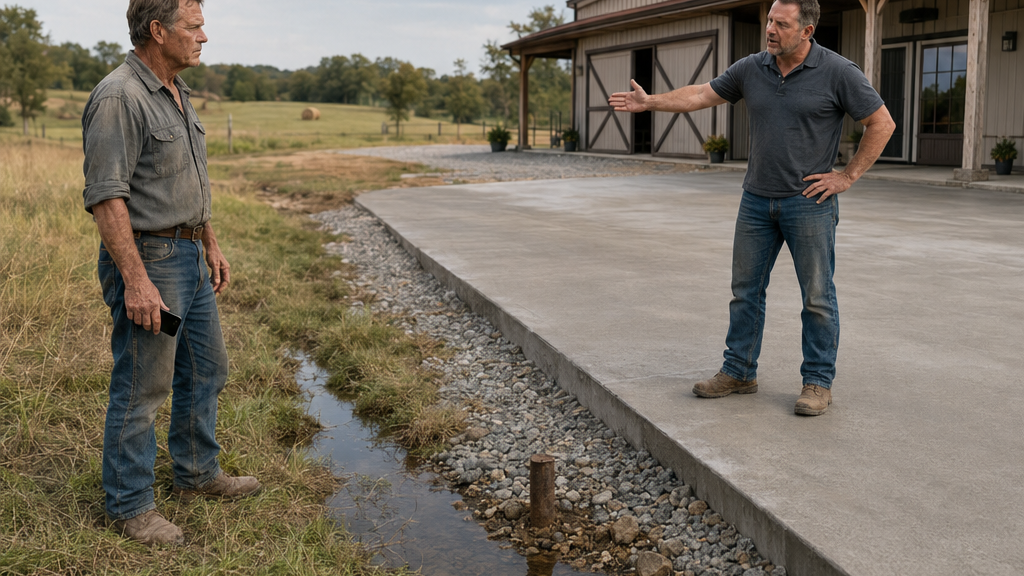
He Poured a Concrete Pad Across the Farm Line—Then the First Heavy Rain Exposed What He Had Buried
Chapter 1: The Concrete Ended Where His Hayfield Began
The concrete truck was already halfway down the county road when Kevin Walker saw what it had left behind.
He stopped his pickup beside the cattle gate and stared across the shared entrance. Where there had been grass that morning, a clean gray sheet now spread from Brian Nelson’s event-barn drive toward Kevin’s lower hayfield.
For several seconds Kevin did nothing.
The new pad was bigger than he had expected. Brian had mentioned widening the turnaround so delivery trucks and wedding vendors would stop backing into the lane. Kevin had nodded at the idea weeks earlier. He had not asked for dimensions.
That was the part that bothered him now.
He had nodded.
Fresh concrete reached past the gravel shoulder and into a shallow depression Kevin had mowed for years. The depression was hardly noticeable in dry weather. It dipped through the grass, curved along the field entrance, then disappeared toward the lower pasture.
Kevin shut off the pickup.
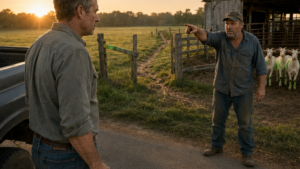
Brian came from behind the event barn carrying a push broom. His jeans were dusted pale at the knees.
“Looks good, doesn’t it?” he called.
Kevin walked toward the slab.
The surface was smooth except for broom lines and expansion joints. A strip of wet gravel had been pressed against the outside edge. Near the far end, the pad seemed to sit several feet beyond the line Kevin carried in his head.
“How wide did you make it?”
Brian rested the broom against his shoulder.
“Enough to get a box truck around without tearing up the shoulder.”
Kevin pointed. “I mean this side.”
Brian followed his hand.
“That’s the turnaround.”
“That’s my side.”
Brian gave him a puzzled look rather than an angry one.
“Kevin, people have turned there since before I bought the barn.”
“Turning on grass isn’t the same as pouring concrete.”
“It was gravel half the time anyway.”
Kevin stepped off the road and walked along the pad.
He knew the land by use rather than measurement. His father had cut hay across it. Kevin had repaired a fence there after an ice storm. Trucks from Brian’s place had occasionally swung wide over the corner, and Kevin had never complained because tires on dry grass were not worth starting a feud over.
But concrete was different.
Concrete announced permanence.
“You have a survey?” Kevin asked.
Brian exhaled.
“The contractor laid it out off the drive.”
“That wasn’t my question.”
“No, I didn’t order a new survey for a turnaround we’ve both been using for twenty years.”
Kevin looked at him.
“Both?”
Brian spread one hand toward the lane.
“You’ve had feed trucks swing through there too.”
That was true.
Kevin disliked how quickly the fact entered the argument.
A gust carried the damp mineral smell of curing concrete toward the field. Kevin crouched beside the outer edge and pressed his fingers into the disturbed gravel.
Water had collected in a shallow pocket between the slab and grass.
Not much. Just enough to darken the soil.
Brian said, “It’s already done.”
Kevin looked up.
“That make it yours?”
“I didn’t say that.”
“You said it like being finished settles something.”
Brian set the broom down.
“What do you want me to do? Tear it up because you think the line is somewhere else?”
Kevin stood.
“I want to know where the line is.”
Brian’s jaw tightened.
“The strip has always been turnaround.”
There it was again.
Always.
Kevin had learned to distrust that word on farms. Always could mean forty years. It could also mean three people remembering the same convenience.
He walked farther along the concrete.
At the corner nearest the hayfield, fresh gravel covered ground he remembered as grass. He nudged it with the toe of his boot.
Something dark showed beneath the stone.
Kevin bent.
He brushed away a handful of gravel, then another. A small metal head emerged, rust-dark and round, set almost flush with the dirt.
Brian stopped talking.
Kevin cleared the stone carefully with his fingertips.
The top of the old pin was scarred but unmistakable.
He remembered seeing it years before while replacing a broken fence brace. He had forgotten exactly where it sat because nothing had depended on remembering.
Until now.
Kevin took out his phone and photographed the pin.
Then he backed up and took another picture that included the pin, the concrete edge, and the water gathering between them.
Brian walked closer.
“That could be anything.”
“Could be.”
“You don’t know that’s the corner.”
“No.”
Brian seemed almost relieved.
Kevin wiped grit from his fingers onto his jeans.
“That’s why I’m not arguing with you about it.”
“You’ve been arguing for ten minutes.”
“No. I’ve been telling you I’m getting it checked.”
Brian looked toward the barn. Beyond it, rows of white folding chairs were stacked under an open lean-to. A refrigerated delivery van waited near the service door. Kevin knew Brian had two September weddings booked and at least one anniversary party.
“You know what a survey costs?” Brian asked.
Kevin gave him a flat look.
“You know what concrete costs?”
Neither man spoke.
The pad had already begun to set hard enough that no bootprint marked it. Removing any part of it now would not mean scraping away wet cement. It would mean saw cuts, breakers, hauling, disposal and another crew.
Kevin felt the anger rise again.
He also felt something less comfortable beneath it.
He should have stopped this sooner.
He had seen stakes near Brian’s drive three days earlier and assumed they belonged to the contractor. He had not asked. He had noticed a skid steer grading near the swale and told himself Brian knew where his own property ended.
Kevin had trusted habit more than boundaries because habit had been easier.
Brian said, “Give me a number if you think I owe you something.”
Kevin turned toward him.
“This isn’t about a number yet.”
“Everything becomes a number eventually.”
“Not before we know what belongs to who.”
Kevin walked back to his truck.
Emily answered on the fourth ring.
“Dad?”
“You still have the name of that surveyor you used on your place?”
A pause.
“What happened?”
Kevin looked through the windshield at the clean gray slab extending toward his hayfield.
“Brian poured his turnaround.”
“And?”
Kevin watched Brian kick gravel back from the exposed pin without quite covering it.
“I think part of it is mine.”
Chapter 2: The Line Was Farther Over Than Either Man Claimed
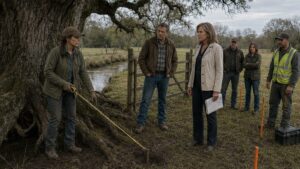
The surveyor drove a wooden stake through a drilled mark in the concrete.
Kevin heard the hammer strike from twenty feet away.
Brian heard it too.
“That can’t be right,” he said.
The surveyor did not answer immediately. He checked the prism pole, glanced toward a second marker farther uphill, then looked at the figures on his data collector.
Kevin stood beside the pickup with his arms folded.
It was Monday morning. The concrete had cured into a pale, hard surface. Yellow caution tape that had surrounded it Saturday was gone. Tire marks already crossed the section nearest Brian’s barn.
The new stake stood almost four feet inside the outside edge.
The surveyor walked toward the opposite corner.
“I’m going to verify the rear monument again.”
Brian followed him two steps.
“The drive has been in the same place forever.”
“The drive isn’t what I’m surveying.”
“I’m saying the boundary should follow it.”
The surveyor looked at him.
“Property lines don’t move because a drive does.”
Kevin almost smiled, but the satisfaction died before it reached his face.
He had wanted certainty.
Now he had it.
And certainty looked expensive.
By noon, three temporary stakes traced a line across the new pad. At the widest point, more than six feet of Brian’s concrete sat on Kevin’s parcel.
The rust-dark pin Kevin had exposed Saturday matched one of the controlling monuments.
Brian stared at it for a long time.
Then he said, “That still doesn’t explain the turnaround.”
Kevin knew what he meant.
The old traffic pattern curved across both properties. Farm trucks, feed deliveries and occasional trailers had swung over the disputed strip for years.
Samuel Brown arrived before lunch after Kevin called him.
Samuel was retired now, but for decades he had cleaned roadside ditches, set culverts and repaired washouts for farms throughout the county. He parked his aging pickup beside the gate and walked the survey line slowly.
“I remember this being open,” he said.
Brian seized on it.
“Exactly.”
Samuel ignored the tone.
“I remember your uncle bringing hay wagons through here, Kevin.”
“He did.”
“And trucks from this side.”
“Yes.”
Samuel looked at the concrete.
“I couldn’t have told you who owned the turn.”
Brian pointed toward him.
“There.”
Kevin rubbed his jaw.
“That isn’t the same as an easement.”
“No,” Samuel said. “But it’s why people thought what they thought.”
The words bothered Kevin more than Brian’s arguments had.
By late afternoon, Emily had converted the old desk in Kevin’s farm office into a spread of records.
Survey copy.
Tax parcel map.
Old aerial photographs.
Deed descriptions.
A county GIS printout with boundary lines that were useful for orientation but not precise enough for argument.
She sat behind the desk with reading glasses pushed into her hair.
“You let people use it.”
“I let trucks turn.”
“For how long?”
Kevin leaned against the filing cabinet.
“I don’t know.”
“Ten years?”
“More.”
“Fifteen?”
“Probably.”
Emily tapped a pencil against the paper.
“And you never told Brian they were crossing your land?”
“I never needed to.”
She looked up.
“You needed to Saturday.”
Kevin frowned.
“You think this is my fault?”
“I think you’re asking why Brian believed it was shared.”
“He poured concrete without checking.”
“Yes.”
“And that’s somehow because I didn’t hand him a map every time a feed truck crossed grass?”
“That’s not what I said.”
It was close enough to what Kevin had heard.
He went outside.
The farm office sat within sight of the shared entrance. Across the lane, the new stakes looked strangely fragile on top of the concrete, as though a little wind could undo what they represented.
Brian was standing near them.
When Kevin approached, Brian said, “I talked to the contractor.”
“And?”
“He laid the outside edge where the old gravel stopped.”
Kevin looked down.
“Old gravel wandered.”
“Because people drove there.”
“That doesn’t change ownership.”
Brian’s expression hardened.
“You keep saying ownership like I came over in the night and stole acreage.”
“You poured a permanent slab six feet over the line.”
“On a strip we both used.”
“Then you should’ve asked.”
Brian opened his mouth, then closed it.
That silence landed harder than Kevin expected.
For the first time, Brian looked less certain than defensive.
Still, when he spoke, his voice was tight.
“If this turns into some legal fight over twenty feet of turnaround, nobody wins.”
Kevin glanced toward the survey stakes.
“I’m not looking for a fight.”
“You hired a surveyor.”
“I hired a measurement.”
Brian gave a humorless laugh.
“Same thing, sometimes.”
That evening Emily drove into town to check the county recorder’s index.
Kevin remained at the farm, moving cattle between paddocks and trying not to watch the entrance.
Near seven, she returned carrying a folder.
“No recorded easement,” she said.
Kevin stopped beside the barn door.
“For Brian’s side?”
“For the turnaround. Nothing in your deed. Nothing in his deed. No separate access agreement I could find.”
Kevin felt a brief loosening in his chest.
Then Emily pulled out an older aerial photograph.
“But look.”
The image showed the shared lane years earlier. A pale arc of worn ground crossed the same corner.
Kevin recognized his father’s equipment shed and Samuel’s old fence.
The turnaround had been there long before Brian.
Emily said, “The paperwork says it’s yours.”
Kevin studied the photograph.
“The ground says everybody treated it like it wasn’t.”
Chapter 3: The Strip Nobody Valued Carried Every Storm
The county drainage inspector stopped at the concrete edge and asked one question.
“Why did somebody pave over the flow path?”
Kevin looked at him.
“The what?”
The inspector pointed with the end of a folded map.
The shallow dip Kevin had spent years mowing ran toward the slab, disappeared beneath its widened edge, then reappeared lower down beside the field entrance.
“That depression.”
Kevin glanced at it.
“That’s just low ground.”
“No.”
The inspector unfolded the map across the hood of his truck.
A faded line crossed the parcel near the boundary. It was not a drainage easement. It was not even labeled as a formal ditch. But older topographic information and county stormwater notes showed runoff moving through the same low corridor.
“Water from the upper pasture and that road shoulder comes through here,” the inspector said. “Maybe not every rain. But when you get volume, this is where the grade sends it.”
Kevin looked toward Brian’s pad.
The concrete sat almost flat across the shallow channel.
“What happens now?”
“That depends on how the contractor graded underneath and where the edge elevations ended up.”
“That means?”
“It means water finds another route.”
Kevin did not like how ordinary the sentence sounded.
At the county office earlier that morning, he had expected a land-use clerk to tell him which form handled an encroachment. Instead, the survey triggered questions about setbacks and whether the commercial parking improvement had been properly reviewed.
The clerk found no final permit tied to the pad.
That did not automatically mean it was illegal. The project might fall under a different filing category, or the contractor might have submitted documents not yet indexed. But the absence was enough for the county to send someone out.
Now the problem was no longer just where Brian’s concrete ended.
It was what the concrete had covered.
The inspector walked downhill.
Kevin followed.
The swale was shallow enough to disappear beneath thick summer grass. Kevin had driven over it hundreds of times. His father had never called it a ditch. No one had cleaned it with machinery or lined it with stone.
It simply existed.
Near the lower field, the grade flattened and spread water across a broad strip before it reached a natural outlet beyond the fence.
Kevin pictured spring storms there: water moving fast for half an hour, then dropping away without much fuss.
He had never thought about why.
The inspector knelt near a patch of dry mud.
“You had flow here recently.”
“Thunderstorm last week.”
“And before the pad?”
“Water ran this way.”
The inspector nodded.
“Exactly.”
Kevin stood and looked back uphill.
For two days he had been thinking about six feet of land.
Now six feet felt like the smaller problem.
His phone buzzed.
Emily.
“You need to look at Thursday’s forecast,” she said when he answered.
“How bad?”
“Two to three inches possible overnight.”
Kevin looked toward the concrete.
“You sure?”
“Enough that the weather service put out a flood watch for the county.”
He ended the call and found Brian beside the barn.
Brian was unloading cases of bottled water from the back of a utility vehicle.
“The county inspector’s here,” Kevin said.
“I saw.”
“He says your pad covers a drainage path.”
Brian set down a case harder than necessary.
“Now it’s a drainage path?”
“It always was.”
“You told me Saturday it was your grass.”
“I didn’t know.”
Brian stared at him.
For a second, Kevin understood exactly what Brian was thinking: the problem changed every time somebody new looked at it.
First boundary.
Then survey.
Now drainage.
Brian said, “This is starting to sound like you’ll keep finding reasons until I tear the whole thing out.”
Kevin’s temper rose.
“You poured over the line. I didn’t create that.”
“No, but you’re acting like every tire that touched that corner for twenty years was some invasion nobody noticed.”
Kevin stepped closer.
“I’m not talking about tires.”
“Neither am I. I’ve got fourteen events booked between now and November. I need delivery trucks to turn. I need caterers to get in and out. That pad is not decoration.”
There was the first clean glimpse Kevin had gotten of what lay beneath Brian’s stubbornness.
Not entitlement alone.
Fear.
Brian had spent two years converting the old livestock barn into an event space. New electrical service. Restrooms. Roof repairs. Fire inspection. Gravel parking. Kevin had watched the work without asking how much of it was financed.
Brian wiped both hands on his jeans.
“What if I buy the strip?”
Kevin blinked.
“What?”
“The part that’s over. We’ve got a survey now. Put a value on it.”
Kevin looked past him toward the concrete.
Two days earlier, he might have considered it.
He did not need six feet of grass for hay. The acreage was trivial.
But now he could see the shallow line of the swale entering the slab and stopping.
“That doesn’t fix the water.”
“Then we put in a drain.”
“You don’t even know what you changed.”
“Neither did you until today.”
The words hit because they were true.
Kevin had owned the ground for decades and thought of the swale as something the mower dipped into.
Brian had built over it without knowing.
Kevin had defended it without knowing.
Neither fact canceled the other.
The inspector returned carrying a level rod.
“I’m going to shoot elevations along the edge,” he said. “After that I’ll send the county a field report.”
Brian asked, “Are you ordering me to remove it?”
“Not today.”
Brian relaxed slightly.
The inspector continued.
“But I wouldn’t add anything else until this is resolved.”
By late afternoon, the air had become heavy and still.
Kevin moved equipment away from the lower entrance. He pulled a stock trailer onto higher gravel and checked the fence corner where the swale flattened into the field.
Emily arrived with plastic sleeves for the survey and county paperwork.
“You’re preparing like the creek’s coming through,” she said.
“There isn’t a creek.”
“That sounded convincing.”
Kevin looked uphill.
The concrete pad caught the fading light in one hard, uninterrupted plane.
The swale reached it and vanished.
At six, Brian walked over carrying a folded sheet of paper.
“What’s that?”
“Offer.”
Kevin did not take it.
“I told you, the drainage changes things.”
“Read it first.”
Brian held the paper out.
Kevin finally accepted it.
The price was more than the narrow strip was worth as pasture.
Enough that Emily raised her eyebrows when she saw it.
Brian said, “You get paid. I keep the turnaround. We engineer whatever drain the county wants.”
Kevin folded the offer back along its crease.
A low rumble sounded beyond the western ridge.
Brian heard it too.
Neither man spoke.
The first drop struck the concrete between them, dark and round.
Then another hit the dust beside Kevin’s boot.
Kevin looked toward the shallow swale.
Water had not reached it yet.
But for the first time in all the years he had owned that ground, he found himself waiting to see exactly where the rain would go.
Chapter 4: One Night of Rain Changed the Argument
At four-thirty the next morning, water was crossing Kevin Walker’s farm lane in a place he had never seen it cross before.
His headlights caught the movement first.
A shallow brown sheet slid over the gravel just below the shared entrance, carrying bits of grass and pale concrete dust toward the lower hayfield. Kevin stopped the pickup and left the engine running.
Rain struck the hood hard enough to blur the windshield.
He stepped out anyway.
Cold water ran down the back of his collar as he walked toward the new pad. The shallow swale above it was full now, not deep but moving. Water reached the concrete edge, spread sideways along it, and then broke toward the lane where the grade offered an easier path.
The slab had become a wall.
Kevin took out his phone.
He photographed the water entering the swale.
Then the place where it struck the concrete.
Then the muddy current crossing the lane.
By the time he reached the lower fence corner, his boots were coated in red-brown mud.
One post leaned farther than it had the evening before.
Water had carved a narrow trench around its uphill side, exposing roots and stones.
Kevin grabbed the post and pushed.
It moved.
“Great.”
He returned to the equipment shed, loaded a shovel and two steel posts, then drove back down.
Headlights appeared on Brian’s side of the entrance.
Brian stopped beside the pad and stepped out in a rain jacket.
“You been down there?”
Kevin pointed toward the lane.
“You can see it from here.”
Brian walked to the edge.
The water gathered against the concrete in a broad rippling pool before peeling off toward Kevin’s field.
Brian stood silently.
Kevin watched his face.
“This didn’t happen before,” Kevin said.
Brian did not answer.
“This lane has been here longer than either of us has owned these places.”
“I know.”
“Water never crossed it there.”
“I said I know.”
That was different.
No argument.
No reminder about shared turnaround.
No offer to buy the strip.
Brian stepped closer to the concrete and crouched.
Water curled around the corner in a muddy stream.
“What if we cut a channel through it?” he asked.
Kevin shook his head.
“I’m not cutting anything until the county looks at this.”
“We can’t leave it doing that.”
“I didn’t say leave it.”
“You just said don’t touch it.”
“I said don’t start guessing again.”
Brian stood.
The rain ran off the brim of his cap.
Kevin expected another argument.
Instead Brian looked toward the lower fence.
“Is that corner moving?”
“Yes.”
They worked without discussing whose fault it was.
Brian carried steel posts while Kevin drove them beside the weakened corner. They pulled the woven wire back enough to keep cattle from pushing through. Water rose around their boots.
For fifteen minutes, the dispute shrank to a practical problem.
Hold the fence.
Keep the lane open.
Get through the storm.
Then Kevin noticed Brian staring at the survey pin.
The pin stood just beyond the slab edge, washed clean by rain. Gravel that had partly hidden it was gone.
“You looked at that Saturday like you’d seen it before,” Kevin said.
Brian turned.
“What?”
“The pin.”
Brian said nothing.
Kevin drove the last steel post into the soft ground.
“You told me it could be anything.”
“It could’ve been.”
“That’s not what I asked.”
Brian looked toward the barn.
Kevin waited.
The rain softened slightly.
Finally Brian said, “I saw it when they graded.”
Kevin stopped.
“When?”
“Thursday.”
Two days before the pour.
Kevin felt something inside him go still.
“The contractor saw it?”
“I don’t know.”
“You knew there was a marker sitting where they were laying out concrete.”
“I knew there was metal in the ground.”
“You knew enough to notice it.”
Brian rubbed water from his face.
“I thought it was an old fence marker.”
“You thought.”
“Yes.”
“And you didn’t call me.”
Brian’s voice sharpened.
“Because every time somebody digs around here they find something. Old posts. Pipe. Scrap. Half the property used to be fenced differently.”
“You saw a marker on the exact side you were widening.”
“And I thought the turnaround line was the line.”
Kevin stared at him.
There it was.
Not ignorance.
Not exactly.
Brian had seen something that might have contradicted what he wanted to believe, and he had chosen the explanation that let the work continue.
Kevin turned toward the water.
“Why?”
Brian did not pretend not to understand.
He took off his cap, squeezed rain from the brim, and put it back on.
“I had concrete scheduled.”
“That’s your answer?”
“No.”
“Then what is?”
Brian looked toward the event barn.
Even in the gray morning, its exterior lights glowed above the doors.
“I’ll show you.”
Kevin gave a short laugh.
“Now?”
“You want to know why I didn’t stop them?”
“Yes.”
“Then come over after daylight.”
A stronger surge of water spilled around the slab and crossed the lane.
Both men looked down.
Whatever explanation Brian had was not going to change the current moving across Kevin’s ground.
Kevin pointed toward it.
“You seeing this?”
Brian nodded.
“Yes.”
“Good.”
Brian’s shoulders sagged.
Not surrender.
Not yet.
But the certainty Kevin had heard Saturday was gone.
By seven, the worst of the rain had passed.
The fence corner held. The lane was scarred but usable. The swale above the slab still carried a shallow stream that had nowhere to go except sideways.
Kevin stood at the lower gate, mud drying on his jeans.
Brian approached from across the lane.
He held no paperwork, no check, no argument.
“Come to the barn,” he said.
Kevin looked at him.
Brian added, “You asked why I saw that pin and kept going.”
Kevin waited.
Brian glanced toward the concrete.
“Because by Thursday afternoon, stopping that pour felt like losing more than the pad.”
Chapter 5: Brian Had Seen the Marker Before the Pour
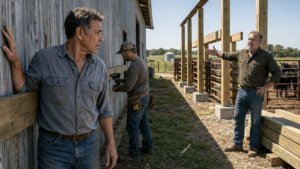
Brian put six unpaid invoices on the event-barn desk before Kevin had finished his coffee.
They were not small invoices.
Electrical work.
Kitchen equipment.
Roofing.
Portable restrooms from the previous season.
A final bill from the company that had installed fire doors and emergency lighting.
Brian sat across from him and turned a wall calendar around.
Nearly every Saturday through October had a name written inside the square.
Kevin did not read the names.
He saw deposits.
Deadlines.
Commitments.
Brian tapped September.
“The catering trucks were getting stuck trying to back around the old gravel.”
Kevin said, “That explains why you wanted a turnaround.”
“I know.”
“It doesn’t explain pouring onto my property.”
Brian looked tired.
The storm had left dried mud on both men’s boots.
“No,” he said. “It explains why I didn’t want to ask a question that might stop the job.”
The answer was plain enough that Kevin almost preferred an excuse.
Brian leaned back.
“I’d already moved the pour twice. First because of the electrical trench. Then because the contractor lost three days on another job. If I canceled Thursday, he couldn’t get back for at least a month.”
“So you saw the pin.”
“Yes.”
“And decided it was nothing.”
“I decided the old turnaround mattered more.”
Kevin’s expression changed.
Brian caught it.
“I know how that sounds.”
“It sounds exactly like what happened.”
Brian looked toward the barn doors.
“When I bought this place, everybody told me trucks had always turned there. Samuel told me. The previous owner told me. I watched your feed deliveries use the same arc.”
“They drove over grass.”
“Yes.”
“And I never stopped them.”
“No.”
Kevin looked at the invoices.
For years he had treated that strip as too unimportant to discuss.
A truck tire crossed it, the grass bent, then stood again.
Nothing permanent happened.
His silence had created a habit.
Brian had mistaken the habit for a right.
That did not excuse what he had done, but Kevin could no longer pretend the misunderstanding had appeared out of nowhere.
“I should’ve told you years ago where the line was,” Kevin said.
Brian looked surprised.
Kevin disliked the surprise.
“That does not mean you get the concrete.”
“I didn’t say it did.”
“I’m saying I let the ambiguity sit there because I didn’t want to be the man measuring tire tracks.”
Brian nodded slowly.
“And I used that.”
Kevin looked at him.
“Yes.”
The word settled between them.
Not shouted.
Not softened.
Used.
Brian folded his hands on the desk.
“What if I pay for an engineered drain?”
“The county hasn’t said that fixes it.”
“What if it does?”
“Then I’d listen.”
“But?”
“But the concrete is still on my land.”
Brian’s jaw worked.
“If I remove six feet off that side, I lose the turning radius.”
“Then the pad was designed wrong.”
“For my business, maybe not.”
“For the property, yes.”
Brian stood and walked to the window.
Outside, the concrete gleamed wet beneath clearing clouds.
“You know what happens if I lose two September events?”
“No.”
“I refund deposits. I lose the caterers who finally started recommending this place. I probably miss the payment on the new roof.”
Kevin said nothing.
Understanding was not the same thing as agreement.
Brian turned.
“I’m not asking you to donate land.”
“You offered to buy it yesterday.”
“I still will.”
“And if the drainage inspector says the swale needs to be open?”
“Then we put in pipe.”
“You keep looking for a way to make the slab stay.”
“Because tearing it out is not free.”
“Neither is water cutting my field entrance.”
Brian’s hands tightened.
Then he nodded.
“I saw that this morning.”
That admission mattered more than Kevin expected.
Not enough.
But something.
They walked outside.
The storm had left a brown stain along the concrete edge. Below it, the swale had been scoured clean in places, exposing dark soil beneath the grass.
Brian stopped there.
“I thought this was useless ground.”
“So did I.”
Brian looked at him.
Kevin gave a small shrug.
“Difference is I didn’t pour on it.”
For the first time in days, Brian almost smiled.
It vanished quickly.
A county vehicle turned into the lane before either man spoke again.
The drainage inspector stepped out with the land-use clerk.
The clerk carried a large envelope.
Brian’s face changed.
“That doesn’t look informal.”
It was not.
They met beside the pad.
The clerk explained that the county had completed its preliminary review. The new concrete crossed the surveyed parcel boundary. The work also altered a documented surface drainage path without an approved grading plan.
Brian asked the question Kevin had been waiting to hear.
“Are you ordering demolition?”
The clerk handed him the envelope.
“We’re issuing a correction notice.”
Brian opened it immediately.
Kevin watched his eyes move down the first page.
“What does ‘restoration plan’ mean?”
The inspector answered.
“It means the owner of the work needs to show how the encroaching portion will be removed or otherwise corrected and how the original drainage function will be restored.”
“I offered to buy the strip.”
“That’s between you and Mr. Walker. It doesn’t resolve the drainage issue by itself.”
Brian flipped to the second page.
“What if we install pipe?”
“You can submit an engineered alternative.”
“So removal isn’t automatic.”
The inspector chose his words carefully.
“Not at this stage. But leaving the site as it is isn’t an option.”
Kevin felt no triumph.
Brian was reading numbers now. Deadlines. Required submissions. Inspection language.
The practical consequences had finally reached him in a form no argument could dilute.
The clerk gave Kevin a copy.
He read it beneath the barn overhang.
The county was not demanding punishment.
It was demanding correction.
That distinction mattered.
By the time the officials left, Brian had folded the notice twice.
“You got what you wanted,” he said.
Kevin looked at him.
“No.”
Brian gestured toward the paper.
“Looks like it.”
“I wanted you not to pour over the line.”
Brian stared at him.
Kevin continued.
“That option is gone.”
A long silence followed.
Then Brian asked, “If an engineer can make the drainage work and I pay you fair value, will you sell?”
Kevin looked down the swale.
Yesterday he might have answered from anger.
Today the question was harder.
If the land could function properly with the slab, was ownership alone enough reason to make Brian tear it out?
Or would taking the money mean accepting the same logic that had created the problem—that ground mattered only when someone could price it?
Kevin folded his copy of the correction notice.
“I’ll tell you after I know what restoring it actually requires.”
Brian’s eyes narrowed.
“You’re still considering removal.”
“Yes.”
“Even if it costs me bookings.”
Kevin met his gaze.
“Yes.”
Brian looked back at the barn.
For the first time, Kevin could see exactly what the decision might cost him.
That made the choice heavier.
It did not make it disappear.
Chapter 6: Kevin Refused the Check and Chose the Ground
Brian placed the purchase offer on Kevin’s kitchen table at eight on Tuesday morning.
This time it was not a folded sheet from a pocket.
It was a typed proposal with a dollar figure, a parcel sketch, and a check clipped behind it.
Emily sat across from Kevin.
Brian remained standing.
Kevin looked at the number.
It was higher than the first offer.
High enough to buy replacement fencing for half the farm.
High enough to cover a difficult winter if hay prices fell.
Emily looked at him but said nothing.
Brian said, “That’s for the strip, survey costs, and the inconvenience.”
Kevin touched the edge of the check.
“You already have this much cash available?”
“It’s not all cash.”
“Then what is it?”
“A business line.”
Kevin pushed the papers back.
Brian did not take them.
“You haven’t even read the terms.”
“I read the number.”
“The drain engineer says we can handle runoff with an inlet and underground pipe.”
“Can.”
“Yes.”
“Not should.”
Brian exhaled.
“We’re back to that?”
“No.”
Kevin stood and walked to the counter.
A county restoration sketch lay beside his coffee mug.
Emily had spent most of the previous evening comparing it to the survey and old aerial photographs. One alternative stood out.
Not because it preserved Brian’s concrete.
Because it preserved access.
Kevin carried the sketch to the table.
“I’m not selling the strip.”
Brian’s face tightened.
Emily watched both men.
Kevin placed one finger on the drawing.
“But I’m not trying to shut your turnaround down either.”
Brian looked at the page.
The proposed route shifted the turning area uphill, away from the swale. It was narrower than Brian’s new pad and would need to remain gravel where it approached Kevin’s side.
Brian studied it.
“That radius is tight.”
“For a tractor trailer, yes.”
“For a catering box truck too.”
“Not if they enter straight.”
“They don’t.”
“Then change how they enter.”
Brian gave Kevin a hard look.
“You make everything sound simple when you don’t have customers arriving.”
Kevin felt the old irritation return.
He almost answered with the obvious line: You made your customers my problem.
Instead he sat down.
“I let your trucks use that corner for years.”
Brian said nothing.
“I knew some of them crossed the line. I didn’t care because it was grass and because you were a neighbor.”
Emily looked toward Kevin.
He continued.
“I figured if it ever mattered, we’d talk.”
Brian glanced at the check.
“And now it matters.”
“It mattered before. I just didn’t treat it like it did.”
Kevin turned the survey so the boundary line faced Brian.
“That’s on me.”
Brian’s expression softened, but Kevin raised a hand.
“Don’t confuse that with me taking responsibility for the pour.”
“I’m not.”
“I should’ve marked the line. I should’ve put our access understanding in writing. I didn’t because paperwork between neighbors felt unfriendly.”
Emily said quietly, “And now you have more paperwork than if you’d done it once.”
Kevin looked at her.
“Thank you.”
She smiled without apology.
Brian pulled out a chair.
“So what are you proposing?”
Kevin pointed to the alternative.
“Remove the portion over my line. Restore the swale to the county grade. Keep your legal pad. Then I give you written permission for a gravel turning apron here.”
Brian leaned over the sketch.
“How wide?”
“Enough for normal deliveries.”
“Define normal.”
“We define it together.”
Brian sat back.
“And if I sell the barn someday?”
“The agreement spells out whether it transfers.”
“You’ve thought about this.”
“Apparently I’m learning.”
Emily slid another sheet across the table.
A draft access agreement.
Brian looked from her to Kevin.
“You already wrote it?”
“Drafted it,” Emily said. “Nothing final.”
Brian read the first page.
Kevin watched him reach the clause requiring the swale to remain unobstructed.
He stopped.
“You really won’t pipe it?”
Kevin shook his head.
“Not unless some future engineer and the county both say that’s better for the land.”
Brian tapped the paper.
“This costs me more now.”
“Yes.”
“And gives me less pavement.”
“Yes.”
Brian looked toward the window.
From Kevin’s kitchen, the event barn roof was just visible beyond the trees.
“What do I get?”
“A route that nobody can argue about five years from now.”
Brian laughed once.
“Expensive lesson.”
“For both of us.”
That quieted him.
Later that morning they met the county inspector beside the boundary.
The inspector reviewed the proposed gravel turnaround and restoration plan.
He walked the swale twice.
“This works conceptually,” he said. “Final grade still has to be verified.”
Brian asked, “And I can keep the rest of the concrete?”
“If it’s entirely on your parcel and meets the other requirements.”
Brian looked at Kevin.
There was no gratitude in the look.
Kevin did not expect any.
This arrangement still required Brian to pay for demolition, hauling, grading, gravel, and another inspection. It would probably disrupt at least one event.
Fair did not mean painless.
The concrete contractor arrived after lunch to estimate the removal.
He paced the survey line and marked a saw cut in chalk.
Brian watched the line appear across the slab.
“That much?”
The contractor nodded.
“If you want a clean edge.”
Brian rubbed his forehead.
“What happens to the corner?”
“We break it, load it, grade the soil back.”
Kevin pointed toward the swale.
“That grade has to match the county plan.”
The contractor looked at Brian.
Brian said, “Yes.”
No argument.
No joke about Kevin becoming an inspector.
Just yes.
By late afternoon, they returned to Kevin’s kitchen.
The purchase offer still sat on the table.
Brian unclipped the check.
For one strange second Kevin wondered whether he would increase it again.
Instead Brian tore the offer in half.
“Thursday,” he said.
Kevin looked up.
“The crew can start Thursday morning.”
Emily pushed the removal authorization toward him.
Brian picked up the pen.
Before signing, he said, “If I do this, I need the gravel agreement finished before my next Saturday event.”
Kevin answered, “If the restoration passes inspection, we’ll finish it.”
Brian studied his face.
“No handshake version?”
Kevin looked at the survey, the county sketch, the access draft, and the torn purchase offer.
For years he had thought requiring paper meant expecting betrayal.
Now he understood the opposite could also be true.
Sometimes writing down an agreement was how two people stopped asking trust to carry more weight than it could bear.
“No handshake version,” Kevin said.
Brian signed.
The pen scratched across the page.
When he finished, he pushed the authorization toward Kevin.
Outside the window, the concrete remained intact beneath the afternoon sun.
But now there was a date for the jackhammer.
Chapter 7: The Jackhammer Stopped at the Survey Stake
The first blow landed six inches from the survey line.
Concrete shuddered beneath the jackhammer, and a white crack shot toward the wooden stake before stopping short of it.
Kevin stood beside the lower gate with both hands wrapped around a paper cup of coffee.
The equipment operator looked up.
“Still want the cut here?”
Kevin glanced at the chalk line crossing the pad.
The licensed surveyor had returned the afternoon before and marked the boundary again. This time there was nothing hidden about it. Bright stakes stood at both ends, and the chalk cut ran between them across the concrete Brian had poured only weeks earlier.
“Yes,” Kevin said. “Right there.”
The operator nodded and lowered his face shield.
The hammer started again.
Brian stood near the event barn with his arms folded.
He had not come over to Kevin’s side.
Kevin understood that.
The removal crew had arrived before seven. By seven-thirty, the first saw cut had separated the legal portion of Brian’s pad from the section extending across Kevin’s land.
Now the jackhammer was breaking the encroaching concrete into pieces small enough to load.
Each strike seemed louder in the open morning.
Emily had come down from the farm office long enough to watch the first section come free. She had said nothing about justice or being proved right.
She only looked at the survey stake and said, “At least nobody has to guess anymore.”
Then she went back to work.
Kevin was grateful for that.
He did not want an audience.
Two neighboring farmers slowed their pickups on the county road, saw the equipment, and continued on. One raised a hand. Kevin returned the gesture.
That was enough.
By nine, nearly half the disputed slab was gone.
Broken concrete filled the dump trailer in jagged gray pieces.
The removal exposed the compacted gravel base underneath.
The county drainage inspector arrived just as the crew began scraping it away.
He walked the exposed ground slowly, checking elevations against the restoration plan.
“Take another two inches off here,” he told the equipment operator.
The bucket peeled back a thin layer of crushed stone.
Dark soil appeared beneath it.
Then something Kevin had not expected became visible.
A shallow groove.
Not dramatic.
Not a ditch.
Just a broad depression running exactly where the old swale had disappeared beneath the pad.
The inspector pointed.
“There it is.”
Kevin stepped closer.
Years of water had shaped the land more clearly than he had ever noticed from above.
The groove curved gently toward the lower field.
Brian came across the lane.
For several seconds, the two men stood over it.
Brian said, “That’s what we covered.”
Kevin nodded.
Neither of them added anything.
There was no need.
The ground had answered them.
The crew continued removing gravel until the original grade could be rebuilt.
Topsoil arrived before noon.
The equipment operator spread it in thin passes, working from the upper pasture toward the field entrance. The inspector checked elevations twice before allowing him to continue.
Brian stayed nearby.
At one point, he walked to the legal edge of his remaining concrete.
Without the encroaching section, the pad looked smaller.
Not ruined.
But smaller.
The outer edge now ended almost exactly where the surveyor had said it always should have.
Brian ran the toe of his boot along the saw cut.
Kevin approached.
“You lose the Saturday event?”
Brian shook his head.
“Moved deliveries to Friday morning. Told the caterer to use the upper entrance.”
“That work?”
“We’ll find out.”
Kevin looked toward the gravel area marked for the future turning apron.
“You’ll have that once inspection clears.”
Brian nodded.
After a moment he said, “I still think a pipe could’ve worked.”
Kevin almost smiled.
“I know.”
Brian looked at him.
“And I still think you could’ve told me ten years ago those trucks were using your side.”
Kevin took a sip of coffee.
“I know that too.”
Brian seemed surprised by the answer.
Kevin looked toward the restored ground.
“I kept thinking being easy to get along with meant not making things formal.”
Brian said nothing.
Kevin continued.
“Turns out all I did was leave both of us room to believe different things.”
Brian looked toward the barn.
“You planning to put signs up now?”
“No.”
“Fence?”
“Not there.”
“Then what?”
Kevin nodded toward the folder Emily had left in his truck.
“Paper.”
Brian gave a tired laugh.
“Never thought I’d hear you say that.”
“Neither did I.”
By afternoon, the restoration had begun to look less like excavation and more like land again.
Seed and straw covered the upper portion of the swale. The lower section remained bare because the inspector wanted to see how it handled water before final approval.
The gravel turning apron was roughed in uphill, safely away from the channel.
Brian walked its curve with the concrete contractor.
They argued quietly over whether a box truck could make the turn without backing.
Kevin stayed out of it.
The exact geometry belonged to Brian now, provided it stayed inside the written limits.
That difference mattered.
At three, the inspector called Kevin and Brian over.
He stood where the swale met the lower field.
“The grade is back where it needs to be.”
Brian asked, “So we’re done?”
“Construction-wise, almost. I want one runoff event before I close it out.”
Brian looked toward the clear sky.
“You ordering rain?”
The inspector smiled.
“Not in my department.”
Two days later, a short afternoon storm moved across the county.
Nothing like the heavy rain that had cut the lane.
Just enough.
Kevin was in the equipment shed when Emily called from outside.
“Dad.”
Something in her voice made him put down the wrench.
He walked toward the entrance.
Rain tapped lightly against the metal roof.
Emily stood near the gate looking uphill.
Kevin followed her gaze.
Water moved through the grass.
It entered the restored swale above the old concrete line, slipped past the edge of Brian’s remaining pad, and continued downward through the shallow depression.
No pooling.
No muddy sheet crossing the lane.
No water cutting toward the fence corner.
The swale simply carried it.
Brian appeared on the other side.
He watched the same narrow current.
After a moment he walked over.
Kevin said, “Looks like it remembers where to go.”
Brian looked down.
“Ground usually does.”
They stood together without speaking.
The following Monday, Emily brought the final access agreement to Kevin’s kitchen.
Brian arrived after lunch.
The document gave his event business permission to use the new gravel turning apron under specific conditions. The swale had to remain open. No permanent structures could cross the boundary. Maintenance responsibilities were written plainly.
Brian read every page.
Kevin waited.
At the signature line, Brian stopped.
“You know this is a lot less convenient than the old setup.”
“Yes.”
“And probably better.”
Kevin raised an eyebrow.
Brian signed.
Kevin signed after him.
No handshake was required, but when Kevin closed the folder Brian held out his hand anyway.
Kevin looked at it once, then took it.
The grip was brief.
Not reconciliation in the way people liked to imagine it.
No apology erased the concrete.
No piece of paper restored the easy assumptions they had once carried about each other.
But the next delivery truck that came to Brian’s barn followed the gravel apron.
Its rear wheels stayed clear of the swale.
Kevin watched from the hayfield as the truck completed the turn and headed back toward the road.
Near the grass, the rust-dark survey pin remained visible.
Kevin had cleared a small circle around it.
He intended to keep it that way.
A few yards below, water from the previous evening’s rain still darkened the bottom of the swale.
For years Kevin had thought of that strip as ground too ordinary to matter.
Then Brian had covered it.
The survey had named its owner.
The storm had revealed its purpose.
And Kevin had finally learned that protecting a boundary did not require building a wall around every relationship.
Sometimes it meant knowing exactly where one thing ended, where another began, and being willing to write it down before either man had to learn the difference with a jackhammer.
The story has ended.