The Blue Herbicide In The Heritage Oak And The Drilled Trunk
CHAPTER 1: THE TURQUOISE POOL AND THE SHADOWED TRUNK
The warm Georgia sun filtered down through the sprawling, cathedral-like canopy of the ancient white oak, casting dapples of golden light across the manicured boundary lawn of Whispering Oaks. At sixty-seven years old, Thomas ‘Tom’ Holloway knew the anatomy of every tree on his four-acre homestead better than he knew the faces of most county politicians. He stood with his calloused hands resting lightly on the rough, ridged bark of the massive oak that had anchored his family’s property since his great-grandfather planted it as a sapling in the spring of 1890. The trunk was colossal, measuring over five feet in diameter, its massive limbs extending eighty feet into the sky like the outstretched arms of a benevolent giant.
Tom was a retired senior research forester for the Georgia Forestry Commission and a decorated combat veteran of the Vietnam War. For forty years, he had surveyed timber bluffs across the Chattahoochee River basin, battled Southern pine beetle infestations, and calculated timber yield metrics. He lived alone in the brick craftsman home his father had built, surrounded by old-growth hickory, native dogwood, and sweetgum. He valued silence, honest labor, and the sacred permanence of the living forest. What he could not abide was the reckless arrogance of people who believed money gave them the right to butcher living monuments.
‘Cut it down, Thomas! I don’t want to hear another word about history or heritage! That tree is dropping leaves and acorns into my infinity pool, and it is coming down this week!’
The grating voice echoed over the cedar privacy fence that separated Tom’s land from the newly constructed estate next door. Striding across her flagstone patio was Karen Sterling-Price. At fifty-four, Karen was the architectural review director for the Whispering Oaks Homeowners Association. She was married to a regional luxury pool and outdoor living contractor, and she carried herself with the sharp, vindictive entitlement of someone accustomed to using association bylaws as an offensive weapon. She wore expensive designer linen resort wear, oversized designer sunglasses, and pointed an accusatory finger toward the overhanging oak boughs that shaded her turquoise swimming pool.
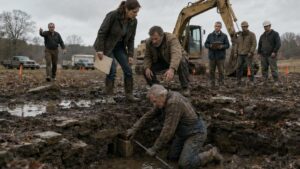
Beside her, kneeling near the root flare of the great tree, was Dr. Sarah Chen. Sarah was forty-one, dressed in the dark olive field jacket, heavy denim trousers, and steel-toed boots of the Cobb County Tree Preservation and Forestry Commission. Under her arm, she carried an aluminum field clipboard, a digital acoustic hammer for testing internal trunk rot, and an increment borer. Sarah had spent fifteen years evaluating heritage timber across northern Georgia, and her clinical assessments were respected by every municipal court in the state.
‘Mrs. Sterling-Price, please step back onto your patio and allow me to conduct this inspection without interruption,’ Dr. Chen said, her tone cool, level, and professional. ‘Under Cobb County Heritage Tree Protection Ordinance Section 114, any native hardwood exceeding forty inches in diameter at breast height is classified as a protected heritage specimen. A certified municipal arborist must confirm irreversible structural failure or terminal biological disease before any removal permit can even be reviewed by the zoning board.’
‘Look at my water, Sarah!’ Karen shrieked, gesturing frantically toward her pristine swimming pool, where half a dozen golden oak leaves floated on the shimmering surface. ‘Those leaves are clogging my automated filtration skimmers! The tannin from the acorns is staining my imported French limestone coping! My husband spent two hundred and twenty thousand dollars installing this pool complex, and this decrepit weed is ruining our investment! It is an active residential nuisance!’
Tom looked down at the root flare, his sharp forester’s eyes catching something unusual in the dark pine mulch at the base of the trunk. ‘Sarah,’ Tom said quietly, his voice dropping into a low, dangerous register, ‘take a look at the lower bark right here on the northern quadrant.’
Dr. Chen shifted her position, kneeling in the soft mulch. She pulled a brass inspection scraper from her pocket and brushed away a loose layer of pine needles. Her breath caught in her throat.
Directly into the living sapwood of the tree’s root flare, three clean, circular half-inch holes had been drilled. The holes were bored at a steep downward forty-five-degree angle, penetrating four inches deep through the protective cork cambium into the active vascular xylem vessels. Fresh, sticky amber sap was weeping from the wounds, running down the bark in thick, glistening ribbons. But it was not just sap.
Packed tightly into each drilled cavity were dozens of bright, brilliant blue crystalline pellets. As the natural sap dissolved the pellets, an unnatural, electric-blue chemical sludge was oozing from the holes, soaking the surrounding mulch and turning the soil an ominous shade of cyan.
Dr. Chen gently inserted a stainless steel probe into the second drill hole, noting the angle of inclination on her digital inclinometer. ‘Forty-five degrees downward, directly intersecting the primary vascular transport ring,’ Sarah murmured, shaking her head in clinical dismay. ‘The person who drilled this knew exactly what they were doing. They targeted the tension wood on the compression side of the tree, maximizing chemical uptake while systematically undermining the structural integrity of the main trunk.’
Dr. Chen leaned closer, wafting the air above the holes with her hand. Her eyes narrowed into slits of cold fury. ‘Hold up. These drill holes are completely fresh. The wood shavings around the rim haven’t even oxidized.’
Tom’s jaw clenched with such force that the muscles in his weathered cheek jumped. ‘That’s industrial-grade copper sulfate herbicide mixed with triclopyr. Someone intentionally bored into the vascular cambium to pump poison straight into the tree’s water column.’
Tom pulled a small brass magnifying loop from his pocket, inspecting the fine wood fibers clinging to the cork cambium. ‘A white oak’s outer bark is built from dead suberized cells that insulate the inner living tissue,’ Tom explained to Sarah, his voice trembling with anger. ‘The xylem vessels directly beneath this layer transport thousands of gallons of nutrient-rich groundwater from the deep roots to the leaves under immense negative pressure. When someone injects a water-soluble systemic chemical directly into the xylem during peak transpiration hours, the tree literally drinks its own poison within minutes. This wasn’t an accident. This was a cold, calculated assassination of a two-hundred-year-old living organism.’
Tom turned slowly, his eyes locking onto Karen Sterling-Price. Karen had stepped backward, her hands instinctively darting behind her back.
‘Who drilled them, Karen?’ Tom asked, his voice steady, quiet, and deadly serious.
Karen’s face flushed a violent, blotchy red. ‘How should I know?! You probably drilled them yourself to stage some pathetic drama and frame the association!’
Dr. Chen stood up to her full height, her gaze dropping to Karen’s waistline. Tucked into the side pocket of Karen’s linen jacket were a pair of heavy, suede-palmed leather gardening gloves. Sticking out of the pocket, clearly visible in the bright Georgia sunshine, the fingertips of the suede gloves were caked in fresh, pale yellow oak wood shavings and stained with bright, powdery blue chemical dust.
‘Karen,’ Dr. Chen said, her voice dropping into icy official authority, ‘take your hands out of your pockets. Why are your gardening gloves coated in fresh oak sawdust and blue copper herbicide?’
Karen gasped, stumbling backward against the fence gate, her eyes darting frantically toward her house as Tom pulled his radio from his belt.
‘Don’t move, Karen,’ Tom said, dialing the emergency forestry line. ‘Because poisoning a registered heritage oak tree in the state of Georgia is a class-three felony. And looking at this bark, you’ve got about twenty minutes before this poison shuts down the entire root system.’