The Blue Herbicide In The Heritage Oak And The Drilled Trunk
CHAPTER 2: THE MACRO-INFUSION EMERGENCY
The high-pitched whine of a diesel engine echoed up the winding driveway as a heavy-duty Dodge Ram 3500 utility truck pulling a tandem-axle forestry trailer roared to a halt beside Tom’s barn. On the side of the truck was the bold green emblem: HOLLOWAY ARBORICULTURAL PRESERVATION & CANOPY RESCUE.
Out of the driver’s seat stepped Tom’s thirty-five-year-old son, Jason Holloway. Jason was a certified master arborist, an ISA board-certified master climber, and one of the foremost vascular tree-trauma specialists in the Southeast. He wore high-visibility climbing trousers, reinforced work boots, and carried a pair of heavy aluminum medical-grade infusion cases.
‘Dad! Dr. Chen!’ Jason called out, sprinting across the lawn with an urgency usually reserved for paramedics arriving at a cardiac arrest. ‘I heard the emergency radio dispatch. How deep are the drill wounds?’
‘Three holes, half-inch diameter, four inches deep into the xylem,’ Dr. Chen reported, stepping aside to give Jason room. ‘They used high-concentration copper sulfate crystals combined with an ester-form triclopyr surfactant. The vascular uptake has already started. Look at the leaves on the lower eastern bough—they’re starting to cup and chlorose.’
Jason dropped to his knees, shining a high-powered inspection light into the drilled cavities. He pulled a specialized brass extraction syringe from his medical kit, carefully vacuuming out the undissolved blue chemical pellets into an airtight glass biohazard container.
‘The vascular pressure in a white oak this size pulls hundreds of gallons of water upward to the canopy every single day,’ Jason explained, his hands moving with surgical speed and precision. ‘Triclopyr acts as a synthetic auxin overdose. It forces the plant cells to divide uncontrollably until the vascular cambium ruptures from the inside out, cutting off all water transport within seventy-two hours. If we don’t counter-infuse this trunk immediately, this two-hundred-year-old tree will be completely dead by Friday.’
Jason opened his aluminum cases, unpacking a closed-circuit macro-infusion apparatus. The system consisted of twelve pressurized glass infusion bottles filled with a dark, proprietary solution of pharmaceutical-grade activated charcoal slurry, fulvic acid, and chemical chelating agents designed to bind and neutralize heavy metal ions in tree sap.
Using a specialized, low-speed variable drill fitted with a razor-sharp, surgical brad-point bit, Jason bored eight small, five-sixteenths-inch micro-ports around the circumference of the trunk, two inches below the poisoned drill holes. He tapped specialized plastic infusion tees into the sapwood with a rubber mallet and connected the manifold of high-pressure silicone tubing.
‘Pressurizing the manifold to fifteen PSI,’ Jason said, pumping the hand gauge. ‘The activated charcoal will bind the free triclopyr molecules before they can translocate past the lower scaffold limbs, while the chelating solution neutralizes the copper sulfate.’
While the dark antidote began pulsing slowly into the tree’s living vascular veins, Tom walked fifty feet down the boundary line toward the rear corner of Karen’s infinity pool. A newly poured concrete retaining wall stood barely two feet from the property line.
Jason checked the pressure valves on the fourth infusion bottle, monitoring the absorption rate of the activated charcoal. ‘The cellular structure of white oak is unique because it forms tyloses—balloon-like outgrowths that plug vascular vessels when the plant is wounded,’ Jason observed, pointing to the dark sapwood. ‘If the tree can seal off the infected channels before the poison reaches the main crown, the living canopy will survive. But with three major holes drilled at four-inch depths, the chemical bypassed the natural barrier zones. Every minute we spend waiting is another hundred linear feet of vascular tissue destroyed by synthetic hormones.’
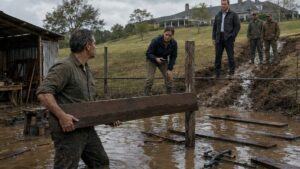
Tom bent down, his forester’s intuition drawing him to a freshly excavated trench behind the concrete footing. Exposed at the bottom of the muddy trench was a massive, severed wooden limb sticking out from the red clay.
‘Jason, Sarah, come look at this footing,’ Tom called out, his voice shaking with restrained fury.
Jason and Dr. Chen hurried over, looking down into the trench. A massive, twelve-inch-thick primary lateral anchor root of the heritage oak had been brutally severed by a commercial excavator bucket, its shredded wood fibers left exposed to rot in the mud.
‘That root represents thirty percent of this tree’s structural anchorage against westerly wind loads,’ Dr. Chen said, her face pale. ‘Under the county tree ordinance, the critical root zone of an eighty-foot oak extends fifty feet in all directions. Karen’s husband poured this pool wall right through the structural anchor zone, three feet inside your surveyed property boundary.’
Jason stood up, wiping clay from his fingers, his jaw set in stone. ‘She didn’t just try to poison the tree, Dad. When they severed this major root during pool excavation, they realized the oak was going to show crown decline from their construction damage. She drilled and poisoned the trunk so she could claim the tree died of natural disease before the county inspectors noticed their illegal root trench.’