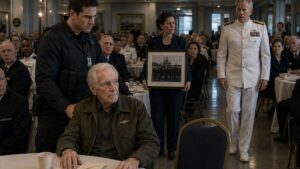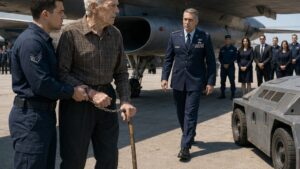
The General They Made Wait Outside the Hangar Learned Which Name Still Mattered
Chapter 1: The Woman at the Hangar Door
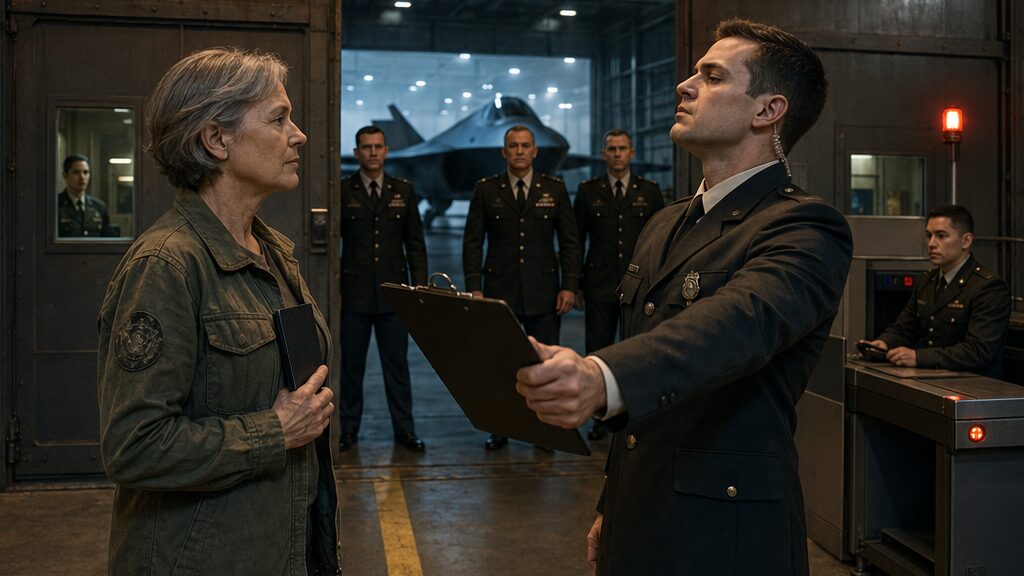
The security door buzzed red before Catherine Davis reached the yellow line.
A young man in a pressed uniform jacket stepped out from behind the checkpoint desk and planted himself between her and the sealed entrance to Hangar Four. Behind him, through a narrow armored window, the black nose of a next-generation aircraft sat under white lights like something waiting to wake.
“Stop,” he said, one palm lifted. “You’re out of uniform regulations. I cannot let you onto the parade ground.”
Catherine looked at the palm first, then at the man’s badge.
John Lewis.
The badge was polished. The jacket was lint-free. His clipboard was tucked under one arm as though it had rank of its own.
“I’m not here for the parade ground,” Catherine said.
Her voice carried almost no force. It did not need to. It was level, dry, and quiet enough that the two security personnel near the scanner glanced over as if silence had become louder than the hangar machinery.
John’s eyes moved over her faded veteran’s jacket, plain dark trousers, and practical shoes. There were no visible stars, no shining collar pins, no aide trailing her, no staff car idling at the curb. The jacket had been patched at one cuff with thread that did not quite match. The left breast carried an old unit patch so faded its edges had gone soft.
“You’re not cleared to pass this point,” John said.
Catherine held up a slim black folder. “My identification.”
He glanced at the folder the way a person glanced at a delay, not a document. His hand did not reach for it.
“All non-uniformed visitors need to process at the station.” He pointed with the clipboard toward a standing table under a sign marked TEMPORARY ACCESS REVIEW. “Fill out a form and wait.”
A hydraulic hiss rolled from somewhere inside the hangar. The locked door stayed red.
Catherine lowered the folder by an inch. “I’m expected inside.”
“Everyone says that.”
“Not everyone is expected inside this hangar.”
John’s mouth tightened. It was not quite a smile. “Ma’am, this is a restricted aerospace readiness facility. I don’t care what office sent you, what tour group lost you, or what reunion event you think you’re here for. You cannot walk through my checkpoint dressed like that.”
One of the security personnel at the scanner looked down at the counter too quickly. Catherine noticed. She noticed the warning lights above the door cycling amber-red. She noticed the camera mounted in the corner, angled more toward uniforms than faces. She noticed John’s right thumb pressing against the metal clip of his board, bending and releasing it with small bright clicks.
She had spent forty years learning what nervous authority sounded like.
“I’m not asking to walk through without verification,” she said. “I’m asking you to verify.”
John exhaled through his nose. “And I’m telling you the process.”
Catherine held the folder out farther.
John did not take it.
A transport cart rolled past behind her, slowing just enough for its driver to see the exchange. Two contractors in gray coveralls paused near a stack of sealed crates marked with barcodes and hazard symbols. Public embarrassment did not always need a crowd. Sometimes it needed only three witnesses pretending not to watch.
Catherine shifted the folder to her left hand.
“Your name?” John asked, as though doing her a favor.
“Catherine Davis.”
He clicked his pen. “Affiliation?”
Catherine looked past him at the narrow slice of aircraft visible beyond the armored window. Its surface absorbed the hangar light instead of reflecting it. No one had given that machine a public name yet. Men and women inside that building had lost sleep over a dozen systems she was expected to review before noon.
“United States Army,” she said.
John looked back at her jacket. “Retired?”
“Not today.”
The pen stopped.
For one second, something uncertain moved through his expression. Then his eyes dropped again to the faded cuff, the unmarked collar, the absence of visible rank. His face closed around the uncertainty.
“Current personnel are required to appear in appropriate uniform for ceremonial movement across the parade-ground access route,” he said. The words had the sound of something recently memorized. “You’re out of uniform regulations. I cannot let you onto the parade ground.”
“As I said, I’m not here for the parade ground.”
“You would have to cross its controlled edge to reach this entrance.”
“I have crossed more controlled edges than that.”
John’s pen tapped once against the clipboard.
“Ma’am,” he said, and now the word had sharpened, “this is exactly why we use procedure. People come here thinking past service gives them permission to bypass current regulations. It doesn’t.”
Catherine studied him. He was younger than she had first thought. Late twenties, perhaps. His face still held the soft strain of someone trying to look older under fluorescent light. His haircut was exact. His boots were perfect. The pocket of his jacket carried a folded memo with a red tab protruding from the edge. He had prepared for inspection. He had not prepared for judgment.
“I am not asking to bypass anything,” she said again.
“Then fill out the form.”
This time he turned his body toward the clipboard station and waited, expecting her to follow.
Catherine did not move.
The red light above the hangar door pulsed steadily. Somewhere beyond it, officers would be checking watches without making a show of it. She could imagine the room: tablets awake, coffee cooling, seats arranged with perfect spacing, everyone pretending not to wonder why the morning’s principal review had not begun.
John looked back. “Is there a problem?”
“Yes,” Catherine said.
His eyebrows lifted.
“You haven’t checked my name.”
“I asked for your name.”
“That isn’t the same thing.”
The scanner guard’s eyes flicked up again.
John’s face warmed, not quite red, but close. “I have a line of responsibility here.”
“So do I.”
“You are delaying the checkpoint.”
Catherine glanced around. There was no line behind her, only the cart driver still pretending to adjust something on his display.
“I appear to be the only person at your checkpoint,” she said.
John’s jaw tightened.
For the first time, Catherine saw the decision form behind his eyes. He could step back and examine the folder. He could call inside. He could ask why a woman who did not fidget, plead, or bluff was standing at a restricted hangar with a classified-access folder in her hand.
Instead, he turned to the small terminal on the desk.
“Name given,” he muttered as he typed. “Catherine Davis. Civilian presentation. Noncompliant attire. Access refused pending temporary review.”
Catherine’s gaze dropped to the screen.
“Civilian presentation?” she asked.
“That is what you are presenting.”
“No,” she said. “That is what you are assuming.”
He clicked a dropdown menu. “Civilian risk waiting outside restricted zone.”
The words appeared in the box.
Catherine felt, not anger exactly, but the old pressure of a door being closed by someone who had not looked at the orders. It pressed against a memory she kept folded away: a younger version of herself outside another guarded room, hearing a man laugh because he had mistaken her assignment for a clerical error.
She had promised herself then never to beg for recognition.
She had also promised never to let lazy authority go uncorrected.
John printed a temporary holding slip and tore it from the machine. “Stand by the clipboard station, please.”
Catherine did not take the slip.
“John Lewis,” she said.
His eyes moved sharply to hers.
She nodded once toward his badge. “That is your name?”
His shoulders squared. “Yes, ma’am.”
“Are you sure you want the delay logged under your name?”
For the first time since stepping in front of her, John did not answer immediately. The hangar door hummed behind him, locked and red, while Catherine stood on the wrong side of it with her black folder still unopened in her hand.
Chapter 2: Fill Out the Form and Wait
John slid the form across the standing table with two fingers, as though the paper itself could push Catherine farther from the hangar.
“Print clearly,” he said. “No abbreviations. No blank fields.”
Catherine looked down at the form. It was a generic visitor access sheet, the kind used for repair contractors, visiting vendors, and relatives confused about base ceremonies. The top line asked for name. The second asked for organization. The third asked for rank or title, if applicable.
John placed a pen beside it.
The pen rolled once before Catherine stopped it with her fingertip.
Behind the checkpoint glass, a warning light continued its patient red blink. Beyond that, the hangar swallowed sound and gave back only fragments: a tool cabinet closing, the muffled grind of machinery, the distant clip of boots on polished concrete.
John returned to his terminal. He did not sit. He wanted height. He wanted posture. He wanted the two security personnel and the cart driver and the contractors to see a man enforcing procedure.
Catherine wrote her name.
Catherine Davis.
She wrote United States Army beneath organization.
Then she left the rank line empty.
John noticed before the ink fully dried. “You skipped a field.”
“No,” Catherine said. “I left it blank.”
“It says rank or title.”
“It says if applicable.”
His mouth tightened again. “Rank is applicable to Army personnel.”
“Not to your decision, apparently.”
The scanner guard coughed into one fist. John turned his head just enough for the guard to become very interested in the ID scanner.
“Ma’am,” John said, lower now, “you are making this more difficult than it needs to be.”
“I thought that was your job.”
He took the form before she could add anything else. His eyes moved down the page. They stopped on the empty line, then on her old jacket, then on the empty line again.
Inside the hangar operations room, Melissa Walker stood beside a wall display that showed the morning’s schedule in clean blocks of blue and white. Every block had shifted by five minutes, then ten. Nobody had changed the official start time yet. That would have meant admitting the morning was no longer on time.
Jonathan Roberts stood at the head of the long table, one hand resting beside a closed tablet. He had the stillness of a man who preferred delays to have explanations before they reached him.
“Status?” he asked.
Melissa checked the arrivals list for the third time.
“Engineering team seated. Flight systems seated. Security liaison present. Sergeant Major White is en route from the command building.” She hesitated. “The principal reviewer has not checked in.”
Jonathan looked up.
No one at the table moved, but the room tightened.
“Not checked in,” he repeated.
“No, sir.”
“Was the arrival route confirmed?”
“Yes, sir. Restricted hangar entrance, east side.”
“Then find out why my meeting is waiting on an empty chair.”
Melissa nodded and turned to the side console.
Outside, John stamped Catherine’s form with a temporary hold mark hard enough to leave a purple edge around the box.
“You’ll wait here while this is reviewed.”
“By whom?”
“Access control.”
“Is that you?”
“I initiate the review.”
“That is not what I asked.”
John’s eyes narrowed. For a moment, his confidence thinned into irritation. “I was assigned this checkpoint because people got sloppy with exceptions. Last month a senior officer walked a civilian contractor through the side access without a completed form. Guess whose desk that landed on.”
Catherine said nothing.
John seemed to hear himself after the fact. His expression closed again.
“Procedure exists because people with more rank than patience create problems and leave junior staff to answer for them,” he said.
There it was, Catherine thought. Not the whole man, but enough of him to explain the shape of his mistake.
“Then you understand why names matter,” she said.
“I understand paperwork matters.”
“No. Paperwork records judgment. It does not replace it.”
John clipped her form to his board. “You can wait.”
The terminal behind him chimed. He glanced at it, typed, then touched the radio at his shoulder.
“Checkpoint east to hangar access,” he said. “Temporary visitor issue at exterior control point. Noncompliant individual, claims Army affiliation, no visible rank, refusing to complete rank field. Holding at station.”
Catherine’s eyes lifted.
Claims.
The word moved through the air more heavily than the rest.
John looked at her as he spoke, perhaps expecting a reaction. Catherine gave him none.
The radio crackled, then a voice answered from inside. “East checkpoint, repeat name of individual.”
John looked at the form as if annoyed by the interruption.
“Catherine Davis,” he said.
There was a pause.
Melissa stood at the operations console with the handset half lifted, staring at her screen. On the restricted arrival list, one line had been entered differently from the rest. No rank. No title. No visible office code. Just a name, a time, and a special handling note locked behind a clearance tag she could not open from her station.
Catherine Davis.
Melissa clicked the name. A warning box appeared.
ACCESS AUTHORITY: RESTRICTED
CONTACT COMMAND CHANNEL
Her throat went dry.
“East checkpoint,” she said into the handset, careful not to let her voice jump. “Can you verify spelling?”
John rolled his eyes toward the ceiling. “D-A-V-I-S. Catherine. Like the form says.”
Melissa looked toward Jonathan. He was speaking quietly with a systems officer and had not seen her face change.
“Is she carrying identification?” Melissa asked.
John pressed the transmit button too hard. “She has a folder. She is out of uniform regulations and cannot access the parade-ground route. I have initiated visitor review.”
Melissa stared at the warning box.
Not denied.
Not visitor.
Contact command channel.
She swallowed. “Do not finalize classification yet.”
John’s brows drew together. “Say again?”
“Do not finalize classification.”
Outside, Catherine watched the first real crack appear in John’s certainty.
Then he looked at her blank rank field again, at the faded jacket, at the old shoes planted neatly on the concrete, and the crack sealed itself.
“Understood,” he said into the radio, though his tone said the opposite. “Pending review.”
He released the button and entered another note into the terminal.
CIVILIAN RISK DELAYING CONTROLLED ACCESS NEAR PARADE-GROUND ROUTE.
Catherine saw every word.
“Careful,” she said quietly.
John did not look up. “That is what I’m being.”
“No,” she said. “That is what you’re performing.”
He stopped typing.
Inside the hangar, Melissa opened the restricted arrival list again, hoping the screen would explain itself. The name remained alone, without rank, more powerful for its silence than all the titles around it.
Catherine Davis.
No rank beside it.
No mistake she could see.
And suddenly Melissa understood enough to freeze.
Chapter 3: The Name Without a Rank
The meeting could not begin because the empty chair at the head of the table had no nameplate.
That was the first thing Melissa noticed after the delay became impossible to hide. Every other seat had a printed card placed with surgical precision: systems, command, security, readiness, evaluation. The chair at the head had only a leather folder lying closed before it, as if the room itself had been told to wait for someone too important to label.
Jonathan Roberts checked his watch.
The sound of his thumb brushing the metal rim seemed louder than the ventilation system.
“Melissa,” he said.
“Yes, sir.”
“Where is my reviewer?”
The word my did not belong there, and Melissa knew it. The chair did not belong to Jonathan’s reviewer. The aircraft did not belong to his demonstration. The morning did not belong to the base commander, no matter how polished the hangar looked.
“I’m checking the access channel now,” she said.
“Check faster.”
She turned back to the console. The restricted list still showed the same line.
Catherine Davis. Arrival confirmed at east perimeter. No rank field. Special handling.
Melissa opened the message thread attached to the morning’s route plan. Most of it was ordinary: access windows, aircraft shielding schedule, approved personnel lanes, parade-ground restrictions due to a noon ceremony. Then she found the line she had skimmed the night before because it looked like administrative preference.
Principal reviewer requests no escort at exterior arrival. Plain entry. Verify by name through command channel if challenged.
Melissa read it twice.
Her stomach dropped.
Outside, Catherine stood beside the clipboard station while John took a call through his desk handset. He spoke with his shoulders squared and his voice pitched slightly louder than necessary.
“Yes, the individual is still here. No, she has not produced appropriate uniform compliance. She wrote Army but left rank blank.” He listened, jaw tight. “Because current movement guidance requires visible compliance for personnel crossing the parade-ground edge.”
Catherine’s eyes moved to the folder in his hand. Her folder. He had finally taken it, but he held it upside down, pinched between thumb and forefinger as if it were evidence he preferred not to examine.
The old unit patch on her jacket caught a strip of light. One of the security personnel at the scanner saw it and went still. Not dramatic. Not enough for John to notice. Just a pause, a flicker of recognition, then the careful blankness of someone deciding silence was safer than involvement.
Catherine saw that too.
John ended the call and set her folder on the desk unopened.
“Access control agrees you need to remain here pending clarification.”
“Did access control read my name?”
“They read the situation.”
“That is often where people begin to fail.”
His eyes snapped up. “You know, I have been patient.”
Catherine almost smiled. “Have you?”
“I don’t care how many years you served. I don’t care what office you used to walk into. Today, at this checkpoint, I am responsible for that door.”
“Yes,” Catherine said. “You are.”
The agreement seemed to throw him off more than argument would have.
His radio crackled.
“East checkpoint, operations. Verify whether the individual’s ID folder has been opened.”
John’s hand moved toward the folder. Then stopped.
Catherine watched the calculation pass across his face. If he opened it now because someone inside asked, it would look as if he had not already done so. If he did not open it, he would have to explain why.
He picked it up.
Upside down.
Catherine’s phone was in her jacket pocket. Her fingers found it without looking. She could end this now. One call, perhaps two sentences. The door would open; John would pale; Jonathan would come quickly; Andrew White would make enough noise to rattle the glass.
She had never enjoyed that kind of theater.
But she had used it when necessary.
John flipped the folder clumsily, still talking into the radio. “Opening now.”
“Read the name exactly as printed,” Melissa said through the speaker.
John opened the first flap.
He did not look at the credentials first. His eyes caught on the old photograph clipped to the inside sleeve: Catherine younger by thirty years, standing in desert light with a small team whose faces had been blurred in the copy. Her posture had not changed much. Neither had her eyes.
For a second, John looked from the photograph to her.
Catherine waited.
The scanner guard took one step closer, pretending to adjust a cable.
John’s gaze moved toward the credential page. Then a warning tone sounded from the terminal behind him. He turned too quickly, letting the folder tilt. A message had appeared on his screen.
VERIFY ALL NAMES BEFORE STATUS CLASSIFICATION. DO NOT RELY ON VISUAL RANK INDICATORS.
It had come from operations.
John’s face hardened.
He pressed the radio button. “Operations, east checkpoint. If you’re referring to the current visitor, I have already advised she lacks visible rank and uniform compliance.”
Melissa closed her eyes for one half second.
In the operations room, Jonathan had come to stand behind her. “What visitor?”
Melissa lowered the handset. “Sir, the person at east checkpoint gave the name Catherine Davis.”
Jonathan did not react at first.
Then the color changed around his mouth.
“Say that again.”
“Catherine Davis.”
The systems officer nearest the table stopped arranging cables. Two senior staff members turned in their chairs.
Jonathan reached past Melissa and took the handset himself.
“East checkpoint,” he said, voice clipped. “This is Roberts. You will verify the individual’s credentials by name immediately.”
Outside, John’s spine straightened at the base commander’s voice.
“Yes, sir. I am verifying now.”
Catherine watched him look down at the folder again.
This time his eyes found the printed name.
CATHERINE DAVIS.
Below it were clearance markings that had no decorative value and no ambiguity. His eyes moved over them too fast, then back up, searching for the rank line he wanted. There was none visible on the front page. Only name. Access authority. Command channel.
He frowned, as if the document had refused to cooperate.
“Sir,” John said into the radio, “the document is nonstandard. It does not display a conventional rank field on the first page.”
Jonathan’s voice sharpened. “Then use the name.”
John glanced at Catherine.
She stood where he had told her to stand, hands relaxed, expression unchanged. Around them, the small audience had grown by accident: a contractor with a crate scanner, the cart driver, two security personnel, and a maintenance technician who had stopped halfway through removing his gloves.
John felt them watching. Catherine could see the moment pride became a locked door.
“Sir,” John said, “with respect, she is not dressed for authorized movement. Not dressed like that, she’s not.”
The words carried beyond the radio. They carried across the checkpoint. They reached the maintenance technician, the scanner guard, the driver, Catherine.
The silence afterward was immediate and clean.
Catherine looked at John for a long moment.
There had been a chance. A small one, but real.
She drew the phone from her pocket.
John finally opened the folder wider, but in his haste he turned it upside down again. The credential page faced Catherine now, her own name inverted between them.
Her thumb hovered over the contact.
She stopped.
Not because she doubted what needed to happen.
Because John Lewis, with all his polished certainty, was now staring down at the upside-down name as if it might still save him if he could read it before she made the call.
Chapter 4: The Civilian Risk Report
“Civilian risk contained at the checkpoint.”
John said it with the folder still open in his hand.
The words struck the air flat and official, and Catherine felt the old door inside her close another inch. Not because she had never been misidentified before. She had. Not because a junior aide had chosen the wrong phrase. Many people reached for the wrong phrase when frightened. But because John had finally seen enough to slow down, and instead he had chosen a label that made slowing down harder.
The scanner guard’s head lifted.
The maintenance technician lowered his half-removed glove.
Even the cart driver stopped pretending to work.
John released the radio button and set Catherine’s folder on the desk as if it had failed inspection.
“You understand what you just recorded?” Catherine asked.
“I recorded the situation.”
“You recorded an assumption.”
He looked at the terminal. “You are outside the restricted point. You are not in visible compliance. You declined to complete your rank field. You claimed Army affiliation without presenting standard rank verification on the first page.”
“The folder has more than one page.”
“I have not completed review.”
“You completed enough to call me a risk.”
John’s cheek moved once, a small twitch near the jaw. “Ma’am, I’m not going to be intimidated into bypassing procedure.”
Catherine watched his hand settle over the folded memo in his breast pocket. The red tab had a crease worn into it, as though he had opened and closed the paper too many times. His thumb brushed it whenever someone questioned him.
“What happened last month?” she asked.
John went still.
The question had landed where she intended. Not hard. Not loud. Precisely.
“That has nothing to do with this checkpoint.”
“It has everything to do with the way you’re standing at it.”
He pulled his hand from the memo. “A senior officer directed me to process a contractor manually through a side access point. I questioned it. He told me to stay in my lane. The contractor’s paperwork was incomplete. When it came back through review, the officer said I should have followed procedure.” His voice did not rise, but the words grew sharper. “So now I follow procedure.”
Catherine nodded once. “And did you learn judgment from that?”
“I learned signatures matter.”
“Names matter first.”
His eyes flicked to the folder. He did not touch it.
Inside the hangar, Melissa stood with the restricted arrival note open on one screen and the checkpoint report on another. The two entries contradicted each other so cleanly she felt cold.
Principal reviewer requests no escort at exterior arrival. Plain entry. Verify by name through command channel if challenged.
Civilian risk contained at the checkpoint.
She brought the handset close again. “East checkpoint, operations. Do not submit final classification. Repeat, do not submit final classification.”
John looked toward the speaker. “Operations, this is east checkpoint. I have a noncompliant individual standing at the boundary of a restricted hangar during a classified demonstration window.”
“She is not listed as a visitor,” Melissa said.
John glanced at Catherine, then at the two security personnel. “Then someone needs to correct the roster.”
Melissa closed her eyes for the shortest possible moment. Jonathan was now behind her again. Andrew White had entered the operations room without ceremony, a broad-shouldered figure whose presence changed the posture of everyone within six feet.
“What is happening?” Andrew asked.
Jonathan did not answer. He was reading over Melissa’s shoulder.
The moment he saw the checkpoint classification, his hand tightened on the back of her chair.
“Who submitted that?” he asked.
“John Lewis at east checkpoint, sir.”
Andrew leaned in. “Who is outside?”
Melissa swallowed. “The name given is Catherine Davis.”
Andrew’s face changed so quickly that Melissa almost stepped back.
“Where is she?”
“East checkpoint.”
“Why is she at east checkpoint?”
Jonathan’s voice came low. “Because your system has her there, Andrew.”
Andrew shot him a look. “My system says verify by command channel if challenged. It does not say call her a civilian risk.”
Melissa watched the two senior men realize, in different ways, that the morning had already gone wrong. Jonathan looked toward the closed hangar door, measuring reputational damage. Andrew looked toward the radio, measuring discipline.
Outside, John’s terminal chimed again.
A new notice appeared.
DELAY STATUS: OFFICIAL
PRINCIPAL REVIEWER NOT PRESENT IN HANGAR
COMMAND NOTIFIED
John stared at the screen. The confidence on his face did not disappear, but it thinned.
Catherine read the notice over his shoulder.
“There it is,” she said.
“What?”
“The delay. Under your name.”
John’s expression hardened at the edge. “If command wants to override the checkpoint, they can override the checkpoint.”
“That isn’t what command is for.”
He picked up the folder again, finally turning to the second page. Catherine saw the moment his eyes found the command-channel authorization. Not full rank. Not the title he wanted. But enough. More than enough.
He stopped breathing for one beat.
Then his thumb shifted, covering part of the line.
Catherine let her gaze rest on his hand.
“Move your thumb,” she said.
He looked up.
“Move it.”
The scanner guard’s shoulders tightened. John’s thumb remained where it was.
“I need to confirm through proper—”
“No,” Catherine said. “You need to decide whether you are afraid of making a mistake or afraid of admitting you already made one.”
The words did not come out harsh. That made them worse.
John’s eyes flashed. “You think I don’t know how this works? Someone important arrives without the right visible markings. Everyone expects the person at the bottom to guess. If I guess wrong, I’m careless. If I hold the line, I’m arrogant.”
Catherine’s face softened by a degree. “That is almost true.”
“Almost?”
“You were not asked to guess. You were asked to read.”
For a moment, there was only the hum of the locked door.
Inside the operations room, Melissa lifted her voice despite Jonathan standing close enough to hear her swallow. “Sir, the special handling note says she requested plain entry.”
Jonathan looked at her.
Melissa continued before she could lose nerve. “It says verify by name. It does not say verify by uniform. It does not say verify by visible rank.”
Andrew reached for the command phone. “I’m calling east checkpoint.”
Jonathan stopped him with two fingers lifted. “Wait.”
Andrew’s eyes narrowed. “Why?”
Jonathan looked toward the head of the table, toward the empty chair with no nameplate. “Because if Catherine Davis wanted this solved by your voice, it would already be solved.”
The sentence settled over the room.
Outside, Catherine slid her phone fully from her pocket.
John saw it.
His voice changed. “Who are you calling?”
Catherine did not answer immediately. She looked at the warning lights, the camera, the sealed door, the folder in John’s hand, the form clipped under the wrong category.
Then she looked at John.
“You had my name,” she said. “You had my folder. You had operations asking you to verify. You had every chance to be careful.”
His face had gone pale under the fluorescent light.
“I’m trying to follow the rule,” he said.
“No,” Catherine said. “You are hiding inside it.”
She tapped one contact.
The call connected after a single tone.
John stood very still.
Catherine’s voice stayed quiet, almost conversational. “Mr. Secretary, I’m trying to get to the meeting, but your security says I’m a civilian risk.”
Chapter 5: The Voice in the Earpiece
John’s earpiece crackled so violently he flinched before the voice came through.
“Lewis! Stand at attention immediately!”
The command tore across the checkpoint, tinny and distorted, but unmistakable. John’s spine snapped straight as though a cable had been pulled through him. The folder slipped against his fingers. Catherine reached out and caught it before it hit the desk.
Sergeant Major Andrew White’s voice kept coming, loud enough that the scanner guard heard every word.
“Do not speak. Do not move. Do not classify. Stand at attention and keep your eyes front.”
John’s face drained of all expression except shock.
Catherine ended her call without another word.
The red light above the hangar door changed to amber.
Then white.
Locks released inside the frame with a heavy mechanical sequence, one after another, like the building itself reconsidering what it had refused. The sealed door began to open.
The sound of boots came first.
Fast.
From the widening gap emerged Jonathan Roberts at a pace just short of a run, followed by Andrew White and a cluster of senior officers whose uniforms carried all the visible authority John had trusted more than the name in his hand. Melissa came behind them, not running, but moving quickly enough that her tablet was pressed flat against her ribs.
John’s eyes did not leave the space ahead of him. His hands trembled once around the edge of the clipboard, then locked.
Catherine stood where she had been placed, on the wrong side of the line, the faded jacket hanging open, her black folder now closed in her hand.
Jonathan reached her first.
He stopped hard, squared himself, and saluted.
Every officer behind him did the same.
The checkpoint became so quiet that Catherine could hear the small electric buzz of John’s earpiece.
“General Davis,” Jonathan said.
The title did not echo. It did not need to. It struck each witness once and remained there.
The cart driver’s mouth parted. The maintenance technician slowly lowered his glove. One of the security personnel stared at John as if seeing him from farther away than before.
John’s eyes flicked, just once, toward Catherine.
General.
The word passed through him visibly. Catherine saw the exact moment he understood that the answer had been printed inside the folder, waiting for him beneath his own thumb.
Catherine returned Jonathan’s salute.
“At ease,” she said.
No one moved as quickly as they wanted to. They lowered their hands with care, as though any abruptness might make the moment worse.
Andrew stepped forward, anger held in the rigid line of his shoulders. “General, I apologize. This should never have reached you.”
“It did reach me,” Catherine said.
Andrew’s jaw tightened. “Yes, ma’am.”
Jonathan looked toward John. The base commander’s face carried embarrassment first, then calculation, then a polished attempt to remove calculation from his expression.
“Lewis,” Jonathan said.
John did not answer. His throat moved.
Andrew turned on him. “When I give an order through your earpiece, you acknowledge.”
“Yes, Sergeant Major,” John said, barely audible.
“Louder.”
“Yes, Sergeant Major.”
“Did you deny access to General Catherine Davis?”
John’s lips parted. No sound came.
Catherine watched him stand inside the wreckage of his own certainty. She could have let Andrew finish. She could have watched the man who called her a civilian risk be reduced in front of every person who had watched her wait.
A younger Catherine might have wanted that. Not for cruelty. For balance.
But balance was not command.
“Sergeant Major,” she said.
Andrew stopped at once.
Catherine turned to John. “Answer the question.”
John swallowed. His eyes stayed forward. “Yes, ma’am.”
“Did you open my folder before entering the classification?”
His face tightened. “No, ma’am.”
“Did operations advise you not to finalize classification?”
“Yes, ma’am.”
“Did you see my name?”
His fingers curled against his trouser seam. “Yes, ma’am.”
“And what did you check first?”
The answer cost him. She could see it. Not because he was noble, but because pride always made payment painful.
“My appearance, ma’am.”
The words moved through the checkpoint like a second door opening.
Andrew’s nostrils flared. “General, with your permission, I’ll have him removed from the post and—”
“No.”
Andrew stopped.
Jonathan looked at Catherine, surprised enough to forget to hide it.
“No?” Andrew repeated carefully.
Catherine’s gaze remained on John. “Not yet.”
Inside the hangar, the next-generation aircraft sat revealed in full now, matte dark and wide-winged beneath suspended lights. A dozen screens glowed along the far wall. The meeting room beyond the aircraft was visible through glass, its table still waiting, the empty chair still at the head.
Catherine crossed the yellow line at last.
No one stopped her.
The motion was small, but everyone saw it. She passed the point where John had blocked her, then stopped just inside the threshold instead of continuing toward the aircraft. That was when Jonathan’s face changed again. He had expected the meeting to resume. He had expected the correction to be complete because the right person was finally inside.
Catherine did not move farther.
“General,” Jonathan said, “the team is assembled. We can recover the schedule if we begin immediately.”
Catherine looked at the aircraft. “Can we?”
Jonathan hesitated.
Andrew was still watching John as though discipline were a physical thing he was holding back with both hands.
Melissa stood near the door, tablet clutched in front of her. Catherine turned to her.
“You saw the roster issue?”
Melissa straightened. “Yes, ma’am.”
“When?”
Melissa’s eyes flicked once to Jonathan. “Before the final classification, ma’am.”
“And did you stop it?”
“I tried to advise against final classification.”
“That is not what I asked.”
Melissa’s face flushed. She did not look away. “No, ma’am. I did not stop it.”
Catherine nodded.
Then she looked at Jonathan. “Your operation produced one person who misread the name, one person who saw the risk but did not press hard enough, and one room of officers waiting for rank to appear before responsibility did.”
Jonathan absorbed that in silence.
Andrew said, “General, Lewis made the entry.”
“Yes,” Catherine said. “And the system made it easy for him to believe the entry was enough.”
John’s eyes shifted toward her again. The terror in his face had changed. It was still fear, but now confusion had entered it. He had expected her to crush him. He had not expected her to widen the circle.
That did not absolve him. Catherine had no intention of letting him think it did.
“Lewis,” she said.
“Yes, ma’am.”
“You are still responsible for what you chose.”
His jaw trembled once. “Yes, ma’am.”
Andrew took a breath. “General, he should be relieved immediately.”
Catherine turned to him. “He will be relieved when I decide what lesson this checkpoint is going to learn.”
Andrew’s mouth closed.
Jonathan’s hand moved slightly, as if he wanted to guide Catherine toward the meeting room by force of etiquette alone. He knew better than to try.
“General,” he said, “we are already behind.”
Catherine looked through the open hangar door at the checkpoint desk, the form, the terminal, the place where she had been told to wait. Then she looked back at the aircraft.
“No,” she said. “We were behind before I arrived.”
Andrew’s earpiece hissed softly. Somewhere inside the hangar, a technician paused beside a screen, waiting for permission to continue.
Two security personnel stepped toward John, responding to an unspoken expectation that he would be removed.
Catherine raised one hand.
“No,” she said. “He stays.”
Chapter 6: When Protocol Becomes Vanity
Catherine walked into the hangar and stopped before the aircraft’s shadow touched her shoes.
The entire demonstration stalled behind her.
Screens remained awake. Officers remained standing. A technician held a cable in one hand, frozen halfway between a console and the floor. The aircraft dominated the space in silence, its matte skin swallowing light, its pointed nose aimed toward the closed far doors like it could leave the building if only the humans around it proved worthy.
Jonathan stepped beside Catherine, but not ahead of her.
“General,” he said quietly, “do you want the room cleared?”
“No.”
“Do you want the aircraft secured?”
“It already is.”
Andrew stood on Catherine’s other side, still carrying the heat of the checkpoint in his posture. John had been brought just inside the threshold and ordered to stand near the access desk, clipboard against his thigh, eyes forward. Melissa remained near the operations console with the arrival roster open on her tablet.
Catherine placed her black folder on a steel worktable.
“Bring me the form,” she said.
John moved too quickly, then checked himself. He took the visitor sheet from his clipboard and approached. His hand shook as he set it beside the folder.
Catherine did not touch either document at first.
“Read the name on the form,” she said.
John looked down. “Catherine Davis.”
“Read the name on the restricted arrival roster.”
Melissa stepped forward and held out the tablet.
John’s throat moved. “Catherine Davis.”
“Same name?”
“Yes, ma’am.”
“Same person?”
“Yes, ma’am.”
Catherine opened her folder and placed the credential page beside the form. On the visitor sheet, her name sat under temporary review, rank blank, classification marked in John’s blocky letters. On the roster, the same name sat beside a restricted command-channel marker.
Two documents. One name. Two opposite meanings.
Catherine let everyone look long enough to feel the discomfort of it.
“Where did the failure begin?” she asked.
John did not answer.
Andrew did. “At the checkpoint, ma’am.”
Catherine looked at him.
Andrew’s jaw tightened. “With the classification.”
Catherine waited.
He exhaled through his nose. “With the decision to classify before verification.”
“Closer,” she said.
The room held still.
Melissa’s fingers tightened around the tablet. “With the assumption that no visible rank meant no command authority.”
Catherine turned to her. “Yes.”
John’s face had gone rigid, but there was no smugness left in it. Only the grim effort of a man trying not to collapse into either shame or defense.
Catherine looked back at him. “You saw my name before you saw my rank.”
“I saw your jacket first,” John said.
The admission came out rough. Andrew’s head turned sharply, but Catherine lifted one finger without looking at him.
John swallowed. “I saw the jacket. The blank rank field. The shoes. I thought—” He stopped.
“Finish.”
“I thought if you mattered to the meeting, someone would have made you look like you mattered.”
The sentence landed harder than an excuse would have.
Catherine looked toward the aircraft. Under the hangar lights, its shape was all precision, all intention. Nothing about it asked to look important. Its danger was in what it could do.
“That,” Catherine said, “is the habit that worries me.”
Jonathan stepped in carefully. “General, the access note was correct. The command-channel marker was present. The system functioned once escalated.”
“Once escalated,” Catherine repeated.
Jonathan accepted the hit with a small nod. “Yes, ma’am.”
“And before escalation?”
He looked at the two documents. “Before escalation, we relied on people to interpret what they were seeing.”
“No,” Catherine said. “You trained them to see the wrong thing first.”
Andrew shifted. “General, with respect, strict appearance standards exist for a reason.”
“They do.”
“And restricted access requires visible compliance.”
“It requires verified identity.”
“Both matter.”
Catherine turned to him. “In what order?”
Andrew’s answer did not come as quickly as his anger had.
Melissa lowered her tablet slightly.
Catherine looked across the officers gathered near the aircraft. “This morning was not a trick to embarrass a checkpoint aide. I requested plain entry because this demonstration is not only about whether that aircraft can perform under ideal conditions. It is about whether the people around it can think under imperfect ones.”
Jonathan’s eyes flicked to the aircraft, then back to her.
Catherine continued, quieter. “A system that only recognizes authority when it arrives decorated for recognition is not secure. It is vain.”
No one moved.
John looked down at the form. His name was printed at the bottom in the processing field. JOHN LEWIS. For the first time, he seemed to understand that his own name had also become part of the record.
Jonathan cleared his throat. “General, we can handle this internally and keep the demonstration schedule intact. The incident does not need to leave this hangar.”
Catherine looked at him for a long moment.
There it was again. Not John’s fear. Not Melissa’s hesitation. A cleaner, higher version of the same instinct: make the surface presentable, hide the flaw, resume the ceremony.
“Colonel Roberts,” she said.
Jonathan straightened.
“Are you offering to erase the mistake or correct it?”
His face tightened, almost imperceptibly. “I am offering to prevent one aide’s error from overshadowing years of work by this base.”
“One aide did not design the culture that made his error plausible.”
Andrew’s mouth pressed into a line.
Catherine looked at the visitor form again. Her own blank rank line stared back at her. For the first time that morning, she felt the edge of her own responsibility cut inward.
She had allowed the lesson to deepen because she believed people revealed themselves in silence. They did. But missions did not exist for lessons. The aircraft behind her, the personnel in the room, the delayed schedule—none of those were props in her private argument with old rooms that had once refused to see her.
She touched the blank rank field.
“I let this run too long,” she said.
Jonathan blinked. John looked up despite himself.
Catherine did not soften the admission by explaining it. “I gave this checkpoint enough rope to show me the knot. I also let the delay become official. That is on me.”
Andrew’s brows drew together. “General—”
“No,” she said. “Command includes the cost of how we teach.”
The words changed something in the room. Not dramatically. No one breathed out in relief. But John’s shame stopped being a spectacle for a moment. Melissa’s shoulders lowered by a fraction. Jonathan looked less like a man managing damage and more like one being required to stand inside it.
Catherine closed the folder.
“The demonstration is paused,” she said.
Jonathan’s expression sharpened. “Paused, ma’am?”
“Until the checkpoint team, operations desk, and senior command present can explain the rule this base will follow from this morning forward.”
Andrew looked toward John. “And Lewis?”
Catherine turned toward the hangar threshold where the red light had gone dark above the open door.
“He will answer first,” she said. “Not as a scapegoat. As the man who had the name in his hand and chose not to read it.”
John’s face tightened with the impact of that mercy. It did not rescue him. It gave him nowhere to hide.
Catherine stepped back from the steel table, leaving the visitor form beside the roster for everyone to see.
“Bring the checkpoint personnel inside,” she said. “No aircraft movement, no ceremonial crossing, no recovery of the schedule until every person at that door understands what comes before rank.”
Chapter 7: Check the Name Before the Rank
John stood at attention with his clipboard trembling against his thigh while Catherine looked at the visitor form as if it were a live instrument that had failed under load.
The checkpoint team had been brought just inside the hangar doors. The scanner guard stood near the access desk, pale and silent. The maintenance technician had been asked to remain because he had witnessed the denial. Melissa held the restricted roster open on her tablet. Jonathan stood beside the steel worktable, his polished stillness worn thinner now. Andrew White remained near John, arms at his sides, his anger disciplined but not gone.
The aircraft waited behind them all.
Catherine did not begin with John’s punishment.
She pointed to the form.
“Read what you wrote first.”
John’s eyes dropped. His mouth opened once before sound came out. “Catherine Davis.”
“After that.”
“United States Army.”
“After that.”
He swallowed. “Rank field blank.”
“And the classification?”
His fingers tightened on the clipboard. “Civilian risk.”
The words were smaller now. Not because they were less official, but because he finally had to hear them in the room where they had done damage.
Catherine nodded toward Melissa. “Read the roster.”
Melissa stepped forward. Her voice was steady, though her knuckles were white around the tablet. “Catherine Davis. Arrival confirmed. Special handling. Verify by name through command channel if challenged.”
Catherine turned back to John. “What did you fail to check first?”
John’s jaw worked. Around him, everyone waited. Andrew’s expression suggested he already knew the answer and had no patience for the time it took John to reach it.
“My assumption,” John said.
Catherine watched him.
It was not wrong. It was not enough.
“What did you fail to check first?” she repeated.
John looked at the form, then at the roster, then at the black folder resting between them. “The name, ma’am.”
The hangar seemed to settle around that answer.
Catherine let the silence hold just long enough for it to belong to him.
Andrew stepped forward half a pace. “General, he admits failure at the access point. The classification was improper. The delay affected a restricted demonstration. I recommend immediate removal from all controlled-access duties pending formal action.”
John’s face did not change, but the muscles in his throat tightened.
Catherine looked at Andrew. “Would that satisfy you?”
“It would be appropriate.”
“That is not what I asked.”
Andrew’s eyes narrowed slightly. He had served long enough to recognize when a question was not about its surface.
“It would restore discipline,” he said.
“Would it correct the cause?”
“The cause is a failure to follow verification protocol.”
Catherine touched the visitor form with two fingers. “Part of it.”
Andrew’s voice stayed controlled. “General, fear of consequences is not always the enemy of discipline.”
“No,” Catherine said. “But fear can teach people to protect themselves from blame instead of protecting the mission.”
Andrew’s face closed.
The words had found him too.
John looked up before he could stop himself. Catherine saw it, that quick involuntary glance of a man recognizing someone had named the place he had been living inside for months.
Andrew saw it too. His expression hardened, but not with anger now. Something more uncomfortable moved underneath.
Catherine turned to Jonathan. “Colonel Roberts, who owned the checkpoint process this morning?”
Jonathan answered carefully. “The base did, ma’am.”
“Not Lewis alone?”
“No, ma’am.”
“Who owned the roster language?”
“Operations, under my authority.”
“Who owned the readiness culture?”
Jonathan’s gaze moved briefly to the aircraft. “I did.”
Catherine nodded once. No victory in it. Only record.
Then she looked at Melissa. “When you saw the name without a rank, what did you think?”
Melissa stood straighter. “I thought it was unusual.”
“And what did you do?”
“I checked the handling note.”
“And then?”
Melissa’s lips pressed together. “I advised east checkpoint not to finalize. I did not elevate fast enough.”
“Why?”
Melissa glanced at Jonathan, then forced her eyes back to Catherine. “Because everyone in that room was waiting for the demonstration to begin, and I did not want to be the junior person who implied the checkpoint and command staff had missed something obvious.”
Catherine did not soften her face, but her voice lowered. “Thank you for saying it plainly.”
Melissa nodded once, eyes bright with contained embarrassment.
Catherine turned to the scanner guard. “You recognized the patch.”
The guard stiffened. “Ma’am?”
“On my jacket. You saw it.”
The guard’s gaze dropped to the faded unit patch. “Yes, ma’am.”
“And said nothing.”
His face flushed. “I wasn’t certain.”
“No,” Catherine said. “You weren’t comfortable.”
The guard absorbed that quietly.
Catherine looked at them all: John with his trembling clipboard, Melissa with the tablet, Jonathan with his controlled shame, Andrew with his anger restrained into posture, the others who had witnessed and waited.
“This is what happened,” she said. “A name appeared without decoration. A person arrived without the costume you expected. A junior aide filled the silence with certainty. Operations saw danger and hesitated. Command waited for the system to solve what people were already watching happen.”
No one interrupted.
Catherine picked up the visitor form and held it beside the roster.
“One name,” she said. “Two meanings. The difference was not the paperwork. The difference was the judgment brought to it.”
John’s eyes stayed fixed ahead, but something in him had stopped resisting. Shame was still there, sharp and visible. Under it, attention had begun.
Andrew drew a breath. “General, what action do you want taken?”
Catherine lowered the papers. “The incident remains in the record.”
John’s face tightened.
“He is removed from solo controlled-access duty pending retraining and review. He returns only under supervision, and only after he can explain verification protocol without hiding behind it.”
Andrew looked unsatisfied, though not surprised. “No formal reprimand?”
“I did not say that.”
John’s fingers flexed against the clipboard.
Catherine turned to him. “You made a damaging entry. You delayed a classified meeting. You publicly treated a verified military officer as a civilian risk because her appearance did not flatter your expectation of authority. That will be written down.”
“Yes, ma’am,” John said.
“But I will not end your usefulness to this service simply because you learned the wrong lesson from a senior officer’s cowardice last month.”
The words struck him harder than the threat had.
His eyes widened slightly before he forced them still.
Catherine stepped closer, stopping just beyond arm’s reach. “That officer left you with a fear of being blamed. You turned that fear into a weapon and pointed it at the next person who did not fit your picture of safety. That part belongs to you.”
John’s voice came rough. “Yes, ma’am.”
“What will you do with it?”
He looked down at the form again.
For a moment he seemed younger than the uniform he wore. Not innocent. Not excused. Just young enough for the mistake to become either a scar or a shape.
“I will check the name first,” he said. “I will verify before I classify. And if I don’t understand what I’m looking at, I will ask through the correct channel before I decide what someone is.”
Catherine studied him.
“That is a start.”
Andrew’s jaw shifted. “And the demonstration?”
Catherine turned toward the aircraft. Its shadow reached almost to the threshold now, a dark line between the checkpoint and the room beyond.
“The demonstration will proceed,” she said. “After the checkpoint log is corrected in front of everyone who watched it become wrong.”
Melissa moved first, stepping to the terminal. John looked at Catherine.
“You will do it,” she said.
He crossed to the access desk. No one cleared a path dramatically; they simply moved enough for him to pass. The same terminal where he had typed civilian risk now waited with the report open. His hands shook once over the keys.
He deleted nothing.
Catherine noticed. Good.
Instead, he added a correction beneath the original line.
IDENTITY VERIFIED BY NAME THROUGH COMMAND CHANNEL. ORIGINAL CLASSIFICATION ENTERED BEFORE COMPLETE DOCUMENT REVIEW. ERROR ACKNOWLEDGED BY JOHN LEWIS.
He stopped, then added one more sentence.
RANK VISIBILITY WAS IMPROPERLY PRIORITIZED OVER NAME VERIFICATION.
When he finished, the hangar remained silent.
Catherine looked at Jonathan. “That correction stays attached.”
“Yes, ma’am,” Jonathan said.
She looked at Melissa. “The roster procedure will be rewritten so special handling does not become mysterious to the people expected to execute it.”
“Yes, ma’am.”
She looked at Andrew. “And discipline will not be taught as panic over earpieces unless panic is actually required.”
Andrew held her gaze. For a second, Catherine thought he might defend himself. Instead, he gave a small, hard nod.
“Yes, ma’am.”
Only then did Catherine turn back to John.
“Bring the roster.”
Melissa handed him the tablet. John took it with careful hands and stood before Catherine.
“Read the name,” she said.
His eyes moved to the screen. “Catherine Davis.”
“Again.”
“Catherine Davis.”
“What comes before rank?”
“The name.”
“What comes before appearance?”
“The name.”
“What comes before fear?”
John’s voice caught. He looked at the form, the folder, the open hangar door, then back at her.
“Duty,” he said.
Catherine’s expression changed for the first time that morning. It was not a smile exactly. It was smaller and more costly than that.
“Yes,” she said.
The aircraft lights brightened behind her as technicians resumed their stations. The hangar began to breathe again: soft radio checks, rolling carts, screens waking from pause. But the checkpoint line remained still for one more moment, held by the thing that had happened there.
Catherine stepped close enough for John to see the worn stitching at her cuff, the faded patch, the jacket he had mistaken for irrelevance.
“You did secure the gate,” she said.
His eyes flicked to hers, startled.
“You were not lazy about the barrier. You were lazy about the person standing at it.”
The distinction seemed to hurt him because it was precise.
She placed one hand on his shoulder.
Not heavy. Not forgiving everything. Not making a show for the others.
Just enough that he had to receive the lesson as contact, not punishment.
“Good job securing the gate, son,” Catherine said. “But always check the name before you check the rank.”
John stood rigid beneath her hand, terrified, ashamed, and listening.
Behind Catherine, the senior officers remained at attention while the hangar doors opened wider to the morning light.
The story has ended.