The Recruits Laughed at the Old Man’s Target Until They Learned Why He Kept Missing Nothing
Chapter 1: The Tightest Grouping on the Range
The target should not have looked that way.
Charles Mitchell stood with his hands tucked into the pockets of his faded field jacket and stared downrange while the morning sun climbed over the berms. Around him, the qualification range buzzed with the familiar rhythm of commands, gunfire, and impatient young voices.
The paper target hanging at Lane Seven fluttered in a light breeze.
Five shots.
One tight cluster.
Almost touching.
Almost perfect.
And wrong.
Charles narrowed his eyes.
A recruit behind him laughed.
“Come on, Tyler. Let the old guy take a look. Maybe he remembers when targets were made of wood.”
A few others chuckled.
Charles ignored them.
After fifty years around ranges, he had learned something important. Most mistakes announced themselves loudly. The dangerous ones looked impressive.
The recruit called Tyler Davis stepped forward, grinning.
“Pretty good shooting, right?”
Charles glanced at him.
The young man carried himself with the confidence of someone who had recently discovered he was good at something.
The target certainly looked impressive.
Five rounds clustered tightly together.
Just not where they should be.
“You aiming center mass?” Charles asked.
Tyler shrugged.
“Obviously.”
“Then why’s your group drifting left?”
Tyler’s smile faded slightly.
“It’s still a qualifying score.”
Charles nodded.
That was true.
A very good score.
The problem was that Tyler wasn’t the only one.
Charles looked farther down the line.
Lane Four.
Same pattern.
Lane Nine.
Same pattern.
Lane Twelve.
Again.
Not identical. Close enough.
Tight groups.
Consistent shooters.
Shots landing slightly left.
The same correction.
The same compensation.
The same hidden problem.
Range Officer Jacob Rodriguez approached carrying a clipboard.
“Morning, Charles.”
“Jacob.”
The younger man glanced toward the targets.
“Looks like they’re shooting well.”
Charles pointed toward Tyler’s paper target.
“What do you see?”
Jacob barely looked.
“I see a recruit who’s passing.”
“What else?”
Jacob smiled politely.
The kind of smile people used with old men.
“Charles, not everything is a mystery.”
A few recruits laughed again.
Charles said nothing.
That irritated Jacob more than an argument would have.
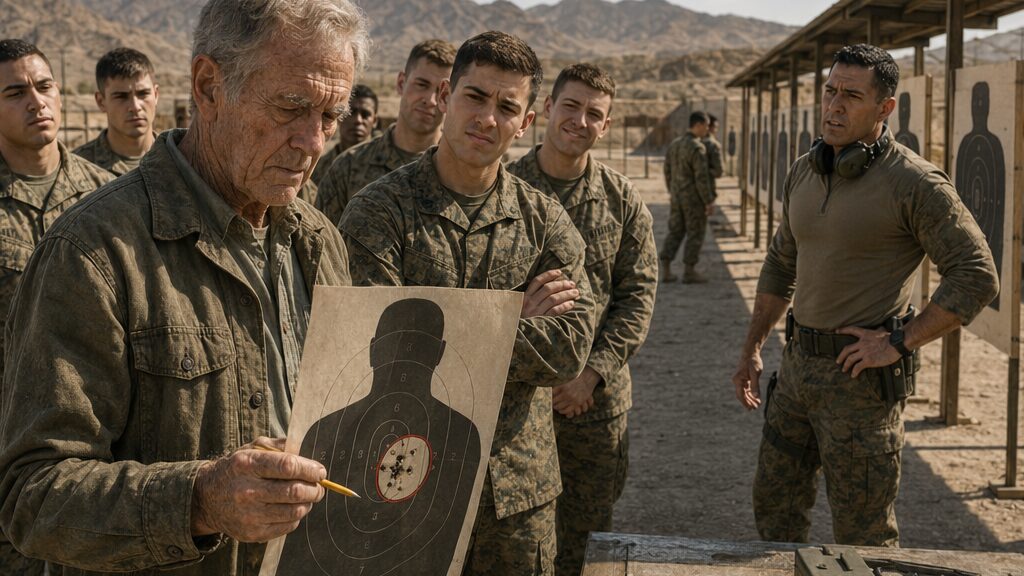
The older man simply walked closer to the target stand.
He removed a pencil from his pocket.
Then he drew a small circle around the shot cluster.
Not the center of the target.
The grouping itself.
Tyler exchanged a glance with Scott Flores.
“What is he doing?”
“No idea.”
Charles stepped back.
His eyes moved from target to target.
Years ago, he had taught Marines how to read paper.
Most people saw holes.
He saw habits.
Breathing patterns.
Trigger anticipation.
Sight adjustments.
Compensation.
Fear.
Confidence.
Fatigue.
Paper remembered everything.
The recruits continued their qualification cycle.
More shots echoed across the range.
More targets came back.
More clusters appeared.
The same drift.
The same correction.
The same story.
Charles opened a worn notebook.
The cover had softened with age.
The corners had rounded.
Inside were pages filled with dates, observations, sketches, and tiny notes written in careful block letters.
He wrote:
Lane 7.
Left drift.
Same as March.
Same as April.
Same as June.
He underlined June twice.
Jacob noticed.
“You still keeping that thing?”
Charles closed the notebook.
“Still reading targets.”
“You retired ten years ago.”
Charles smiled faintly.
“Targets didn’t retire.”
Tyler overheard.
Scott laughed.
Tyler joined him.
Charles let them.
Young men often confused confidence with understanding.
The qualification cycle continued.
By midmorning, heat shimmered above the dirt.
A line of fresh targets hung downrange.
Tyler returned carrying another sheet.
This one looked even better.
Five rounds nearly touching.
He held it up.
“How about this one?”
Several recruits gathered around.
Charles studied it.
The cluster sat left again.
Not much.
Enough.
“What did you change?” Charles asked.
Tyler frowned.
“Nothing.”
“You changed something.”
“No.”
Charles tapped the paper.
“You adjusted after the first round.”
Tyler’s expression shifted.
A tiny movement.
Barely visible.
Charles saw it.
The recruit had adjusted.
Subconsciously.
He hadn’t even realized it.
Charles folded his arms.
Interesting.
Very interesting.
Jacob stepped between them.
“Charles.”
His tone carried a warning.
“We’re running qualifications.”
“I’m aware.”
“Then let us do our jobs.”
Charles nodded.
He walked away without argument.
That should have ended it.
But the feeling stayed with him.
Like a stone in his boot.
Something wasn’t right.
He moved toward the equipment area.
Several rifles sat waiting for inspection.
He paused.
Looked.
Touched nothing.
Just observed.
The armorer waved from across the shed.
“Need something?”
“No.”
Charles kept looking.
Then he returned to the range.
Gunfire cracked through the morning.
Another relay began.
Tyler entered the line again.
The recruit looked relaxed.
Maybe too relaxed.
The command came.
Weapons up.
Fire.
The first few shots sounded normal.
Then Charles noticed something.
A movement.
Tiny.
Fast.
Tyler adjusted his stance.
His rifle shifted.
His support hand slipped.
Only for an instant.
Charles took one step forward.
Then another.
A second later Tyler jerked backward.
The muzzle dipped sharply.
A round struck dirt several yards short of the target line.
The range fell silent.
“Cease fire!”
Jacob’s voice thundered across the lanes.
Everyone froze.
Tyler stared at his rifle.
Confused.
Embarrassed.
The weapon had not malfunctioned.
But something had happened.
Something small.
Something dangerous.
Charles watched the young recruit gripping the rifle.
Watched the uncertainty in his eyes.
And for the first time that morning, Tyler looked less certain than amused.
Charles looked toward the target still hanging downrange.
The same tight cluster sat slightly left of center.
Waiting.
Like a clue nobody else could read.
Chapter 2: Notes Nobody Wanted
The range office smelled like dust, coffee, and old paperwork.
Charles sat alone at a metal desk near the back wall while ceiling fans pushed warm air in lazy circles overhead.
His notebook lay open beside him.
The page from that morning was already crowded with notes.
Lane numbers.
Dates.
Measurements.
Observations.
The pattern kept repeating.
That bothered him more than Tyler’s near accident.
Accidents happened.
Patterns meant something else.
He turned several pages backward.
March.
The same drift.
April.
The same drift.
May.
Again.
A careful observer might dismiss it as coincidence.
Charles had spent too many years teaching marksmanship to believe in coincidence.
A knock sounded against the open door.
Rachel Jones stepped inside carrying a tablet.
Charles recognized her.
Civilian safety analyst.
New.
Maybe mid-thirties.
Serious eyes.
Efficient walk.
She glanced around.
“Mind if I sit?”
Charles shrugged.
“Free country.”
Rachel smiled and pulled out a chair.
For several moments she studied him.
Not rudely.
Curiously.
“You were the volunteer everyone was talking about.”
Charles snorted softly.
“That usually means trouble.”
“It usually means you’re annoying somebody.”
“That’s closer.”
Rachel opened her tablet.
“I heard there was a cease-fire this morning.”
“There was.”
“And?”
Charles leaned back.
“Recruit lost control for a second.”
“Equipment issue?”
“Maybe.”
Rachel waited.
Charles didn’t continue.
Finally she said, “You don’t sound convinced.”
“I rarely am.”
That earned another faint smile.
Rachel glanced toward the notebook.
“You keep records?”
“Old habit.”
“What kind?”
“The useful kind.”
She laughed quietly.
The conversation ended there.
Not because Rachel wanted it to.
Because Charles had spent decades learning when silence produced more information than questions.
Eventually she left.
Charles returned to the notebook.
The problem wasn’t merely the targets.
It was timing.
The pattern began several months earlier.
That date mattered.
He opened a filing cabinet standing against the wall.
Qualification records filled several drawers.
He searched for reports from the previous year.
The folders appeared organized.
At first.
Then he noticed gaps.
Several reports missing.
Not misplaced.
Missing.
Charles frowned.
He checked another drawer.
Same thing.
Missing weeks.
Missing inspections.
Missing maintenance logs.
That was unusual.
Not impossible.
Unusual.
The office door opened again.
Jacob entered carrying a stack of paperwork.
His expression darkened immediately.
“What are you doing?”
“Looking.”
“Through what?”
“Records.”
Jacob set the paperwork down.
“Those files aren’t for volunteers.”
Charles closed the drawer.
“I wasn’t taking them home.”
“That’s not the point.”
“No?”
Jacob crossed his arms.
The younger man wasn’t hostile.
Just impatient.
The range operated on schedules, numbers, and reports.
Charles operated on observations.
The difference irritated both of them.
Jacob pointed toward the notebook.
“You see problems everywhere.”
“No.”
Charles stood slowly.
“I see patterns.”
“Patterns don’t mean anything if you can’t prove them.”
Charles met his gaze.
“They usually mean something before you can prove them.”
Jacob shook his head.
“There was no equipment malfunction.”
“Maybe.”
“The inspection was clean.”
“Maybe.”
“You keep saying maybe.”
Charles looked toward the range outside the window.
“That’s because I don’t know yet.”
Jacob exhaled sharply.
The answer seemed to frustrate him more than certainty would have.
After a moment he left.
Charles remained where he was.
Thinking.
Watching.
Listening.
An hour later he returned to the firing lanes.
The range had quieted.
Most recruits were gone.
Paper targets lay stacked near a disposal bin.
Charles picked several from the pile.
Then several more.
And more.
He spread them across a table.
Shot clusters.
Different shooters.
Different days.
The same subtle drift.
Again.
Again.
Again.
His pencil moved quickly.
Measurements.
Angles.
Distances.
Notes.
The pages of his notebook filled.
A shadow crossed the table.
Tyler.
The recruit looked awkward now.
Less confident than before.
“You’re still looking at those?”
Charles nodded.
Tyler pointed at the targets.
“They all passed.”
“I know.”
“Then what’s wrong?”
Charles considered the question.
“What happens when you drive a car with the steering wheel slightly crooked?”
Tyler frowned.
“You compensate.”
“Without thinking.”
“Yeah.”
Charles tapped the targets.
“What if everybody’s compensating?”
Tyler stared at the paper.
The answer clearly hadn’t occurred to him.
“What are you saying?”
“I’m saying I don’t know yet.”
Tyler looked disappointed.
He wanted certainty.
Young people often did.
Charles returned to measuring.
The recruit eventually walked away.
Near sunset, Charles carried his notebook back toward the office.
The grounds were quiet.
Long shadows stretched across the dirt.
He stopped near the filing room one final time.
Something bothered him.
The missing reports.
The dates.
The timing.
He opened the cabinet again.
Carefully.
Methodically.
And found another gap.
Three consecutive weeks absent from the maintenance records.
Not misfiled.
Gone.
Charles stared at the empty space.
Then slowly closed the drawer.
The pattern wasn’t just on the targets anymore.
Someone had removed part of the story.
Chapter 3: The Wrong Explanation
A week later, Tyler stood in formation while an instructor explained why recruits had been struggling.
The explanation sounded clean.
Simple.
Comforting.
That alone made Tyler suspicious.
“Poor fundamentals,” the instructor said.
“Too much reliance on optics. Not enough discipline.”
Several recruits nodded.
The explanation spread quickly through the training facility.
Scores drifting?
Recruit problem.
Weapon handling inconsistency?
Recruit problem.
Near accidents?
Recruit problem.
Everything pointed back to the shooters.
At least officially.
Tyler glanced toward Scott.
Scott seemed relieved.
“So that’s it?” Scott whispered.
“Guess so.”
But Tyler wasn’t sure.
He remembered Charles standing beside the targets.
The old man hadn’t looked surprised.
He had looked concerned.
There was a difference.
The morning training session began.
Targets appeared.
Rounds fired.
Scores recorded.
Everything continued as normal.
Almost.
Tyler noticed things now.
Little things.
A slight correction after the first shot.
Tiny adjustments.
Small habits shared by different shooters.
Things he had never paid attention to before.
He hated admitting it, but Charles had planted a question in his head.
Questions were difficult to remove.
During a break, Tyler walked toward the observation area.
Charles sat alone beneath a shade structure.
Notebook open.
Coffee untouched.
Studying targets again.
Tyler approached.
“You still think something’s wrong.”
Charles didn’t look up.
“Yes.”
“You got proof yet?”
“No.”
Tyler waited.
The old man finally closed the notebook.
“You ever notice how everybody wants proof before they start paying attention?”
“Isn’t that normal?”
“Sure.”
Charles pointed toward the firing line.
“But if you wait for proof in the wrong situation, somebody gets hurt first.”
The words stayed with Tyler longer than he expected.
Later that afternoon another qualification cycle began.
Jacob Rodriguez supervised personally.
The range officer seemed determined to demonstrate that everything was under control.
The recruits moved through drills.
Scores looked good.
Paperwork looked good.
Everything looked good.
That was the problem.
Tyler found himself staring at targets instead of celebrating scores.
The clusters kept appearing.
Slightly left.
Consistent.
Predictable.
Odd.
Rachel Jones arrived near midday.
She spent nearly an hour reviewing reports with Jacob.
From a distance they appeared locked in polite disagreement.
Rachel pointed at documents.
Jacob responded with frustration.
Eventually they separated.
Tyler noticed Rachel walking toward Charles.
The two spoke quietly.
Not long.
Just enough.
Charles handed her a photocopy from his notebook.
Rachel studied it carefully.
That caught Tyler’s attention.
If she was listening, maybe there was more to this than old-man instincts.
The afternoon exercise moved to a different section of the facility.
Different rifles.
Different targets.
Different instructors.
The pattern remained.
That bothered Tyler.
A lot.
As the day ended, recruits gathered around a table reviewing scores.
Scott grinned.
“Highest qualification rates all year.”
Several others celebrated.
Tyler tried.
It felt forced.
Across the room, he saw Charles leaving.
Notebook under one arm.
Head down.
Nobody stopped him.
Nobody asked questions.
Nobody cared.
For a moment Tyler felt uncomfortable.
Then annoyed at himself for feeling uncomfortable.
The old man was probably wrong.
Maybe.
Outside, vehicles rolled across the training grounds.
Dust drifted through late-afternoon sunlight.
Tyler was heading toward the barracks when a commotion erupted near one of the secondary ranges.
People started moving.
Fast.
Instructors.
Safety staff.
A medical vehicle.
Tyler stopped.
A recruit had suffered a close call during a drill.
No serious injury.
But close enough.
The whispers spread quickly.
Equipment issue.
Shooter issue.
Nobody knew.
Hours later, after sunset, Tyler sat alone cleaning his rifle.
The explanation from that morning suddenly sounded less convincing.
Poor fundamentals.
Recruit problem.
Simple answer.
Simple answers were supposed to make things clearer.
Instead, everything felt murkier.
On the workbench beside him sat a discarded target from the afternoon exercise.
Tyler stared at it.
A tight cluster.
Slightly left.
Exactly like the others.
For the first time, he picked up a pen.
Then circled the grouping the same way Charles always did.
The moment the pencil completed the circle, a chill ran through him.
Because another target on the table beside it showed the exact same pattern.
And another.
And another.
Something was definitely wrong.
The question was no longer whether Charles had noticed something.
The question was whether anyone would listen before it mattered.
Chapter 4: What the Targets Were Saying
Rachel Jones did not like mysteries that left fingerprints.
Most problems did.
People forgot things. Misfiled things. Misunderstood things.
The range records felt different.
She sat alone in a storage room lined with gray cabinets and cardboard archive boxes. Dust floated through the narrow beam of a fluorescent light overhead.
Spread across the table before her were qualification reports, maintenance logs, safety reviews, and photocopies Charles Mitchell had given her.
One stack represented official records.
The other represented Charles’s notebook.
The notebook was winning.
Rachel leaned back.
That irritated her.
Not because Charles was right.
Because he might be.
The old veteran’s notes were meticulous.
Dates.
Lane numbers.
Weather conditions.
Weapon assignments.
Target measurements.
Observations.
Nothing dramatic.
No grand conclusions.
Just details.
The kind of details most people ignored.
Rachel picked up another target photocopy.
The same slight leftward grouping.
Again.
And again.
And again.
Not every shooter.
Not every day.
Enough to matter.
Her tablet buzzed.
A message from Jacob Rodriguez.
Still reviewing?
Rachel typed back.
Still finding things.
Several minutes passed.
Then Jacob appeared at the doorway.
“You look like you haven’t left this room all day.”
“I haven’t.”
Jacob walked inside.
Rachel slid several pages across the table.
“Explain this.”
He glanced at them.
“Targets.”
“I noticed.”
Jacob sighed.
“Rachel.”
“No. Look.”
She pointed.
“Different shooters.”
Another page.
“Different dates.”
Another.
“Different instructors.”
Another.
“Different weapons.”
Jacob crossed his arms.
“The groups are still qualifying.”
“That’s not what I’m asking.”
He stared at the targets longer this time.
Long enough for uncertainty to appear.
Only briefly.
Then it disappeared.
“Could be coincidence.”
Rachel opened Charles’s notebook.
“Three months of coincidence?”
Jacob didn’t answer immediately.
The silence itself felt significant.
Rachel turned several pages.
“Why are maintenance records missing?”
Jacob frowned.
“What?”
She showed him.
“Three separate gaps.”
His expression changed.
Not much.
Enough.
“I’ll check.”
“You didn’t know?”
“No.”
Rachel studied him carefully.
The reaction seemed genuine.
That eliminated one possibility.
Not all of them.
Jacob left with copies of the missing dates.
Rachel remained.
The storage room grew quieter.
Outside, distant gunfire echoed from training lanes.
Pop.
Pop.
Pop.
A rhythm she had grown used to.
She looked down at Charles’s notebook again.
Near one page, he had written a single sentence.
Compensation becomes invisible when everyone learns it.
Rachel read it twice.
Then a third time.
The words stayed with her.
Hours later she found Charles sitting beneath a covered observation shelter.
The range had mostly emptied.
Evening sunlight stretched long shadows across the dirt.
Charles looked exactly where she expected him to be.
Watching.
Not working.
Watching.
Rachel approached carrying a folder.
“You knew before anyone else.”
Charles didn’t look surprised.
“Knew what?”
“There was a pattern.”
He shrugged.
“I suspected.”
Rachel sat beside him.
For several moments neither spoke.
The silence felt comfortable to him.
Uncomfortable to her.
Eventually she opened the folder.
“The maintenance gaps line up with equipment changes.”
That got his attention.
Only slightly.
“Which changes?”
“Target carrier replacements.”
Charles nodded once.
As though confirming something.
Rachel frowned.
“You expected that.”
“No.”
“Then why aren’t you surprised?”
Charles looked toward the firing lanes.
“When people compensate long enough, they stop noticing what they’re compensating for.”
Rachel followed his gaze.
“I’m listening.”
Charles pointed toward a distant target stand.
“Everybody thinks accuracy means the bullet lands close to the last bullet.”
Rachel nodded.
“That’s accuracy.”
“No.”
Charles shook his head.
“That’s consistency.”
Rachel considered that.
The distinction mattered.
A lot.
“If the target system is introducing a tiny error,” Charles continued, “good shooters compensate.”
“And eventually the compensation becomes normal.”
“Exactly.”
Rachel felt a chill.
Because suddenly the targets made sense.
The recruits weren’t creating the pattern.
They were adapting to it.
Without realizing it.
The old veteran had been right from the beginning.
Not because he possessed secret knowledge.
Because he had spent decades noticing things other people stopped seeing.
Rachel looked down at the notebook.
“Why didn’t you just tell everyone?”
Charles smiled faintly.
“I did.”
That answer left her quiet.
Across the range, a new training schedule was being prepared for a large live-fire exercise planned later that week.
Rachel knew about it.
Everyone did.
It was considered routine.
Reliable.
Safe.
She suddenly wasn’t sure.
Before leaving, she closed the notebook.
“What happens if the compensation gets worse?”
Charles’s eyes followed the distant target stands.
The answer took several seconds.
“Then eventually somebody trusts the wrong thing.”
Rachel looked back toward the range.
For the first time, the upcoming exercise felt less routine.
And far more important.
Chapter 5: The Exercise Everyone Trusted
The live-fire course had run successfully dozens of times.
That fact was repeated often enough that it had become a form of faith.
Charles heard it all morning.
Training staff said it.
Range officers said it.
Recruits repeated it.
The exercise worked.
The exercise was proven.
The exercise was safe.
The problem with proven systems, Charles knew, was that people eventually stopped proving them.
Before sunrise he arrived at the course carrying his notebook.
The air smelled of damp earth and gun oil.
Floodlights illuminated shooting stations scattered across several hundred yards of terrain.
Vehicles moved slowly between checkpoints.
Instructors checked equipment.
Everything looked organized.
Everything looked correct.
Charles hated that feeling.
Because dangerous mistakes often hid inside things that looked correct.
Rachel arrived shortly afterward.
“You really think something’s wrong today?”
“I think something’s wrong every day.”
She laughed despite herself.
“I’m serious.”
“So am I.”
Charles handed her several pages.
Target measurements.
Equipment notes.
Dates.
Rachel studied them.
“You think the target carrier alignment issue affects this course too?”
“I think nobody checked.”
That answer stayed with her.
Because she had already discovered enough missing records to know he might be right.
Across the range, Jacob Rodriguez coordinated final preparations.
The range officer looked tired.
Several investigations were already underway.
None had produced definitive answers.
The training schedule remained intact.
The exercise would proceed.
As expected.
By midmorning, recruits moved through the first stages.
Tyler Davis among them.
The young recruit looked sharper now.
Less arrogant.
More observant.
Charles noticed him checking target placements twice before beginning a stage.
Good.
Questions were useful.
The first portion of the exercise proceeded smoothly.
Then the second phase began.
Moving targets.
Timed engagements.
Multiple firing positions.
A more complex environment.
Charles watched quietly.
Notebook open.
Pencil ready.
One team completed the course.
Then another.
Something felt wrong.
Not dramatic.
Subtle.
He checked his notes.
Compared angles.
Distances.
Target movements.
A familiar sensation settled into his chest.
The same sensation he had experienced on the qualification range.
Pattern recognition.
The feeling that separate details were beginning to connect.
Rachel noticed him staring.
“What?”
Charles didn’t answer immediately.
He watched another relay begin.
A moving target crossed its track.
A shooter engaged.
The target reacted.
But not quite correctly.
Tiny.
Almost invisible.
Charles stood.
Rachel followed his gaze.
“What did you see?”
“That.”
The target crossed again.
The movement lagged slightly.
A fraction.
Nothing more.
Yet Charles’s expression hardened.
He started walking.
Rachel hurried after him.
They reached one of the target control stations.
An operator looked annoyed.
“Can I help you?”
Charles pointed.
“When was that unit calibrated?”
The operator blinked.
“I don’t know.”
Charles looked at Rachel.
Rachel looked at the operator.
The answer alone was troubling.
Another relay prepared to begin.
Jacob approached.
“What’s going on?”
Charles spoke calmly.
“Stop the exercise.”
Jacob stared.
For a moment nobody spoke.
Then he laughed once.
Not because it was funny.
Because the request sounded impossible.
“Absolutely not.”
Charles nodded.
He had expected that.
“Then check the calibration records.”
“We already inspected the equipment.”
“Did you check the records?”
Jacob hesitated.
Only briefly.
Rachel noticed.
Charles noticed too.
Another relay prepared to enter the course.
The countdown began.
Jacob folded his arms.
“Charles, you’re working off assumptions.”
“No.”
The veteran pointed toward the moving targets.
“I’m working off patterns.”
The countdown continued.
Five.
Four.
Three.
Rachel looked toward the control station.
Then back toward Charles.
Something in his face unsettled her.
Not certainty.
Concern.
The kind that came from experience rather than ego.
Two.
One.
The relay started.
Charles watched for only a few seconds.
Then he stepped forward.
His voice cut across the range.
“Cease fire!”
The command rang through the course.
Conversations stopped.
Heads turned.
Shock spread instantly.
Jacob froze.
The relay halted.
For several long seconds nobody moved.
The old veteran stood alone in the center of dozens of angry stares.
Notebook in one hand.
Pencil in the other.
Rachel’s heart pounded.
Because whether Charles was right or wrong, there would be consequences now.
And for the first time since arriving at the base, he had forced everyone to listen.
Chapter 6: The Shot That Changed the Argument
Silence spread across the range faster than gunfire ever could.
Every eye fixed on Charles Mitchell.
The old veteran stood calmly beneath a cloudless sky while instructors, recruits, and range staff tried to understand what had just happened.
Jacob Rodriguez reached him first.
His face burned with frustration.
“What are you doing?”
Charles didn’t raise his voice.
“Preventing a mistake.”
“You don’t know there’s a mistake.”
“I know enough to stop and look.”
The surrounding personnel watched closely.
Rachel remained nearby.
Tyler stood several yards away with the other recruits.
Nobody seemed comfortable.
Good.
Comfort had been part of the problem.
Jacob gestured toward the course.
“You’re shutting down an entire exercise based on a feeling.”
Charles shook his head.
“Based on evidence.”
“What evidence?”
The question hung in the air.
Charles opened his notebook.
Not dramatically.
Not triumphantly.
Just as a man might open a grocery list.
He turned several pages.
Then handed it to Jacob.
The range officer frowned.
Targets.
Dates.
Measurements.
Annotations.
Months of observations.
Page after page.
Jacob flipped through them.
His irritation slowly gave way to concentration.
Rachel watched the change happen.
The notebook wasn’t proving everything.
But it was proving something.
Charles had not invented his concerns this morning.
He had been documenting them for months.
Still, Jacob looked up.
“This doesn’t explain the course.”
“No,” Charles agreed.
“It explains why I looked closer.”
That answer frustrated several people immediately.
They wanted certainty.
Charles kept giving them process.
A murmur spread among the recruits.
Tyler stepped forward slightly.
“Then show us.”
The words surprised everyone.
Including Tyler himself.
Charles looked at him.
Then nodded.
“Fair enough.”
Within minutes a target was brought onto an empty lane.
Fresh paper.
Fresh measurements.
Fresh equipment.
A small crowd gathered.
Nobody called it a demonstration.
That was exactly what it became.
Jacob folded his arms.
“You’re saying the issue is visible?”
“I’m saying part of it is.”
Charles accepted a handgun from range staff.
Several recruits exchanged amused glances.
The expression was familiar.
Rachel recognized it immediately.
The same assumption from the first day.
Old man.
Old hands.
Old reflexes.
Old stories.
Charles stepped into position.
Nothing about him looked impressive.
His shoulders were slightly rounded.
His movements economical.
No performance.
No theatrics.
Just routine.
He fired five shots.
The reports echoed sharply.
Then the target returned.
The crowd moved closer.
Five rounds.
One cluster.
Almost touching.
Several recruits stared.
Tyler among them.
The grouping sat tightly together.
Not center mass.
Slightly offset.
Exactly where Charles intended it.
He pointed at the paper.
“What do you see?”
Nobody answered.
Eventually Tyler spoke.
“Good shooting.”
A few nervous laughs followed.
Charles nodded.
“Anything else?”
Silence.
Then Rachel stepped forward.
“The offset is intentional.”
Charles looked at her.
“Why?”
Rachel studied the target.
Thinking.
“The grouping isn’t the point.”
Charles smiled faintly.
For the first time all day.
“Correct.”
He took a pencil and circled the cluster.
The same motion he had performed countless times before.
Same circle.
Same quiet gesture.
The recruits watched closely now.
Nobody laughed.
Charles pointed toward another target collected from the live-fire course.
Then another.
Then another.
Each carried the same subtle pattern.
The same compensation.
The same correction.
The same invisible adjustment.
Understanding began spreading through the crowd.
Slowly.
Like dawn.
Not dramatic.
Just unavoidable.
Rachel felt it happen.
Tyler too.
Jacob stared at the targets.
Then at the equipment reports recently delivered by a technician.
His face tightened.
“What is it?” Rachel asked.
Jacob looked up.
The answer came reluctantly.
“Calibration records.”
Nobody spoke.
Jacob continued.
“Several systems were adjusted months ago.”
Charles said nothing.
Jacob glanced down again.
“Follow-up verification wasn’t completed.”
The words landed heavily.
Not because they revealed catastrophe.
Because they revealed neglect.
Small neglect.
Repeated neglect.
The most dangerous kind.
A technician stepped forward.
“The target tracking delay is minor.”
Charles nodded.
“I know.”
“Then why stop the course?”
The veteran looked around the range.
At recruits.
At instructors.
At equipment.
At paper targets hanging in the distance.
“Because people stopped seeing it.”
No one laughed this time.
No one dismissed him.
The silence felt entirely different now.
A vehicle appeared at the far end of the range.
Dark-colored.
Official.
Dust trailing behind it.
Several personnel turned immediately.
The vehicle stopped near the command area.
A driver exited first.
Then another figure.
Commander Jeffrey Johnson.
His arrival pulled everyone’s attention away from the targets.
The commander surveyed the scene.
The halted exercise.
The gathered crowd.
The paperwork.
The targets spread across tables.
Then his gaze settled on Charles.
And the notebook in his hand.
Jeffrey began walking toward them.
No one spoke.
No one moved.
Because suddenly the argument had become much larger than a qualification exercise.
And everyone knew it.
Chapter 7: What Listening Finally Cost
Three days after the halted exercise, Tyler Davis sat outside a command office staring at a closed door.
Inside, people were discussing reports.
Outside, recruits were discussing rumors.
The rumors changed every hour.
Some claimed the exercise shutdown had been an overreaction.
Others claimed equipment failures had nearly caused something serious.
Most people admitted they didn’t know.
Tyler had stopped pretending he knew either.
The door opened.
Rachel Jones stepped out carrying a thick folder.
She looked exhausted.
Tyler stood.
“How bad is it?”
Rachel studied him for a moment.
“Depends what you mean.”
“The investigation.”
She glanced down the hallway before answering.
“The calibration issue was real.”
Tyler nodded slowly.
He already suspected that.
“The missing records?” he asked.
“Real too.”
“What happens now?”
Rachel shifted the folder under her arm.
“People answer questions.”
Then she continued down the corridor.
Tyler remained where he was.
The answer sounded simple.
It wasn’t.
For the next several days, the base felt different.
Not dramatic.
Subtle.
Conversations lowered when supervisors approached.
Maintenance teams rechecked equipment.
Training schedules shifted.
Files were reviewed.
People who had never cared about paperwork suddenly cared very much.
Tyler noticed something else.
Nobody laughed about Charles anymore.
Not openly.
That changed the atmosphere more than anything.
The old veteran still appeared at the range each morning.
Same jacket.
Same notebook.
Same quiet habit of watching.
Yet people moved differently around him now.
Some nodded.
Others greeted him.
A few even asked questions.
Charles answered only when necessary.
Nothing about him suggested satisfaction.
That confused Tyler.
If their positions had been reversed, Tyler would have enjoyed proving everyone wrong.
Charles seemed uninterested.
One afternoon Tyler finally approached him.
The veteran sat beneath the observation shelter reviewing targets.
The notebook rested on his knee.
Tyler stopped beside the table.
“You were right.”
Charles kept studying the paper.
“About what?”
Tyler almost laughed.
“Everything.”
“No.”
Charles circled a grouping with his pencil.
“Not everything.”
The answer annoyed Tyler.
Mostly because it sounded honest.
After a moment he sat down.
For several minutes neither spoke.
The silence felt less awkward than it once had.
Eventually Tyler pointed at the notebook.
“How long have you been keeping that?”
“Years.”
“Why?”
Charles looked out toward the firing lanes.
“Because memory changes.”
Tyler frowned.
“What does that mean?”
“It means people remember conclusions.”
The pencil tapped lightly against the notebook cover.
“They forget details.”
Tyler watched recruits moving between stations.
“You knew nobody was listening.”
Charles nodded.
“Mostly.”
“So why keep trying?”
For the first time, the veteran took a little longer to answer.
“When I was younger, I thought being right was the important part.”
Tyler waited.
Charles smiled faintly.
“It isn’t.”
“What is?”
“Being responsible.”
The answer settled heavily between them.
Tyler thought about it long after the conversation ended.
A week earlier, he would have dismissed it as old-man wisdom.
Now it sounded different.
More practical.
More difficult.
Later that day, Commander Jeffrey Johnson visited the range again.
No ceremony accompanied him.
No speeches.
He simply walked through the facility with several staff members carrying folders.
Tyler watched from a distance.
At one point the commander stopped beside Charles.
The two men spoke quietly.
No one could hear them.
The conversation lasted less than two minutes.
Then Jeffrey moved on.
Charles returned to examining targets.
As though nothing important had happened.
That bothered Tyler enough to ask Rachel later.
“What did the commander say to him?”
Rachel looked up from her tablet.
“You really want to know?”
“Yeah.”
She considered.
“He thanked him.”
Tyler blinked.
“That’s it?”
“That’s it.”
The answer felt strangely significant.
Not because it was dramatic.
Because it wasn’t.
The investigation findings eventually circulated through the chain of command.
Several maintenance procedures had been neglected.
Verification requirements had not been completed.
Target tracking discrepancies had gone unnoticed because experienced shooters had unconsciously adapted to them.
Exactly as Charles suspected.
Exactly as the targets had shown.
The report stopped short of claiming catastrophe.
No disaster had occurred.
No one had been seriously injured.
But the report included a sentence Tyler never forgot.
Repeated adaptation concealed systemic error.
When he read it, he immediately thought of Charles’s notebook.
And the circles around the targets.
The circles nobody had cared about.
Until they mattered.
Near the end of the week, Tyler arrived at the range early.
Something felt different.
The observation shelter was empty.
The table was empty.
No notebook.
No coffee.
No Charles.
At first Tyler assumed he was late.
Then another day passed.
Still nothing.
On the third morning Tyler found Rachel near the office.
“Have you seen Charles?”
She hesitated.
That was answer enough.
Tyler’s stomach tightened.
“What?”
Rachel sighed.
“He’s thinking about leaving.”
The words hit harder than expected.
Tyler looked toward the quiet shelter.
Toward the empty chair.
Toward the range where Charles had spent months watching details everyone else missed.
For the first time, Tyler realized how easily someone could disappear after finally being noticed.
Chapter 8: The Lesson Left on Paper
The classroom overlooked the qualification range.
Large windows faced the firing lanes where paper targets moved back and forth throughout the day.
Charles Mitchell stood alone near the front table arranging folders.
His notebook rested beside them.
The same worn notebook.
The same bent corners.
The same pages that had quietly started an argument nobody wanted.
He was packing it away when the classroom door opened.
Tyler stepped inside.
“You really leaving?”
Charles looked up.
The young recruit seemed almost annoyed.
Charles understood why.
People often mistook departure for rejection.
“I’m thinking about it.”
Tyler folded his arms.
“Why?”
Charles considered the question.
Outside the windows, a fresh group of recruits moved toward the firing line.
The sight felt familiar.
Comfortably familiar.
Maybe too familiar.
“I volunteered here because I missed the work,” he said.
Tyler waited.
“And?”
“And eventually you have to decide whether you’re helping or just staying.”
The recruit frowned.
That answer clearly failed to satisfy him.
Good.
Life rarely provided cleaner ones.
A few minutes later several recruits entered the classroom.
Then more.
Then instructors.
Rachel arrived carrying folders.
Jacob Rodriguez followed shortly afterward.
The range officer looked uncomfortable.
Not nervous.
Just determined.
The feeling of a man preparing to do something overdue.
Charles had been invited to review new training procedures.
Nothing ceremonial.
No recognition event.
No announcement.
Just work.
Exactly the way he preferred it.
The session began.
Jacob stood at the front.
For several moments he shuffled papers.
Then he looked toward Charles.
The room quieted.
“I owe everyone an explanation.”
No one moved.
Jacob continued.
“The investigation found equipment verification failures that should have been caught.”
His gaze shifted briefly toward Charles.
“They weren’t.”
The room remained silent.
“Several people identified concerns.”
Another pause.
“One person identified them first.”
Jacob didn’t say anything else.
He didn’t need to.
Everyone understood.
Tyler glanced toward Charles.
The old veteran simply sat there.
No reaction.
No satisfaction.
No victory.
Just attention.
The meeting moved forward.
Target procedures.
Inspection schedules.
Verification steps.
Cross-check requirements.
Practical improvements.
Nothing glamorous.
Yet every change connected back to something Charles had noticed months earlier.
Rachel eventually distributed copies of a new review checklist.
At the bottom appeared a simple instruction.
Review pattern consistency, not score alone.
Charles read it twice.
Then set the paper down.
The words meant more than any praise could have.
Because somebody had listened.
Not to him.
To the evidence.
To the process.
To the habit of paying attention.
The session ended around noon.
People gradually left the classroom.
Several recruits remained behind.
Questions followed.
Not about Charles’s military career.
Not about old stories.
About targets.
About observation.
About mistakes.
About details.
The kinds of questions he actually enjoyed answering.
Hours passed quickly.
By late afternoon only a handful of people remained.
Tyler sat across from Charles reviewing targets.
The recruit held a pencil.
The same way Charles always did.
Studying patterns.
Looking carefully.
Taking notes.
Outside, another qualification cycle ended.
Fresh targets moved back from the firing line.
Tyler picked one up.
A decent grouping.
Not perfect.
He examined it quietly.
Then circled the cluster.
Charles watched.
“You see something?”
Tyler nodded.
“Maybe.”
Charles smiled.
“Good.”
The recruit looked down at the paper again.
Not searching for confirmation.
Searching for understanding.
That difference mattered.
The sunlight outside softened toward evening.
Rachel gathered her folders.
Jacob headed toward the range.
The classroom slowly emptied.
Eventually only Charles remained.
He looked down at the notebook resting on the table.
Years of observations.
Years of details.
Years of things nobody had asked for.
He opened the cover.
Then hesitated.
Instead of putting it into his bag, he left it on the table.
A note sat inside the front page.
For training review use.
Nothing more.
No speech.
No lesson.
No farewell.
Just a tool.
The same way it had always been.
Charles walked to the window and looked out at the range one final time.
The targets moved steadily along their tracks.
Paper rising.
Paper falling.
People learning.
People missing things.
People noticing things.
The process would continue long after him.
For the first time in a long while, that thought felt reassuring.
Behind him, the notebook remained on the table.
Open.
Waiting for the next person willing to look closely.
The story has ended.