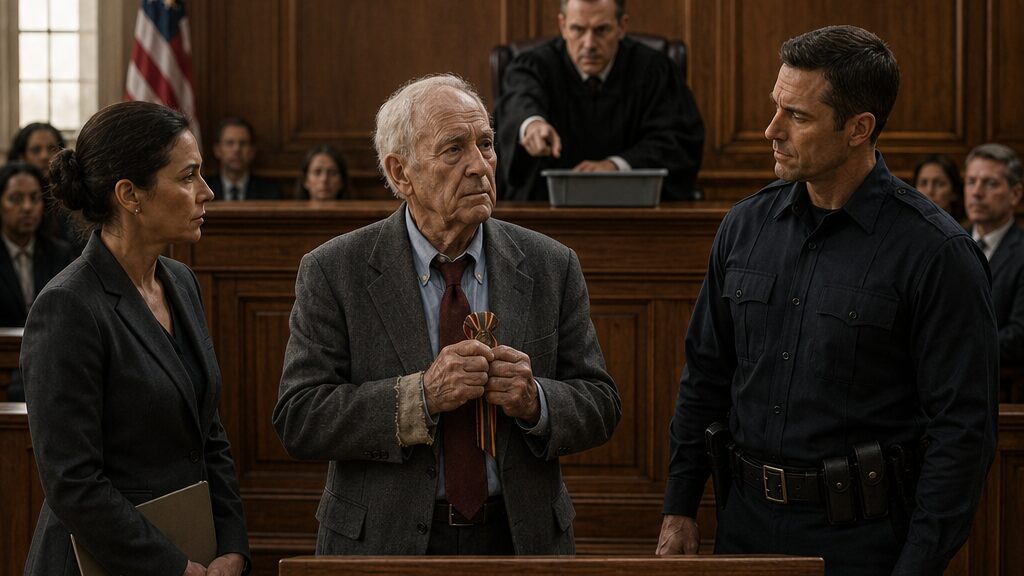
They Called Him a Thief Until the Court Officer Recognized the Medal He Wouldn’t Surrender
Chapter 1: The Judge Told Him to Put the Medal Down
“Put the medal in the tray, Mr. Nelson.”
Samuel kept both hands closed around it.
The evidence tray waited on the clerk’s table, gray plastic beneath fluorescent light. It was the kind used for wallets, keys, pocketknives, anything a person might carry into a courtroom and be required to surrender. The medal did not belong among those things.
Judge Andrew White leaned forward above the wood-paneled bench.
“Mr. Nelson, I have asked you twice.”
Samuel heard the impatience behind the words. He also heard papers turning in the rows behind him, shoes shifting on the tile, the faint breath of people relieved that someone else’s trouble had delayed their own.
His gray jacket pinched across the shoulders. He had bought it nineteen years earlier for a funeral and worn it only when a room required a man to look respectable before it decided whether he was.
The medal rested against his palms. Its red-and-yellow ribbon had faded unevenly. Near the clasp, several crooked stitches crossed the fabric, too large and too tight, pulling one edge higher than the other.
The assistant prosecutor stood at a side table with a thin file open.
“The item was recovered from the defendant at the county veterans hall,” she said. “Security footage shows him entering a restricted archive room after closing.”
“I read the complaint,” Andrew said. His attention remained on Samuel. “What I need is cooperation.”
Samuel looked at the judge, not at the tray.
The public defender beside him whispered, “Let me hold it.”
Samuel’s grip tightened.
The judge noticed.
“Is there a reason you will not release county property?”
“Yes.”
Several faces behind Samuel lifted.
Andrew waited. “What reason?”
Samuel said nothing.
The silence changed the room. A silence in a church could be reverence. A silence at a graveside could be mercy. A silence before a judge became obstruction almost immediately.
Andrew set down his pen.
“Mr. Nelson, this is an initial appearance on misdemeanor theft and trespass charges. I am not asking you to surrender the item permanently. I am ordering it entered into evidence.”
Samuel studied the tray. A white inventory label had already been stuck to its bottom.
“Ask before you move it,” he said.
The judge’s expression hardened. “I just did.”
“No, sir.”
One of the waiting defendants gave a quiet laugh and stopped when the bailiff turned.
Andrew folded his hands. “Then help me understand the distinction.”
Samuel looked down at the ribbon. The repaired clasp had pressed a shallow line into the base of his thumb.
“You asked me to put it down.”
“That is correct.”
“You didn’t ask to handle it.”
The public defender shut her eyes briefly.
Andrew glanced toward the clock above the courtroom door. Nine cases remained on the docket. A reporter from the county paper sat near the back, tapping something into a phone. The judge had been criticized the previous month for letting misdemeanor hearings consume entire mornings. Samuel knew none of that, but he could see the pressure in the man’s jaw.
“Mr. Nelson,” Andrew said, “your age does not exempt you from courtroom procedure.”
Samuel raised his eyes.
“I didn’t say it did.”
“Then place the item in the tray.”
The side door opened. A woman in a navy blazer entered carrying two folders and a long inventory printout. She moved quickly to the prosecutor’s table and identified herself as Lisa Perez, administrator of county archives and property.
Andrew motioned her forward.
Lisa took the witness spot without sitting. “The object was part of the veterans hall collection. It had been cataloged as county property and scheduled for deaccession.”
Samuel’s fingers shifted over the medal’s edge.
Andrew noticed. “Deaccession?”
“Removal from the collection,” Lisa said. “The exhibit was closed for structural repairs. Items without active display designation were reviewed for transfer, sale, or disposal.”
“Sale,” Samuel said.
Lisa turned toward him. “Potentially.”
“It had a lot number.”
The prosecutor looked at her file.
Lisa’s mouth tightened. “Several items had temporary contractor numbers.”
“Lot 214-B,” Samuel said.
The prosecutor found a page and stopped.
Samuel continued. “Cabinet three. Upper shelf. Brown archive box marked K through M. County inventory V-7719.”
The courtroom went still again, but the silence no longer suggested confusion.
Andrew looked from Samuel to Lisa. “Is that accurate?”
Lisa checked the printout. “Yes.”
The public defender leaned closer to Samuel. “How did you know that?”
He did not answer.
Andrew sat back slightly. “Mr. Nelson, that degree of knowledge suggests planning.”
“Yes, sir.”
“You entered after public hours?”
“Yes.”
“You went into a room marked staff only?”
“Yes.”
“You removed this medal?”
“Yes.”
Each answer seemed to place another weight on the prosecutor’s side of the scale. Samuel could feel the public defender’s concern beside him.
“Did you have permission?” Andrew asked.
Samuel looked at the repaired clasp.
“Mr. Nelson?”
“No.”
The prosecutor rose. “The county requests the item be secured and asks for a no-contact order concerning the veterans hall pending resolution.”
Samuel’s head came up. “No.”
Andrew’s voice sharpened. “You do not decide that.”
“There are other things in that room.”
“That is not before me.”
“They’re already tagged.”
Lisa shifted the folders against her chest. “The review is lawful.”
“Did you call the families?”
“We followed the records available.”
“That wasn’t my question.”
Andrew struck the bench once with the flat of his hand, not hard enough to be called a gavel blow, but hard enough to stop them both.
“This is not an administrative hearing,” he said. “Mr. Nelson, you have admitted entering a restricted area and removing an item without permission. You refuse to surrender that item despite a direct order. If this continues, I will have you held until you comply.”
The public defender whispered urgently, “Samuel, give it to me. I’ll make sure it is handled correctly.”
He wanted to believe her. She had been kind since meeting him seven minutes earlier. Kindness, however, was not knowledge.
He looked beyond her toward the uniformed court officer standing by the rail. The man had watched everything without expression. His posture was straight but not rigid, his hands resting near the front of his duty belt.
Samuel returned his attention to the judge.
Andrew pointed toward the tray.
“Last opportunity. Place the medal into evidence.”
Samuel loosened one hand, then the other, but did not set the medal down. Instead he held it openly at the height of the lectern. The dull metal caught the courtroom light. The faded ribbon hung beneath it, the crooked repair visible near the clasp.
“There,” Samuel said. “You can see it.”
Andrew’s patience broke.
“That is not compliance.”
“No, sir.”
“Then I will order the bailiff to take it.”
The uniformed officer at the rail moved one step forward.
Samuel closed his fingers again.
Andrew’s voice dropped. “Why are you making this harder than it needs to be?”
Samuel looked at the judge for a long moment.
Because a child had once repaired that ribbon with red thread that did not match. Because a man had trusted him with things no county ledger could own. Because thirty-five years of silence had not made the promise smaller.
He gave Andrew the only answer he could give without naming her.
“It was never county property.”
Chapter 2: The Officer Saw the Repair in the Ribbon
Raymond Lewis had heard the sentence before Samuel said it.
Not the sentence about county property. The other one.
Ask before you move it.
The words struck an old place in Raymond’s memory: a Reserve medical exercise at Fort McCoy, a senior instructor correcting a young soldier who had reached for a casualty’s gear without checking the tag. The instructor had said there were rules for bodies, rules for belongings, and rules for the living people who would someday ask what had happened to both.
Raymond looked more closely at the medal.
The service emblem on its face was partly covered by Samuel’s thumb. The engraved edge showed only three letters, but the ribbon repair was clear—a crooked band of red stitches near a brass clasp darkened with age.
He had seen those stitches in a photograph.
The photograph hung in the county veterans hall before the roof leak closed the east gallery. A medic in field gear stood with one hand on the shoulder of a thin girl holding up a medal ribbon she had repaired. The caption named the medic Joseph King. Behind them, half outside the frame, stood a younger Samuel Nelson.
Raymond looked at Samuel’s face now and found the same level gaze, worn down but not altered.
Judge White motioned impatiently. “Officer.”
Raymond did not move toward the medal.
“Your Honor,” he said, “may I approach the lectern first?”
The judge stared at him. Raymond had worked in his courtroom for three years and had never interrupted an evidentiary order.
“For what purpose?”
“I believe I can identify the item.”
Lisa Perez opened her folder. “It has already been identified.”
“Not the way he means,” Samuel said.
Raymond heard no triumph in the old man’s voice. Only fatigue.
Andrew looked from Raymond to the packed rows behind Samuel. He seemed to recognize that whatever happened next would be watched more closely than everything that had come before.
“Approach,” he said.
Raymond stepped through the gate. He stopped an arm’s length from Samuel and did not reach out.
Up close, the jacket was more worn than it had appeared from the rail. One cuff had been repaired with thread almost the same shade of gray. Samuel’s hands were steady, though the medal had left a deep red mark across one palm.
Raymond lowered his voice.
“Sergeant Nelson?”
The public defender turned toward Samuel.
So did the prosecutor.
Samuel’s expression changed only around the eyes.
“I retired a long time ago,” he said.
“Yes, sir.”
Andrew’s shoulders shifted at the word sir. Not offended—alert.
Raymond looked down at the ribbon.
“May I examine the clasp?”
Samuel’s thumb moved away from it.
“The ribbon only.”
Raymond touched the edge with two fingers. He did not lift it or pull it from Samuel’s grasp. The stitches were rough and slightly uneven. Whoever had made them had pushed the needle through too close to the fold, bunching the fabric.
Raymond said, “This repair is in the memorial photograph.”
Lisa stepped nearer. “What photograph?”
“The east gallery. Joseph King and his daughter.”
Samuel’s hands closed enough to hide the engraving again.
Raymond withdrew his fingers.
Andrew’s voice had lost its sharp edge. “Mr. Nelson, were you in the Army?”
“Yes.”
“What was your rank when you retired?”
“Platoon sergeant.”
A murmur passed through the back row. Andrew looked toward it, and the room quieted.
The judge spoke more slowly. “Why did you not tell the court?”
“You didn’t ask.”
The reply might have sounded insolent from someone else. Samuel offered it as fact.
The assistant prosecutor rose halfway. “Your Honor, military service does not alter the elements of the charges.”
“No,” Andrew said. “It does not.”
Samuel nodded once, as if that mattered more to him than any display of admiration.
Andrew looked at Raymond. “What exactly have you identified?”
Raymond studied the medal’s edge. Samuel had allowed the ribbon, not the metal. The distinction seemed important.
“The clasp and ribbon match a county memorial image. The medal appears to have belonged to Army medic Joseph King.”
“Appears?”
“I can’t confirm the engraving without handling it.”
Samuel rotated the medal in his palm himself. Along the rim, faint letters caught the light.
KING, JOSEPH.
The public defender’s whisper was barely audible. “It isn’t yours.”
Samuel heard her.
“No,” he said.
Andrew leaned forward again, but differently now. His forearms rested on the bench rather than his hands gripping its edge.
“Then why do you have it?”
Samuel looked at the judge.
The entire courtroom seemed to wait for a story that would turn the old man from defendant into hero. Samuel could feel that expectation rising around him. It made him more uncomfortable than the accusation had.
“I took it,” he said.
The prosecutor straightened.
Andrew frowned. “You are admitting the removal?”
“I already did.”
“Did Joseph King give it to you?”
“No.”
“Did his family?”
Samuel did not answer.
Lisa Perez said, “The item was displayed under a county accession number for more than twenty years.”
Samuel turned toward her. “A number isn’t ownership.”
“It is evidence of it.”
“It’s evidence somebody typed one.”
Lisa’s face flushed. “Those records were audited.”
“When?”
She hesitated.
Andrew intervened before the exchange could grow. “Ms. Perez, remain available. Mr. Nelson, I am trying to give you room to explain.”
Samuel looked at Raymond. The officer had returned to a neutral stance, but he remained closer than before. He had not saluted. He had not announced Samuel’s service to the room as if it erased the present charge. He had simply asked permission and listened to the answer.
It was the first correct thing anyone had done with the medal that morning.
Andrew said, “Did you serve with Joseph King?”
“Yes.”
“Were you responsible for the item after his death?”
Samuel’s jaw tightened.
“No.”
“Do you know who was?”
“Yes.”
The public defender touched his sleeve. “Samuel, this is the point where you let me help.”
He moved his arm away, not roughly.
Andrew noticed that too.
“Mr. Nelson, if another person has an ownership claim, that information could materially affect this case.”
Samuel’s gaze fell to the crooked stitches.
A girl of nine had sat at a kitchen table under a yellow lamp, tongue caught between her teeth as she pushed a needle through the ribbon. Her father had laughed when the thread knotted and told her no good repair ever looked perfect.
Samuel had stood in the doorway holding his hat, already preparing to leave before anyone asked him to stay.
Andrew waited.
“Who authorized you to recover the medal?” he asked.
“No one.”
“Who told you it did not belong to the county?”
Samuel’s fingers tightened.
The judge’s voice remained controlled now, but the legal pressure had not changed. “If you are protecting someone, understand that your silence may place you in custody and leave the medal with the county anyway.”
That struck where the earlier threats had not.
Samuel looked toward the evidence tray. Then at Raymond. Then back to Andrew.
“No one who should be dragged into this room,” he said.
Chapter 3: The County Ledger Had Two Different Owners
Lisa Perez returned after lunch carrying a document that seemed, at first glance, to end the argument.
The page bore the county seal, an accession number, a typed description of Joseph King’s medal, and a line reading PERMANENT DONATION. At the bottom was a signature in blue ink.
Lisa placed it on the interview-room table between Samuel and his public defender.
“There,” she said. “The county did not invent ownership.”
Samuel did not touch the paper.
The small room had no windows. Its walls were painted the same pale beige as the courthouse corridors, and the air-conditioning vent rattled every forty seconds. Raymond stood near the door. Andrew had ordered him to remain while records were reviewed, though the judge himself had returned to the bench to finish the morning docket.
The public defender read the form.
“Donor: King family,” she said. “Date received, June eighteenth, twenty-two years ago.”
Samuel looked at Lisa. “Who signed it?”
“The signature is on the page.”
“That’s not what I asked.”
Lisa turned the form toward him. The name beneath the blue line had been typed: Emma King. The signature above it was little more than a hooked E followed by an unreadable stroke.
Samuel’s face remained still.
“That isn’t hers.”
“You recognize her signature from twenty-two years ago?”
“Yes.”
Lisa crossed her arms. “You have not been willing to identify her in court, but now you are an expert on her handwriting?”
Samuel ignored the edge in her voice.
“Emma makes the K first. Always has.”
The public defender examined the signature. “This may be an intake employee’s initials.”
“It may be,” Lisa said, “but the accession record has controlled the item for more than two decades.”
“Wrong records can last a long time,” Samuel said.
Lisa’s expression tightened. “You broke into a restricted archive because you decided the county was wrong.”
“I walked through a door that didn’t latch.”
“That does not make the room public.”
“No.”
“And you removed an item.”
“Yes.”
“You could have requested a review.”
“I did.”
The words stopped her.
Samuel reached into his jacket slowly. Raymond’s posture changed at once, and Samuel paused.
“Letters,” he said.
Raymond nodded.
Samuel withdrew three folded copies and placed them on the table. Each bore a county receiving stamp. The first was dated four months earlier. The second, seven weeks. The third, twelve days.
Lisa read the top page.
Request for ownership review before disposal of Item V-7719.
Her eyes moved to the lower right corner, where an administrative notation had been added.
No responsive documentation found. Proceed under existing accession.
“I never saw these,” she said.
“They went to your office.”
“My office receives hundreds of inquiries.”
Samuel sat back. “That medal got one family.”
The door opened. A records technician pushed in a cart stacked with binders and archive boxes. He looked apologetic.
“Ms. Perez, we found the intake materials from the old veterans committee.”
Lisa stepped aside.
The technician opened a narrow binder whose plastic sleeves had yellowed at the edges. “The county took over the hall collection fifteen years ago. Before that, volunteers kept separate exhibit cards.”
He found a card written in fading black ink.
Joseph King service medal. Loaned by family for twelve-month memorial exhibit. Return upon request.
The public defender leaned forward.
“Lender’s name?”
The technician pointed to the bottom. Only the first name had been completed.
Emma.
The surname line was blank. The signature line carried the same first name in a different hand from the blue mark on the county form.
Lisa placed the permanent-donation sheet beside the old card.
Two records. Two owners.
For the first time since entering the courtroom that morning, Samuel loosened his shoulders.
The public defender noticed. “This supports what you said.”
“It supports part of it,” Lisa replied. “The card is incomplete. No full legal name, no address, no witnessed signature.”
“It proves the county knew it was a loan,” Samuel said.
“It proves a volunteer wrote that word on a card.”
The technician lifted another item from the box: a faded photograph in a clear sleeve.
Raymond moved away from the door.
The picture showed Joseph King in uniform beside a glass display case. A thin girl stood at his side, holding one end of the medal ribbon between both hands. Her hair had been cut unevenly at the shoulders. She was smiling at the camera, proud of the repair she had made. The same crooked stitches were visible near the clasp.
Samuel stared at the photograph.
He remembered the kitchen where the repair had actually happened, the smell of coffee gone cold, Joseph pretending not to wince each time the needle slipped. Emma had insisted she could fix it because her father fixed people.
In the photograph, Samuel stood in the background near the edge, one hand raised as if he had been caught deciding whether to enter or leave.
The public defender looked from the picture to the medal sealed now inside a clear evidence pouch on the table. After the hearing, Samuel had agreed to let Raymond package it, but only after the officer placed clean archival paper beneath it and asked before every movement.
“The repair matches,” she said.
Lisa studied the image. Some of the certainty left her face.
“That still does not prove the girl in this photograph is the lender named on the card.”
“Her name is on the caption,” Raymond said.
Beneath the image, typed on a strip of paper, were the words:
Joseph King with daughter Emma, opening of county memorial exhibit.
Samuel looked away.
The public defender said, “We need to contact her.”
“No,” Samuel said.
Everyone turned toward him.
Lisa gave a disbelieving laugh. “You have spent all day arguing that the family owns the medal.”
“They do.”
“Then the family must confirm it.”
“No.”
The public defender lowered her voice. “Samuel, this can help you.”
“That isn’t the same as helping her.”
Lisa gathered the two ownership records. “If Emma King is alive, the county has a duty to locate her.”
“You had that duty before you put her father’s medal in an auction list.”
The words landed hard enough that Lisa’s face changed. Not into remorse, not yet, but into something less defended.
“We inherited a broken system,” she said. “The hall roof failed. Mold spread through two storage rooms. I have three employees and nearly four thousand objects, many with no valid contact information. The county gave me sixty days to clear the unsafe building.”
“And you chose which promises still counted.”
“I chose what could be documented.”
Samuel glanced at the incomplete loan card.
“No,” he said. “You chose which missing pieces were convenient.”
Lisa closed the folder more sharply than necessary.
The technician excused himself to search for contact records. Raymond remained by the door, watching Samuel rather than the medal.
An hour later, they returned to the courtroom. Andrew had cleared the public benches except for the reporter and two people waiting on late cases.
He reviewed both records in silence.
“The county’s ownership claim is no longer straightforward,” he said. “Neither is Mr. Nelson’s conduct. An incomplete loan card does not authorize private entry into a restricted room.”
Samuel nodded.
Andrew looked at him. “You understand that?”
“Yes.”
“And you still refuse to provide Emma King’s contact information?”
Samuel looked at the photograph lying beside the file.
“I don’t have permission.”
“From whom?”
He did not answer.
Andrew removed his glasses and pressed two fingers against the bridge of his nose.
“I will continue this matter until tomorrow morning. The county will make a documented effort to locate the lender or her legal successor. Mr. Nelson will be released on his own recognizance, with no entry into the veterans hall or county archive.”
The prosecutor began to object, but Andrew raised a hand.
“The medal remains secured under conditions approved by the court. It is not to be transferred, auctioned, cleaned, displayed, or otherwise handled without further order.”
Raymond stood straighter.
Samuel heard the difference. Not respect spoken aloud, but respect turned into a rule.
The clerk approached the bench carrying a yellow message slip.
“Judge White.”
Andrew read it. His gaze moved first to Samuel, then to the courtroom doors.
“Apparently,” he said, “the county will not need until tomorrow to find Ms. King.”
Samuel’s hand closed around the empty place where the medal had rested.
Andrew set the slip down.
“Emma King is downstairs.”
Chapter 4: She Wanted the Medal Back, Not His Silence
“You came for the medal before you came to me.”
Emma King stood just inside the consultation-room door, one hand still gripping the strap of her bag. She was in her late forties, perhaps fifty, though the years had settled around her eyes more heavily than Samuel remembered. Her hair, once cut unevenly at the shoulders, was now dark with gray at the temples.
Samuel rose too quickly. The chair legs scraped the floor.
“Emma.”
She looked at him as if the use of her name were another thing he had taken without permission.
Raymond remained by the door. The public defender gathered her papers but did not leave. Andrew had authorized a private conversation before the resumed hearing, provided court staff remained present.
Emma’s gaze moved to the evidence pouch on the table.
The medal lay flat on archival paper. The repaired clasp pointed toward her.
Her face tightened.
“They told me someone broke into the veterans hall,” she said. “They did not tell me it was you.”
“The door didn’t latch.”
“That is the part you want to correct?”
Samuel lowered himself back into the chair.
Emma approached the table but stopped short of the medal. She studied the crooked stitches through the plastic.
“I did that with upholstery thread,” she said. “My mother said it was too thick. My father said thick meant it would hold.”
Samuel remembered Joseph laughing as the needle caught the ribbon and Emma frowned at her own work.
“It held,” Samuel said.
“For thirty-five years.”
The public defender gently turned the county loan card toward Emma. “Ms. King, do you recognize this?”
Emma read it without touching it.
“I signed an exhibit card when the hall opened. It was supposed to be for one year.”
“Did you donate the medal permanently?”
“No.”
Lisa Perez, seated at the far end of the table, straightened. “The county has a later accession form.”
“I never signed a donation form.”
Lisa slid the page across.
Emma looked at the blue mark beneath her typed name. “That is not my signature.”
Samuel kept his eyes on the medal.
For one brief moment, the theft charge seemed to loosen around him. The public defender’s shoulders eased. Lisa made a note. Raymond looked toward the door, perhaps already considering how the information would be presented upstairs.
Then Emma said, “That doesn’t mean he had permission to take it.”
The room tightened again.
The public defender paused. “Did you ask Mr. Nelson to recover the medal?”
“I asked him to find out why the county would not return my calls.”
Samuel’s gaze lifted.
Emma faced him. “I sent you the auction notice. I said, ‘Can you help me get an answer?’”
“They had already numbered it.”
“I know.”
“They were moving the boxes Friday.”
“I know that too.”
“You said they would sell it.”
“I said I was afraid they would.”
Samuel’s hand settled flat against the table. “They would have.”
“Maybe. But I did not ask you to enter a closed room.”
Lisa exhaled quietly, vindicated and uncomfortable at once.
Emma heard it. “And that does not make what the county did acceptable either.”
Lisa lowered her eyes to the folders.
Emma turned back to Samuel. “You always do this.”
His fingers curled.
“Do what?”
“Decide what everyone else can survive knowing.”
The public defender looked down at her notes.
Samuel said, “I was trying to keep your name out of court.”
“You kept my name out of your mouth for most of my life.”
He had no answer that did not sound smaller than the silence itself.
Emma pulled out a chair but did not sit. “My mother wrote to you after the funeral.”
“I received the letters.”
“She called your work.”
“I know.”
“She asked you to tell me what happened.”
Samuel looked toward the wall.
Emma’s voice dropped. “You came once. You stood in our kitchen. You watched me repair that ribbon. Then you left before dinner.”
“You were a child.”
“I was nine. I knew when an adult was running away.”
Raymond shifted his weight near the door. The movement was slight, but Samuel noticed. The officer had recognized him as a soldier. Emma recognized what he had been as a man.
The court clerk appeared and said Andrew was ready to resume.
In the courtroom, Emma took the witness chair. The room was quieter than it had been the day before. The reporter sat in the back again, but Andrew instructed that no photograph of the medal be taken.
Emma confirmed the temporary loan. She identified the stitches. She denied signing the donation form.
The assistant prosecutor approached carefully.
“Did you authorize Mr. Nelson to enter the archive?”
“No.”
“Did you authorize him to remove the medal?”
“No.”
“Did you tell him it belonged to you?”
“Yes.”
“Did you ask him for help?”
“Yes. Help is not the same as deciding for me.”
Samuel absorbed the distinction without looking up.
The prosecutor returned to her table. The public defender rose.
“Ms. King, do you want the county to retain the medal?”
“I want the county to stop pretending that question belongs to them.”
Andrew’s pen stilled.
Emma continued. “But I also want the court to understand that Samuel chose this method. Not me.”
The theft allegation had weakened, but the trespass charge stood more clearly than before.
During recess, the prosecutor offered a resolution. She spoke to the public defender at the end of the counsel table, but not so quietly that Samuel could not hear.
“If Mr. Nelson accepts that he became confused about authorization, we can recommend a deferred disposition. Age, stress, misunderstanding. No jail.”
The public defender looked at Samuel.
He shook his head.
She moved closer. “It may be the safest outcome.”
“It isn’t true.”
“You believed you had a claim of right.”
“I believed the county was wrong. I knew the door said staff only.”
“The distinction may not help you.”
“It’s still the distinction.”
The prosecutor folded her arms. “Mr. Nelson, no one is trying to insult you.”
Samuel looked toward the bench, then at the evidence pouch.
“That’s not the same as telling the truth.”
Andrew returned and called the room to order.
The public defender informed him that Samuel would not accept a resolution based on confusion or diminished understanding.
Andrew studied Samuel for several seconds.
“Then this matter continues.”
Emma remained in the witness chair. She had not looked at Samuel since recess.
Andrew asked whether she had anything further relevant to ownership.
Emma placed both hands in her lap.
“Yes.”
The courtroom waited.
She looked directly at Samuel.
“I want to know why he could break into a county building for my father’s medal, but could not walk through my mother’s front door for thirty-five years.”
Andrew’s expression changed, but he did not stop her.
Emma’s next question was quieter.
“What order did you give my father on the night he died?”
Chapter 5: The Order He Had Repeated for Thirty-Five Years
“Clear the courtroom.”
Samuel’s request was so quiet Andrew nearly asked him to repeat it.
The judge looked toward the reporter, the clerk, and the two people waiting on late matters.
“This is an open proceeding,” Andrew said.
“I know.”
“Then why are you asking?”
Samuel stood at the lectern with both hands resting on its edge. The medal remained sealed at the evidence table. Emma sat behind the rail, rigid and watchful.
“Because Joseph doesn’t belong to everybody just because the county lost his paperwork.”
Andrew’s face tightened at the criticism, but he did not reject it.
He addressed the reporter. “The court is taking a brief recess. Counsel, court security, Ms. King, and Ms. Perez will remain.”
When the door closed behind the last spectator, the room seemed larger and more severe. Empty benches offered no cover.
Andrew returned to the bench but did not sit.
“You may answer Ms. King’s question.”
Samuel looked at Emma.
For thirty-five years, he had reduced the night to an order. Everything before it became preparation. Everything after it became consequence.
“We were moving wounded men from a temporary aid position,” he said. “The route out had narrowed. Vehicles could not reach us.”
Emma did not blink.
“Your father was the senior medic there. We had more injured than we could carry.”
Samuel’s voice remained level, but his right hand had closed against the lectern.
“We received instructions to withdraw before the route closed completely.”
“What did you tell him?” Emma asked.
“I told him to prepare the men who could be moved.”
“That is not the order.”
Samuel looked down at the wood grain.
“No.”
No one in the courtroom moved.
“I told the platoon to withdraw.”
Emma’s jaw shifted.
“And my father?”
“He stayed with three wounded soldiers.”
“You left him.”
The words struck with the clean force of something long rehearsed.
“Yes.”
Raymond lowered his gaze.
The public defender started to speak, perhaps to frame the answer, but Samuel raised one hand.
“I gave the order,” he said. “Joseph told me two of the men could not survive being carried over that ground. I told him we could not hold the position. He said he needed more time.”
Samuel could see it without closing his eyes: Joseph crouched beside a wounded soldier, one hand pressed against a dressing, the other pointing toward the narrow path. Mud on his sleeve. His face infuriatingly calm.
“What happened next?” Andrew asked.
“I ordered everyone capable of moving to fall back.”
“And Joseph refused?”
Samuel’s mouth tightened. “He did not use that word.”
“What did he say?” Emma asked.
Samuel’s eyes remained on the lectern.
“He said, ‘Ask before you move them.’”
Raymond looked up sharply.
Samuel continued. “It was something we taught. Do not pull a casualty because panic tells you to. Check the wound. Check the route. Ask the medic. Ask the man, if he can answer. A body is not cargo because the situation is bad.”
The phrase that had sounded stubborn in court now occupied another room, another time.
Emma’s voice was barely above a whisper. “And you moved the platoon.”
“Yes.”
“Without him.”
“Yes.”
Samuel had repeated those two answers in his head for decades. They had never grown easier.
Andrew sat down slowly. “Was there an evacuation arranged for the position?”
“A team was supposed to reach them from the south.”
“Did it?”
“Not in time.”
Emma turned her face away.
Samuel forced himself to continue.
“We reached the secondary line. I tried to send men back. The route was gone.”
“Was my father alive when you left?” she asked.
“Yes.”
“Did he know you were leaving?”
“Yes.”
“Did he ask you to stay?”
Samuel hesitated.
Emma stood. “Did he?”
“No.”
The answer did not relieve her. It seemed to make her angrier.
“Then why did you let my mother believe you had abandoned him without a word?”
“I did abandon him.”
“You gave an order under conditions he understood.”
“I gave the order that put distance between us.”
“That is not the same thing.”
“It was to me.”
Emma stared at him.
Samuel looked toward the sealed medal. “Afterward, I brought his personal effects home. Your mother asked what he said. I told her he stayed with the wounded.”
“She asked whether it was his choice.”
“I didn’t answer.”
“Why?”
“Because I was the one who had authority.”
The words came harder now.
“If I said he chose it, it sounded like I was trying to clear myself. If I said I ordered the withdrawal, it sounded like I was blaming procedure. So I said nothing.”
Emma’s eyes shone, but her voice remained controlled.
“You let us build the worst version.”
Samuel did not defend himself.
The ventilation system clicked off. In the silence, the faint plastic rustle of the evidence pouch seemed too loud.
Lisa Perez stood near the prosecutor’s table, holding the contradictory records against her chest. Whatever argument she had prepared about forms and signatures no longer fit the room.
Samuel said, “Your mother had enough to carry.”
“So you gave her uncertainty too?”
He closed his eyes for one moment.
“Yes.”
The admission changed something in Emma’s face. Not forgiveness. Recognition, perhaps, of the exact shape of the harm.
The public defender asked, “Mr. Nelson, did Joseph leave any written report or message?”
“Not that I received.”
Emma’s attention sharpened.
“You received letters from my mother.”
“Yes.”
“Did you open all of them?”
Samuel looked at her.
The question reached beyond the courtroom.
“No.”
“How many?”
He did not answer.
Emma stepped through the gate before Raymond could decide whether to stop her. She placed her bag on the counsel table and opened the inner compartment.
“My mother kept copies of everything,” she said. “After she died, I found one envelope she had never mailed because she decided you had already refused enough.”
She removed a yellowed envelope sealed with tape along one edge.
Samuel recognized Joseph’s handwriting before she turned it over.
His name was written across the front.
Sgt. Samuel Nelson.
The room narrowed around the envelope.
Samuel’s hands left the lectern.
“Where did she get that?”
“It was with my father’s papers.”
“That isn’t possible.”
“It was addressed to you.”
Samuel shook his head once. “No.”
Emma held it out.
The old envelope trembled slightly between them, though her hand was steady.
“You have spent thirty-five years answering a letter you never read,” she said.
Chapter 6: The Letter Refused to Make Either Man a Hero
“I don’t want it.”
Samuel did not reach for the envelope.
They had moved to Andrew’s conference room, where the long table was polished so thoroughly that the sealed letter reflected beneath Emma’s hand. The judge sat at one end. Lisa and the assistant prosecutor remained near the door. Raymond stood beside a cabinet, close enough to intervene and far enough to leave the decision Samuel’s.
Emma pushed the envelope toward him.
“Your refusal has already lasted thirty-five years.”
Samuel stared at Joseph’s handwriting.
The letters were blocky and slightly slanted, the same hand that had labeled medical supplies and written bad jokes in the margins of duty rosters. Samuel had known that hand under rain, dust, and dim red light. Seeing his own name in it felt less like receiving a message than being called to account.
“When was it written?” he asked.
“Two days before he died.”
Samuel looked at her sharply.
Emma sat across from him. “My mother found it inside a book he had mailed home with other papers. She thought it was a draft. She kept waiting for you to answer questions you didn’t know he had answered first.”
Samuel touched the envelope but did not lift it.
The paper was brittle at the corners. Fold marks crossed it beneath the writing.
Andrew spoke quietly. “You are not required to read it here.”
Samuel looked at him.
The judge’s tone held none of the impatience from the first morning. He was not granting permission or issuing an order. He was leaving space.
Samuel slid a finger beneath the taped edge.
Inside was one sheet folded into thirds.
He opened it carefully.
Samuel—
If this gets to you, it will probably arrive late, which is how most useful things reach us.
Emma says the medal ribbon looks better with her stitches. She is wrong, but do not tell her.
Samuel stopped.
Emma looked down.
He continued.
You worry too much about moving people before they are ready. Sometimes that saves them. Sometimes it frightens them. Ask before you move what belongs to someone else, especially grief. People carry it badly when we decide its shape for them.
Samuel’s thumb pressed into the paper.
The room fell away for an instant, replaced by Joseph tying off a bandage and telling him that command had made him impatient with pain that did not follow orders.
He read on.
If the choice comes between keeping the unit together and keeping me beside you, choose the unit. I know what my work is. You know what yours is. Do not turn either of us into a hero afterward. Heroes are difficult for children to know.
Tell Emma I hated powdered eggs. Tell her I sang badly and cheated at cards. Tell her I carried the picture she drew of our dog even though the dog looked like a horse.
Tell her I was her father before I was anybody’s fallen soldier.
Samuel lowered the page.
No one asked him to continue.
Emma’s eyes were fixed on the table. “There is more.”
He knew there would be.
He lifted the letter again.
And if something happens, do not make a monument from guilt. Stone is useful because it stays where it is put. A man should know better.
Joseph
Samuel read the last line twice.
For years he had believed silence prevented him from turning Joseph’s death into a defense of his own choices. The letter exposed another possibility: that silence had become the monument Joseph warned against, fixed and heavy, demanding that everyone walk around it.
Emma said, “He did not absolve you.”
“No.”
“He did not blame you either.”
“No.”
“He asked you to tell me who he was.”
Samuel folded the letter along its old lines.
“I didn’t.”
Her anger remained, but it no longer stood alone. Grief had entered beside it.
“You decided not speaking was more honorable.”
“Yes.”
“It was easier.”
Samuel almost denied it.
Then he looked at the sealed medal beyond the glass partition in the adjacent room, lying exactly where the court had ordered it left.
“Yes,” he said.
The answer seemed to cost him more than any admission about the archive.
Andrew removed his glasses.
“The ownership issue may dispose of the theft allegation,” he said. “If the county never obtained lawful title, the state may not be able to prove that element.”
The assistant prosecutor nodded reluctantly. “That remains under review.”
“But trespass is separate,” Andrew continued. “The door was marked. Mr. Nelson entered knowingly.”
Samuel folded Joseph’s letter once more, though it did not need folding.
“I know.”
“The prosecutor’s earlier offer remains possible.”
“No.”
Andrew’s expression tightened slightly. “You have not heard the revised terms.”
“If the terms say I was confused, the answer is no.”
“They might avoid a conviction.”
“They would avoid the truth.”
Lisa shifted near the door. “The county ignored three inquiries. That should matter.”
“It does,” Andrew said. “It does not erase his decision.”
Samuel looked at Lisa. She appeared tired rather than defensive now. The folders in her arms had begun to bend at the corners.
“I went in because I thought you would move the boxes before anyone listened,” he said.
“We would have.”
Her honesty surprised the room.
Lisa continued. “The contractor was scheduled for Friday. I approved the list even though the handwritten records had not all been reconciled.”
The assistant prosecutor turned toward her. “Ms. Perez.”
“It is already in the documents.”
Andrew leaned back. “Then both the county’s conduct and Mr. Nelson’s conduct require a public record.”
The phrase settled over Samuel.
A public record meant the courtroom again. Questions. The reporter. Emma hearing everything he had refused to say. It also meant no private bargain built on a false story about an old man’s confusion.
Emma touched the letter.
“What are you going to do?” she asked.
Samuel looked at Joseph’s words, then at the woman Joseph had asked him to know.
For decades, Samuel had treated responsibility as something a man carried alone. Alone had been the part he understood best.
He placed the letter on the table between himself and Emma.
“I’ll say what I did.”
“And what he did?”
Samuel nodded.
“And what you didn’t do afterward?”
His mouth tightened.
“Yes.”
Andrew watched him carefully. “You understand that a statement in open court may be used in resolving the trespass charge.”
“Yes, sir.”
“Your service will not decide the legal issue.”
“It shouldn’t.”
Raymond’s gaze shifted toward Samuel. The recognition in it was no longer about rank.
Andrew closed the file in front of him. “The court can reconvene tomorrow after the records review.”
Samuel stood.
“No.”
The assistant prosecutor frowned. “No?”
Samuel tucked Joseph’s letter back into its envelope and handed it to Emma rather than placing it in his own pocket.
Then he faced Andrew.
“Put the case back on the record.”
Chapter 7: He Asked the Court Not to Call Him Confused
“I was not confused.”
Samuel’s voice carried farther in the full courtroom than it had in the conference room.
The reporter sat in the back row with her phone facedown beside her notebook. Lisa Perez occupied the witness chair. Emma sat behind the defense table, Joseph’s letter inside her bag. Raymond stood near the rail, his uniform pressed, his attention fixed on Samuel rather than the spectators.
The assistant prosecutor had just described the proposed resolution: Samuel’s age, the disorder of the county records, and a possible misunderstanding about his authority could support leniency.
Samuel looked directly at Andrew.
“I understood the sign on the door. I understood the hall was closed. I understood the medal had been entered into county inventory.”
The public defender touched the edge of her legal pad but did not interrupt.
“I went in anyway,” Samuel said.
Andrew rested his hands on the bench. He had not leaned forward or glanced at the clock since the hearing began.
“Why?”
“Because the county ignored three letters, and the contractor was coming Friday.”
The prosecutor rose. “Mr. Nelson, were you aware there were lawful methods to challenge the disposal?”
“I used them.”
“You received no final denial.”
“I received no answer.”
“That is not the same thing.”
“No.”
Samuel did not soften the word.
The prosecutor walked to the evidence table, where a square of clean archival cloth had been placed beside the sealed medal.
“You took property that was not yours.”
Samuel looked at Emma.
“The medal was not mine.”
“Then you had even less authority to remove it.”
“Yes.”
A few people shifted in the benches. They had expected resistance, perhaps a story of a veteran forced into desperate action by careless officials. Samuel gave them no clean version.
Andrew said, “Mr. Nelson, do you wish to explain your intent?”
“I intended to stop the medal from leaving the building.”
“By taking it yourself?”
“Yes.”
“Did you plan to keep it?”
“No.”
“Where were you taking it?”
Samuel hesitated.
Emma’s gaze held him.
“To her,” he said.
The prosecutor turned. “But Ms. King has testified that she did not authorize your entry.”
“She didn’t.”
“And you concealed her identity from the court.”
“Yes.”
“Why?”
Samuel’s fingers tightened against the lectern, then released.
“Because I thought protecting her meant deciding what she should have to face.”
Emma looked down.
Samuel continued. “I have been wrong about that before.”
The courtroom remained silent. No one applauded. No one murmured approval. The absence suited him.
Andrew turned toward Lisa.
“Ms. Perez, return to the question of county procedure.”
Lisa lifted the accession form from the file.
“When our office assumed control of the veterans hall collection, older records were converted into the central database. The permanent-donation entry was treated as controlling.”
“Despite the handwritten loan card?”
“I did not see the card until Monday.”
“Did anyone in your office see it before the disposal list was approved?”
Lisa looked toward the records technician seated behind counsel.
“Yes.”
The prosecutor frowned.
Lisa swallowed. “An employee flagged the box as having incomplete source records. The notation was entered in a review column.”
Andrew said, “And what did you do with that notation?”
“I approved disposal pending later reconciliation.”
“Why?”
“The building had mold. We had a contractor deadline. My department was already over budget, and every delayed box increased storage costs.”
“Did you contact the King family?”
“No valid address appeared in the database.”
“Did you search the original exhibit materials?”
“No.”
“Did you respond to Mr. Nelson’s letters?”
“They were marked for review.”
“That was not my question.”
Lisa looked at Samuel for the first time.
“No.”
The answer did not make her cruel. It made the failure ordinary, which was worse in its own way.
Andrew sat back.
“The county had pressure,” he said. “That pressure explains the process. It does not correct it.”
He looked toward Samuel.
“Likewise, the county’s failure explains why you believed the medal was in danger. It does not authorize trespass.”
“I know.”
Andrew’s gaze moved to Raymond. “Officer Lewis, is the evidence prepared?”
“Yes, Your Honor.”
Raymond approached the table. He unfolded the archival cloth without touching the pouch.
Then he faced Samuel.
“Mr. Nelson, may I remove the medal from the evidence sleeve and place it on the cloth?”
The question passed quietly through the room.
Samuel nodded. “Yes.”
Raymond opened the sleeve. He held the medal by the ribbon’s edges, avoiding the repaired clasp, and set it down between Samuel and Emma.
The metal made almost no sound against the cloth.
The object looked smaller outside Samuel’s hands.
Andrew addressed the courtroom.
“Mr. Nelson’s Army service does not establish ownership. It does not excuse unlawful entry. It does not require this court to disregard evidence.”
Samuel held his gaze.
Andrew continued. “It also does not permit this court, or anyone in it, to speak to him as though age were incompetence, silence were confusion, or worn clothing were proof of dishonesty.”
His eyes moved briefly toward Samuel.
“I did that on Monday.”
The acknowledgment was spare. Andrew did not ask to be forgiven.
“The court will not repeat it.”
He turned to the prosecutor. “Based on the temporary-loan record, Ms. King’s testimony, the defective accession form, and the county’s failure to establish lawful title, the theft count lacks sufficient foundation to proceed.”
The prosecutor nodded. “The state will dismiss that count.”
A breath moved through the benches.
Samuel did not look relieved. The remaining charge still rested where he had placed it himself.
Andrew said, “The trespass matter remains.”
“I know,” Samuel repeated.
The public defender rose. “The defense requests a noncustodial disposition.”
Andrew looked at Samuel. “And what do you request?”
The question seemed to surprise everyone except Emma.
Samuel looked at the medal. The crooked stitches no longer appeared merely as damage repaired. They were the work of a child whose choices he had repeatedly taken from her in the name of protection.
“I request that the county review every item from that hall before anything is transferred,” he said.
“That concerns the county. What do you request for yourself?”
Samuel drew a breath.
“I entered the room. I should answer for that.”
The public defender started to turn toward him, but he continued.
“No jail,” he said. “Not because I’m old. Because it would not repair what happened. Give me work in the records room. Supervised. Let me help contact the families whose names got separated from their things.”
Lisa’s head lifted.
Andrew considered him.
“You understand community service is not an opportunity for you to take control of the archive?”
“Yes.”
“You will follow Ms. Perez’s procedures.”
“If the procedures include asking the families.”
Andrew glanced toward Lisa.
She met Samuel’s eyes. “They will.”
The judge made several notes.
“The court will defer disposition pending a written restorative-service plan. Mr. Nelson will remain responsible for the unlawful entry. The county will remain responsible for its records failure. Neither responsibility cancels the other.”
Samuel nodded.
Andrew then looked toward Emma.
“The medal is not county property. As the family representative, you may take possession today or authorize another arrangement.”
Emma rose slowly.
Every eye in the room moved toward her, but she looked only at Samuel.
Andrew asked, “Ms. King, where do you want it to go?”
Emma stepped to the evidence table. She placed one finger near the repaired clasp but did not touch it.
“I cannot answer that yet.”
The prosecutor shifted. “The court needs a custodial direction.”
“I understand.”
Emma faced Samuel.
“First, I need him to answer one more question.”
Samuel’s back straightened.
Emma’s voice did not break.
“When this case is over, are you going to disappear again?”
Chapter 8: This Time He Asked Before Letting It Go
“Are you?”
Emma’s question remained between them after the courtroom had emptied.
Andrew had ordered a recess before entering the final disposition. Lisa carried the files to the clerk. The prosecutor left through the side door. Raymond stayed near the rail, far enough away to give them privacy without abandoning the medal on the table.
Samuel looked at Emma.
He had answers for actions. Yes, he had entered the archive. No, he had not possessed permission. He could identify dates, inventory numbers, doors, orders.
This question offered nowhere to stand except the future.
“I don’t know what you want from me,” he said.
Emma’s mouth tightened. “That is the same excuse in a different uniform.”
He absorbed the words.
She picked up Joseph’s letter from her bag and placed it beside the archival cloth.
“I wanted my father’s medal back,” she said. “I thought I wanted it in my house where no office could lose it again.”
Samuel glanced at the repaired clasp.
“You should take it.”
“That is what you decided before asking.”
He looked at her.
Emma touched the edge of the cloth.
“My father loaned it because he wanted people to know something. The county turned the loan into ownership. You turned my anger into permission. Both of you made the same mistake from different directions.”
Samuel’s first impulse was to deny the comparison. He had not placed an auction number on Joseph’s medal. He had not ignored three letters.
But he had moved what belonged to someone else without asking.
“What do you want?” he said.
“I want the choice to remain mine.”
Samuel nodded.
“And I want the display changed,” Emma continued. “Not just his rank. Not just where he died. I want the photograph with the bad stitches. I want the letter’s line about powdered eggs. I want people to know he was my father before he became a name under glass.”
Samuel’s eyes moved to Joseph’s handwriting.
“That would be right.”
“I am not asking whether you approve.”
He looked back at her.
“No,” he said. “You’re not.”
Emma waited.
Samuel understood that agreement was not the answer she had requested.
“I won’t disappear,” he said.
The promise sounded dangerously large.
Emma heard that too. “Do not promise thirty-five years in one sentence.”
He considered it.
“I can call Thursday.”
Her expression shifted slightly.
“At seven,” she said. “Not before. I work late.”
“Seven.”
“And if you cannot answer something, say that. Do not stop answering everything.”
Samuel nodded.
When Andrew returned, Emma gave her decision. The medal would remain temporarily in secure court custody until the county prepared a new agreement. The agreement would identify the King family as owner, require annual renewal, prohibit transfer without written consent, and permit immediate return upon request.
The display would include Joseph’s life beyond his death.
Andrew approved the arrangement.
For the trespass charge, Samuel accepted supervised community service in the archive and restitution for the damaged interior latch, though the latch had already failed before he entered. He did not argue over the amount.
Andrew ordered a review of every veterans hall item with incomplete ownership records.
Lisa did not promise the work would be quick.
She promised each identified family would be contacted before anything moved.
That was different.
Several weeks later, Samuel stood inside the repaired east gallery of the veterans hall wearing work gloves and the same gray jacket, though Emma had told him twice that the room was warm enough without it.
The new display case remained open.
Inside lay a clean cloth support, a copy of Joseph’s photograph, and a short caption Emma had written herself.
Joseph King: father, Army medic, poor singer, suspected card cheat.
Below that, in smaller letters, the account of his final service avoided words like glorious and fearless. It said he stayed with wounded men because moving them would have caused greater harm.
Lisa stood nearby with a clipboard.
“We can add the medal now,” she said.
Samuel reached toward it, then stopped.
Emma held the medal by the ribbon. The crooked stitches remained untouched.
“May I place it in the case?” Samuel asked.
Emma studied him for a moment.
“Yes.”
She handed it to him.
He accepted it with both hands.
The medal felt lighter than it had in court, though nothing about it had changed. Samuel positioned it beneath the photograph but did not fasten the ribbon.
Emma leaned over the case.
“The clasp will tip forward.”
Samuel moved his hand away. “Do you want to secure it?”
She smiled faintly. “I was nine the last time.”
“You did good work.”
“I did uneven work.”
“It held.”
Emma took a small mounting thread from Lisa’s tray. Her fingers were steadier than Samuel remembered from the kitchen, but she preserved the crooked repair rather than hiding it. When she finished, the ribbon rested naturally against the backing.
Lisa checked a new card attached to the case.
OWNER: KING FAMILY.
TERM: RENEWABLE TWELVE-MONTH LOAN.
HANDLING: FAMILY CONSENT REQUIRED.
The old phrase had become procedure without being carved into a plaque or turned into a slogan.
Across the room, county staff worked through boxes from the closed archive. Each item had been separated into one of three groups: verified donation, active family loan, ownership unresolved.
Samuel spent his service hours tracing names. Some letters came back unopened. Some numbers no longer worked. A few calls ended in tears. One family had assumed a uniform and photograph had been destroyed twenty years earlier. Lisa arranged their return herself.
She and Samuel disagreed often.
He thought her forms asked too little about people. She thought his handwritten notes asked too much. Neither of them walked away from the table.
On Thursday evenings, Samuel called Emma at seven.
The first conversation lasted eleven minutes. The second lasted eight. On the third, she asked whether Joseph truly cheated at cards.
Samuel told her that her father considered looking at another man’s hand a form of battlefield awareness.
Emma laughed once, unexpectedly, then became quiet.
The years between them did not vanish. They became something named rather than avoided.
When the new exhibit was ready, there was no ceremony. Emma had refused one. The hall opened on an ordinary afternoon with a few visitors moving through the gallery.
Raymond arrived near closing in civilian clothes, carrying Samuel’s identification card.
“It was still in the court file,” he said.
Samuel accepted it.
Raymond looked toward Joseph’s display but did not approach until Emma nodded.
He read the caption, including the line about the dog that looked like a horse. When he finished, he stood straighter for a moment. He did not salute. He simply removed his hand from his pocket and gave the case his full attention.
Then he turned to Samuel.
“Mr. Nelson.”
Not Sergeant. Not defendant. Not sir spoken out of sudden obligation.
Samuel looked at him.
Raymond extended the identification card.
Samuel took it.
Emma had already put on her coat. “Seven on Thursday?”
“Yes.”
“You said that last week.”
“I called.”
“You did.”
She held the gallery door open.
Samuel glanced once at the medal. For weeks he had believed letting it go would mean failing Joseph a second time. Now it rested where Emma had chosen, under terms she controlled, beside words that made her father human again.
Samuel stepped through the doorway.
Raymond waited until Emma followed, then turned off the gallery lights.
The story has ended.