The Young Soldier Opened Her Black Bag And Finally Saw The War She Never Spoke About
Chapter 1: The Black Bag At The Chain Line
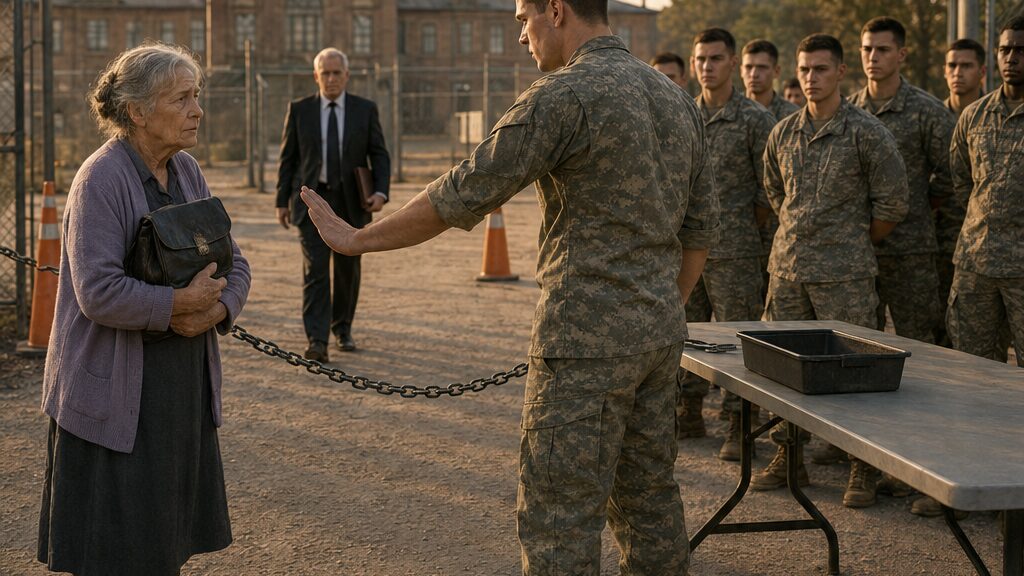
“You can’t cross this line, ma’am.”
The young soldier’s finger stopped inches from Nancy Hall’s chest.
Not at her face. Not at the visitor badge clipped crookedly to her lavender cardigan. At her chest, where both of her hands held the worn black leather bag as if the thing inside it might hear him.
Behind him, orange cones cut a bright crooked path through the dust. A chain sagged between two temporary posts, marking the place where visitors were supposed to stop. Beyond it, soldiers in camouflage moved folding chairs, tied red-white-and-blue bunting to metal railings, and pretended not to watch. But they were watching. Nancy could feel their attention gathering on her shoulders.
The soldier’s name strip read Carter.
He was young enough that his boots still looked newly shaped by regulations instead of weather. His jaw was tight, his sleeves sharp, his posture built for being seen. He had the expression of someone who had been given a small piece of authority and was determined not to drop it.
Nancy looked past his pointing hand toward the old infirmary building at the far edge of the base road.
It was smaller than she remembered.
Or maybe she was.
The white paint had gone thin and gray. A temporary demolition fence stood near one side. In the late afternoon light, the building looked less like a place and more like a memory that had been warned to leave.
“I’m expected,” Nancy said.
Her voice came out rougher than she intended. She had not used it much on the bus ride. She had sat with the bag on her lap, one hand over the cracked clasp, counting the stops and refusing to count the years.
Carter glanced at the tablet in his hand. “Name.”
“Nancy Hall.”
He tapped the screen. “Not listed.”
“Try Hall under Army Nurse Corps.”
His eyes lifted for half a second, then dropped again. “Ma’am, I don’t search it that way. This is a secured preparation area.”
“I understand secured areas.”
A couple of the watching trainees shifted. One of them gave a small breath that might have been a laugh or just surprise. Carter heard it. His neck colored.
“Then you understand you don’t go in without clearance.”
Nancy tightened her left hand around the handle of the bag. It was black leather, old enough that the corners had softened and gone pale. There was a split near one seam she had stitched twice, once with proper thread, once with dental floss in a motel room because she had been too tired to find a store. The clasp did not close unless she pressed it with both thumbs.
“I was told to ask for Robert Lee,” she said.
Carter looked toward the gate booth. “Nobody by that name cleared you.”
“He’ll know.”
“That’s not how this works.”
Nancy let her eyes rest on him then. Not hard. Not pleading. Just long enough for him to decide whether he was speaking to a problem or a person.
Carter chose the problem.
“Step back from the chain.”
The words were not loud, but he put them where everyone could hear.
Nancy did not move.
Dust blew lightly against the toes of her practical black shoes. They had been polished once, before she left home, though the road from the bus stop had taken most of the shine. Her knees ached from the walk. Her shoulder throbbed where the bag strap had pulled. She could have told him that she had stood in worse heat, with worse pain, under worse orders. She could have told him that the base’s old infirmary had once smelled of iodine, boiled coffee, and fear. She could have told him that the building he was guarding from her had once swallowed her whole youth.
Instead she said, “I need to reach that building before morning.”
Carter followed her gaze to the infirmary. “That building is off-limits.”
“It always was.”
He blinked, annoyed by the answer because he could not tell whether it was sarcasm.
A gate sergeant emerged from the booth, looking irritated before he understood the shape of the scene. “Problem?”
“No problem,” Carter said too quickly. “Unlisted visitor attempting entry with a bag she won’t identify.”
Nancy turned her body slightly so the bag rested between her and both men.
“I asked for Robert Lee,” she said.
The sergeant looked at Carter’s tablet, then at Nancy. His expression softened for less than a second, not enough to become help. “Ma’am, if you’re here for the ceremony, public seating opens tomorrow morning.”
“I’m not here for seating.”
“What’s in the bag?” Carter asked.
Nancy’s fingers stopped moving over the cracked clasp.
No one else would have noticed the stillness. Carter did. It sharpened him.
“Ma’am,” he said, louder now, “I asked what’s in the bag.”
Nancy breathed once through her nose. The air tasted of dust and cut grass and diesel from the equipment near the infirmary.
“Something that does not belong on the ground,” she said.
The trainees heard that. One of them looked away.
Carter took a step closer. “Open it.”
“No.”
The word was quiet. It landed harder than she expected.
Carter’s face tightened. “No?”
“It can be inspected privately.”
“It can be inspected here.”
“That would be a mistake.”
He almost smiled, but it did not reach his eyes. “Are you refusing a security inspection?”
Nancy looked again toward the old infirmary. The sun was lowering behind the watchtower, laying long shadows across the road. She had planned to arrive before the ceremony setup, before uniforms and speakers and ropes, before anyone could ask her to explain. But the bus had been late, and then the driver had let her off at the wrong entrance, and pride had made her walk instead of calling the number printed at the bottom of the invitation.
Pride, she thought, was just fear that had learned to stand straight.
“I am asking you not to open it in front of them,” she said.
That was when Carter made his mistake.
He looked back at the watching soldiers.
Nancy saw the decision form in him before he reached for the bag. It was not cruelty alone. It was embarrassment. It was the need to regain control of the scene he had allowed to become uncertain. It was the fear that if he gave one old woman privacy, every young man watching would think he had been moved.
“Place the bag on the table,” he said.
There was a folding inspection table beside the chain line. Its metal legs sank unevenly into the dust. Nancy did not move toward it.
Carter reached for the handle.
Nancy stepped back. Her heel caught a ridge in the dirt, but she steadied herself before anyone could touch her elbow. The bag pressed hard against her chest.
“Please,” she said.
The word made him angrier.
“Ma’am, don’t make this harder.”
“It already is.”
The sergeant murmured, “Carter.”
But the warning came too late. Carter took the bag by the side strap and pulled. Not violently. Not enough to throw her off balance. Just enough to make the watching soldiers understand who had command.
Nancy let go because the alternative was to wrestle a young soldier in the dust.
The instant the bag left her hands, something in her face closed.
Carter set it on the folding table. He flipped the cracked clasp with his thumb. It stuck. He frowned and forced it. The old leather mouth opened with a dry, tired sound.
Inside lay a square of brown cloth, folded around something flat and stiff. Beside it, partly tucked under the cloth, was an old brass key darkened with age. Its tag was brittle, the ink faded but still readable if held close.
Carter lifted the cloth edge.
Nancy looked down, not at him but at the dust between them.
A field medical ledger lay inside, its cover worn soft, its corners rounded by hands long gone. Across the front, faint beneath stains and age, was an infirmary stamp from this base. Not the current logo. An older seal. One Carter had seen only in framed photographs along the administrative hallway.
The sergeant stopped breathing loudly.
Carter’s fingers withdrew from the ledger as if it had burned him.
For the first time since Nancy had reached the chain, he looked at her without the shape of an order already in his mouth.
“What is this?” he asked.
Nancy put one hand on the table, not touching the bag yet. Her fingers were small, the knuckles raised, the nails plain and short.
“That,” she said, “is why I asked for privacy.”
No one moved.
Then a voice came from behind the line of cones.
“That bag should never have been opened here.”
An older man in a dark suit was walking toward them with a folder tucked under one arm, his pace stiff but urgent. The gate sergeant straightened. Carter turned.
Nancy did not.
She knew Robert Lee’s voice before she saw his face, and for one dangerous second, the old infirmary behind him became young again.
Chapter 2: The Name Missing From The List
Andrew Carter found her in the archive system under a name that did not exist on his tablet.
Not the visitor list. Not the ceremony guest roster. Not the temporary clearance file Rebecca Young had approved that morning. The name appeared on an old scanned personnel card Robert Lee had pulled up on the security office computer with two fingers and no patience.
HALL, NANCY. FIELD NURSE ATTACHMENT. TEMPORARY MEDICAL UNIT.
Andrew stared at the grainy image on the screen.
The woman in the old file was not the woman seated beside the wall with her black bag on the metal chair next to her. In the photograph, her hair was pinned under a service cap, her eyes were direct, and her mouth had the unsmiling steadiness of someone accustomed to being useful while afraid. The photo had been taken long before Andrew was born. Long before the base had automatic gates, visitor badges, tablets, or young soldiers told to keep ceremonies clean.
But the eyes were the same.
Andrew hated that he noticed.
Robert Lee stood behind him, still holding the folder that had ended the scene at the chain line. He had not raised his voice. That somehow made it worse.
“You opened her bag publicly?” Robert asked.
Andrew kept his eyes on the monitor. “It was an unverified bag at a restricted entrance.”
“That was not my question.”
The gate sergeant stood near the door with his arms folded. He had the look of a man deciding how much of a mistake belonged to him.
Andrew swallowed. “Yes.”
Nancy sat three chairs away. She had not asked for water. When the security clerk offered it, she thanked him and did not drink. The bag sat close enough for her to touch. She had placed one hand on the chair seat beside it, palm down, as if the leather needed the warmth of her presence.
Andrew could still hear the sound the clasp had made when he forced it open.
He looked away from the bag.
Robert leaned over the desk and tapped the old personnel image. “She was invited through the heritage office. I sent that request myself.”
“Then why wasn’t she in the system?” Andrew asked.
It came out too sharp. He heard it and wanted to pull it back, but pride had momentum.
Robert gave him a level look. “That is what we are about to find out.”
The security clerk clicked through screens. “Her invitation was entered under Nancy Hall. No middle initial. But the old service attachment has her archived under a temporary unit code. The public ceremony list pulled from the donor and family registry, not the medical attachment roster.”
Andrew pointed at the tablet on the desk. “So she wasn’t cleared.”
“She was invited,” Robert said.
“Those aren’t the same thing.”
Nancy’s eyes moved to Andrew then. Not angry. That bothered him more than anger would have.
Robert closed the folder with one hand. “No, they are not. And that difference is exactly how people get erased while everyone claims they followed procedure.”
Andrew felt the gate sergeant glance at him.
He straightened. “Sir, I was assigned to access control because command wanted no mistakes. We have demolition crews, public visitors tomorrow, media, veterans’ families—”
“And an old woman with a bag,” Robert said quietly.
Andrew’s face went hot. “I didn’t know who she was.”
“You did not need to know who she was to treat her privately.”
The office went silent except for the low hum of the air conditioner and the clicking of the clerk’s mouse.
Andrew wanted to say that civilians arrived at gates every week with stories. That some tried to slip into restricted areas for souvenirs, photographs, arguments, protests, attention. That he had been briefed for forty minutes that morning on the consequences of one unsecured item near ceremony staging. That he had only done what the checklist said.
But he remembered Nancy saying, “Something that does not belong on the ground.”
He had put it on a folding table in the dust.
The door opened before he could answer.
Rebecca Young entered with a clipboard pressed to her chest and a phone in her hand. She was dressed in a navy blazer, flats, and the tense expression of someone whose entire day had been eaten by other people’s emergencies.
“I just got a call that there was an access incident,” she said. “Please tell me this is not going to affect tomorrow morning.”
Robert looked at her. “That depends on what you mean by affect.”
Rebecca’s eyes moved around the room: Andrew, the sergeant, Robert, Nancy, the bag. She paused on the bag longer than Andrew expected, then turned back to Robert.
“Mr. Lee, I was told all late additions had to be finalized yesterday. The program is printed. The seating chart is locked. The demolition notice has already been signed. If Mrs. Hall wasn’t on the confirmed roster, I couldn’t leave a space open forever.”
Nancy spoke for the first time since entering the office. “I did not ask for a chair.”
Rebecca’s professional expression faltered. “Ma’am?”
“I said I did not ask for a chair.”
Rebecca looked down at the clipboard as if a chair might still be the answer. “Then what were you requesting access for?”
“The infirmary.”
Rebecca’s mouth tightened. “No one is authorized inside the old infirmary now. It has asbestos warnings, structural concerns, and demolition staging begins in the morning.”
“In the morning,” Nancy repeated.
Rebecca turned to Robert. “This is exactly why the list had to be controlled. We cannot have visitors wandering toward condemned structures.”
“She is not wandering,” Robert said.
Andrew watched Nancy’s hand slide over the bag’s handle.
Rebecca lowered her voice, as though softness could make refusal kinder. “Mrs. Hall, I’m sorry for any confusion, but the ceremony is not inside the infirmary. It will be held outside the memorial board, with limited remarks, wreath placement, and then the demolition crew begins final sealing after inspection.”
“When?”
“Early morning for sealing. Full demolition after the ceremony window.”
Nancy’s face did not change, but Andrew saw the hand on the bag tighten.
Robert opened his folder and took out a printed letter. “I requested special access for her last month.”
Rebecca accepted the page, scanned it, and shut her eyes briefly. “This was never attached to the active event packet.”
“Why not?”
“Because it came through the heritage archive, not base operations. It probably sat in the old email chain.” Rebecca looked at Nancy. “I’m not saying that’s acceptable. I’m saying that’s what happened.”
Andrew expected Nancy to accuse someone. She did not.
She looked toward the dark window, where the reflection of the office showed her seated small and still under fluorescent light, the bag beside her like a second person.
Robert said, “Nancy served in the Army medical attachment connected to that building.”
Rebecca’s eyes returned to the clipboard, then lifted slowly. “You’re a veteran?”
Nancy’s answer was almost too quiet. “I was a nurse.”
Andrew felt the words land in the room. Not like a trumpet. Like a door closing gently on everyone who had spoken too quickly.
Rebecca looked at him then, and he hated the calculation in her face. Not judgment exactly. Damage assessment.
“I need to know if an incident report has been filed,” she said.
Andrew touched the folded form in his cargo pocket. He had started writing it before Robert arrived. Unlisted visitor resisted inspection. Unknown bag opened after refusal. Possible unauthorized archival materials.
He had written the words cleanly. They looked different now.
The gate sergeant noticed his hand. So did Robert.
Rebecca sighed. “If that report goes in as written, her access will be restricted automatically pending review.”
Robert’s jaw tightened. “Then do not file it as written.”
Andrew said, “I have to file something.”
Nancy turned from the window.
“Yes,” she said. “You do.”
No bitterness. No rescue offered.
Andrew looked at her, and for the first time he understood that her silence was not letting him go.
Rebecca checked her phone. “Even if we correct the access issue, it may not matter. The demolition crew is scheduled to seal the infirmary by morning. No one goes in after that without a safety escort, and I do not have one.”
Robert looked at Nancy. “I can try to call the base office.”
Nancy stood slowly.
Her knees did not obey at once, but she did not reach for anyone. She lifted the black bag herself and held it against her chest with both hands.
“Then I have one night left,” she said.
Chapter 3: The Ward Key Wrapped In Cloth
Nancy checked the clasp three times after Robert returned the bag to her.
Once with her thumb.
Once with her forefinger.
Once by pressing the leather mouth closed until the old metal clicked and held.
Only then did she sit in the visitor waiting room outside the archive corridor, where the chairs were hard plastic and the walls displayed photographs of ribbon cuttings, command changes, and units standing in neat rows under flags. She did not look at the photographs long. Photographs liked to pretend everyone had been present, everyone had been named, everyone had been standing when the important things happened.
Robert sat across from her with his folder on his knees.
Andrew stood near the doorway because no one had told him to leave and no one had invited him to stay. That seemed right to Nancy. He was caught between punishment and duty, and she had known many young soldiers who lived there.
Rebecca had gone to make calls. The gate sergeant had disappeared with the security clerk. The hallway smelled of floor wax and old paper.
Robert cleared his throat. “Nancy, I need to document what you brought.”
“No.”
He looked tired. Older than he had looked at the chain line. “I’m not asking to take it.”
“You are asking to turn it into a record.”
“That may be the only way to keep it from being lost.”
Nancy’s hand rested on the bag. Beneath the leather, she could feel the shape of the ledger as surely as if it were against her palm.
“Records are not the same as memory,” she said.
“No,” Robert answered. “But memory dies faster when no record survives.”
That made her look at him.
Robert did not flinch. The Robert Lee she remembered had been young and sharp-shouldered, a lieutenant who once carried messages through crowded wards without stepping on a single blanket laid on the floor. This man had silver hair, a careful gait, and the same habit of saying difficult things without decoration.
“You used to dislike paperwork,” Nancy said.
“I still do. That’s why I know when it matters.”
A faint sound came from the doorway. Andrew shifting his boots.
Nancy looked down at the bag again. The clasp held. The seam near the corner had not split when Carter pulled it from her hands. The cloth inside had not fallen open. The key had not slid to the ground.
Small mercies, she thought, were sometimes only disasters that had missed by an inch.
Robert leaned forward. “Open it here. On your lap. No one touches anything unless you say so.”
Nancy’s fingers stiffened.
“I don’t need an audience.”
Robert glanced toward Andrew. “Carter.”
Andrew straightened. “Sir?”
“You may wait in the hall.”
Andrew’s eyes moved to Nancy, then away. “Yes, sir.”
He stepped backward, but Nancy spoke before he reached the threshold.
“He can stay.”
Andrew stopped.
Robert’s eyebrows lifted slightly.
Nancy did not look at the young soldier. “He has already seen it wrong. He may as well see it correctly.”
The words made Andrew’s face change, not with relief. Something closer to shame having been given a chair.
Nancy placed the bag on her lap and opened it.
This time the leather mouth parted without force. She unfolded the brown cloth slowly, corner by corner. It had once been part of a blanket, army-issue, rough wool cut down and hemmed by hand. A darker patch marked one edge, old enough that it no longer looked like a stain unless a person already knew what stains did to cloth.
The ledger lay inside.
Its cover was gray-green, softened by heat and hands and years. The faded stamp on the front showed the old infirmary mark, and beneath it, in pencil pressed nearly through the paper, someone had written TEMP WARD EAST.
Beside it lay the brass key.
Robert exhaled.
“I thought the ward keys were all turned in before the renovation,” he said.
“They were supposed to be.”
“You kept this?”
“I was given it.”
“By whom?”
Nancy rested the key on her palm. It was smaller than Andrew expected; she could see that surprise on his face. He had probably imagined relics larger. Men often did when they had not yet learned how small the things that carried a life could be.
“The night before we shipped out,” she said. “The ward clerk couldn’t find the officer in charge. Patients kept being moved. The lock on the east room jammed if you used the new key. I had the old one.”
Robert leaned closer but did not touch. “And the ledger?”
Nancy closed her hand around the key.
“The official files were collected later.”
“That doesn’t answer me.”
“No.”
Robert sat back. He looked toward the corridor, then lowered his voice. “Was Benjamin Allen in this ledger?”
Nancy’s fingers closed so hard around the key that the edge bit her palm.
Andrew looked up.
The name had struck him too. Nancy saw recognition pass over his face, quick and uncertain, like a light behind a covered window.
Robert saw it as well. “You know the name?”
Andrew hesitated. “It’s on the memorial wall draft. I saw it this morning on the staging board. Benjamin Allen. Infantry. Deceased in overseas service.”
Nancy almost smiled. Almost.
“That is one way to write him,” she said.
The waiting room seemed to grow smaller.
Robert’s voice softened. “Nancy.”
She opened the ledger.
The pages had browned at the edges. Some were loose. Some bore water rings, thumbprints, hurried notes, vital signs, names, numbers, abbreviations that would mean nothing to anyone who had not once measured a life in pulse, pressure, bleeding, fever, breath.
She turned past pages without reading them. Not because she did not remember, but because she did.
Andrew remained still by the door.
She stopped at a page marked with a folded corner.
Robert leaned forward.
Nancy did not let him see all of it. Her hand covered the lower half before his eyes could settle.
At the top of the entry was the name.
BENJAMIN ALLEN.
The ink had faded to brown. The handwriting was hers.
Andrew took one step before catching himself.
Nancy lifted her eyes. “Do not come closer unless you can do it without looking hungry.”
He froze.
The color rose in his face again, but this time he did not defend himself. “Yes, ma’am.”
The ma’am sounded different now. Not polished. Earned halfway and ashamed of being late.
Robert sat very still. “Why did you bring it today?”
Nancy closed the ledger but kept the key in her palm.
“Because they are tearing the building down.”
“We can preserve the ledger in the archive.”
“That is not why I came.”
“Then why?”
Nancy looked toward the hallway that led, eventually, to the old infirmary road. Somewhere beyond the walls, crews were arranging chairs for a ceremony that would say what fit on a program and leave out what did not.
“I was not invited to be honored,” she said. “I came because I made a promise.”
Andrew’s head lifted slightly.
Robert waited.
Nancy could have said the rest then. The name. The cot. The boy’s hand searching for something to hold. The way the ward lights flickered that night. The way she had written one line because there had been no time for more.
But the words had lived too long in the dark. They did not come just because a room had gone quiet.
Footsteps clicked down the corridor.
Rebecca appeared, phone in hand, face pale with urgency. “We have another problem.”
Nancy folded the cloth over the ledger.
Rebecca looked at the open bag and then at the key in Nancy’s palm. “If those are original base materials and they were removed without authorization, the archive office may require them to be secured tonight.”
Nancy’s hand closed around the key.
Robert stood. “No one is confiscating anything.”
“I’m telling you what legal just told me,” Rebecca said. “If it enters the record improperly, it becomes a chain-of-custody issue.”
Andrew looked from Rebecca to Nancy, and Nancy saw the exact moment he understood that the bag he had opened might now be taken because he had opened it.
From the hallway, a worker called Rebecca’s name. She turned halfway, still speaking. “And Benjamin Allen’s name is already in tomorrow’s ceremony. I need to know why everyone in this room reacted like that changes something.”
Nancy did not answer.
Andrew’s eyes remained fixed on the ledger, now hidden again beneath the old brown cloth.
“I know that name,” he said quietly. “It’s on the wall draft.”
Nancy looked at him, and the key pressed a crescent into her palm.
“Yes,” she said. “But not the way he asked me to remember it.”
Chapter 4: The Memorial Script Left Someone Out
Rebecca Young read the ceremony line aloud, and the old woman’s black bag snapped shut like a reprimand.
“Benjamin Allen, infantry, remembered for courage in overseas service,” Rebecca said, her finger still holding the place on the printed program.
The sound of the clasp made everyone in the staging tent look up.
Nancy Hall sat in the second row of folding chairs, the bag under her seat but close enough that her ankle touched it. Her face had not changed, yet the small force of that closing bag had cut through the tent more sharply than any objection.
Rebecca paused.
Outside, workers were testing the microphone. A short burst of feedback scraped through the morning air, followed by a man saying, “Check, check,” as if every sound could be made orderly by repeating it. Beyond the tent flap, the old infirmary waited behind temporary fencing, its windows blank, its side door streaked with rust near the hinges.
Rebecca looked down at the program again. “Is there an issue with the wording?”
Nancy’s eyes stayed on the page in Rebecca’s hand. “It is clean.”
Rebecca heard the criticism hidden inside the word. She had been hearing hidden criticism all morning. From the base office because the seating chart had changed. From the demolition supervisor because the ceremony schedule had compressed his crew. From Robert Lee because old archives apparently did not match current records. From herself because she had removed Nancy Hall from the confirmed list with one tired click at 11:42 the previous night.
“Clean is usually the goal,” Rebecca said.
“Not always.”
Andrew Carter stood near the tent entrance, hands behind his back, jaw set. He had the rigid stillness of someone trying not to become part of the conversation. Rebecca noticed, with irritation, that he had not stopped watching Nancy since they all left the security office.
Robert sat at the far end of the table with the old folder open before him. The field ledger was not on the table. Nancy had refused to surrender it. Rebecca understood that refusal emotionally, perhaps, but not operationally. Operationally, it was a nightmare.
She took a breath and kept her voice professional. “The ceremony is meant to honor fallen service members connected to the old infirmary site. We cannot rewrite the entire program the morning of the event.”
Nancy looked at her then. “Who wrote it?”
Rebecca glanced toward Robert.
“I assembled the names from verified memorial records,” she said. “Public affairs approved the wording. Families were notified. The base office reviewed it twice.”
“And the people who were carried in but did not die neatly enough for a wall?”
Rebecca’s mouth closed.
The tent shifted around the silence. A stack of folded programs sat on the table between them, each one crisp, each one bearing the base seal and the schedule. Welcome remarks. Historical note. Reading of names. Wreath placement. Moment of silence. Closing.
So clean.
Rebecca had been proud of that cleanliness at midnight, when she finally sent the file to print. Now she saw Nancy staring at it as if it were a freshly painted door over an unmarked room.
Robert folded his hands. “Rebecca, the old medical attachment records are incomplete. Nancy’s ledger may contain entries that were never merged.”
“May,” Rebecca said. “That word matters.”
“It does.”
“If I add unverified material to an official ceremony, I create a record problem.”
Nancy’s eyes dropped to the bag under her chair. “You already have one.”
Rebecca felt heat move up the back of her neck. She wanted to dislike the woman. It would be easier if Nancy were demanding, dramatic, impossible. But she was none of those things. She was worse. She was calm.
Rebecca turned a page on her clipboard though she did not need to. “Mrs. Hall, the ceremony begins in less than three hours. Guests are arriving by noon. The media pool checks in at one. The demolition crew has a safety window. I have six departments expecting this event to proceed as written.”
“And I have a boy in that book who asked not to be made into a line.”
The words did not rise. They did not need to.
Andrew shifted at the tent entrance. Rebecca saw his hand go briefly to his cargo pocket. A folded paper corner showed there: the incident report. She knew the form. Once entered, it would follow Nancy through every access decision left in the day. Unlisted visitor. Refused inspection. Unauthorized materials.
Rebecca had told him to file something. She had meant accurate documentation. She had not considered that accuracy could become another kind of injury if written by a frightened man trying to protect himself.
“Carter,” she said.
His eyes snapped to her. “Ma’am?”
“Have you submitted your report?”
“No, ma’am.”
“Why not?”
His jaw worked once. “It needs revision.”
Robert looked at him, but said nothing.
Nancy did not turn around.
Rebecca saw then that the morning had shifted without asking her permission. The old woman with the bag was no longer merely an access problem. The young soldier was no longer merely the guard who had created one. And the printed program in Rebecca’s hand, which had seemed like the solution to weeks of disorder, had become evidence of what order could leave out.
She sat down at the table.
“I am not cruel, Mrs. Hall,” she said, and hated that she needed to say it. “I know that sounds like something cruel people say before they continue, but I’m telling you because I need you to understand the pressure here. Last year, this base had a ceremony where a family member’s name was mispronounced, and the clip circulated for weeks. The command office blamed public affairs. Public affairs blamed the event team. The family blamed everyone, and they were right. This year, I was told no improvising. No surprise additions. No off-script remarks. No unauthorized access.”
Nancy listened without softening.
Rebecca continued anyway. “If I let this become a dispute over missing names two hours before the ceremony, the people who get hurt first may be the families already coming to hear the names we do have.”
“That is true,” Nancy said.
Rebecca blinked.
Nancy reached down and touched the bag handle. “It is also not the whole truth.”
The answer found a place under Rebecca’s ribs and sat there.
Outside, a truck beeped as it backed toward the infirmary road. The sound repeated, patient and mechanical. Through the tent opening, Rebecca saw the demolition supervisor in a hard hat speaking with two workers near the fence. One of them looped a heavy chain over his shoulder.
Robert stood. “I can take responsibility for a limited addition to the archive note.”
“You can’t authorize ceremony changes,” Rebecca said.
“No. But I can authorize a review of the ledger.”
“The ledger is not in your possession.”
Nancy’s hand remained on the bag. “Nor will it be, unless I know where it is going.”
Rebecca rubbed her forehead once, quickly, before anyone could mistake it for weakness. “Here is what I can do. Mrs. Hall may attend the ceremony in the reserved section as a guest of the heritage office. Afterward, Mr. Lee can initiate a formal review. Until then, she does not enter the infirmary, she does not approach the demolition area, and the program remains unchanged.”
Andrew looked toward Nancy as if waiting for her to object.
Nancy did not speak at once. Her gaze moved beyond Rebecca, beyond the table, beyond the tent fabric stirring in the hot breeze. Rebecca followed it and saw the infirmary side door, the one half hidden by a temporary panel.
When Nancy spoke, her voice was quieter than before.
“So I may sit where you place me and listen while you leave out why I came.”
Rebecca had no answer that did not sound worse than silence.
A worker lifted the chain near the infirmary fence. Metal scraped against metal, and everyone in the tent heard it.
The demolition supervisor stepped into the tent opening, clipboard in hand. “Ms. Young? We’re moving up the safety seal. Doors get chained in two hours.”
Nancy’s hand closed around the bag handle under the chair.
Rebecca saw it happen and knew, with sudden certainty, that the old woman had just stopped asking permission.
Chapter 5: The Door That Remembered Her Hands
Nancy stood before the infirmary side door with the old brass key trembling between her fingers.
The key looked too small for the lock now. Or the lock looked too large because so many years had gathered around it. Paint had bubbled along the frame. A strip of caution tape hung loose from a nail and snapped softly in the breeze. Beyond the temporary fence, the ceremony tent glowed white in the late morning sun, full of voices pretending not to notice that an old woman had walked away from the approved chairs.
“Nancy,” Robert called behind her. “Wait.”
She did not turn.
The black bag hung from her forearm. Its weight pulled at her shoulder, but she welcomed the pain. It told her where she was. It told her this was not memory. Not yet.
Andrew caught up first, boots grinding dust against the broken pavement. He stopped several steps away, breathing hard, as if he had run but was not sure he had the right to arrive.
“Mrs. Hall,” he said. “You can’t open that door.”
Nancy held the key up to the lock.
“I know.”
He looked back toward the tent. Rebecca was coming fast, one hand holding her blazer closed, the other gripping her phone. Robert followed with less speed and more dread.
Andrew lowered his voice. “I can stand by the corner. For a minute. I won’t see anything.”
Nancy turned her head then.
The offer had cost him something. She could hear that. It was a young man’s clumsy attempt at repair, and part of her wanted to accept it because the door was in front of her and time had become narrow.
Instead she said, “Do not lie for me.”
Andrew flinched.
“I’m not—”
“You would be,” she said. “And then this place would have taught you nothing.”
His face changed, not with anger this time. With the sting of being seen too clearly.
Rebecca reached them. “Mrs. Hall, step away from the door.”
Nancy looked at the lock again.
She remembered this door when it had opened inward with a shoulder bump because nurses never had both hands free. She remembered balancing trays of instruments against her hip. She remembered carrying blankets through the gap with her chin pressed into the wool. She remembered young men trying not to cry because the ward was listening.
“Nancy,” Robert said, softer. “If you open it without authorization, they can stop everything.”
“They already have.”
Rebecca’s phone buzzed. She ignored it. “You are putting me in an impossible position.”
Nancy inserted the key halfway.
It resisted.
Her fingers tightened. For one breath she was certain the years had won, that the key had become only a keepsake after all, brass memory with no teeth left for the world. Then she angled it the way her wrist remembered, lifting slightly before turning.
The lock gave.
Not smoothly. Not kindly. It turned with a grinding complaint that ran through the metal frame and into Nancy’s bones.
Andrew’s eyes widened.
Rebecca whispered, “Oh no.”
Nancy pushed the door.
For a moment nothing happened. Then the swollen wood broke its seal with a sound like a long-held breath escaping.
An alarm began inside.
It was not loud at first. A thin electronic pulse, weak and offended. Then it found power and sharpened, echoing through the empty infirmary and out across the yard.
Every head near the ceremony tent turned.
The watching soldiers came again, drawn by sound the way they had been drawn by Carter’s raised voice at the chain line. The demolition supervisor shouted something. A worker dropped a coil of caution tape. The gate sergeant started toward them at a quick walk.
Nancy stood with the open door before her and the alarm ringing over all of them.
Andrew stepped forward, then stopped himself. “Mrs. Hall, if you go in now—”
“I will go in honestly,” Nancy said.
Rebecca stared at her. “That does not make it permitted.”
“No.”
The answer seemed to disarm Rebecca more than an argument would have.
Nancy took the black bag in both hands and crossed the threshold.
The air inside was warm, stale, and layered with old dust. Light came through high windows in flat, pale strips. The hallway was narrower than memory and longer than the building looked from outside. The walls had been stripped of most fixtures, but shadows remained where signs and frames had hung. At the far end, a plastic sheet stirred from the movement of the opened door.
The alarm pulsed overhead.
Nancy’s shoes made small sounds on the floor.
Behind her, voices gathered at the entrance.
“Ma’am, you need to come back out,” the gate sergeant called.
Robert answered him before Nancy could. “Give her one minute.”
“I can’t give her anything with an active alarm.”
Andrew spoke then, surprising Nancy. “I opened her bag in public yesterday.”
The hallway went still except for the alarm.
“That has nothing to do with—” the sergeant began.
“It has everything to do with why she doesn’t trust us to do this right,” Andrew said.
Nancy stopped but did not look back.
Rebecca’s voice came sharper, frightened by the widening circle of witnesses. “Carter, do not make this worse.”
“I already did, ma’am.”
There it was. No speech. No performance. Just the beginning of an admission, made where other soldiers could hear it.
Nancy closed her eyes once.
Then she moved forward.
The old ward lay beyond a pair of double doors that had been wedged open for inspection. Most of the beds were gone. The room had been emptied into a shell, but the floor still bore rectangular scars where cot frames had stood for years. A few old numbers remained painted low on the wall, half covered by later coats, ghost marks for places where bodies had once been placed and moved and counted.
Nancy’s breathing changed.
She hated that it did. She had promised herself she would walk in like a nurse, not a mourner.
The bag knocked softly against her leg.
She passed the first mark, then the second. Some numbers were missing. Some were nothing but scratches beneath peeling paint. She moved along the wall, one hand hovering near it but not touching.
Behind her, Robert entered first. Then Andrew, slow, cap in hand though no one had told him to remove it. Rebecca stayed at the ward doorway, caught between stopping the violation and witnessing the reason for it.
The alarm finally cut off outside, silenced by someone with a code.
The quiet after it rang louder.
Nancy reached the far corner.
There, near the baseboard, under a streak of old beige paint, the number remained.
Not clean. Not preserved. Not honored. Barely there.
But there.
Nancy bent slowly. Her knees protested so sharply that Andrew moved before thinking, one hand out. He stopped when she lifted her palm.
She touched the painted number with two fingers.
The wall was cool.
For a second, the empty ward filled around her: metal frames, damp sheets, the smell of antiseptic fighting a losing battle, distant artillery that did not belong in this room but followed the men into it anyway. A young voice asking if numbers stayed when names did not.
Nancy opened the black bag.
No one spoke.
She took out the brown cloth, unfolded it beside the painted number, and set the ledger on the floor where a cot leg had once stood.
Robert’s voice was hushed. “Nancy.”
She placed the brass key on top of the ledger.
Then she looked at Andrew.
“You wanted to know what was in the bag,” she said. “This is where it belonged first.”
Andrew stared at the number on the wall.
“Cot twenty-seven,” he said.
Nancy nodded once.
Outside, a worker called that the safety seal could not wait much longer.
Inside, Nancy touched the faded number again and found, beneath the dust, the place where Benjamin Allen had once asked her not to let him disappear.
Chapter 6: The Promise Beside Cot Twenty-Seven
Nancy touched the painted number before anyone else entered the circle of meaning around it.
Twenty-seven.
The paint was rough beneath her fingertips, raised at the edge where some long-ago hand had marked the wall quickly and moved on. It had outlasted orders, renovations, ceremonies, rosters, and the people who believed a building forgot once it was emptied.
Her knees ached from kneeling. She stayed down anyway.
The black bag lay open beside her. The field ledger rested on the brown cloth. The brass key sat across the cover like a weight meant to keep the past from closing too soon.
Andrew stood several feet away, one hand in his pocket, gripping the folded incident report he had not yet submitted.
Nancy knew he held it. She could hear paper move when his fingers tightened.
Robert crouched with difficulty near the opposite wall, careful not to crowd her. Rebecca remained at the doorway, phone silent now, clipboard lowered to her side. The demolition supervisor waited outside with two workers and the patience of a man whose schedule had begun costing money.
No one asked a question.
That was wise.
Nancy opened the ledger to the folded page.
The handwriting was smaller than she remembered. That seemed impossible. She had been young when she wrote it, quick and tired and furious at anything that required ink while men needed hands. The page held temperature readings, blood pressure numbers, transfer notes, initials, times. The official language of trying.
At the top: Benjamin Allen.
Andrew took half a step. This time Nancy did not stop him.
“He was nineteen,” she said.
Her voice did not echo. The empty ward held it close.
Robert bowed his head slightly.
Nancy ran one finger along the margin without touching the ink. “He told everyone he was twenty-one because he thought the older boys would stop calling him kid.”
Andrew looked down.
“He had a photograph folded into his boot,” Nancy said. “Not in his pocket. His boot. Said pockets got searched, lost, washed, stolen, but nobody checked a boot unless things were already bad.”
Rebecca’s face changed at the doorway. Not softened fully. Something more uncomfortable than softness.
Nancy turned the page a fraction and stopped. “He came in after midnight. There were too many that night. We made the east ward out of a room meant for storage. Cot numbers were painted because the tags kept getting moved. Twenty-seven was near the corner because the ceiling leaked in the middle.”
The room was still.
Andrew’s hand came out of his pocket. The folded report was crushed in his fist.
“He asked me,” Nancy continued, “whether a name stayed with a man if the papers got wet.”
She had not meant to say it like that. She had meant to remain practical. Names, records, transfer lists. She had not meant to feel again the heat of Benjamin’s fingers around her sleeve.
Robert said quietly, “What happened to his official file?”
Nancy looked at the ledger. “Part of the ward was transferred. Part was shelled. Part burned later. You know how records travel when everyone is alive enough to be moved but not important enough for anyone to stop the trucks.”
Robert did know. She saw it in his face. That was worse than explaining to someone who did not.
“I copied what I could,” she said. “This ledger stayed with me because no one came back for it. Or because I did not try hard enough to give it back.”
“That’s not the same thing,” Robert said.
Nancy almost smiled. “It feels the same if you carry it long enough.”
Andrew unfolded the incident report without seeming to know he had done it. His eyes moved over the lines he had written. Nancy watched him read his own words in the room where Benjamin’s name had nearly been reduced once already.
Unlisted visitor.
Refused inspection.
Unauthorized materials.
He looked ill.
Nancy closed the ledger halfway. “Benjamin knew he was dying before I did. Or before I admitted it. He asked me to write his name where someone would have to see it.”
She touched the wall beside the number.
“I told him the official record would have it.”
Her mouth tightened.
“He said, ‘Official means somebody else remembers. Promise me you will too.’”
No one moved.
Nancy stared at the number until it blurred. She did not wipe her eyes. She had learned long ago that tears demanded attention better spent elsewhere.
“I promised.”
Rebecca stepped into the ward then, one careful step, as if entering a room where people were sleeping.
“But his name is in the ceremony,” she said softly. “It is on the wall draft.”
Nancy looked up at her. “Yes.”
“Then what is missing?”
Nancy folded the ledger cloth back from the lower page and turned it for them to see.
Beneath Benjamin’s name were three other entries marked only by initials, then two described by condition and cot placement because no identification had arrived with them. One had no name at all. Beside those lines, younger Nancy had written, stayed through night. east ward staff present. no transfer.
Rebecca stared.
The printed program in her hand had made fallen men clean by naming only those who fit the record. The ledger did not. It held the unfinished, the unnamed, the tended, the ones whose last proof was that someone had stayed.
“Benjamin did not ask to be famous,” Nancy said. “He asked not to be turned into a number. But I kept the book for him, and in keeping it, I kept the others from everyone.”
Robert’s face tightened. “Nancy, you were trying to preserve it.”
“I was trying not to stand in rooms like this.”
That was the truth she had avoided. Not the only truth, but the one sharpest in her mouth.
She had told herself she carried the ledger because archives failed, because systems lost what was inconvenient, because the dead deserved a witness. All of that was true. It was also true that as long as the book stayed in the bag, she never had to let anyone read the places where she had been young and helpless and unable to save enough of them.
The demolition supervisor appeared in the doorway behind Rebecca. He removed his hard hat without making a show of it.
“Ma’am,” he said, not sure which woman he was addressing, “we have to seal this side before the ceremony crowd moves closer.”
Rebecca did not answer him.
Robert touched the floor with one hand and pushed himself upright. “I can submit the ledger for emergency archival review, but it cannot be publicly added today without verification.”
Nancy closed her eyes briefly.
There it was again. The clean wall. The proper process. The place where truth waited politely until the door was locked.
Andrew’s paper tore.
The sound made everyone turn.
He looked down at his hands as if surprised by them. The incident report had ripped halfway across. He tore it again, deliberately this time, then once more. The pieces shook slightly in his fingers.
Rebecca said, “Carter.”
He did not look at her. “I can write another.”
“That is not how reports work.”
“It is if the first one is wrong.”
His voice was low. Not defiant. Stripped down.
He stepped closer to Nancy, then stopped at the edge of the old cot space. He did not cross it.
“I wrote that you refused inspection,” he said. “I wrote that the materials were unauthorized. I wrote it like you were the problem I handled.”
Nancy watched him.
Andrew swallowed. “That would follow you. Maybe not forever. But enough. And it would sound official.”
The word official sat between them, suddenly heavier than the key.
He looked at the ledger, then at the painted number.
“I don’t know how to fix what I did,” he said. “But I can start by not writing another lie that looks clean.”
Nancy felt the old stubbornness rise in her. The instinct to take the ledger, close the bag, and spare him nothing because he had spared her nothing at the chain line.
Then she saw his hand.
It was young, strong, and ashamed. Ink smudged one finger. Paper dust clung to his palm where he had torn his own protection apart.
Benjamin had been young too. Young and afraid of becoming a line someone else wrote badly.
Nancy lowered her eyes to the ledger.
Robert waited. Rebecca waited. Even the demolition supervisor waited.
Andrew held the torn report pieces at his side like a surrendered weapon.
“What should I write instead?” he asked.
Nancy looked at the old number on the wall, then at the black bag lying open beside it.
For the first time since she had arrived at the base, she did not reach to close it.
Chapter 7: What The Young Soldier Chose To Write
Andrew was ordered to submit his final report before the ceremony began.
The instruction came through Rebecca’s phone while he stood just outside the old infirmary with torn paper still in his hand. She listened, said, “Understood,” twice, and then looked at him with the expression of someone who had run out of room to protect anyone from consequences.
“Carter,” she said. “Command wants the access incident documented now. Not after the ceremony. Now.”
The pieces of his first report felt damp in his palm.
Beyond them, folding chairs had begun to fill near the memorial board. Guests moved in small clusters under the afternoon sun. Some wore dress uniforms. Some leaned on canes. Some held folded programs against their chests. The chain line where Andrew had stopped Nancy the day before still marked the road, though now it looked less like a boundary than an accusation.
Nancy sat on a metal chair in the shade near the tent entrance, the black bag resting on the ground beside her right foot.
Not clutched.
Not hidden.
Andrew noticed that before anything else. The bag sat upright, its cracked clasp closed, its handle tilted toward her but not under her hand. It looked smaller in the open air. Or maybe it looked less suspicious because he had finally stopped needing it to be.
Robert Lee stood with the base archivist near the infirmary door, speaking quietly over the ledger now wrapped again in brown cloth. Rebecca hovered between them and the ceremony area, pulled by every ringing phone, every arriving guest, every problem with a clipboard attached.
Andrew unfolded a clean report form on the hood of a utility cart.
His first version had been easy because it had been written from the safest distance. Visitor unlisted. Refused inspection. Bag opened. Materials discovered.
The clean words had carried no dust, no trembling hand, no old key on a ledger beside cot twenty-seven.
He wrote his name.
Then stopped.
The gate sergeant approached and stood beside him. “Keep it factual.”
Andrew nodded.
The sergeant lowered his voice. “Factual doesn’t mean decorative. Don’t hang yourself trying to sound noble.”
“I’m not trying to sound noble.”
“Good. Because noble reports get rewritten by people who weren’t there.”
Andrew looked toward Nancy.
She was speaking to Robert now. Her hands rested in her lap. Her posture was straight, but not stiff. The black bag sat at her feet as if waiting to be told whether it was still needed.
The sergeant followed his gaze. “You made a bad call.”
“Yes, Sergeant.”
“You also had a reason to inspect.”
Andrew looked down at the blank form. “I had a reason to inspect. Not to make her stand there while I did it.”
The sergeant said nothing.
Andrew began writing.
At approximately 1640 yesterday, I stopped Mrs. Nancy Hall at the temporary access chain after her name did not appear in the active visitor list. I questioned her in public view. When she requested private inspection of her bag, I refused. I opened the bag at the chain line in front of other personnel.
His hand slowed.
He could feel the sergeant reading over his shoulder.
Andrew continued.
The contents were later identified as historical medical records and a ward key connected to the old base infirmary. My decision to open the bag publicly escalated the incident and failed to meet the respect expected when handling personal or service-related materials.
The sergeant exhaled through his nose.
“That last line will travel,” he said.
“It should.”
Rebecca came over before the sergeant could answer. She took the report and read it quickly. Her lips pressed together.
“This creates a problem,” she said.
Andrew waited.
“It creates an accurate problem,” Rebecca amended, and looked almost angry at herself for saying it.
From the ceremony area, someone tested the microphone again. This time the sound was clear. Guests began moving toward their seats. The printed programs were being handed out by two soldiers near the aisle. Andrew watched one guest open a program and scan the names inside.
Benjamin Allen was there.
So were the others who fit the record.
Not the unnamed. Not the ward staff. Not the line Nancy had asked the room to remember.
Rebecca folded the report. “There is still time for a limited statement.”
Nancy looked up sharply.
Rebecca saw it and raised one hand. “Not from the stage, if you don’t want that. But there are ways to acknowledge an archive correction.”
“No,” Nancy said.
Andrew turned.
Nancy’s voice was quiet, but it reached them all. “Do not apologize to me from a microphone.”
Rebecca looked confused. “Mrs. Hall, that isn’t what I meant.”
“It is what it would become.”
Robert said, “Nancy.”
“No.” She bent, picked up the black bag, and set it on the chair beside her instead of against her chest. “That boy in the book is not a prop. Neither am I. If you put an apology into the ceremony, everyone will watch the old woman and the young soldier instead of the names.”
Andrew felt the words hit him in a place worse than blame.
He had wanted, though he had not admitted it, for some visible correction. A moment that would tell the watching soldiers he understood now. A way to stand up straighter inside his shame.
Nancy had seen even that.
Rebecca held the folded report against her clipboard. “Then what are you asking for?”
Nancy looked toward the memorial board. It stood near the chain line, covered in dark cloth until the ceremony. At its base were wreaths, small flags, and a table with stacks of programs too clean to hold what the ward had held.
“One blank line,” Nancy said.
Rebecca blinked. “In the program?”
“In the record first. The printed programs can remain as they are. But the board has a temporary insert panel for today, doesn’t it?”
Rebecca’s eyes moved to Robert.
Robert answered before she could. “There is a removable panel for the historical note. We left space in case the archive office approved a site description.”
Nancy nodded. “Then leave me one line.”
“For Benjamin?” Rebecca asked.
“For him. And not only him.”
Andrew watched Rebecca’s face tighten around the practical difficulty, then loosen around the moral one.
“I can’t add unverified names.”
“I am not asking you to.”
“Then what line?”
Nancy looked down at the bag. She placed her hand on the handle but did not lift it.
“The line I should have given you before I made you all guess.”
Andrew’s report lay between them now, folded beside the black bag on the chair. The sight made him swallow: the paper that told what he had done, and the bag that held why it mattered, touching without either one explaining the other fully.
Rebecca called the base archivist over. Robert spoke with him in a low voice. There was resistance, then a glance toward Nancy, then the weary nod of someone allowing a small truth because the larger one would take months to process.
The ceremony music began, quiet through the speakers.
Guests settled.
The chain line still blocked the road.
Andrew picked up his revised report and held it out to Rebecca. “File this one.”
She took it. “You understand what it says about your conduct.”
“Yes, ma’am.”
“Command may ask why you wrote it this way.”
Andrew looked at Nancy. “Because the first version made me look better than I was.”
Nancy’s eyes met his briefly.
There was no forgiveness in them. Not yet. But there was recognition of the first honest thing he had placed between them.
Rebecca turned toward the memorial table, then stopped. “Mrs. Hall, the blank line needs words.”
Nancy stood slowly. For the first time all day, she did not reach for the bag immediately. She let it rest on the chair, open to view, while she walked toward the board.
“What should it say?” Rebecca asked.
Nancy looked at the covered memorial, at the printed programs in strangers’ hands, at the old infirmary beyond the fence waiting to be sealed.
Then she said, “Give me the pen.”
Chapter 8: The Line She Carried Home
Nancy stood before the blank line and could not write.
The pen was light. Too light for the thing it was being asked to hold. Rebecca had uncapped it for her and stepped back. Robert stood to one side with the base archivist. Andrew waited near the chain line, his revised report no longer in his hands. The ceremony guests had been asked to remain seated while a “brief archive correction” was made, which was Rebecca’s careful phrase for a truth no schedule had expected.
The removable panel lay on a folding table near the memorial board.
At the top, a printed paragraph described the old infirmary as a support facility where service members had received treatment before transfer. Beneath it, Rebecca had left one ruled space.
Nancy’s hand hovered over it.
She had written through shelling. She had written temperatures in the dark. She had written names while men called for water, mothers, wives, brothers, God. She had written Benjamin Allen on a page that should have gone to someone with more authority and less fear.
Now one clean line stopped her.
The black bag sat open on the chair behind her. For once, she was not touching it. The brown cloth lay folded back just enough to show the corner of the ledger. The brass key had already been taken out and rested in Nancy’s cardigan pocket, warm from her body.
A woman approached the edge of the ceremony area, guided by a soldier who spoke softly and pointed toward Robert. She was middle-aged, travel-worn, holding a program bent in one hand. She had the searching look Nancy had seen too many times in hospital corridors.
Robert noticed her first.
The woman spoke to him, and his face changed.
He brought her toward Nancy slowly. “Mrs. Hall,” he said, using the gentleness of warning, “this guest arrived late. She is Benjamin Allen’s surviving relative.”
Nancy’s fingers tightened around the pen.
The woman held the program against her chest. “I’m sorry,” she said. “They told me the seating had already started. I almost didn’t come. I’m from his sister’s side.” Her eyes moved to the panel, then to Nancy’s face. “They said you knew something about him.”
Nancy looked at her and saw no photograph in a boot, no nineteen-year-old trying to pass for older, no hand clutching her sleeve. She saw a living person who had inherited a name with gaps in it.
“I knew him for one night,” Nancy said.
The woman’s mouth trembled with the effort not to ask too much at once.
“One night can matter,” she said.
Nancy looked down.
Yes, she thought. It can ruin a life. It can save one from being lost. Sometimes the same night does both.
The guests had grown quiet. Not the hungry quiet from the chain line, when soldiers had watched to see whether Andrew would win. This was different. Uneasy, respectful, uncertain of what it was being allowed to witness.
Nancy lifted the pen again.
She wrote slowly, because her fingers no longer trusted speed.
Benjamin Allen was known by name at cot 27; others were known by need, by care, and by the hands that stayed.
The line was not enough.
No line would be.
But when Nancy stepped back, it did not look clean. That comforted her.
Rebecca read it once, then again. She said nothing. She only nodded to the base archivist, who lifted the panel carefully as if the ink were not yet strong enough to bear handling.
The ceremony resumed without drama. There was no announcement about Andrew. No public apology. No story made from Nancy’s humiliation. The names were read. Benjamin Allen’s was among them. When it came, the woman from his sister’s side pressed the bent program to her mouth.
Nancy stood near the back, beside the chair with the black bag. Andrew stood several feet away at attention, but not for display. His eyes stayed forward. When the moment of silence came, his shoulders lowered a fraction, as if something hard had finally stopped pushing from inside him.
Afterward, guests moved toward the wreaths and memorial board. Some paused at Nancy’s added line. Some read it and continued. A few touched the panel lightly. No one clapped. No one asked Nancy to stand in front of them and become the lesson.
That was mercy.
The woman from Benjamin’s family found Nancy near the edge of the tent.
“Did he suffer?” she asked, then closed her eyes as if she wished she had chosen different words.
Nancy did not soften the truth into something useless.
“He was afraid,” she said. “And he was not alone.”
The woman nodded once, hard. Tears slipped down her face without sound.
Nancy opened the black bag and took out the ledger. Robert stepped closer, but she held up a hand.
“Not yet.”
She turned to the folded page and showed the woman only what belonged to her: the name, the cot number, the time, the note in the margin written after dawn.
asked to be remembered by name.
The woman touched the edge of the page but did not touch the ink.
“Thank you,” she said.
Nancy almost said she had done nothing worthy of thanks. The old answer rose easily. Too easily.
Instead she closed the ledger and held it against her chest once, not to hide it, but to say goodbye to the part of it that had been hers alone.
Later, when the sun had lowered and the ceremony chairs were being folded, the demolition supervisor opened the infirmary side door for her one final time.
“No more than two minutes,” he said.
Rebecca started to object, then stopped herself. “Two minutes,” she agreed.
Robert walked with Nancy to the threshold but did not follow her inside. Andrew stayed near the chain line. The black bag hung from Nancy’s forearm, lighter now though nothing had been removed except secrecy.
She entered the old ward alone.
The afternoon light came through the high windows in long amber bars. Dust moved inside them like breath. Cot twenty-seven waited in the corner with its stubborn painted number still visible near the baseboard.
Nancy stood before it and took the brass key from her pocket.
For decades, she had believed carrying it was faithfulness. Then punishment. Then proof. Now, in the room where it had once mattered, it became simply a key again.
She set it on the windowsill above cot twenty-seven.
The metal clicked softly against the painted wood.
“I remembered,” she said.
The room gave nothing back. It did not need to.
She closed the ledger, wrapped it in the brown cloth, and placed it in the black bag. This time, when she pressed the cracked clasp, she did not check it three times. Once was enough.
Outside, Robert waited with the archivist. Nancy handed him the bag.
Not all of it. Not forever. The ledger would be copied, reviewed, preserved with her conditions and Benjamin’s family notified before any public display. The bag itself she kept. Empty now except for the worn shape left by what it had carried.
Robert accepted the ledger bundle with both hands.
“I should have found you sooner,” he said.
Nancy looked at him. “I should have answered sooner.”
Neither apology repaired the years. Both were true.
Rebecca approached, holding a corrected archive intake form. “Mrs. Hall, I’ll send you the proof before anything is finalized.”
Nancy nodded.
Rebecca hesitated. “And the access list procedure will change. Heritage invitations will be cross-checked before public events.”
It was a small sentence, nothing fit for a ceremony. It was also the first practical act of respect Nancy had heard from her.
“Good,” Nancy said.
Andrew waited at the chain line as she walked back toward the entrance road.
The same chain sagged between the same posts. The same dust gathered around her shoes. The watching soldiers were still nearby, but they were no longer pretending not to see. They watched quietly as an old woman with an empty black bag approached the boundary where she had been stopped the day before.
Andrew stepped forward.
He did not salute. He did not apologize loudly. He did not ask for forgiveness while others could admire him for asking.
He simply lifted the chain before she reached it and held it aside.
Nancy stopped in front of him.
His eyes met hers. “Mrs. Hall.”
There was more in his face, but he did not make her carry it.
Nancy looked at the chain in his hand, then at the road beyond it.
“Carter,” she said.
His throat moved.
She passed through.
The black bag swung lightly at her side, empty of the ledger, empty of the key, but not empty of meaning. Behind her, the old infirmary stood in sunset light, already half returned to memory. Ahead, the road to the gate stretched plain and dusty and open.
Andrew held the chain until she was well clear of it.
He did not say another word.
The story has ended.