The Young Instructor Mocked An Old Veteran’s Hands Until The Desert Target Came Back Silent
Chapter 1: The Old Rifle Case At Lane Seven
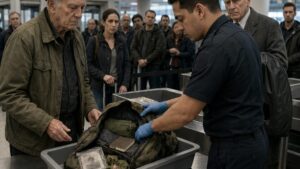
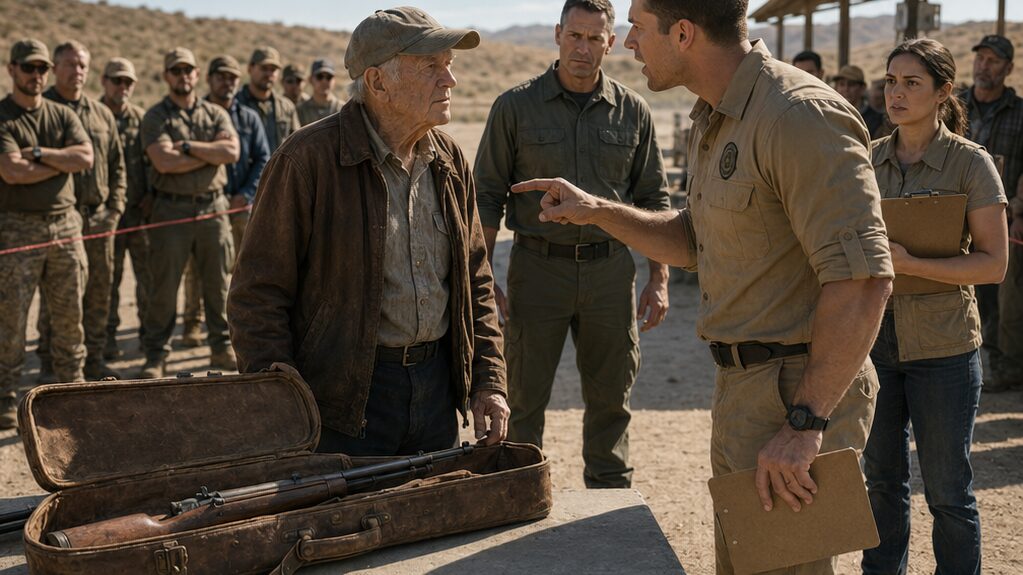
The young instructor put his palm on the old rifle case before Larry King could set it down.
“Sir,” he said, loud enough for the line to hear, “this is not the visitor bench.”
Larry looked at the hand first.
It was a strong hand, clean, sun-browned, with a black range watch strapped tight above the wrist and a small scar across the thumb. The fingers pressed against the brown leather of Larry’s case as if the case were a thing left in the wrong place by mistake. Dust had already settled along its seams. One brass latch was darker than the other. The handle had been wrapped twice in old tape, the kind that no sporting goods store had sold in years.
Larry lifted his eyes to the instructor.
The name strip on the tan uniform read Davis. The badge clipped above it said Instructor. The young man had the sharp posture of someone who knew people were watching and enjoyed it too much to pretend otherwise.
Behind him, the desert range stretched in pale bands: concrete firing line, gravel lanes, sun-baked berms, steel target frames, and wind flags snapping in short, irritated jerks. Beyond the far berm, the land went empty and bright until it disappeared into heat.
Larry had been standing in that heat for six minutes.
He had signed the charity waiver. He had placed a folded receipt in his jacket pocket. He had listened to the range clerk explain the schedule for the memorial shoot even though Larry had read it twice before driving out. He had walked slowly from the check-in canopy to Lane Seven with the old case held at his side.
None of that had drawn attention until Brandon Davis saw him.
Now half the first relay had turned its heads.
“I’m assigned here,” Larry said.
His voice came out softer than the wind.
Brandon gave a quick smile, the kind meant for witnesses. “Assigned by who?”
“The clerk at registration.”
“This lane is for qualified shooters.”
Larry nodded once. “That is what she said.”
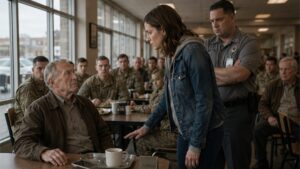
A few trainees shifted behind Brandon. Most of them were young enough to still look new inside their range vests. One woman with dark hair tied back under a cap held a clipboard tight against her chest and watched without blinking. Her vest carried no instructor patch. Her eyes moved from Brandon’s hand on the case to Larry’s face.
Brandon leaned closer.
“Sir, I’m trying to be respectful,” he said, using a tone that made the word respectful sound like a warning. “This is a veterans charity event, but it is still a live-fire range. We have juniors, volunteers, former service members, active security trainees, and invited guests. We do not have time for someone to wander onto the line because he wants a picture with an old rifle.”
The case under his hand creaked as Larry adjusted his grip.
Larry did not pull it away.
He looked past Brandon to the target stands downrange. The wind lifted little sheets of tan dust from the gravel and dropped them again. The flags near the two-hundred-yard berm pointed right, then loosened, then pointed right again with less certainty. A restless morning. Not bad. Just honest.
“I don’t take pictures with rifles,” Larry said.
Brandon’s smile thinned.
A veteran spectator near the shade canopy gave a cough that might have been a laugh. Two trainees looked down. Someone at the far end snapped a magazine into a case with more noise than necessary.
Brandon removed his hand from the rifle case and folded his arms.
“All right. Then let me ask you directly. When was the last time you qualified on a modern range?”
Larry rested the case on the bench.
The bench was too low now. Or maybe he had simply become taller in memory than he was in the morning sun. His knees did not like the bend. His right hand, the one that had held the case for most of the walk, trembled once when he let go of the handle.
Brandon saw it.
His eyes dropped. His mouth barely moved, but Larry caught it before the words came.
“Exactly,” Brandon said.
The old feeling passed through Larry without leaving a mark on his face. Men had always noticed the wrong things first. A patch. A limp. A fresh haircut. A missing one. A hand that shook while reaching for coffee. A hand that stopped shaking when it had a reason.
He placed both palms flat on the case lid until the tremor settled.
“I’m here for the memorial lane,” Larry said.
“The memorial lane dedication is at thirteen hundred,” Brandon replied. “The charity qualification starts now. If you want to watch, the shade canopy is behind the yellow rope.”
“I was told to shoot the morning relay.”
“By the clerk?”
“Yes.”
“She must not have understood.”
Larry almost smiled, but he didn’t. “She understood fine.”
Brandon glanced at the old jacket, the faded cap, the boots polished long ago and scuffed since. His gaze caught on the case again. “What is that, anyway?”
“A rifle case.”
“I can see that.”
“Then I misunderstood the question.”
A short sound moved through the line. Not laughter, exactly. More like air escaping under pressure.
Brandon’s jaw tightened.
“Open it.”
Larry looked at him.
“Safely,” Brandon added, as if catching himself. “Open it safely.”
Larry turned the case so the muzzle end would face downrange when opened. He touched the left latch, then the right. He did not hurry. He did not glance at the crowd. When the lid rose, the smell of old oil and dry canvas came out like a memory that had waited patiently in the dark.
The rifle inside was plain, worn, and clean.
It did not shine. It did not wear the heavy modern furniture Brandon’s rental rifles wore. Its stock showed darkened dents where hands had learned it over years. Its sling was faded at the edges. The metal carried the soft dullness of a tool maintained because it mattered, not because it impressed anyone.
Brandon gave a quiet breath through his nose.
“You brought that to a precision charity shoot?”
Larry checked the chamber before answering. Empty. He angled it so Brandon could see without touching. “I brought what I shoot.”
“That thing is older than half the staff.”
“So am I.”
This time one of the veteran spectators did laugh, a single low sound that died quickly when Brandon turned his head.
The young instructor picked up his clipboard from the bench and tapped it against his thigh.
“Sir, you understand we have standards here. This is not a nostalgia booth. We’re running timed stages after the basic qualification. We have optics checks, safety calls, position transitions, scoring. Nobody gets to hold up a relay because they want to prove a point.”
Larry folded the case lid back until it rested open. Inside the lid, under two loops of worn elastic, lay a folded yellowed card. He touched the edge of it with his thumb, then left it where it was.
“I’m not here to prove a point.”
“Then why are you here?”
Larry’s gaze moved downrange again.
At the far left end of the range, still covered in brown paper, stood a new sign waiting beside a short walkway of swept concrete. Memorial Lane Dedication, the banner above the registration table had said. In honor of service, instruction, discipline, and sacrifice. Larry had read the words and kept walking.
He could still hear another voice in his head from years before. Younger. Laughing. Asking if the wind ever got tired of being blamed for bad shooting.
Larry closed his hand lightly over the rifle’s sling.
“Someone asked me to come,” he said.
Brandon looked around theatrically. “I don’t see anyone claiming that.”
Larry said nothing.
The young woman with the clipboard took half a step forward, then stopped. Her eyes had sharpened with the discomfort of someone watching a thing turn unfair but not yet knowing where to place her courage.
Brandon noticed her movement.
“Amanda,” he said without looking at her, “stay behind the red line.”
She froze.
Larry’s face did not change, but he marked the name. Amanda.
Brandon stepped closer to Larry, lowering his voice just enough to make the insult seem private while keeping it clear enough for the nearest lanes.
“Look, I get it. You probably shot well once. A lot of men did. But that doesn’t mean you walk onto my line with shaking hands and a museum piece and expect me to risk everyone’s morning because your pride got lonely.”
Larry let the words settle.
They were not the worst words he had heard. Not close. But they had a shape he recognized. Pride. Lonely. Old. Risk. The young often believed cruelty became responsibility if spoken in a firm voice.
He removed a small cloth from the case and wiped dust from the rifle’s rear sight.
Brandon waited for an argument.
Larry gave him none.
The wind dragged grit across the concrete. A target frame clattered downrange. Somewhere behind the canopy, a loudspeaker crackled and died.
Larry’s hands moved slowly, but every motion ended exactly where it needed to. Cloth folded. Chamber checked again. Muzzle downrange. Finger clear. Sling free. Nothing extra. Nothing careless.
Brandon watched despite himself.
For one second, his expression changed. Not respect. Not yet. Just irritation at seeing no obvious mistake.
Then he covered it with a laugh.
“All right,” he said, turning toward the trainees. “Everybody pay attention. This is why we verify before we assume. Mr. King here says he belongs on the relay. So we’ll give him a basic handling check before anyone goes hot.”
Larry looked at him. “That isn’t necessary.”
“It is if I say it is.”
The range seemed to quiet around the sentence.
Brandon lifted his voice. “Pick it up, sir. Show us you can still handle it.”
Larry did not move at once.
He looked at the rifle. He looked at the open case. He looked at the folded card tucked inside the lid, its old paper yellow against the brown lining.
Then he took one steady breath, let half of it go, and reached for the rifle as if everyone on the line had disappeared except the target waiting in the heat.
Chapter 2: The Rule Brandon Forgot To Say
Amanda Rivera had been afraid of looking foolish since seven that morning.
She had arrived early, parked too far from the shade canopy, and walked across the gravel with her gear bag knocking against her knee. Everyone else seemed to know where to stand, where to sign, how to joke with instructors, how to check equipment without looking down too often. Amanda had checked the chamber of her borrowed rifle three times before registration and still worried she had done it wrong.
Brandon Davis had noticed her nerves almost immediately.
“Confidence is half the shot,” he had told her, loud enough for the men beside her to hear. “The other half is not thinking too much.”
Amanda had nodded because nodding seemed safer than asking what that meant.
Now, from behind the red safety line, she watched the old man named Larry King lift his rifle from the case with hands that looked too thin for the desert wind. His fingers had age in them. Knuckles swollen slightly, skin marked brown and pale, veins raised along the backs. When he had first placed the case on the bench, those fingers had trembled.
But the tremor was gone now.
Not hidden. Gone.
The rifle came up from the case with its muzzle pointed downrange. Larry’s trigger finger rested straight along the receiver, not near the trigger. His eyes did not search for approval. He moved like a man following a path worn so deep he could walk it in the dark.
Amanda felt something in her own shoulders loosen.
Brandon did not.
“Stop there,” he said.
Larry stopped.
“Action open.”
Larry opened it.
“Show clear.”
Larry angled the rifle without turning the muzzle away from the berm.
Brandon stepped in, looked, then made a small shrug for the benefit of the line. “At least somebody taught you that.”
A few people smiled because they thought they were supposed to.
Larry’s face remained calm.
Amanda’s grip tightened around her clipboard.
She wanted Brandon to stop making the moment bigger than it needed to be. But she also knew why people listened to him. Brandon had the kind of energy that filled a range. He spoke with certainty. He moved quickly. He knew the equipment, knew the schedule, knew the language of qualification and scoring and stages. When he corrected people, he sounded like the range itself had given him permission.
Larry sounded like he did not need permission from anyone.
Brandon pointed toward Lane Seven. “Bench it.”
Larry set the rifle down with the action open.
“Step back.”
Larry stepped back.
Brandon turned toward the rest of the relay. “That, people, is how we begin. Clear firearm, visible chamber, muzzle discipline. Now, once we go live, nobody moves off their mark unless an instructor tells them to move. Nobody loads until I call load. Nobody fires until I call fire. Nobody touches a thing when the line is cold.”
Amanda had heard the rules that morning. She had repeated them under her breath beside her car. Still, she noticed Larry’s eyes narrow almost imperceptibly.
Not in anger.
In attention.
Brandon checked his watch. “We’re behind because of this delay, so we’re going to tighten up. First relay, step to your benches.”
Eight shooters moved forward.
Amanda took her assigned place at Lane Six, immediately to Larry’s right. Brandon had given her that lane earlier, saying it would be easier for him to keep an eye on her. Now she wondered if he regretted it.
Larry stood beside his bench, not touching the rifle.
His open case remained beside him, lid raised. Amanda could see the inside from where she stood: old canvas, oil-darkened corners, a folded yellow card held under elastic. There was something written on it, but the angle hid most of the words.
Brandon walked behind the line with his clipboard.
“Eye protection.”
Glasses went on.
“Ear protection.”
Muffs settled.
Amanda’s heart began thumping inside the sealed quiet around her ears.
Brandon raised one hand. “Load.”
Several shooters reached for ammunition.
Amanda did too.
Larry did not.
His head turned slightly toward Brandon.
At first Amanda thought she had imagined it. Then she saw that Larry’s left hand remained flat at his side. His rifle lay open. Empty. Untouched.
Brandon saw it a second later.
“Problem, Mr. King?”
Larry spoke calmly. “You didn’t call the line hot.”
Brandon stared at him.
The words reached Amanda a heartbeat later, then landed hard.
Brandon had said nobody loads until he called load. He had said nothing about making the line hot. In the morning briefing, another instructor had explained the sequence clearly: eyes, ears, line is hot, load, ready, fire. It had seemed formal at the time, maybe excessive.
Now the missing words felt like a hole in the concrete.
A man two lanes down froze with a cartridge halfway to his rifle.
Amanda stopped with her own fingers inside her ammunition box.
Brandon’s expression flickered.
“It’s implied,” he said.
Larry’s voice stayed even. “Not on a range.”
The wind moved across the line, rattling paper targets far ahead.
Nobody loaded.
Amanda looked at Brandon, waiting for him to laugh it off or bark back. Instead, he glanced down the row, saw every shooter paused, and understood that the old man had not challenged his authority. He had exposed a gap in it.
Brandon’s face reddened beneath the tan.
“Fine,” he said. “Good catch. That is why we stay alert.”
Larry said nothing.
The silence after that was worse than any reply.
Brandon drew himself taller. “The line is hot.”
Only then did Larry reach for his ammunition.
Amanda watched him from the corner of her eye as she loaded her own rifle. One round at a time. The old man’s movements were unhurried. He did not fumble. He did not look triumphant. If anything, he looked slightly tired, as though he wished the rule had never needed saying.
Brandon resumed control with a sharper voice.
“Shooters ready.”
Amanda tried to breathe slowly. Her finger wanted to curl too early. She straightened it along the stock the way she had been told. Her cheek felt wrong against the comb. Her right shoulder tightened.
Larry was not aiming yet.
He had lowered his head slightly, not to the sight but to himself. Amanda saw his chest rise and pause. Then he let out a measured breath, not all of it, just enough. His body seemed to settle around the rifle.
Brandon called, “Fire.”
Shots cracked down the line in uneven bursts.
Amanda flinched at the first one even through her ear protection. Her own shot broke late and low. She knew it before the target told her. Her shoulder jerked. Her breath had caught. Brandon’s voice from that morning rang in her head: Confidence is half the shot.
She fired again too fast.
The second shot felt worse.
Beside her, Larry had not fired.
She blinked and risked a glance.
He was waiting.
Not frozen. Waiting.
His eye remained aligned with the sight, but the rifle did not chase the wind flag or twitch with impatience. He watched something downrange Amanda could not see.
Then the wind flag near the berm slackened for half a second.
Larry fired once.
No drama. No flourish. Just a single controlled crack folded into the larger noise of the line.
He opened the action, breathed, waited.
Amanda fired again and knew she had pulled it left.
Brandon walked behind them, stopping at her lane.
“Too much thinking,” he said near her shoulder.
She swallowed.
At Lane Seven, Larry fired a second time.
Brandon looked over, irritated by the timing.
“You planning to finish today?” he asked.
Larry kept his cheek on the stock. “Planning to finish safely.”
The third shot came only after the dust between the berms shifted.
Amanda did not understand how he could see anything in that shimmer. She only knew that the old man seemed to belong to the pauses more than to the shots.
When the string ended, Brandon called cease fire. Amanda lowered her rifle, opened the action, and stepped back with the others. Her target hung far away, unreadable in the brightness. Larry’s target looked no different from where she stood.
But the line felt different.
People had heard the missing command. People had seen Larry wait. Brandon moved with more force now, as if he could push the morning back into shape by walking harder.
“Actions open,” Brandon called. “Chambers visible.”
He inspected each lane. When he reached Larry, he looked into the open chamber and said nothing.
Larry’s hands rested lightly at his sides.
Brandon lifted his chin. “Cold line.”
This time he said it clearly.
Amanda looked at Larry.
He did not smile.
That made it worse for Brandon somehow.
Down by the shade canopy, a white range truck rolled to a stop in a cloud of dust. The driver’s door opened. A man in a plain field uniform stepped out, close-cropped hair graying at the temples, posture straight without effort. Conversations near the registration table faded as he crossed toward the firing line.
Brandon saw him and stiffened.
Amanda knew the man from the welcome briefing. David Thompson. Senior range officer. The one everyone seemed to lower their voices around.
David walked past the instructors, past the first lanes, past Brandon’s forced nod. He slowed when he reached Lane Seven.
His eyes did not go first to Larry.
They went to the open rifle case.
To the worn latches.
To the folded yellow card tucked inside the lid.
For the first time all morning, Brandon Davis had nothing to say.
Chapter 3: When The Senior Officer Stopped Talking
David Thompson had learned long ago that silence on a firing line was rarely empty.
Sometimes silence meant discipline. Sometimes confusion. Sometimes anger looking for a place to go. As he walked toward Lane Seven, he heard all three layered beneath the wind.
Brandon stood too straight.
That was the first sign.
The second was the way the shooters avoided looking directly at him. They kept their faces forward, but their attention leaned toward Lane Seven as plainly as grass leaning in weather. The young trainee at Lane Six held her clipboard against her vest with both hands. Her eyes moved from Brandon to the old man and then to David, asking a question she did not have the rank to speak.
The old man stood beside an open rifle case.
David had intended to ask for a routine status update. He had been dealing with a late ammunition delivery, a sponsor who wanted photographs before the memorial dedication, and a charity organizer worried that the afternoon wind might ruin the final stage. He had come to the line ready to solve practical problems.
Then he saw the case.
Brown leather. Old tape around the handle. One brass latch darker than the other. Interior lining faded from years of oil and desert dust.
His words stopped behind his teeth.
He had seen hundreds of rifle cases. Thousands. But memory did not work by logic. It took one worn corner, one taped handle, one folded card under elastic, and opened a door without asking permission.
Brandon cleared his throat.
“Sir,” he said. “Minor delay on the first relay. It’s handled.”
David did not answer at once.
The old man turned toward him.
Late seventies, maybe. Faded cap. Brown jacket despite the heat. Pale eyes steady beneath weathered lids. He looked smaller than David’s memory wanted him to look, but time did that. It took broad-shouldered men and folded them inward. It thinned the wrists, slowed the knees, roughened the breath.
It did not always touch the eyes.
David looked at those eyes and felt a name move somewhere deep, not yet reachable.
“Mr. King,” Brandon said, too quickly, “was placed on the relay by registration. I was verifying suitability before we continued.”
The old man gave no protest.
That interested David more than any complaint would have.
“Suitability,” David repeated.
Brandon held his clipboard tighter. “Yes, sir. Age, equipment, pace. We have newer shooters on the line. I wanted to make sure he could safely participate.”
David looked at the open rifle. Empty chamber. Muzzle downrange. Bench clear. Ammunition placed neatly, not scattered. Case positioned correctly. The old man’s trigger finger rested straight even though he was not holding the rifle.
“What happened?” David asked.
Brandon took half a breath. “There was a procedural correction.”
The young trainee at Lane Six looked down.
David saw it.
“From whom?”
Brandon’s jaw flexed. “Mr. King pointed out that I had not formally called the line hot before load.”
David turned to the old man.
Larry King.
The name sat in the air now, but still did not fully open.
“Is that accurate?” David asked.
Larry nodded once. “He corrected it.”
There was no accusation in the answer. No invitation for punishment. That restraint carried weight.
Brandon jumped into the space. “We were not unsafe, sir. The line was controlled. It was an omitted phrase, not an omitted practice.”
David looked at him. “On a range, phrases are practice.”
Brandon’s face tightened.
The wind snapped the nearest flag hard to the right. Downrange, a target frame clicked against its bracket.
David stepped closer to the bench. “May I?”
Larry followed his gaze to the rifle case.
For a moment, something guarded moved behind the old man’s eyes. Not fear. Not guilt. A private reluctance. Then Larry reached into the case, lifted the folded yellow card from the elastic, and held it between two fingers.
He did not hand it over.
David saw only part of the writing.
Block letters faded at the fold. A date from years back. A range grid drawn by hand. Wind notes in pencil. Initials at the bottom.
D.T.?
No. Not his.
The memory opened another inch.
A training day. Heat coming off the berm. A younger version of himself standing behind a line of recruits, frustrated by misses he blamed on wind. An older instructor’s voice behind him, quiet as shade.
You do not beat the wind by shouting at it.
David’s mouth went dry.
He looked from the card to Larry’s face.
Larry returned the card to the case before David could read more.
Brandon noticed. “Sir?”
David forced himself back into the present. He had a line full of shooters, an event schedule, and a young instructor already embarrassed enough to become careless if handled poorly.
“Mr. King,” David said, “do you feel able to continue the relay safely?”
Brandon blinked, surprised by the question.
Larry looked downrange before answering. “Yes.”
“Do you require accommodation?”
“No.”
“A different lane?”
“No.”
Brandon shifted. “Sir, with respect, Lane Seven has the worst crosswind this morning. I assigned it temporarily because—”
“Because?” David asked.
Brandon stopped.
The silence widened.
Larry closed the case lid halfway but left the rifle on the bench, action open. “Lane Seven is fine.”
David studied him.
There were easier choices. He could move Larry to a calmer lane. He could pause the relay and ask for credentials. He could avoid the discomfort building behind Brandon’s eyes and keep the event smooth. That was what senior officers were often expected to do: keep things smooth.
But the old man had not asked to be rescued.
More than that, he had refused it before it was offered.
David turned to Brandon. “What stage were you preparing?”
“Basic qualification, then timed demonstration.”
“Distance?”
“One hundred for this string. Longer lanes after lunch.”
David glanced at the flags. “And Lane Seven?”
Brandon’s voice lowered. “Quartering crosswind, inconsistent. It’s not ideal.”
“For whom?”
Brandon looked at him.
David let the question remain.
The veteran spectators near the canopy had stopped pretending not to listen. The charity organizer stood frozen beside a stack of programs. Even the range clerk had come to the edge of the shade.
Brandon’s authority was still intact, but it had become brittle. David could see the young man’s fear beneath the arrogance now: fear of losing face, losing control, being corrected in front of people he wanted to impress. It was a common fear. Dangerous when mixed with firearms. More dangerous when praised as confidence.
Larry seemed to see it too.
He looked at Brandon, not unkindly. “You can run your line.”
That irritated Brandon more than an insult would have.
“My line is running,” Brandon said.
“Then run it.”
David almost smiled. He didn’t.
Brandon turned away, cheeks darkened by heat and pride. “Fine. Mr. King stays at Lane Seven. Same rules as everyone else.”
“Good,” Larry said.
One word. No victory in it.
David stepped back, but his attention remained on the case. The folded card had disappeared beneath the half-closed lid, yet he could still see its corner, yellow against brown.
He knew that card.
Not exactly. Not enough.
But he knew the habit of it. The hand-drawn grid. The pencil marks. The way old instructors kept weather and performance notes as if paper could hold a man accountable better than memory could.
Brandon raised his voice to restart the relay. It came out clipped.
“Shooters, reset for second string. We are continuing. No one fires until command.”
The shooters moved carefully.
Larry did not touch the rifle yet. He stood behind the bench, eyes on the range, breathing as if waiting for the desert to finish speaking first.
David moved beside Brandon.
“After this string,” he said quietly, “put him on the long-distance lane.”
Brandon stared at him. “Sir?”
“You heard me.”
“With that rifle?”
“With that rifle.”
Brandon looked toward Larry, then toward the wind flags, then back at David. “Lane Seven long-distance is the hardest lane on the range.”
David’s gaze settled on the old case one more time.
“I know,” he said.
Brandon swallowed whatever he wanted to say.
At Lane Seven, Larry King lifted his rifle again. Slow. Careful. Muzzle downrange. Finger clear.
David watched the motion, and the memory finally brought back the voice with it.
Slow is smooth. Smooth is accurate.
The old man placed the rifle into position as Brandon called the line hot, and David understood with a quiet, uneasy certainty that the morning had stopped belonging to the schedule.
It belonged to whatever Larry King had carried back to this range inside that worn brown case.
Chapter 4: The Wind Did Not Care Who Was Young
By noon, the desert had stopped pretending to be gentle.
The flags along the long-distance lanes jerked in different directions, not wildly, but with just enough disagreement to make careless shooters blame the range. Dust lifted in pale ribbons from the gravel and crossed the firing line in broken sheets. Beyond the three-hundred-yard berm, the targets wavered in the heat as if they were floating on water.
Larry King stood behind Lane Seven and listened to the wind.
He did not listen with his ears alone. That had never been enough. Wind said one thing in the flag, another in the dust, another in the dry grass beyond the berm, another in the way a shooter’s jacket moved against the ribs. The young often looked for one answer. Larry had learned to wait until the range stopped arguing with itself.
Beside him, Brandon Davis was making a show of checking the equipment.
He inspected the target screen, the spotting scope, the scoring tablet, and the bench rest Larry had not asked for. He spoke to the trainees as if this were a lesson arranged for their benefit.
“Long-distance work is where modern fundamentals matter,” Brandon said. “Stable platform, consistent data, proper equipment, clean glass, repeatable process. Guessing at the wind is not a plan.”
Larry kept his hand on the old rifle case.
Amanda stood with the second group behind the red line, her clipboard forgotten at her side. David Thompson was farther back, near the shade edge, arms folded loosely, face unreadable beneath the brim of his cap. Several veteran spectators had come closer. Even the charity organizer, who had been worrying over the schedule all morning, now watched without glancing at a clock.
Brandon pointed at Lane Seven.
“Since Mr. King is confident this lane is fine, we’ll let him demonstrate. Five rounds, kneeling supported if he wants it. Same target size as the charity qualifier. No warm-up. No coaching. No equipment substitutions.”
Larry looked at the bench rest.
“No support,” he said.
Brandon’s mouth twitched. “Excuse me?”
“Kneeling is enough.”
The line seemed to inhale.
Brandon glanced at David, perhaps expecting him to intervene. David did not. Larry saw the younger man’s frustration tighten into a smile.
“Your choice,” Brandon said. “But nobody here is going to call it unfair afterward.”
Larry opened the old case.
The rifle lay where he had left it, action open, sling loose, dark wood dull beneath the overhead glare. The folded yellow card remained tucked inside the lid. He did not touch it. Not yet. He lifted the rifle with both hands and felt its familiar weight settle through him.
For a moment, age returned honestly.
His knees ached before he bent them. His right shoulder was stiff from the drive. His fingers complained around the stock, not loudly, but enough to remind him that memory did not make bone young again. He accepted each complaint as information. Nothing more.
Brandon raised his voice. “Observe muzzle discipline. Observe trigger finger. Observe stance. This is a live demonstration, not a performance.”
Larry almost looked at him then.
Not a performance.
Good.
He stepped to the mark. The gravel shifted under his boots. The target downrange was a small pale square with a dark center that wavered in the heat. Three hundred yards was not far by the standards of his old life. It was far enough for pride to embarrass a man.
He lowered himself slowly.
The first bend of the knee drew a flash of pain sharp enough to bring sweat along his neck. He paused with one hand on the rifle, not because he had lost control, but because forcing old joints for the sake of watching eyes was foolish. The desert wind pressed against his jacket. Someone behind him whispered.
Brandon did not whisper.
“We can get you a chair, Mr. King.”
Larry lowered the rest of the way.
One knee touched the mat. The other rose, boot planted. He threaded into the position carefully, not the way a young body dropped, but the way a craftsman sets a fragile instrument where it belongs. Sling set. Elbow placed. Stock seated. Cheek lowered.
The world narrowed.
Not to the target.
To the space between breath and movement.
Brandon’s voice came from behind him, slightly blurred now by Larry’s ear protection. “Shooter ready?”
Larry did not answer immediately.
The wind flag at one hundred yards pointed right. The flag at two hundred fluttered, then dipped. Dust crossed low from left to right near the berm, but higher heat shimmer leaned the other way. The target face trembled in the mirage.
Larry let his breath in.
Not deep. Deep breathing was for people trying to calm themselves after they had already lost calm.
He let half of it out.
“Ready,” he said.
“The line is hot,” Brandon called, very clearly this time. “Load one round.”
Larry loaded.
“Fire when ready.”
No one moved.
Larry waited.
Ten seconds passed. Fifteen. The wind flag snapped right again. Brandon shifted his weight behind him.
“Clock is running,” Brandon said.
Larry heard the young man’s impatience and let it pass. The wind did not care who was young. The target did not care who was loud. A rifle did not care what anyone thought of the hand that held it.
The dust at the berm loosened and fell.
Larry fired.
The shot broke clean.
He opened the action, caught the empty case in his palm, and set it on the mat beside his knee.
Brandon checked the spotting scope.
His face did not change, but his shoulders did.
Larry loaded the second round.
The desert shifted again. The flag at one hundred yards lied first, hard and confident. The two-hundred flag told a smaller truth. Larry watched a thread of dust move near the bottom of the target frame. He adjusted less than a young shooter would have. Less than pride wanted. Just enough.
Second shot.
The spectators heard only the rifle.
Larry heard the silence afterward.
The third round waited longer. The wind started, stopped, came back with a different edge. His knee pulsed with pain now. His right hand wanted to tremble between shots, and he let it. There was no shame in a hand shaking at rest. The shame was in pretending that rest and work were the same thing.
When the sight settled, the tremor ended.
Third shot.
Brandon stepped closer to the spotting scope. Amanda’s eyes followed him.
Fourth round.
Larry remembered a younger man laughing beside this same desert years ago, asking whether the wind ever got tired of being blamed. Larry had drawn a grid on a card then and made the student write what the wind had actually done, not what his pride said it did. That student had become better because he had learned to tell the truth about a miss.
Larry waited until the heat shimmer leaned, held, and softened.
Fourth shot.
The line stayed still.
Even Brandon did not speak.
Larry loaded the fifth round. He felt the ache in his knee deepen and the old rifle settle into the pocket of his shoulder as if both of them had agreed to finish before complaining. The wind tried one more trick across the open lane. He watched it cross the dust, touch the flag, and leave the target face almost untouched.
He smiled faintly, not for the crowd.
For the honesty of it.
Fifth shot.
Larry opened the action, checked clear, and laid the rifle down with the muzzle still pointed toward the berm. Only then did he lift himself from the kneeling position. It took effort. He would not pretend otherwise. One hand pressed against his thigh. His breath shortened. The pain moved from knee to hip and settled there.
No one laughed.
Brandon walked toward the target retrieval controls.
“The target will tell you,” Larry said.
The words were quiet, but they carried.
Brandon paused with his fingers above the button. For the first time that day, he did not answer.
The target carrier began its slow return.
Metal hummed along the cable. The pale square grew larger, swinging slightly in the wind. People leaned without meaning to. Amanda took one step closer to the red line, then caught herself.
Brandon reached for the target when it arrived and lifted it from the holder.
He stared.
The silence changed.
It was no longer waiting silence. It was the silence that came after something undeniable entered the room, except there was no room, only sun and concrete and desert air.
Brandon turned the target slightly, as if angle might alter it.
Five holes sat in a tight cluster near the center, so close that from a few feet away they looked like a single torn dark mark with ragged edges. Not magic. Not impossible. Just disciplined enough that no one on the line wanted to be the first to explain it away.
Amanda’s mouth parted.
One of the veteran spectators removed his cap.
The charity organizer stopped clutching the programs.
David Thompson walked forward slowly.
Brandon held the target with both hands now. His face had gone still in a way that made him look younger, almost unprotected. He looked from the target to Larry, then to the old rifle on the mat, then back to the target.
Larry did not look at him.
He was brushing dust from his knee.
David stopped beside the open case. His eyes lowered to the folded yellow card, now loosened slightly from the elastic by the wind.
The corner had lifted.
Enough of the faded writing showed for him to see the hand-drawn grid.
Enough to see the initials.
David’s voice came low, almost to himself.
“I know that card.”
Larry’s hand stilled over the old rifle case.
Chapter 5: The Name Behind The Range Card
David Thompson did not reach for the card.
He wanted to. The impulse came sharp and immediate, like a young man’s mistake. The yellowed paper lay half-loose inside the old rifle case, one corner lifted by the wind, its pencil lines faded but still legible enough to pull the past closer than David was ready for.
But the card was not his.
So he stood beside Lane Seven and waited for Larry King to decide what the range was allowed to know.
Brandon still held the target.
Nobody had taken it from him. Nobody had needed to. The cluster in the center spoke with more authority than any instructor patch on the line. The young man’s knuckles were pale around the paper. His mouth had opened twice and closed twice.
David had seen men miss before. He had seen men lose. He had seen men humbled by weather, distance, equipment, fatigue, and bad habits. But this was different. Brandon had not simply been outshot. He had been outwaited.
Larry closed the rifle’s action only after checking it again. Empty. Safe. Then he laid the rifle into the case without ceremony.
The movement freed the card from the elastic.
It slid down against the lining and landed faceup.
David saw the name.
Not Larry’s.
His chest tightened.
Corporal Kevin White.
Beneath it, in older handwriting: Wind log, Lane Seven. Correct what you can. Respect what you cannot.
David looked away toward the covered memorial sign near the far end of the range. Brown paper still hid the plaque. The charity organizer had planned to remove it at one o’clock while families, donors, and former unit members stood in a neat semicircle and listened to a short prepared speech.
In honor of Kevin White.
David had approved the wording himself.
He had not known that Larry King would arrive carrying Kevin’s old range card.
Brandon lowered the target slowly.
“Sir,” he said to David, voice quieter than before, “what card?”
David did not answer him.
Larry reached into the case and picked up the yellow paper before the wind could take it. He folded it along the old crease, once, twice, exactly as it had been folded before. His thumb paused on the name.
The crowd remained still.
David said, “You knew him.”
Larry’s face did not harden. It softened, and that was harder to look at.
“I trained him,” Larry said.
The words moved through the line like wind through dry grass.
Amanda glanced toward the memorial sign. Brandon followed her gaze. For a second he looked confused, then memory caught up with him: the programs at registration, the banner, the dedication scheduled for afternoon, the name printed beneath the charity logo.
Kevin White.
David saw Brandon understand that the old man he had mocked had not wandered into the event. Larry had come carrying a piece of the man the event was supposed to honor.
“Why didn’t you say something?” Brandon asked.
It came out defensive, but not as loud as before.
Larry placed the folded card back inside the case. “You didn’t ask who sent me. You asked when I last qualified.”
Brandon flinched as if the words had weight.
David stepped between them slightly, not to protect Larry, but to keep Brandon from trying to repair pride with more words.
“Bring the target,” David said.
He began walking toward the memorial wall.
The group followed without anyone formally dismissing the line. The range clerk came out from the shade. The charity organizer clutched the programs to her chest and hurried ahead, unsure whether she should stop them or let the moment become part of the day. Veteran spectators moved slowly, some with canes, some with folded arms, all drawn toward the covered sign.
Larry carried the old case himself.
David noticed that. Someone offered to take it. Larry shook his head once. The case remained in his hand, heavy enough to pull his shoulder down slightly but not heavy enough for him to surrender.
The memorial wall was a low stretch of sand-colored stone near the administrative building. Brass plaques marked names from past dedications: instructors, volunteers, service members, one civilian coach who had run youth safety classes for twenty-six years. At the center stood the covered new plaque.
The charity organizer looked to David.
He nodded.
She removed the tape and drew the brown paper aside.
Kevin White’s name caught the sun.
For a moment, no one spoke.
David had known Kevin as an adult: calm, exacting, patient with nervous shooters, merciless only toward sloppy safety. Kevin had trained on that range, taught on that range, and spent his last years returning every summer to run the junior program. David had respected him without ever knowing who had first shaped the habits he admired.
He looked at Larry.
“How long ago?” David asked.
Larry set the rifle case on the low stone ledge beneath the plaque. “Long enough that he still thought fast meant good.”
A faint breath of laughter came from one of the veteran spectators. It vanished quickly.
Larry looked at the name on the plaque, not at the crowd.
“He was bright,” he said. “Too bright sometimes. Wanted to solve wind with math before he learned to feel it on his face. Wanted every shot to prove something. I made him keep that card because paper doesn’t flatter a man.”
David remembered Kevin’s old phrase then, spoken to juniors who argued with their targets.
Paper doesn’t flatter you.
He had thought it was Kevin’s line.
Brandon stared at the target still in his hands. The tight cluster at the center seemed suddenly less like an embarrassment and more like a key to a room he had not known existed.
“You were his instructor,” Brandon said.
Larry nodded.
“At this range?”
“Before this building was here. Before half these lanes were poured.”
David felt the past settle into place. The old case. The wind log. The phrase. The careful handling. The refusal to brag. Larry had not come as a competitor. He had come as a man carrying the beginning of another man’s discipline back to the place where it had done the most good.
The charity organizer’s eyes shone, but she wisely said nothing.
Brandon’s face worked through several expressions before landing on resistance. Not disbelief. Something more painful. The need to find a corner of the morning where he was still right.
“He still entered the qualifier,” Brandon said.
David turned slowly.
Brandon swallowed. “I mean, sir, respectfully, the event has scoring. Mr. King shot well. Very well. But one group doesn’t complete the full stage. We still have posted rules.”
Amanda looked at him as if he had dropped something breakable.
David felt anger rise, then checked it. A public crushing would teach Brandon nothing except how humiliation breeds more humiliation.
Larry saved him from answering.
“He’s right,” Larry said.
Brandon looked surprised.
Larry closed the old case latches. One brass click, then the darker one. “A good group is not a completed course.”
David studied him. “You don’t have to do anything else.”
“No,” Larry said. “I don’t.”
There was a firmness in it that made everyone wait.
Larry lifted his eyes to Brandon.
“But if your concern is whether the old man can finish what he starts, I’ll finish the course.”
Brandon’s pride heard permission before his better sense could stop it.
“Final scored stage is at sixteen hundred,” he said. “Timed position transition. Standing to kneeling. Five rounds. Same scoring standard. No exceptions.”
“Brandon,” David said.
Larry raised one hand slightly.
Not to silence David. Not exactly. To spare him.
“I’ll shoot it,” Larry said.
Amanda stepped forward before she seemed to know she had moved. “Mr. King, you don’t have to.”
Larry looked at her, and his face changed in the smallest way. The sternness left his eyes.
“No,” he said. “But sometimes a lesson isn’t finished when people first go quiet.”
Brandon looked away.
The wind pressed the edge of the memorial paper against the stone and held it there. Larry picked it up, folded it neatly, and handed it back to the charity organizer as if order in small things still mattered.
David looked at the target in Brandon’s hands.
“Post it beside the stage board,” he said.
Brandon hesitated.
David’s voice remained calm. “People should know what standard they’re chasing.”
Brandon carried the target toward the board.
He did not walk as tall now, but he still walked like a man trying not to limp from something no one could see.
Larry stayed by the plaque for a moment longer. His fingers rested on the old rifle case. His thumb moved once over the taped handle.
David stood beside him without speaking.
At last Larry said, “He became better than I was.”
David looked at Kevin White’s name.
“Maybe that was the point.”
Larry did not answer.
Across the range, Brandon pinned the target to the stage board. The wind lifted one corner, revealing and hiding the cluster in quick flashes.
Then Brandon turned back toward them, pride not gone, only cornered.
“One final stage,” he called.
Larry picked up the case.
The memorial plaque shone behind him, and the desert wind moved across Lane Seven as if it had been waiting all day.
Chapter 6: One More Shot Was Not For Pride
By late afternoon, Amanda Rivera no longer trusted the word confidence the way she had that morning.
It had sounded clean when Brandon said it. Confidence is half the shot. Confidence keeps you fast. Confidence keeps you from choking.
But from behind the final qualification line, watching Larry King sit quietly with his old rifle case beside his boot, Amanda began to think confidence was too easy a word for what mattered. Brandon had confidence. He had so much of it that it filled every pause before anyone else could learn from one.
Larry had something smaller and steadier.
He had breath.
Amanda watched him breathe while the final stage was set.
The sun had lowered enough to turn the range gold, but the air still held heat against the concrete. Long shadows stretched from the benches toward the red safety line. The final course stood ready across three marked positions: standing, kneeling, and a supported final shot from behind a low barricade. It was not dangerous if run correctly. Nothing on the range was supposed to be dangerous if people respected the rules. But speed had a way of making simple things complicated.
Brandon had explained the stage twice.
His voice had recovered some of its force. Not all of it. The target from Larry’s noon group remained pinned beside the stage board, and no matter where Brandon stood, that torn center watched him.
“This is a timed qualification,” he said. “The purpose is control under transition. You will begin standing with an unloaded rifle, action open. On command, you load one, fire one from standing, open, transition to kneeling, load one, fire one, open, move to barricade, load and fire three. Muzzle downrange at all times. Finger clear during movement. Anyone breaks safety, the run stops.”
He looked at Larry when he said the last sentence.
Larry nodded as if the rule were made of plain sense, not challenge.
Amanda was scheduled two shooters before him.
She wished she had been after.
She wished she had not come at all.
Her morning target had been poor. Not terrible, Brandon had said, but the way he said it made terrible feel kinder. Her second string had improved only because she slowed down when he was not looking. Now the final stage put all her weaknesses into one neat public package: movement, timing, position change, and everyone watching.
The shooter before her finished clean.
“Rivera,” Brandon called.
Amanda stepped forward.
Her hands felt too large and too distant. She checked the chamber, saw empty, stepped to the mark. She heard Brandon’s instructions through ear protection and heartbeat.
“Shooter ready?”
She nodded too fast.
“Stand by.”
The start tone sounded.
Amanda loaded.
Her first shot cracked high. She opened the action, tried to move, felt the sling catch against her wrist, corrected too sharply, and heard Brandon behind her.
“Move, move.”
She dropped toward kneeling.
Her knee hit the mat wrong. Pain flashed. Her support hand reached for the rifle before her body had settled. The muzzle dipped, still downrange but low enough that panic shot through her. She jerked it upward. Her finger, which should have been straight, touched the trigger guard.
“Finger,” Brandon snapped.
Amanda froze.
The line froze with her.
She could feel everyone seeing the mistake before she understood how to fix it. Her breath vanished. The rifle seemed suddenly heavier than it had been all day.
“Open the action,” Brandon said. “Slowly.”
She tried.
Her hand shook too hard. The cartridge did not seat right. Her mind filled with white noise.
Then a voice came from Lane Seven.
“Stop trying to be fast.”
Not loud. Not sharp.
Amanda turned her head slightly.
Larry stood behind his line, not moving toward her, not crossing safety boundaries, his hands visible and empty.
“Keep the muzzle where it belongs,” he said. “Now take your finger away from everything that makes noise.”
Her finger straightened.
“Good. Open the action.”
She did.
The cartridge came free.
“Step back when Brandon tells you.”
Brandon’s face had gone red again, but this time his anger had nowhere simple to land. Larry had not touched her. He had not interfered with the firearm. He had not broken command. He had done what Brandon should have done before speed became panic.
Brandon swallowed. “Step back from the line.”
Amanda stepped back.
Her eyes burned inside the hard press of her glasses.
“I’m sorry,” she said.
Brandon reached for the clipboard. “Disqualified from the scored stage.”
The word hit harder than she expected.
Larry said nothing.
That almost made it worse. Amanda wanted him to defend her, but another part of her knew he would not pretend the mistake had not mattered. Safety was not softened by sympathy.
She walked behind the red line and stood with the failed run sitting heavy in her chest.
Brandon reset the stage with clipped efficiency. The next shooter passed. Then another. The sun dropped lower. The wind eased, then returned in low gusts.
Finally Brandon called, “King.”
The range seemed to gather itself.
Larry picked up his rifle.
Amanda noticed the effort now in every movement because she had learned not to mistake effort for weakness. His knee did not bend easily. His shoulder took a moment to accept the rifle. He checked the chamber with the same care he had shown all day, neither slower nor faster because more people watched.
Brandon stood with the timer.
David watched from the side, silent.
“Shooter ready?” Brandon asked.
Larry looked downrange.
“No.”
A murmur passed behind the line.
Brandon lowered the timer slightly. “No?”
Larry kept the rifle open and pointed downrange. “The barricade mat shifted during the last reset.”
Brandon looked.
A corner of the mat near the final position had folded under, just enough to catch a boot if someone moved quickly. It was small. Easy to miss. Easy to dismiss.
Brandon stared at it.
Larry did not.
The young instructor walked down the safe side after the line was confirmed cold and fixed the mat himself. When he returned, his jaw was tight, but he did not speak.
“Shooter ready?” he asked again.
Larry’s eyes moved briefly toward Amanda.
She felt it like a hand steadying the air in front of her.
“Ready,” Larry said.
The tone sounded.
Larry loaded and fired standing.
Not fast. Clean.
Action open. Finger clear. Muzzle downrange.
He moved to kneeling with visible pain, but no disorder. His knee found the mat. The sling settled. He loaded, breathed, fired.
Action open.
He rose more slowly than the timer wanted.
Brandon’s thumb hovered near the device. Amanda could almost hear his thoughts: too slow, too old, too far behind.
Larry moved toward the barricade.
Then he stopped.
Not because he had stumbled. Not because he had forgotten.
He stopped beside Amanda’s position, where her cleared cartridge still lay in the dust near the edge of the mat. A small thing. Harmless now. But out of place.
Larry looked at it.
The clock was still running.
Brandon’s mouth opened. “Mr. King, continue the stage.”
Larry did not move to fire.
He opened his action fully, checked clear, kept the rifle controlled, then spoke without turning.
“Loose round on the line.”
Brandon looked down.
So did everyone else.
The cartridge caught the late sun and shone in the dust like an accusation.
Amanda’s stomach tightened. She had left it there. In her shame, stepping back, she had not seen it.
The range went still.
Brandon’s face changed slowly, the way the target had changed him at noon. He had missed the folded mat. He had missed the loose round. He had called speed when Amanda needed sequence. Larry had stopped his own timed run for things that could not improve his score but protected the line.
David’s voice came from the side. “Cease stage. Clear the line.”
Brandon repeated the command, quieter.
Larry waited until the line was safe. Only then did the range clerk retrieve the loose cartridge.
Amanda wanted to disappear.
Instead Larry looked at her and said, “That is why we do not rush shame either.”
The words did not excuse her. They gave her a way to stand still beneath the mistake.
Brandon looked at the timer in his hand.
“Run is invalid,” he said, but there was no victory in it.
Larry nodded. “Yes.”
“You stopped before finishing.”
“Yes.”
“You understand that means you forfeit the stage.”
Larry rested the rifle safely against his shoulder, muzzle downrange, action open. “A stage is not worth more than a rule.”
The late sun caught the old rifle case behind him. The taped handle cast a small crooked shadow across the concrete.
For the first time all day, Brandon did not answer quickly.
Amanda looked at Larry’s cleared rifle, the open action, the dust where her cartridge had been, the target from noon still pinned to the board. The old man could have finished. He could have won again. He could have let the score prove one more thing.
Instead he had stopped where everyone could see what mattered more.
David stepped forward. “Mr. King, the line is clear. You may complete the course from the point of interruption if you choose.”
Brandon looked at him sharply, then stopped himself.
Larry looked at the targets glowing in the low light.
Amanda held her breath.
The whole range seemed to ask the same question without speaking.
Would the old man take the chance to finish, or had he already shown them what he came to show?
Chapter 7: The Target Told Them Everything
Larry King looked at the targets glowing in the low light and knew the answer before anyone else did.
He could finish the course. The rifle was clear, the line had been made safe, the stage could be reset from the point of interruption. David Thompson had offered him the chance cleanly, without pity. Brandon Davis held the timer at his side, waiting with the stiff stillness of a man who had not yet learned whether he wanted the old man to succeed or fail.
Amanda Rivera stood behind the red line with her eyes lowered toward the dust where the loose cartridge had been.
That was where Larry looked last.
Not at Brandon. Not at the score board. Not at the target from noon with its tight little cluster pinned where everyone could see it. He looked at Amanda, because shame was a dangerous instructor when left alone.
“I’ll finish,” Larry said.
The range exhaled.
Brandon lifted the timer, then hesitated. “From the barricade?”
“From where I stopped.”
David nodded. “Stage resumes after safety interruption. Shooter will begin at the barricade position. Rifle clear until command.”
Brandon repeated the instruction. His voice was flatter now, stripped of performance. That made it better.
Larry stepped back to the line while the range clerk confirmed the stage. His knee objected with every movement. He had asked enough of it today. More than enough. He could feel the cost rising through his hip into his back, the old arithmetic of a body that remembered more than it could still do easily.
The rifle remembered, too.
It lay open in his hands, plain and worn, neither proud nor ashamed of the attention fixed upon it. Larry checked the chamber again, though he had checked it already. Habit was not suspicion. Habit was how men survived the moment after certainty.
Brandon watched the check.
For once, he did not rush it.
“Line is hot,” Brandon called. “Load on command only.”
The correction landed softly but clearly.
Larry heard it.
So did Amanda.
Brandon’s throat moved. “Load one round.”
Larry loaded.
“Shooter ready?”
Larry settled behind the low barricade. The position was not comfortable. It was not meant to be. The angle pressed his shoulder forward and pulled at his knee. The target waited downrange, blurred slightly by heat and sunset.
He breathed in.
Half out.
“Ready.”
The timer sounded.
Larry fired once.
Open action. Clear. Load.
Second shot.
The wind slipped low across the lane, not enough to matter if a man did not overcorrect. Larry let it pass.
Third shot.
He opened the action and held the rifle clear.
“Cease fire,” Brandon called. “Clear.”
Larry cleared. Stepped back. Waited.
No one moved until Brandon made the line cold.
That mattered more to Larry than the target.
The range clerk brought the target back. It hummed along the carrier, swinging faintly in the cooling wind. The paper arrived with three new holes grouped close enough to the earlier standard that nobody had to ask whether the old man had lost control after stopping.
Brandon removed it from the holder.
His eyes stayed on the paper for a long time.
Then he walked to the stage board and pinned it beneath the first target.
No speech. No flourish.
The two papers hung together in the sunset: one from the long lane, one from the interrupted stage. Both plain. Both quiet. Both more honest than any voice on the range.
Larry set his rifle into the old case.
The brass latch clicked once.
Before he closed the second latch, he removed the folded yellow range card and held it in his hand.
David stepped closer but kept enough distance to leave the choice with him.
The charity organizer had gathered the spectators near the memorial wall. Nobody had planned the dedication this way. The program in her hand was still folded to the prepared remarks, but she did not read them. The day had written over the page.
Larry walked to the plaque for Kevin White.
He moved slowly now. There was no hiding that. The old rifle case hung from his left hand, and the yellow card rested between two fingers of his right. Amanda followed at a distance. Brandon came last, still holding the timer though the stage was over.
At the memorial wall, Larry stood before Kevin’s name.
For a moment, the years returned without sound. A younger man on this same desert. A grin too quick to be careful. A first good group. A first honest miss. A student learning that discipline was not hardness; it was respect made repeatable.
Larry touched the folded card to the top of the stone ledge.
“He kept this longer than I expected,” he said.
David’s voice was quiet. “You gave it to him?”
“I made him earn it.” Larry looked at the pencil lines, the wind grid, the old notes. “Then he made better use of it than I did.”
Brandon stood a few steps away, face shadowed by the lowering sun.
“I owe you an apology,” he said.
Larry turned.
Brandon’s hands were empty now. He had set the timer on the ledge beside the programs. Without it, he looked less like an instructor and more like a young man trying to decide what honesty would cost him.
“I judged you before I checked anything that mattered,” Brandon said. “Your age. Your rifle. Your pace. Your hands.” His eyes flicked to the targets, then back. “I made it about proving control. Mine, not yours.”
Larry waited.
The old habit in him wanted to make it easier for the younger man. A nod. A brief line. A way out. But apology, like marksmanship, lost value when rushed.
Brandon swallowed. “And I pushed speed harder than safety today. Amanda’s mistake was hers, but I helped build the pressure around it.”
Amanda looked up sharply.
Brandon turned toward her. “I’m sorry for that.”
The words did not erase the morning. They did not need to. They only marked the first clean shot Brandon had taken all day without trying to impress anyone.
Amanda nodded once, small but real.
Larry looked at Brandon. “An apology is a start.”
Brandon accepted that with a slight drop of his chin.
“The first rule is respect,” Larry said. “The second is safety.”
Brandon’s eyes lifted.
Larry folded the range card along its old crease. “People argue about which comes first. They belong together. You disrespect a person, you stop seeing clearly. You disrespect the line, you stop thinking clearly. Either way, something gets missed.”
The wind moved across the wall.
No one clapped.
Larry was grateful for that.
He opened the rifle case and took from the inner pocket a cleaner copy of the card, newer paper but the same hand-drawn grid. He placed the original on the stone ledge beneath Kevin White’s name, weighting it with a small smooth rock from the base of the wall.
“For the memorial,” he said to David.
David looked at the card for a long moment. “We’ll protect it.”
“Use it,” Larry said. “Protected things stop teaching.”
David’s mouth tightened with emotion he did not display. “Then we’ll frame a copy and keep the lesson alive.”
Larry nodded.
Amanda stepped forward, hesitant. “Mr. King?”
He turned to her.
She held her hands together, fingers pressed around the place where fear had lived all day. “When I froze, you told me to stop trying to be fast.” She looked toward the targets, then back at him. “Could you teach me the breathing rule?”
Larry studied her face.
In her eyes he saw what he had seen in better students before they became good: not talent, not confidence, but willingness to be corrected without breaking.
He took the copied range card and held it out.
Amanda did not take it immediately.
“Sir, I can’t—”
“It’s a copy,” Larry said. “The paper isn’t the lesson.”
She accepted it carefully.
Larry lifted his right hand. It trembled now, plainly, in the cooling air. He let her see it.
“A hand can shake before,” he said. “Sometimes after. What matters is what you teach it to do during.”
Amanda looked at the hand, then at his face.
Larry took a slow breath in, let half of it out, and held the pause gently.
“Do not trap the breath,” he said. “Do not chase the shot. Let the noise happen after the work is done.”
Amanda tried it once without a rifle. Awkwardly. Honestly.
Larry gave a small nod. “Again later. Not now. Tired people practice mistakes.”
A faint smile touched her mouth.
The sun lowered behind the far berm. The range was no longer bright enough for shooting, only for gathering equipment and carrying home whatever the day had left behind.
Brandon picked up Larry’s final target and brought it to him.
“I thought you’d want this,” he said.
Larry glanced at the paper. The group was good. Not perfect. Good enough to tell the truth.
He shook his head. “Put it beside the other one until the juniors leave.”
Brandon looked surprised.
“They should see both,” Larry said. “The one where the shooting mattered, and the one where stopping mattered more.”
Brandon’s grip tightened gently on the paper. “Yes, sir.”
Larry closed the old rifle case.
The darker latch clicked after the bright one.
He lifted the case from the stone ledge. For a moment, David looked as if he might offer to carry it, then thought better of it. They stood together in the last light, two men separated by years but joined by a line of instruction neither had fully understood until that day.
“You’ll come back?” David asked.
Larry looked at Amanda, who was holding the copied card as if it might blow away. He looked at Brandon, who stood quieter now beside the posted targets. He looked at Kevin White’s name and the original card resting beneath it.
“I came back,” Larry said.
David understood the difference and did not press.
Larry walked away from the memorial wall with the old case at his side. His steps were slow across the gravel. No one moved to stop him. No one called after him. The desert wind followed lightly, lifting dust around his boots, carrying behind him the faint rattle of targets being taken down for the night.
At Lane Seven, the two targets remained pinned to the board.
People passed them in silence.
The story has ended.