The Old Veteran Everyone Moved Aside Until the Shepherd Lay Down at His Feet
Chapter 1: The Man in the Blue Cap at the Rope Line
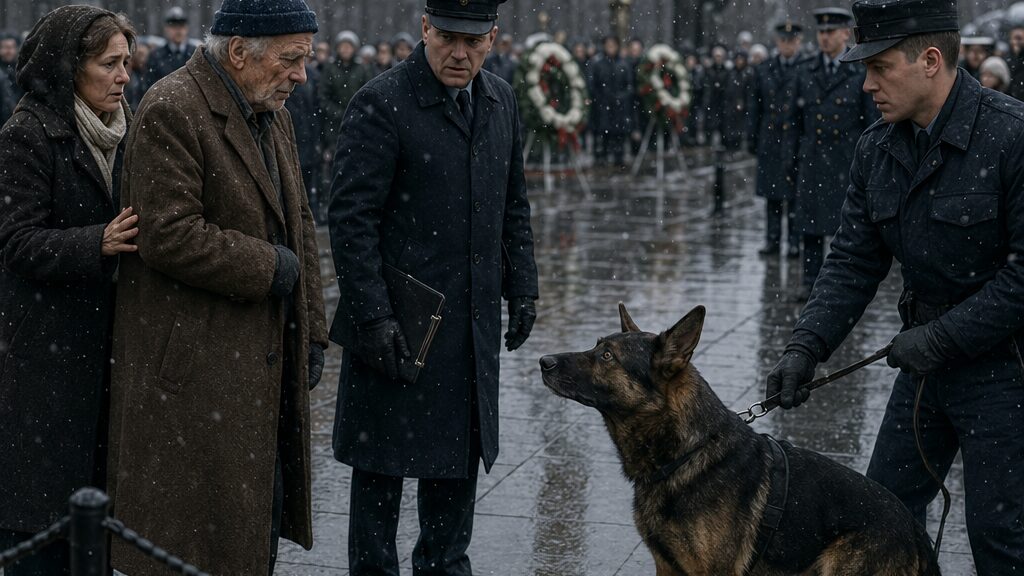
Snow had started before dawn, light enough to drift sideways in the wind but steady enough to soften the edges of the memorial plaza. It gathered on the bronze shoulders of statues, along the black railings, in the folds of wreath ribbons, and on the narrow ropes that kept visitors from stepping onto the ceremonial path.
Joseph Bennett stood at the far end of that rope line with both hands buried in the pockets of his brown wool coat.
His blue knit cap sat low over his ears. The cap had once belonged to Mary’s husband, but she had pressed it into Joseph’s hands that morning with the stern look she used when love came out as orders.
“You’ll wear this,” she had said. “And gloves. No arguing.”
He had not argued. He had dressed slowly, buttoning the coat with fingers that did not always answer on the first try, then folded a dark leather strap twice over and slipped it inside the inner pocket, against his chest.
Now the strap lay there like an old, sleeping thing.
A volunteer in a yellow safety vest hurried past with a box of programs tucked under one arm. “Sir, general seating is back by the heaters.”
Joseph turned his head just enough to show he had heard.
“I’m all right here.”
The volunteer gave him the quick smile people used for the elderly when they did not have time to be patient. “This section’s restricted once the procession starts. Families and invited personnel only beyond this point.”
Joseph looked past the rope toward the wet stone path. The snow melted as it touched the dark surface, leaving a shine that reflected the wreath stands and the gray sky. At the center of the plaza stood a low memorial wall, its etched names dark with moisture. Beyond it, uniformed men and women arranged themselves in quiet lines.
He did not need to be beyond the rope. Not yet.
“I’ll stay here,” he said.
The volunteer hesitated, then glanced behind her. More people were arriving now. Families in heavy coats. Children with red cheeks. Older men with unit caps and careful steps. A few women carried framed photographs wrapped in plastic against the snow. The day had the hushed, organized confusion of public grief.
“Just don’t step through, okay?” the volunteer said.
Joseph nodded.
She moved on before she could notice that he had answered like someone who had spent a life following lines drawn by other people, and crossing them only when something mattered more than permission.
A gust of wind pushed snow under the brim of his cap. Joseph blinked and watched the wreaths being set along the path. Green circles, red bows, white tags clipped to the wire frames. Each one was carried with two hands and placed with rehearsed care. People came to ceremonies for names, he knew. Names made grief manageable. Names told the living where to stand.
He had stayed away from names for a long time.
“Dad.”
Mary’s voice came from behind him, breathless with the effort of finding him through the crowd. She wore a dark coat, a cream scarf, and the worried expression she had inherited from her mother. Her hair, mostly tucked into her hood, had collected tiny beads of snow.
“I turned around for one minute,” she said.
Joseph looked at her, then back toward the path. “I didn’t run.”
“That’s not funny.”
“I wasn’t trying to be.”
Mary softened, but only a little. She came beside him and followed his gaze. “We can sit near the heaters. They said the ceremony will still be visible from there.”
“It’s better here.”
“Better for what?”
Joseph’s right hand tightened around the lining of his pocket. Through wool and cotton, he felt the edge of the folded leather. “Seeing.”
Mary said nothing for a moment. When she spoke again, her voice had changed from complaint to caution. “You didn’t tell me this was a military working dog ceremony.”
“It’s a wreath ceremony.”
“Dad.”
He kept his eyes on the memorial wall.
Mary had learned, over many years, that some doors in her father did not open wider because she knocked harder. When she was young, she had imagined those doors hiding adventure. Later, she had decided they hid pain. Lately, as his hands shook more and his chair at the kitchen table seemed too large for him, she had feared they hid nothing at all but old habit and empty rooms.
“I just don’t want you getting overwhelmed,” she said.
Joseph almost smiled. Overwhelmed was a new word for what people used to call weather, orders, blood, waiting, and the sudden absence of a sound you had counted on.
“I’m all right,” he said.
The plaza loudspeakers crackled once. A coordinator’s voice asked families to gather near the assigned wreath stations. An honor guard crossed the path in measured steps. Their boots struck the wet stone softly, not marching, not casual. Somewhere behind the memorial wall, a dog barked once, sharp and contained.
Joseph’s head lifted.
Mary noticed. “What is it?”
“Nothing.”
But it was not nothing. It was a sound from a place inside him that had remained intact against his will. Not memory exactly. Memory came with pictures. This came with the body: the old tightening between the shoulders, the breath held, the listening for a handler’s command after the bark.
Another staff member approached, older than the volunteer but younger than Mary, with a clipboard in one hand and a radio clipped to his coat. He wore a badge that read EVENT COORDINATOR. His mouth had the fixed line of someone responsible for keeping solemn things on schedule.
“Sir,” he said to Joseph, “I’m going to need this corner clear before the canine procession comes through.”
Mary answered before Joseph could. “We can move.”
Joseph looked at the man’s badge. “What time do they bring the dogs?”
The coordinator checked his clipboard though he surely knew. “In about ten minutes. The working-dog unit comes through before the wreath placement.”
Joseph nodded.
The coordinator waited for him to move. Joseph did not.
“Sir,” the man said, more gently this time, “there’ll be active handlers coming through. These dogs are trained, but we keep the pathway controlled. For everyone’s safety.”
Joseph heard what was under it: old man, narrow path, liability, confusion, problem.
Mary touched Joseph’s sleeve. “Dad, come on.”
Joseph allowed her hand there, but he did not step back. “I won’t be in the path.”
“You’re close enough to make them nervous,” the coordinator said.
“Nervous dogs shouldn’t work ceremonies.”
The words came out before Joseph could decide whether to keep them. The coordinator’s eyebrows moved slightly. Mary’s hand tightened on his sleeve.
“I’m sure you know what I mean,” the coordinator said, less gently.
Joseph turned toward him fully. The movement took longer than he wanted. Age had made even defiance look like hesitation.
“I do,” Joseph said.
That seemed to make the coordinator uncomfortable. He glanced at Mary, as if hoping she would translate him into obedience.
Mary lowered her voice. “Please. It’s cold. Let’s not make this harder.”
There it was again. Harder. As if difficulty itself were the enemy. As if a life should be arranged, in its final stretch, around avoiding anything that pressed too sharply against the heart.
Joseph looked toward the memorial wall. Snow slid down one of the engraved panels in a thin white line. He could not read the names from where he stood, but he knew the section. He had checked once, years ago, online, then closed the laptop before Mary came into the room.
“I came this far,” he said.
Mary’s face changed. Not understanding. Not yet. But she heard something in his voice that belonged to an older version of him, the one who had once lifted her onto his shoulders without wincing and built shelves perfectly level without measuring twice.
The coordinator exhaled. “You can stand behind the second rope. That’s still a good view.”
He gestured to a spot farther back, between a trash bin and a temporary sign pointing toward accessible seating.
Joseph looked at the place. It was not far. Ten steps, maybe twelve. To anyone else it would have meant nothing. But from there, the line of sight to the low wall would be broken by the wreath stands. From there, he would see the ceremony but not the stone.
Mary followed his eyes and finally understood that he was not being stubborn about comfort.
“Is there someone’s name?” she asked softly.
Joseph’s throat tightened. Snow tapped against the brim of his cap and melted on his eyelashes.
The coordinator’s radio hissed. “Canine unit moving to start point.”
He lifted the radio, answered, then looked back at Joseph. “Sir, now.”
Mary stepped closer, ready to guide him. Joseph let her take his elbow because he had learned that refusing help could become its own kind of pride. He moved with her behind the second rope. Each step sent a small ache through his hip. He did not look at the coordinator. He did not look at Mary.
When they reached the new place, Joseph adjusted his coat. The folded leather strap shifted inside his pocket, hard against his ribs.
The crowd settled. Conversations thinned. Children were pulled closer to parents. The honor guard straightened. The wreath ribbons snapped softly in the wind.
At the far end of the path, a uniformed handler appeared.
He was young, square-shouldered under his dark service coat, with a leash held short but not tight in his gloved hand. Beside him walked a German Shepherd, black and tan, head level, ears forward, moving with the contained power of a trained animal that understood both discipline and weather.
Joseph felt the plaza fall away.
Not gone. Not exactly. He still saw the snow and the wreaths, still felt Mary’s hand hovering near his elbow, still heard the speaker’s faint hum. But another path opened over this one, dry dirt instead of wet stone, dust instead of snow, a dog’s flank brushing his knee, a leather lead warm from his own palm.
The Shepherd at the end of the path paused.
The handler gave a quiet correction. The dog did not sit, did not bark. It simply turned its head.
Toward Joseph.
Mary whispered, “Dad?”
Joseph’s hand moved inside his coat until his fingers closed around the folded leather.
The dog stared through the snowfall, ears fixed, body still.
Then it took one step out of line.
Chapter 2: The Shepherd Who Would Not Follow the Leash
Samuel Carter felt the change travel through the leash before he saw it.
Most people thought the leash controlled the dog. Handlers knew better. The leash spoke. It carried questions, warnings, refusals, small storms under fur and muscle. The Shepherd at his side had been steady all morning through trucks, crowds, wreath stands, a brass ensemble warming up badly behind the tents, and children reaching with mittened hands before parents stopped them.
Then, halfway onto the memorial path, the leash went alive.
“Cooper,” Samuel murmured.
The dog did not lunge. That would have been easier to correct. He did not bark or shy away. He halted with such intent that Samuel nearly took another step without him.
The crowd had quieted for the procession. The honor guard stood waiting near the wall. The coordinator, Anthony Reed, made a small impatient gesture from the side of the path: keep moving.
Samuel shortened the lead. “Heel.”
Cooper’s ears stayed forward.
Samuel followed the dog’s gaze and found an elderly man behind the second rope. Brown coat. Blue cap. Dark gloves. Slightly bowed posture. The kind of visitor Samuel had been warned about during public ceremonies—well-meaning, emotional, unpredictable in small ways that could become problems around working dogs.
Beside him stood a woman, probably his daughter, her hand half-raised as if ready to catch him.
“Cooper,” Samuel said again, firmer.
The dog turned its head only a fraction, enough to show he heard, not enough to obey.
Samuel felt heat creep up the back of his neck despite the cold. He had been assigned the lead position because Cooper was reliable and because Samuel was reliable with him. That was what the unit commander had said. Ceremony work was not glamorous, but it mattered. You did not let a dog improvise in front of Gold Star families, retired officers, and three rows of phones pointed at anything that might become a moment.
“Forward.”
Cooper took a step.
Not down the path.
Toward the rope line.
A murmur moved across the nearest spectators. Anthony’s face tightened. Samuel shifted his weight, preparing to bring Cooper back into position, but the dog’s body had changed. He had softened, not with distraction but with recognition. His tail lowered. His head dipped.
The old man did not move.
That bothered Samuel more than if he had reached out or called to the dog. People who wanted attention made themselves visible. They smiled too broadly, clicked their tongues, said, “Here, boy,” as if every dog in uniform were a pet in a park.
This man stood as still as a post in snow.
“Sir,” Anthony said from the path edge, his voice low but sharp enough to carry. “Please keep your hands to yourself.”
The old man looked at him. Not offended. Not submissive. Just aware.
Mary spoke quickly. “He isn’t doing anything.”
“He needs to step back,” Anthony said.
Joseph Bennett heard the words without taking his eyes off the dog.
The Shepherd had a white fleck on his muzzle, small as a snowflake that did not melt. His coat was darker than the one Joseph remembered, his chest broader, his left ear tipped forward with a tiny imperfection, but the eyes had the same old seriousness. Not the same dog. Joseph knew that. Age did not make him foolish.
Still, something in the animal’s stance reached across years and laid a hand on the back of his neck.
Samuel stepped closer, controlled and professional. “Sir, I need you to give us room.”
Joseph looked at the young handler’s grip. Good hands. A little tight, but good. The leash ran from Samuel’s left hand with the thumb locked down. Not a show handler’s hold. A working hold.
“What’s his name?” Joseph asked.
Samuel blinked. “Cooper.”
The name struck Mary before it struck Joseph. She looked from the dog to her father. “Like—”
Joseph shook his head once. Not now.
The Shepherd took another step. The rope trembled where his shoulder brushed it.
“Cooper, heel,” Samuel ordered.
The dog stopped, but he did not turn back. His nose lifted slightly, drawing in the air around Joseph’s coat.
Joseph’s fingers found the leather inside his pocket.
It had darkened with age until it was almost black. The edges were cracked. One brass rivet had a flat scar where it had been struck against stone or metal long ago. The stamped unit mark near the fold was nearly gone, but Joseph could feel the depression with his thumb. He had known that mark in darkness, in rain, with gloves on, with blood on his sleeve, with dust in his teeth.
Mary whispered, “Dad, don’t.”
She did not know what she was asking him not to do. That made the plea harder to bear.
Joseph withdrew his right hand from his coat, but not the lead. He pulled off one glove finger by finger, slow enough that Samuel had time to object.
“Sir,” Samuel said. “Keep your hand back.”
Joseph stopped.
For a moment the old and the young man looked at each other across the rope. Samuel’s face held duty, embarrassment, and the rising fear that the morning was slipping out of his control. Joseph knew that fear. He had seen it on men who had trained for pressure and found that pressure did not always arrive in the shape promised.
Joseph lowered his bare hand to his side, palm inward. Two fingers curved slightly.
It was not a command most people would notice. It was smaller than a wave, quieter than a point. A habit worn down to the bone.
Cooper saw it.
The Shepherd’s ears shifted. His whole body stilled so completely that even the leash seemed to lose weight.
Joseph’s voice came out rough and low. “Easy, boy.”
Samuel felt the leash slacken.
Cooper lowered his head.
“No,” Samuel breathed, not as an order, but as disbelief.
The dog stepped under the rope before anyone could stop him. Not fast. Not disobedient in the wild sense. He moved like he had been released into an older rule than the one Samuel held. His nose touched the air near Joseph’s hand. Then, with a soft exhale visible in the cold, Cooper folded his front legs and lay down on the wet stone at Joseph Bennett’s feet.
The plaza went silent in layers.
First the people nearest the rope. Then the volunteers. Then the photographer, whose camera hung forgotten against his chest. Even the brass ensemble behind the tent seemed to stop testing notes.
Mary covered her mouth.
Anthony’s clipboard lowered slowly.
Samuel stood with the leash in his hand and no command in his throat.
Joseph looked down at the dog. Snow gathered along Cooper’s back and vanished into the dark fur. The dog rested his chin near Joseph’s boot, eyes lifted, waiting.
Joseph bent with care. His hip protested. His knees complained. Mary reached for him, but he raised his left hand just enough to stop her.
He touched Cooper’s head with two bare fingers first, as if asking permission from the animal.
Cooper’s eyes closed.
Joseph’s hand settled, thin and spotted with age, against the Shepherd’s skull. He rubbed once behind the ear. The dog leaned into it, almost imperceptibly.
“That’s it,” Joseph whispered. “That’s it.”
Samuel heard the words and felt something inside him give way.
He had seen Cooper ignore food, sirens, shouting, crowds, and once a loose terrier that had charged him outside a school demonstration. The dog did not break position for sentiment. He did not lie down at strangers’ feet. He certainly did not answer unissued commands from old men behind rope lines.
Samuel looked at Joseph’s hand.
Not the hand on the dog. The other one.
Joseph’s gloved left hand had returned to his coat, not inside the pocket but over it, guarding something there. The coat had opened slightly when he bent, and Samuel caught sight of a strip of dark leather tucked against the lining.
For a second, it meant nothing.
Then the fold shifted. A worn brass rivet caught the gray light. Beneath it, stamped into the leather so faintly Samuel almost missed it, were three characters from an old working-dog unit mark he had seen once in a framed training manual: K-9.
His mouth went dry.
Anthony came closer, careful now. “Carter?”
Samuel did not look away from the leather. “Wait.”
The single word changed the air more than a command would have.
Anthony stopped.
Joseph continued to stroke the dog’s head. There was no triumph in his face, no pleasure at having made the ceremony pause. If anything, he looked stricken by what had happened, as though the dog had opened a door Joseph had spent years holding shut.
Samuel lowered his voice. “Sir.”
Joseph looked up.
This time Samuel did not say step back. He did not say keep your hands away. He did not say regulations or safety or active dog.
He stood straighter, not stiffly but with care, as if something in the old man’s presence required him to correct himself before speaking.
“May I ask your name?”
Mary looked at Samuel then, startled by the change.
Joseph’s hand rested still on Cooper’s head. The Shepherd did not move.
“Joseph Bennett,” he said.
Samuel repeated it silently. Joseph Bennett. He knew the name only as a shape of familiarity, the way a half-remembered line from a training story could return without its meaning. Bennett. Working dogs. Old unit notes. A handler whose methods were still quoted without a first name attached.
Anthony took another step. “Mr. Bennett, we need to continue the ceremony.”
Samuel turned his head. “Give him a minute.”
Anthony stared at him. “We’re on schedule.”
“Give him a minute,” Samuel said again.
This time there was no impatience in it. Only certainty.
Joseph’s fingers tightened once in Cooper’s fur, then released. He forced himself to straighten. Cooper lifted his head but remained lying down.
“Up,” Samuel said gently.
Cooper did not move.
A faint tremor passed through the gathered people, not laughter, not shock exactly. Something softer and stranger.
Joseph looked at the dog, then at Samuel. “He heard you.”
“I know.”
“He’s choosing.”
Samuel swallowed.
Joseph bent his head toward Cooper. He made that tiny two-finger motion again, smaller than before, and said, “With him.”
Cooper rose at once and stepped back to Samuel’s side.
The sound that moved through the plaza was barely a sound at all. Breath. Realization. The collective understanding that something had happened, though no one yet knew what to call it.
Joseph pulled his glove back on with slow, clumsy care.
The ceremony did not resume immediately. Anthony was speaking into his radio in a lowered voice. Mary stood close to Joseph, but she no longer touched his elbow.
Samuel gathered the leash, then glanced once more at the opening in Joseph’s coat.
The leather fold had disappeared back into shadow.
But Samuel had seen enough to know that the dog had not made a mistake.
And not enough to know why.
Chapter 3: A Name Samuel Was Not Supposed to Know
The side tent smelled of wet canvas, coffee, and pine branches.
Portable heaters hummed in the corners, turning the cold air damp instead of warm. Folding chairs lined one side, most of them occupied by family members waiting for their part of the ceremony. A table near the entrance held programs, extra gloves, a stack of small flags, and a box of tissues no one wanted to be seen reaching for.
Joseph stood near the back of the tent, refusing a chair.
Mary had brought him there after the dog incident, not by pulling him this time, but by walking beside him as if she had forgotten the old habit of steering. She kept looking at him when she thought he would not notice. He noticed every time.
“Dad,” she said quietly, “do you want to sit?”
“No.”
“Coffee?”
“No.”
“Your hand is freezing.”
Joseph pulled the glove tighter over the fingers he had exposed to touch the dog. “It’ll warm.”
Mary folded her arms around herself. She wanted to ask too many things. He could feel them crowding her throat. When she had been a child, questions had spilled out of her faster than answers could form. Why did dogs tilt their heads? Why did Mom cry after certain phone calls? Why did he never hang photographs from his service years in the hallway like other fathers from church did?
He had been careful with what he gave her.
Too careful, maybe.
Across the tent, Samuel Carter spoke with Anthony Reed in voices low enough not to disturb the families but sharp enough for Joseph to read the shape of disagreement. Samuel still held Cooper’s leash. The Shepherd sat against his left leg, calm now, but his eyes returned again and again to Joseph.
Anthony looked over once and caught Joseph watching. His expression shifted into professional politeness.
“I don’t like surprises during formal movements,” Anthony said to Samuel. “Especially with a crowd this size.”
“He knew a field signal,” Samuel answered.
“A lot of older veterans know dog commands.”
“Not that one.”
Anthony glanced at Cooper. “The dog broke formation.”
“The dog recognized something.”
“The dog smelled leather and got sentimental?”
Samuel’s jaw tightened. “Working dogs don’t get sentimental because of old leather.”
Joseph almost smiled at that. Almost.
Samuel lowered his voice further. “There’s a unit stamp on the lead in his coat.”
Anthony paused. “What lead?”
“He’s carrying one. Old. Not decorative.”
“That doesn’t mean—”
“I’ve seen that mark.”
Anthony rubbed a hand over his mouth, then looked toward the far end of the tent where Benjamin Harris stood with a paper cup of coffee, speaking to a widow in a navy coat. Benjamin was tall and thin, with a retired chaplain’s habit of listening with his whole face. His hair had gone white around the temples, and his black overcoat hung from him like it remembered a broader man.
Anthony crossed to him. Samuel followed.
Joseph turned slightly away, but his hearing, inconveniently, remained better than people assumed.
“Chaplain,” Anthony said, “do you know a Joseph Bennett?”
Benjamin’s head lifted.
It was the smallest movement, but Joseph saw the answer before the man gave it.
Benjamin looked past Anthony to Joseph. Their eyes met across the tent. Not surprise. Not exactly recognition either. More like the careful sadness of a man who sees a name step out of an old file and into weather.
“I know of him,” Benjamin said.
Samuel’s grip shifted on the leash. “Sir, was he military working dog?”
Benjamin did not answer quickly.
Anthony said, “We need to know whether this affects the ceremony.”
Benjamin’s gaze remained on Joseph. “Everything affects a ceremony. The question is whether you let it.”
Anthony frowned. “Sir.”
Benjamin sighed softly. “Joseph Bennett served before most of the people here were born. He worked dogs when the program still depended more on instinct than manuals. I have seen his name in records.”
Mary had heard enough to turn fully toward her father. “Records?”
Joseph looked at the heater in the corner as if its orange coils required his attention.
Samuel asked, “Why isn’t he on the guest list?”
“Because he likely didn’t ask to be,” Benjamin said.
Anthony’s face settled into discomfort. “If he has a service connection, we can arrange acknowledgment.”
“No,” Joseph said.
The single word crossed the tent and stopped them all.
Mary looked wounded by how quickly he had spoken, as though the refusal had been aimed at her.
Joseph took one step toward the men. Cooper rose without command. Samuel glanced down but did not correct him.
“No acknowledgment,” Joseph said.
Anthony recovered first. “Mr. Bennett, if there was an oversight—”
“There wasn’t.”
Benjamin studied him. “You came for the wreath.”
Joseph’s left hand moved to his coat pocket.
Mary saw it now because she knew to look. “What are you carrying?”
Joseph did not answer.
Samuel stepped closer, careful to leave space. “Sir, I saw the lead.”
The word landed harder than Joseph expected. Lead. Not leash. A leash was what civilians called it, what people bought at pet stores and hung by the back door. A lead was a line of trust between a handler and a dog, a conversation made of leather, pressure, release, and breath.
Mary’s eyes dropped to his coat.
“Dad?”
Joseph felt the old anger stir, not at her, not at Samuel, but at the way the past could be summoned by one correct word after years of obedient silence.
“It’s mine,” he said.
Samuel nodded. “Yes, sir.”
Sir.
Anthony heard it too. He looked at Samuel sharply, but Samuel kept his eyes on Joseph.
“I’m not asking to take it,” Samuel said. “I just need to understand what Cooper responded to.”
Joseph looked down at the Shepherd. Cooper stood beside Samuel, but his weight leaned subtly toward Joseph, as if the leash ran two directions now.
“He responded to training,” Joseph said.
Samuel waited.
Joseph’s mouth tightened. That had been too much already.
Benjamin came closer, holding his coffee in both hands. “Joseph, they don’t need the whole story.”
“No one does.”
“No,” Benjamin said gently. “But some people may need enough to stop doing the wrong thing.”
Joseph looked at him then. The chaplain’s words had no accusation in them, which made them harder to dismiss.
Anthony cleared his throat. “Mr. Bennett, I apologize if you were treated abruptly outside. We have safety protocols.”
“I know what protocols are.”
“Yes, sir.”
It came awkwardly from Anthony, less natural than Samuel’s, but not false.
Mary stared at her father as though pieces of furniture in a familiar room had begun moving on their own. “Why didn’t you tell me you worked with dogs like Cooper?”
Joseph’s face changed at the name.
Samuel saw it. “Cooper was named after a handler. Not officially, maybe. The unit kept the name alive. Our dogs come through lines with old call signs sometimes.”
Joseph looked at the dog. “He shouldn’t have that name.”
Samuel did not know what to say.
Anthony’s radio crackled. “Five minutes to wreath placement reset. Need canine unit ready.”
He lifted the radio but did not answer at once. His eyes moved from Joseph to Cooper to Benjamin, calculating schedule against something he had not expected to weigh.
“Can the dog continue?” Anthony asked.
Samuel looked down at Cooper. “Yes.”
Benjamin said quietly, “The question is whether Joseph can.”
Mary stepped closer to her father. “Can you?”
He wanted to be annoyed at her for asking in front of them. He wanted to say of course, to make his body straighten and his voice hard enough that all of them would remember he had once been more than careful steps and cold fingers.
But Cooper was watching him.
That dog, with another dog’s name.
Joseph looked toward the tent opening. Through it he could see the memorial path, the wreaths waiting in snow, the low wall beyond them.
“I can stand where I was told to stand,” he said.
Samuel’s eyes narrowed slightly, not in suspicion but in attention. “Where did you want to stand?”
Joseph did not answer.
Mary did. Her voice was soft. “Where he could see the wall.”
Anthony shifted his weight. “The families have assigned positions.”
“I’m not family,” Joseph said.
Benjamin looked at him for a long moment. “That depends on what you mean by family.”
The old irritation rose again. “Don’t.”
Benjamin lowered his eyes, accepting the boundary.
Samuel understood then that the mystery was not just the old lead or the dog’s reaction. It was the way every path around Joseph seemed to end at a closed gate.
He took a breath. “Mr. Bennett, I don’t know what your connection is to Cooper’s line. I don’t know why he responded like that. But I know my dog. He didn’t mistake you for someone else.”
Joseph’s hand tightened over his pocket.
Samuel continued, quieter. “If you tell me where you need to stand, I’ll ask.”
Anthony gave him a warning look. “Carter.”
“I said I’ll ask.”
“That’s not your call.”
“No,” Samuel said. “It’s his.”
The tent fell quiet around them. A woman seated nearby lowered her program and looked over. The heater hummed. Outside, a command was given, faint through the canvas.
Joseph felt Mary watching him, waiting not with pressure now but with something more dangerous: hope.
He could have ended it there. He had ended larger things with less. A nod, a denial, a step backward. He had built the second half of his life out of not troubling people with the first.
But the dog had lain down.
Joseph drew the folded leather lead halfway from his coat.
It emerged dark, cracked, and plain. No medal hung from it. No polished tag. Just leather worn smooth where a man’s hand had held it too often, and a brass rivet dulled by years.
Samuel’s expression changed. Not excitement. Recognition, but incomplete.
“There’s a stamp,” Samuel said.
Joseph folded the leather back before he could lean closer. “There used to be.”
“May I—”
“No.”
Samuel stopped immediately. “Yes, sir.”
That mattered. Joseph hated that it mattered.
Anthony, to his credit, said nothing.
Benjamin spoke only after Joseph had returned the lead to his coat. “He is not here to be announced.”
Samuel looked at Benjamin. “Then why is he here?”
Benjamin’s face carried the answer and refused to give it away.
Joseph turned toward the tent opening. “Because I kept something too long.”
Mary inhaled softly.
Before anyone could ask, a young officer appeared at the entrance. “Mr. Reed, they’re ready for the canine wreath.”
Anthony looked from the officer to Joseph. The schedule had returned, indifferent as weather.
Benjamin stepped beside Samuel and spoke so low only he and Anthony could hear.
“Do not make him tell that story in front of a crowd.”
Chapter 4: Mary Thought She Was Protecting Him
Mary Cooper had spent the last three years learning the small mathematics of her father’s limits.
How many stairs before his breath changed. How long he could stand before his left hand began searching for something solid. Which mugs he could grip safely. Which chairs were too low. Which questions made him disappear into himself even while his body remained at the table.
She had not thought of it as control.
She thought of it as love with a calendar, love with pill bottles, love with weather reports checked before sunrise. She knew when ice made the porch dangerous. She knew which grocery aisles were too crowded for him on Saturdays. She knew to say “let me get that” before he reached for anything heavy enough to embarrass him.
Now, in the warming room beside the ceremony tent, with snow melting from the shoulders of his brown coat and the German Shepherd’s hair still clinging to his glove, Mary wondered when protection had started to sound like permission.
Joseph stood near a window streaked with condensation. Outside, volunteers moved wreaths along the path. The ceremony had resumed in a slowed, uneasy way, as if everyone had agreed to keep going while privately glancing back at the question he had left behind.
Mary held a paper cup of coffee she had not drunk. “You should sit.”
Joseph looked at the chairs lined against the wall. “I’ve sat enough.”
“You’ve been on your feet since we got here.”
“I can tell.”
She almost snapped at him. The old habit rose quickly: if he joked, she worried; if he went silent, she worried harder. Instead, she set the coffee down on a folding table and rubbed her cold hands together.
“Why didn’t you tell me?” she asked.
Joseph did not turn from the window. “Tell you what?”
“That you worked with dogs. That your name was in records. That this ceremony meant something more than a wreath.”
“It’s still a wreath.”
“Dad.”
His reflection in the glass looked thinner than he did in daylight. The blue cap made him seem almost boyish from the back, a strange trick Mary disliked. She had spent so much of adulthood watching him grow smaller that she sometimes forgot he had ever occupied space differently.
He reached inside his coat and touched the pocket, not reaching fully in, just confirming the object remained there.
Mary saw it.
“That lead,” she said. “Is that why you came?”
He let his hand fall. “Part of why.”
“Whose was it?”
Joseph watched a child outside try to catch snowflakes with one mitten while an older woman adjusted the child’s scarf. “A dog’s.”
Mary waited. Her father had always answered the smallest possible version of any painful question.
“What dog?”
His jaw moved once. “Cooper.”
She looked toward the tent, where Samuel’s Shepherd had been taken to wait out of public view. “The dog outside is named Cooper.”
“Not the same dog.”
“I know that.”
He looked at her then, and for the first time that morning she saw irritation sharpen through the fatigue. “Do you?”
Mary stepped back without meaning to. His anger was not loud. It rarely had been. But when it surfaced, it carried the weight of things buried carefully and not dead.
“I’m trying to understand,” she said.
“No,” Joseph said. “You’re trying to manage it.”
The words struck cleanly.
Mary looked down at the cup on the table. Steam no longer rose from it.
In the room’s corner, a heater clicked and hummed. Someone in the adjoining tent laughed softly, then stopped as though remembering where they were. Outside, the ceremony announcer’s voice rolled through the loudspeaker, muffled by canvas and glass.
Mary folded her arms. “I manage things because you don’t tell me what you need.”
“I didn’t ask you to.”
“You don’t ask anyone.”
“That’s not a crime.”
“No,” she said. “But it leaves me guessing. And when I guess wrong, you look at me like I’ve failed some test I never knew I was taking.”
Joseph’s gaze dropped.
She had not meant to say it that way. It had lived in her longer than she had known, packed beneath appointment cards, grocery lists, and winter coats.
“When Mom was alive,” Mary continued, quieter, “she knew what not to ask. I watched her do it. She would stop at a closed door and just stand there with you. I don’t know how to do that. I keep thinking if I ask the right way, you’ll let me in. Or if I take care of enough things, you won’t have to carry whatever this is alone.”
Joseph closed his eyes briefly.
Mary regretted the words and did not regret them.
He turned back to the window. “Your mother knew because I told her once.”
“About Cooper?”
“Enough.”
“What happened?”
His face went still in the way she knew meant he was moving away from her without taking a step.
Mary inhaled slowly. “Fine. Not that. Then tell me this. Did you come here to give the lead back?”
The room seemed to lean toward the question.
Joseph’s hand rose again toward his coat. He stopped before touching the pocket, as if ashamed of how often he had checked.
“I thought I did,” he said.
Mary’s throat tightened. “And now?”
He looked through the glass at the low memorial wall beyond the wreaths. “Now I don’t know if I can.”
It was the first honest thing he had said that day without armor around it.
Mary pulled out a chair and sat, not because she wanted to, but because standing over him felt wrong now. She placed her hands in her lap and kept them still.
“When I was little,” she said, “I thought Cooper was a person.”
Joseph looked at her.
“You said the name once in your sleep. I must have been eight or nine. Mom came into my room because I got scared. I asked if Cooper was a soldier. She said Cooper was someone who brought you home.”
Joseph’s face changed, not with surprise but with recognition of a truth softened for a child.
“She said that?”
Mary nodded. “I asked why Cooper never visited.”
A faint sound left Joseph, not quite a laugh.
“She told me some people visit by staying in the things we don’t throw away.”
His eyes went to the pocket.
Mary followed them. “She meant the lead.”
He sat then, suddenly, as if his legs had made the decision before his pride could object. Mary did not rush to help. She gripped her own hands together and made herself stay in the chair across from him.
Joseph took off his glove again. The bare fingers were pale from cold. He opened his coat with slow care and drew out the folded lead.
In the warming room, under the flat light, it looked smaller than Mary expected. Plain. Tired. A strip of old leather cracked near the edges, darkened by years of oil and hands. She had imagined medals, tags, something engraved and official. This was only a working thing, worn nearly beyond usefulness.
Joseph held it across both palms.
“Your mother hated this,” he said.
Mary looked up. “She did?”
“She hated that I kept it in the drawer and never touched it. Then hated that I moved it to the closet. Then hated that I took it out some nights and sat with it.” His thumb passed over the brass rivet. “She never asked me to get rid of it.”
“Why not?”
“Because she knew it wasn’t only mine.”
Mary leaned forward slightly. “Who else?”
Joseph’s fingers tightened. “A young handler. A dog. Men whose names are on that wall. Men whose names aren’t.”
The answer opened more questions than it closed, but Mary let them remain. She was learning, painfully late, that not every silence was a locked door. Some were rooms where the lights had to come on slowly.
“Why today?” she asked.
Joseph looked toward the window again. Snow moved past the glass in fine white lines. “Because I read they were placing a wreath for the working-dog teams. Because I’m old enough now that waiting feels like lying. Because the drawer where I kept it started looking like a grave.”
Mary’s eyes burned.
He folded the lead once, then unfolded it, as if the leather itself were breathing.
“I didn’t come for them,” Joseph said. “I came for him.”
Mary knew better now than to ask which him.
She stood carefully. “Then I should stop trying to take you home.”
Joseph looked at her, guarded.
“I’m still going to worry,” she said. “I don’t know how not to. But I can stand beside you instead of in front of you.”
The old man’s eyes lowered to the lead. His hand trembled once, barely enough to move the leather.
“That may be harder,” he said.
“For both of us,” Mary answered.
Outside, a bell sounded once to gather participants back toward the path. Joseph folded the lead and slipped it inside his coat, but not as deeply as before.
Mary picked up his glove and held it out.
He took it from her.
This time, she did not tell him to put it on.
Chapter 5: The File With the Missing Handler’s Note
Samuel Carter had been taught that old records were unreliable in the ways old men were said to be unreliable.
They left things out. They used names that had changed. They assumed the reader already understood what had once been obvious. Dates blurred. Acronyms multiplied. Margins carried more truth than official summaries, if anyone had bothered to keep the margins.
The base records office occupied the back half of a temporary administration building near the memorial grounds. It was warm, cramped, and lit by humming fluorescent panels. A clerk behind the desk looked unhappy to be interrupted during the ceremony but became less unhappy when Anthony Reed showed his badge and used the phrase “event verification.”
Samuel stood with Cooper beside his leg while Anthony leaned over the counter.
“I need anything tied to Joseph Bennett,” Anthony said. “Military working-dog program. Older records, probably archived. Could be under K-9 unit.”
The clerk frowned at the computer. “How old?”
Anthony looked at Samuel.
Samuel said, “Vietnam era into early transition years, maybe later as instructor. I’m not sure.”
“That’s helpful,” the clerk muttered, and began typing.
Cooper sat motionless, but his attention remained elsewhere, as if some part of him had stayed back in the warming room with Joseph. Samuel understood the feeling.
He had replayed the moment on the path a dozen times. The tiny hand signal. The low voice. Cooper folding to the ground as if answering not a command but a memory carried in his bones. Samuel had wanted, at first, to explain it away. Scent. Tone. Body posture. Training. All of those were true. None of them were enough.
Anthony checked his watch. “We don’t have time for a historical project.”
“You asked for verification,” Samuel said.
“I asked because you said the dog recognized something.”
“He did.”
Anthony rubbed the bridge of his nose. “Carter, I’m not dismissing you. But we have families waiting outside in the snow, a schedule that’s already been disrupted, and a man who expressly said he does not want acknowledgment.”
“Then don’t acknowledge him. Understand him.”
Anthony gave him a tired look. “That sounds noble until it creates a second disruption.”
Samuel looked down at Cooper. “Maybe the first disruption was us moving him away.”
Anthony did not answer.
The clerk’s typing slowed. “Joseph Bennett. There are several.”
“Working dogs,” Samuel said.
“One result flagged in digitized training references. Another in scanned commendation index.” The clerk squinted. “Most of the older file is restricted or incomplete. Some paper holdings were transferred.”
Anthony said, “Can you open the training reference?”
The clerk clicked. A grainy scan appeared on the monitor, black text faded gray. The clerk turned the screen slightly.
Samuel leaned in.
The page seemed to be from an old handling manual, later retyped and photocopied. Near the bottom was a paragraph about nonverbal control under noise discipline. Samuel read quickly, then stopped.
The example cited “Bennett’s two-finger settle cue.”
Samuel felt the cold from outside return under his collar.
“That’s what he used,” he said.
Anthony read the line twice. His expression changed by degrees, caution giving way to discomfort.
The clerk clicked to another page. “There’s a note attached. ‘Bennett method incorporated informally after field use. See Cooper report.’ But the Cooper report file doesn’t open.”
“Why not?” Samuel asked.
“Missing scan.”
Anthony leaned closer. “Missing as in classified?”
“Missing as in someone wrote ‘missing’ forty years ago and no one fixed it.”
Samuel looked at the dog. “Cooper report.”
The Shepherd’s ears flicked at his name.
Anthony exhaled. “So the dog is named after a report?”
“Or the report was named after a dog,” Samuel said.
The clerk scrolled again. “There’s a commendation index line. Bennett, Joseph. Handler/trainer. Working-dog recovery and patrol support. There’s a cross-reference to a handler named Cooper.”
“First name?” Anthony asked.
The clerk shook her head. “Only surname in this index. Cooper, KIA annotation, but the details aren’t in this system.”
The room went quiet except for the fluorescent hum.
Samuel had read enough training histories to know that service dogs often became footnotes even when they saved lives. Handlers sometimes became footnotes beside them. Procedures absorbed their instincts. Manuals flattened their fear into technique.
“Can you print this?” Anthony asked.
The clerk hesitated. “Not if it’s restricted.”
“The visible training reference. Not the missing report.”
She printed two pages, stamped COPY across the top, and passed them over.
Anthony held them as though paper had become heavier in his hand. “This still doesn’t tell us why he’s here today.”
“No,” Samuel said. “But it tells us we were wrong about him.”
Anthony’s mouth tightened. “I already apologized.”
Samuel did not respond.
Anthony looked at him. “You think I don’t get it?”
“I think you’re trying to keep everything smooth.”
“That is my job.”
“Maybe smooth isn’t the same as respectful.”
The words came out sharper than Samuel intended. The clerk pretended to study her monitor.
Anthony folded the pages once. “You’re young enough to think respect is always stopping the room. Sometimes it’s keeping the room from swallowing people.”
Samuel considered that. Outside the records office window, he could see the edge of the memorial plaza. Families moved in clusters beneath umbrellas. Wreath ribbons flashed red against the snow.
“Chaplain Harris said not to make him tell the story in front of a crowd,” Samuel said. “He didn’t say pretend there isn’t one.”
Anthony looked toward the plaza too. “There’s a difference between giving a man space and turning him into the ceremony.”
“Then ask him what he needs.”
“He already said no acknowledgment.”
“He didn’t say he wanted to stand behind a trash bin.”
Anthony winced, because they both remembered the place Joseph had been moved to.
Cooper shifted beside Samuel, not restless, but alert. Samuel looked down and noticed the dog’s gaze fixed through the glass toward the warming room.
“What is it?” Samuel murmured.
Cooper’s tail moved once, then stilled.
The clerk clicked again. “There’s one more thing.”
Anthony and Samuel turned back.
“I searched the current ceremony files for Cooper,” she said. “The working-dog wreath today is dedicated to three teams from different periods. One is a historical representative entry. It says: Handler surname Cooper and military working dog designation C-47. Informal call name, Cooper. The dog line used for today’s ceremonial Shepherd descends from the same kennel program. That’s probably why your dog’s ceremonial name is Cooper.”
Samuel stared at the screen. “C-47.”
The clerk nodded. “No full narrative here. Just the dedication line.”
Anthony was very still.
Samuel thought of Joseph saying, He shouldn’t have that name.
Now the words carried a different weight. Not anger at the dog. Not confusion.
Pain at hearing the dead called into the snow without warning.
“Print the dedication line,” Anthony said softly.
The clerk did.
When she handed it over, Anthony did not fold this page. He held it flat.
On the walk back, the snow had thickened. Cooper moved at Samuel’s side with perfect discipline, but twice he tried to angle toward the warming room before Samuel corrected him. The plaza sounds grew clearer: the announcer, the shuffling crowd, the low brass notes, the radio calls stacking over one another.
Anthony stopped under the overhang outside the tent.
“If we give him a place near the wall,” he said, “people will notice.”
Samuel waited.
“If we don’t,” Anthony continued, “I’ll notice.”
That was the first honest thing Samuel had heard from him all day.
They entered the ceremony tent and found Benjamin Harris near the side flap, speaking quietly with a widow. Mary stood by the warming room door, arms crossed, watching for them. Joseph was not visible.
“Where is he?” Samuel asked.
Mary pointed through the flap toward the path. “He wanted air.”
Samuel stepped outside.
Joseph stood near the second rope again, exactly where they had left him, as though the morning had circled back to the same mistake and was waiting to see if anyone had learned from it. His coat was buttoned. His blue cap was dusted white. His left hand rested over the inner pocket.
Samuel approached slowly. Cooper’s ears lifted.
Joseph did not turn. “You went looking.”
“Yes, sir.”
“Find what you wanted?”
Samuel stood beside him, leaving a respectful space between them. “Not what I wanted.”
Joseph looked at him then.
Samuel held out the training reference, but did not push it toward him. “Enough to know the cue had your name.”
Joseph glanced at the page and away. “Names get attached to things.”
“There was also a dedication line. Cooper. C-47.”
Joseph’s face did not break. It withdrew.
Samuel lowered the papers. “I’m sorry.”
“For what?”
“For saying his name like I understood it.”
Joseph looked toward the memorial wall. The wreath for the working-dog teams had not yet been placed. It waited on a stand, green branches glossy with melted snow.
After a long moment, he said, “Understanding is overrated. Handling matters more.”
Samuel absorbed that.
Behind them, Anthony came through the tent flap. He did not bring the papers. He did not bring a radio in his hand. He approached Joseph with both hands visible and empty.
“Mr. Bennett,” Anthony said, “the working-dog wreath will be placed soon. If you wish to stand where you can see the wall, I can make room.”
Joseph stared at him as if the offer were more difficult to accept than the earlier dismissal had been to endure.
“No announcement,” Joseph said.
“No announcement.”
“No explanation.”
“Not from me.”
Joseph looked at Samuel.
Samuel nodded. “Not from me.”
Cooper stepped forward until the leash stopped him. Joseph glanced down, and for an instant the old man’s face softened in a way Samuel had not yet seen.
Then the loudspeaker called the families and representatives back toward the path.
Joseph’s hand closed over the lead inside his coat.
“I’ll stand,” he said, “where I can see.”
Chapter 6: The Wreath They Nearly Placed Without Him
By late afternoon, the snow had become fine and steady, the kind that did not seem heavy until it had covered everything.
Joseph stood near the front now, not at the center, not where a camera would find him easily, but close enough to see the memorial wall without obstruction. Anthony had moved a rope stand and spoken to two volunteers in a low voice. No one announced the change. No one asked Joseph to explain why he belonged there.
That should have made it easier.
It did not.
The wall was closer than Joseph had expected it to be after all these years of avoiding it. Names cut into dark stone held beads of melted snow in their grooves. Some belonged to men. Some to dogs. Some to units collapsed into letters and numbers too small to carry the weight of what they meant.
Mary stood a step behind him and to his right. She had not taken his elbow again. The absence of her hand felt strange. A mercy and a loss.
Samuel waited farther down the path with Cooper. The Shepherd sat at attention, but his gaze kept returning to Joseph. Every time it did, Joseph felt the leather in his coat grow heavier.
The ceremony moved through its program.
A prayer. A short reading. A list of names. A moment of silence measured by bowed heads and the faint electric hiss of the speaker system. Joseph heard some of it. Other parts passed over him like wind over closed ground.
He knew ceremonies. He knew their usefulness and their failure. They gave people a place to put grief for an hour. They did not tell you what to do with it when you got home and found the same drawer, the same folded thing, the same absence that had learned your schedule.
The working-dog wreath waited on a stand near the path. It was smaller than some of the others, pine and cedar woven around a plain frame, with a red ribbon that moved whenever the wind came through the plaza. A small card hung from it in a plastic sleeve.
Joseph could not read the card from where he stood.
He did not need to.
Mary leaned slightly toward him. “Are you all right?”
He could have lied automatically. Instead, he considered the question.
“No,” he said.
She did not touch him. “Do you want to leave?”
“No.”
A breath left her, almost a laugh, almost a sob. “Then I’ll stop asking.”
The corner of Joseph’s mouth moved.
At the far side of the plaza, Anthony consulted with the honor guard and then looked toward Samuel. The sequence was advancing. The crowd shifted in anticipation. People lifted phones, though most held them low out of respect. The event photographer crouched near the wreath stands.
Joseph disliked all of it—the watching, the capturing, the way grief became an image before anyone had finished feeling it.
He slid his hand into his coat.
The leather lead was warm now from lying against him. He unfolded it once inside the pocket, feeling the length with his fingertips. There had been a time when he could clip it to a collar in darkness. A time when the smallest vibration through the leather told him whether Cooper had caught scent, lost interest, sensed fear, or prepared to move without permission.
The first Cooper had been stubborn.
Not difficult. People who did not understand dogs called intelligence difficult when it refused to flatter them. Cooper had questioned everything that did not make sense and obeyed instantly when it did. He had been lean, dark-faced, quick to judge, slow to forgive, and gentle with sleeping men in a way that made even the hardest among them pretend not to notice.
Joseph had been younger then than Samuel was now.
He had believed skill could save what courage could not. He had believed good hands, good dogs, good instincts, and enough attention to the wind could bring everyone home.
The ceremony announcer called for the working-dog wreath.
Samuel stepped onto the path with Cooper at his side.
Joseph’s fingers closed around the lead so hard the cracked edges pressed into his skin.
The wreath was lifted by two service members. They carried it forward slowly, boots dark against the wet stone. Cooper walked beside Samuel, controlled and solemn. The dog’s breath showed white. His ears were forward.
The crowd watched the wreath.
Joseph watched the dog.
For a moment, time folded in the cruel way it sometimes did. Wet stone became packed earth. Snow became dust. The red ribbon became a strip of cloth tied hurriedly to a pack. A young handler turned his head, grinning at something Joseph had said. Cooper’s body moved ahead in the corner of his vision. The lead ran through Joseph’s hand.
Then the memory ended where it always ended: with his hand empty.
Joseph’s knees weakened.
Mary saw it but did not grab him. She moved only half a step closer, enough for him to know she was there.
The wreath bearers reached the stand before the wall.
Anthony’s voice came through the speaker, formal and subdued. “This wreath honors the military working-dog teams whose service protected lives, carried messages, found the lost, and stood beside their handlers when no one else could.”
Joseph stared at the card hanging from the wreath.
The letters blurred, then sharpened.
COOPER / C-47
AND ALL TEAMS WHO DID NOT RETURN WHOLE
The phrase was wrong.
Not false. Wrong.
They had returned whole in the only way anyone returned from such things: carrying the missing inside them. Joseph had returned with a lead, a habit of waking before dawn, and a silence that Mary had mistaken for distance because he had taught her to.
The two service members began lowering the wreath into place.
Joseph felt the drawer at home. The one beneath the clean towels in the hall cabinet after he had moved the lead out of his bedroom. He saw his hand opening it at night. Folding the leather. Unfolding it. Telling himself another year, another Memorial Day, another winter, another time when his legs were steadier and his heart less foolish.
Waiting had become a second betrayal.
His hand came out of his coat with the lead.
Mary’s breath caught.
The leather hung from his fingers, dark against the snow.
No one noticed at first. The crowd’s attention remained on the wreath. The service members adjusted the frame. Anthony prepared to move to the next part of the ceremony.
Joseph stepped forward.
The rope line was no longer in front of him, but there was still a boundary. He felt it as clearly as if someone had stretched wire across his chest. The old rule: do not interrupt. Do not burden. Do not make the living uncomfortable with what the dead cost.
He took another step.
Mary whispered, “Dad.”
Not warning. Not stopping. Just his name.
Samuel saw him then. Cooper saw him first.
The Shepherd’s head turned sharply. Samuel followed the motion and froze.
Joseph stood on the edge of the ceremonial path with the old leather lead in his bare hand. He had forgotten his glove. Snow touched his skin and melted.
Anthony lowered his program.
One of the service members holding the wreath looked uncertainly toward the coordinator.
It would have been easy, even now, for Joseph to retreat. To smile apologetically. To say old men did strange things in cold weather. To fold the lead and take it back to the drawer, where it could outlive him and become Mary’s unanswered question.
Instead, he stepped past the line.
A young officer near the path moved instinctively to block him.
Samuel spoke before Anthony could.
“Let him through.”
The officer hesitated.
Anthony looked at Joseph, at the lead, then at the wreath. His face had lost all schedule, all polish. He gave one small nod.
The officer stepped aside.
The plaza quieted, though the microphone carried no explanation. Phones lifted higher now. Joseph saw them and hated them, then found he did not have enough room in himself for hatred. There was only the wreath, the wall, the dog, the lead.
He walked slowly. Every step required attention. Wet stone could betray an old man faster than enemy ground ever had. Cooper stood rigid at Samuel’s side, trembling not from cold but restraint.
Joseph stopped before the wreath.
The card with Cooper’s designation swung in the wind. He could read it clearly now. C-47. The official mark. The reduced shape of a breathing animal who had once disliked rain, stolen socks, and placed his body between Joseph and danger with such ordinary devotion that no ceremony could understand it.
Joseph lifted the lead.
His hand shook.
For one terrible second, he could not lower it.
Mary stood behind the rope with both hands pressed to her mouth. Samuel waited, eyes wet but steady. Anthony had removed his cap without seeming to know it.
Joseph looked at the leather in his hand and felt, with a clarity that nearly broke him, that letting go was not the same as leaving.
He bent toward the wreath.
His body resisted. His hip burned. His breath shortened. Samuel shifted as if to help, then stopped himself.
Joseph saw the restraint and was grateful.
He laid the lead across the bottom of the wreath, beneath the red ribbon, where the leather darkened against the green.
His fingers remained on it a moment longer.
“Easy, boy,” he whispered.
The microphone did not catch it. The crowd did not hear it.
Cooper did.
The Shepherd gave a low sound, not a bark, not a whine, something held deep in the chest. Then he lowered his head.
Joseph straightened with effort.
The lead stayed.
His hand, empty now, felt impossibly light and useless at his side.
Anthony looked toward the announcer, then away. The next line of the program did not come. For once, no one seemed willing to force the moment forward.
Joseph turned to leave the path.
Behind him, Cooper took one step and stopped at the end of the leash.
Samuel did not correct him.
The dog stared at the wreath where the old leather lay.
Then, slowly, Joseph turned back.
Chapter 7: Permission Before the Salute
Joseph turned back because Cooper had not moved.
The Shepherd stood at the end of Samuel’s leash with his head lowered toward the wreath. His body was still, but the stillness had pressure inside it. Not disobedience. Not confusion. Waiting.
Samuel felt it travel up the leather in his own hand.
He looked at Joseph across the path and understood, with a sudden clarity that made him ashamed of every quick assumption he had made that morning, that the dog was not asking him for the next command.
He was waiting for the old man.
The ceremony had stalled in a silence too complete to hide. The announcer stood at the microphone with one hand on the program, eyes lowered as if reading from a page that no longer contained instructions. The two service members who had placed the wreath remained on either side of it. Behind the rope, families watched without speaking. Phones were still raised, but even those seemed to have become uncertain in people’s hands.
Anthony stepped toward Joseph, then stopped before entering his space.
“Mr. Bennett,” he said quietly, without the microphone, “would you like a moment?”
Joseph looked at him.
Earlier, the same man had told him to move. Not cruelly. Not with hatred. That had made it worse in some ways. Cruelty could be resisted cleanly. Efficiency, impatience, safety, procedure—those were softer weights. A man could be pressed down by them all day and no one would think they had done harm.
Now Anthony stood bareheaded in the snow, cap against his chest, asking instead of directing.
Joseph’s empty right hand flexed.
“I had my moment,” he said.
Cooper made the low sound again.
Samuel looked down. “Sir,” he said to Joseph, “I think he’s asking for one too.”
A breath moved through the front row of the crowd. Mary stood so still she seemed afraid any movement would break what was happening.
Joseph’s eyes went to the wreath. The old lead lay across the green branches, already collecting tiny points of snow. He had carried that strip of leather longer than he had carried some friendships, longer than he had lived in the house Mary knew, longer than his knees had ached, longer than his wife’s voice had been absent from the rooms.
He had thought placing it down would be the end.
But endings, he should have known, did not always obey the people who needed them.
Samuel stepped closer, stopping well outside Joseph’s reach. “Permission to bring him forward?”
The formality of it struck Joseph in a tender place. Permission. Not command. Not display. Not We need you to. Not The ceremony requires. A young handler asking an old handler because some lines of respect could not be printed in a program.
Joseph looked at Cooper. “He’s your dog.”
“Yes, sir,” Samuel said. “But he knows something I don’t.”
Joseph swallowed.
The snow thickened, blurring the faces beyond the rope into a wall of dark coats and pale ovals. The world narrowed to the wreath, the lead, the dog, and the young man holding himself straight enough not to intrude.
Joseph gave one small nod.
Samuel did not move at once. He lowered his hand toward Cooper’s collar, touched once behind the Shepherd’s ear, and whispered something only the dog could hear. Then he loosened the leash.
“With me,” he said.
Cooper walked beside him to the wreath.
Three steps from Joseph, the dog stopped and looked up.
Joseph’s left hand rose before he thought to raise it. Two fingers curved slightly, the old cue worn into muscle and memory.
“Easy,” he said.
Cooper folded down beside the wreath, not at Joseph’s feet this time, but beside the lead. His body stretched along the wet stone, head resting near the leather, muzzle almost touching it.
Someone in the crowd began to cry. Not loudly. A contained sound, quickly covered.
Anthony turned toward the microphone, then stopped himself. Whatever he had nearly said, he let it go.
Benjamin Harris stepped forward from the side of the path. He had remained nearly invisible through the ceremony, a black-coated figure at the margin, but now his presence seemed expected. He did not approach Joseph directly. Instead, he stood near Anthony and spoke low.
“Ask him,” Benjamin said.
Anthony looked at him.
“Don’t narrate him,” Benjamin added. “Ask.”
Anthony’s throat moved. He stepped to Joseph, close enough for private speech, far enough for dignity.
“Mr. Bennett,” he said, “is there anything you want said?”
Joseph looked at the microphone. Then at the crowd. Then at Mary, whose eyes were full but steady.
For most of his life after service, he had feared that speaking would make the memory smaller. Words were poor carriers. They turned dogs into designations, fear into incidents, sacrifice into lines on folded paper. They let people nod and believe they understood.
But silence had done damage too. Mary had grown up outside it. His wife had aged beside it. And Cooper—old Cooper, real Cooper—had become a name Joseph had protected so fiercely that almost no one knew whom he was protecting.
“Not much,” Joseph said.
Anthony waited.
Joseph looked at Samuel. “Can they hear me without that?”
Samuel glanced at the crowd, then at the microphone. “Not everyone.”
Joseph disliked that answer. He disliked more that it was true.
Anthony gestured to the microphone stand. “Only if you want.”
The walk to the microphone was short. It felt longer than the whole path had. Joseph felt every eye and refused most of them. Mary moved as if to follow, then stopped herself again. That restraint nearly undid him.
At the microphone, Joseph rested one hand lightly on the stand. His fingers looked old against the black metal.
For a moment, no sound came.
Then he said, “That lead belonged to a working dog named Cooper.”
The speaker carried his voice thinly across the plaza, roughened by age and cold.
“He was not famous. He did not know what a ceremony was. He knew work. He knew my hand. He knew when men were afraid and pretended they weren’t.”
The crowd remained still.
Joseph looked down at the wreath, not at the people.
“He brought some of us home. He did not bring himself home.”
Mary closed her eyes.
Samuel lowered his head.
Joseph’s grip tightened on the microphone stand. “I kept his lead because I thought someone should. Then I kept it because I didn’t know how to stop. Today I came to leave it where his name was spoken.”
His voice thinned on the last word. He let go of the stand.
There were many things he did not say. The young handler who had laughed too easily. The dust. The empty return. The way Cooper had once pressed his head against Joseph’s knee during a night so dark Joseph had believed morning might not come. The promise Joseph had made with no witness but a dying animal and a God he had not spoken to properly for years.
Those things stayed where they belonged.
Joseph turned from the microphone.
Anthony did not applaud. No one did. That was the first mercy.
Then Samuel brought his right hand up in a salute.
It was not theatrical. It was not for the crowd. His glove touched the brim of his cap, and his eyes stayed on Joseph with a steadiness that asked nothing back.
The honor guard followed, not as a wave of spectacle, but as men and women recognizing the shape of respect when it appeared in front of them. Anthony stood straighter. Benjamin bowed his head. Mary pressed one hand to her heart, not because anyone had taught her to, but because something in her needed holding.
Joseph did not return the salute. He was not in uniform. He was an old man in a blue knit cap with cold in his bones and an empty pocket in his coat.
He gave Samuel one small nod.
That was enough.
Cooper remained lying beside the wreath.
Samuel lowered his hand, then looked down at the Shepherd. “Cooper. Up.”
The dog did not move.
A faint ripple went through the crowd.
Samuel’s mouth tightened with emotion. He tried again, softer. “Up.”
Cooper’s ears flicked. His head stayed beside the old leather lead.
Joseph looked at the dog for a long moment. Then he stepped carefully back toward the wreath. No one moved to help him. No one moved to stop him.
He crouched only as far as his body allowed and laid his bare hand on Cooper’s head.
“It’s all right,” Joseph whispered. “You can leave him there.”
The Shepherd closed his eyes.
Joseph straightened slowly. This time Samuel did reach out, not to lift him, but to offer an arm if Joseph chose it.
Joseph looked at the arm.
Then he took it.
Chapter 8: The Quiet Walk Back Through the Snow
Dusk came early under the snow clouds.
By the time the ceremony ended, the memorial lights had turned on along the path, small gold circles glowing against wet stone. People moved away slowly, speaking in the low voices used after funerals and first snowfall. Some stopped near the working-dog wreath. They did not touch the leather lead. They looked at it, read the small card, and moved on with more care than they had arrived.
Joseph watched from beneath the edge of the tent while Mary returned with his gloves.
“You left one by the microphone,” she said.
“Careless.”
“A little.”
She handed it to him without trying to put it on for him. He noticed. She noticed him noticing.
The pocket inside his coat hung empty. He had checked it twice since leaving the wreath, each time finding nothing and feeling the same small drop inside his chest. He had expected relief to arrive cleanly. Instead, grief had changed shape. It was no longer a stone hidden in his coat. It was weather—around him, through him, impossible to hold and impossible to misplace.
Samuel stood a short distance away with Cooper. The Shepherd had finally risen after Joseph touched his head a second time and gave the old two-finger cue. Since then, Cooper had remained calm, but his eyes followed Joseph whenever people crossed between them.
Anthony approached with his cap back on, though he held the clipboard at his side instead of against his chest like armor.
“Mr. Bennett,” he said, “the wreath will be moved inside overnight because of the weather. The lead will stay with it. It will be handled carefully.”
Joseph looked toward the plaza. “Thank you.”
Anthony seemed ready to say more, then chose less. “I’m sorry for earlier.”
“You had a job.”
“I still should have seen you.”
Joseph studied him. The apology did not ask to be absolved. That made it easier to accept.
“Next time,” Joseph said, “see slower.”
Anthony nodded once. “Yes, sir.”
When he left, Mary watched him go. “See slower,” she repeated softly.
Joseph pulled on his glove. “Not bad advice.”
“No.”
They started toward the parking area. Mary walked beside him, matching his pace without making a performance of it. The snow had softened the noise of the crowd. Somewhere behind them, a child asked a parent why the dog lay down, and the parent answered too quietly for Joseph to hear.
He was glad.
Not every question needed a full answer on the same day it was born.
At the edge of the path, Benjamin Harris waited with his hands folded over the top of his cane. He looked older now than he had in the tent, or perhaps Joseph was only seeing him without the blur of avoidance.
“You did well,” Benjamin said.
Joseph made a dry sound. “I stood there and nearly fell over.”
“Yes,” Benjamin said. “With great discipline.”
Despite himself, Joseph smiled.
Benjamin’s face softened. “Your wife would have been proud.”
The smile faded, but not painfully. “She would have said I took too long.”
“She would have been right.”
Joseph nodded.
For a while, neither man spoke. Mary stood a few steps away, giving them the courtesy of space while pretending to adjust her scarf.
Benjamin looked toward the wreath. “You left enough.”
Joseph understood. Enough of the story. Enough of the burden. Enough for the living to handle carefully.
“I almost took it back,” Joseph said.
“I know.”
“I thought my hand wouldn’t open.”
“But it did.”
Joseph looked at his gloved fingers. “After forty years.”
Benjamin’s eyes stayed on the plaza. “Some doors are heavy.”
Mary returned to Joseph’s side when Benjamin stepped back. This time, when she took her place beside him, she did not ask whether he was tired. He was. She knew. He knew she knew. The knowledge did not require management.
They reached the parking lot as the last of the daylight drained out of the snow. Cars moved slowly between lines of slush. Volunteers guided traffic with glowing orange wands. The ordinary world resumed its small inconveniences: fogged windshields, cold keys, people searching pockets, engines reluctant to turn over.
Mary unlocked the car but did not open the door immediately.
“Dad,” she said.
Joseph waited.
“What was he like?”
The question settled between them without forcing its way in. She had not asked what happened. She had not asked how he died. She had asked what he was like.
Joseph looked back toward the memorial lights. In the distance, Samuel stood with Cooper near the path, speaking to a child who had stopped with a parent. Cooper sat patiently, ears forward, snow bright on his back.
“He hated thunder,” Joseph said.
Mary blinked.
“And canned peaches. Wouldn’t touch them. Loved socks. Not to chew. Just stole them and hid them like evidence. He could find a man in brush so thick you couldn’t see your own boot. But if it rained, he’d look at me like I had arranged it personally.”
Mary laughed once, surprised and wet-eyed.
Joseph let the memories come in small, ordinary pieces. “He leaned heavy when he slept. Snored sometimes. Pretended not to like new handlers until they proved they had sense. He trusted slowly. That was wise of him.”
Mary’s smile trembled. “He sounds difficult.”
“He was excellent,” Joseph said.
She nodded as if those were not opposites anymore.
Across the lot, Samuel raised a hand. Not a salute this time. Just farewell. Cooper stood beside him, calm and upright. The dog’s gaze found Joseph through the falling snow.
Joseph lifted his hand in return.
Cooper did not move, but his ears came forward.
Mary opened the passenger door. Joseph stood a moment longer, feeling the emptiness inside his coat. It no longer felt like theft. It felt like space.
When he sat, Mary waited until he had settled before closing the door. She came around to the driver’s side and started the engine. Warm air pushed weakly from the vents.
They sat without moving.
“Will you tell me more sometime?” Mary asked.
Joseph looked out the windshield at the blurred memorial lights.
Sometime used to frighten him. It sounded like a trap set by people who wanted all of a thing at once. Tonight it sounded different. A door left unlocked, not forced open.
“Yes,” he said. “Not all at once.”
“Not all at once,” she agreed.
Mary put the car in gear.
As they drove away, Joseph looked back once. Through the snow and glass and distance, he saw the working-dog wreath beneath the lights. The old lead was no longer visible from the road, but he knew where it lay.
For the first time in many years, he did not need to touch it to be sure.
The story has ended.