The General They Questioned in Silence Had Carried Their Fathers’ Names for Forty Years
Chapter 1: The Civilian at the Command Table
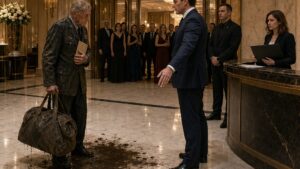
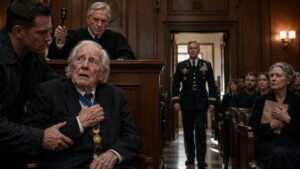
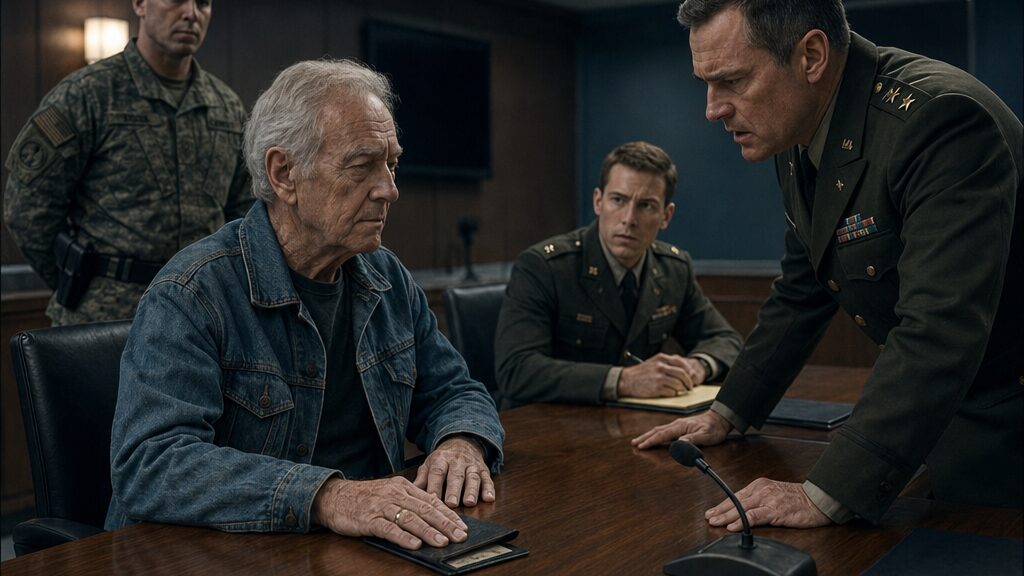
“Who allowed that civilian to sit at the command table?”
The question stopped the room before the door had fully closed.
Samuel Mitchell kept his hand flat against the polished wood. The table was newer than the one he remembered, darker at the edges and fitted with recessed microphones, but the room’s proportions had not changed. No windows. Two doors. A ventilation hum behind the north wall. The emergency release panel still sat beneath a brass cover near the rear exit.
Brigadier General Brandon Hall stood at the head of the table, one palm resting beside a stack of sealed folders. His uniform was exact down to the final ribbon. The irritation in his face was not.
A security sergeant glanced from Brandon to Samuel.
“Sir, he presented an invitation at reception.”
“That does not answer my question.”
Samuel had arrived fourteen minutes early. He had given the receptionist the cream-colored letter, waited while she scanned it twice, and followed the security sergeant through three controlled doors. No one had asked him to state his rank. The invitation had not included one.
PRIMARY SURVIVING WITNESS, it said beneath his name.
Samuel had been grateful for that.
Now four uniformed officers watched him as though he had wandered in from the street. A civilian legal adviser closed her laptop halfway. At Brandon’s right, a young captain bent over a digital recorder and a yellow legal pad, his pen suspended above the page.
Samuel recognized the habit. Men who trusted machines still wrote down what frightened them.
“Mr. Mitchell?” the captain asked. “Did the reception desk verify your identification?”
“They copied my driver’s license.”
Brandon’s gaze moved over Samuel’s faded denim jacket, dark shirt, khaki trousers, and worn brown shoes. Samuel had dressed carefully. The jacket was clean. Ruth had once said it made him look like a man who knew how to repair a fence without announcing it to the neighborhood.
The thought came with a pressure behind his ribs, light but exact.
Brandon tapped the invitation with one finger. “This review concerns classified command records. It is not an open veterans’ forum.”
“I understand.”
“Then you understand why we cannot seat an unverified visitor at this table.”
Samuel’s wedding ring turned beneath his thumb.
The black credential case rested inside his jacket, against the left side of his chest. Its edges had softened over forty years. He could have removed it. He could have given his full name, former command, service number, and the date on which the room itself had been reassigned under his signature.
Instead he said, “You can check the witness list again.”
The captain searched the screen in front of him. “Sir, there is a Samuel Mitchell listed.”
Brandon looked toward him.
The captain straightened. “Primary surviving witness. No grade or former position attached.”
“That could be any Samuel Mitchell.”
“It includes the same date of birth as his license.”
Brandon’s jaw tightened, not because the information was uncertain, Samuel thought, but because it had contradicted him in front of the board.
“What is your name, Captain?” Samuel asked.
The young officer hesitated. “Timothy Scott.”
“Captain Scott, does the entry include an originating office?”
Timothy checked. “Historical Accountability Division.”
“Then they know why I am here.”
Brandon stepped away from the head of the table and came down the side. He did not hurry. The room belonged to him in the present, and he wanted that understood.
“The division that issued this invitation was reorganized six months ago,” he said. “Half its staff is gone. The archive closes Friday. We are here to certify what remains, not reopen every grievance attached to a forty-year-old operation.”
Samuel looked at the folders before Brandon. One bore the faded typed label GRAY LANTERN—FINAL CONSOLIDATED REVIEW.
The word final had been stamped twice.
Behind Brandon, a wall display showed a countdown to the transfer deadline: four days, six hours, nineteen minutes. After that, processed files would move to permanent storage. Unprocessed analog materials would be disposed of under the closure order.
Samuel had read the notice three nights after Ruth’s funeral.
He had nearly thrown it away.
Then he had found her note folded inside the envelope, written months before her death in the narrow handwriting she used when pain made her fingers stiff.
Silence can protect people, Sam. It can also leave them alone with the wrong story.
He turned his ring again.
Brandon stopped beside him. From this distance, Samuel could see a pale line at the general’s temple and the fatigue beneath his eyes.
“You were invited to give a statement?” Brandon asked.
“Yes.”
“About what?”
“The record.”
“That is not an answer.”
“It is the reason stated in the invitation.”
A review-board colonel shifted in his seat. The legal adviser opened her laptop again but did not type.
Brandon leaned closer. His shadow crossed Samuel’s hand.
“Mr. Mitchell, I have an inspector arriving Thursday, an archive that is over budget, and families who have waited decades for a final accounting. I will not let an elderly walk-in derail this review because an outdated office mailed the wrong form.”
The words were delivered quietly. That made them worse.
Samuel looked at the rows of ribbons on Brandon’s chest. None had existed when Gray Lantern took place. Brandon had earned them somewhere Samuel had not been. That deserved recognition. It did not excuse contempt.
At the rear door, the security sergeant reached for the brass emergency cover when his radio cord snagged against it.
“Don’t pull that,” Samuel said.
The sergeant froze.
Samuel pointed. “The release cycles both doors if the north latch is engaged. Use code seven-one-four on the lower panel first, or you will lock the archive corridor for twenty minutes.”
No one moved.
The sergeant looked to Brandon, then crouched beside the lower panel. He entered the code.
A green light appeared.
“How did you know that?” Timothy asked.
Samuel studied the brass cover. “The mechanism has not changed.”
Brandon’s expression hardened around the uncertainty the answer created.
“This building has been modified repeatedly.”
“Not that part.”
“You worked here?”
Samuel could have said yes. He had approved the original secure-room design after an intelligence leak exposed the old records wing. He had stood in the same place while engineers explained how the doors would fail under fire.
“I have been here before,” he said.
Brandon drew himself upright. “Captain Scott, amend the witness status. Unverified visitor pending identity confirmation.”
Timothy’s pen hovered. “Sir, his name and birth date match.”
“That is not confirmation of access.”
Samuel saw Timothy’s discomfort. The captain looked at the recorder, then at the official witness list, as if accuracy had become two competing orders.
“Record what he directed,” Brandon said.
Timothy wrote.
The scratch of pen against paper seemed louder than it should have.
Brandon returned to the head of the table. “We will begin. Mr. Mitchell may remain against the rear wall until security completes verification.”
Samuel did not rise.
The security sergeant took one cautious step toward him.
“Mr. Mitchell,” Brandon said, “this is not a negotiation.”
“No.”
“Then move.”
Samuel felt the old tremor begin in his right hand. It had worsened over the past year, especially when he was tired. He pressed his palm more firmly to the table until the movement became almost invisible.
“I was invited to this seat,” he said.
“And I have withdrawn that access pending verification.”
“For what reason?”
“Because you cannot establish who you are.”
Samuel looked around the room. The colonels avoided his eyes. The legal adviser watched Brandon. Timothy’s pen remained on the page, recording the conversion of a witness into an inconvenience.
Forty years earlier, Samuel had learned how quickly a room could accept the language supplied by the person standing tallest.
Brandon opened the first folder.
“Let the record show that the scheduled testimony of Samuel Mitchell has been removed from today’s agenda due to failure to establish credentials.”
Timothy looked up. “Sir—”
“Record it.”
Samuel’s disappointment settled into something cleaner.
He had not come to reclaim a title. He had not come for an apology. He had come because eleven names were about to disappear beneath the word final.
His left hand slipped inside the faded denim jacket.
Brandon stopped speaking.
The security sergeant moved forward.
Samuel’s fingers closed around the worn black case.
Chapter 2: The Number Inside the Worn Case
The security sergeant reached Samuel just as the black case touched the table.
It landed without weight or ceremony, a square of cracked leather no larger than a man’s palm. One corner had been repaired with dark thread. The clasp had lost most of its finish.
Samuel rested his trembling hand over it.
“Step away from the object,” Brandon said.
“It is a credential wallet.”
“That has not been established.”
Samuel looked at Timothy. “Record the number inside the cover before you decide it means nothing.”
Brandon remained standing. “You will address me.”
“I did.”
A faint change passed through the room. Not defiance exactly. Recognition that Samuel’s calm had not come from confusion.
The security sergeant waited for instruction.
Brandon nodded toward the case. “Open it slowly.”
Samuel lifted the clasp with his thumb. The leather resisted at the fold. He opened it only far enough to reveal a yellowed identification card beneath a clouded plastic sleeve.
The photograph showed a younger man with dark hair cut close and an expression Ruth had once called unnecessarily severe. The printed title above the photograph had faded into gray. The expiration date belonged to another century.
Timothy leaned forward.
“Read the number,” Samuel said.
Brandon’s eyes stayed on him. “Captain.”
Timothy moved around the table, careful not to touch the case. He read the sequence once silently, then again.
His face changed.
“What?” Brandon asked.
Timothy looked toward the board members. “The prefix is CJ-Seven.”
The legal adviser frowned. “That designation was retired.”
“Yes, ma’am.”
“What did it indicate?”
Timothy swallowed. “Command-level joint access. Theater operations or higher.”
The room went still enough for Samuel to hear the recorder’s cooling fan.
Brandon gave a short, humorless breath. “Or a forged card made by someone familiar with obsolete formats.”
Timothy did not answer.
Brandon’s gaze dropped to the credential. “The card expired thirty-eight years ago.”
“Thirty-nine in November,” Samuel said.
The correction drew Brandon’s eyes back to him.
“You expect us to accept this as current identification?”
“No.”
“Then why produce it?”
“Because the number can be checked.”
“The archive system does not validate retired credentials.”
“The accession ledger does.”
Kathleen Garcia entered through the rear door as he spoke, carrying two binders against her chest. Her silver-streaked hair had escaped its clip on one side, and a security badge swung from her neck.
“I was told the review had begun without the archive director,” she said.
Brandon did not look away from Samuel. “We had an access problem.”
Kathleen set the binders down. Her eyes moved to the open case.
“Where did that come from?”
“Mr. Mitchell claims it establishes his right to participate,” Brandon said.
Samuel noted the word claims.
Kathleen approached, but Samuel lowered the cover before she reached it.
“Verify the number first,” he said.
She glanced at him. “Why?”
“Because you will trust the ledger more than my face.”
Something in the sentence unsettled her.
Brandon folded his arms. “This has already delayed us ten minutes.”
Kathleen looked toward the countdown display. “Then another five will not destroy the archive.”
The remark landed closer to accusation than agreement.
She turned to Timothy. “Write the number.”
He showed her his pad.
Kathleen read it, and her expression narrowed. “CJ-Seven-Four-One-Nine.”
Samuel’s hand tightened over the case.
Brandon noticed. “What does the final sequence mean?”
Kathleen opened one of her binders. “It may be an individual accession key. Old command records were sometimes indexed to the credential numbers of originating officers.”
“May be?”
“The system predates my employment by fourteen years.”
“You run the archive.”
“I run what survived three reorganizations and two failed digitization contracts.”
Brandon looked toward Samuel. “Convenient.”
Samuel had heard the word in harsher rooms, from men who believed suspicion was the same as thoughtfulness.
Kathleen carried the binder to the wall terminal. “I can query the legacy ledger, but it is not connected to the active network.”
“Do it,” Timothy said.
Brandon turned his head.
The captain’s face reddened. “Sir, for the accuracy of the record.”
Brandon held his gaze long enough to remind him who wrote the evaluations.
“Proceed.”
While Kathleen entered the query, Samuel watched Brandon’s left hand. The thumb rubbed once across the side of his index finger. Patrick had done that when holding back anger.
Samuel looked more closely at the nameplate on Brandon’s uniform.
HALL.
The room contracted around the five letters.
He had known there would be families involved. The invitation mentioned observers, descendants, and legal representatives. He had not asked for names.
That, too, had been a kind of avoidance.
Kathleen’s terminal emitted a low tone.
“No digital result,” she said.
Brandon’s shoulders eased slightly.
“But there is a linked analog index.”
She turned the monitor so the others could see. A scanned catalog page filled the screen. Most of the entry beside the credential number had been blacked out during an old classification review.
One phrase remained visible.
ORIGINATING COMMAND AUTHORITY—OPERATION GRAY LANTERN.
Brandon’s hand stopped moving.
Timothy read the phrase twice.
The legal adviser lowered her eyes to the credential case. One of the board officers sat back in his chair.
Samuel felt no vindication. Only the old weight, shifting.
Brandon came around the table.
“What connection do you claim to Gray Lantern?”
Samuel kept his hand on the case. “The ledger establishes the connection.”
“It establishes that the number appeared in an index.”
“Yes.”
“It does not establish that the card belongs to you.”
“No.”
Brandon leaned over him again, but the posture had changed. The confidence remained; the certainty did not.
“Who gave it to you?”
Samuel looked at the scar at Brandon’s temple, the squared shoulders, the anger disciplined into official language.
“No one.”
“You found it?”
“No.”
“You inherited it?”
Samuel’s wedding ring turned once beneath his thumb.
Brandon saw the movement and mistook it for hesitation.
“My father’s name was Patrick Hall,” he said. “Communications officer, Relay Team Four.”
Timothy stopped writing.
Brandon continued, his voice lower now. “He died during Gray Lantern after command withdrew air support. My mother received six lines and a folded flag. The official report said operational necessity. No names. No decision chain. No explanation.”
Samuel looked at him.
Brandon’s face no longer belonged to the general standing over an old civilian. For one moment it belonged to a boy waiting beside a mother who had read the same letter until the folds tore.
“Did you know him?” Brandon asked.
“Yes.”
The answer passed through the room like a door opening.
Brandon’s breath caught, then steadied.
“What was his rank?”
“Major.”
“What unit?”
“Joint Tactical Communications, attached to the evacuation command.”
“What was the call sign at the relay station?”
Samuel did not answer.
Brandon bent closer. “If you knew him, answer.”
Samuel remembered Patrick in the command tent, sleeves rolled, arguing that the north ridge gave better relay coverage despite the exposed approach. He remembered the pencil behind his ear. The coffee he never finished. The way he said sir when he disagreed and Samuel when he thought no one else could hear.
“Lantern Four,” Samuel said.
Brandon’s expression broke for half a second.
That call sign had never appeared in the family summary.
Samuel saw Timothy notice.
Brandon straightened abruptly. “Close the doors.”
The security sergeant moved to the rear entrance.
“Sir,” the legal adviser said, “we have family observers scheduled—”
“Remove them from the corridor. No press access. No external recording until identity is confirmed.”
The doors shut with a magnetic thud.
Kathleen remained beside the terminal, staring at Samuel as if searching his present face for someone buried in the archive.
Brandon placed both hands on the table.
The medals, ribbons, and stars on his uniform seemed suddenly less like authority than armor.
“What did you do to my father?”
Chapter 3: The Photograph No One Had Checked
Timothy found the matching number beside a name someone had tried to erase.
He stood alone in the archive corridor, tablet in one hand and the copied accession sequence in the other. Behind the closed review-room doors, no voices carried through the soundproofing. That silence felt worse than shouting.
CJ-7-419.
The scanned ledger page Kathleen had shown them contained only the redacted line and the Gray Lantern reference. Timothy had been ordered to remain in the room and maintain the official record. Instead, when Brandon demanded the original index, Kathleen had asked for an assistant.
Timothy had volunteered before he could lose his nerve.
The archive corridor smelled of paper, cold dust, and overheated wiring. Framed photographs covered one wall: command staffs, evacuation teams, dedication ceremonies, rows of officers whose uniforms belonged to different wars.
Kathleen unlocked a rolling shelf.
“The digital catalog says Box Forty-One,” she said. “The physical ledger says Forty-Nine. That usually means someone changed one and forgot the other.”
“Could the credential be forged?”
“Anything can be forged.”
“That is not what I asked.”
She studied him. “It would be an unusually patient forgery.”
They pulled Box Forty-Nine first. Inside were brittle index cards separated by warped plastic tabs. Kathleen turned each card with both hands.
Timothy kept seeing Samuel at the table. The old man had not flinched when security approached. He had not claimed privilege. He had asked them to check a number.
Timothy had watched Brandon convert uncertainty into accusation because accusation preserved control.
He had recorded every word.
Kathleen stopped.
The card she held bore the same number.
The name beside it had been covered with black classification tape. Age had dried the adhesive, lifting one corner.
“Can we remove that?” Timothy asked.
“Not without authorization.”
“What if it falls off?”
“It has survived four decades.”
As she spoke, the loose corner detached and curled upward.
Neither of them touched it.
Beneath the tape, three letters appeared.
MIT.
Kathleen exhaled.
A notation at the bottom directed them to Command Visual Index, Gray Lantern, Group C.
They crossed to the photograph wall.
Group C was mounted higher than eye level, between an airlift squadron and a map of the evacuation corridor. The image showed twelve officers outside a temporary command post. Sandbags rose behind them. A radio mast cut through the pale sky.
The central figure wore three stars.
His hair was dark. His posture was rigid. A narrow scar crossed the skin near his left eyebrow.
Timothy stared at the face.
Kathleen stepped closer until her badge touched the glass.
“I met him once,” she said.
“When?”
“I was twenty-three. A junior research assistant. He came to review the first declassification plan.” Her eyes remained on the photograph. “He asked why the casualty annex listed aircraft before people.”
Timothy looked toward the sealed door at the end of the corridor.
“You did not recognize him?”
“I recognized an old man in a denim jacket who had waited forty years to be invited into a room.”
“That is not an answer.”
“No.” Kathleen’s voice thinned. “I did not.”
A brass plate beneath the photograph carried the names.
LIEUTENANT GENERAL SAMUEL MITCHELL, JOINT EVACUATION COMMANDER.
Timothy read the line once, then again.
The discovery should have simplified everything. Instead it made the room behind the door more dangerous.
Samuel had been telling the truth without saying it.
Brandon had been wrong about who sat before him.
But the line below Samuel’s title read:
FINAL WITHDRAWAL AUTHORITY, OPERATION GRAY LANTERN.
Timothy photographed the plate and the credential card under Kathleen’s supervision. Then he noticed a reference number handwritten on the reverse of the index card.
“What is that?”
Kathleen followed his finger. “Operational disposition summary.”
They found it in Box Forty-One.
The folder was thin. Too thin for an operation that had moved hundreds of people through a collapsing air corridor.
The first page listed successful evacuations. The second recorded aircraft loss. On the third, beneath a black classification bar, a sentence remained visible:
FINAL WITHDRAWAL APPROVED BY COMMAND AUTHORITY AT 2147 HOURS. RELAY TEAM FOUR NOT RECOVERED.
Eleven names followed.
Patrick Hall was last.
Timothy felt the triumph drain from the discovery. He understood now why Samuel had not offered his rank as a defense. Rank attached him not only to command but to the final order.
Kathleen closed the folder halfway. “We take both.”
When they returned, Brandon was standing beside the table rather than over Samuel. The change was subtle, but Timothy saw it immediately.
Samuel had not moved. The black case remained beneath his hand.
Brandon looked at Timothy. “Well?”
Timothy placed the photograph on the display.
The old image appeared beside Samuel’s present face.
A silence spread through the room, not sudden but complete. One board officer rose instinctively, then stopped, uncertain whether the gesture would honor Samuel or embarrass everyone else.
The security sergeant lowered his eyes.
Kathleen set the original index card inside a clear evidence sleeve. “The credential number matches the accession ledger. The photograph and command roster identify the holder as Lieutenant General Samuel Mitchell.”
Brandon looked from the three-star officer in the photograph to the old man seated before him.
For the first time, he seemed to see the scar.
His mouth opened, but no title came.
Samuel spared him the attempt. “Sit down, General Hall.”
Brandon did.
The physical reversal carried no satisfaction for Samuel. Timothy could see that. The old man’s expression had not softened. His right hand still trembled against the leather case.
The legal adviser cleared her throat. “Given the authentication, the witness should be restored to the agenda.”
Brandon did not respond.
Kathleen placed the command roster beside the case. “General Mitchell was the originating command authority for Gray Lantern.”
The board colonel who had nearly stood said, “Sir, we were not informed—”
“That was the point,” Samuel said.
Every face turned toward him.
He looked at Timothy. “Did you record how I was treated before the photograph appeared?”
Timothy felt Brandon’s attention settle on him.
“Yes.”
“Keep it in the record.”
The legal adviser shifted. “We can correct the preliminary characterization.”
“Do not correct it by removing it.”
Brandon’s eyes hardened, though the confidence behind them had changed into something more painful.
“You came here anonymously to test us?”
“No.”
“To expose General Hall?”
“No.”
“Then why omit your rank?”
Samuel’s thumb touched his wedding ring.
“Because my rank is not the evidence I came to give.”
Kathleen opened the thin operational folder.
Brandon saw the casualty page.
The last restraint left his face.
He took the folder from her, read the surviving sentence, and placed it on the table beside Samuel’s credential.
The two objects lay inches apart: proof of command and proof of consequence.
Brandon turned the page so Patrick Hall’s name faced Samuel.
“You approved the withdrawal.”
Samuel looked at the line.
“Yes.”
“You left Relay Team Four behind.”
The room waited for denial.
Samuel gave none.
Brandon pushed the casualty report closer until its edge touched the worn black case.
He did not call Samuel General.
He did not call him sir.
“What is missing from this report, Mr. Mitchell?”
Chapter 4: Eleven Names Beneath the Credential
Brandon expected Samuel to reach for another credential.
Instead, Samuel lifted a folded sheet of paper from behind the expired card.
It had been opened and closed so many times that the creases had turned white. The edges were soft, almost clothlike. No official seal marked it. No letterhead. No signature block.
Samuel placed it between the black case and Patrick Hall’s casualty report.
Brandon did not touch it.
“What is that?”
“The part the report forgot.”
Samuel unfolded the paper carefully. His right hand shook more when he used his fingertips, and the smallest fold resisted him. He flattened the page with his palm.
Eleven names appeared in dark blue ink.
The handwriting was firm near the top and less steady toward the bottom. Beside each name was a unit, a duty position, and one small detail that no official record would have required.
A preferred coffee. A daughter’s age. A promise to repair a radio after the evacuation. A birthday three days away.
Patrick Hall’s name came last.
Beside it Samuel had written 21:56.
Brandon stared at the time.
“What does that mean?”
Samuel looked at the casualty report. The official withdrawal had been approved at 21:47.
“It is the last time I heard his voice.”
The words produced no visible reaction in Brandon at first. Then his hand closed around the edge of the table.
Timothy’s pen began moving again.
Brandon heard it and turned. “You do not need to record personal annotations.”
Samuel answered before Timothy could.
“He does if they explain why I came.”
Brandon faced him. “You came to defend a list?”
“I came to stop the archive from closing with eleven people reduced to one sentence.”
“The report names them.”
“The report counts them.”
“It records the operational outcome.”
“It records the outcome command approved for release.”
The distinction tightened the room.
Kathleen remained standing beside the display. The historical photograph still showed the younger Samuel in three-star uniform. No one had removed it. The contrast between that face and the old man at the table made each silence feel deliberate.
Brandon pulled the folded list closer.
“You rewrote this?”
“Every year.”
“Why?”
“The paper wears out.”
“That is not what I asked.”
Samuel’s thumb found his wedding ring.
He remembered Ruth at their kitchen table, watching him copy the names while the old sheet rested beside the new one. She had never interrupted. Only once, after his hand began to tremble, had she asked why he refused to type them.
Because handwriting takes time, he had told her.
She had looked at him for a long moment.
So does telling the truth.
Samuel stopped turning the ring.
“I did not want to forget the order,” he said.
“The order they died in?”
“The order in which I learned they were gone.”
Brandon looked down again.
The first name belonged to the relay team’s medic. Samuel remembered a red pencil tucked behind her ear and a laugh too loud for the command tent. The second belonged to an aircraft mechanic who had volunteered to reinforce the transmitter shelter. The third had carried two wounded civilians uphill after the road was cut.
Samuel gave each detail without embellishment.
He did not make them saints. One had been repeatedly late. Another had argued with Patrick over antenna placement. One had been under formal reprimand for striking a contractor who refused to open a supply cage.
They had been difficult, ordinary, necessary people.
When Samuel reached Patrick, Brandon interrupted.
“My father hated coffee.”
Samuel looked at the note beside Patrick’s name.
It read: never finishes it.
“He carried a cup all day,” Samuel said. “It was usually cold by noon.”
Brandon’s mouth tightened.
“My mother said he drank tea.”
“Perhaps he did at home.”
The answer was too modest to reject. Brandon stared at the list as if the unfamiliar version of his father offended him less than it hurt.
“Did he talk about us?”
Samuel could have answered immediately. Patrick had spoken often of a boy who dismantled radios and could not reassemble them. He had carried a photograph inside the clear cover of his field notebook.
Samuel saw the question’s danger. A comforting memory offered too quickly could sound purchased.
“He mentioned a son,” Samuel said. “He said the boy asked questions until adults admitted they did not know the answer.”
Timothy stopped writing for half a beat.
Brandon leaned back. “You remember that after forty years?”
“I remember what I was responsible for.”
The words were neither apology nor defense.
Brandon’s eyes sharpened. “Responsibility would have meant telling our families what happened.”
“Yes.”
The admission shifted something. Samuel felt it in the way Kathleen lowered her binder and the legal adviser ceased arranging her files.
Brandon had expected resistance. Samuel gave him none.
“Then tell me now.”
Samuel looked toward the countdown display.
Four days, five hours, thirty-two minutes remained, but the number no longer mattered in days. It mattered in boxes, tapes, reels, and unindexed fragments.
“Preserve the archive first.”
Brandon laughed once, without humor. “You still give orders.”
“No. I am telling you the truth has a deadline.”
Kathleen stepped forward. “He is right about that.”
Brandon turned on her. “You said processed records would transfer.”
“Processed records will. Unprocessed analog materials are scheduled for disposal under the closure directive.”
“How much remains unprocessed?”
Kathleen hesitated.
Samuel knew the answer would be worse than Brandon expected.
“Six hundred and twelve audio items,” she said. “Most are duplicate traffic logs or damaged training recordings. We do not have staff to identify all of them.”
“Gray Lantern?”
“Twenty-seven items are tagged to the operation. Nine are unplayable. Fourteen have incomplete labels. The rest were previously judged duplicative.”
“By whom?”
“Contract review teams.”
“When?”
“Over eleven years.”
Brandon looked at the thin casualty folder. “And this board is expected to certify the record as complete?”
“The certification language says complete to the extent processed.”
“That is not what families will hear.”
Kathleen’s face hardened. “I have objected to the closure order twice.”
“To whom?”
“To offices that sent me new formatting guidance.”
Samuel watched the anger move through Brandon. Until then, the archive deadline had been a pressure he used against others. Now it had become an accusation against him.
The legal adviser spoke carefully. “A delay would require evidence that the unprocessed material has unique historical value.”
Samuel tapped the handwritten time beside Patrick’s name.
“Find the transmission recorded at 21:56.”
Kathleen looked at him. “Which channel?”
“Relay Four’s secondary command net.”
“The summary says that channel failed at 21:41.”
“The summary is wrong.”
Brandon stood.
“How do you know?”
“Because I heard Patrick after that.”
“Then why is there no transcript?”
Samuel’s fingers rested on the creased list.
“The recorder was damaged during extraction. Intelligence took custody of the surviving reels.”
Kathleen went to the terminal and began searching. “There are no secondary-net transcripts in the digital inventory.”
“Look for analog material transferred from theater intelligence, not communications command.”
She changed the query.
The terminal returned three results, two marked disposed and one marked condition unknown.
Kathleen read the final entry aloud. “Unidentified partial transmission. Magnetic damage. Source code Lantern Four.”
No one spoke.
The entry listed a box in cold storage.
Brandon looked at Samuel. Suspicion remained, but it no longer stood alone. Beside it was a hope he did not trust.
“Can it be restored?”
Kathleen shook her head. “I do not know.”
A knock struck the rear door.
The security sergeant opened it for an archive technician carrying a tablet and wearing protective gloves. The technician looked from Kathleen to the officers around the table.
“Ma’am, we found the reel,” he said. “The housing is cracked, but part of the tape may still be readable.”
Brandon’s gaze dropped to the time beside his father’s name.
“What is on it?”
The technician held the tablet close to his chest.
“We will not know until we try.”
Chapter 5: The Nine Minutes Missing From History
“Command, confirm the corridor is still open.”
Patrick Hall’s voice emerged through forty years of damage.
It was thinner than Brandon remembered, flattened by static and magnetic decay. Yet the cadence was familiar. The pause before still. The slight rise at the end of a technical question, as if the answer mattered less than whether the person giving it understood the machinery involved.
Brandon stood behind the audio console and did not breathe.
The restoration suite was too small for the full board. Only he, Samuel, Timothy, Kathleen, the legal adviser, and the archive technician had been admitted. The reel turned behind a clear plastic panel in brief controlled increments. Every few seconds, the technician stopped playback to prevent the brittle tape from tearing.
Static swallowed the next reply.
Then Patrick again.
“Three civilian aircraft remain in the eastern queue. Relay Four has line-of-sight. If we shut down now, they lose the corridor beacon.”
Brandon glanced at Samuel.
The old man sat against the rear wall rather than beside the console. His denim jacket remained buttoned. The black case lay on his knee, closed. He showed no surprise at the words.
“You heard this before,” Brandon said.
Samuel looked at the spinning reel. “Once.”
“When?”
“The night it was recorded.”
The technician raised a hand for silence and restarted the tape.
A younger voice broke through.
“All relay elements prepare for extraction. Repeat, prepare for extraction. Air support window closes at twenty-one forty-seven.”
Brandon knew the voice before Kathleen checked the command log.
Samuel’s.
Not the uncertain voice of an old man at a review table. It was clipped, controlled, and exhausted, with the authority to move aircraft and people by a sentence.
Patrick replied, “Acknowledged. We need four minutes to transfer guidance.”
The recording jumped. A scraping sound replaced speech. Then a fragment of another voice reported wounded personnel near the relay shelter.
The technician stopped the reel.
“That section is fused,” he said. “I may be able to separate another layer, but not without risking the tape.”
Brandon stared at the frozen counter.
21:43:12.
“What happened during the four minutes?” he asked.
Kathleen opened the operational timeline. “The official summary records that the final civilian aircraft entered the corridor at 21:51.”
Brandon turned. “The extraction window closed at 21:47.”
No one answered.
He looked at Samuel.
“You extended the corridor.”
Samuel’s gaze stayed on the reel. “I delayed the withdrawal order.”
“For how long?”
“Nine minutes.”
The number seemed too small to contain eleven deaths.
Brandon stepped away from the console. “You kept the relay team in place nine minutes past the air-support window.”
“I kept the corridor active.”
“Do not change the subject.”
“It is the same subject.”
“How many people were on those aircraft?”
“One hundred eighty-six.”
The legal adviser looked up from her notes.
Brandon felt the answer strike the room and divide it into columns no decent person could balance. Eleven against one hundred eighty-six. Soldiers against civilians. An order given under pressure against a family that waited for a father who did not return.
He hated Samuel for making the arithmetic real.
“You chose them,” Brandon said.
“I chose to keep the corridor open.”
“Which meant choosing who stayed behind.”
“At the time, I believed we could still recover Relay Four by ground.”
“Believed?”
“The northern route had not yet been cut.”
“And then?”
“It was cut.”
“At what time?”
“Twenty-one fifty-two.”
Five minutes after the original extraction window. Four minutes before Patrick’s last recorded transmission.
Brandon turned back to the console. His own reflection hovered in the clear panel over the old reel.
For most of his life, the story had been simple. Senior command had withdrawn. His father’s team had been forgotten. The language in the casualty letter—operational necessity—had always sounded like polished cowardice.
Now Samuel’s voice on the tape had ordered the team to prepare for extraction.
That did not absolve him. It made the failure harder to hold.
The technician advanced the reel.
Another burst of Samuel’s voice emerged.
“Lantern Four, extraction vehicle is moving north. Shut down and proceed to Point Cedar.”
Patrick answered, but the first words vanished beneath static.
“…wounded cannot move without assistance.”
A second voice said something about the beacon.
Then silence.
Brandon leaned toward the speaker. “Play it again.”
The technician did.
The gap remained.
“Is that where he chose to stay?” Brandon asked.
“We do not know,” Kathleen said.
Samuel said nothing.
Brandon faced him. “You know.”
“I know what I heard over the command net. I do not know what this reel retained.”
“Then say what you heard.”
Samuel’s thumb moved over the edge of the black case.
“No.”
The refusal restored Brandon’s anger because anger was easier than uncertainty.
“You came here demanding a complete record, but you will not complete it.”
“Not from memory when a recording may exist.”
“My father’s voice is on that tape.”
“Yes.”
“And you would rather make me wait for a machine than answer one question.”
Samuel finally looked at him. “Your father deserves better than the version that best serves either of us.”
The sentence stopped Brandon.
It could have been evasion. It could also have been the first honest thing anyone had said about Patrick’s death.
The technician removed his headphones. “There is another channel embedded under the primary track.”
Kathleen approached. “A bleed?”
“Possibly a synchronized recorder. It is weaker. I need time.”
“How much?”
“Several hours. Maybe the rest of the day.”
Brandon looked at the countdown clock mounted above the suite door. Less than three days remained before the closure inspection.
“Do it.”
The technician hesitated. “Restoration at this level is outside the approved scope.”
“I am expanding the scope.”
The legal adviser shifted. “General Hall, that may require written justification.”
“Use the casualty discrepancy.”
Kathleen closed the official summary. “I will sign the archive request.”
For the first time since Samuel had entered the building, Brandon and Kathleen acted without looking to the old man for permission or blame.
Samuel watched them, and Brandon saw something close to relief pass across his face.
That angered him too.
“You do not get to look relieved,” Brandon said.
Samuel’s expression settled.
“I am not.”
“You saved one hundred eighty-six people. Is that what you wanted us to find?”
“No.”
“Then why preserve the tape?”
“Because eleven people were asked to pay for that decision, and the record never allowed them to speak.”
Brandon walked closer.
“Did my father volunteer?”
Samuel’s hand tightened on the case.
“The damaged section matters.”
“Did he volunteer?”
“I gave an order to evacuate.”
“That was not my question.”
“No,” Samuel said. “It was not.”
The technician’s console chimed. A catalog field had appeared after the secondary-track scan.
Kathleen leaned over the screen.
“What is it?” Timothy asked.
She read the line silently, then opened the linked metadata.
The document was not an audio file. It was a routing entry created three days after Gray Lantern.
DISSENT MEMORANDUM—COMMAND DECISION REVIEW.
Originator: Mitchell, Samuel.
Status: sealed by originating authority.
Brandon looked from the screen to Samuel.
“You wrote a dissent against your own decision?”
Samuel did not answer.
Kathleen scrolled farther.
The routing history showed the memorandum had been excluded from the public casualty archive and transferred to restricted command files.
A final notation appeared beneath it.
FAMILY BRIEFING REQUEST WITHDRAWN BY ORIGINATOR.
Brandon read the words aloud.
The new truth did not soften him. It sharpened every question.
“You asked to tell us,” he said. “Then you changed your mind.”
Samuel lowered his eyes to the worn black case.
Kathleen’s voice was quiet.
“Why was the memorandum sealed?”
Chapter 6: What Patrick Chose and Samuel Allowed
“Negative, command. We are not shutting down.”
Patrick’s refusal came from beneath the first recording, faint but unmistakable.
The technician had isolated the secondary channel after four hours of work. By then, Tuesday’s light had vanished from the high corridor windows, and the review room had been reopened for the playback. No one had gone home.
Samuel sat where Brandon had first found him, at the end of the polished table.
The black case lay closed before him.
The speakers crackled.
Samuel’s younger voice answered, harder than before.
“Lantern Four, that is a direct order. Transfer guidance and move to Point Cedar.”
Patrick replied, “Transfer will break the beacon for three minutes. Eastern Three is carrying wounded civilians. They will enter blind.”
“You have an extraction vehicle inbound.”
“We also have six nonambulatory wounded at the shelter.”
A burst of static swallowed the next exchange.
Then Patrick again.
“Give us six minutes.”
Samuel closed his eyes.
He had remembered the words for forty years. Hearing them returned not only the voice but the command tent: sweat under his collar, fuel smoke in the canvas, three clocks showing different times, a map crowded with grease-pencil marks. Officers waiting for him to make one decision that would become many other people’s consequences.
On the recording, the younger Samuel said, “You may not have six.”
Patrick answered, “Neither do they.”
The reel continued.
Another officer reported the northern ground route under fire. An air controller warned that the final escort aircraft had reached minimum fuel. Patrick kept the beacon active.
At 21:54, Samuel ordered Relay Four to abandon the equipment and move the wounded.
Patrick refused a second time.
Not dramatically. Not with farewell language. He listed the practical consequences of shutting down, then said he would remain with two volunteers while the others attempted the northern route.
Brandon stood with both hands against the table.
“He chose to stay.”
The statement sounded less like relief than collapse.
Samuel opened his eyes. “Yes.”
“You ordered him out.”
“Yes.”
Brandon turned toward him. “Then the official report was wrong.”
“Incomplete.”
“My father was not abandoned.”
Samuel looked at Patrick’s casualty report.
“He was placed in a position where remaining became the choice he believed duty required.”
“He made that choice.”
“Yes.”
“Then why have you carried this as though you killed him?”
Because command did not end where another man’s courage began.
Samuel did not say it yet.
Kathleen stopped the playback at 21:55:41. “There are fourteen seconds left, but the signal is unstable.”
“Play them,” Brandon said.
The technician glanced at Samuel.
“Play them,” Samuel repeated.
Patrick’s voice returned through a wash of noise.
“Command, Eastern Three has the beacon. Tell the next crew the ridge reflects south after dark. They need to angle two degrees west.”
No goodbye followed. No message for his family. Only an instruction intended to keep strangers alive.
The transmission ended at 21:56.
Brandon lowered his head.
Samuel’s handwritten time lay visible through the edge of the black case.
For several seconds, no one moved.
Then Brandon said, “You should have told us.”
Samuel’s thumb touched his ring.
“Yes.”
The simplicity of the answer brought Brandon’s head up.
“You had proof that he stayed voluntarily.”
“Yes.”
“You requested a family briefing.”
“Yes.”
“And then withdrew it.”
Samuel looked at Kathleen. “Show him the routing warning.”
She opened the scanned memorandum metadata. Attached to the withdrawal entry was a legal notice from command headquarters. Disclosure, it warned, could expose the identities of an allied evacuation network, reveal the position of a still-active corridor, and endanger families who had remained in the region.
Brandon read it.
“You were ordered to remain silent.”
“No.”
The answer surprised everyone.
Samuel turned the ring once.
“I was warned that disclosure carried risk. I made the decision to withdraw the request.”
“To protect the network.”
“In part.”
“What was the other part?”
Samuel’s hand left the ring and settled on the black case.
He opened the outer flap, removed the expired credential, and slid a finger beneath the worn lining. The leather had been restitched along one edge. From the narrow space inside, he drew a sealed envelope no thicker than several folded pages.
Kathleen stared at it.
“The original memorandum?”
Samuel placed it on the table.
“I retained my copy.”
The legal adviser leaned forward. “That document may remain classified.”
“It does.”
“You cannot introduce it into an open review without authorization.”
“This is not yet an open review.”
Brandon’s eyes stayed on the envelope. “What does it say?”
“It records the nine-minute delay. The alternatives available. The casualty estimates. The failure of the northern route.”
“And?”
Samuel felt Ruth’s note as clearly as if it rested inside his pocket.
Silence can protect people. It can also leave them alone with the wrong story.
“It says the delay was mine.”
Brandon’s face tightened. “We already know that.”
“It says the decision was defensible.”
The word hung in the air.
“And was it?” Brandon asked.
“Yes.”
Brandon’s anger returned instantly.
Samuel continued before it could harden.
“It was also not inevitable.”
The room stilled.
“Another commander might have closed the corridor at 21:47 and recovered Relay Four. One hundred eighty-six civilians would then have entered without guidance or remained behind. No calculation makes the alternative clean.”
Brandon stepped closer. “You are saying you would do it again.”
“I am saying I do not know.”
That answer cost Samuel more than any certainty would have.
“I told myself for years that releasing the memorandum would turn explanation into excuse,” he said. “The classification warning made silence lawful. My shame made it convenient.”
Timothy’s pen moved softly.
Samuel looked at him. “Record that.”
The captain did.
Brandon picked up the sealed envelope but did not open it.
“You let my mother believe no one had questioned the decision.”
“Yes.”
“You let me believe command never spoke my father’s name.”
“Yes.”
“Why?”
Samuel’s tremor spread through both hands now.
“Because I believed carrying the blame quietly was more honorable than asking families to understand me.”
“And now?”
“Now I think silence allowed the institution to hide behind me.”
Kathleen closed her eyes briefly.
The archive had preserved the authorized conclusion and discarded the commander’s doubt. Samuel had called that sacrifice. Others had used it as convenience.
Brandon set the envelope down.
“We can resolve this without reopening the full review,” he said. “The archive retains the audio. The family summary is corrected. Your memorandum can be evaluated under seal.”
The offer was controlled, almost reasonable.
It would protect Patrick’s record. It would protect allied details. It would spare Samuel public exposure. It would also keep the central failure inside another closed room.
Samuel recognized the temptation because he had accepted its shape before.
“You want a private settlement,” he said.
“I want an accurate result without turning this into spectacle.”
“So do I.”
“Then agree.”
Samuel looked around the same room where Brandon had called him an unverified civilian and ordered Timothy to remove his testimony. The recorder remained on. The initial transcript existed. So did the incomplete archive, the sealed warning, and the memorandum that could damage his name.
He closed the credential case but left the envelope outside it.
“No.”
Brandon stared at him.
“The next session goes on the permanent record,” Samuel said. “The complete one.”
The legal adviser began to object.
Samuel raised one hand, not with former authority but with exhausted certainty.
“Include the way I was treated before you knew my rank. Include Patrick’s choice. Include my delay. Include the withdrawn family briefing. No edited summary.”
Brandon’s voice lowered.
“You understand what that may do to your reputation.”
Samuel looked at the eleven names on the folded sheet.
“For forty years, reputation was the only casualty the record knew how to protect.”
He pushed the sealed memorandum toward Kathleen.
“Schedule the public session.”
Chapter 7: The General Who Entered His Own Failure
“Should the transcript address you by rank?”
Timothy asked the question before the public session began.
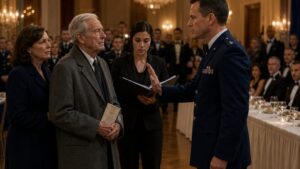
The review room no longer felt sealed from the world. Two rows of chairs had been placed along the rear wall for family observers. Three members of the press sat behind a marked line with their devices muted until the board formally opened the record. The restored reel rested inside a clear evidence case beside Kathleen. The legal adviser had arranged Samuel’s sealed memorandum beneath a red cover sheet.
Samuel sat at the same end of the polished table.
His faded denim jacket remained buttoned. The black credential case lay before him, beside the folded list of names. Nothing about his appearance had changed since Brandon had called him an unverified civilian.
Only the room had changed.
“Use my name,” Samuel said.
Timothy paused over the transcript template.
“Until every name on that list has been read.”
Across the table, Brandon lowered his eyes.
The board convened at nine. Kathleen authenticated the credential, the archive ledger, the historical photograph, the restored transmission, and Samuel’s original memorandum. Her testimony was precise. She did not soften the archive’s failures or pretend that missing records were neutral accidents.
Then the legal adviser requested a recess.
Samuel knew why before she approached him.
“We can enter the operational facts without releasing your evaluative language,” she said quietly. “The passages concerning command alternatives are personal conclusions, not necessary findings.”
“They are necessary.”
“They could reopen the original review.”
“Yes.”
“Your decision was within accepted command authority.”
“That is in the memorandum.”
“So is language that may be interpreted as an admission of negligence.”
Samuel looked at the red cover sheet.
“Is it inaccurate?”
“That is not the standard I am advising you on.”
“It is the standard I came for.”
The adviser’s voice dropped. “There is a difference between accountability and surrendering your reputation to people who were not in that room.”
Samuel’s thumb found his wedding ring.
He imagined Ruth beside him, not as she had been near the end, thin beneath a blanket, but at their kitchen table with both hands around a cup. She had understood his fear before he named it. He had believed silence kept the dead from being used in arguments. He had not admitted how much it also kept him from being judged.
He removed his thumb from the ring.
“Release the full memorandum.”
The adviser studied him, then nodded once and returned to her seat.
When the session resumed, Timothy activated the recorder.
Brandon spoke first.
His uniform was as exact as it had been Monday morning, but he no longer used it to fill the room.
“Before testimony continues,” he said, “I request an addition to the record.”
The senior board officer looked surprised. “State it.”
Brandon kept his gaze on the microphone.
“On Monday, I declined to verify Mr. Mitchell’s invitation before changing his status to unverified visitor. I ordered his testimony removed. I spoke to him in a manner inconsistent with the standards of this command.”
A reporter’s pen moved.
Brandon continued.
“I believed he might be exploiting an old record to interfere with the review. That concern did not require public disrespect.”
He stopped there.
Samuel could have allowed the statement to stand. It was accurate and professionally damaging. It was also incomplete.
“Why did you refuse verification?” he asked.
Brandon looked at him.
The question had not been arranged.
The board officer shifted. “Mr. Mitchell, General Hall’s statement—”
“Let him answer.”
Brandon’s jaw tightened with the old reflex. Then it loosened.
“Because if he was an ordinary civilian,” he said, “I thought I could remove him without consequence.”
The room became very quiet.
Timothy’s pen stopped.
The legal adviser leaned toward him and whispered, “That phrasing can be clarified in the final transcript.”
Timothy looked at Brandon.
“No, ma’am.”
It was the first direct refusal Samuel had heard from him.
Timothy placed his hand beside the recorder. “The statement was clear.”
Brandon nodded.
“Keep it.”
Samuel watched the young captain write the exact words. On Monday, Timothy’s silence had helped Brandon turn a witness into an inconvenience. Now he accepted the cost of accuracy.
It was a small act. Samuel knew institutions changed, when they changed at all, through such acts repeated after attention moved elsewhere.
Kathleen opened the memorandum.
The first page recorded the conditions at 21:38: three civilian aircraft waiting east of the corridor, one hundred eighty-six evacuees aboard, hostile fire approaching the northern ground route, and a relay station carrying the only functioning beacon.
Samuel gave the timeline without decoration.
At 21:42, he had received the recommendation to close the corridor.
At 21:43, Patrick requested four minutes to transfer guidance.
At 21:45, intelligence estimated that the civilian aircraft would lose navigation if the beacon ceased.
At 21:47, the escort window ended.
Samuel did not order withdrawal.
At 21:51, the final civilian aircraft entered the corridor.
At 21:52, the northern route was cut.
At 21:54, Samuel ordered Relay Four to abandon the station.
Patrick refused.
At 21:56, the last transmission ended.
Samuel’s right hand trembled beside the black case. He did not cover it.
The senior board officer asked, “Was the nine-minute delay militarily defensible?”
“Yes.”
“Was it required?”
Samuel looked at the eleven names.
“No.”
A murmur moved through the observers and died quickly.
“What alternative existed?” the officer asked.
“I could have closed the corridor at 21:47 and recovered Relay Four while the northern route remained open.”
“What would have happened to the civilian aircraft?”
“I do not know.”
“Your assessment at the time?”
“They might have entered without guidance. They might have turned back. They might have been lost.”
The officer waited.
Samuel understood the request hidden inside the silence. Give the room arithmetic. Let the greater number justify the smaller.
He would not.
“I chose the civilians,” he said. “Patrick Hall and the others carried the cost of that choice. Their courage does not erase my responsibility for creating the conditions in which it was required.”
Brandon’s eyes stayed on him.
Samuel opened the black credential case completely.
He removed the expired card and placed it to the left. He unfolded the casualty list and placed it in the center. Then he lifted the memorandum from beneath the red cover sheet and aligned it to the right.
Credential. Names. Decision.
The history of command reduced to three objects on a table.
Samuel read the memorandum’s final paragraph himself.
“I recommended a direct briefing for the families of Relay Team Four. I later withdrew that recommendation after receiving a warning concerning allied exposure. The warning was legitimate. My withdrawal was not solely protective. I believed silence would prevent explanation from becoming excuse. I did not sufficiently consider that silence would also leave the families with an official account emptied of human choice.”
His voice tightened, but did not break.
“That failure continued long after the operation ended.”
No one applauded.
Samuel was grateful.
The board withdrew for twenty-three minutes. During that time, the reporters were not permitted to ask questions. Brandon remained seated across from Samuel. Neither man spoke.
When the board returned, it voted to suspend the archive closure order for Gray Lantern materials, preserve every surviving analog item, and enter Samuel’s memorandum into a new command review subject to necessary protection of allied identities.
The vote did not clear Samuel.
It reopened him.
Kathleen exhaled beside the evidence case. Timothy lowered his pen.
Samuel felt no victory. Only the strange lightness of no longer being the sole container of the truth.
The senior officer asked whether any final question remained before adjournment.
Brandon stood.
He did not look at the board.
He looked at Samuel.
“My father understood the risk,” he said. “The recording proves that.”
Samuel waited.
Brandon’s control thinned around the next words.
“But did he know he was going to die?”
Chapter 8: The Names Read Before the Ranks
“Your father knew the risk,” Samuel said. “That is not the same as wanting to die.”
The public session had ended, but no one had left.
Brandon stood across the table with one hand resting beside Patrick’s casualty report. The question had stripped the general from his posture. He was no longer asking for an official conclusion. He was asking for something the record could not certify.
Samuel would not manufacture comfort for him.
“Did he sound afraid?” Brandon asked.
“Yes.”
The answer caused a small movement in the rear chairs.
Brandon’s face tightened.
Samuel continued before fear could become shame.
“He checked the beacon frequency twice when he already knew it was correct. He spoke faster when the northern route failed. He asked how many civilians remained in the corridor.”
“Did he say anything about my mother?”
“No.”
“About me?”
“No.”
Brandon looked down.
Samuel understood the wound. Families often imagined final words as proof that love survived the last moment. Sometimes it did. Sometimes duty occupied every available second.
“His final words were instructions for the next crew,” Samuel said. “The ridge reflected the signal south after dark. He told them to angle two degrees west.”
“That was all?”
“That was what he chose to leave.”
Samuel looked at the handwritten time beside Patrick’s name.
“He was not thinking about how history would describe him. He was trying to keep people he would never meet from making the same mistake.”
Brandon sat.
This time he lowered himself without shock or loss of status. He pulled the chair near Samuel and faced him at eye level.
For several seconds, neither spoke.
Then Brandon turned toward Timothy.
“I ordered you to characterize Mr. Mitchell as an unverified claimant after you found a matching witness entry.”
“Yes, sir.”
“I also suggested the preliminary transcript could be corrected.”
“Yes, sir.”
“That would have removed evidence of my conduct.”
Timothy said nothing.
Brandon’s voice grew quieter.
“I am sorry.”
The captain’s surprise showed more clearly than his relief.
“I should have challenged the order sooner,” Timothy said.
“You should not have needed to.”
Brandon then faced Samuel.
“I was wrong before I knew who you were.”
Samuel waited.
“Not because you had once held higher rank,” Brandon said. “Because I believed a man without visible authority could be handled without respect.”
The apology did not repair forty years. It did not restore Patrick, Ruth, or the others on the folded page. It did not erase Brandon’s choice to loom over an old man while a room watched.
But it named the correct offense.
Samuel nodded.
“That is the apology I can accept.”
Kathleen approached with a proposal for a formal recognition ceremony once the revised archive opened. The command could restore Samuel’s name to the exhibit, display his photograph prominently, and invite surviving families.
“No ceremony for me,” Samuel said.
Kathleen frowned. “The public record should reflect your position.”
“It should.”
“Then what do you want displayed?”
Samuel slid the casualty list toward her.
“The names first.”
One month later, the Gray Lantern exhibit reopened in the archive corridor.
There was no podium. No band. No reserved row for senior officers.
A new panel stood beneath the restored command photograph. At the top, in plain lettering, were eleven names. Patrick Hall appeared last, followed by the time 21:56 and a short description of Relay Team Four’s final guidance transmission.
Only beneath the names did the exhibit identify Lieutenant General Samuel Mitchell as joint evacuation commander.
The revised text stated that his nine-minute delay preserved the corridor for one hundred eighty-six civilians and contributed to the loss of the relay team’s final extraction window. It also stated that the official record had failed to preserve the full decision process or provide the families with an adequate account.
No sentence called him hero.
No sentence called him villain.
Samuel stood before the panel in the same faded denim jacket.
The review of his historical conduct remained open. The legal finding might change. His reputation might narrow into arguments between people who preferred clean conclusions.
He found that he could live with that.
Kathleen had placed the original handwritten list inside the exhibit under protective glass. Samuel had resisted at first. For forty years, he had folded it into his own case, copied it when the paper weakened, and believed remembrance was a private duty he could perform alone.
Now strangers stopped to read each name.
A retired enlisted witness touched two fingers to the glass beside the medic’s entry. A family observer corrected the spelling of a hometown, and Kathleen changed it before the day ended. Timothy brought the unedited transcript into the permanent collection, including Brandon’s description of Samuel as an unverified civilian.
The record no longer protected anyone by pretending the failure had been simple.
Brandon arrived after the corridor had emptied.
He stood beside Samuel, not in uniform but in a dark suit. He read Patrick’s name without speaking.
After a while, he said, “They offered me another chairmanship.”
“Did you accept?”
“No.”
Samuel glanced at him.
“I did not decline command,” Brandon said. “I declined that review.”
“Why?”
“Because I was too close to it.”
“That did not stop you before.”
“No.”
The admission remained between them.
Brandon looked at the exhibit. “I used to think someone had to be innocent for my father’s death to mean something.”
Samuel understood. He had once believed someone had to remain silent for the dead to keep their dignity.
“Meaning is not a verdict,” he said.
Brandon nodded.
Samuel opened the black credential case.
The casualty list was gone. The memorandum was gone. Only the expired card remained beneath the cloudy sleeve, showing a severe young officer who had believed command meant making decisions and carrying their cost without asking anyone else to look.
Samuel closed the case.
It felt almost weightless.
As they left the archive corridor, an elderly custodian struggled to steer a heavy supply cart through the security door. One wheel had caught against the raised threshold. People passed around him, badges visible, conversations continuing.
Brandon stopped.
He placed one hand beneath the front of the cart and lifted while the custodian guided the wheel free.
“Thank you, sir,” the custodian said.
Brandon held the door until the cart cleared.
Only afterward did he notice Samuel watching.
Samuel gave no sign of approval. Brandon did not seem to expect one.
They walked together as far as the lobby, then separated without a salute.
Samuel stepped outside in his old jacket, the empty case resting against his heart. For the first time in forty years, the names remained behind him without being abandoned.
The story has ended.