The Soldier Grabbed the Old Sweeper’s Arm Before Anyone Asked Why He Still Came Back
Chapter 1: The Red Tape Beside the Tattoo
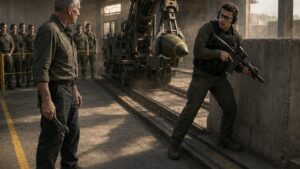
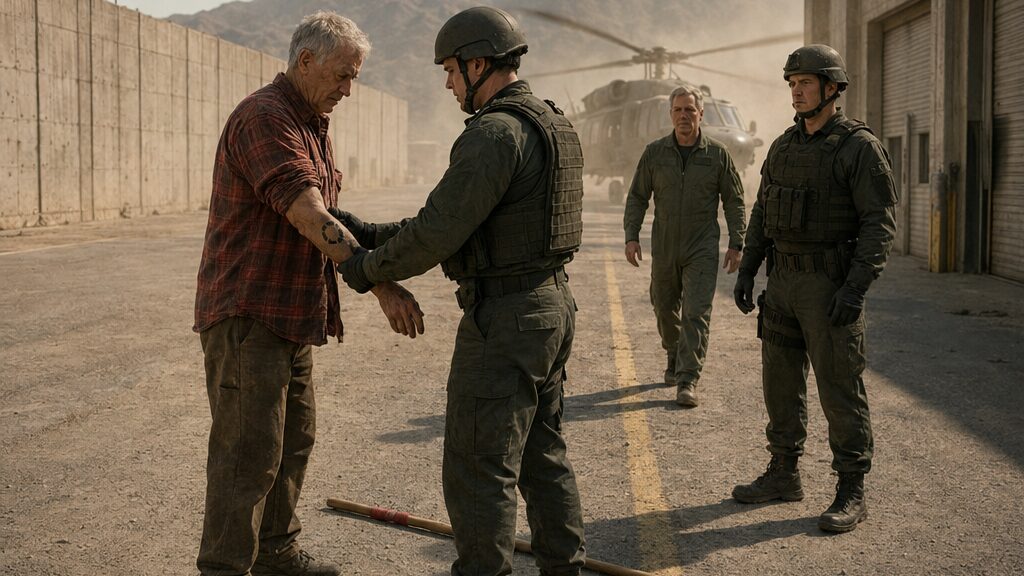
Nicholas Adams’s gloved hand was already locked around Dennis Walker’s forearm when the helicopter began winding down behind them.
The rotors beat the hot air into hard pulses. Dust climbed the concrete blast wall and swept across Dennis’s worn brown trousers. His long-handled broom tipped from his fingers, struck the pavement, and rolled until the faded red tape around its handle lay beside the dark mark Nicholas had exposed beneath his sleeve.
A broken circle. Three short blades. One gap where the fourth should have been.
Nicholas pulled the cloth higher.
“Where’d you get this?”
Dennis looked first at the hand around his arm, then at the young sergeant’s face. Nicholas’s helmet shadowed his eyes, but not the certainty in them.
“You can ask without holding me.”
The other security soldier stood several paces back near the restricted-lane marker. He gave a short laugh, as though Dennis had answered with something clever.
Nicholas did not release him.
“You were past the yellow line without an escort.”
“I was picking up grit.”
“On an active lane.”
“The wind doesn’t read signs.”
The second soldier laughed again. Nicholas’s jaw tightened, not at Dennis, Dennis thought, but at the sound behind him. The grip around his forearm became firmer.
Dennis’s employee badge hung from a frayed blue cord inside his shirt pocket. He had been reaching for it when his sleeve caught and the old tattoo showed. He could still feel the badge’s laminated edge against his ribs.
Nicholas turned Dennis’s arm toward the light.
“This isn’t a unit mark I recognize.”
“It isn’t on your arm.”
“That supposed to be funny?”
“No.”
The helicopter’s engine note dropped. Beyond the settling dust, crew members moved beneath the rotor arc with heads lowered. Dennis felt the old rhythm before he understood he was following it—the change in pitch, the slowing shadow, the point when men who knew better still waited.
Nicholas nodded toward the mark. “You get that at some veterans’ bar? Online stencil?”
The other soldier smiled openly now.
Dennis lowered his eyes to the tattoo. The ink had softened with his skin. The circle was no longer round. One blade had blurred into a dark vein near his wrist.
He could have given his service dates. He could have named aircraft, bays, supervisors, operations. He could have told Nicholas exactly how much hydraulic fluid stained concrete after a main line split, or how rotor dust tasted when it mixed with blood.
Instead he said, “Let go.”
Nicholas shifted his feet. “You don’t give orders here.”
Dennis felt the young man’s thumb press against the thin ridge of bone. His arm had bruised easily since winter. That fact embarrassed him more than the laughter.
The helicopter’s rotors slowed toward stillness.
Without thinking, Dennis raised his free hand and held two fingers beside his temple.
Rotor stopped. Approach safe.
The signal had belonged to five people and a time before standardized paddles, before laminated checklists, before the installation had painted every danger in reflective colors. It was not a salute. It had never been one.
Across the lane, a gray-haired officer who had been walking from the helicopter changed direction.
Dennis dropped his hand.
Nicholas saw the movement but misunderstood it. “What was that?”
“Nothing.”
“It looked like a threat.”
“At my age, Sergeant, most things look more dangerous than they are.”
The second soldier’s smile faltered. Nicholas’s grip did not.
The officer approached without hurrying. Dennis recognized him as the installation aviation commander, though they had never spoken. Colonel Daniel Moore carried no helmet. Gray showed at his temples, and the wind pressed his flight suit against a body that had thickened slightly with command.
He looked at Nicholas’s hand first.
“Sergeant, release his arm.”
Nicholas let go at once.
The absence of pressure hurt more sharply than the grip had. Dennis drew his sleeve down, but Daniel’s gaze had already found the broken rotor circle.
“What happened here?”
“Unauthorized civilian presence near a restricted flight lane, sir,” Nicholas said. “He refused to identify himself and displayed a questionable service insignia.”
Dennis reached into his shirt pocket and withdrew the badge.
Nicholas glanced at it, then away.
Daniel took the card. The plastic was yellowing at the corners, but the expiration strip remained valid. Dennis had worked civilian maintenance on the installation for eleven years, long enough for three supervisors to retire and two buildings to be renamed.
Daniel read the card, then studied Dennis’s face.
“Dennis Walker?”
“Yes.”
Daniel’s eyes returned to the tattoo. Something in them shifted—not recognition exactly, but the discomfort of seeing a shape from a dream.
“Were you in Bay Twelve,” he asked, “when the rotor came through the roof?”
The question struck Dennis lower than Nicholas’s hand had.
Behind Daniel, the condemned bay stood beyond a second blast wall. Its corrugated doors were shut. A red demolition notice had been wired to the fence that morning.
Dennis looked toward it.
“I was outside when it came down.”
Daniel waited.
Dennis bent for the broom. His fingers closed around the handle where the old red tape had been worn smooth by his palm.
“What does that mean?” Daniel asked.
“It means I was outside.”
“Did you work there?”
“I work everywhere they send me.”
“I’m asking about then.”
“And I answered about then.”
Nicholas shifted beside them. The tactical vest that had made him seem large a moment earlier now looked like equipment he had not decided how to stand inside.
Daniel handed the badge back, but he did not release it when Dennis took hold.
“There’s going to be a report.”
“There generally is.”
“Did Sergeant Adams use unnecessary force?”
Nicholas stared straight ahead.
Dennis could feel the shape of the answer waiting. He could say yes and watch the institution turn its machinery toward the younger man. He could say no and let the bruise speak later to no one.
“He held me,” Dennis said.
“That isn’t what I asked.”
“It is what happened.”
Daniel’s mouth tightened. “Did you resist inspection?”
“No.”
“Did you refuse identification?”
“I was reaching for the badge when he took my arm.”
Nicholas spoke quickly. “Sir, he was evasive, and the symbol could indicate unauthorized affiliation.”
Dennis looked at him. “You knew my arm wasn’t a weapon.”
Color moved into Nicholas’s face.
Daniel finally released the badge. “Mr. Walker, I’m suspending your flight-line access pending review.”
Dennis said nothing.
“You’ll report to the clinic, then security administration.”
“My shift ends at fourteen hundred.”
“Your shift ends now.”
The words were quiet. That made them official.
Dennis slipped the badge back into his pocket. Bay Twelve’s doors remained visible above the wall. Monday was the day he swept inside it. He had missed only twice in eleven years—once for pneumonia and once when a sandstorm closed the installation.
Today the floor was half done.
Daniel gestured toward the broom. “Someone will collect your equipment.”
“I collect my own.”
“That area is restricted to you now.”
Dennis rested both hands on the handle. The red tape touched the base of his thumb.
The second soldier was no longer smiling. Nicholas seemed ready to speak, but nothing came.
Dennis turned toward the clinic. He walked steadily until he had passed the corner of the blast wall. Only then did he stop and press his freed forearm against his side.
Behind him, Daniel asked Nicholas to begin again from the moment he saw Dennis cross the line.
Dennis did not hear the answer. A helicopter engine started farther down the row, swallowing the first words.
Daniel remained beside the fallen dust where the confrontation had begun. When the others left to file their statements, he entered his office and locked the door.
From the bottom drawer of his desk, beneath an old flight manual and his father’s discharge papers, he removed a photograph with one corner missing.
Five maintenance workers stood outside Bay Twelve. Their tools were wrapped with narrow strips of red tape. On the back, in his father’s handwriting, was a number Daniel had never understood.
He placed Dennis’s personnel number beside it.
The digits matched.
Chapter 2: A Name Missing From the Unit Wall
The clinic nurse photographed the finger-shaped bruises on Dennis’s forearm while he kept telling her they were not worth filing.
She lowered the camera. “That isn’t your decision.”
“It is my arm.”
“It happened on federal property.”
“So do sunburns.”
She did not smile. “Roll the sleeve higher.”
Dennis obeyed, though he disliked the clean white light and the way it made his skin look almost transparent. The tattoo sat inside the darkening marks from Nicholas’s glove.
The nurse photographed it from two angles.
“What does the symbol mean?”
“Old work.”
“That’s not a medical answer.”
“It wasn’t a medical question.”
She set the camera aside and tested his wrist. Pain ran toward his elbow, small and bright.
“You may have a mild strain.”
“I sweep for a living. Everything is mildly strained.”
She wrapped the arm anyway. When she finished, she picked up Dennis’s broom from beside the examination-room door.
“Security said this has to be held with your other work equipment.”
“It goes in the maintenance shed.”
“They told me the supply closet.”
“That closet is damp.”
“It’s a broom.”
Dennis looked at the faded red band around the handle. One edge had begun to lift.
“Yes,” he said. “It is.”
The nurse carried it across the hall. Before she shut the closet, Dennis saw the red tape through the narrow opening between mops, chemical containers, and folded caution signs.
He remained on the examination table until she returned with his release paper.
At security administration, Nicholas had changed out of his helmet and body armor. Without them he looked younger, though the neatness of his uniform seemed designed to correct that impression.
A second chair stood across from his desk. Dennis sat without being invited.
Nicholas opened a report on the monitor.
“You have the right to submit a statement.”
“I’ve already spoken.”
“To Colonel Moore. This is the official incident record.”
“Then put down what I said.”
“I need clarification.”
Dennis glanced at the clock. His shift would have ended in eighteen minutes.
Nicholas folded his hands. “Why were you across the yellow line?”
“Rotor wash pushed aggregate from the shoulder onto the lane.”
“You had no clearance to enter.”
“My badge allows maintenance access.”
“Not while aircraft are active.”
“The aircraft was parked. The rotor had not started.”
Nicholas’s expression changed by a degree. “My report states the aircraft was operating.”
“It was when you grabbed me. Not when I crossed.”
“You expect me to remember the exact second?”
“You’re writing the exact report.”
Nicholas leaned back. “And the gesture?”
“What gesture?”
“Two fingers near your temple.”
“A safe-approach signal.”
“It isn’t in current procedure.”
“It was in ours.”
“Whose?”
Dennis looked toward the frosted window in the door.
Nicholas waited.
When Dennis did not answer, the sergeant turned the monitor slightly. A paragraph had been highlighted.
Subject resisted inspection through physical tension and maintained an ambiguous hand gesture after verbal direction.
“I didn’t resist.”
“You stiffened your arm.”
“You were bending it.”
“You refused commands.”
“I asked you to release me.”
“You never explained the symbol.”
Dennis’s wrapped forearm rested on the chair arm between them. “Not knowing something does not make it a command violation.”
Nicholas stared at him. For a moment, Dennis saw something under the practiced certainty—anger, but not all of it directed at the room.
“My brother lost twelve thousand dollars to a man who claimed he ran a rehabilitation fund for combat veterans,” Nicholas said. “He wore unit marks, told stories, had photographs. None of it was his.”
Dennis did not respond.
“That man counted on people being too polite to ask.”
“You asked.”
“And you still haven’t answered.”
Dennis stood. “Put in the report that I asked you to let go before Colonel Moore ordered it.”
Nicholas’s eyes dropped to the bandage.
“That detail won’t change why I stopped you.”
“No,” Dennis said. “It changes what you did after.”
He left before Nicholas dismissed him.
Kimberly Rivera met him in the aviation headquarters corridor carrying a tablet, a paper folder, and an expression that suggested each minute had already been assigned.
“Mr. Walker?”
He stopped.
“I’m facilities transition and safety archives. Colonel Moore asked me to verify your access history.”
“You found the clinic.”
“I found your service record.”
The corridor wall behind her held framed unit lineages, each insignia printed above dates and campaign names. Dennis had passed them for years without slowing.
Kimberly opened the folder.
“Twenty-two years Army service. Aviation maintenance, recovery operations, final rank staff sergeant. Several assignments at this installation under its previous designation.”
Dennis said nothing.
“So the concern that you never served is unsupported.”
“A concern created by looking at my shirt.”
“The insignia is a separate question.”
“It is not an insignia.”
“What is it?”
“A mark.”
“That distinction matters to you?”
“Yes.”
“It does not appear in the unit registry, the lineage database, or the installation museum inventory.”
Dennis looked past her at the wall. There were polished emblems for units that had occupied buildings for six months. There were none for the five people who had marked their tools with red tape because no one else came when aircraft broke beyond the paved lines.
Kimberly tapped the tablet. “Your personnel file also contains no authorization for the symbol.”
“We didn’t ask.”
“That creates a problem.”
“For whom?”
“For anyone trying to establish what happened this morning.”
Dennis almost laughed, but the sound would have been too tired. “What happened this morning is written on my arm.”
“I mean before that.”
She handed him a printed copy of Nicholas’s report. Dennis read the line about resistance. He read the description of the two-finger gesture as “potentially threatening.” At the bottom, Nicholas had recommended temporary suspension pending verification of identity, access authority, and possible misrepresentation.
The paper trembled once in Dennis’s hand. He folded it before Kimberly could notice.
“You may submit a rebuttal.”
“No.”
“Then this version stands unchallenged.”
“He knows what he wrote.”
“That is not the same as you correcting it.”
Dennis handed the report back.
Kimberly studied him, impatient but not unkind. “Colonel Moore wants to know why your employee number appeared in his father’s records.”
“That is between him and his father.”
“His father has been dead thirty-seven years.”
“Then the conversation is overdue.”
She drew a breath through her nose. “You are suspended from restricted facilities until the review is complete. That includes Bay Twelve.”
Dennis’s eyes shifted toward the windows at the end of the corridor. From there, the upper edge of the condemned bay could be seen beyond the blast walls.
“The demolition is Monday,” he said.
“It was Monday.”
He looked back at her.
“The contractor had an opening. Work begins Friday at dawn.”
“Friday?”
“The utilities isolation passed early.”
“That bay hasn’t been cleared.”
“The inspection says it has.”
“The west tool rack is still bolted in.”
Kimberly checked her tablet. “The inventory lists no retained equipment.”
“I didn’t say equipment.”
“What is on the rack?”
Dennis folded his arms, then stopped when the bandage pulled.
Kimberly waited. “Mr. Walker, what is in Bay Twelve?”
He thought of five strips of red tape, hardened with age, flattened beneath layers of dust and paint. He thought of a locker tag behind the rack, if no one had moved it. He thought of a promise he had kept so long it no longer sounded like words.
“Nothing the inventory would count,” he said.
“Then why do you need access?”
Dennis looked toward the unit wall, where every recognized name and emblem sat behind glass.
Because some things disappeared first from paper, he thought, and then from rooms, and finally from the mouths of people who still remembered.
He did not say it.
Kimberly closed the folder. “Friday, Mr. Walker. Once the contractor takes control, no one enters.”
She walked away, leaving Dennis beneath the polished emblems.
Through the corridor window, sunlight struck the roof of Bay Twelve. A white demolition mark was already visible on one door.
Dennis had three days to reach what remained inside.
Chapter 3: The Bay He Swept After Everyone Left
The demolition crew painted a white X across Bay Twelve’s door while Dennis watched through the perimeter fence.
The first diagonal line ran from the upper hinge to the lower latch. The second crossed it cleanly. The painter stepped back, checked the mark, and moved to the next panel.
Dennis stood outside the restricted boundary in the same red plaid shirt he had worn the day before. His left sleeve was buttoned at the wrist. The broom was not in his hands, and the absence of its weight made him feel uneven.
A young maintenance apprentice approached from inside the fence carrying a coil of cable over one shoulder.
“You’re not supposed to be here, Mr. Walker.”
“I’m not inside.”
“They said no contact with the work area.”
“I’m looking at a door.”
The apprentice glanced toward the security post. “Colonel Moore came by twice.”
“He owns more doors than I do.”
“They cleared the east lockers this morning.”
Dennis’s attention sharpened. “And the west wall?”
“Tomorrow.”
“Tool rack still there?”
“I think so.”
“You think?”
The apprentice lowered his voice. “There’s not much left. Rusted brackets. Old hooks. Some tape stuck under paint.”
Dennis looked back at the white X.
Every Monday for eleven years, he had opened Bay Twelve at six-thirty. He swept from the rear wall toward the doors, never the other way. Dust had to be moved toward daylight. That was what they had done after the accident, before investigators arrived, before someone ordered them to stop touching anything.
The routine had outlived the reason he gave for it.
“Do not remove anything,” Dennis said.
The apprentice shifted the cable. “I didn’t say I would.”
“I’m saying it now.”
A vehicle passed on the access road. Both men waited until it was gone.
The apprentice reached into his coveralls. “Then I guess this fell through the fence.”
He slipped a small metal tag between the links.
Dennis did not take it immediately.
The tag was green with corrosion. One corner had broken away, but the stamped image remained visible: the broken rotor circle and, beneath it, the number five.
“Where?”
“Behind the east locker base. It was loose.”
“You entered a controlled disposal area?”
“I was assigned there.”
“You were assigned to inventory, not souvenir hunting.”
The apprentice’s face tightened. “I thought it mattered to you.”
“That does not make it yours to move.”
“I was trying to help.”
Dennis closed his fingers around the tag. It was warmer than he expected from the apprentice’s pocket.
“You can lose your access for this.”
“So can you, apparently.”
Dennis looked at him.
The apprentice regretted the words at once. “I’m sorry.”
“You should be.”
A voice sounded behind them.
“He should be what?”
Daniel Moore had approached along the outside path without an aide. He wore his flight suit again, sleeves rolled once at the forearms.
The apprentice stepped away from the fence.
Daniel’s gaze moved from Dennis to the metal tag in his hand.
“Where did that come from?”
The apprentice opened his mouth.
Dennis said, “The east lockers.”
“I asked who removed it.”
“I have it.”
“That is not an answer.”
Dennis held the tag through the fence. “Put it back.”
The apprentice did not move.
Daniel took the tag instead. He turned it in his palm, brushing dust from the stamped mark with his thumb.
“You encouraged him to enter the bay?”
“No.”
“You came here the morning after your suspension and discussed a specific rack.”
“I told him not to remove anything.”
“After he handed this to you?”
“Before anything else leaves.”
Daniel’s expression hardened. “You expect me to accept that distinction?”
“I expect you to ask him.”
The apprentice stood straighter. “Sir, Mr. Walker didn’t ask me to take it. He told me I could lose my access.”
Daniel looked at the young man for several seconds. “Return to your supervisor. You will report the removal yourself.”
“Yes, sir.”
When he was gone, Daniel remained by the fence with the tag.
“You are making this harder,” he said.
“I have been told that before.”
“I verified your service.”
“That should settle Sergeant Adams’s first accusation.”
“It does not explain the symbol or your presence here.”
“I work here.”
“You sweep one condemned bay every Monday whether it is on your task sheet or not.”
Dennis said nothing.
Daniel stepped closer to the fence. “Facilities records show that routine began eleven years ago. Why?”
“Dust.”
“There are six condemned structures in this sector. You don’t sweep the others.”
“They don’t collect it the same.”
Daniel gave him a tired look. “My father wrote your employee number on the back of a photograph decades before you became an employee.”
“Then it wasn’t an employee number.”
“What was it?”
Dennis watched the demolition painter drag his bucket toward the western door.
“An old roster number.”
“For what roster?”
Dennis did not answer.
Daniel closed his fingers around the locker tag. “I cannot help you if you insist on making every fact sound like an accusation against you.”
“I did not ask for help.”
“No. You came to a fence and let a nineteen-year-old risk his position because you would rather stand here than explain why that piece of metal matters.”
The words landed cleanly because they were partly true.
Dennis turned away.
Back in his rented room that evening, he opened the small steel toolbox beneath his kitchen table. Four narrow strips of red tape lay inside a plastic envelope. He had cut them years ago, each exactly the width used on the recovery tools.
He took one out.
The broom leaned against the wall beside the refrigerator. The clinic had released it after facilities signed the property transfer. The tape around its handle had begun peeling where it struck the pavement.
Dennis sat with the broom across his knees and unwound the damaged layer. Beneath it, the wood was pale and smooth.
He remembered four other sets of hands marking tools in Bay Twelve because equipment kept vanishing into other shops. Red meant return it. Red meant theirs. Later, it meant come when called. Later still, it meant remember who had answered.
Dennis wrapped the fresh strip carefully and pressed the end flat with his thumb.
A knock came just after dark.
Daniel stood in the corridor holding a manila envelope.
“I won’t stay.”
Dennis did not invite him inside, but he opened the door wider.
Daniel removed a photograph and held it beneath the hallway light.
Five people stood outside Bay Twelve. Dennis recognized his own younger body before he allowed himself to see the others. Maria Hernandez stood at the left, one hand raised against the sun. Red tape circled the handles of the tools at their feet.
At the right edge, a jagged white gap cut into the picture where someone had been removed.
Daniel pointed to it.
“My father kept this in his flight manual. I assumed he cut himself out because he hated photographs.”
Dennis stared at the torn edge.
“He didn’t cut himself out,” he said.
Daniel’s face changed. “So that was him?”
Dennis looked at Maria, then at his own younger face, then at the space where the fifth person had stood.
“Yes.”
“Why would someone remove him?”
Dennis’s grip tightened around the broom handle.
Daniel turned the photograph over. The old roster number was written across the back. Beneath it, almost erased, were three words in his father’s handwriting.
Ask Walker outside.
“Who cut the photograph?” Daniel asked.
Dennis lifted his eyes.
“I did.”
Chapter 4: The Photograph With One Soldier Removed
Daniel placed the photograph tattoo-side down on his desk.
“Why did you cut my father out of his own unit picture?”
Dennis remained standing. The office window behind Daniel looked toward the flight line, but the blinds were half closed, breaking Bay Twelve into narrow white bars.
“It wasn’t his unit.”
Daniel’s hand flattened over the photograph. “You just said that was him.”
“It was.”
“Then answer the question.”
Kimberly Rivera sat at the end of the desk with a document scanner and three archive folders arranged in exact alignment. She had invited Dennis to sit twice. He had declined twice.
Daniel turned the photograph over.
Five younger figures stood in front of Bay Twelve, though the jagged gap at the right edge left only four complete bodies. Dennis wore grease-dark coveralls and held a tow bar upright. Maria Hernandez had one boot on a tool case. Every visible handle near their feet was wound with red tape.
The torn edge passed through Daniel’s father’s shoulder.
Dennis remembered the scissors. He remembered how cheaply the old paper had resisted, bending before it cut.
“He asked me to,” Dennis said.
Daniel’s face did not move. “When?”
“Before he died.”
“That photograph was found among his things after the accident.”
“I gave it back to him.”
“You cut him out and returned the rest?”
“Yes.”
“Why?”
Dennis looked at Kimberly’s folders. One bore the current installation seal. Another carried an older designation, the ink faded to brown.
Daniel leaned forward. “Did he believe he didn’t belong with you?”
“No.”
“Did you?”
“No.”
“Then what did he ask you to do?”
“He said his family should have the piece with him in it.”
Daniel stared at the missing space.
“And you kept the rest?” he asked.
“For a while.”
“Where is it now?”
“I don’t know.”
The answer was true, though it left out the years the photograph had remained folded inside Dennis’s toolbox. Maria had taken it after the inquiry. Or thrown it away. He had never asked.
Daniel pushed back from the desk. “You keep saying you don’t know as though it ends the question.”
“Sometimes it does.”
“Not this time.”
Kimberly opened the oldest folder. “The people in that photograph do not appear as a formal section.”
Dennis looked at her.
“I checked unit tables, temporary duty rosters, maintenance detachments, and post-accident records. There is no broken rotor emblem, no five-person recovery team, and no authorized subunit operating from Bay Twelve.”
“We weren’t a subunit.”
“What were you?”
“The people they called when the first people couldn’t finish.”
Daniel’s eyes narrowed. “Finish what?”
“A hard landing in the training corridor. A gearbox fire on the western range. Aircraft stuck where standard recovery trucks couldn’t reach. Anything command needed moved before someone higher asked why it was still there.”
Kimberly made a note. “Who assigned you?”
“No one consistently.”
“That is not how military maintenance works.”
“It is how it worked when the paperwork arrived after the aircraft.”
Dennis stepped closer to the photograph and pointed without touching it.
“Maria was a flight medic. Your father flew test runs after repair. I handled rotor and control systems. The other two covered recovery rigging and fuel. Different shops, different chains. We used Bay Twelve because it had space and no one wanted responsibility for it.”
“The tattoo?” Daniel asked.
“Not a tattoo then. A mark on tools.”
Dennis indicated the red bands visible in the photograph.
“Equipment kept disappearing. Red meant bring it back.”
Kimberly glanced at his covered forearm. “And later?”
Dennis lowered his hand.
“Later it meant something else.”
“What?”
“That the tool belonged to someone who would come when called.”
The office went quiet except for the muted thump of a helicopter beyond the blinds.
Daniel sat again. Some of the anger had shifted, but it had not left.
“My father was part of this informal group.”
“He came when called.”
“And he died at Bay Twelve.”
“Yes.”
“During an accident the official report says began with an unexpected rotor-control failure after maintenance.”
Dennis’s throat tightened.
Kimberly pulled a photocopy from the third folder. “There is another issue.”
She turned the page toward him.
The document was a personnel action summary. Most of the original text had been reduced to codes, but one line remained readable.
SSG WALKER REENTERED ACTIVE HAZARD ZONE AFTER DIRECT EVACUATION ORDER.
Daniel read it aloud.
Dennis did not look at the page.
“What did you go back for?” Daniel asked.
“People.”
“My father?”
“Among them.”
Daniel’s fingers closed around the edge of the report. “Did your reentry interfere with emergency response?”
“No.”
“Did it move anyone into greater danger?”
“No.”
“Then why were you disciplined?”
“Because I went back.”
“That isn’t enough.”
“It was enough for them.”
Kimberly studied Dennis. “The notation references an annex, but the annex is not attached.”
“I know.”
“You saw it?”
“I signed something.”
“What did it say?”
“That I had ignored an order.”
“What else?”
Dennis stared at the white space where the missing photograph piece had been.
The first order had come from outside the bay. Clear the area. Fuel vapor. Secondary ignition risk.
The second had come from beneath twisted metal, in a voice Daniel had inherited without knowing it.
He forced his attention back to the room.
“I don’t remember.”
Daniel stood so abruptly that his chair struck the wall.
“You remember which direction you swept that floor for eleven years. You remember the exact rack no one inventoried. You remember a hand signal no longer in use. But you do not remember what happened when my father died?”
Dennis did not answer.
Daniel crossed the room until the desk no longer separated them. “Were you outside because you had been ordered out?”
“Yes.”
“And then you went back in?”
“Yes.”
“Did your decision contribute to the failure?”
“No.”
“How can you be sure?”
“Because the failure had already happened.”
“That is not what I asked.”
Dennis met his eyes.
Daniel’s grief was old enough to have hardened into family fact. His father had died in a maintenance accident. Someone had disobeyed orders. The photograph had been cut. Every piece could be arranged into a shape that placed Dennis at the center.
Dennis knew how tempting such shapes were.
“I went back,” he said. “That part is mine.”
Daniel’s voice lowered. “And the rest?”
Dennis buttoned his jacket over the red plaid shirt.
“The rest belongs to people who aren’t in this office.”
Daniel stepped away as though Dennis had pushed him.
Kimberly closed one folder but kept the personnel notation out. “There may be another way to establish the sequence.”
She pointed to a reference code at the bottom of the page.
“Maintenance warning seven-one-four, rotor-control vibration. The annex continues under this number.”
Daniel leaned over her shoulder.
“Can you retrieve it?”
“The archive index says it is sealed with the accident file.”
“Then open the accident file.”
Kimberly turned the tablet toward him. “The seal record exists. The annex does not.”
Daniel looked at Dennis.
“Was there a warning before the accident?”
Dennis picked up the photograph, placed it carefully beyond Daniel’s reach, and aligned it with the edge of the desk.
“There was always a warning,” he said.
Kimberly’s fingers moved over the tablet. “This reference number appears again.”
“Where?” Daniel asked.
“Two months later. Different classification.”
She opened the entry.
The same warning number had been attached to a routine parts invoice.
Whatever had once followed it had been filed somewhere no accident investigator would think to look.
Chapter 5: The Warning Filed Beneath a Different Number
Kimberly found the missing warning because someone had ordered twelve hydraulic couplings.
The parts invoice lay inside a storage carton marked for disposal. Its first page listed fittings, seals, and freight charges. The second carried the same reference code as Dennis’s disciplinary notation.
Kimberly held it beneath the archive lamp.
“Seven-one-four,” she said. “But this has nothing to do with rotor vibration.”
Dennis stood on the other side of the steel table, his broom upright beside him. Daniel had restored his access only for the archive interview, not the flight line. A temporary visitor card hung from Dennis’s shirt.
“Turn it over,” he said.
The back appeared blank.
Kimberly angled the page. Faint impressions crossed the paper where another form had once been written on top of it.
She used the scanner’s side light. Lines emerged.
Recurring lateral vibration under load. Control feedback intermittent. Recommend immediate inspection across training fleet before extended operation.
Daniel read the impression twice.
“Who wrote this?”
“I did,” Dennis said.
Kimberly enlarged the lower section. “There’s no signature.”
“There was on the original.”
“Where is the original?”
Dennis looked at the box.
“This is a carbon impression. The original would have gone through maintenance control.”
Daniel’s face had lost the anger from the morning. In its place was calculation.
“Was the fleet grounded?”
“No.”
“Were the aircraft inspected?”
“One was.”
“The one that failed?”
“No.”
Kimberly tapped the invoice. “Why was the reference number reused?”
“To close it.”
“That is not a recognized records procedure.”
“It was a recognized way to make an open item disappear.”
Daniel looked toward the archive door, though no one stood there.
“Who ordered that?”
Dennis rested both hands on the broom handle. “The people who signed the maintenance schedule are dead or retired.”
“That doesn’t answer me.”
“It is the answer you have.”
Kimberly began photographing each page. “This establishes that a warning existed. It does not establish deliberate suppression.”
“No,” Dennis said. “It establishes that the warning was turned into a parts purchase.”
Daniel walked to the end of the table. “Why didn’t you take this outside the chain?”
“I did.”
“To whom?”
“The accident panel.”
“And?”
“They asked whether I had personally inspected the failed assembly.”
“Had you?”
“No.”
“Then they dismissed it.”
“They said I was connecting separate faults because I felt responsible.”
Kimberly looked up. “Were they separate?”
Dennis did not answer immediately.
The vibration he had reported had come and gone. The failed aircraft had shown no fault during its last ground test. There had been reasons to doubt him, practical ones. He remembered those reasons because they had become the language used against him.
“I couldn’t prove they weren’t,” he said.
Daniel exhaled. “This may reopen the accident classification.”
“It may not.”
“You don’t seem concerned.”
“I was concerned thirty-seven years ago.”
Kimberly slid the invoice into a protective sleeve. “There is one surviving person listed in related medical transport records.”
Dennis knew before she said the name.
“Maria Hernandez,” Kimberly continued. “Retired flight medic. She lives forty minutes from here.”
“No.”
Daniel turned. “No what?”
“No need to involve her.”
“She was in the photograph.”
“She has her own life.”
“She may verify the warning.”
“She will verify what she remembers.”
“That is generally the purpose.”
Dennis lifted the broom.
Kimberly stepped between him and the door. “You came here because you wanted something preserved before Bay Twelve was demolished.”
“I wanted the rack cleared properly.”
“You wanted more than that.”
Dennis’s grip tightened.
“You have refused to explain the tattoo, the roster, the photograph, the disciplinary notation, and the missing annex. Each time, someone else has had to find the next piece.”
“I did not ask you to.”
“No,” Kimberly said. “You made sure no one could finish without you.”
The words stopped him.
Daniel watched without intervening.
Dennis had believed silence kept his hands clean. No boasting. No accusation. No demands made in the names of the dead.
But Kimberly was right about one thing: every withheld answer forced someone else to dig through what he had left buried.
“Call her,” he said.
Maria chose a roadside diner rather than the installation.
She arrived after sunset wearing a denim jacket and using a cane she seemed to resent. Her white hair was cut close, and her eyes found Dennis before Kimberly rose from the booth.
Maria stopped.
“Well,” she said. “The broom survived.”
Dennis had brought it because he did not trust the archive closet. He leaned it against the wall.
“You still carrying tools?” he asked.
Maria sat across from him. “Only the ones that behave.”
From her jacket pocket she produced a short flathead screwdriver. Its handle was wrapped in faded red tape.
She placed it on the table.
The broom and screwdriver stood an arm’s length apart, marked with the same old color.
Daniel remained quiet at the end of the booth. Maria had looked at him once, recognized something in his face, and looked away.
Kimberly laid copies of the warning and invoice between them.
“Did Dennis report rotor-control vibration before the Bay Twelve accident?”
Maria read the first page.
“Yes.”
“Did you observe it?”
“I observed pilots complain about it. Maintenance called it feedback. Pilots called it a shiver. Command called it within tolerance.”
Daniel spoke. “My father flew that aircraft.”
Maria looked at him fully then. “I know who you are.”
“Did he know about the warning?”
“He knew Dennis had raised one.”
“Did he agree?”
“He agreed enough to fly a test after repair. Not enough to refuse the flight.”
Daniel absorbed that without protest.
Kimberly pointed to the invoice. “Do you know why the warning number was reassigned?”
Maria gave a humorless smile. “Because an open warning delayed the training cycle. A parts invoice did not.”
“Can you sign a statement confirming that?”
Maria looked at Dennis.
He looked down at the tabletop.
“I’ll sign,” she said, “after he tells you what happened after the rotor came through.”
Dennis’s head rose. “That is not part of the warning.”
“It is part of why you let them bury it.”
“I testified.”
“You answered questions. That is not the same.”
Daniel’s voice was careful. “What did he leave out?”
Maria picked up the screwdriver and turned it between her fingers.
“Dennis thinks silence is a shelter. It isn’t. Not after this long.”
“Maria.”
“You kept sweeping that bay?”
He said nothing.
“For how many years?”
“That is my business.”
“You kept the wrong promise.”
The waitress approached, saw the papers, and retreated without asking for an order.
Dennis felt Kimberly and Daniel waiting, but Maria’s anger belonged to a room none of them had entered.
“What promise?” Kimberly asked.
Maria’s gaze remained on Dennis.
“The five of us marked the tools so they would come back,” she said. “After the accident, we promised the people would come back too. In reports. In training. In whatever they changed so it couldn’t happen again.”
She tapped the warning.
“Dennis decided remembering privately was enough.”
“I did not decide for you.”
“You disappeared.”
“I stayed here.”
“You hid here. There is a difference.”
Daniel looked between them. “What happened after the crash?”
Maria set the screwdriver beside the invoice.
“Dennis had three people within reach. Two could be moved. One could not.”
Daniel’s hand flattened on the table.
“My father?”
Maria nodded.
Dennis stared at the red tape on the screwdriver. Maria had wound it badly, as she always had—overlapping near the base, leaving a ridge that caught grease.
“He was unconscious,” Dennis said.
Maria’s expression changed.
“No,” she said. “He wasn’t.”
Dennis looked at her.
“You told yourself that before the inquiry, and then you kept telling it until you could live inside it.”
“He didn’t speak.”
“He spoke to me first.”
Maria leaned closer.
“And after you crawled back under that wreckage, he spoke to you.”
Chapter 6: What the Dying Man Actually Ordered
“Say the words exactly,” Maria told Dennis. “Not the version you have used for thirty-seven years.”
The observation room overlooked Bay Twelve through a wide pane of dust-filmed glass. Below them, the demolition crew had staged barriers and machinery beyond the blast wall. Work lights threw long white shapes across the condemned doors.
Daniel stood near the window. Kimberly had placed a recorder on the table but had not switched it on.
Dennis sat with his wrapped forearm resting across his knees.
“He was trapped,” he said.
“That is not what he said.”
“His legs were under the frame.”
“Dennis.”
Fuel had run along the bay floor in shining threads. The rotor blade had entered through the roof at an angle, cutting sheet metal, lights, and support braces before striking the concrete. Afterward, there had been a silence so complete Dennis had heard a loose bolt spin to a stop.
He had been outside when it came down.
That sentence had carried the shape of truth without its weight.
“I went in after the first fire bottle discharged,” he said.
Daniel turned from the window.
“Your father was near the aircraft nose. Maria was behind the workbench. Another man was against the east wall.”
“One of the other two from the photograph?” Kimberly asked.
Dennis nodded.
“The evacuation order came because fuel vapor had reached the drain channel. They expected ignition.”
Maria sat opposite him. “Keep going.”
“I got Maria clear first.”
“You dragged me by the harness and dislocated my shoulder.”
“You complained for six months.”
“I am still complaining.”
The edge in her voice kept the room from becoming ceremonial.
Dennis looked at Daniel.
“Your father was awake when I returned.”
Daniel’s jaw worked once. “Could he move?”
“No.”
“Could you move him?”
“Not alone. Maybe not with four people.”
“But you tried.”
“Yes.”
The twisted frame had pinned Daniel’s father below the hips. Dennis had braced one boot against a broken cabinet and pulled until the man shouted. That shout had been the first sign he was conscious.
Behind them, someone coughed through smoke.
The third injured man lay near the east wall with a fractured arm and burns along one side. Maria, barely able to stand, had been trying to reach him again.
“What did my father say?” Daniel asked.
Dennis lifted his hand without realizing it. Two fingers rose beside his temple, reflected faintly in the observation glass.
Rotor stopped. Approach safe.
His hand remained there.
“He asked whether the rotor had stopped.”
Daniel looked at the reflected gesture.
“I said yes.”
“What else?”
“He asked about the fuel.”
Maria’s voice softened but did not release him. “Then?”
Dennis lowered his hand.
“I told him we had minutes.”
“You told him less than that,” Maria said.
“I don’t remember.”
“You said, ‘Maybe one.’”
Daniel closed his eyes briefly.
Dennis could smell the fuel again, though the observation room held only dust and old air-conditioning.
“Your father looked toward the east wall,” Dennis continued. “He could hear the other man coughing.”
Daniel waited.
Dennis’s mouth had gone dry.
“He said, ‘Take the two.’”
The words were smaller in the room than they had been in Bay Twelve.
Daniel looked at Maria.
She nodded.
“He meant Maria and the man near the wall,” Dennis said. “I told him I could come back.”
“What did he say?”
Dennis’s fingers pressed into his knees.
“He said no.”
Maria leaned forward. “Exactly.”
Dennis looked at her with anger he had denied himself for years.
“You know what he said.”
“Daniel does not.”
Daniel did not move.
Dennis forced the words out.
“He said, ‘Do not spend them on me.’”
The air-conditioning clicked off.
Daniel turned toward the window and braced one hand against the frame.
Dennis continued because stopping would make the sentence the whole story.
“I carried the other man out. Maria moved under her own power after that. The fuel ignited before we reached the barrier.”
“And my father?” Daniel asked.
Dennis looked down.
“He was still inside.”
Daniel’s shoulders rose and fell once.
“You obeyed him.”
“I left him.”
“You obeyed him,” Maria repeated.
Dennis stood. The chair legs scraped the floor.
“I chose the people I could lift.”
“He chose them first.”
“I was the one who moved.”
“You were the one who had to live after.”
Dennis faced her. “You think that makes it easier?”
“No. I think you made it harder because you believed suffering longer would make the choice fair.”
The words struck with more force than Nicholas’s hand had.
Kimberly reached toward the recorder, then stopped. “Was this included in the inquiry?”
“Parts of it,” Maria said. “They recorded that the trapped pilot could not be recovered before ignition. They did not record his order.”
“Why not?”
“Because command did not want a final statement creating questions about who knew the aircraft was unsafe.”
Daniel turned back. “My father knew the risk and flew anyway.”
“He knew there had been complaints,” Maria said. “He did not know the warning had been buried.”
Dennis stared through the glass at Bay Twelve.
For decades he had carried the belief that one more pull, one different angle, one refusal to obey might have changed the outcome. It had seemed indecent to let Daniel’s father’s choice release him.
Maria stood with difficulty and came beside him.
“You cut him out of the picture because he asked for a copy for his family,” she said. “But after he died, you acted as if removing him was your punishment.”
Dennis said nothing.
“You swept the bay because you could not carry him out.”
His reflection in the glass looked older than he felt and younger than he deserved.
Daniel approached the table. When he spoke, his voice had become formal.
“We can correct the incident report from Monday. Mr. Walker’s access can be restored immediately. The allegation regarding unauthorized insignia can be closed as unfounded.”
Kimberly looked at him. “And the maintenance warning?”
Daniel kept his eyes on Dennis. “The warning is thirty-seven years old. We preserve it in the archive and note the procedural gap. Opening a formal review before demolition would delay contracted work and invite conclusions the surviving evidence may not support.”
Maria gave a short, bitter breath.
Daniel continued. “I can ensure Sergeant Adams receives corrective action for the physical handling and inaccurate language. Quietly. Mr. Walker returns to duty. Bay Twelve proceeds on schedule.”
Dennis heard the offer for what it was: his name cleared, his badge returned, Nicholas corrected, the old room left to fall without further disturbance.
Privacy. No spectacle. No one turned into a symbol.
For one unsteady moment, it felt like dignity.
Daniel retrieved Dennis’s access badge from his pocket and held it out.
Dennis took it.
The plastic was warm from Daniel’s hand. His photograph showed a face taken six years earlier, already old but not yet tired in the same places.
Kimberly gathered the warning documents slowly.
Maria did not look at him.
Dennis clipped the badge to his shirt.
Daniel’s shoulders eased.
Then Dennis thought of Nicholas’s report, where stillness had become resistance. He thought of the warning turned into a parts invoice. He thought of the polished unit wall and the white X across Bay Twelve.
Silence had not kept the truth clean. It had only left the writing to whoever remained at the desk.
Dennis unclipped the badge.
He placed it on the table in front of Daniel.
“I want a formal safety review before they touch that building.”
Daniel’s face closed. “You understand what that may do to your employment.”
“Yes.”
“And to people who cannot answer for decisions made decades ago.”
“They do not have to answer for the dead.”
“Then who?”
Dennis looked at his bruised forearm, at the broken rotor circle distorted beneath old skin.
“The people still teaching the same lesson.”
Daniel glanced at the dark bay below.
“What lesson is that?”
“That if a man looks small enough, his warning can be filed anywhere.”
Dennis pushed the badge across the table.
“Put my name back when the record is ready to carry
Chapter 7: The Statement That Refused an Easy Villain
Nicholas entered the review room expecting to face a misconduct panel and found Dennis seated closest to the door.
There was no witness table. No raised platform. A rectangular conference table filled most of the room, with three safety officers along one side and Kimberly Rivera at the end beside stacked files. Maria sat near the window, her cane hooked over the back of her chair. Daniel occupied no special position.
Dennis’s broom rested against the wall behind him.
Nicholas looked at it before he looked at Dennis.
His uniform was pressed sharply enough to hold its own shape. He carried a folder under one arm and kept his injured certainty around him like the tactical vest he was not wearing.
One of the panel members motioned toward an empty chair.
Nicholas sat.
The chair placed him directly across from Dennis.
Daniel began with the date, location, and purpose of the review. His voice remained level until he reached the phrase “potential suppression of a maintenance warning.” Then a slight pause opened before he continued.
“This review is not a criminal proceeding,” he said. “It concerns current safety implications, the accuracy of Monday’s security report, and whether demolition of Bay Twelve may proceed as scheduled.”
The demolition foreman stood near the rear wall with his hard hat tucked under his elbow. He glanced at the clock.
Kimberly activated the recorder.
She began with the old warning.
The documents did not prove everything. She made that clear. They proved Dennis had reported recurring rotor-control vibration. They proved the warning number had later been attached to a parts invoice. They proved the accident record referenced an annex that could no longer be located.
They did not prove who had ordered the reassignment. They did not prove the vibration had caused the failure. They did not restore the voices of the people who had signed the original forms.
Dennis appreciated her caution more than certainty offered on his behalf.
When she finished, one of the panel members asked him to describe the recovery section.
“It was not a section on paper,” Dennis said.
“Then what authority did it operate under?”
“Whatever authority came with a broken aircraft blocking someone’s schedule.”
A pen stopped moving.
Dennis corrected himself. “We were drawn from maintenance, medical, rigging, fuel, and test flight personnel. We recovered damaged aircraft and crews when normal resources were insufficient.”
“Who commanded you?”
“No one consistently.”
“Who designed the symbol on your arm?”
“One of us drew it on a tool cabinet.”
“Why tattoo it?”
Dennis looked toward Maria.
She did not help him.
“After the accident,” he said, “five people became four. We thought marking ourselves would keep the group from disappearing.”
The panel member glanced at the photograph in Kimberly’s file. “But it did disappear.”
“Yes.”
“Why?”
Dennis folded his hands.
“Because we let other people decide what counted as official.”
Kimberly placed Nicholas’s security report on the table.
The room shifted toward the more recent wound.
“Sergeant Adams,” she said, “you reported that Mr. Walker resisted inspection and made a potentially threatening gesture.”
Nicholas opened his folder. “That was my assessment at the time.”
“Describe the resistance.”
“He tensed his arm and declined multiple instructions.”
Dennis watched him speak. The sentences were clean, rehearsed, and almost true.
Kimberly turned to Dennis. “Did you tense your arm?”
“Yes.”
Nicholas looked up.
“Why?” she asked.
“He was bending it.”
“Did you attempt to pull free?”
“No.”
“Did you threaten him?”
“No.”
“The hand gesture?”
Dennis raised two fingers beside his temple.
Nicholas’s shoulders tightened.
“It meant the rotor had stopped and the approach was safe,” Dennis said. “It belonged to the recovery group.”
One panel member asked, “Why didn’t you explain that at the scene?”
“Because I was angry.”
The admission drew more attention than denial would have.
Dennis continued. “And because I thought answering would turn the moment into a request for permission to have lived my own life.”
Maria watched him carefully.
“That was pride,” Dennis said. “Not dignity.”
The recorder’s red light remained steady.
Kimberly addressed Nicholas again. “Did Mr. Walker’s age or appearance influence your assessment?”
“No.”
Dennis heard the answer arrive too quickly.
Nicholas must have heard it too. His eyes dropped to the report.
Daniel said, “Sergeant, this room exists so the record can become more accurate, not more defensible.”
Nicholas’s face reddened.
“My brother was defrauded by someone using false service claims,” he said. “I have seen what happens when people refuse to question symbols because they are afraid of offending someone.”
“That explains why you asked,” Dennis said.
Nicholas looked at him.
“It does not explain why you kept holding me.”
Silence settled over the table.
Nicholas’s hand moved once against his folder, thumb pressing into the cardboard edge.
“The other soldier laughed,” he said.
No one interrupted.
“I had already stopped Mr. Walker. I had already said the mark looked false.” Nicholas swallowed. “When he told me to let go, I thought releasing him would make it look like I had lost control of the contact.”
“Did you believe he posed a physical threat?” Kimberly asked.
“No.”
“Did you recognize that his arm was vulnerable?”
Nicholas stared at the bruise still visible beneath Dennis’s rolled cuff.
“Yes.”
“And you tightened your grip?”
“Yes.”
The word did not transform him. It only removed the shelter around what he had done.
Nicholas pushed the report away.
“I wrote resistance because I knew the clinic photographs might show force. I wanted the force to have a reason.”
The second panel member made a note.
Daniel’s expression became formal. “That admission will be addressed separately.”
Dennis saw Nicholas prepare for the room to turn entirely against him.
“He wrote a false detail,” Dennis said. “He should answer for it.”
Nicholas lifted his eyes.
“But he is not the whole problem.”
One panel member frowned. “Mr. Walker, the security incident is a distinct matter.”
“No. It is the same matter, closer in time.”
Dennis turned his forearm upward but did not expose the tattoo yet.
“One bad grip grew from years of teaching people that civilian clothes erase military memory. The wall outside this room lists recognized units. Our work is not there. The accident file lists disobedience. It does not list the order given under the wreckage. A warning became an invoice because the man raising it was easier to dismiss than a training schedule.”
Daniel’s gaze lowered.
Dennis continued without raising his voice.
“Sergeant Adams chose what he did. Do not reduce that choice. But do not use him to make everything else look clean.”
The room remained still.
Daniel spoke next.
“I offered Mr. Walker private correction of the security report and restoration of his access if the demolition continued without formal review.”
A safety officer looked at him. “Why?”
“To avoid delay, speculation, and unsupported allegations against former personnel.”
“And to keep my father’s accident from becoming an institutional failure,” Daniel added. “That was also part of my reasoning.”
Maria leaned back. For the first time since entering, she appeared less angry than tired.
Kimberly slid the photograph toward Dennis.
He rolled up his own sleeve.
Nicholas did not move.
“This mark was never a qualification,” Dennis said. “It does not prove courage, rank, or special skill. It was five workers telling one another they would answer when called.”
He looked directly at Nicholas.
“You may look.”
Nicholas’s eyes moved to the broken rotor circle. Dennis kept his arm on his side of the table.
No one touched him.
The demolition foreman cleared his throat from the back.
“I need a determination,” he said. “Equipment starts at dawn. A delay beyond the contracted window triggers penalties and affects two other facilities.”
The practical world entered the room again: money, machinery, schedules, people waiting to work.
The panel withdrew for eleven minutes.
Dennis did not reach for the broom. Maria said nothing. Nicholas sat with his report closed.
When the panel returned, demolition was approved.
Daniel’s shoulders lowered, though not entirely with relief.
Then the senior safety officer continued.
Work would be delayed two hours. Dennis would receive supervised access to remove one authorized item from Bay Twelve. Kimberly would record an oral maintenance history inside the structure. The recovered warning would be added to current training review, and Nicholas’s report would be corrected rather than deleted.
The old bay would still fall.
The record would not fall with it.
As the room emptied, Kimberly asked Dennis what item he intended to remove.
He looked through the narrow window toward Bay Twelve, where the first work lights were already being positioned for dawn.
“The west wall rack,” he said.
“You can choose one item, not a fixture.”
Dennis picked up his broom.
“What I need is attached to it.”
Chapter 8: The Morning Dennis Left the Broom Standing
Dennis entered Bay Twelve alone while the demolition engine idled beyond the blast wall.
Kimberly waited outside with a camera and recorder. The foreman had given them ninety minutes instead of two hours, muttering about hydraulic checks and contractual mercy.
Inside, the old bay smelled of dust, cooling metal, and concrete that had not seen rain in years.
The white demolition X showed faintly through the door seams.
Dennis set his broom upright near the center of the floor.
For eleven years, he had begun at the rear wall and swept toward daylight. That morning he did not move a single line of dust.
The west tool rack remained bolted beneath layers of gray paint. Most of its hooks were empty. One held a cracked rubber mallet head without a handle. Along the lower rail, nearly hidden beneath paint and dirt, were five narrow strips of red tape.
Dennis used Maria’s screwdriver to lift the first edge.
The tape resisted. It had hardened until it felt more like thin plastic than cloth. He worked slowly, preserving each strip as Kimberly photographed from the doorway.
“You can come closer,” he told her.
She stepped inside.
He removed four strips intact. The fifth split near the middle.
Dennis held the two pieces in his palm.
“That one was his?” Kimberly asked.
“There was no assigned order.”
She understood the boundary and did not ask again.
The old rack itself was scarred where tools had been thrown against it, returned too hard, or removed in a hurry. Dennis ran his fingers over five shallow cuts near the side.
“This is the item,” he said.
“The rack?”
“The marked rail.”
“It is bolted into masonry.”
“The foreman has a saw.”
Kimberly looked toward the doors. “You could have asked for the photograph.”
“It is already outside.”
“A tool?”
“They were tools. They did not need preserving.”
She lowered the camera. “Why this?”
Dennis placed the recovered strips in a paper sleeve.
“Because it shows what the tape was for before anyone made it mean more.”
Footsteps sounded at the entrance.
Nicholas stood beyond the threshold without body armor, helmet, or sidearm. He wore a plain duty uniform and carried nothing in his hands.
Kimberly glanced at Dennis.
He nodded once.
Nicholas remained outside.
“May I come in?”
Dennis looked at the open space between them. Two days earlier, Nicholas had crossed that distance as though authority were permission enough.
“Yes.”
Nicholas entered and stopped beside the broom. His right hand opened near the handle but did not touch it.
“I was told you had limited time.”
“We do.”
Nicholas looked toward the rack. “I won’t keep you.”
He drew a breath.
“I am sorry I stopped seeing you as a person once I decided you might be lying.”
Dennis said nothing.
“I am sorry I held your arm after you asked me to release it. I knew you were not a threat. I let another soldier’s reaction matter more than what was in front of me.”
The demolition engine changed pitch outside.
Nicholas continued.
“And I wrote that you resisted because I wanted my force to look necessary.”
His apology did not ask Dennis to make him feel better. That gave it weight.
Dennis slipped the paper sleeve into his shirt pocket.
“You will have to live differently for it to matter.”
“I know.”
“No,” Dennis said. “You know the sentence. The living takes longer.”
Nicholas accepted that.
His gaze moved to Dennis’s buttoned sleeve.
“May I see it again?”
Dennis unfastened the cuff himself and rolled the cloth above the bruises.
Nicholas looked at the broken rotor circle without leaning closer.
“It was five people?” he asked.
“Yes.”
“Does the missing blade represent the one who died?”
Dennis studied the old mark.
“No. The gap was there from the start.”
“Why?”
“Because a rotor drawn complete looked like it was turning. We wanted it stopped.”
Nicholas nodded. The answer was practical, not heroic. Dennis could see that it unsettled whatever grand meaning the young man had expected.
“That was the signal you made?”
Dennis raised two fingers.
“Stopped. Safe to approach.”
Nicholas repeated the gesture once, then lowered his hand.
Outside, the foreman called that they had forty minutes.
Nicholas stepped away from the broom. “Thank you for letting me enter.”
He left without asking whether he was forgiven.
The foreman cut the marked section from the rack. Sparks struck the concrete and vanished in the dust. When the rail came free, it was lighter than Dennis expected.
Daniel met them in the new maintenance training room later that morning.
The rail had been mounted beneath a plain panel describing the informal recovery group, the buried warning, and the procedural changes added to current training. The broken rotor symbol appeared once, small and black, beside no ranks or decorations.
Daniel stood before a temporary sign.
“I thought the room could carry the group’s name,” he said. “The Bay Twelve Recovery Section Training Room.”
Dennis read it.
“No.”
Daniel’s disappointment appeared before he contained it. “Why?”
“We were not a section. And we did not do that work to have a room.”
“It would preserve the history.”
“Teach the warning. Teach what happens when schedules make doubt inconvenient. That preserves it.”
Daniel looked toward Kimberly.
She removed the temporary sign.
Maria arrived as the first impact sounded from across the installation. Bay Twelve’s demolition had begun.
Dennis had left the broom standing inside.
He watched dust rise beyond the training-room window.
Maria followed his gaze. “You planning to bury that too?”
“It is a broom.”
“Then it still has work.”
The foreman had noticed it before clearing the bay. A young apprentice brought it across the walkway, carrying it carefully with both hands.
“I thought you meant to leave it,” the apprentice said.
Dennis took the handle. The new strip of red tape was clean against the old wood.
“For a minute, I did.”
The apprentice looked toward the new panel. “They want us to study the warning next week.”
“Good.”
A heavy section of Bay Twelve’s roof folded inward behind the blast wall. There was no ceremony. Workers continued guiding machinery. A truck reversed with a measured electronic beep.
Dennis handed the broom to the apprentice.
The young man held it awkwardly, too high on the handle.
“Not like that,” Dennis said.
He took it back, a faint smile pulling at one side of his mouth.
“You keep your lower hand loose. Otherwise every stone comes through your shoulder.”
The apprentice adjusted his stance.
Dennis pointed toward the maintenance lane, where dust had gathered near a drainage channel.
“And never push grit toward an intake.”
“I know that.”
“You know the sentence.”
Maria made a quiet sound that might have been laughter.
Dennis set the broom bristles to the pavement and showed the apprentice how to angle them. Behind him, Bay Twelve came down in a cloud that moved across the morning light and then began to settle.
He did not turn to watch every piece fall.
There was work in front of him, and this time it was only work.
The story has ended.