The Morning He Brought Back the Names No One Had Spoken
Part I — At the Gate
The old man reached the front gate just after sunrise, limping past a line of polished cars, pressed uniforms, clean shoes, and people who looked as if they had been expected.
He did not look expected.
His gray hair stood up in uneven tufts. His plaid shirt was buttoned wrong beneath an old field jacket. Dust clung to the cuffs of his pants, and one of his boots had a split along the side that opened and closed with every step.
The young guard watched him approach with the expression of someone already preparing to say no.
“Sir,” the guard said, stepping in front of the barrier, “this entrance is restricted today.”
“I know,” the old man said.
His voice was rough, but not loud. He lifted one hand to his jacket as if to make sure something was still there.
Beyond the gate, Fort Calder was dressed for a ceremony.
Rows of white chairs had been set near the visitor center. A covered wall stood at the far end of the courtyard, its shape hidden under heavy gray fabric. Small flags moved in the morning wind. A news van idled near the curb. Families waited behind velvet ropes with folded programs in their hands.
The guard glanced at the line of cars backing up behind the old man.
“Are you on the list?”
“No.”
“Do you have identification?”
The old man took out a cracked wallet and handed over a state ID so old the plastic had gone cloudy.
The guard studied it, then studied him.
“George Walker?”
The old man nodded once.
The guard looked down at his clipboard. “You’re not listed.”
“I didn’t ask to sit down.”
“That’s not how this works.”
“I need to get inside before they start.”
The guard’s shoulders squared. He was young, maybe twenty-three, with a close haircut, polished boots, and the tight patience of someone who had practiced authority in the mirror.
His name tape read Michael.
“Sir, everyone here needs to get inside before they start.”
George looked past him, toward the covered wall.
His hand went again to the inside of his jacket.
Michael noticed.
“What’s in your coat?”
George did not answer right away.
That small delay changed the air.
The second guard near the booth turned his head. A woman in a sedan lowered her window. Somewhere behind them, a horn tapped once, impatient and embarrassed by itself.
Michael lifted his voice.
“Sir, I need you to step aside and empty your pockets.”
George looked at him then. His eyes were pale, tired, and not confused.
“I brought what they forgot.”
Michael stared at him for half a second.
Then he gave the kind of smile that was not a smile at all.
“Everybody at this gate has a story today.”
The words did not sound cruel.
That made them worse.
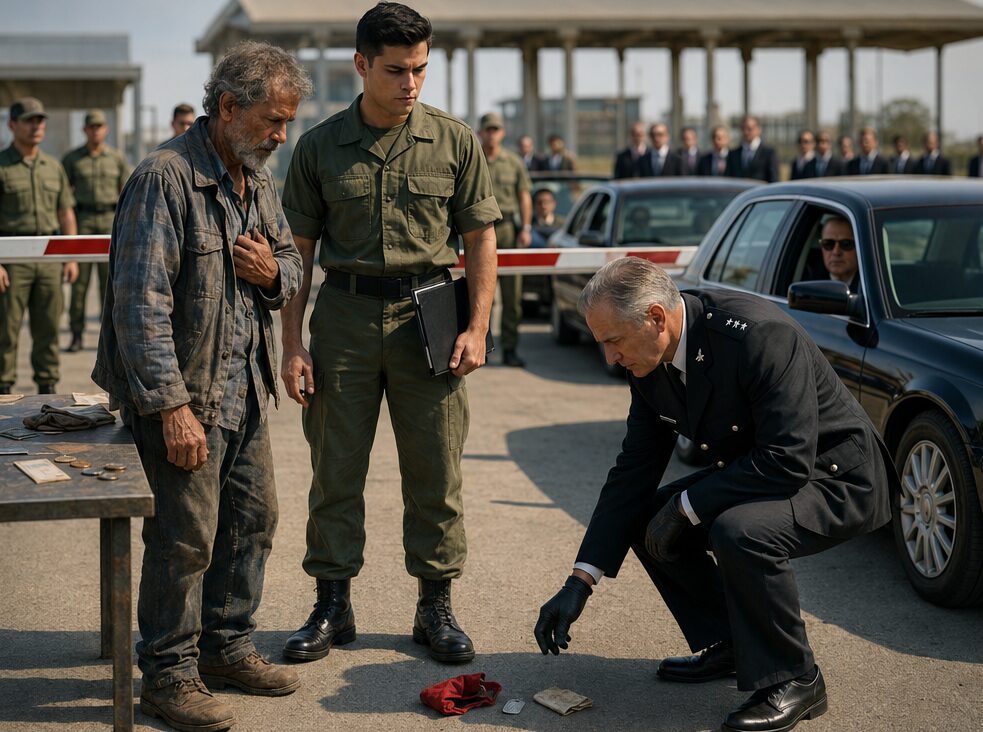
George stepped to the side because Michael pointed there. He laid his wallet, a handkerchief, two coins, and an old bus receipt on the inspection table. His fingers trembled as he did it, but not from fear alone.
Michael watched him.
“The inside pocket.”
George closed his hand over the left side of his jacket.
“No.”
Michael’s jaw tightened.
“Sir.”
“It’s not property.”
“I didn’t ask what it was.”
George’s breathing changed. Not heavier. Smaller.
A black sedan rolled forward in the car line behind them, then stopped. Someone inside leaned toward the windshield.
Michael noticed the delay spreading. He noticed the faces. He noticed the way the old man’s refusal made him look less in control.
That was when his voice sharpened.
“You can either hand it over, or you can leave.”
“I served at the old border station before you were born,” George said. “I’m not here to make trouble.”
“Then don’t make trouble.”
For the first time, anger moved through George’s face.
Not much. Just enough to prove he had carried it longer than anyone at that gate had been alive.
Michael reached toward the old man’s jacket.
George caught his wrist.
It was not a strike. It was not even close. It was the quick, desperate grip of a man stopping a hand from entering a room where someone was still sleeping.
But Michael reacted like the whole line had seen him fail.
He twisted George’s arm behind his back and pressed him forward against the inspection table.
The old man gasped.
The red cloth pouch slipped from his jacket and hit the concrete.
It landed between their boots.
The knot came loose.
A tarnished metal tag slid out on a broken chain.
Beside it fell a folded piece of paper, browned at the edges, wrapped so carefully it looked less stored than guarded.
George stopped breathing.
Michael let go of him slowly.
The second guard stared at the tag.
The sedan door opened behind them.
A man in a dark formal uniform stepped out, silver at his temples, expression controlled in the practiced way of men who had learned never to show the first thing they felt.
“What’s holding my gate?” he asked.
No one answered.
The man’s gaze dropped to the concrete.
To the red cloth.
To the tag.
Then he bent and picked it up.
His face changed before the rest of him did.
Stamped into the metal were four words:
Frank T. Harris.
The officer closed his fingers around it.
When he looked at George, his voice was quiet.
“Where did you get this?”
George looked at the tag in the officer’s hand, not at the officer.
“I told them once,” he said. “Nobody wrote it down.”
Part II — The Name on the Metal
The officer’s name was William Harris.
Everyone at Fort Calder knew it that morning because the programs said so. Colonel William Harris would deliver the dedication remarks. Colonel William Harris would unveil the wall. Colonel William Harris would honor those lost during Operation Red Line.
And at the top of that new wall, polished above all the others, would be the name of his father.
Frank T. Harris.
William held the old tag like it might burn through his glove.
Michael saw the name too. He had been trained to read stamped metal quickly. He had been trained to notice details. He had not been trained for the moment a dirty old man at the gate suddenly became connected to the commander’s family.
“Colonel,” Michael said, too fast, “he resisted inspection.”
George gave no defense.
That silence bothered Michael more than an argument would have.
William looked at the red cloth on the ground. “Pick that up.”
Michael bent, but George moved first.
His stiff hand closed over the cloth and the folded paper.
Not the tag. The tag stayed in William’s hand.
“Careful,” George said.
It was the first word he had spoken with command in it.
Michael froze.
William noticed.
“So you can speak up,” Michael muttered, and regretted it as soon as he said it.
George turned his head slowly.
“I speak when it helps.”
The line of cars had gone completely still. People watched without trying to look like they were watching. The memorial guests held their programs. A reporter near the van lifted her phone, then lowered it when William glanced her way.
William’s face returned to order.
“Bring him inside.”
Michael straightened. “Sir?”
“Inside,” William said. “Not through the courtyard. Visitor center. Back room.”
George looked toward the covered wall.
William followed his eyes.
“Not yet,” he said.
George gave a small nod, as if he had expected that too.
Michael guided him away from the gate, not touching him this time. The old man walked slowly, shoulders bent, one hand still pressed against the red cloth. He did not look back at the people staring.
That made Michael feel worse than if he had.
Inside the visitor center, the air smelled of fresh paint, coffee, and flowers cut too early. Volunteers moved boxes of programs. A woman arranged framed photographs on a table. Through the glass, George saw the covered wall again.
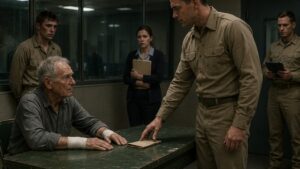
William led them into a narrow administrative room with a metal desk, two folding chairs, and a framed base map on the wall.
“Sit,” William said.
George sat.
Michael stayed by the door.
William placed the tag on the desk between them.
He did not sit.
“Start with your name.”
“George Walker.”
“Service record?”
George stared at the tag. “Radio operator. Attached to Red Line evacuation command.”
William’s eyes narrowed. “That unit roster has been public for years.”
“Not all of it.”
“My father’s records are public too.”
“No,” George said. “His citation is public.”
The room went still.
William folded his hands behind his back.
Michael knew that posture. It meant the colonel was controlling his temper, not lacking it.
“You walked into my gate on the morning of my father’s dedication,” William said, “carrying his identification tag in your coat.”
“Yes.”
“And you expect me to believe that no one has ever heard this story before?”
“I expect nothing.”
“Then why come?”
George touched the red cloth.
His thumb moved over it once, the way people touch a door before entering a room they fear.
“Because soon I won’t be able to say it right.”
William’s expression flickered.
George looked at Michael, then back at the officer.
“My hands started first. Then names. Dates. Some mornings I wake up and the room has moved on me. But today I still know what I saw.”
Michael shifted by the door.
He wanted to say something. He did not know whether it should be an apology or another question.
William sat at last.
“The ceremony begins in twenty-eight minutes.”
George gave a tired nod. “Then I’ll say it short.”
“Say it true.”
That made George look up.
For the first time since the gate, his eyes held.
“That’s the part people don’t like.”
Part III — What the Paper Held
George unfolded the paper with both hands.
It took longer than it should have.
No one rushed him.
The paper had been folded so many times that the creases looked permanent. The edges were soft. A faint stain had darkened one corner. Names covered the page in two kinds of handwriting: one neat and official, one cramped and hurried, as if written while the world was shaking.
William saw his father’s handwriting before George said anything.
He knew it from birthday cards stored by his mother. From old field notes preserved under glass. From a letter that had begun, Will, if this reaches you late, don’t let anybody make me taller than I was.
William had been seven when that letter came.
He had spent the rest of his life ignoring that sentence.
George placed one finger near the margin.
“If I don’t walk out,” he read, “Walker carries them.”
William’s mouth tightened.
Michael looked from the paper to George.
“Carries who?” Michael asked.
George answered without turning.
“The ones who didn’t count.”
William’s voice dropped. “Careful.”
George nodded. “That’s what I told myself for fifty years.”
Outside, someone tested the microphone. A burst of feedback cut through the room, then died.
George closed his eyes for one second.
When he opened them, he was somewhere else and still in the chair.
“Operation Red Line was supposed to be an evacuation. Not a last stand. Not a legend. A way out. Families from the old station. Two interpreters. Three local drivers. A nurse. Our people. Their people. People who had names even when the paperwork didn’t.”
William did not interrupt.
George went on.
“I was nineteen. Good with equipment. Bad with fear. Your father put me on radio because I could hear static and pull sense from it. Then the relay failed, and I called in the wrong grid.”
Michael’s eyes lifted.
George’s face did not change, but his hand closed on the paper.
“Not by much. Enough.”
The room seemed to shrink.
“The extraction moved to the wrong road. The convoy waited where nobody was. The people at the station waited where we were. Then the shelling started, and the road went white, and I couldn’t hear orders anymore.”
He swallowed.
“I froze.”
William looked at him.
There it was. Not excuse. Not performance.
A fact laid down like a weight.
“My father’s citation says he held the line,” William said.
“He did.”
“It says he ordered his unit out.”
“He did.”
“It says he stayed behind to cover the evacuation.”
George’s eyes moved to the tag. “He stayed because I couldn’t move.”
Michael looked down at the floor.
George’s voice did not rise.
“Your father hit me across the helmet hard enough to split the strap. I remember being grateful because pain was easier to understand than fear. He gave me that red signal cloth and tied it around my wrist so the people in the drainage culvert would follow me in the smoke. Then he tore off his tag.”
William’s hand moved, almost involuntarily, toward the metal on the desk.
“He said, ‘If you lose your name, carry mine.’”
George breathed in.
“He gave me the paper after that. Names. Not all uniformed. Not all approved. Not all convenient. He told me to get them home.”
Michael’s voice was soft now. “Did you?”
George looked at him.
“Some.”
One word. No decoration.
William stood abruptly and turned toward the window.
The ceremony chairs were filling. Families sat with straight backs and uncertain smiles. A little girl near the aisle swung her shoes under a chair. A veteran in a clean cap touched the program to his chest.
William’s father was about to be remembered by people who needed the memory clean.
Behind him, George said, “I tried twice.”
William did not turn.
“First time I was twenty-six. I had the tag in my pocket and too much whiskey in me. They heard a drunk. Not a witness.”
Michael looked at George’s hands.
“Second time?” William asked.
“Fifty. Your mother was still alive. I got as far as the visitors’ lot. Saw her picture in the paper holding your father’s flag.” George’s mouth tightened. “I went home.”
William turned then.
Anger came back into his face, but grief was under it.
“You had fifty years.”
“I know.”
“You let my family tell an incomplete story for fifty years.”
“Yes.”
“You let me build a career on it.”
George’s voice was barely above a whisper.
“I let myself live under it too.”
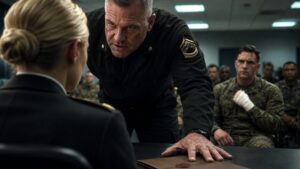
William leaned over the desk. “And now you want me to change the dedication twenty minutes before it begins?”
“No,” George said.
William blinked.
George folded the paper once, carefully.
“I want you to read the names.”
Part IV — The Door Closing Quietly
William did not read them.
Not then.
He looked at the paper as if it were a hand reaching up through polished stone.
Then he pushed it back toward George.
“The Army investigated Red Line.”
George nodded.
“The records were reviewed.”
George nodded again.
“My father was honored by men who served with him.”
“He deserved it.”
“Then what are you asking me to do?”
George looked toward the window, where the covered wall waited.
“Make room.”
William laughed once, without humor.
“You understand what you are implying.”
“I understand what I remember.”
“You understand that memory changes.”
“That’s why I came today.”
The answer landed too quietly for William to push it away at once.
Michael saw it hit him.
George continued. “Soon someone will say I’m confused. Maybe they’ll be right some mornings. Not this one.”
William picked up the dog tag.
It looked small in his hand. Too small for the weight it carried.
“If I let you speak,” he said, “people will hear that my father’s public record was incomplete.”
“Yes.”
“They will hear that the operation failed in ways no one admitted.”
“Yes.”
“They will hear that you made a mistake that cost time.”
George met his eyes.
“Yes.”
William’s anger faltered there.
Most men argued away shame.
George had brought his in wrapped cloth and placed it on the desk.
A knock came at the door.
An aide opened it halfway. “Colonel, they’re ready for you.”
William did not look away from George.
“One minute.”
The aide withdrew.
William took the folded paper and held it out.
George reached for it, but William kept his grip.
“This stays with me.”
“No,” George said immediately.
Michael straightened.
William’s gaze hardened. “You came here to give it to me.”
“I came here to bring it inside. That’s not the same thing.”
The two men stared at each other across the desk.
Then William released the paper.
He made a decision that felt like mercy and cowardice wearing the same coat.
“Private Michael.”
“Yes, sir.”
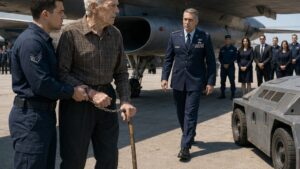
“Escort Mr. Walker back to the gate. Respectfully.”
Michael hesitated.
William’s eyes cut to him.
“Now.”
George stood slowly.
He did not protest. He gathered the red cloth and the paper. William still had the tag.
For a moment, George looked at the metal in William’s hand, and Michael thought he would ask for it.
He did not.
That silence was worse than begging.
Michael opened the door.
The hallway outside was bright and busy. People moved toward the courtyard. Music began somewhere through a speaker, soft and formal. A woman laughed nervously, then stopped when she saw George.
They walked toward the side exit.
Michael stayed half a step behind him.
“Sir,” Michael said.
George did not answer.
“I didn’t know.”
George kept walking.
Michael tried again. “At the gate, I thought—”
“You thought I didn’t belong.”
Michael stopped talking.
They reached the staging area where the wall waited under its covering.
It stood taller than George had expected.
The fabric shifted in the wind, showing the outline of engraved stone beneath. A printed placard near the base showed the design. At the top, centered and larger than the others, was the name:
FRANK T. HARRIS
Under it were rows of names.
Clean rows.
Official rows.
George stepped closer.
Michael glanced back toward the hallway.
“Sir, Colonel Harris said—”
George took the folded paper from the red cloth.
His hand trembled badly now.
He scanned the placard.
Once.
Twice.
Then a third time, slower.
The name he was looking for was not there.
Nor the next.
Nor the one after that.
Something inside his face closed.
Michael saw it and understood before George spoke.
“They left them out,” George said.
His voice had no surprise in it.
Only confirmation.
He took the dog tag’s absence into account. Then he looked at the red cloth in his hand.
He walked to the base of the covered wall and set the folded paper there.
Michael moved fast.
“Sir, you can’t leave that.”
George looked at him.
“Then you carry it.”
Michael froze.
George’s eyes were wet now, but his voice did not break.
“I’m tired of being the only one.”
The ceremony music swelled outside.
The announcer said William’s name.
George stepped back from the wall.
For a moment, Michael was a guard again, a young man with orders, a uniform, a duty, and a clear path out.
Then he bent down and picked up the paper.
He did not escort George to the gate.
He ran.
Part V — The Names Beneath the Program
William was at the edge of the courtyard when Michael caught him.
The chairs were full. The press camera was live. Families stood as William approached the podium. He wore the expression the ceremony required: solemn, composed, already halfway into history.
“Sir.”
William did not stop.
Michael stepped into his path.
“Sir, please.”
William’s eyes flashed. “This is not the time.”
Michael held out the folded paper.
“He didn’t come for a seat,” Michael said. “He didn’t come for a medal. He came because the wall is missing names.”
William looked over Michael’s shoulder.
George stood in the shade near the side entrance, one hand against the wall, looking as if the walk from the gate had taken the rest of his strength.
William took the paper.
He unfolded it once.
Then again.
The first name on the list meant nothing to him.
The second meant nothing.
The third had a note beside it in his father’s handwriting.
Carried child through culvert. Went back for nurse.
William’s throat tightened.
He moved down the margin until he found the words George had read.
If I don’t walk out, Walker carries them.
For one strange second, William was seven again, sitting on the hallway floor while his mother cried behind a closed door. He had spent his life turning his father into a shape he could survive: brave, clean, finished.
Now the man had handwriting.
Now he had unfinished business.
Now he had given an impossible order to a terrified nineteen-year-old who had somehow kept it longer than anyone had the right to ask.
William looked at Michael.
The young man was pale.
“I’m sorry, sir,” Michael said.
William folded the paper carefully.
“No,” he said. “Not yet.”
He walked to George.
The old man straightened when he saw him coming, as if preparing for another removal.
William stopped in front of him.
“Why did you wait?” he asked.
It came out harsher than he intended.
George accepted it anyway.
“I tried when I was young. I was too broken to be useful.” His eyes flicked toward the courtyard. “Tried again when your mother was alive. I saw her holding his picture. Couldn’t take him from her.”
“You wouldn’t have been taking him.”
“I didn’t know that then.”
William looked at the red cloth.
“And now?”
George’s fingers closed around it.
“Now I have days when I misplace my own kitchen. Last month I called a neighbor by a name I hadn’t said since nineteen seventy-three. The doctor gave it a long word.” He gave a thin, tired smile. “Long words are what people use when the short ones scare them.”
William said nothing.
George’s face changed then. Not softer. Clearer.
“Today I still know what I saw.”
The ceremony announcer called William’s name again.
Applause began, polite and expectant.
William looked from George to the podium, then to the covered wall.
His father’s name waited beneath the cloth.
So did the missing.
William held out the dog tag.
George did not take it.
“It was never mine,” George said.
“You carried it.”
“I was told to.”
“That matters.”
George’s eyes held his.
“Then let it matter where they can hear it.”
William turned toward the courtyard.
Every seat faced the podium.
Every camera waited.
Every program in every lap told the clean version.
William walked to the microphone.
The applause faded.
He laid his prepared remarks on the podium.
He looked at the first line.
We gather today to honor courage.
For a moment, he almost read it.
It would have been easy.
The words were already printed. The wall was already made. The families had come ready to receive comfort, not complication. His father had been dead for fifty years. What could truth give him now except another kind of absence?
Then William looked to the side.
George stood outside the row of chairs, still in the stained shirt, still carrying the red cloth, still looking like someone the world had learned to step around.
William moved the prepared remarks aside.
“My father once wrote,” he began, “that no one should make him taller than he was.”
The crowd shifted.
William heard the sentence surprise them.
It surprised him too.
“He was brave,” William continued. “That part is true. But this morning, a man came to this gate carrying something my father gave him. Something this memorial needs before it can be complete.”
He turned.
“Sergeant George Walker.”
George did not move.
For a moment, the old fear was visible in him. Not fear of the crowd. Fear of being believed too late.
William said, more quietly, but the microphone carried it, “You carried something home for my father.”
Michael stood at the edge of the courtyard, rigid, eyes fixed on George.
George walked forward.
No one clapped.
That was a mercy.
He reached the podium and placed the red cloth on it. William set the dog tag beside it.
The metal clicked once against the wood.
George unfolded the paper.
His hands shook so badly that William almost reached to help.
He stopped himself.
George steadied the page with both palms.
Then he began to read.
Not a speech.
Names.
Some were American. Some were not. Some came with ranks. Some came with only a note.
A driver.
A nurse.
An interpreter.
A mechanic.
Two men listed as attached support.
A woman George identified only as “the one who would not leave the children.”
The crowd changed as the names continued. Programs lowered. Faces lifted. A few people looked toward the covered wall as if seeing, through fabric and stone, the empty spaces.
George’s voice held until one name near the bottom.
“Angela Reyes,” he read, and stopped.
The paper trembled.
William looked at the note beside it.
Carried child through culvert. Went back.
George closed his eyes.
No one moved.
After a moment, he opened them and finished the list.
At the end, he folded the paper along its oldest crease.
“I was ordered to remember them,” he said.
His voice was thin now, but it reached.
“I did.”
He looked at the wall.
“I am sorry it took me this long to make anyone else listen.”
There was no applause.
Only a silence that stood up straighter than applause could have.
Part VI — What He Kept
After the covering came down, the wall looked unfinished.
Not because the stone was poorly made. It was beautiful. Too beautiful, almost. The engraved names caught the morning light. Frank T. Harris sat at the top, polished and centered, just as the program promised.
But now everyone could see what was not there.
William stood beside George as families approached. Some touched names. Some read silently. Some glanced at the paper on the podium and then back at the wall, as if trying to understand how memory could be both carved and incomplete.
A reporter asked William a question.
He did not answer it.
Not yet.
He turned instead to the aide beside him and said, “The program will be amended before it is archived. The wall will be amended as soon as the stone can be cut.”
The aide nodded quickly, writing it down as if speed could repair time.
George heard him.
He did not smile.
William picked up the dog tag from the podium.
For a long moment, he held it between both hands.
Then he offered it to George.
“You should keep this.”
George shook his head.
“I kept it long enough.”
“My father trusted you with it.”
“He trusted me to carry it. Not own it.”
William looked down at the tag.
The name seemed different now. Less like a monument. More like a man.
George touched the red cloth.
“This is mine,” he said.
William looked at it.
“He tied it around my wrist,” George said. “So they’d follow me through the smoke.”
The word smoke hung there, but George did not go further.
He did not need to.
William closed his hand around the tag.
“Thank you,” he said.
George looked at him, tired beyond politeness.
“Don’t thank me for taking fifty years.”
William accepted that.
Some truths did not become gentle because they were finally spoken.
Near the side of the courtyard, Michael waited until George stepped away from the podium.
Then he approached him without his clipboard.
That mattered.
“Mr. Walker,” he said.
George stopped.
Michael swallowed. “I was wrong.”
George looked at him.
“I treated you like you were trying to take something,” Michael said. “You were trying to return it.”
George said nothing.
Michael’s face tightened.
“I’m sorry.”
The old man studied him for a moment.
The easy version of forgiveness waited there, available to both of them. George could have placed a hand on his shoulder. He could have told him it was all right. He could have turned the young man’s shame into comfort.
Instead he said, “Next time, look twice.”
Michael nodded.
He did not seem relieved.
That was how George knew he had heard it.
The crowd had begun to loosen. People spoke in low voices. The ceremony had ended, but nobody seemed ready to call it over.
George folded the red cloth and placed it inside his jacket.
The pocket lay flat now without the tag.
Somehow it felt heavier.
William walked with him back through the visitor center. Michael followed a few steps behind. No one asked George for paperwork. No one told him where to stand.
At the gate, the morning had grown bright and hard.
The same concrete waited. The same booth. The same barrier.
But when George reached it, Michael moved ahead and opened it himself.
No clipboard.
No questions.
George paused on the threshold.
For a second, William thought the old man might turn back toward the wall, toward the names he had brought out of silence.
He did not.
He looked down the road he had walked in on.
Then he touched the red cloth through his jacket, once.
Not to check if it was still there.
To remind himself it no longer held everything.
William stood with his father’s tag in his palm.
Michael stood beside the open gate.
George stepped through slowly, boot dragging a little on the concrete.
He was still old.
Still tired.
Still carrying more than anyone could see.
But he was no longer carrying it alone.