The Name She Carried
Part I — The Red Blazer
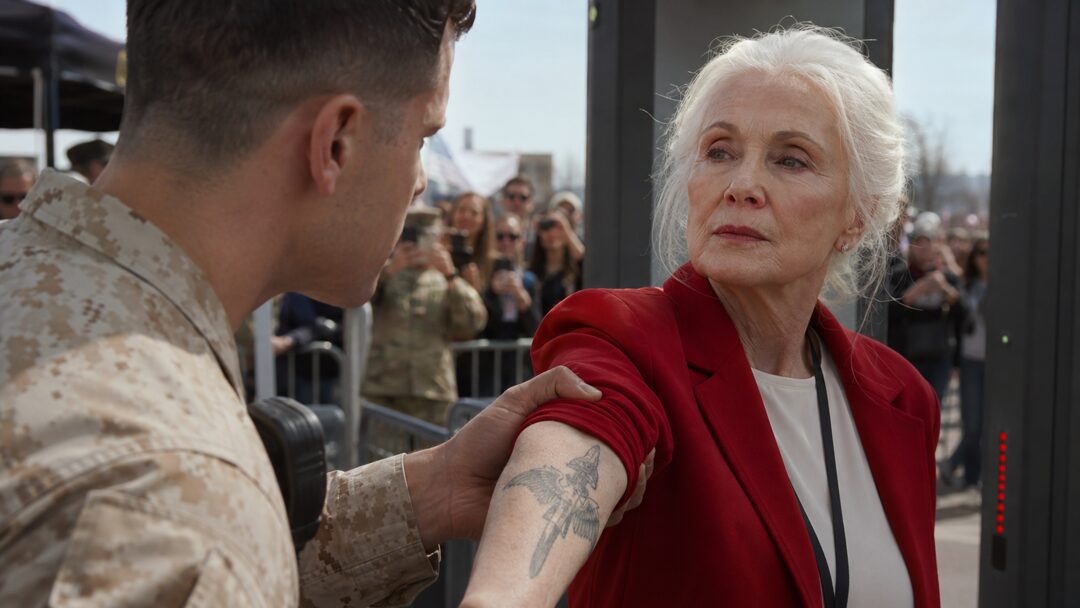
Corporal Ryan Miller caught the old woman by the forearm before she reached the scanner.
Not hard enough to bruise, not soft enough to be mistaken for courtesy.
“Ma’am,” he said, planting himself between her and the entrance gate, “don’t move.”
The line behind her went quiet.
Margaret Walker looked down at his hand first. Then at his face. She was seventy-eight, white-haired, narrow-wristed, and dressed in a red blazer bright enough to be seen from the parking lot. A plastic card clipped to her lapel read VISITOR in black block letters.
Ryan was not looking at the pass.
He was looking at her arm.
The sleeve of her blazer had ridden up when he stopped her. Beneath the thin skin and blue veins was a tattoo, old but unmistakable: a dark-furred creature with a long tail and snout crouched over a winged blade. The ink had faded to black and gray, but the shape still held its teeth.
Behind the gate, on the far side of the temporary fencing, the same symbol hung on a covered memorial banner waiting to be unveiled.
Ryan tightened his grip.
“Where did you get that?”
Margaret’s eyes did not flicker toward the crowd. They did not drop to his rank. They stayed on his face with the patience of someone deciding how much of a child’s mistake to correct.
“Corporal,” she said, “scan the pass.”
Ryan blinked.
The way she said his rank landed wrong. Not impressed. Not afraid. Not even irritated.
Accurate.
“You know what that insignia is?” he asked.
“I know what you think it is.”
A few people in the line leaned sideways to see. Someone whispered. Ryan felt heat rise under his collar. This was the first public dedication he had been trusted to work without a sergeant at his shoulder. The gate was his responsibility. The credentials were his responsibility. The restricted memorial area was his responsibility.
And an elderly civilian had just walked up wearing a tattoo that matched a symbol most people weren’t supposed to recognize.
He glanced at the ink again.
The beast over the winged blade.
Not a sticker. Not a temporary mark. Old work. Deep work. The kind done by hands that believed they were making something permanent.
“That tattoo is in regulation,” he said, mostly to himself.
Margaret’s mouth tightened.
“Then you’re only half wrong.”
Ryan looked up.
“What did you say?”
“You’re out of your depth, Corporal.”
The words did not come loud. They did not need to.
The man behind Margaret sucked in a breath. A woman farther back lowered her sunglasses. Ryan felt the circle of watching faces close around him. He could hear the ceremony speakers warming up beyond the gate, a soft thump of microphone feedback, the rustle of flags in the clean morning wind.
He hated that she had made him feel small.
“Then prove it,” he said. “Right now.”
Margaret lifted her free hand and tapped the plastic badge on her blazer.
“Scan the pass or step aside.”
It should have been simple. Scan it. Let the system decide. That was what Captain Carter had said in the morning briefing.
But the tattoo had changed the air.
Ryan imagined the banner inside. The covered wall. The polished stone. The families gathered under the white canopy. Colonel Harris preparing to speak. He imagined this woman slipping through with a copied symbol on her arm and a calm voice, playing at belonging among names that had cost people everything.
His jaw set.
He let go of her arm only to pull the black radio from his vest.
“Control,” he said, eyes on Margaret, “I’ve got a situation at Gate Two. Possible stolen valor.”
The words hit the line like a dropped glass.
Phones rose.
Margaret stepped closer.
For the first time, something changed in her face. Not fear. Not surprise.
Coldness.
She reached up and closed her hand around the radio before Ryan could lower it.
“Say that again,” she said.
Ryan stared at her fingers over his.
They were thin. Knuckled. Steady.
“Ma’am,” he warned, “remove your hand.”
“Say it again,” Margaret said. “But this time, know what you’re touching.”
Part II — The Pass
Two military police officers arrived first, moving fast along the fence line. Captain Emily Carter followed close behind with a tablet in one hand and irritation already sharpened in her eyes.
“What happened?” she asked.
Ryan straightened. “Possible fraudulent military identification, ma’am. Visitor has restricted insignia tattooed on her arm. Matches the memorial banner.”
Emily looked at Margaret.
Margaret looked back.
The captain’s expression shifted only slightly, but she saw what Ryan had not bothered to see: the clean set of the old woman’s shoulders, the clipped pass, the stillness. Not helplessness. Not confusion.
Containment, Emily thought.
Then she hated herself for thinking like that before she knew what needed containing.
“Ma’am,” Emily said carefully, “let’s step into the side tent and sort this out privately.”
“No.”
Ryan’s eyes narrowed.
Emily kept her voice level. “This entrance is active. We need to keep the line moving.”
“Then scan my pass.”
“We can do that inside.”
“You can do it here.”
The crowd had grown bolder. Not loud, but hungry. The way crowds get when they smell someone else’s embarrassment and want to know whether it will become justice or spectacle.
Ryan gestured toward Margaret’s arm. “Captain, she’s wearing unit ink tied to a closed dedication. If we let her through and she’s lying—”
Margaret turned her head slowly.
“If?”
Ryan heard the warning in it and stepped into it anyway.
“You’re playing off dead men’s honors.”
The wind moved the flags. Somewhere beyond the gate, a band tested three clean notes and stopped.
Margaret’s face did not fall apart. That would have been easier to watch.
Only her breathing changed.
Once in. Once out.
Then her eyes went to the covered memorial banner behind Ryan. The dark cloth over the stone. The folded program in a volunteer’s hand. The empty space where a name should have been.
Emily noticed.
So did Ryan, but he misread it.
“See?” he said. “You know exactly what this is.”
Margaret’s voice dropped. “I know exactly who it is.”
Emily stepped between them before Ryan could answer.
“Corporal, enough. Release the visitor’s arm.”
“I already did, ma’am.”
“Then step back like you meant it.”
Ryan moved half a pace.
Margaret lifted her pass toward Emily. The plastic trembled once, just barely, before her hand stilled again.
Emily took the badge and scanned it with her tablet.
The screen flashed green.
Then red.
Then blank.
Emily frowned and tapped it twice.
A new message appeared.
RESTRICTED CONTACT. COMMAND VERIFICATION REQUIRED.
Below that was a line Emily had only seen in training modules and old-access drills.
DO NOT DETAIN. DO NOT DISCLOSE. ESCALATE TO O-6 OR ABOVE.
Emily’s mouth went dry.
Ryan saw the red screen and seized on it.
“I knew it.”
Emily turned the tablet away from him.
“No,” she said quietly. “You didn’t.”
Ryan’s confidence faltered.
“What does that mean?”
“It means,” Emily said, looking at Margaret now with a very different kind of attention, “you need to stop talking.”
Margaret gave a small, humorless breath.
“The machine remembers better than people do.”
The sentence landed like it had been waiting years to be spoken.
Emily lowered her voice. “Mrs. Walker, I’m going to contact Colonel Harris.”
Margaret’s eyes sharpened at the name.
“He knows I’m here?”
“He’s the senior officer on site.”
“That isn’t what I asked.”
Emily did not answer. She didn’t know how.
Ryan looked from one woman to the other. For the first time since he grabbed Margaret’s arm, the ground under him seemed uncertain. He had thought he was guarding a gate. He had thought the rules were objects he could hold.
Now the pass had opened something he could not see.
Margaret adjusted her red sleeve over the tattoo, not to hide it, but to put herself back in order.
“Call him,” she said. “And tell him Margaret Walker is done waiting outside.”
Part III — The Man Who Knew
Colonel James Harris arrived without running, but everyone at Gate Two felt the speed beneath his control.
He was tall, silver-haired, immaculate in dress uniform. His ribbons caught the sun. His left hand, the one with the thin old scar across the knuckles, rested briefly against the side seam of his trousers as if checking that it was still there.
Ryan snapped to attention.
“Sir.”
James did not look at him first.
He looked at Margaret.
The ceremony noise behind the gate seemed to thin out. People were still moving, still speaking, still adjusting chairs and programs, but for a moment none of it reached the checkpoint.
James’s face lost all its official arrangement.
“Margaret,” he said.
Ryan’s stomach dropped.
Not Mrs. Walker.
Not ma’am.
Margaret.
She looked at him the way she had looked at Ryan: straight on, without decoration.
“James.”
Emily stood very still.
Ryan waited for the colonel to explain. To take command. To confirm that everything could be contained. But James only stared at the old woman in the red blazer as if a closed door had opened in the middle of the day.
Finally he said, “Let her through.”
Margaret did not move.
“No.”
James blinked once. “Margaret.”
“Not until your Corporal finishes what he started.”
Ryan felt the eyes return to him. The line. The officers. The colonel. The woman.
James turned.
“What did he start?”
Ryan swallowed. The radio on his vest suddenly felt heavier than the rest of his gear.
“Sir, I identified a possible unauthorized use of restricted insignia.”
James’s gaze went to the edge of Margaret’s sleeve.
“Her tattoo?”
“Yes, sir.”
“And?”
Ryan forced the words out because stopping now felt worse than continuing.
“I called in possible stolen valor.”
James closed his eyes.
It lasted less than a second. It still felt like a verdict.
Margaret said, “No, let him say it properly.”
James opened his eyes.
Ryan’s face burned. “Sir?”
She turned toward him.
“You had courage enough for the radio. Have courage enough for the room.”
There was no room. Only the gate, the crowd, the sunlight, the fence, the covered stone.
But Ryan understood her.
He understood that she meant the place inside a person where a word cannot be taken back.
“I accused you of stolen valor,” he said.
Margaret nodded once.
James looked older now. Not by years. By memory.
“Corporal Miller,” he said, voice low, “that insignia was never public issue. Not officially. Not in any handbook you’ve read.”
Ryan did not move.
“It belonged to a small extraction cell attached to an operation most of the people here only know by its clean name.” James looked at Margaret’s sleeve. “They called themselves Knife Wing.”
The crowd went silent enough that the flags sounded loud.
Ryan looked at Margaret’s arm as if the ink itself had moved.
“She was attached?” he asked.
James’s jaw worked.
Margaret answered before he could soften it.
“I carried their maps. I moved their messages. I opened doors that were supposed to stay shut. Once, I carried him.”
She nodded toward James.
Ryan looked at the colonel.
James did not deny it.
Margaret’s voice remained even. “Not far. Far enough.”
James said, “She saved my life.”
The sentence should have made the moment simple.
It did not.
Because Margaret’s expression hardened.
“Tell it right or don’t tell it.”
James flinched.
That was the first thing that truly frightened Ryan.
Not Margaret’s tattoo. Not the system lock. Not the restricted notice.
The flinch.
A decorated colonel had flinched from a retired records clerk in a red blazer.
Emily’s tablet lowered slowly to her side.
James turned toward the side tent.
“We should speak privately.”
Margaret’s eyes went past him to the covered memorial wall.
“That is what you said the first time.”
James looked at her.
She stepped closer, lowering her voice enough that only the three of them heard.
“And the second. And the year they sent me the sealed letter. And the year you wrote to say the record was complicated. And the year I stopped answering.”
James’s face tightened.
Ryan could no longer tell whether he wanted to disappear or stay long enough to understand the damage he had stepped into.
Margaret took one step toward the side tent.
“Five minutes,” she said. “Then I walk through that gate with or without your permission.”
James nodded.
It was not command.
It was surrender.
Part IV — The Missing Place
The side tent smelled of canvas, sun-warmed plastic, and bottled water. It was meant for small logistical problems: misplaced credentials, fainting guests, late speakers, chairs in the wrong row.
Not this.
Emily stood near the entrance. Ryan remained just outside until James said, “Come in.”
Ryan hesitated.
Margaret did not look at him.
“Let him,” she said. “He wanted proof.”
Ryan entered.
The tent flap fell behind him, muting the crowd.
James removed the folded speech from inside his jacket. The paper was thick, cream-colored, official. Margaret looked at it as if it were something alive enough to bite.
“You read it?” James asked.
“I read the draft they mailed to committee donors.” Her voice was calm. “Operation names. Dates. Unit acknowledgments. Final casualty count.”
James did not answer.
Margaret held out her hand.
After a moment, he gave her the speech.
She turned one page. Then another. She did not need to search long. Her finger stopped halfway down the second sheet.
“There.”
Ryan could not help himself. He leaned just enough to see.
A paragraph about a rescue under impossible conditions. A line about six personnel lost before extraction. A sentence praising unnamed support assets whose contributions remained classified.
Margaret tapped the number.
“Six.”
James said, “That is the official count.”
“No,” Margaret said. “That is the convenient count.”
Emily’s eyes moved to James.
Ryan felt the first clean crack of shame. Not embarrassment. Shame.
He had wanted to catch a liar.
He had found a wound.
James spoke carefully. “Samuel Reed was never attached on paper.”
Margaret’s hand tightened on the speech.
“He was attached enough to stay behind.”
No one spoke.
For the first time, Margaret’s age showed. Not in weakness. In the terrible effort it took to stand inside a memory without leaning on anything.
Ryan saw it happen in fragments: her thumb pressing the edge of the paper, the red sleeve slipping back again, the old tattoo breathing with her pulse.
James said, “Margaret, if I name him publicly without clearance—”
“You are about to dedicate stone to a number you know is wrong.”
“The process to amend—”
“Do not give me process.”
Her voice cut through the tent so cleanly Ryan looked up.
Margaret did not raise it. That made it worse.
“I worked in records for thirty-one years after I came home,” she said. “I know what process is. Process is where truth goes when men are afraid to hold it.”
James looked down.
Emily’s face changed at that.
Ryan saw her hear it not as accusation only, but as instruction.
Margaret folded the speech once. Neatly. Exactly along its existing crease.
“I did not come here for my name.”
James’s eyes lifted.
“I know.”
“No,” she said. “You don’t. If you did, Samuel would not be missing.”
The name seemed to alter the air.
Samuel Reed.
Ryan had never heard it. There was no reason he should have. That was the point, and suddenly the point felt unbearable.
Margaret looked at Ryan then.
“You said dead men’s honors.”
He could not hold her gaze for long.
“Yes, ma’am.”
“Samuel was twenty-six. He had a bad knee, a laugh that carried through walls, and a habit of giving away his socks to anyone colder than him. He did not care about honors.”
Her mouth trembled once, and she stopped it.
“He cared that people got home.”
James’s scarred hand curled.
“He got me home,” he said.
Margaret turned on him.
“Then say so.”
The tent went very still.
Outside, an announcer asked guests to take their seats.
The ceremony was beginning.
James looked toward the sound. Duty pulled at him. Habit pulled harder. The old machinery of rank, order, timing, appearance. Ryan recognized it because he had lived by a smaller version of it all morning.
Keep the line moving.
Protect the gate.
Trust the procedure.
Do not be fooled.
James looked back at Margaret.
“I can request an amendment.”
She gave him a sad smile.
“You have been requesting courage for thirty years.”
That line hit harder than anger would have.
James’s face went pale.
Emily stepped forward. “Colonel, the unveiling is in three minutes.”
Margaret handed him the speech.
“Then you still have time not to lie.”
She walked out of the tent before anyone could stop her.
Ryan moved instinctively toward the entrance, then froze.
Margaret’s words at the gate returned to him.
Scan the pass or step aside.
For the first time that morning, he understood that both were orders.
Part V — The Correction
The crowd had settled under the white canopy. Rows of folding chairs faced the covered memorial wall. Families held programs in their laps. Veterans sat with hands folded over canes. Officers stood along the edges, polished and watchful.
Margaret did not take a seat.
She stood near the gate.
Ryan stood ten feet away, close enough to stop her if she moved where she was not authorized to move.
Close enough to choose not to.
James stepped to the podium.
Applause came, respectful and brief. He placed the speech down. Smoothed it once. Looked at the first line.
Margaret watched him.
Ryan watched Margaret.
Emily watched all of them.
James began the way official speeches begin: with gratitude, with honor, with the weight of the day. His voice was steady. The crowd leaned into it. He spoke of service, of memory, of names preserved so they would not be lost to time.
Then he reached the paragraph.
Ryan saw it happen.
Not dramatically. Not for the crowd.
James simply stopped.
His eyes stayed on the page.
The silence stretched.
An officer near the wall shifted his weight. Someone coughed. A child whispered and was hushed.
James lifted the page slightly, then set it down again.
Margaret moved.
Two security personnel took half a step inward. Ryan stepped in their path before he understood he had done it.
One of them looked at him.
Ryan shook his head once.
Let her.
Margaret walked with the careful steadiness of a woman who refused to hurry for people who had already made her wait most of a lifetime. Her red blazer cut through the muted rows like a small flag no one had planned for.
She stopped at the memorial gate scanner, the same model Ryan had ignored at Gate Two.
She lifted her visitor pass.
For one second, Ryan saw her hand tremble.
Then she pressed the card flat to the scanner.
The device chirped.
Green.
A soft mechanical click sounded at the gate.
The system had known her all along.
Margaret reached for Ryan’s radio.
He unclipped it and placed it in her hand.
No resistance.
No warning.
No performance.
Her fingers closed around it, the same way they had at the checkpoint. But this time Ryan let go.
She pressed the button.
“Control,” she said.
Every head turned.
Her voice carried through the speakers at the gate and the small security channel clipped to three uniforms nearby.
“Correction to the record.”
James closed his eyes at the podium.
Margaret looked at the covered stone.
“The final personnel count for the evacuation is incomplete. Add one name.”
No one breathed loudly.
“Samuel Reed.”
The name entered the ceremony without music. Without applause. Without permission dressed up as permission.
Margaret continued, because now that the first stone had moved, the rest had to follow.
“Medic. Attached in action. Present at final extraction. Remained behind by choice so others could move.”
Her throat worked once.
“He got them home.”
That was all.
She lowered the radio.
No speech. No plea. No demand for herself.
The crowd did not erupt. It would have been wrong if they had. Instead, the silence changed. It became heavier, but cleaner.
James stepped away from the podium.
For one terrible second, Ryan thought the colonel would regain control the old way. Fold the moment. Smooth it. Thank everyone for their patience.
Instead, James picked up the printed speech.
He looked at Margaret.
Then he folded it once.
Twice.
And put it inside his jacket.
When he returned to the microphone, his voice was no longer ceremonial.
“I am here,” he said, “because Samuel Reed stayed where I could not.”
Margaret’s eyes closed.
Just briefly.
James looked at the covered wall.
“And because Margaret Walker carried the way out when the rest of us could no longer see one.”
The sound that went through the crowd was not applause.
It was recognition arriving late.
Margaret opened her eyes and looked at James, not grateful, not forgiving, not untouched.
Only present.
The cloth came down from the memorial wall.
The engraved names caught the sun.
Samuel’s was not there.
That absence was visible now.
And because it was visible, it could no longer pretend to be nothing.
Part VI — The Proper Scan
Afterward, people approached Margaret carefully.
Some thanked her. Some could not speak. An older man in a dark suit took her hand in both of his and bowed his head over it until she gently pulled away. A woman with tears in her eyes asked if Samuel had family.
Margaret answered what she could and refused what she would not turn into spectacle.
James stood near the wall with Emily, already speaking in low tones about amendments, affidavits, archived files, formal corrections. Not fast enough. Not after thirty years. But not nothing.
Ryan waited until Margaret stepped away from the crowd.
She was near the outer gate again, where the morning had first gone wrong. The line was gone now. The checkpoint tape fluttered loose in the wind.
He approached with his cover tucked under one arm.
“Mrs. Walker.”
She turned.
He stood straighter, then seemed ashamed of using posture as a substitute for courage.
“I owe you an apology.”
“Yes,” she said.
The word hit him harder than forgiveness would have.
Ryan swallowed. “I was trying to protect something I didn’t understand.”
Margaret looked at him for a long moment.
“That is how most damage begins.”
He nodded once.
“I’m sorry.”
She studied his face, and for the first time that day, her expression softened. Not much. Just enough to show she could see the young man beneath the uniform, and that seeing him did not erase what he had done.
“Do you know the difference between guarding a gate and guarding honor, Corporal?”
Ryan’s throat tightened.
“No, ma’am,” he said. “Not well enough.”
“Then learn it before someone pays for your lesson.”
He accepted that.
There was nothing else to do with a sentence that true.
Margaret adjusted the pass on her blazer and stepped toward the scanner.
Ryan moved automatically to help, then stopped himself.
“May I?” he asked.
She gave him the pass.
This time, he looked at it before he touched the scanner.
Margaret Walker.
VISITOR.
The word seemed smaller now. Almost foolish.
He scanned it.
The light turned green.
The gate clicked open.
Ryan stepped aside.
Not halfway. Not reluctantly. Completely.
Margaret walked through, then paused just beyond him.
Ryan saluted.
It was not required. It was not in the morning briefing. It did not fix the radio call or the grip on her arm or the years that had taught her to carry proof no one wanted to read.
But it was clean.
Margaret looked at the salute.
Then at him.
She did not return it. She was not in uniform. She had not been allowed that kind of ending.
Instead, she touched two fingers to the edge of her red sleeve, just above the old tattoo, where the beast and the winged blade rested under cloth.
Then she walked toward the parking lot alone.
Behind her, the memorial wall shone with one name missing and one truth newly spoken.
Ryan remained by the open gate until she disappeared from sight.
Only then did he lower his hand.