The Officer Spilled an Old Sailor’s Water Before Learning Why the Glass Was Empty
Chapter 1: The Wheelchair at the Empty Place
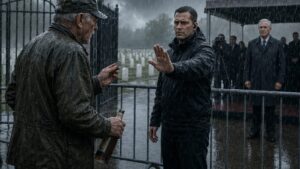
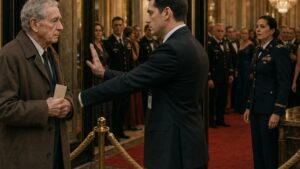
The young officer stepped in front of Stephen’s wheelchair and asked, “Who left you unattended?”
For a moment, Stephen thought he had misheard him.
The entrance hall was crowded with men in dark jackets, women carrying folded programs, and younger volunteers guiding guests toward the dining room. Brass plaques caught the amber light along the walls. Beyond the open double doors, white tablecloths shone beneath chandeliers, and the low murmur of old voices rose and fell like water against a pier.
Stephen looked up at the officer.
The man was perhaps thirty-five, clean-shaven, straight-backed, and dressed in a white Navy uniform so sharply pressed that the sleeves seemed cut from paper. A nameplate read MILLER.
“I came in through the front door,” Stephen said.
The officer glanced past him toward the corridor.
“That isn’t what I asked, sir.”
Stephen rested both hands on the arms of his wheelchair. His right hand still curled slightly inward from the stroke. On cold mornings, the fingers refused to open without help. Tonight they had cooperated until the transport driver lowered him onto the cracked stone ramp and hurried away to another pickup.
“I’m not lost,” Stephen said.
A volunteer carrying place cards slowed down, then kept walking.
Lieutenant Brandon Miller lowered his voice, though not enough to make the conversation private. “This is a closed supper. The rehabilitation group is in the east hall.”
Stephen’s gray cardigan hung unevenly over his shoulders. Pamela had wanted him to wear the navy blazer she had bought after his hospital discharge, but one sleeve caught against the wheelchair brake. He had chosen the cardigan instead, along with a pale shirt and the only loose shorts he could manage without assistance.
He knew how he looked beside the polished shoes and dark suits passing them.
He also knew why he had come.
“Dining room,” he said.
Brandon’s gaze moved to the white envelope on Stephen’s lap. “Do you have an invitation?”
Stephen placed his palm over it.
He had opened the envelope six times since it arrived. Andrew’s handwriting had grown shaky, but the pressure of the pen was still hard enough to leave grooves in the paper.
Come this year. No speeches. No surprises. Just sit with me.
Stephen had not replied. He had not telephoned. At seven that morning, he had finally told Pamela he needed a ride.
Her face had gone still.
“You’re going there?”
“For supper.”
“After seventeen years?”
“They serve food every year.”
She had looked as though she wanted to argue, then saw the envelope in his hand and did not.
Now Brandon held out his palm.
“I’ll need to see it.”
Stephen did not move.
A woman in a black dress approached with a tablet pressed against her chest. Her badge identified her as Jessica Moore, event administrator. She gave Stephen a quick, professional smile that did not quite reach her eyes.
“Is there a problem?”
“He says he’s here for the remembrance supper,” Brandon said.
He spoke to Jessica rather than to Stephen.
Jessica searched the tablet. “Name?”
Stephen looked at her.
“Your name, sir.”
“Stephen Harris.”
Her finger moved down the screen. She tried the surname twice, then looked through a stack of printed pages on a nearby podium.
“I don’t see you here.”
“Try Andrew Walker.”
“That’s another guest?”
“The man who invited me.”
Jessica’s expression changed by a degree. “Mr. Walker is here, but he can’t add guests directly. All invitations had to go through the office.”
Stephen watched the dining-room doors.
Seventeen years had changed less than he expected. The dark paneling remained. So did the framed photographs along the far wall and the ship’s bell mounted beside the lectern. The curtains were new, and the tables were arranged farther apart, perhaps for wheelchairs, though the route between them was narrowed by a display of donor placards.
Near the center of the room stood a smaller table set for one absent man.
The chair was empty.
A folded card rested against a plain water glass.
Stephen’s breath stopped before he could prevent it.
The card bore two words in block lettering.
JACK THOMPSON.
The room tilted—not enough for anyone else to notice, but enough that Stephen tightened his left hand around the wheel.
He had imagined the glass many times. In some memories, it was the thick cafeteria tumbler from the first supper. In others, it was the chipped one Jack had kept near his bunk. This glass was newer, heavy-bottomed and clear, but it stood in the same place.
Empty.
Brandon followed his gaze. “That’s a ceremonial seat.”
“I know.”
“Then you understand it isn’t available.”
Stephen almost turned his chair around.
The urge came with such force that his left foot shifted on the metal rest. He could leave before Andrew saw him. He could tell Pamela the transport service had made a mistake. He could return to his small kitchen, heat soup, and put Andrew’s invitation in the drawer with the other letters he had never answered.
Then he noticed a second card lying flat beneath the glass.
Only one corner showed, but he recognized the slanted S.
His name.
Andrew had placed it there himself.
Stephen pushed forward.
Brandon stepped aside too late to make the movement seem voluntary.
“Sir, wait.”
The dining room quieted in small sections as Stephen crossed it. Faces turned, then turned away. An elderly man near the wall narrowed his eyes as though trying to place him. A younger volunteer moved a chair without being asked, opening a narrow path.
Stephen stopped beside Jack’s empty place.
The years between his visits seemed to gather around the table. He remembered Andrew carrying in the first glass wrapped in a dish towel. He remembered his own hands being steadier then. He remembered saying the glass should stay empty because some absences ought not be decorated.
He reached out.
Two fingers touched the rim.
The glass was cool.
That was all he had come to do: touch it, sit near it for one meal, and leave before anyone decided his return meant more than it did.
Behind him, Brandon said, “Mr. Harris, you cannot occupy this position.”
Stephen turned his chair slightly. “I’m not occupying the empty chair.”
“You’re blocking the aisle.”
“There’s room.”
“There won’t be once service begins.”
Jessica arrived with the printed seating chart. “I checked again. There is no Stephen Harris registered.”
“The card is under the glass,” Stephen said.
Jessica leaned closer. Her brow tightened.
“That isn’t one of ours.”
It was cream-colored instead of white, cut by hand, with Stephen’s name written in blue ink.
“Mr. Walker may have placed it there,” she said, “but this seat has to remain untouched during the observance.”
Stephen looked at the card and then at Jack’s name.
“I’m aware.”
Brandon’s patience thinned into something visible. Several guests were watching now. At the far side of the room, a donor representative stood beside the association president, waiting to be introduced. Servers had begun lining up near the kitchen doors.
“We have a waiting area in the side lounge,” Brandon said. “Someone can help contact your transportation provider.”
“I did not come here to wait for a ride.”
“Then show us a valid invitation.”
Stephen’s hand remained over the envelope on his lap.
He could have ended it. He could have handed Brandon Andrew’s note. He could have called across the room. He could have explained that his name had once appeared in the association ledger more often than most of the men staring at him.
But to explain now felt like asking permission to possess his own life.
He looked again at the empty glass.
“Andrew invited me,” he said.
Jessica sighed softly. “We cannot confirm that at the moment.”
Brandon stepped closer to the table. “Then someone put you in the wrong place.”
He reached beneath the glass for the handwritten card.
Chapter 2: The Water Crossed the Polished Table
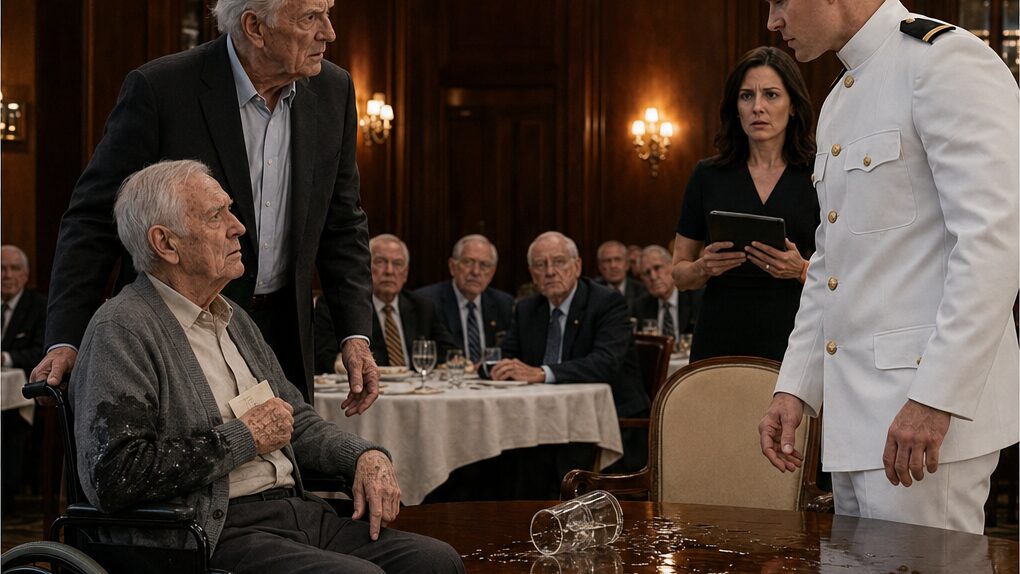
The glass tipped before anyone decided whether Stephen belonged there.
Brandon’s fingers caught the edge of the handwritten card. The card slid. Stephen reached to steady the glass, but his right hand closed too slowly.
The heavy base struck the polished table with a flat knock.
Water spread in a shining sheet.
For one second, no one moved.
The liquid ran over Jack Thompson’s printed name card, crossed the white cloth, and streamed toward Stephen’s lap. He pulled the edge of his cardigan over the table and pressed the wool against the flow.
Someone behind him drew in a breath.
Brandon still held the handwritten card between two fingers.
“You shouldn’t have reached across me,” he said.
Stephen looked down at his sleeve darkening with water.
The old anger arrived cleanly. It was not loud. It did not shake him. It simply placed every object in the room into sharp focus: Brandon’s polished cuff, the wet tablecloth, Jessica’s tablet, the two elderly men watching from three seats away, and the corner of Andrew’s card softening between Brandon’s fingers.
Stephen could have said, You pulled it.
He could have said, You speak as though I am furniture.
Instead, he took the card from Brandon.
The paper bent where the young officer had pinched it. A drop of water had touched the first letter of Stephen’s name.
Stephen laid the card against his dry palm and folded his cardigan sleeve around it.
Brandon straightened the overturned glass.
“Sir, this is exactly why we need to move you somewhere safer.”
Stephen looked at him.
“That glass wasn’t set for me.”
The words carried farther than he intended.
At the nearest table, a fork stopped against a plate. One of the elderly guests leaned forward. Jessica’s gaze dropped to the glass.
A worn engraving showed briefly through the clear base.
J.T.
Beneath the initials was a date.
Brandon saw it too, but the letters seemed to mean nothing to him.
“It’s part of the remembrance display,” he said.
“I know what it is.”
“Then you know it should not be handled.”
Stephen pressed the wet sleeve against the remaining water. “I was trying to keep you from knocking it over.”
A faint flush rose along Brandon’s neck.
The association president began moving toward them, but the donor representative caught his arm and asked something in a low voice. The president answered without taking his eyes from Stephen.
Jessica crouched beside the table, careful not to touch the wheelchair. “Mr. Harris, we can find you another seat while we resolve this.”
“Resolve what?”
“Your registration.”
“You mean whether I was invited.”
“Yes.”
“And until then?”
“The lounge would be more comfortable.”
Stephen glanced toward the service corridor. Through the open door, he saw stacked banquet chairs, gray utility carts, and a row of coat hooks. Comfortable was not the word anyone would have used if a donor were being sent there.
Brandon gestured toward a volunteer. “Please assist Mr. Harris.”
The volunteer, a young woman with a navy ribbon pinned to her dress, hesitated.
Stephen set both hands on his wheels.
“No.”
Brandon’s expression sharpened. “Sir, I am not asking you to leave the building.”
“No. You’re asking someone else to roll me out of the room so you don’t have to look at me.”
The silence widened.
That was more than Stephen had meant to say. He felt the old instinct immediately: close the door, lower his eyes, let the other man save face. For decades, silence had seemed cleaner than conflict.
But his wet sleeve clung to his forearm, and Andrew’s card was softening inside his hand.
Brandon took a breath through his nose.
“You arrived without confirmed registration, occupied a ceremonial area, and interfered with the table setting. I am trying to handle this discreetly.”
“You’re doing it in front of the room.”
“I lowered my voice.”
“You spoke about me as though I couldn’t hear.”
The two elderly men at the nearest table exchanged a glance. One looked down.
Stephen noticed and understood something bitter: they were ashamed now, not because Brandon had begun badly, but because Stephen had forced them to recognize that they had watched.
A chair scraped across the floor.
At the far side of the dining room, Andrew Walker had risen.
He was thinner than Stephen remembered. His dark suit hung loosely from his shoulders, and his white hair was combed straight back from a face sharpened by age. He held the table edge for balance before stepping away from his chair.
For seventeen years, Stephen had imagined meeting him in a dozen places: a hospital corridor, a grocery aisle, a funeral. Never here. Never with water dripping from his sleeve.
Andrew walked toward them.
His gaze moved from Stephen to the glass, then to the bent card in Stephen’s hand.
“Stephen?”
The name landed harder than the spill.
Stephen’s first thought was that Andrew sounded relieved.
His second was that he sounded angry.
Brandon turned. “Mr. Walker, do you know this gentleman?”
Andrew stopped beside the table. Up close, the years were less forgiving. A pale scar crossed the side of his chin. His eyes remained the same gray they had been aboard ship.
“I invited him.”
Jessica stood. “You submitted a guest request?”
“I wrote to him.”
“That isn’t the same thing.”
“It was to me.”
Andrew looked at Stephen’s wet cardigan. “What happened?”
“The glass was knocked over,” Brandon said.
Andrew’s gaze shifted to him.
“By whom?”
“There was confusion over the seating card.”
“That isn’t an answer.”
Stephen unfolded the damp corner of his sleeve. “Leave it.”
Andrew’s eyes snapped back to him. “You don’t get to arrive after seventeen years and tell me to leave anything.”
The words were quiet, but they altered the room more than a shout could have.
Stephen felt every watcher lean closer without moving.
Brandon seemed to sense that the problem had changed shape. “Mr. Walker, perhaps we should continue this privately.”
Andrew ignored him. He picked up the glass and turned it over. His thumb passed across the worn initials.
For a moment, the anger in his face broke.
“You still have the original?” Stephen asked.
“We replaced it twice. This is the third. Same engraving.”
Andrew set it down with care.
The association president had reached the table now. “Andrew, what is going on?”
Andrew did not look at him.
“You kept his name out of the program again.”
Stephen tightened his grip on the wheelchair rim. “I asked them to.”
“You asked once. Seventeen years ago.”
“That should have been enough.”
“For you, maybe.”
The president cleared his throat. “Perhaps introductions are in order.”
Andrew gave him a hard look. “That is exactly the problem.”
Brandon held out the damp handwritten card. “I apologize if there was an informal invitation, but this area was reserved, and Mr. Harris was not on the official list.”
Andrew took the card from him.
“You want the official list?”
His voice rose just enough to reach the nearest tables.
“Andrew,” Stephen warned.
Andrew flattened the card against the tablecloth. The blue ink had bled along the edge, but Stephen’s name remained readable.
“I put that there this afternoon.”
Jessica said, “Without notifying me.”
“Yes.”
“You know we have procedures.”
“I know you have a spreadsheet.”
The donor representative had moved close enough to hear. So had the building inspector. Brandon noticed both and squared his shoulders.
“Mr. Walker, this event has security and accessibility requirements. We cannot allow unregistered guests to choose seats, particularly ceremonial ones.”
Andrew looked at Stephen’s wheelchair, then at the narrow aisle partially blocked by a donor display.
“Accessibility,” he repeated.
Brandon’s jaw tightened. “The renovation grant would correct several current limitations.”
“And until then, you store the men with limitations in the lounge?”
“That is not what happened.”
Stephen watched the exchange gathering speed and felt an old dread rise in him. Andrew had always fought by widening the battlefield. Brandon had made one cruel choice; Andrew would make it represent the whole institution, every ceremony, every forgotten man. Soon Stephen would disappear beneath their argument.
He pushed himself back from the wet table.
The chair wheel caught against a table leg.
Brandon reached instinctively toward the handle.
Stephen turned sharply. “Don’t.”
Brandon stopped.
The single word left him standing with his hand suspended in the air.
Andrew looked at Stephen, and something in his face softened. Not forgiveness. Not yet. Recognition, perhaps, of how many hands had moved Stephen without asking since the stroke.
Andrew stepped behind the empty chair instead of the wheelchair.
“I should have come to your house,” he said.
Stephen’s throat tightened. “You did.”
“Once.”
“You stayed on the porch.”
“You wouldn’t open the door.”
“There was nothing to say.”
Andrew’s mouth drew into a thin line. “There was always something to say.”
Jessica glanced at the gathering guests. “We need to begin dinner.”
The chaplain stood waiting beside the lectern. Servers lined the wall with covered plates. The room had reached that uncomfortable point when ceremony could either resume or break apart.
The association president lowered his voice. “Andrew, who exactly is Mr. Harris?”
Stephen looked at the empty glass.
There it was—the question he had feared. Not whether he had been invited. Not whether Brandon had treated him wrongly. Who exactly was he, as though dignity required a useful answer.
Andrew turned toward Brandon first.
“You have no idea whose place you just cleared.”
A murmur stirred behind them.
Then Andrew looked at Stephen, and the anger returned—not the bright anger meant for Brandon, but the older one Stephen remembered from the hospital passage, where Andrew had stood with smoke-blackened hands and refused to meet his eyes.
“And neither,” Andrew said, “do half the men in this room.”
Chapter 3: The Invitation That Was Never Entered
The invitation was genuine.
Brandon learned that within four minutes, and it did not help him.
Jessica stood beside the event-office desk with Andrew’s handwritten note open beneath the lamp. The paper had been folded into quarters. At the bottom, Andrew had written the date, the supper time, and the words Jack’s place will be ready.
“No RSVP,” Jessica said. “No guest form. No phone confirmation.”
Brandon stared at the note.
“But it is an invitation.”
“Personally, yes. Administratively, no.”
“That distinction sounded better before the water hit the table.”
Jessica’s lips tightened.
The office was hardly more than a converted storage room behind the side lounge. Shelves held old programs, boxes of name badges, and binders with years written along their spines. Through the thin wall came the muffled movement of guests being seated.
Stephen waited outside near the service corridor.
Brandon could see part of his wheelchair through the open door. Andrew stood beside him, one hand resting on the back of an empty banquet chair rather than on Stephen’s handles. They were not speaking.
The bent seating card lay beneath the desk lamp, drying.
Brandon looked at the blue ink spreading faintly through the paper.
“What was he doing at Thompson’s seat?”
Jessica shook her head. “Andrew won’t say.”
“He said the room didn’t know whose place I cleared.”
“That could mean anything with Andrew.”
“Does Harris have a rank listed?”
“I’m checking.”
“That isn’t what I asked.”
Jessica looked up from the computer. “You’re asking whether you embarrassed someone important enough to cause trouble.”
Brandon felt heat rise behind his collar.
“I’m asking for context.”
“You had context. He was an elderly man in a wheelchair.”
“He was unregistered and sitting in a restricted ceremonial position.”
“And you could have brought me over before you touched the card.”
“You were dealing with the donor party.”
“I was six yards away.”
Brandon looked toward the doorway.
Stephen had refused a dry jacket. A catering server had brought towels, but he had used them on the table first and then folded one over his lap. His cardigan sleeve remained dark from wrist to elbow.
The image was worse from a distance.
A uniformed officer standing over him. A tipped glass. Old men watching.
Brandon had spent six months trying to prevent the association from appearing careless toward disabled veterans. The rear ramp failed inspection in March. Two restroom doors were too narrow. The dining room’s central aisle did not meet the recommended turning radius once all chairs were occupied.
The grant would fix those problems.
Now the donor representative had witnessed Brandon attempt to remove a wheelchair user from the most visible table in the building.
A knock sounded against the doorframe.
The donor representative stood there with the building inspector.
“Lieutenant, is everything under control?”
“Yes, ma’am.”
Her gaze passed him to Stephen in the corridor. “The gentleman has been placed beside the kitchen.”
“He has not been placed anywhere,” Brandon said. “He chose to wait there.”
The sentence sounded defensive even to him.
The inspector studied the corridor. “Is that your designated accessible waiting area?”
“No.”
“Where is it?”
“The side lounge.”
“Through that door?”
“Yes.”
The inspector looked at the threshold. A raised metal strip ran across it.
“Can he clear that independently?”
Brandon had not checked.
Jessica answered first. “We have volunteers available.”
The donor representative’s expression cooled. “That was not the question.”
Brandon felt the event slipping out of his control in precise, measurable pieces.
“We are resolving a registration discrepancy,” he said.
“Is he a veteran?”
“Yes,” Andrew called from the corridor.
Brandon turned.
Andrew stood with one hand in his coat pocket. Stephen looked straight ahead.
The donor representative walked toward them. “Sir, were you invited to tonight’s event?”
Stephen lifted his eyes to her. “A man invited me.”
“Were you told where to sit?”
His gaze moved to Andrew.
Andrew said, “I put his card beside mine.”
“That wasn’t your card,” Brandon said. “It was at the remembrance place.”
“I know where I put it.”
Stephen’s face changed by almost nothing, but Brandon saw it. A tightening near the mouth. A warning meant only for Andrew.
The donor representative noticed too.
“What is the connection between Mr. Harris and the remembrance place?”
Andrew looked at Stephen.
Stephen looked down at his wet sleeve.
“You’ll have to ask him,” Andrew said.
The donor representative waited.
Stephen gave no answer.
Brandon felt frustration return, unwelcome but familiar. Every step could have been easier. Stephen could have shown the invitation at the entrance. Andrew could have registered him properly. Either man could explain the connection to Jack Thompson.
Instead, they stood inside a public event guarding private truths and making everyone else responsible for guessing correctly.
Then Brandon remembered his own hand pulling the card.
He had not guessed. He had decided.
A bell sounded once from the dining room, signaling five minutes until the opening remarks.
Jessica returned to the office and began opening old membership files.
“Stephen Harris,” she murmured. “Navy. Former association member.”
“How former?”
“Dues stopped seventeen years ago.”
Andrew heard her. “His membership didn’t stop.”
“The records say it did.”
“The records say he stopped paying.”
“That is how membership works.”
Andrew laughed once without humor. “There’s your problem.”
Stephen finally turned toward him. “Don’t start.”
“I should have started years ago.”
“You tried.”
“No. I sent letters. Letters are what men send when they’re afraid of the answer.”
Brandon looked between them.
This was not a reunion. It was an old argument that had arrived before either man was ready.
Jessica pulled a binder from the lowest shelf and set it on the desk. “Annual supper ledgers.”
Dust lifted from the cover.
Brandon stepped inside as she opened it. The first pages contained typed menus and lists of attendees. Later pages had photographs taped beside handwritten notes.
Jessica searched backward through the years.
“Thompson,” Brandon said. “Find the first year his empty seat was listed.”
She scanned an index. “The observance predates our current program format.”
Andrew remained at the doorway. “Second binder. Near the back.”
Jessica took another volume from the shelf. The spine cracked when she opened it.
Inside were pages browned at the edges. One heading had been written by hand:
Empty Glass Observance.
Below it, a paragraph described the practice in plain language. One chair would remain vacant. One glass would remain unfilled. No rank, decoration, or account of death would be read until after the meal.
At the bottom were two signatures.
Andrew Walker.
Stephen Harris.
Brandon read them twice.
Jessica glanced toward the corridor.
Stephen had turned his wheelchair away from the office. He faced the closed dining-room doors as though listening to a ceremony only he could hear.
“He helped create it,” Jessica said.
Andrew’s voice came from behind them.
“He wrote the first words.”
Brandon looked at the ledger, then at the wet card beneath the lamp.
“If he created the observance,” he said, “why hasn’t he attended it in seventeen years?”
Andrew did not answer.
Stephen’s left hand closed around the wheel.
The bell sounded a second time, calling the guests to order.
Chapter 4: Seventeen Years Outside the Door
Pamela arrived with Stephen’s coat over one arm and the expression she usually wore when a doctor had changed his medication without calling her.
“We’re leaving.”
She stopped beside his wheelchair in the service corridor, saw the water-darkened sleeve of his cardigan, and looked past him toward the dining room.
“What happened?”
“Nothing that requires your voice to get louder.”
Her eyes moved to Brandon, then Jessica, then Andrew.
“That usually means something happened.”
Pamela crouched and touched Stephen’s sleeve. Cold water pressed through the wool against his skin.
“Who did this?”
“The glass fell.”
“Glasses don’t make decisions.”
Brandon shifted a step closer. “Ma’am, there was a misunderstanding concerning registration and seating.”
Pamela stood.
“My father’s name is Stephen Harris. He told me he was invited. Did anyone ask him before deciding he was confused?”
“I did ask.”
“You asked who left him unattended.”
Brandon’s face tightened. Stephen glanced at Pamela.
“How do you know that?”
“The volunteer at the entrance told me while I was looking for you.”
Pamela unfolded the coat, but Stephen put his hand against it.
“I’m not leaving yet.”
She stared at him.
That surprised her more than the soaked cardigan.
That morning, when he had finally shown her Andrew’s invitation, Pamela had offered to drive him herself. Stephen had refused. She had a work appointment, he said. The rehabilitation transport was already arranged, he said. He did not need her managing the evening.
She had dropped him at the transport center anyway and made him promise to call when the supper ended.
He had not called when the driver left him late. He had not called when Brandon stopped him. He had not called after the glass spilled.
Stephen could see the whole list forming behind her eyes.
“You said you would stay only long enough to see the table,” she said.
“I changed my mind.”
“You don’t change your mind. You hide it until everyone else has made plans around the wrong answer.”
Andrew gave a small, involuntary sound that might have been agreement.
Pamela turned toward him. “You’re Andrew.”
“I am.”
“The man who sends letters every December.”
Andrew looked at Stephen. “Some of them were in June.”
“He keeps them in a kitchen drawer.”
Stephen’s jaw tightened. “Pamela.”
“What? You both seem committed to not saying anything useful.”
A catering server approached with a fresh towel. Pamela thanked her, then gently pulled Stephen’s wet sleeve away from his wrist. He resisted for a moment before allowing her to ease the cardigan off one shoulder.
The stroke had left his right side slower, not helpless. Pamela knew the difference, but when she was anxious, she forgot to let him prove it.
“I can do that,” he said.
“I know.”
She continued anyway.
Andrew watched, then looked away.
Pamela twisted the wet portion of the sleeve over an empty ice bucket. Water pattered against the metal. A gray stain had begun to spread where the polished table’s dark finish had bled into the fabric.
“Seventeen years,” she said. “You wouldn’t come here for seventeen years. Tonight you come in shorts, alone, without confirming the ride home, and now you refuse to leave after someone humiliates you.”
“I wasn’t humiliated.”
Brandon’s gaze dropped.
Pamela held the sleeve still. “That isn’t dignity. That’s vocabulary.”
Stephen looked toward the dining-room doors.
Inside, the chaplain had begun asking guests to take their seats. Silverware touched china. The opening bell had sounded, but the room had not settled. People were still talking about the man in the wheelchair, the officer in white, and the glass that should not have fallen.
Andrew moved closer.
“Stay for Jack.”
Stephen looked at him. “You don’t get to use his name like a rope.”
“I’m not dragging you.”
“You invited me without telling anyone.”
“If I’d gone through the committee, they would have made a ceremony out of your return.”
Stephen’s eyes narrowed.
Andrew continued. “The president would have put your photograph on the program. They’d have called the newspaper. Someone would have found a flag big enough to cover the fact that none of them had asked why you left.”
“So you hid me in the seating plan.”
“I put you beside me.”
“You put me beside Jack.”
Andrew did not deny it.
Pamela glanced between them. “What is the glass?”
Neither man answered.
She looked at Stephen. “You made me drive past this building for years without telling me why you couldn’t come inside.”
“I didn’t ask you to drive past it.”
“No. You just went quiet every time we did.”
Stephen pulled his cardigan sleeve from her hands. It was still damp. He worked the fabric back over his shoulder with his left hand.
Andrew said, “He helped start the observance.”
Pamela turned.
“The empty chair?”
“The glass,” Andrew said. “No water. No speech until after supper. No polished version before people had eaten beside the absence.”
Stephen’s mouth hardened. “That was the idea.”
“And then you stopped coming.”
“I had my reasons.”
“You had silence.”
Stephen looked directly at him. “I did not stay away because this place forgot me.”
Andrew’s expression shifted.
Stephen’s voice lowered.
“I stayed away because it remembered the wrong thing.”
The dining-room doors opened. The association president appeared, holding several folded programs.
“We need to begin,” he said. “Andrew, your table is waiting. Mr. Harris, we can place you near the rear entrance until we determine—”
“No,” Pamela said.
Stephen raised one hand before she could continue.
The president stopped.
Andrew took one of the programs. His eyes moved over the cover.
“What are you reading tonight?”
“The usual remembrance account.”
“Which version?”
The president looked confused. “The approved one.”
Stephen reached for the program.
Andrew hesitated before handing it to him.
The paper was thicker than the old programs, glossy beneath Stephen’s thumb. Inside was a page devoted to Jack Thompson. A younger photograph showed Jack in working uniform, grinning at someone beyond the camera.
Below it, the account had been reduced to four clean paragraphs.
Stephen read until he reached the final sentence.
The corridor seemed to narrow around him.
Jack Thompson died after every man under his care had reached safety.
Pamela leaned close enough to read it.
“What’s wrong?”
Stephen kept his eyes on the sentence.
He had written those words seventeen years earlier. Not for the association. For Jack’s family. The association had copied them later, then shortened everything around them until the sentence became the only part anyone repeated.
Andrew watched him.
“They still use it,” he said.
Stephen closed the program.
“It isn’t true.”
Chapter 5: The Story They Needed to Believe
The chaplain began reading the false account before Stephen reached the table.
“Petty Officer Jack Thompson remained at his station during the fire—”
Stephen stopped his wheelchair at the edge of the dining room.
The guests had taken their seats. Covered plates waited before them. At Jack’s empty place, the wet tablecloth had been replaced, but the water glass was gone. Only the printed name card remained.
The chaplain continued.
“—ensuring that every man under his care reached safety before he succumbed—”
Stephen pushed forward.
Pamela walked beside him without touching the chair. Andrew followed. Brandon stood near the lectern, speaking quietly to the association president, but he fell silent when he saw them enter.
Stephen reached the open position beside Jack’s chair.
A volunteer had removed the handwritten card.
Andrew pulled out the adjacent chair and sat. Pamela remained near the wall.
The chaplain looked down at the program.
Stephen could stop him with one word.
He did not.
That was the old habit: allow the wrong sentence to finish because interrupting it would force him to supply the right one.
“His sacrifice,” the chaplain said, “embodied the highest traditions of service and brotherhood.”
Several guests bowed their heads.
Andrew leaned toward Stephen.
“Say something.”
“Not yet.”
“When?”
“When it belongs to me.”
Andrew’s hand closed around the edge of the table. “You surrendered that privilege when you let them print it.”
Servers entered from the kitchen and began removing covers from the plates. Steam rose. Water pitchers moved from guest to guest, filling every glass in the room.
At Jack’s place, there was no glass to leave empty.
Stephen noticed the absence before anyone else did.
Brandon noticed him noticing.
He spoke to a server, then looked toward the office, but the server shook her head. The original glass was being cleaned.
The program continued with other names. The room relaxed into ceremony. People lifted forks. A few glanced at Stephen, waiting for Andrew’s unfinished promise to become an explanation.
Andrew lowered his voice.
“You saved eleven men.”
Stephen looked at the plate placed before him. Roast chicken, potatoes, green beans arranged with unnecessary precision.
“That number is why Jack stayed behind.”
Andrew flinched as if the words had crossed the table physically.
“You were following triage.”
“I was choosing.”
“You were doing your job.”
“I was choosing who moved first.”
Smoke returned to Stephen in fragments: the copper taste at the back of his throat, boots slipping on wet steel, a young sailor repeating his mother’s telephone number as if someone were writing it down. Jack’s hand clamped around Stephen’s wrist. Andrew somewhere beyond the hatch, shouting through the alarm.
Not the end. Never the end. Only the choices leading toward it.
Andrew said, “Two of those men would have died before reaching the ladder.”
“Yes.”
“And Jack knew it.”
Stephen cut one potato with the side of his fork. His right hand trembled once, then steadied.
“That doesn’t make the arithmetic holy.”
“No one said it did.”
“The program does.”
Andrew looked toward Jack’s photograph.
“It says he stayed until everyone was safe.”
“He didn’t.”
The words were barely audible.
Andrew’s face changed.
Stephen continued before he could ask.
“Not everyone was safe. Not him. Not me. Not you.”
Across the room, the association president was introducing the donor representative. She spoke about accessibility, preservation, and making the building fit for future generations. Stephen watched Brandon listen from beside the lectern, his white uniform bright against the dark wood.
Andrew said, “I defended you.”
“In public.”
“I told anyone who asked that there was no other decision.”
“In public.”
Andrew’s eyes remained on the table. “You want me to say it?”
“I don’t want anything from you.”
“That has always been your cleanest lie.”
Stephen’s hand stopped.
Andrew’s voice roughened. “I knew the choice was medically right. I knew Jack had less time and the others could be moved. I told the inquiry. I told his wife. I told myself.”
He looked at Stephen.
“And for years, some part of me still thought you should have found another way.”
The confession did not relieve Stephen. It settled between them with the weight of something long carried by both.
Andrew went on. “Then you vanished, and I decided that proved I was right to blame you.”
Stephen looked toward Pamela. She stood near the wall with her arms folded, watching him rather than Andrew.
“What changed?” Stephen asked.
“I got old enough to understand that silence can look like guilt even when it’s only pain.”
Stephen’s mouth tightened. “Mine was both.”
A server reached Jack’s place and paused, uncertain. She held a water pitcher above the empty space before realizing there was no glass.
Stephen saw Brandon approaching.
The officer had removed none of his formality, but his posture was different. Less vertical. Less certain.
“Mr. Harris,” he said quietly, “I’ve confirmed that your invitation was legitimate.”
Stephen looked at him.
Brandon continued. “The seating error was ours. I intend to correct it publicly before the closing remarks.”
“The seating mistake is the least dishonest thing happening in this room.”
Brandon glanced at Andrew.
“I don’t understand.”
“No,” Stephen said. “You don’t.”
The chaplain closed the program and asked the guests to continue eating. Conversation resumed in cautious pockets.
Brandon remained beside Stephen’s chair.
“Then help me understand enough not to make it worse.”
Stephen almost laughed. The request was reasonable. That made it harder.
He looked at Jack’s printed photograph, then at the empty place where the glass should have been.
“The account says he died after everyone was safe.”
Brandon nodded.
“He didn’t.”
Brandon’s gaze sharpened.
Andrew said, “Stephen.”
“What?”
“You don’t have to do this here.”
Stephen turned toward him. “That is what you wanted.”
“I wanted you recognized.”
“For what?”
“For bringing men out.”
“And if the truth makes that recognition less comfortable?”
Andrew did not answer.
Brandon looked between them. “Was there an investigation?”
“Yes,” Stephen said.
“And you were cleared?”
Andrew answered. “He was.”
Stephen’s hand tightened on the wheel.
There it was again. Cleared. A useful word. A clean word. It meant the rules had accepted what the heart could not.
Brandon lowered his voice. “If the program is inaccurate, the association can issue a correction.”
“You think this is a printing error?”
“No.”
“You think correcting one sentence makes the room honest?”
Brandon’s face hardened slightly. “I am trying to address what I can.”
Stephen looked at the white sleeve, the polished buttons, the careful control returning around the officer’s mouth.
“You tried that when you moved me.”
Brandon absorbed the blow without replying.
At the far end of the table, the association president rose and tapped a spoon against his glass. Conversations quieted.
“Before dessert,” he said, “we have an unexpected honor to acknowledge.”
Andrew pushed back his chair.
Stephen knew at once what he intended.
“No.”
Andrew kept rising. “They should know.”
“They should know what happened, not what you need me to become.”
The president smiled toward them.
“We are privileged tonight by the return of one of the men who established this very observance—”
Stephen turned his wheelchair toward the aisle.
Not to leave.
To reach the microphone before anyone else finished his story for him.
Chapter 6: What the Uniform Could Not Protect
Jessica placed the incident report in Brandon’s hand and said, “This version protects the grant.”
He read the first paragraph beneath the kitchen’s fluorescent light.
An unregistered attendee entered the ceremonial seating area and made contact with a table setting, resulting in an accidental spill.
Brandon looked up.
“You wrote this?”
“I wrote what can be documented.”
“You watched me pull the card.”
“I watched several hands move at once.”
“Mine moved first.”
Jessica crossed her arms. “The donor representative has already asked whether we have procedures for confused or unaccompanied guests. The association president wants this handled before the closing remarks.”
“Mr. Harris was neither confused nor unaccompanied.”
“He arrived alone.”
“That isn’t the same thing.”
“No, but it is the kind of distinction that disappears in a liability review.”
Beyond the kitchen entrance, applause began in the dining room. Brandon heard the association president introducing Stephen as a founder of the empty-glass observance.
He pictured Stephen’s face when the president called his return an honor.
Not gratitude. Alarm.
Jessica tapped the report.
“If you sign, we can state that the registration failure contributed to the incident. I’ll take responsibility for the list.”
“You didn’t overturn the glass.”
“And you didn’t erase his name from the system.”
“I decided he was a problem before I checked.”
Jessica’s expression softened, but only slightly. “Then decide whether confessing that tonight helps him or simply satisfies your conscience.”
A catering server entered carrying the cleaned glass in a folded towel.
“Where should this go?”
Brandon took it.
The heavy base was cold in his palm. The initials J.T. showed faintly underneath, followed by the worn date.
He remembered another banquet, twelve years earlier, where his father had been given a plaque beneath a banner printed with the wrong middle initial. Three weeks later, a benefits office had lost his medical appeal for the second time.
His father had left the plaque in its box.
“They’ll stand when you walk in wearing white,” he had once told Brandon. “See whether they answer the phone when the uniform comes off.”
Brandon had believed he understood the warning. He had come to dislike ceremonies that mistook recognition for care. Tonight he had been managing a grant for wider doors, safer ramps, and accessible restrooms—things that mattered after the speeches ended.
Then an old man in a wheelchair disrupted his seating chart, and Brandon treated him as an obstacle to the work supposedly being done for men like him.
He folded the report once and handed it back.
“I won’t sign that.”
Jessica exhaled. “Then the association may lose funding.”
“If it loses funding because the truth is worse than the brochure, the brochure was the problem.”
“That sounds principled. It won’t widen the restroom doors.”
“No. But blaming him won’t either.”
Brandon carried the glass into the alcove beside the dining room.
Stephen was there, angled away from the noise. The introduction had stopped. Andrew stood near the center table speaking urgently with two elderly members. Pamela watched from beside the wall.
Stephen looked at the glass in Brandon’s hand.
“You cleaned it.”
“Yes.”
“People clean objects faster than they correct themselves.”
Brandon accepted that.
“My father hated these events,” he said.
Stephen’s eyes narrowed. “Is that meant to make us alike?”
“No.”
“Good.”
“He served twenty-two years. They invited him to dinners and photographed him at parades. When he needed help after his lungs failed, every office sent him to another office.”
Stephen studied him.
Brandon continued. “I thought if this building got the grant, at least something practical would come from tonight.”
“And when I complicated the picture?”
“I saw an unregistered man in the wrong seat.”
“You saw an old body someone else had failed to manage.”
Brandon looked down at the glass.
“Yes.”
Stephen’s voice remained controlled. “You may be right about empty ceremonies. That does not excuse treating an old man like misplaced furniture.”
“No.”
“You could have checked privately.”
“Yes.”
“But you wanted the room to watch you restore order.”
Brandon met his eyes.
“Yes.”
The admission seemed to surprise them both.
From the dining room came Andrew’s voice, louder now.
“This cannot be dismissed as a misunderstanding. Lieutenant Miller publicly degraded a veteran and then attempted to remove him from the room.”
One of the elderly members answered, “We should suspend him from the committee tonight.”
Brandon felt the glass grow heavier.
Stephen looked toward the voices. “Andrew always preferred a clean target.”
“He is not wrong about what I did.”
“No. But being right about harm does not make every punishment useful.”
Jessica appeared in the alcove. “The president wants you both inside. Andrew has gathered enough members to demand an immediate vote.”
Brandon said, “I’ll accept whatever review they require.”
Stephen gave him a tired look. “That is easier than staying where people can watch you change.”
The words found a place Brandon had not protected.
Pamela crossed the room toward them. “Dad, Andrew is about to turn this into a trial.”
Stephen set his hands on the wheels.
His right fingers slipped. Pamela reached forward, then stopped herself.
Stephen tried again. The wheel moved.
“Where are you going?” she asked.
“To interrupt him.”
“Are you going to defend the officer?”
Stephen looked at Brandon, then at the empty glass in his hand.
“I’m going to stop Andrew from borrowing my humiliation.”
The microphone squealed in the dining room.
Andrew’s voice followed.
“I move that Lieutenant Miller be removed from all association duties pending—”
Stephen pushed out of the alcove and headed toward the lectern.
Chapter 7: The Choice No Table Could Simplify
“Do not use me to do to him what he did to me.”
Stephen’s voice reached the microphone before his wheelchair reached the lectern.
Andrew stopped mid-sentence.
The room held still around him. One elderly member had already raised his hand in support of the motion. The association president stood beside the lectern with his mouth slightly open. Near the kitchen entrance, Brandon held Jack’s cleaned glass against the white front of his uniform.
Stephen pushed once more and positioned himself beside Andrew.
The microphone was too high.
Pamela started forward, but Stephen looked at her and shook his head. Brandon moved instead, then stopped several feet away.
“May I lower it?” he asked.
Stephen nodded.
Brandon adjusted the stand without touching the wheelchair. He lowered the microphone to Stephen’s height, stepped back, and kept the empty glass in both hands.
Andrew leaned down. “Stephen, you don’t owe this room anything.”
“That has never stopped this room from taking.”
A few faces turned away.
Stephen placed the folded program on the lectern. The false sentence lay hidden inside it, but he could feel its weight as surely as if the paper were iron.
“I heard what Andrew moved for,” he said. “Lieutenant Miller should answer for what he did. He decided what I was before he knew my name. Then he made that decision public.”
Brandon did not look down.
Stephen continued. “But if the purpose of this room is to teach men that one mistake defines them forever, then we should close the doors now. We have no shortage of mistakes in here.”
The man who had raised his hand lowered it.
Andrew’s jaw tightened. “This is not about one mistake.”
“No. It is about several.”
Stephen opened the program.
The photograph of Jack Thompson faced the room. Jack was twenty-six in the picture, his grin slightly crooked because he had chipped a tooth opening a bottle with a tool he should not have used.
“The words printed here say Jack died after every man under his care reached safety.”
Stephen paused.
“They are not true.”
The silence changed. It was no longer the silence of people waiting for punishment. It was the silence of people realizing the evening itself had become uncertain.
The association president shifted closer. “Mr. Harris, that account came from the original family statement.”
“I wrote the original statement.”
Andrew’s eyes closed briefly.
Stephen kept his left hand flat against the lectern. His right hand rested curled against his thigh.
“There was a fire below deck. Smoke filled the passage faster than we could move the injured. I was assigned to the medical team. When the ladder route opened, we had time to move two men before the compartment became impassable.”
The room around him faded at the edges.
He saw the passage as it had been: red emergency lights, black smoke pushing along the ceiling, water sliding under his knees. A sailor with burns along one arm. Another whose breathing had become a wet rattle. Jack against the bulkhead, one leg trapped beneath twisted metal.
Stephen heard Jack coughing.
Not heroically. Not quietly.
Afraid.
“There were three men who could still speak,” Stephen said. “Two had a chance if we moved them immediately. Jack’s injuries were worse.”
Andrew’s fingers closed around the back of the nearby chair.
Stephen looked at him before continuing.
“Jack was conscious when I left him.”
A sound escaped someone near the rear table.
“He knew what I was deciding. He told me to take the younger men first.”
Stephen’s throat tightened. He waited until he could speak without forcing the words.
“He did not say it like a man in a program. He was angry. He was frightened. He asked me twice whether I would come back.”
Pamela stood near the wall with both hands pressed together.
“I told him I would.”
Stephen looked at Jack’s photograph.
“I did go back. The passage was sealed before I reached him.”
The program page shifted beneath his fingers.
“The inquiry found the evacuation decision correct. Eleven men survived that fire. People heard that number and wanted a story that made the cost bearable. So I gave them one.”
He lifted the program slightly.
“I told Jack’s family he died quickly. I said he remained until everyone else was safe. It was easier than telling them he knew I was leaving. Easier than saying he was scared. Easier than admitting that the last promise I made him was one I could not keep.”
Andrew’s face had gone pale.
Stephen turned toward him.
“You defended the decision.”
“In public,” Andrew said.
“Yes.”
Andrew’s voice was barely audible. “And blamed you where no one could hear.”
“You were not alone.”
Stephen looked down at his own hand.
“I blamed myself where no one could reach me.”
The sentence remained between them.
Pamela lowered her eyes.
Stephen had thought the confession would feel like losing something. Instead, it felt like discovering how much weight silence had required him to hold.
He faced the room again.
“Andrew wrote to me every year. I did not answer. My daughter asked why I would not come here. I gave her no reason. I told myself I was protecting Jack from a smaller story and his family from an uglier truth.”
He looked at Pamela.
“Mostly, I was protecting myself from hearing it spoken.”
The association president stepped nearer. “We can amend the program. We can prepare a proper account of your service and—”
“No.”
The word came harder than Stephen intended.
The president stopped.
“Do not replace one clean story with another. Do not make Jack fearless because fear makes you uncomfortable. Do not make me noble because guilt makes you uncomfortable.”
No one applauded.
Stephen was grateful.
The quiet was harder and more honest.
Andrew looked toward Brandon. “That does not erase what happened tonight.”
“No,” Stephen said. “It does not.”
Brandon took one step forward.
“I knew I could verify your invitation privately,” he said. “I chose not to. I wanted the room to see me put things in order.”
His voice carried without the microphone.
“The records were incomplete, but the records did not pull the card. I did.”
Jessica stood near the office door, the unsigned incident report in her hand.
Brandon continued. “I am sorry, Mr. Harris.”
Stephen studied him.
An apology offered in front of witnesses could be another performance. But Brandon did not ask to be forgiven. He did not explain the grant or his father. He simply remained where the room could see him.
Stephen glanced at the glass.
“Is that Jack’s?”
“Yes.”
“Bring it here.”
Brandon approached.
When he reached the wheelchair, he did not stand over Stephen. He bent one knee only far enough to bring their eyes level.
“May I place it back?”
“Not empty.”
Confusion crossed Brandon’s face.
Stephen looked toward the water pitcher on the central table.
“Fill it first.”
Andrew stared at him. “The glass is supposed to remain empty.”
“It will.”
Stephen waited.
Brandon understood. He carried the glass to the pitcher, filled it, and returned. Water caught the chandelier light inside the clear sides.
Stephen held out his left hand.
Brandon gave him the glass.
It was heavier full.
Stephen raised it only a few inches.
“To the truth before it becomes useful,” he said.
He poured the water into his own drinking glass.
Then he handed Jack’s glass back, empty once more.
“Put it at his place.”
Brandon set it beside Jack’s name card with both hands.
The reversal was small. No one stood. No one saluted. The officer in white simply returned what he had displaced and waited for permission to step away.
Stephen turned to the association president.
“If this organization wants to correct tonight, begin with the things that happen before a man reaches a microphone. Put a person at the entrance who asks before assuming. Accept invitations that do not arrive through a computer. Have disabled members test the route between the door, the tables, and the restrooms. And remove that donor display from the aisle.”
The building inspector looked toward the narrowed passage.
The president nodded slowly. “We can form a committee.”
“Not a committee made entirely of men who can climb the front steps.”
Jessica spoke from the doorway. “I can rebuild the registration process.”
Stephen looked at her. “With the people it failed.”
“Yes.”
Andrew rested both hands on the empty chair beside Jack’s place.
“What about Miller?”
Stephen turned toward Brandon.
“There should be a review.”
Brandon nodded.
“And he should sit through the rest of supper.”
Andrew frowned. “Beside you?”
“If he can manage it without reorganizing me.”
A faint, uneasy laugh moved through one table and died quickly.
Brandon pulled out the chair on Stephen’s other side.
Before sitting, he asked, “Is this space wide enough?”
Stephen tested the turn of his wheel.
“Move it two inches.”
Brandon did.
The association president closed the program and set it facedown.
Dinner resumed unevenly. Forks moved. Voices returned in low tones. The room did not know how to behave after losing the story it had rehearsed.
That, Stephen thought, might be useful.
Andrew remained standing beside Jack’s chair.
“Should we remove this one?” he asked.
Stephen looked at the empty seat, the unfilled glass, and the place where he had spent seventeen years imagining only the dead were entitled to remain.
He placed his hand on the chair back.
“No,” he said. “Pull it closer.”
Chapter 8: The Glass Stayed Empty, but the Chair Did Not
Three months later, Stephen arrived early enough that no one was waiting to recognize him.
The front entrance stood open. The donor placards were gone from the central aisle, and a new threshold ramp lay flush beneath the doors. Yellow tape still marked unfinished work near the side hall, but Stephen could push from the entrance to the dining room without asking anyone to move a chair.
He stopped just inside.
There was no remembrance supper that evening. No uniforms. No photographer. Only a weekday meal for association members, with soup warming in the kitchen and card games already beginning near the windows.
For a moment, ordinary inclusion frightened him more than ceremony had.
At the remembrance supper, he had possessed a reason to enter. Jack’s card had waited beneath the glass. Andrew had invited him. Conflict had left no room for retreat.
Tonight, he had come because Jessica had mailed the monthly schedule and written one sentence at the bottom:
Your regular membership card is enclosed.
Stephen had carried it in his pocket for nine days before telling Pamela he planned to attend.
She had offered to come.
He had said no.
She had looked at him for a long moment, then placed the transport number beside the telephone without calling it herself.
Now Stephen moved toward the central tables.
Jessica stood at the new registration desk, where a printed list sat beside a handwritten ledger. A sign asked guests how they preferred to receive invitations: mail, telephone, email, or in person.
She smiled when she saw him, then checked herself before making the welcome too large.
“Evening, Stephen.”
“Jessica.”
“Your seat is open. You can choose another if the turn space doesn’t work.”
He glanced at the floor markings. “You measured.”
“Three wheelchair users argued over the correct radius.”
“Good.”
“They were all right in different ways.”
“Better.”
She handed him no badge and asked no unnecessary question.
Inside the dining room, Jack’s empty place remained near the center. The plain glass stood beside the printed card. The chair next to it was occupied by Andrew, who was sorting playing cards into piles with no visible logic.
“You’re late,” Andrew said.
Stephen looked at the wall clock. “I’m twelve minutes early.”
“You were seventeen years late last time. My standards changed.”
Stephen positioned his chair beside the table.
The handwritten card from the supper had been repaired between two thin sheets of clear archival paper. It lay beneath Jack’s printed name.
Stephen touched one corner.
“You kept it.”
Andrew continued sorting. “Jessica said wet paper tears if people keep unfolding it.”
“That was always true.”
“I did not always listen to Jessica.”
“Also true.”
Their corrected account had gone to Jack’s family six weeks earlier.
Andrew had written the first draft. Stephen had crossed out every sentence that made Jack sound calm. Pamela had typed the final version because Stephen’s right hand tired quickly and Andrew refused to use a computer.
Jack’s surviving sister had replied with four handwritten pages.
She had been angry.
She had also thanked them.
Stephen kept the letter in the kitchen drawer with Andrew’s old invitations. He had not answered it yet, but the paper no longer lay beneath unopened envelopes.
A chair scraped behind him.
Brandon approached wearing a dark civilian suit. The review had removed him from event authority for two months but not from the association’s accessibility project. He now attended meetings without introducing himself by rank unless someone asked.
He stopped beside Stephen.
“Would you like me to move the chair behind you?”
Stephen checked the space.
“Yes. Toward the wall, not the aisle.”
Brandon moved it and waited.
“That enough?”
Stephen turned his wheel once.
“Yes.”
Brandon nodded and returned to the water station.
He did not mention the spill.
He had apologized once more in private, two weeks after the supper, without defending himself. Stephen had accepted the apology as a statement of fact, not a contract promising that everything between them was repaired.
Since then, Brandon had changed in less dramatic ways. He asked before touching wheelchairs. He stopped calling every older man “sir” when he had not bothered to learn his name. He spent one afternoon navigating the building in a borrowed chair and discovered that the new restroom door opened in the wrong direction.
The change did not make him innocent.
It made him responsible for what came next.
Andrew gathered the cards and tapped them into a straight stack.
“The president wants to make this your permanent seat.”
Stephen looked at Jack’s empty chair.
“No.”
Andrew’s mouth tightened. “Why not?”
“Because it is Jack’s place.”
“The one beside it.”
“Also no.”
“You belong here.”
“I belong at any table that has room.”
Andrew studied him. “You always make acceptance sound like a dispute.”
“And you always try to turn guilt into furniture.”
That landed. Andrew looked down at the cards.
Stephen let the silence remain, but not long enough to become another wall.
“I’ll sit here tonight,” he said. “Next week I may sit by the window.”
Andrew nodded.
It was not forgiveness. It was practice.
A server brought bowls of soup. She placed a full water glass before Stephen and left Jack’s untouched.
One empty.
One filled.
For years, Stephen had believed remembering Jack required refusing ordinary comfort. He had confused punishment with loyalty, absence with honesty, silence with restraint.
He lifted his glass and drank.
The water was cool. Nothing ceremonial happened.
Across the room, Jessica explained the new telephone-confirmation system to an elderly member who distrusted voicemail. Near the entrance, the building inspector measured the final clearance beside the coat rack. Brandon carried a stack of bowls from the kitchen because the server had asked for help.
Pamela had wanted proof that Stephen would not disappear again.
He could not promise that.
There would be mornings when leaving the house felt like presenting evidence. There would be letters he delayed answering and truths he still tried to edit into smaller shapes.
But he had come without a ceremony to force him.
That mattered.
Andrew dealt two hands of cards.
“You remember how to play?”
“No.”
“You cheated every week for six years.”
“That was why I remembered then.”
Andrew almost smiled.
Brandon returned with a pitcher and set it on the table within Stephen’s reach. He started to turn away.
Stephen looked at the distance. His right hand could not lift the full pitcher safely, and his left shoulder had begun to ache from pushing across the ramp.
Once, he would have said nothing. He would have waited until someone noticed or gone thirsty rather than expose need to the wrong person.
He looked at Brandon.
“Pass the water.”
Brandon picked up the pitcher.
He did not straighten to full height. He did not lean across Stephen or take his glass without asking. He simply held the pitcher near the table.
Stephen slid his glass forward.
Brandon filled it and passed it back.
Beside them, Jack’s glass remained empty.
The chair did not.
The story has ended.