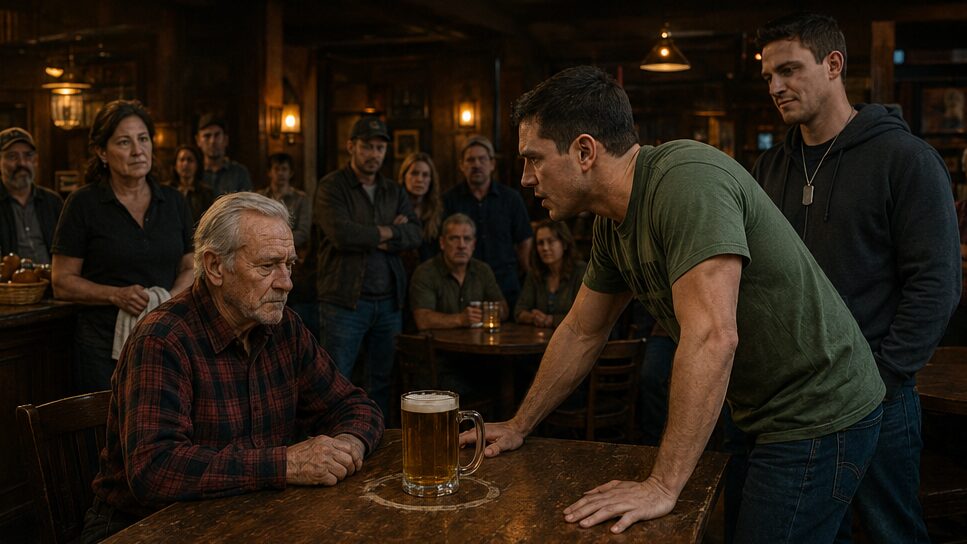
The Young Men Laughed At The Old Veteran’s Beer Mug Before Learning Why He Never Touched It
Chapter 1: The Mug Was Already On The Table
The first thing James Torres noticed was not the old man.
It was the beer mug sitting in the exact center of the reserved table, full to the rim, untouched, catching the amber light from the wall lamp as if somebody had placed it there for a photograph.
James stopped with a stack of folded table tents tucked under one arm. Behind him, Jacob Davis nearly ran into his shoulder.
“What?” Jacob asked.
James didn’t answer right away. He looked past the mug to the man sitting behind it.
The old man wore a red-and-black plaid shirt buttoned cleanly to the collar, the kind of shirt that had been washed so many times the red had softened into rust. His white hair was combed back, not stylishly, but carefully. Gray stubble shadowed his jaw. His hands rested flat on either side of the beer mug, palms down, fingers slightly bent from age. He was not reading, not watching the televisions over the bar, not talking to anyone. He was simply sitting there.
At Jeffrey Mitchell’s age, stillness had become the one thing people mistook most often. They mistook it for confusion. They mistook it for sleepiness. They mistook it for weakness. Sometimes they mistook it for an invitation.
He knew the young man with the table signs had stopped nearby. He did not look up immediately. Instead, Jeffrey checked the mug.
The handle faced right.
The base sat exactly inside the pale ring worn into the old tabletop.
The foam had lowered by a quarter inch, settling into a thin white lace along the glass.
Good.
Around him, the bar worked itself into the kind of early-evening noise that always came before a public event. Chairs scraped. Someone tested a microphone near the back wall and then cursed softly when it squealed. The smell of fried onions, floor polish, and spilled beer hung in the warm air. Volunteers in green shirts moved between tables, setting out small signs that read SUPPORT LOCAL VETERANS. A few wore hoodies with the same block letters across the chest. The letters meant something to them. Team pride, maybe. A league name. Jeffrey had not asked.
He had arrived before the signs.
That mattered to him, though he knew it would not matter to anyone else.
Stephanie Clark had unlocked the side door for him at four-thirty, the way she did every year. She had said, “Evening, Jeffrey,” softly enough that the closing-shift bartender wiping glasses might not hear the sadness underneath.
Jeffrey had nodded, touched two fingers to the edge of his cap, then walked to the table in the corner by the third wall lamp.
Not the biggest table.
Not the best table.
Not even the table it had once been.
Years ago, it had been a two-person booth with cracked brown vinyl seats and a lamp that flickered whenever the front door opened. After the renovation, the booths were torn out, the walls sanded, the floor restained, the layout widened to make room for trivia nights and fundraisers and darts. But Jeffrey had asked Stephanie to keep this one square tabletop. She had looked at him for a long moment, then said she would see what she could do.
Now the old surface sat on newer legs, darker than the others, scarred near one corner, polished smooth in the center from years of elbows, glasses, and time. The ring mark was still there if a person knew where to look.
Jeffrey always knew where to look.
“You waiting on somebody?” James asked.
His voice was not sharp yet. Busy, maybe. Irritated around the edges. Jeffrey lifted his eyes.
James was broad-shouldered, clean-shaven, and young enough to believe urgency was the same as authority. He wore a green shirt with big white letters across the front, tucked halfway into dark jeans. His hair was short, his watch bright, his jaw set in the determined expression of a man trying to be in charge of something bigger than himself.
Behind him stood Jacob Davis in a dark hoodie, hands in the front pocket, gaze moving from the beer to Jeffrey’s face and back again. Jacob had the look of someone prepared to laugh if James laughed first.
“No,” Jeffrey said.
James blinked once. “You’re not waiting on anybody?”
Jeffrey looked at the mug.
“No.”
James shifted the table tents from one arm to the other. “Okay. Well, this section is reserved tonight.”
Jeffrey nodded.
The nod seemed to bother James more than refusal would have. “For the fundraiser,” he added.
“I know.”
“You know?”
Jeffrey placed one finger near the base of the mug, not touching it yet. “Saw the signs.”
James glanced over his shoulder at Jacob as though the old man had made a joke at the wrong time. Jacob gave a small shrug.
“All right,” James said, stretching the words. “Then you understand we need this table.”
Jeffrey looked at the tabletop. At the ring. At the line where old wood met newer varnish. “I’m using it.”
James exhaled through his nose. “Sir, there are other tables.”
There were. Three two-tops along the front window. A high table near the dartboard. Several stools at the bar. Jeffrey had sat in all kinds of places in his life. Cargo floors. Aid stations. Church basements. Hospital chairs. Airport benches. Folding chairs next to graves. The place itself was not the point unless it was the place.
“I’m fine here,” he said.
The microphone squealed again. A woman near the raffle basket winced. Someone laughed by the jukebox. On the wall above the bar, a game played with the sound off, men running across bright green turf beneath captions Jeffrey did not read.
James stepped closer.
Jeffrey noticed the young man’s hands before anything else. They were strong hands, restless hands, hands that wanted to arrange the world quickly. One gripped the table tents. The other hovered near the back of the empty chair opposite Jeffrey.
“You’re not on the volunteer list,” James said.
“No.”
“You’re not with one of the sponsor tables?”
“No.”
“You buying tickets?”
Jeffrey took his time answering. “Maybe later.”
James’s mouth tightened. “The event starts in half an hour.”
“I know.”
“You keep saying that.”
Jeffrey said nothing.
It was an old habit, silence. Not empty silence. Not the sulking kind. The useful kind. A man could learn a great deal by letting others spend their words first.
James glanced at the beer mug again. “You planning to drink that?”
Jeffrey’s right hand moved before his voice did. Two fingers touched the glass near the base and turned it a fraction of an inch, less than most people would notice. The handle came back into line. He withdrew his hand.
“No.”
That made Jacob’s eyebrows lift.
James stared at him. “You ordered a beer you’re not drinking?”
Jeffrey kept his eyes on the mug. “Yes.”
“Why?”
The question came too quickly. Too casually. Jeffrey felt it land, then pass through all the rooms inside him where he did not allow strangers.
He had answered it once, years ago, when his wife was still alive and had asked from the kitchen doorway why he came home smelling like old wood and beer on the same night every year. He had answered it badly then. Too little. Too late. She had not pressed. Rachel had heard pieces later and shaped them into a worry she carried like a duty.
A chair scraped behind him. More volunteers arrived, talking over one another. The bar’s front door opened and let in a quick stripe of cold evening air before falling shut.
James leaned down slightly, lowering his voice but not enough to make it private. “Look, I don’t want to be rude.”
Jeffrey looked at him then.
The words had come dressed as courtesy, but both men knew they were the last step before courtesy disappeared.
James continued, “We’ve got people coming in. Donors. Families. Actual veterans. This table is part of the setup.”
Actual veterans.
Jeffrey held his gaze for a second too long. Not to threaten him. Not to correct him. Just long enough that James might hear himself if he was listening.
James was not listening yet.
Jeffrey picked up the mug by the handle.
For one brief second James looked relieved, as if the problem had decided to carry itself away.
Jeffrey lifted the beer only high enough to slide the paper coaster underneath it back into place. Then he set the mug down in the same pale ring.
Glass met wood with a soft, final sound.
“I’m not finished sitting here,” Jeffrey said.
Jacob looked away, perhaps to hide a smile. James’s face colored slightly.
At the bar, Stephanie turned from the register. She was too far away to hear every word, but Jeffrey saw her notice the shape of the conversation: young man standing, old man seated, table between them, room beginning to glance.
“Sir,” James said, and the word had lost whatever respect it first carried, “we’re not trying to ruin your night.”
Jeffrey almost smiled at that. Not because it was funny, but because of how little one night could be ruined after a man had lived through enough of them.
“It isn’t ruined,” he said.
James set the stack of table tents on the chair across from Jeffrey. Not on the table, but close enough to mark territory.
“Then help us out.”
Jeffrey’s eyes moved to the chair.
He remembered another jacket hanging there. Younger shoulders. A laugh that came too easily in bad places. A voice saying, When we get back, Doc, I’m buying. Not that watered-down mess from the tent. A real beer. In a real place. You pick the place.
Jeffrey blinked once.
The bar returned.
James was still waiting.
“I got here early,” Jeffrey said.
“That doesn’t make it yours.”
“No,” Jeffrey said. “It doesn’t.”
Something in that answer unsettled Jacob enough that he straightened. James missed it. He looked around at the volunteers, the signs, the half-arranged raffle table, the local reporter setting up a camera near the back. The more people arrived, the more the old man became a visible problem.
James stepped closer, his shadow falling across the mug.
“Listen,” he said, the edge now plain in his voice. “This table is not for old guys killing time.”
Chapter 2: The Laugh That Made The Whole Room Look Over
For a moment after James said it, the bar seemed to keep moving without sound.
Jeffrey saw mouths opening and closing near the raffle table. He saw a bartender lift a tray. He saw the television flicker blue across a row of bottles. But the words sat between him and James like something spilled that no one wanted to clean up.
Old guys killing time.
Jeffrey had heard worse. Men in pain had said worse. Men afraid to die had said worse. Officers too young for the weight on their shoulders had said worse. Strangers in pharmacies, grocery stores, waiting rooms. People behind him in lines when his hands would not move quickly enough. He had learned that most insults said more about the hurry of the person speaking than the worth of the person receiving them.
Still, some words knew where to land.
He looked at the beer mug.
The foam had thinned to almost nothing.
James seemed to realize the room had shifted. Instead of stepping back, he pushed forward.
“I mean, come on,” he said, louder now, turning slightly so Jacob could hear him fully. “You show up during a veterans’ fundraiser, take the reserved table, order one beer, and just sit there guarding it like it’s a museum piece?”
Jacob let out a short breath through his nose. Not quite a laugh. Not yet.
Jeffrey’s right hand moved to the mug again. Two fingers. Gentle pressure. He slid it back less than half an inch, aligning the base with the old circular stain in the tabletop. The motion was small, practiced, almost tender.
James watched him do it.
Then he laughed.
It was not a long laugh at first. It burst out of him, sharp and surprised, as if Jeffrey had confirmed every private joke James had been holding back. He tipped his head toward Jacob.
“Did you see that?” James said. “He’s got a parking spot for the beer.”
Jacob laughed then, because the line had been offered to him and because the room had not yet decided whether it was cruel.
A couple of volunteers turned. The woman near the raffle baskets stopped tying a ribbon around a stack of gift cards. The local reporter lowered her camera slightly. At the bar, Stephanie’s expression changed.
James leaned over the table, both hands now planted on the wood near the mug, not touching it but enclosing it. His green shirt filled Jeffrey’s view. The white letters across it bent with his shoulders.
“You worried somebody’s gonna steal it?” James asked. “Because from the looks of it, nobody’s fighting you for that one.”
The laughter spread in fragments. Not through the whole room. Not even most of it. But enough. A few chuckles from people who did not know what they were laughing at. One uncomfortable snort. Someone near the back muttered, “Let it go,” but too quietly to matter.
Jeffrey looked at James’s hands.
They were close to the mug.
Too close.
He could have stood then. He was still tall enough to surprise people when he straightened completely. He could have made his voice hard. He could have said four words that would have rearranged the faces in the room: I served before you.
But the words would have been small once they left him. They would have turned into a badge held up for inspection. A claim to be weighed. A way of asking the room to return dignity it should never have taken.
So he stayed seated.
“Move your hands,” Jeffrey said.
His voice did not rise. It carried only to the nearest tables.
James’s smile faded in a way that made him look younger. “Excuse me?”
“Please.”
The please was not soft. It was exact.
Jacob stopped smiling.
James looked down at his hands as if only then noticing where they were. For a second he almost moved them. Pride stopped him. The room was watching now, and pride was often just fear with its jacket zipped up.
“You know what?” James said. “I’ve been polite.”
Jeffrey looked up at him. “You have not.”
A few heads turned more fully. Someone at the bar murmured under their breath.
James’s face tightened. “This night is for people who actually served the cause. People who show up. People who help. We’ve got families coming in who care about veterans, and you’re sitting here making it about yourself.”
The words struck differently than the first insult. Not harder. Deeper. Not because Jeffrey believed them, but because of how easily a man could stand beneath a banner of respect and still fail to recognize the thing itself.
Jeffrey’s thumb brushed the mug handle.
“I am not making it about myself,” he said.
“Then what’s it about?”
Jeffrey did not answer.
James gave a humorless little laugh and looked around as if inviting the room to witness the absurdity. “Exactly.”
Stephanie came out from behind the bar.
She was in her fifties, with dark hair pulled back and a dish towel over one shoulder. Her face had the calm of someone who had broken up arguments without breaking glasses. But Jeffrey saw concern behind it.
“James,” she said. “Take a breath.”
James turned toward her. “Stephanie, you told us we could use this section.”
“I did.”
“This table is in the section.”
“I know.”
“Then tell him.”
Stephanie looked at Jeffrey.
He gave her no signal. Asked for no rescue. His hand remained near the mug.
That was the hard part for her. Jeffrey had been coming long before she owned the place. Before the new sign outside. Before the polished floor. Before the fundraiser nights had grown big enough for posters in the windows. He always paid cash. Always sat at the same table on this date. Always ordered the same beer. Always left it untouched until closing, when he would stand, press the coaster flat beneath the mug, and walk out with his receipt folded once in his shirt pocket.
She knew the routine.
She did not know the reason.
“Jeffrey,” she said carefully, “we can find you another spot where it’s quieter.”
The room waited.
Jeffrey’s eyes moved from her face to the mug. He did not look angry. That made it worse. If he had been angry, people might have known where to place the moment. Anger was easy. This was something else.
“No,” he said.
Stephanie absorbed the answer with a small nod. James threw up one hand.
“There it is,” he said. “Everybody else is supposed to adjust.”
Jacob shifted his weight. “James—”
“No, I’m serious.” James looked at Jeffrey again. “What’s so special about this table?”
The question opened a door Jeffrey had kept closed so long the hinges had become part of him.
He saw rain in a place where it had not rained enough. He saw canvas walls trembling under rotor wash. He saw a young man with a bandaged forearm sitting on an ammunition crate, grinning with blood on his teeth because he had managed to make another man laugh. He heard, clear as the glass before him: You pick the place, Doc. First round’s on me.
Jeffrey pressed his fingertips to the table.
The wood beneath the varnish felt warm.
“This one is fine,” he said.
James stared.
Then he laughed again, louder than before, not because anything was funny now, but because he needed it to be. The laugh cracked across the bar and made nearly everyone look.
“Man,” James said, shaking his head. “You hear that? This one is fine.”
Jacob did not laugh this time.
Jeffrey waited until the sound drained out. Then he lifted the mug.
The beer trembled slightly in the glass. Not from fear. His hand did that sometimes now. He steadied it with his other hand and placed it exactly on the pale ring again.
The movement took effort.
That was when Jacob noticed.
Not the age. Not the tremor. The precision. The way Jeffrey’s attention narrowed around the ring as if the old mark had more authority than every sign James had brought into the room.
Stephanie noticed too.
She stepped closer, lowering her voice. “James.”
He turned, still flushed with embarrassment disguised as irritation. “What?”
Stephanie looked at him for a long second. “He buys that beer once a year and never takes a sip.”
The words did not silence the entire bar. Nothing so dramatic. A glass still clinked near the sink. Someone coughed. The microphone hummed softly.
But the small circle around the table changed.
James’s mouth opened, then closed.
Jacob looked at the mug as if it had become something he should not have been standing over.
Jeffrey kept his eyes on the ring beneath the glass.
He wished Stephanie had not said it. He knew she meant kindness. But kindness, offered in public, could still uncover what a man had taken pains to cover.
James cleared his throat. “What does that mean?”
Stephanie did not answer.
Jeffrey looked up.
For the first time, James seemed unsure whether he still wanted to know.
Chapter 3: Stephanie Knew The Routine But Not The Reason
Stephanie moved the fundraiser signs herself.
She did it without asking James and without making a show of it. She took the stack from the chair across from Jeffrey, tucked them beneath one arm, and carried them to the next table over. Her movements were practical, almost ordinary, as though this had always been the plan and nobody needed to discuss it further.
James watched her, jaw tight.
Jacob stood beside him with his hands no longer in his hoodie pocket. He looked uncomfortable now, which was something, though discomfort was easy after damage had already been done.
“We can use the two tables by the wall,” Stephanie said.
James lowered his voice. “That throws off the layout.”
“Then throw it off.”
“It’s a fundraiser.”
“It’s a bar first,” she said. “And he was here first.”
Jeffrey did not look at them while they spoke. He looked at the mug, at the old circle beneath it, at the small bubbles clinging to the inside of the glass. The beer had gone still. A drink, neglected long enough, took on the look of a specimen.
He wondered whether he should leave.
The thought came every year in some form. Sometimes at the door before he entered. Sometimes after Stephanie set the mug down and walked away. Sometimes near closing, when the place had thinned and the old table seemed to hold more silence than wood. This year the thought came sharper because other people had touched the edges of it.
Leaving would be simple. He could stand, lay cash on the table, and go. The bar would rearrange itself behind him. James would get his table. Stephanie would look sorry. Jacob would avoid his eyes. Rachel, if she heard about it, would say maybe it was time.
Maybe.
Jeffrey’s hand went to his shirt pocket.
The paper was there, folded small and soft from years of being opened and closed. He did not take it out. Just touched the shape of it through the plaid fabric until his breathing settled.
Stephanie returned with a fresh coaster she did not need.
“You all right?” she asked.
Jeffrey looked up at her. “I’m sitting.”
“That isn’t what I asked.”
“It’s what I’m doing.”
Her mouth tightened in the way it did when she wanted to scold him but knew he would only sit through it. Behind her, James and Jacob had moved toward the far tables. James was speaking too quickly to a pair of volunteers. Jacob kept looking back.
Stephanie sat in the chair across from Jeffrey without permission. Not heavily. Just enough to put herself between him and the room for a moment.
“I should’ve handled that before it got there,” she said.
Jeffrey shook his head once.
“Yes,” she said. “I should’ve.”
He let the correction stand because it mattered to her. Then he said, “He’s young.”
“That’s not a license.”
“No.”
“He was wrong.”
“Yes.”
Stephanie waited for more. Jeffrey gave her nothing.
The old tabletop glowed under the wall lamp. Its newer legs were square and too dark, but the top still carried its history. A nick near the corner from when someone had dropped a bottle opener. A faint scratch where a wedding ring had worried the varnish. And the pale ring near the center, not from tonight’s mug, though tonight’s mug fit it perfectly.
Stephanie followed his gaze.
“You know,” she said, “when I bought this place, the contractor told me that top wasn’t worth saving.”
Jeffrey’s eyes moved to hers.
“He said it didn’t match the rest of the remodel.” She smiled a little, not happily. “I told him I had a regular who’d burn the building down with his eyes if I tossed it.”
“I wouldn’t have burned anything.”
“With your eyes, Jeffrey.”
He almost smiled.
It was the nearest thing to relief she had seen from him all night.
“I never asked you why,” she said.
“No.”
“You asked me to keep it. I kept it.”
“I know.”
“You never said why it mattered.”
The room seemed to press closer at the edges. Jeffrey could hear James’s voice across the bar, softer now but still tense. He could hear a volunteer tearing tape. He could hear the ice machine drop a load behind the counter like distant stones.
He touched the mug again, not moving it this time.
“Some things don’t get better when they’re explained,” he said.
Stephanie leaned back slightly. “Sometimes they get protected.”
He looked at her then. She meant it. That was the trouble. People who meant well could become harder to refuse.
Before he had to answer, a volunteer called for Stephanie from the back hallway. Something about extension cords. She closed her eyes briefly, then stood.
“Don’t leave yet,” she said.
Jeffrey looked at the beer. “I wasn’t done sitting.”
She gave him a look that carried apology and warning together, then went toward the hallway.
The bar thickened with arrivals. Older couples came in wearing jackets against the cold. A few men in baseball caps stood near the donation table. Younger volunteers guided people with too much cheer. The reporter lifted her camera again, aiming it toward the banners, careful not to catch the argument that had already happened.
James avoided Jeffrey’s table, but avoidance was its own kind of attention. He moved signs. Shifted chairs. Corrected a volunteer who had placed raffle tickets too close to the edge of a basket. Every few minutes, his eyes returned to the mug.
Jacob approached once, stopping a few feet away.
Jeffrey looked at him.
Jacob rubbed the back of his neck. “You need anything?”
The question was clumsy, but not cruel.
“No.”
Jacob nodded too many times. “Okay.”
He left before either of them had to decide what the moment was.
Jeffrey waited until the crowd noise swelled enough to hide a small sound. Then he reached into his shirt pocket and took out the receipt.
It had once been white. Now it was the color of weak tea, folded along the same crease so often the paper was soft as cloth. The ink on the front had faded almost beyond reading, but he knew what it had said. Two draft beers. One burger. One fries. Paid cash.
He did not unfold it.
He set it flat beneath his palm on the table, hidden from everyone else. The paper warmed there, caught between skin and old wood.
A shadow fell across him.
For half a second he thought James had come back.
But it was Rachel.
She stood beside the table in a dark coat, her hair windblown, her face carrying the expression she used when worry had already become anger because anger was easier to hold in public.
Stephanie was behind her near the hallway, looking apologetic.
“Dad,” Rachel said.
Jeffrey slipped the receipt back into his pocket.
Rachel saw the movement. She always saw more than he wanted her to.
“I got a call,” she said.
Jeffrey looked toward Stephanie, who lifted both hands slightly from across the room as if to say she had only done what seemed necessary.
“I’m fine,” he said.
Rachel glanced at the mug. Then at the table. Then across the room, where James pretended not to notice her arrival.
Her voice lowered. “Why are you still doing this?”
Jeffrey sat back. The question was not new, but tonight it had brought witnesses.
Rachel pulled out the chair across from him, the one James had tried to claim with signs, and sat down carefully, as if the table itself might bruise.
“I heard there was trouble,” she said.
“No trouble.”
“That’s what you call it?”
He did not answer.
Her eyes shone, though she was not crying. Rachel did not like crying in places with strangers. She had inherited that from him, though neither of them said so.
“Stephanie said some young man laughed at you.”
Jeffrey looked at the mug.
Rachel’s voice tightened. “Why did you let strangers laugh at you again?”
Chapter 4: Rachel Wanted To Save Him From The Place He Would Not Leave
Rachel drove him home because she said she was driving him home.
Jeffrey did not argue. Arguing with Rachel when worry had taken hold of her was like pushing against weather. You could stand in it. You could wait through it. You could not command it to stop.
She held the passenger door open longer than necessary, one hand on the frame, the other tucked against her coat as the cold came through the parking lot. The bar windows glowed behind her. Inside, the fundraiser had resumed its shape: signs on tables, people moving in clusters, James across the room pretending to listen while his eyes kept traveling toward the empty corner where Jeffrey had been.
Jeffrey paused before getting into the car.
Through the glass, he could still see the mug on the table.
Stephanie had not cleared it.
That was something.
“Dad,” Rachel said.
“I’m coming.”
He lowered himself into the passenger seat with care, refusing her hand by pretending not to see it. Rachel closed the door with more force than needed, walked around the hood, and got behind the wheel. She did not start the car right away.
They sat in the dark with the dashboard lights glowing blue across her face.
“You should have called me,” she said.
“It wasn’t an emergency.”
“A man humiliates you in public, and that’s not an emergency?”
“No.”
Her hands tightened on the steering wheel. “That answer is exactly what scares me.”
Jeffrey looked out the window. A volunteer came out of the bar carrying an empty cardboard box. The man glanced toward Rachel’s car, then quickly away.
“I’ve been laughed at before,” Jeffrey said.
Rachel turned toward him. “That is not comforting.”
He had not meant it to be. Comfort had never been one of his better skills. He knew how to stop bleeding. He knew how to listen for breathing beneath noise. He knew how to lift a man without worsening a wound. But when his daughter looked at him with that raw, tired fear, he often found himself holding the wrong tool.
Rachel started the engine. The heater coughed cold air before it warmed.
They drove in silence for three blocks. The town passed in small, familiar pieces: the pharmacy sign blinking over an empty sidewalk, the closed hardware store, a flag snapping on a pole in front of the municipal building. Jeffrey watched everything without needing to see it.
“You know what Stephanie said?” Rachel asked.
Jeffrey closed his eyes briefly.
“She said you were calm. Like that made it better.”
“It did.”
“No. It made everyone else comfortable. It made it easier for them to do nothing.”
He looked at her then.
Rachel kept her eyes on the road, but her jaw was set in a way that reminded him of her mother. Kathleen had made that same face when she was trying not to cry in a room where something practical still needed doing.
“I don’t go there to make anyone comfortable,” Jeffrey said.
“Then why do you go?”
The question sat between them all the way to the next red light.
When she was younger, Rachel had asked different versions of it. Why that bar? Why that date? Why that table? Why the receipt in the drawer? Why did her mother grow quiet around that week every year? Jeffrey had answered around the edges. Old habit. Old friend. Something I promised. Enough truth to avoid a lie. Not enough to give her the shape of it.
At the light, Rachel finally looked at him. “I’m not a child anymore.”
“I know.”
“Then stop protecting me like one.”
The light turned green before he could answer.
His house sat at the end of a narrow street lined with old maples. The porch light had been left on because Rachel had turned it on before coming to get him. Jeffrey noticed these small acts because they were the language she used when words failed her.
Inside, the house smelled faintly of furniture polish and the coffee Rachel had made that afternoon but not finished. She took his coat without asking, hung it in the hallway, and went straight to the kitchen. Jeffrey followed more slowly.
The kitchen was small and clean, with a square table under a low lamp. Kathleen had chosen the curtains years ago, pale yellow with tiny blue flowers. Rachel had once suggested replacing them. Jeffrey had said they still worked. Rachel had not brought it up again.
He sat at the table.
Rachel filled the kettle, then seemed to remember neither of them wanted tea. She shut off the faucet and gripped the counter with both hands.
“I hate that place,” she said.
Jeffrey looked at the worn spot on the table where his right hand usually rested.
“No,” he said. “You hate what you think it does to me.”
She turned. “What else am I supposed to think? Every year you go there. Every year you come back smaller. Mom used to wait up after you went, and she never slept right that night. Now Stephanie calls me because some volunteer thinks he can talk down to you in front of a room full of strangers.”
Jeffrey took that in quietly. Some truths sounded different when spoken by someone who had been carrying them without permission.
“I don’t come back smaller,” he said.
Rachel’s face softened for half a second, then tightened again. “You come back somewhere else.”
That struck closer.
He looked toward the hallway, toward the narrow drawer in the side table by the front room. The receipt was still in his shirt pocket tonight, but its absence from the drawer pulled at him. He had taken it with him as always. He had brought it home as always. Nothing had changed, except that now Rachel had watched him hide it.
She sat across from him.
“Were you really a medic?” she asked.
The question surprised him, though it should not have. Rachel knew he had served. She knew photographs existed, though not many. She knew he had been overseas, knew there were years he did not talk about, knew that loud machinery behind him could make his shoulders stiffen. But they had treated the word medic as if it belonged in a locked cabinet.
“Yes,” he said.
She waited.
He rubbed the side of his thumb along a groove in the kitchen table. “Army.”
“I know that part.”
“Then yes.”
Rachel gave a small, helpless laugh. “That’s all?”
“I fixed what I could.”
Her eyes searched his face. “And when you couldn’t?”
The refrigerator hummed. A car passed outside, slow on the residential street. Jeffrey heard, beneath those sounds, things that were not in the kitchen: rain striking metal, a young man coughing, somebody calling for light, his own voice saying stay with me to someone already drifting where no command could follow.
He stood.
Rachel did not stop him.
He walked to the front room, opened the narrow drawer, and took out the small metal box where he kept things that had survived too much handling. Inside lay a watch that no longer worked, a photograph turned face-down, two folded letters, and a space where the receipt usually rested.
He removed nothing else.
When he returned to the kitchen, he took the receipt from his shirt pocket and placed it on the table between them.
Rachel looked at it as if it might break.
“Is that from the bar?”
“Yes.”
“From when?”
“A long time ago.”
She reached for it, then stopped. “May I?”
Jeffrey nodded.
Rachel unfolded it slowly. The paper made almost no sound. Her eyes moved over the faded print on the front, then to the back.
Jeffrey saw the moment she noticed writing there.
A name.
Not fully clear anymore. Time had taken the edges of the ink, but not enough.
Her lips parted. She looked up.
He almost told her then. He came closer than he had in years. The words gathered, old and heavy, pressing behind his teeth. He could have said the young man’s name aloud. Could have said the promise. Could have said that the beer was not his and never had been.
Instead, he reached across the table.
Rachel let him take the receipt back.
He folded it carefully along the old crease.
“Dad,” she whispered.
He placed it in his palm and closed his fingers around it.
“Not tonight,” he said.
Chapter 5: James Tried To Apologize For The Wrong Reason
By noon the next day, James had convinced himself that the problem was not what he had said, but where he had said it.
That was easier to manage.
He stood in the empty bar with a roll of tape hanging from his wrist and a clipboard tucked under his arm, studying the tables like they had betrayed him. Morning light made the place look less forgiving. Without the warm lamps and crowd noise, the scuffed floor showed through. The donation banners sagged slightly. A stack of raffle baskets leaned near the wall. The corner table sat bare except for a clean coaster Stephanie had left in the center.
Not Jeffrey’s coaster.
Just a coaster.
James looked away from it.
“You keep staring at that table like it owes you money,” Jacob said.
He was on a step stool near the back wall, taping up a banner that refused to hang straight.
“I’m trying to figure out the layout,” James said.
“The layout was fine after Stephanie moved the signs.”
“It was not fine. It was improvised.”
“Most things are.”
James shot him a look.
Jacob pressed another strip of tape to the wall. “You could just say you messed up.”
James tightened his grip on the clipboard. “I’m going to apologize.”
“That’s not what I said.”
“It’s close enough.”
Jacob climbed down from the stool. He had been quieter since the night before, and James did not like it. Silence from Jacob usually meant judgment was forming.
“I laughed too,” Jacob said.
James shrugged. “Yeah, well. I was the one talking.”
“You were.”
“Thanks.”
“I’m not saying it to help you feel worse.” Jacob glanced toward the corner table. “I’m saying maybe don’t turn the apology into another thing you control.”
James opened his mouth, then closed it.
Control. People liked to use that word after something went wrong. As if control was a flaw instead of the only reason anything got done.
The fundraiser mattered. That was what James kept coming back to. It mattered more than one awkward moment with one stubborn old man at one table. The event had grown from a small raffle into the bar’s biggest annual night. Local businesses donated. Families came. Money went to transportation vouchers, groceries, home repairs. James had spent weeks organizing it because if he did not push, people drifted. If he did not plan, things fell apart.
His father had drifted.
That thought came uninvited. James shoved it down with the clipboard.
The door from the back hallway opened, and Stephanie stepped in carrying a crate of clean glasses.
“Jeffrey’s coming in at two,” she said.
James looked up. “You called him?”
“He called me.”
“Why?”
“To ask if he left his gloves here.”
“Did he?”
“No.”
James stared. Stephanie set the crate on the bar.
“That mean he’s still coming tonight?” Jacob asked.
Stephanie looked toward the corner table. “He didn’t say he wasn’t.”
James exhaled. “Good. I’ll talk to him before people arrive.”
Stephanie studied him. “Talk how?”
“Apologize.”
“Why?”
The question irritated him. “Because I was out of line.”
“That’s part of it.”
“What else do you want?”
“I don’t want anything,” she said. “I’m asking what you want.”
James glanced at Jacob, who suddenly found the crooked banner fascinating.
“I don’t want this turning into some story,” James said.
Stephanie’s face changed just enough for him to regret the sentence before he finished it.
He added quickly, “I mean, not because of me. Not because I said something stupid and now the whole night becomes about that.”
Stephanie wiped her hands on the towel at her waist. “Maybe don’t start with that when he gets here.”
“I’m not an idiot.”
“No,” she said. “You’re just embarrassed.”
That landed harder than he expected.
James busied himself with the clipboard until Stephanie went back behind the bar. He told himself she was wrong. He was not embarrassed. He was responsible. There was a difference. Embarrassment was selfish. Responsibility was action.
But when Jeffrey came in at two, wearing the same plaid shirt under a faded jacket, James felt the heat rise in his neck before the old man had taken three steps inside.
The bar was closed to the public, quiet except for the refrigerator hum and Jacob moving chairs near the far wall. Jeffrey paused just inside the door as his eyes adjusted. He carried himself carefully, not frailly, but with an economy that made each movement seem chosen.
Stephanie came from behind the bar. “Afternoon, Jeffrey.”
He nodded. “Stephanie.”
“I looked for the gloves.”
“I know.”
“They’re not here.”
“I know that too.”
She gave him a look. He almost smiled, then didn’t.
James stepped forward. “Mr. Mitchell.”
Jeffrey turned to him.
For a moment James forgot the apology he had rehearsed in the shower, in the truck, in the parking lot, and again beside the donation box. The old man’s eyes were clear and tired, which somehow made him harder to face.
“Can I talk to you?” James asked.
Jeffrey looked at the corner table, then back at James. “Here?”
“Maybe by the bar.”
Jeffrey walked there without answering. He did not sit.
James set the clipboard down. “I owe you an apology for last night.”
Jeffrey waited.
“I was under pressure. That’s not an excuse. We’ve got a big event, a lot of moving pieces, and I handled it badly.”
Jeffrey’s expression did not change.
James continued, “I shouldn’t have laughed. I shouldn’t have made a comment about you killing time. That was disrespectful.”
“Yes,” Jeffrey said.
The single word stripped away all the extra padding James had built around the apology.
James swallowed. “Right. So. I’m sorry.”
Jeffrey looked toward the empty corner table.
James followed his gaze. “We can keep that table open for you tonight. Or we can put a reserved sign with your name if you want.”
“No.”
“No?”
“No sign.”
“Okay. No sign.” James nodded too quickly. “I can also say something before the event starts. Just to clear the air. Let people know I was wrong.”
Stephanie, wiping glasses nearby, stilled.
Jeffrey looked at James then. “Why?”
James frowned. “Why what?”
“Why say something?”
“So people know.”
“Know what?”
“That I apologized.”
The silence after that was not empty. It had weight. James felt Jacob stop moving chairs behind him.
Jeffrey rested one hand on the bar. The skin over his knuckles was thin, the veins raised, the fingers steady enough now.
“You want them to know you apologized,” Jeffrey said.
James heard it then. Not an accusation. Worse. A plain inventory.
“I want to make it right,” he said.
Jeffrey studied him. “Those are different things.”
James’s face warmed again. He wanted to defend himself, but defense suddenly seemed childish in front of this man, in this quiet bar, with yesterday’s laughter still caught in the corners.
“My father served,” James said before he had decided to say it.
Jeffrey waited.
James looked down at the clipboard. “He didn’t talk about it. Not really. He came back angry at everything and quiet about why. I grew up around the silence, and then after he died, people kept telling me I should be proud. Proud of what? I didn’t know what he carried. I didn’t know how to ask.”
The words came rougher than he meant them to. He pressed his thumb against the clipboard clip until it hurt.
“So I started helping with this kind of stuff,” he said. “Fundraisers. Drives. Events. I thought maybe that was better than not doing anything.”
“It can be,” Jeffrey said.
James looked up.
“But not if the event becomes more important than the people.”
The bar seemed very still.
James breathed in slowly. The old reflex rose again: explain, justify, point to the work, the hours, the money raised. He let it pass, though not easily.
“What do you want me to do?” he asked.
Jeffrey’s eyes moved to the corner table. The light from the front window lay pale across it. Without the mug, it looked ordinary. Just a table. Just wood.
“I don’t know yet,” Jeffrey said.
James nodded. “Okay.”
Jeffrey reached into his shirt pocket. For a second, James thought he might take out a handkerchief or a list. Instead, the old man’s fingers touched something folded, then stopped.
Whatever it was stayed hidden.
Jeffrey turned back toward James. “You want forgiveness in front of people. I’m asking whether you know what you did when nobody was clapping.”
Chapter 6: The Name On The Back Of The Receipt
By six o’clock, the bar was full enough that the air near the door had turned damp with coats and breathing.
Jeffrey arrived without Rachel. Stephanie noticed that first. She was behind the bar setting out clean glasses when he came in from the side entrance, his plaid shirt visible beneath his jacket, his cap in one hand. He paused near the wall as if counting the distance to the corner table.
The table was not empty.
A folded sign stood on it.
RESERVED DISPLAY AREA.
Beside it sat a shallow wooden tray meant for name cards. A volunteer had placed a small brass lamp there, not yet plugged in, and a stack of donation envelopes. The old ring mark was covered.
Jeffrey did not move for several seconds.
Stephanie saw James notice from across the room. He was near the memory display with Jacob, both of them arranging framed photographs people had brought in. James looked from Jeffrey to the corner table, and all the color left his face.
“I thought you moved that,” Jacob said under his breath.
“I did.”
“Then who—”
James was already walking.
Jeffrey reached the table first. He did not touch the sign. He stood behind the chair where he usually sat, cap held against his side. People moved around him, brushing close, laughing, greeting one another, calling for raffle tickets. The fundraiser had become exactly what James wanted: busy, visible, successful.
And the table had disappeared inside it.
James arrived slightly out of breath. “Mr. Mitchell.”
Jeffrey looked at the sign.
“I didn’t put that there,” James said.
Jeffrey nodded once.
“I moved the display to the back wall. Somebody must have thought—”
Jeffrey set his cap on the chair.
That small action quieted James more than a raised voice could have.
Stephanie came around the bar, wiping her hands. “I’ll clear it.”
“No,” Jeffrey said.
Both of them stopped.
He looked at the sign again. “Not here.”
James hesitated. “We’ll move it.”
Jeffrey’s jaw shifted slightly. “Not here,” he repeated, and this time James understood the words were not about the sign only.
A volunteer approached with another stack of donation envelopes. “Are we using this table or not?”
James turned too sharply. “Not.”
The volunteer blinked. “The reporter wanted a shot of the memory table by the lamp.”
“Use the back wall.”
“But the lighting—”
“Use the back wall,” James said, quieter but firmer.
The volunteer left, confused.
Jeffrey lowered himself into the chair. He did it slowly, not because he wanted help, but because the day had been long and age collected its debts whenever pride looked away. Stephanie removed the envelopes. Jacob took the lamp. James lifted the reserved sign and held it in both hands as if uncertain where a thing went after it had caused harm.
The tabletop reappeared piece by piece.
The old ring mark showed itself again.
Jeffrey looked at it for a long moment. Then he reached into his shirt pocket and took out the receipt.
James saw it this time.
So did Stephanie.
Jeffrey unfolded it once, not all the way. His fingers moved carefully along the crease. The paper seemed too fragile for the room’s noise.
“Stephanie,” he said.
She stepped closer. “Yes?”
“The usual.”
Her eyes softened. “All right.”
She went to the bar.
James stood near the table, holding the sign. Jacob came beside him with the lamp tucked under one arm.
“Where do you want this?” Jacob asked softly.
James looked at Jeffrey.
Jeffrey was looking at the receipt.
“Back wall,” James said.
Jacob went.
James should have followed. Instead he remained near the chair across from Jeffrey, not sitting, not asking. People called his name twice. He ignored them.
Stephanie returned with the beer.
She set it down without flourish. The glass was cold, the foam high, the amber body catching the wall lamp just as it had the night before. Jeffrey waited until she removed her hand, then touched the base with two fingers and slid it into the old ring.
Perfect.
James watched the motion.
“I didn’t know,” he said.
Jeffrey kept his eyes on the mug. “No.”
That no could have meant many things. No, you did not. No, that does not excuse you. No, I am not ready to make this easier.
James accepted all of them.
The event swelled around them. A local reporter interviewed a donor near the raffle baskets. Someone tested the microphone and got it right this time. A few older patrons stood near the back wall looking at photographs. None of them noticed the real memory table was in the corner, unmarked.
Jeffrey unfolded the receipt fully.
He had not planned to do it. Not here. Not with James standing close enough to see. But the sign had covered the ring. The tray had sat where the mug belonged. The room had almost swallowed the only place where the promise still had shape. Something in him had grown tired of guarding the door alone.
He turned the receipt over.
The writing on the back was faded, but the name remained.
James did not lean in. That mattered. He waited until Jeffrey angled the paper slightly.
Only then did he read it.
A first name and surname, written in a younger hand than Jeffrey’s. Beneath it, a date. Beneath that, four words in uneven ink.
First round on me.
James looked from the receipt to the beer.
Jeffrey folded the paper halfway again, then stopped.
“He was twenty-two,” Jeffrey said.
The room did not hear him. James did. Stephanie did from a few feet away. Jacob, returning without the lamp, heard enough to stop behind James.
Jeffrey’s gaze stayed on the glass. “He talked too much when he was scared. Some men go quiet. He went the other way.”
James did not speak.
“Said when we got home, he’d buy me a beer. Real place. Real glass. No dust in it.” Jeffrey’s thumb rested near the writing. “I told him I knew a place.”
Stephanie’s eyes lowered.
James felt something open under his ribs, not dramatic, not clean. Shame, yes, but not only that. Recognition came with it, and recognition hurt because it did not let him remain the person he had been the night before.
“He didn’t come back?” Jacob asked softly.
Jeffrey’s face did not change. “Not all the way.”
The answer was quiet enough that Jacob looked down immediately, as if he had stepped where he should not have.
Jeffrey folded the receipt along the old crease.
“I was a medic,” he said. “That means people remember the ones you saved. You remember the ones you touched last.”
No one answered.
A cheer rose near the bar as someone won a raffle prize. The sound crashed into their silence, then rolled away.
James looked at the mug. Yesterday he had seen an old man guarding a drink. Now he saw an empty chair across from Jeffrey, a promise held open year after year, and his own hands planted on the table close enough to cover it.
“I’m sorry,” James said.
This time the words came without shape around them. No plan. No audience. No need to be seen saying them.
Jeffrey nodded, but did not rescue him from the weight of it.
Across the room, the volunteer with the envelopes waved at James, frustrated. “Where do you want the sponsor cards?”
James turned.
For one instant, Jeffrey thought he would call back instructions and let the room pull him away.
Instead, James walked to the corner table, picked up the RESERVED DISPLAY AREA sign, and tore the tape from its bottom. He crossed to the back wall, where the official memory display had been half-arranged beneath poorer light. He placed the sign there, adjusted two photographs, moved the brass lamp to the center, and stood back.
The corner table remained bare except for the mug, the receipt, and Jeffrey’s hand resting beside them.
When James returned, he did not sit. He did not speak. He only took the chair across from Jeffrey and turned it slightly away from the table, leaving the empty place open.
Then he stepped back.
Chapter 7: No One Raised A Glass Until Jeffrey Did
By closing time, the fundraiser had become what fundraisers often became after the speeches ended and the last raffle ticket was called: half-cleared tables, tired volunteers, donation envelopes stacked with rubber bands, and people lingering in small circles because leaving would make the good intentions feel finished.
No one had made an announcement about Jeffrey.
That was the first thing he noticed.
The reporter had taken pictures of the back-wall display, the brass lamp, the sponsor cards, and a line of smiling volunteers holding a cardboard check. James had stood at one end of the group photo, shoulders stiff, eyes not quite finding the camera. Jacob had carried extra chairs to storage. Stephanie had kept the bar running with the calm speed of someone who could measure a room by sound alone.
The corner table had remained untouched.
People had glanced at it. A few had noticed the old man sitting there with the beer mug before him. One older regular had lifted his chin in quiet greeting, then kept walking. A couple of volunteers started toward the table with donation forms, but Jacob intercepted them without making it obvious. When someone asked whether the table was open, James said, “No,” and nothing more.
That was better than apology.
Jeffrey sat through the noise until it thinned. He did not drink the beer. He did not unfold the receipt again. He kept it beneath his right hand, hidden from most of the room, its thin paper pressed between his palm and the old tabletop.
Across the bar, James finished helping Stephanie stack empty glasses into a crate. Twice he looked toward Jeffrey. Twice he looked away.
The third time, Stephanie said something to him Jeffrey could not hear.
James nodded once, wiped his hands on his jeans, and came over.
He stopped at the edge of the table, far enough back that his shadow did not fall across the mug.
“Mr. Mitchell,” he said.
Jeffrey looked up.
The young man seemed different in the quieter light. Not smaller, exactly. Less arranged. His green shirt was wrinkled now, the block letters creased across his chest. His hair had lost its clean shape from a day of running his hands through it. He held nothing. No clipboard, no signs, no envelopes. Just himself, which made him look less certain and more honest.
“Can I sit?” James asked.
Jeffrey looked at the chair across from him.
Not the one angled away. The other one, left at the side after the tables had been shifted back. James did not reach for it.
Jeffrey nodded.
James pulled the chair out slowly and sat, leaving space between himself and the table, as if the wood had boundaries he had learned too late.
For a while, neither man spoke.
The bar’s last patrons drifted out. The front door opened and closed with soft winter sounds. Stephanie turned off two of the wall lamps, but left the one above Jeffrey’s table burning. Jacob carried a trash bag toward the back hallway and did not look over, though Jeffrey sensed the effort it took him not to.
James rested his hands on his knees. “I wanted to ask you something.”
Jeffrey waited.
“At the end, before everyone leaves, I could still say something. Not everything. Just enough so people know this table means something. So they don’t think…” He stopped, looked at the mug, then corrected himself. “So they don’t make the same mistake I did.”
Jeffrey’s thumb moved once across the folded receipt.
“People make mistakes,” he said.
“That doesn’t mean they shouldn’t be corrected.”
“No.”
James leaned forward slightly, then caught himself and sat back. “Then let me correct it.”
Jeffrey looked at him for a long moment. The young man’s face had no performance in it now, but sincerity could still do harm if it needed an audience too badly.
“Who would it be for?” Jeffrey asked.
James’s mouth tightened, not in anger this time. In thought.
Jeffrey let him sit with it.
Near the bar, Stephanie lowered a crate onto the counter and moved away, giving them the privacy a public room could offer. The back-wall display still held its arranged photographs beneath the brass lamp. Names on cards. Faces in frames. Lives made presentable for a night. There was nothing wrong with that. Some memories needed frames. Others did not survive them.
James looked toward the display, then back at the table.
“I think,” he said slowly, “part of me still wants everyone to know I’m not the guy I was last night.”
Jeffrey appreciated the answer because it cost James something.
“And the other part?”
James swallowed. “The other part doesn’t want anybody else putting a sign on your table.”
Jeffrey’s gaze dropped to the mug.
The beer had gone warm long ago. The foam was gone. A faint line marked where the head had been, like a tide that had withdrawn and left evidence.
“You don’t need a speech for that,” Jeffrey said.
James nodded once. “No, sir.”
The sir was quieter than before. Less useful to James. More respectful to Jeffrey.
From the back hallway, Jacob appeared with his jacket over one arm. He paused near the table. “I’m heading out.”
James looked at him. “Okay.”
Jacob shifted his weight. His eyes moved to Jeffrey. “Mr. Mitchell.”
Jeffrey nodded.
Jacob seemed to want another sentence, but none came easily. After a moment, he said, “I’m sorry I laughed.”
Jeffrey looked at him long enough for Jacob to understand the apology had been received, not erased.
“Good night,” Jeffrey said.
Jacob nodded and left.
The door closed behind him.
James remained seated, quieter now. The bar seemed to settle around the three people left inside: Stephanie behind the counter, James at the table, Jeffrey beside the mug.
“You said he talked when he was scared,” James said.
Jeffrey did not answer right away.
“He did.”
“Your friend.”
Jeffrey looked at the folded receipt. Friend was not wrong, though it was too small and too large at once. In the field, relationships were often built without permission. A man might become your responsibility before he became your friend. A voice might become familiar before a name became history.
“He was someone I was supposed to get home,” Jeffrey said.
James lowered his eyes.
“No,” Jeffrey said.
James looked up.
Jeffrey’s voice remained even. “That wasn’t for you to carry.”
James absorbed the correction.
Jeffrey picked up the receipt and unfolded it halfway. He did not show James the name again. Not because James had not earned it. Because the name did not belong to the lesson. It belonged to the promise.
“I kept thinking,” Jeffrey said, “if I sat here long enough, there’d be one year it felt done.”
James listened.
“It never did.”
The confession surprised Jeffrey after it left him. It was not the thing he had planned to say, but perhaps planned words had been the problem for too long. The old ones guarded the wound. The plain ones let air reach it.
Stephanie came over then, carrying a glass of water and a fresh napkin. She set them on the table near Jeffrey, not where the beer belonged.
“Kitchen’s closed,” she said. “But I can find pretzels if you need them.”
Jeffrey looked up at her. “I don’t need pretzels.”
“You never do.”
She turned to go, but Jeffrey said, “Stephanie.”
She stopped.
“Thank you for keeping the table.”
Her eyes held his for a moment. “You asked me to.”
“Still.”
She nodded once and went back behind the bar before the moment could become too large.
James looked at the water glass, then at the beer. “Do you want me to take that away?”
Jeffrey’s hand moved toward the mug, then stopped.
For years, the ritual had ended the same way. He left the beer until closing. Stephanie cleared it after he was gone. Jeffrey never watched the glass leave the table. That had been one of the rules he had made for himself without admitting it was a rule.
Do not drink it.
Do not toast with it.
Do not throw it away yourself.
Do not let the promise become finished by your own hand.
He looked at the water Stephanie had brought.
The glass was ordinary. Clear, sweating lightly at the base. A thin wedge of lemon floated near the ice, though he had not asked for it.
James followed his gaze but said nothing.
Jeffrey lifted the water.
His hand trembled slightly. He steadied it with his left, the way he had steadied the beer the night before. Across from him, James looked down, granting him the dignity of not being watched too closely.
Jeffrey raised the water no higher than his chest.
Not a toast for the room.
Not a salute.
Just a small lift, barely more than acknowledgment.
Then he drank.
The water was cold enough to hurt his teeth. He swallowed once and set the glass down beside the untouched beer.
For the first time that night, his breath came easier.
James looked at the two glasses. “Should I leave it there?”
“Yes.”
“For how long?”
Jeffrey looked at the beer mug, then at the receipt in his hand.
“One more minute.”
James nodded.
They sat through that minute together.
No one spoke. No one filled the silence with a story. The old wall lamp hummed faintly above them. Somewhere in the building, a pipe knocked once. Outside, a car passed with its tires whispering against the cold street.
When the minute was over, Jeffrey reached for the receipt.
He folded it carefully, but not as tightly as before. The paper did not need to become small. Not tonight.
He placed it in his shirt pocket and pressed it once with his palm.
James stood when Jeffrey did, but he did not offer a hand. He simply moved the chair back enough to clear the way.
Jeffrey put on his cap.
At the bar, Stephanie watched him without pretending not to. “Same time next year?” she asked.
Jeffrey looked at the table.
The beer mug remained on the ring mark. The water glass stood beside it, half-full, catching the same amber light.
“I don’t know,” he said.
Stephanie nodded as if that answer mattered more than yes.
James looked at him. “If you do come, the table will be here.”
Jeffrey studied the young man’s face. There was no promise of perfection there. No sudden wisdom. Just a man who had learned enough to step back from a place that was not his.
“That’ll be up to Stephanie,” Jeffrey said.
Stephanie folded her arms. “It’ll be here.”
Jeffrey walked to the door. His steps were slow, but not uncertain. At the threshold, he turned once.
James had not moved toward the mug. He stood several feet away, hands at his sides, letting the table keep its own silence.
That was enough.
Jeffrey stepped outside into the cold.
The night air touched his face, clean and sharp. For the first time in many years, he did not feel the receipt waiting in the table behind him. He felt it against his chest, coming home with him.
Behind the glass, the bar light glowed around the untouched beer for one more minute.
Then Jeffrey turned toward the parking lot and walked on.
The story has ended.