When They Pulled Open The Old Veteran’s Plaid Shirt, The Bar Finally Remembered His Name
Chapter 1: The Old Man At The Corner Stool
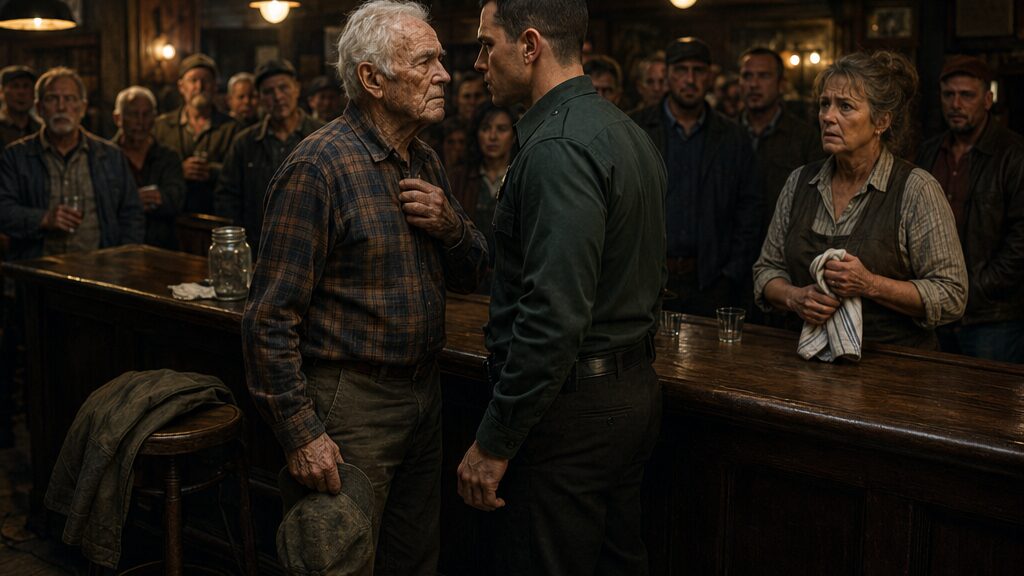
Joshua Bennett came to the tavern every Thursday at six minutes after five, never five sharp, never after the dinner crowd had taken the good stools. He walked with a measured stiffness that made young people glance once and then look away, as though age were something private and mildly embarrassing. His left hand stayed near the top button of his plaid shirt, not touching it exactly, only hovering there whenever the front door swung too hard or laughter broke too loud.
The tavern had once been called Collins Harbor Room, though nobody used the full name anymore. To most of the town it was just Mary’s. A narrow place on a side street two blocks from the river, it smelled of old varnish, fryer oil, cold beer, and the faint dampness that came from a roof nobody had fully trusted in twenty years. The bar ran along the left wall, dark wood polished smooth in the middle and scarred white along the edges where rings had settled into the grain. Above it hung yellowed photographs of fishing boats, softball teams, Christmas raffles, men in work shirts, women in diner uniforms, children who now had children of their own.
Joshua knew where every floorboard dipped.
He paused just inside the door that evening because the tavern did not sound like Thursday. Thursday was usually low conversation, the jukebox humming old country through one good speaker, Paul Reed clearing his throat over a bottle, Mary Collins calling last names instead of first ones when she was busy.
Tonight the room was packed.
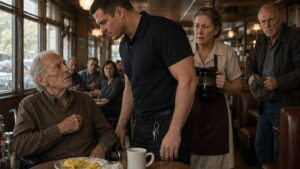
Paper streamers drooped from the ceiling beams. A folding table near the dartboard held foil trays of food, a plastic jar marked ROOF FUND, and a hand-lettered sign asking people to help keep Mary’s open another fifty years. Half the town seemed to have found a reason to come. Men in county jackets stood shoulder to shoulder with young couples and office workers. The stools were taken. People leaned two deep at the bar. The air was warmer than usual, crowded with perfume, damp wool, beer foam, and the sour bite of old wood trying to hide fresh rain.
Joshua removed his cap and held it against his chest. His fingers brushed the top button of his shirt.
No one noticed.
A young bouncer by the door gave him a quick look, the kind that measured whether a person belonged and whether they might become work. Joshua dipped his chin, not enough to invite conversation, enough to say he had entered peaceably. The bouncer looked past him.
At the far end of the bar, beneath a framed photograph of the harbor before the new condos, Joshua’s corner stool was occupied by a man in a fleece vest laughing with his elbows spread wide. A woman beside him had hung her purse from the stool’s back. Joshua stood for a moment, still holding his cap, and watched the place where his hand usually found the bar rail.
Samantha Hayes moved behind the counter with two bottles in one hand and a towel over her shoulder. She saw him on her second pass.
“Mr. Bennett,” she called over the noise, not unkindly. “Busy one tonight.”
Joshua nodded.
“We’re raising money for the back roof,” she said, though he had seen the sign. “Mary said we might actually make it if people keep drinking like this.”
“That’s good,” Joshua said.
His voice disappeared under a burst of laughter from the food table. Samantha leaned forward to hear him better, but someone at the tap waved a twenty-dollar bill, and her eyes flicked away.
“Give me a minute,” she said. “I’ll find you somewhere.”
Joshua looked again at the corner stool. The man in the fleece vest slapped the bar and shouted at a story no one had finished. The purse swung from the stool like a claim staked into the wood.
“No hurry,” Joshua said, though Samantha had already turned.
He took one step toward the repair jar. From his shirt pocket he withdrew a folded envelope. The paper had softened at the edges from being carried too long. He slid two bills through the slit in the jar lid, then paused and added the change from his palm, one coin at a time. The coins sounded small against the roar of the room.
Mary Collins appeared from the kitchen with her sleeves rolled, her gray-streaked hair pinned up too quickly. She looked flushed and pleased and terrified, all at once. When she saw Joshua, something like recognition crossed her face, followed by calculation. Every table was full. Every hand needed something. Every leak in the roof had become visible in her expression.
“Joshua,” she said. “I’m sorry. Your seat’s buried tonight.”
“That’s all right.”
“I should’ve put a sign on it,” she said, and smiled as though joking would make the omission smaller.
Joshua looked at the stool again. “No sign needed.”
Mary did not know what to do with that. She touched his sleeve briefly, then glanced toward the kitchen where someone shouted her name. “Stay a bit. I’ll get you coffee.”
“No need.”
“You sure?”
He nodded.
Mary was pulled away before he could say anything else.
Joshua stood with his cap in both hands. There were places a man could stand in a tavern without being in the way. He had known them once. Tonight every inch belonged to someone younger, louder, steadier on their feet. He moved toward the wall near the old jukebox, taking care not to bump shoulders. Twice people stepped backward into him and apologized without looking fully at his face.
Near the hallway, Tyler Carter watched the room like a man counting problems before they started. He wore his dark green deputy’s shirt even though he was off duty, the shoulder patch bright under the hanging light. Mary had asked him to help because a fundraiser meant cash, noise, and strangers. Tyler had said yes before she finished asking. He liked being useful. He liked rooms becoming calmer when he entered them.
He did not like the old man drifting near the bar with no drink in his hand.
Tyler had noticed him at the door. Thin shoulders, white hair, worn boots, cap held too carefully, shirt buttoned wrong at the top as if dressed in a room with bad light. The old man did not seem drunk, exactly. But he watched the corner stool with a fixedness Tyler had seen in men who were about to make scenes over small things. He touched his shirt too often. He moved whenever people moved around him, not away but alongside, like water finding cracks.
Tyler crossed the room after Joshua stepped near the old jukebox.
“Sir,” Tyler said.
Joshua turned. “Evening.”
“You waiting on someone?”
“No.”
“You need help finding a ride?”
Joshua looked at him carefully. Tyler’s tone had the clean edge of practiced public concern. It was not rude yet, but it was already headed somewhere.
“I walked,” Joshua said.
“From where?”
“Home.”
A server squeezed between them with a tray, and Tyler put a hand out automatically to stop the tray from clipping Joshua’s elbow. To anyone watching, it might have looked protective. To Joshua, it felt like being placed.
“It’s a private fundraiser tonight,” Tyler said. “You know Mary?”
Joshua glanced toward the bar, where Mary was laughing too hard at something a customer had said. “I know Mary.”
Tyler waited.
Joshua did not add more.
The younger man’s jaw set. “All right. Well, it’s crowded, and we can’t have people hanging around the walkway. If you’re here for the event, you need to buy something or take a seat.”
“There isn’t one.”
“I can see that.”
Joshua accepted the words without moving. He folded his cap once, then stopped himself before the brim bent.
Tyler’s eyes dropped to the movement near Joshua’s chest. The old man’s fingers had risen again, hovering over the top button of the plaid shirt, where the fabric pulled slightly uneven at the left shoulder. Tyler saw the edge of dark ink beneath the collarbone, maybe just shadow, maybe something else. The old man noticed him noticing and lowered his hand.
“You got an injury there?” Tyler asked.
“No.”
“Then why do you keep reaching for it?”
Joshua looked toward the corner stool again. The man in the fleece vest had turned now, drawn by the deputy’s voice. So had the woman with the purse. A few nearby faces shifted, eager for something besides raffle numbers and beer.
“Habit,” Joshua said.
Tyler stepped closer, lowering his voice. “I’m trying to keep this easy.”
“So am I.”
For the first time, irritation flashed across Tyler’s face. Not much. Just enough. He was a man used to answers becoming shorter when his questions became clearer. Joshua’s calm unsett
Error in message stream
Retry
When They Pulled Open The Old Veteran’s Plaid Shirt, The Bar Finally Remembered His Name
Chapter 1: The Old Man At The Corner Stool
Joshua Bennett arrived at Mary Collins’s tavern before the sun had fully left the windows.
He liked that hour best, when the glass still held a gray stripe of evening and the neon beer signs had not yet won the room. The bar smelled of old oak, fryer oil, lemon cleaner, and rain caught in people’s jackets. Every Thursday, if his knees allowed it, Joshua crossed the cracked sidewalk from the bus stop, opened the heavy front door with both hands, and paused just inside long enough for his eyes to adjust.
Tonight, he paused longer.
The room was too full.
Paper streamers hung low across the ceiling beams. A hand-lettered poster near the register read HELP SAVE COLLINS TAVERN, and beneath it stood a glass jar already fat with folded bills. Someone had pushed the small tables closer together to make room for a raffle table by the jukebox. Men in work jackets leaned shoulder to shoulder along the wall. Women held plastic cups and paper plates, talking over the old speakers. A young bouncer near the entrance looked at Joshua once and then looked past him, as if deciding he belonged to no category worth naming.
Joshua kept one hand on the door until it closed behind him. The weight of the room pressed against his chest.
He wore the same brown-and-blue plaid shirt he wore most Thursdays, the elbows thin, the collar soft from years of washing. Under his left collarbone, beneath two closed buttons, the old mark pulled at his skin the way it sometimes did when rain came in. It was not pain exactly. More like a finger laid there from another time.
He touched the place once through the cloth.
The bar had changed over the years, then changed back, then changed in ways that looked like surrender. The old brass rail was gone. The mirror behind the bottles had a crack in the lower left corner. The stool at the far end, the one nearest the post where the counter bent, was still there, though somebody had wrapped silver tape around one split in the vinyl. That stool had a wobble in it that only settled if a man placed his right boot against the rail and leaned slightly forward.
Joshua knew the lean.
He took off his cap and moved through the noise.
A man bumped his shoulder and said nothing. A woman near the raffle basket pulled her purse closer when he passed. Joshua kept his eyes lowered enough not to challenge anyone, high enough not to look lost. He had learned that line a long time ago.
Mary Collins stood behind the bar, hair pinned back, sleeves rolled, counting change with the desperate speed of someone trying to keep three conversations alive at once. Her father’s tavern had become hers when the old man’s heart quit in the storage room ten years before. Joshua remembered her as a teenager sitting on a beer crate after school, doing homework under the smell of cigarette smoke and onions. Now she had lines around her mouth and a pencil tucked behind her ear.
She saw him when he reached the end of the bar.
“Joshua,” she said, but not loudly enough for anyone else to hear. “It’s packed tonight.”
He nodded.
“Fundraiser,” she added, as if the poster had not already told him. “Trying to fix the back wall before the city gets on me again.”
Joshua reached into his shirt pocket and pulled out a small white envelope, folded once. He placed it on the bar beside the repair jar.
Mary glanced at it, then at him. “You don’t have to do that.”
He did not answer. He never had the right words when people thanked him before taking what he had offered. He slid the envelope closer to the jar with two fingers.
Mary’s face softened, then tightened again as someone called for three more beers.
“Can you maybe sit at one of the side tables tonight?” she asked. “Just for tonight. We’re trying to keep the end clear for the raffle people.”
Joshua looked toward the corner stool.
A man he did not know had leaned a folded jacket over it, though he was standing near the dartboard laughing with a red cup in his hand. The jacket lay across the seat like a claim.
Joshua set his cap on the counter and waited.
Mary followed his eyes. “I know. I know that’s where you sit.” She lowered her voice. “But there are new folks in tonight. County people. Donors. Tyler’s helping me keep things moving.”
At the mention of Tyler, Joshua noticed the younger man near the side door.
Dark green uniform shirt. County patch. Close-cropped hair. Square shoulders held a little too high. He was not in full duty gear, but he wore enough authority to make people step around him. He spoke to the young bouncer, then looked toward Joshua with the quick measuring glance of a man who liked a room sorted before it could surprise him.
Joshua had known men like that at twenty. He had known men like that at forty. He had even been a little like that once, though the thought sat poorly in him.
“I’ll stand,” Joshua said.
Mary winced as if the words had cost her more than they should have. “No, don’t stand. I just meant—”
A burst of laughter swallowed the rest. Someone bumped the repair jar and Mary caught it with one hand.
Joshua took his cap from the counter. The envelope remained beside the jar, his blocky handwriting facing down. He turned toward the stool and lifted the stranger’s jacket carefully, meaning only to move it to the bar top.
A hand closed around the jacket before he could set it down.
“Sir.” Tyler Carter’s voice cut through the nearby noise. It was not loud, but it had the shape of a command. “That isn’t yours.”
Joshua released the jacket at once.
Tyler stood close enough that Joshua could smell aftershave under the tavern air. Younger than Joshua first thought. Maybe early thirties. Tired at the eyes. Defensive before anything had happened.
“I was moving it,” Joshua said.
“Moving other people’s property?”
Joshua looked at the stool, then at Mary. She had seen them now. Her mouth parted, but a customer pulled her attention with a raised glass.
“That’s where I sit,” Joshua said.
Tyler’s eyes flicked over him: old boots, frayed cuffs, plaid shirt, cap pinched in hand, shoulders not as straight as they used to be. The look did not linger in any one place, yet it seemed to take everything and understand nothing.
“Not tonight,” Tyler said. “Private fundraiser.”
Joshua looked at the repair poster, at the jar where his envelope lay, then back at the stool. “It’s still Mary’s place.”
“It’s a crowded place,” Tyler said. “And you’re blocking the end of the bar.”
Joshua stepped back half a pace. It was not enough for Tyler. The younger man’s gaze dropped to Joshua’s hand, which had moved without permission to the upper buttons of his shirt. The old mark had tightened again beneath the cloth.
“You got something under there?” Tyler asked.
Joshua’s fingers stopped.
The noise around them did not die. It thinned. The nearest people did not turn fully, but their listening changed the air.
“No,” Joshua said.
Tyler looked unconvinced. “You keep reaching inside your shirt.”
Joshua lowered his hand. He made it rest against his thigh.
The stool stood beside them with the stranger’s jacket hanging crooked from Tyler’s fist. Joshua could see the split in the vinyl, the strip of silver tape, the place where a boot could settle against the rail. He could also see, behind the bottles and dusty glass, the lower panel of the bar where a loose piece of trim had never sat flush, not since the summer of 1972.
He had come for that. He had come for the place beneath it. He had come because Thursdays were not all the same, no matter what calendars pretended.
“Sir,” Tyler said, sharper now, “I’m asking you a question.”
Joshua looked at him. Not hard. Not soft. Just long enough.
“I heard you,” he said.
Tyler’s jaw flexed.
Behind him, Mary pushed through from the register, wiping her hands on a towel, but she was intercepted again by a man waving raffle tickets and asking where the donation sheets had gone.
Joshua took another step back, surrendering the stool, the counter, the old lean of the right boot. He could leave. He had left worse rooms than this without looking back. The body learned exits the way it learned scars.
But his envelope still sat beside the jar.
And behind the bar, hidden under varnish and dust and years of other people’s hands, a name waited where almost no one remembered to look.
Tyler moved with him, not letting him pass easily.
“Why do you keep touching your shirt?” he asked.
Joshua’s hand stayed open at his side.
The room seemed to tilt around the question.
Chapter 2: The Badge Mistook Silence For Trouble
Joshua did not answer fast enough.
That was the first thing Tyler Carter decided against him. Silence could be guilt, attitude, confusion, drunkenness, or some old man’s game for sympathy. Tyler had seen all of them. He had watched men pretend not to hear until their hands came up swinging. He had watched harmless-looking people hide knives in boot tops and pills in cigarette packs. He had learned to step early, speak firm, and let nobody make the room his problem.
The trouble was, the old man’s silence did not move like guilt.
It sat there.
It made Tyler feel as if he had stepped into a conversation already underway and said the wrong thing loudly.
“Joshua,” Mary called from behind the bar, finally breaking free of the raffle man. “It’s all right. Tyler, he’s a regular.”
Tyler did not look away from Joshua. “Regulars can answer questions.”
A few heads turned now. Not all. Just enough. The man from the dartboard came over and took his jacket from Tyler with an irritated tug.
“What’s going on?” the man asked.
“Nothing,” Mary said quickly. “Just crowded.”
Joshua’s fingers twitched toward his shirt again and stopped halfway.
Tyler saw it. “There. That.”
Joshua let his hand fall.
“Is there something under your shirt I need to know about?”
The words were wrong for a tavern. Too official. Too clean. They landed among beer glasses and paper plates like a badge laid on a church table.
Joshua’s eyes shifted once toward the door, then to the end of the bar. He did not seem afraid. That bothered Tyler too. Most men, when cornered, gave you anger or apology. This one gave him an old tired patience that felt almost like pity.
“I’m not carrying anything,” Joshua said.
“Then why reach?”
No answer.
The young bouncer drifted closer. Samantha Hayes, working the taps beside Mary, slowed with a glass half-filled beneath the foam. Paul Reed, hunched at the far table with a glass of soda he nursed like whiskey, raised his head.
Tyler lowered his voice. “Sir, you’ve been told the end of the bar is being kept clear. You picked up someone’s jacket. You won’t answer a simple question. And you keep reaching into your shirt.”
“It isn’t your bar,” Joshua said.
The words were quiet, but they changed Tyler’s face.
“No,” Tyler said. “Tonight it’s Mary’s bar, and she asked me to help keep it under control.”
Mary’s lips tightened at the word control, but she said nothing.
Joshua looked at her then. Not pleading. Just looking. That was worse. Mary looked away first.
Tyler reached for Joshua’s arm. He meant to guide him aside, to move him away from the bar, to end the little circle of watching faces before it became something he could not manage. His fingers closed around the old man’s sleeve near the elbow.
Joshua’s body went still.
Not stiff with resistance. Still like a door that had been shut from the other side.
“Don’t,” Joshua said.
“One step over here.”
“Don’t pull me.”
The room heard that.
Tyler heard it too, but he also heard a couple of men by the raffle table muttering, one of them saying, “Somebody’s got to deal with him,” and that pushed him forward. He had a way of obeying pressure while thinking he was giving orders.
Joshua shifted back. The old plaid shirt caught under Tyler’s thumb. A button strained, then popped loose with a small dry sound that somehow reached farther than the jukebox.
The left side of Joshua’s shirt opened.
The room lost its casual noise.
Under the soft cotton undershirt, near the upper chest where the skin had thinned with age, a faded dark marking curved over a pale burn scar. It was not easy to read at first. Ink had blurred with time. Scar tissue had pulled one edge of it out of shape. There were two letters, maybe three, and the suggestion of a small anchor or wave beneath them.
Tyler stared at it.
Then, because he already felt the room watching and because pride often reaches for the nearest weapon, he pointed.
“What is that?” he demanded.
Joshua looked down at Tyler’s finger.
The old man did not cover himself. He did not snatch the shirt closed. He did not slap the hand away. He simply stood with the torn button hanging by one thread and the marking exposed under yellow tavern light.
Samantha’s glass overflowed at the tap and spilled beer across her hand.
Mary whispered, “Tyler.”
But Tyler kept his finger there, inches from Joshua’s skin. “You got some kind of club mark? Prison ink? You come in here trying to scare people?”
A woman near the raffle table sucked in a breath. Someone said, “Come on, man,” under his breath, but not loud enough to count as courage.
Joshua’s gaze moved over the faces. The dartboard man, suddenly interested in the floor. The bouncer, young and unsure. Samantha, pale around the mouth. Mary, one hand gripping the towel. Paul Reed, standing now with one palm on the table, as if the weight of getting up had taken more than his legs.
For a moment Joshua was not in Mary Collins’s tavern.
He was twenty-two years old, coughing smoke in a passageway too narrow for two men to pass without turning sideways. He was holding another man’s wrist. The wrist was slick. Someone was shouting over metal. Someone was praying. A light swung overhead, making the world flash white, dark, white, dark. He smelled oil, salt, burned paint.
Then the tavern returned.
Tyler’s finger was still raised.
Joshua lifted his own hand slowly, not to strike, not to cover the mark, but to take hold of the torn edge of his shirt. His fingers were bent from years of work and weather. He held the cloth closed enough to keep the room from seeing more.
“That mark,” he said, “is older than your badge.”
No one moved.
The sentence did not come out as a challenge. It came out as a fact that had sat quietly for years and had finally been placed on the counter.
Tyler’s face changed before he could stop it. Not into apology. Not yet. Into uncertainty, which he hated more than anger. His finger lowered by an inch.
“What’s that supposed to mean?” he asked.
Joshua looked at the county patch on Tyler’s shirt. “Means you ought to be careful what you pull open.”
Mary stepped from behind the bar, but the space was too narrow and too full. “Joshua, I’m sorry. Tyler, step back.”
Tyler heard her, but he could feel the eyes on him. If he stepped back now, it would look like losing. If he pressed on, it would look like strength. Men had built whole bad lives on choices that simple.
“Sir,” Tyler said, forcing the word into shape, “I need you to come outside.”
Joshua’s face did not move. “No.”
The room tightened.
“You refusing?”
“I came to sit,” Joshua said.
“At a fundraiser you weren’t invited to disrupt.”
Mary flinched.
Joshua looked at her again. Something in his face asked whether that was what she believed too.
Mary opened her mouth, but the words did not arrive.
Paul Reed took one step forward. “Tyler.”
The younger man snapped his head toward him. “Stay out of it.”
Paul stopped. His hand trembled against the back of a chair.
Joshua pulled his shirt closed with one hand, but the missing button left a gap. The tattoo remained partly visible, broken by the edge of cotton. He reached into his pocket and took out his cap.
“I’ll leave,” he said.
Mary shook her head. “Joshua—”
He placed the cap on his head with care. Then he took the white envelope from beside the repair jar before anyone could stop him. For a second Mary’s eyes dropped to it, and shame crossed her face so quickly it might have been missed by anyone who had not spent years learning how people hid pain.
Joshua turned toward the door.
Tyler did not block him this time. He stepped aside, but only just. Their shoulders nearly brushed. Joshua passed without looking at him.
The tavern door opened. Rain smell came in.
At the threshold, Joshua paused and looked back once, not at Tyler, not at Mary, but toward the lower panel behind the bar where the loose trim waited in shadow.
Then he left.
The door closed slowly behind him, and the tavern remained quiet long after the latch clicked.
Chapter 3: The Name Hidden Behind The Bar
After midnight, Mary Collins found the torn button under the bar rail.
It was smaller than she expected. A dull brown thing with a chip on one edge, lying near the rubber mat where spilled beer dried sticky under the smell of bleach. She held it between her thumb and forefinger and stood very still while the last dishwasher hummed in the kitchen.
The fundraiser had made more money than she hoped and less than she needed. The repair jar sat on the back counter, full of other people’s crumpled generosity. Joshua’s envelope was not in it. She had watched him take it back. That, more than Tyler’s raised voice, more than the silence that followed, had stayed with her all night.
He had never taken anything back before.
Mary set the button beside the register.
Samantha had gone home without saying much. Tyler had left earlier, jaw set, after telling Mary he was only trying to help. She had nodded because she was tired and because part of her had wanted the sentence to be true. Now the tavern was empty except for Mary and the sounds old buildings made when they no longer had people to perform for.
A pipe ticked behind the wall. The neon sign buzzed faintly. Rain touched the front window in soft, uneven taps.
Mary walked to the far end of the bar.
Joshua’s stool stood slightly crooked, pushed aside during cleanup. The man from the dartboard had forgotten his jacket after all; it hung over a chair near the back, unclaimed and meaningless. Mary lifted Joshua’s stool and set it upright in its usual place. It wobbled until she turned it a quarter inch. Then it settled.
She frowned.
She had seen Joshua do that a hundred times. Right boot on the rail, slight lean, one hand near the top of his shirt. She had thought of it as habit, the kind old men gathered like lint. Sit here. Drink that. Count change twice. Say little. Leave before the loud songs started.
Her father had never treated Joshua like a habit.
Mary remembered that now.
When she was fifteen, her father would sometimes stop her from clearing the end of the bar before closing. “Leave that be,” he would say if Joshua had not yet come in. “Man’s got his place.” She had rolled her eyes then. Everyone had a place if they came often enough and paid enough. She had not understood the difference between a favorite seat and a kept one.
Mary crouched behind the bar and looked at the lower trim panel near the bend in the counter.
It had always been loose. Her father had cursed it, kicked it, promised to fix it, then never had. During the inspection last month, the city clerk had tapped it with a pen and written something on a clipboard. Mary had meant to glue it before tonight but forgot under the weight of twenty other emergencies.
Now one end of the strip sat lifted from the wood by the width of a fingernail.
Mary tugged lightly. The trim shifted.
Old dust fell onto her wrist.
“Great,” she muttered.
She went to the storage room for a flat screwdriver and came back with her phone flashlight between her teeth. The first nail gave with a soft groan. The second held harder. She worked carefully, more from fatigue than patience, until the strip came free enough to reveal the darker wood beneath.
At first she saw only scratches.
Then the light caught them.
Not random gouges. Letters.
Mary drew closer, knees pressing into the rubber mat.
A name had been carved into the hidden face of the bar, deep enough to survive varnish, smoke, years, and neglect. The first name was worn at the edge, but the letters were still there.
PAUL—
No. Not Paul. The last letter was different, cut at an angle. She moved the flashlight.
P. REED? No.
Beneath it was a date. 1972.
And below that, smaller, almost hidden under a smear of old glue, three initials that made Mary’s throat close though she did not know why.
J.B.
Joshua Bennett.
The screwdriver slipped from her hand and clattered against the floor.
She stood too fast, bumped her shoulder on the bar edge, and turned toward the empty room as if someone had called her name.
No one had.
The front window held only her reflection: tired woman, hair coming loose, shirt stained at the cuff, a brown button on the register behind her like evidence.
The back door opened with a scrape.
Mary startled.
Paul Reed stood in the kitchen entrance wearing his old gray jacket, his cap in both hands. He looked smaller without the crowd around him. Older too. His eyes moved from Mary to the loosened trim, then to the exposed carving.
“I forgot my glasses,” he said, though he was not looking for them.
Mary did not ask how he had come through the alley door. Paul had known the tavern long enough to know which lock had never sat right.
“What is this?” she asked.
Paul’s mouth tightened.
“Paul,” she said, “what is this?”
He came closer slowly, as though approaching a sleeping animal. When he reached the end of the bar, he set his hand on Joshua’s stool. The stool wobbled once and settled under his palm.
“I wondered when that would show again,” he said.
Mary looked back at the carving. “You knew?”
“Not all of it.”
“But you knew there was a name.”
Paul nodded.
“And you never told me?”
His eyes stayed on the dark strip of wood. “Wasn’t mine to tell.”
Mary laughed once, without humor. “That seems to be going around.”
Paul took the rebuke quietly.
Rain ticked harder at the window. Somewhere in the kitchen, the last dishwasher cycle ended with a sigh.
Mary crouched again and angled the flashlight. “I can’t read the first part.”
Paul leaned, squinting. His hand trembled, but his voice, when it came, was steady.
“Not a first name,” he said. “Ship name. Or what was left of one. Your daddy carved it after Joshua came back the first time.”
Mary looked at him. “Came back from where?”
Paul’s eyes flicked to the place where Joshua had stood while Tyler pulled his shirt open.
“A fire,” he said.
The word changed the room.
Mary thought of the mark on Joshua’s chest, not as a tattoo now, not as some strange old ink, but as something that had survived heat. She saw again the way his body had gone still under Tyler’s hand. Not weakness. Not confusion. Memory.
Paul rubbed his thumb over the top of the stool. “There was another boy. Not from here, but he spent his last leave in this bar. Sat right there. Talked too much. Sang worse than he talked.” A faint smile tried to form and failed. “Joshua came back alone.”
Mary swallowed. “Why didn’t Dad tell me?”
“Maybe Joshua asked him not to. Maybe your dad thought silence was kindness. Men did that back then.” Paul’s gaze settled on the carved initials. “Some of us still do.”
Mary stood and wiped her hands on her jeans though they were not dirty.
“He was humiliated in my bar,” she said.
Paul did not answer.
“I watched it happen.”
“You froze,” Paul said.
It was not cruel. That made it harder to hear.
Mary picked up the loose trim strip and held it against the bar, covering the name again. For a moment the wood looked as it always had: old, flawed, ordinary. Then she lowered the strip.
“Who was he?” she asked.
Paul looked at the door Joshua had left through.
“I only know what Joshua let slip,” he said. “And that wasn’t much.”
Mary turned off the phone flashlight. The carved letters disappeared into shadow, but now that she had seen them, the dark seemed thinner there.
On the counter, the repair jar waited. Beside the register, the torn button lay where she had left it.
Paul reached into his coat pocket and pulled out a folded white envelope.
Mary knew it before he placed it down.
“I found it outside,” he said. “Under the awning. Maybe he dropped it. Maybe he changed his mind.”
Mary stared at Joshua’s handwriting on the front.
For Collins repair.
Nothing else.
No demand. No explanation. No accusation.
Paul slid the envelope toward her, but Mary did not touch it.
On the back flap, where rain had dampened the paper and softened the glue, three small letters had bled slightly in blue ink.
The same letters as the tattoo Tyler had pointed at.
Mary sat down on Joshua’s stool because her legs would not hold her.
The stool wobbled, then settled.
Chapter 4: What Paul Reed Remembered Too Late
Paul Reed had spent most of his life believing there were two kinds of silence.
There was the kind a man chose because words would only make him smaller, and there was the kind other people chose because speaking would cost them comfort. For years, he had told himself he belonged to the first kind. After watching Joshua Bennett walk out of the tavern with his shirt torn and his face closed against the room, Paul was no longer sure.
He came back the next morning before Mary unlocked the front door.
The alley behind Collins Tavern smelled of rainwater, wet cardboard, and the sour metal of old beer kegs. Paul used the side door because his knees did not care for the front step anymore and because he had known for thirty years that the latch could be lifted if a man pressed his thumb just right. He found Mary already inside, standing behind the bar with the loose trim laid on a towel and Joshua’s envelope beside it.
She looked as if she had not slept.
“You said it was a fire,” she said.
Paul removed his cap and held it against his stomach. “I said that much.”
“Then say more.”
He glanced at the stools turned upside down on the tables, the swept floor, the repair jar locked in the back cabinet. The tavern in daylight seemed smaller, stripped of its borrowed courage. Without the crowd, without the music, the place showed its age: cracked vinyl seats, chipped bar edge, water stain spreading like a bruise above the jukebox.
“I don’t know the whole of it,” Paul said.
“You know enough to have said something last night.”
He accepted that. It was true, and true things did not become less heavy because a man lowered his eyes.
Mary pushed the envelope toward him. “These letters. Same as his tattoo.”
Paul looked at the damp blue ink on the back flap. Three initials. Not a man’s initials. Not exactly. A piece of a ship’s name, shortened the way young sailors shortened everything. He had heard Joshua say it once, forty years ago, when Joshua was drunk enough to forget he did not drink much.
“He was Navy,” Paul said.
Mary folded her arms. “Joshua?”
Paul nodded.
“He never told me that.”
“He wouldn’t.”
Mary waited.
Paul moved to Joshua’s stool and rested one hand on it. He did not sit. Sitting there felt wrong now, like stepping over a grave marker. The stool gave one small wobble under his palm, then stilled.
“Your father knew,” Paul said. “Not everything. Enough.”
“My father knew everyone’s business.”
“No. Your father knew everyone’s stories. Different thing.”
Mary’s face tightened, but she did not argue.
Paul looked toward the hidden carving behind the bar. In the daylight the letters seemed less mysterious and more wounded, rough cuts made by a hand that had pressed too hard. “The first time I heard any of it, Joshua was standing right there. Must have been early seventies. Your daddy was still running nights, and I was fixing the ice machine because I was young enough to believe I could fix anything. Joshua came in with a shirt buttoned to the throat in July. Wouldn’t sit. Wouldn’t drink. He asked your father if anyone had come through town looking for a sailor.”
Mary’s arms loosened.
“Who?”
Paul rubbed his thumb along the stool’s torn vinyl. “A boy from somewhere west. I don’t remember his full name. Reed, maybe. Maybe that was only what they called him. He’d spent leave here because he knew somebody who knew your father. Sat at this end of the bar for three nights and talked like the world was waiting on him to finish a sentence.”
“Paul Reed?” Mary asked, looking at him sharply.
He shook his head. “No relation that I know of. Same last name maybe, or maybe my memory did what old memories do and stole something close by. I only remember Joshua saying the boy was loud. Happy loud. The kind that fills a room because he’s afraid of empty space.”
Mary looked down at the carved letters. “And the fire?”
Paul’s hand tightened around his cap.
“I was not there,” he said. “I won’t pretend a thing I didn’t carry. What I know came in pieces. A shipboard fire. Smoke in a passageway. Men trapped where the heat came fast. Joshua and two others went in after them. One came out wrong. One didn’t come out at all. Joshua did.”
The tavern seemed to take that in through the old wood.
Mary sat slowly on the stool beside Joshua’s, not on his. Her voice lowered. “The tattoo.”
“Group mark, I think. Young men make marks when they believe they’ll stay young enough to explain them. Then life leaves the mark and takes the explanation.”
“He told you that?”
“No.” Paul’s mouth moved in something like a smile, but it did not last. “That part I figured.”
Mary turned the envelope over again. “Why come here every Thursday?”
Paul looked toward the boarded section of the back wall where the city had marked moisture damage with a strip of yellow tape. “Maybe because the boy sat here on a Thursday. Maybe because Joshua promised something. Maybe because your father let him keep the promise without asking too much.”
“Dad carved the name?”
“I think Joshua did. Your father covered it. Not to hide it cruelly. To protect it maybe. To keep drunks from making jokes. To keep young people from carving over it.” Paul swallowed. “To keep us from having to know what we were looking at.”
Mary stared at the trim strip on the towel. “That sounds like hiding.”
“It was.”
The admission settled between them.
Mary reached for the little brown button beside the register. She turned it over in her palm as if it might hold more than plastic and thread. “Tyler thought he was helping.”
Paul looked at her.
“I know,” she said, her voice rough. “I know that doesn’t fix anything.”
“No.”
“He’s under pressure. His supervisor was here. Half the county donors were here. He’s been trying to get moved into a better position, and he thinks every room is a test.”
Paul’s gaze stayed on the stool. “Then he failed one.”
Mary closed her hand around the button.
Outside, a truck passed slowly, tires hissing on wet pavement. The tavern windows trembled faintly.
“Did Joshua ever tell you why he doesn’t correct people?” Mary asked.
Paul thought of Joshua at twenty-something, though he had never known him then. He thought of the man he had known instead: quiet, exact with money, slow to anger, impossible to flatter. The kind of man who left before birthday songs and never sat with his back fully to the door.
“Maybe correcting people means opening a door he spends the rest of his life holding shut,” Paul said.
Mary leaned forward, elbows on her knees. “Then what am I supposed to do?”
“That depends.”
“On what?”
“On whether you want to feel better, or whether you want to do right.”
She looked up at him.
He wished he had not said it. He wished someone else had earned the right. But the words had come, and once out, they belonged to the room.
Mary stood and walked to the exposed carving. She touched the old letters lightly. “If I ask Joshua, he’ll walk away.”
“Maybe.”
“If I don’t ask, I’m still the person who let it happen.”
Paul had no comfort to offer. Comfort, he had learned too late, was often the cousin of cowardice.
Mary picked up the envelope, slid her thumb under the unsealed flap, then stopped. She did not open it. Instead she held it against her chest for one breath and set it back down.
“It’s his,” she said.
Paul nodded.
The front window brightened as the morning clouds shifted. Dust showed in the light, floating above the bar where so many hands had reached, paid, spilled, begged, celebrated, and failed one another.
Paul put his cap on.
“Where are you going?” Mary asked.
“To see if he’s home.”
“You know where he lives?”
“I know the building. Not the apartment.” He hesitated. “I followed him once.”
Mary’s brows drew together.
“Years ago,” Paul said. “He left here looking bad. Not drunk. Just bad. I wanted to make sure he got in somewhere warm. I never knocked.”
Mary held up the button. “Take this?”
Paul looked at it, then shook his head. “Not from me.”
“Why not?”
“Because I had my chance last night.”
Mary’s mouth tightened again, but this time there was no anger in it.
Paul walked toward the alley door. At the threshold, he turned back. The tavern looked different with the trim removed. Not repaired. Not ruined. Opened.
“Mary,” he said.
She looked at him.
“If you uncover that name, don’t make it a show.”
“I wasn’t planning to.”
“People plan less than they excuse.”
The words hurt her. He saw that. He also saw she kept standing.
Outside, the alley air was cold enough to make his fingers ache. Paul stepped into it slowly, one hand against the brick, and began the short walk toward the bus route he knew Joshua used. He had no speech prepared. He had no right to one.
In his coat pocket, his fingers found the folded receipt he had taken from the repair jar without thinking. It was not money. It was the small slip from the envelope Joshua had used, softened by rain, bearing only the tavern address and those three blue letters.
Paul had not meant to keep it.
But he carried it now like a debt.
Chapter 5: Tyler Carter Heard The Room Go Quiet
Tyler Carter spent the morning writing the incident in his head so it would come out clean if anyone asked.
Elderly male. Agitated. Interfered with property. Repeatedly reached inside shirt. Refused verbal direction. Minimal contact used to maintain safety.
The words were useful because they left things out.
They left out the sound of the button hitting the floor. They left out the old man’s chest under the tavern light, the faded mark dragged thin by age and scar. They left out how still Joshua Bennett had become when Tyler touched his sleeve. They left out Mary’s voice saying his name in a way that made him feel twelve years old and caught with something broken in his hand.
At the sheriff’s substation, Tyler sat at a metal desk under a humming light and tried to finish a stack of parking complaints. The room smelled of burnt coffee and printer toner. On the wall across from him, a framed poster about community trust hung slightly crooked.
He had straightened it twice that week.
Now he hated it.
His phone buzzed. A message from Samantha.
You need to talk to Mary.
He locked the screen.
A minute later it buzzed again.
And you need to stop telling yourself he made you do that.
Tyler turned the phone facedown.
He was not a cruel man. He held that thought with the stubbornness of a drowning man holding driftwood. He helped stranded drivers. He checked on widows when storms knocked power out. He once spent half a shift coaxing a frightened child from under a motel bed while the child’s mother cried in the hallway. Cruel men did not do those things.
But the memory of Joshua’s shirt opening would not obey the categories Tyler made for himself.
He picked up his pen, set it down, and looked at the poster again.
Community trust.
His father’s voice came to him so clearly he almost looked toward the door.
A badge makes people move. It doesn’t make them respect you.
His father had not worn a badge. He had driven a county road truck for thirty-one years, plowed snow through nights when his hands cracked from cold, and came home smelling of diesel and wet canvas. He distrusted uniforms because he trusted work. When Tyler joined the sheriff’s department, his father had hugged him hard, then held him at arm’s length and said, “Don’t confuse being obeyed with being right.”
Tyler had laughed then. “You got that from a movie?”
His father had not smiled. “I got that from watching men.”
Now Tyler stared at his own hands on the desk. Broad hands. Clean nails. A small nick on one knuckle from hauling raffle tables at Mary’s place. Hands that had pulled an old man’s shirt open.
“Carter.”
He looked up.
The desk sergeant stood near the copier with a folder under one arm. “You all right?”
“Fine.”
“You look like you’re trying to arrest that pen.”
Tyler loosened his grip.
The desk sergeant nodded toward the front. “Take lunch. You’ve been staring at the same complaint for twenty minutes.”
Tyler wanted to say he had work. Instead he stood because being told to take lunch felt easier than deciding anything himself.
Outside, the air had warmed but the sidewalks still held dark patches from the rain. Tyler drove without planning to and found himself passing Collins Tavern. The front windows were dark. A hand-painted CLOSED UNTIL FOUR sign hung in the door. Through the glass he could see chairs up on tables and Mary’s shape moving near the far end of the bar.
He did not stop.
He circled the block.
Then he parked badly by the curb and sat with the engine running until a delivery driver behind him leaned on the horn.
Tyler killed the engine and got out.
The bell over the tavern door gave a dull clank when he stepped inside. Mary looked up from behind the bar. She had a screwdriver in one hand and dust on her cheek.
“We’re closed,” she said.
“I know.”
She waited.
Tyler noticed the loose trim panel on the bar, the exposed darker wood beneath it, the towel laid out like a surgical cloth. He also noticed Joshua’s stool set apart from the others, upright, not stacked.
“What are you doing?” he asked.
“Trying to understand my own bar.”
He did not know what to do with that. “Samantha said I should talk to you.”
“Samantha says true things when people least want them.”
Tyler nodded once, though it felt like agreeing to be cut.
He moved closer, but Mary’s eyes sharpened.
“Don’t stand there.”
He stopped.
“That’s where he stood,” she said.
Tyler looked down at the floorboards. For a moment he saw Joshua’s boots there, old leather darkened at the seams, one toe scuffed white. He stepped aside.
Mary set the screwdriver down. “Why did you ask about his shirt?”
Tyler exhaled through his nose. “He kept reaching.”
“He’s seventy-four.”
“That doesn’t mean anything by itself.”
“No,” she said. “It doesn’t.”
The fairness of that made it harder.
“I didn’t know him,” Tyler said.
“You knew he was old. You knew he was smaller than you. You knew he wasn’t swinging at anyone.”
“He picked up a customer’s jacket.”
“He was moving it off his stool.”
“It wasn’t his stool.”
Mary’s face changed.
Tyler realized too late that he had found the wrong hill and climbed it alone.
She turned, lifted the loose trim carefully, and exposed the carved letters. “Maybe it was.”
Tyler frowned. “What is that?”
“I’m still learning.”
He stepped closer despite himself. The carving was rough, old, and half-hidden by glue marks. A date. Initials. A name or part of one he could not read.
“What does it have to do with Bennett?”
Mary looked at him. “Enough that my father covered it and let him sit there for decades.”
Tyler’s mouth went dry.
Mary reached behind the register and brought out the brown button. She placed it on the counter between them.
“You left this on my floor,” she said.
He looked at the button, and the incident report in his head fell apart.
“I didn’t mean to tear his shirt.”
“No. You meant to move him.”
There was no raised voice. No accusation dressed up for effect. Just the thing itself, placed where he could see it.
Tyler touched the edge of the counter, then pulled his hand back. “I thought he was hiding something.”
“He was.”
The answer startled him.
Mary’s eyes stayed on the button. “Just not what you thought.”
Before Tyler could answer, the kitchen door swung open and Samantha came in carrying a crate of clean glasses. She stopped when she saw him.
“I’m not here to fight,” Tyler said.
“Nobody asked you to,” Samantha replied.
Mary gave her a look, but Samantha set the crate down and came to the bar.
“You remember how I told you he only comes every Thursday?” she asked Tyler.
“I remember you texting me like I kicked a church door in.”
“You kind of did.”
“Samantha.”
She ignored Mary’s warning. “He comes every Thursday, but Mary checked the old ledgers. Her dad used to mark house tabs with initials. Joshua paid for two coffees every Thursday for years. Two. Even after he only drank one.”
Tyler looked toward the stool.
Two coffees. One man.
The room seemed to dim though the daylight had not changed.
Samantha’s voice softened, which was worse than when she was sharp. “And the date carved behind the bar? Same day he started coming.”
Tyler swallowed. He wanted details, because details could become a defense or a path. But he also feared them. “Was he military?”
Mary and Samantha exchanged a look.
“We think Navy,” Mary said.
Tyler closed his eyes briefly. The tattoo. The scar. That mark is older than your badge.
He opened them again. “Why didn’t he just say that?”
Samantha looked at him as if he had asked why a wound did not introduce itself politely before hurting.
Mary picked up the button and held it out.
Tyler did not take it.
“What am I supposed to do with that?” he asked.
“Nothing yet,” Mary said. “It isn’t yours to fix just because you feel bad.”
That stung. He nodded once.
The front door opened before anyone spoke again. Paul Reed stepped in from the sidewalk, breathing a little harder than usual from the walk. His eyes moved from Tyler to Mary to Samantha, then to the exposed carving.
“Did you find him?” Mary asked.
Paul shook his head. “Building manager says he went out early. Took the bus toward the river.”
Tyler frowned. “Why the river?”
Paul took off his cap slowly. “There’s a county veterans’ service office down that way. And the old naval memorial past it.”
Mary’s face tightened. “He went alone?”
Paul looked at Tyler then, not angrily, not gently.
“He’s had practice,” Paul said.
The words landed clean.
Tyler reached for the button at last, but Mary closed her fingers around it before he touched it.
“Not yet,” she said.
This time Tyler did not argue.
Chapter 6: The Shirt Samantha Could Not Throw Away
Samantha Hayes found the shirt in a brown paper bag beneath the sink.
At first she thought it was one of the bar towels Mary kept threatening to throw out and never did. The bag had been shoved behind a box of dishwasher tablets, damp at one corner, its top folded twice. Samantha pulled it free while looking for degreaser and saw the plaid through a tear in the paper.
She knew it before she touched it.
The fabric was brown and blue, soft with age, the shoulder seam pulled crooked where Tyler’s thumb had caught it. One button was missing near the top. Another hung loose, swinging from a tired thread. The collar held the faint smell of rain, old soap, and something cleanly medicinal, like the inside of a cabinet where a man kept only what he needed.
Samantha sat back on her heels.
The tavern was still closed, though afternoon light had begun to press against the blinds. Mary had gone to the county office to ask what public records could say without betraying what Joshua had chosen not to. Tyler had returned to work, quieter than when he came in. Paul had settled at a back table with a coffee gone cold and his cap in front of him, staring at the repaired section of wall as though the plaster might confess first.
Nobody had mentioned the shirt.
Samantha carried the bag to the bar and laid the plaid out carefully on the polished wood.
The torn place looked smaller in daylight than it had felt in the room. That embarrassed her. Damage often did. It waited until the noise ended and then pretended it had never been large enough to stop anyone.
She touched the missing buttonhole.
Her grandmother had taught her to sew when she was nine, not because Samantha was patient, but because she was not. “A person should know how to repair what impatience tears,” her grandmother used to say, usually while Samantha rolled her eyes. Now Samantha heard the sentence so sharply she almost looked over her shoulder.
Paul noticed the shirt and stood.
“Where’d you get that?”
“Under the sink.”
He came close but stopped before touching it. “Mary put it there?”
“I guess. Maybe Joshua left it. Maybe somebody picked it up after he walked out.”
Paul’s face tightened. “He walked out wearing it.”
Samantha looked down.
She remembered now. Joshua had held the shirt closed with one hand, cap in the other, then put the cap on before leaving. The shirt had still been on his body. So how had it ended under the sink?
She lifted the bag. There was a folded piece of paper at the bottom, not writing paper, just a receipt from the tavern register. On the back, in Mary’s rushed hand, were three words.
Found outside restroom.
Samantha’s throat pinched.
“He must have taken it off before he left?” she said.
Paul shook his head. “He left through the front.”
“Then maybe he came back.”
The tavern seemed to hear her.
Paul looked toward the back hallway, where the restrooms and storage closet waited in shadow. “After closing?”
“Or before anyone noticed.”
The thought settled between them: Joshua returning unseen, removing the shirt that had been pulled open, leaving it where no one would have to hand it back to him.
Samantha slid her fingers under the collar and turned the shirt over. Inside, along the seam, small repairs ran in neat uneven stitches. Not professional. Careful. A cuff patched from the inside. A side seam reinforced with thread a shade too dark. This was not a shirt a man wore because he had nothing else. It was a shirt he had kept alive.
Paul lowered himself onto the nearest stool with a soft grunt.
“My wife used to mend like that,” he said.
Samantha looked at him.
“Not pretty,” he added. “But meant.”
She found a sewing kit in Mary’s office, a plastic box with loose needles, black thread, white thread, safety pins, and three buttons that matched nothing in the world. The brown button from Joshua’s shirt still sat in Mary’s drawer where she had put it after refusing to give it to Tyler.
Samantha took it out and held it in her palm.
One side was chipped.
She could replace it with a better one. There were spare buttons in the kit, newer and stronger. But the shirt did not ask to be made new. It asked to be returned as itself.
She threaded a needle behind the bar, squinting under the hanging light. Paul watched without speaking. The jukebox was off. The refrigerator kicked on and hummed. Outside, traffic moved with the soft rush of tires over drying pavement.
The first stitch went badly. Samantha pulled it out and started again.
By the third, her hands remembered.
She sewed the button where it belonged, then reinforced the loose one beneath it. The torn shoulder seam took longer. She had to turn the shirt inside out and follow the old stitch line, working the needle through cloth made thin by years. Once, near the tear, her finger brushed a darker place in the fabric where the chest would sit.
Not a stain exactly. More a shadow worn into cloth by the repeated pressure of a hand touching there.
She stopped sewing.
Paul saw. “What?”
“Nothing.”
But it was not nothing. She had seen Joshua make that gesture. Everyone had. Tyler had mistaken it for hiding. She had mistaken it for habit. Now, inside the shirt, the cloth itself proved the motion had existed longer than any of them had bothered to wonder.
She finished the seam and folded the shirt along its old creases.
“What are you going to do?” Paul asked.
“Return it.”
“He may not take it.”
“I know.”
“He may not answer the door.”
“I know that too.”
Samantha put the shirt back into the bag, then changed her mind and took it out again. A paper bag made it look like leftovers or lost property. She found a clean white towel from the stack behind the bar and wrapped the shirt in that instead.
Paul studied her. “You’re doing this because of Tyler?”
Samantha’s mouth tightened. “I’m doing it because I watched.”
“Watching isn’t the same as pulling.”
“No,” she said. “It’s just easier to live with until it isn’t.”
Paul looked down at his hands.
The front door rattled.
Samantha turned. Through the glass, Joshua Bennett stood beneath the small awning, one hand on the doorframe, his cap low against the afternoon light. He wore a plain gray work shirt buttoned all the way to the throat. Without the plaid, he looked both more formal and more exposed.
For a moment no one moved.
Then Samantha picked up the wrapped shirt and walked to the door.
She unlocked it, but she did not open it wide. She let Joshua decide whether to step in.
“We’re closed,” she said, then hated herself for saying the first foolish thing that came to mind.
Joshua’s eyes moved past her to the bar, to Paul, to the exposed trim, to the stool waiting at the end. His face did not change, but something in his shoulders did.
“I know,” he said.
Samantha held out the towel-wrapped shirt with both hands.
“I found this.”
Joshua looked at it. He did not reach.
“I sewed the button back,” she said. “Same one. The chipped one.”
His eyes flicked to her face.
“I didn’t replace it,” she added. “I thought maybe it mattered.”
Behind her, Paul slowly stood. The stool scraped faintly.
Joshua heard it. His gaze shifted.
The exposed carving behind the bar waited in the dimness like a word half-spoken.
Samantha lowered the shirt slightly. “I’m sorry I didn’t say anything when he pulled it.”
Joshua’s hand remained on the doorframe. The fingers were weathered, nails clean, knuckles swollen.
“I’m not the one you were afraid of,” he said.
The sentence was not harsh. That made it harder to hold.
Samantha nodded because there was no useful defense.
Joshua looked once more at the wrapped shirt. This time, he took it.
His hands closed around the towel as if it contained something breakable. He did not thank her. She was grateful for that. Thanks would have made the moment too easy.
Mary’s car pulled up outside then, tires crunching near the curb. She got out quickly, carrying a folder against her chest, and stopped when she saw Joshua at the door.
The four of them stood in a line of unfinished things: Samantha with the key in her hand, Paul near the stool, Mary on the sidewalk with the folder, Joshua holding his mended shirt.
Joshua looked at the folder first.
Then at the uncovered place behind the bar.
“Who moved the trim?” he asked.
No one answered fast enough.
His fingers tightened once around the shirt.
Then he stepped inside.
Chapter 7: Joshua Bennett Opened Only One Door
Joshua stepped into the tavern as if entering a room where someone had been speaking about him before he arrived.
No one moved toward him.
That was wise, though none of them looked certain who had made the wisdom. Samantha stood by the door with the key in her hand. Mary remained halfway between the sidewalk and the bar, folder clutched against her chest. Paul stood near the corner stool, one hand resting on its back but not quite holding it. The air smelled of sawdust, cold coffee, and the faint sharpness of fresh glue from the wall repair.
Joshua looked smaller in the plain gray shirt.
Or maybe the plaid had made him look familiar enough that they had mistaken familiarity for knowing him.
He carried the mended shirt against his forearm. Samantha’s stitches were visible if a person looked closely: neat, not perfect, pulled a little tight at the shoulder. He had noticed the missing button first, then noticed that she had used the chipped one. That had stopped him longer than the repair itself.
A man could be insulted by replacement.
He could be touched by repair.
His eyes went to the exposed strip behind the bar. The trim lay on a towel. The old carved letters stood in the open, no longer protected by dust and varnish. Joshua had thought of that hidden place so often that seeing it uncovered felt less like discovery than indecency.
“Who moved it?” he asked again.
Mary came in from the sidewalk and let the door close behind her. “I did.”
Joshua nodded once.
Not forgiveness. Not anger. A receipt of fact.
Mary held the folder tighter. “The city inspector marked it. I was going to fix the trim. After last night, I looked closer.”
Joshua’s gaze did not leave the carving. “Some things don’t improve from looking.”
“No,” Mary said quietly. “Some things don’t improve from hiding either.”
Paul shifted, uncomfortable with the honesty in the room. Samantha lowered her eyes. Joshua stepped past them and walked to the bar, not to his stool but to the place behind it. His movement was slow enough to show age, steady enough to reject pity.
The carved letters were crude. Time had not softened the force that made them. The first line was partly ruined by glue and an old nail hole. The date remained. The three initials beneath it remained. He did not touch them.
Mary placed the folder on the bar. “I went to the county veterans’ office. They couldn’t tell me much. Privacy rules. Old records. But they helped me confirm the ship initials. They said there was a fire in 1972.”
Joshua looked at the folder.
He did not open it.
“I didn’t ask for your personal file,” she said quickly. “I wouldn’t. I just asked what those letters could mean.”
“That office always did like papers,” Joshua said.
It was the first thing he had said that sounded almost like himself, and the faintness of it made Mary’s eyes shine.
Paul cleared his throat. “I told her what little I knew.”
Joshua looked at him.
Paul held the look. “Too late.”
Joshua considered him a long moment. “Most things are.”
The words were not cruel, but Paul’s shoulders sagged under them.
Samantha moved as if to speak, then stopped. Joshua noticed. He had spent too many years noticing stopped words.
“You fixed the shirt,” he said.
Samantha nodded. “Yes.”
“You sew better than you pour beer.”
A small startled sound escaped her. Not a laugh exactly, but near enough to let the room breathe once.
Joshua set the folded plaid on the bar. He rested his hand over the repaired shoulder seam, thumb against the chipped button. His fingers knew the old cloth better than his eyes needed to.
Mary touched the folder. “Joshua, I don’t want to make this a thing for people to stare at. But I need to know what to do with what we found.”
He looked toward the corner stool. “Put the trim back.”
“I can.”
“Then do that.”
Mary accepted the answer, though it hurt her. “All right.”
Samantha looked at the carving, then at Joshua, but said nothing.
Joshua let his hand remain on the shirt. The gray shirt he wore pulled lightly across his chest when he breathed. Under it the old mark was covered, as it should have been. The skin there ached today. Not from Tyler’s hand. From being seen wrong.
Mary reached for the trim.
“Wait,” Joshua said.
Her hand froze.
He closed his eyes, just once, not long enough to leave the room. When he opened them, he looked at the empty stool. “He sat there because he liked to face the door.”
No one asked who.
Joshua appreciated that.
“He said a man should see what kind of weather’s coming before it gets inside. Talked more than any sailor I knew. Sang like he was killing something small.” The corner of his mouth moved, not quite a smile. “Your father gave him coffee because he was nineteen and trying not to look nineteen.”
Mary drew in a breath.
“He wasn’t from here,” Joshua said. “Didn’t have people close. We were on leave three days. He found this place because it had music and nobody asked him to prove he belonged. Your father let us sit after closing. Said if we were dumb enough to spend Navy pay on watery coffee, he was smart enough to take it.”
Paul looked down, one hand over his mouth.
Joshua’s fingers pressed into the plaid. “Couple weeks later, there was a fire.”
The word entered and changed the light.
He did not tell it like a story. Stories had shape. They gave mercy to what happened by putting one moment after another and pretending that order meant understanding.
“Smoke came first,” he said. “Then heat. Then shouting where shouting didn’t help. Three of us went where we were told not to go. Not because we were brave. Because there were men inside and nobody had time to ask who was brave.”
Samantha’s eyes lowered.
Joshua looked at the carved date. “I got hold of him once. Not enough. He made me promise his name wouldn’t be put somewhere nobody ever laughed.”
Mary’s hand went to her mouth.
“He said that?”
“No.” Joshua’s voice thinned. “He couldn’t. But men ask things without words when they know you’re the one leaving.”
The tavern held still around him.
“I came back after,” he said. “Your father remembered him. Remembered where he sat. I carved what I could. Your father covered it after some drunk tried to scratch a joke under it. Said memory didn’t need to be available to fools.”
Mary wiped her cheek quickly. “I’m sorry.”
Joshua looked at her. “For what part?”
She had no answer, and that was the only answer he trusted.
He took the plaid shirt and unfolded it. For a moment the mended shoulder hung in the air between them. Then he put it on over the gray shirt, moving slowly, his left arm stiff where the old burn pulled. Samantha stepped forward half an inch, then stopped herself.
Joshua buttoned the shirt to the throat.
When he finished, the tattoo was hidden. The chipped button sat where it had always sat, a small damaged thing still doing its work.
Mary watched him. “What do you want us to do?”
Joshua looked at the stool. “Not us.”
Mary followed his gaze and understood before he said the name.
“Tyler?”
“He moved it,” Joshua said. “He can put it back.”
Paul shifted. “Joshua, he may not—”
“He can put it back,” Joshua repeated, not louder. “Or you can put the trim back and forget you saw it. I won’t come to watch either way.”
Mary’s face changed. “You mean you won’t come back?”
Joshua looked around the tavern: the long counter, the raffle poster still taped near the register, the repaired wall waiting for paint, the dust where hidden wood had been opened to light. He did not love the room the way people loved things that had been kind to them. He loved it the way a person loved a scar because it proved the body had closed.
“I mean I’m tired of asking a room to remember what I won’t say.”
No one answered.
Joshua took the envelope from the bar where Mary had left it. The damp flap had dried crooked. He slid it toward the repair jar but did not drop it in.
“This is for the wall,” he said. “Not for guilt.”
Mary nodded.
He turned to leave.
At the door, Samantha spoke. “Will you come Thursday?”
Joshua kept his hand on the knob.
The question was simple. That made it dangerous.
He looked back at the corner stool, at the uncovered name, at the people waiting to see whether they had already lost the chance to become better.
“If the stool’s where it belongs,” he said.
Then he opened the door and stepped into the late afternoon light.
Chapter 8: The Bar Remembered Without Applause
By Thursday evening, the tavern looked almost the same.
Mary had taken down the fundraiser streamers but left the repair poster beside the register, now marked with a careful line through the amount raised. The back wall wore a fresh square of primer, brighter than the paint around it. The chairs were back around the small tables. The jukebox played low enough that people had to lean toward one another to hear it.
At the far end of the bar, the trim remained off.
Mary had not covered the carving. She had not framed it either. No little plaque. No announcement. No ribbon. The exposed strip of dark wood waited behind the corner stool, visible only to anyone close enough to notice and quiet enough to care.
The stool itself was not there.
Mary had placed it in the storage room that morning, leaning against the shelf with the extra napkins. She told no one why except Samantha, and Samantha told no one at all.
Tyler Carter arrived fifteen minutes before Joshua usually did.
He wore plain clothes, not the green uniform shirt, not the county patch. Jeans, work jacket, clean boots. Without the badge shape on his chest, he looked younger and more tired. He stood in the doorway until Mary looked up.
“You don’t have to stay,” she said.
“I know.”
“You don’t have to make a speech.”
“I wasn’t planning to.”
Samantha, wiping glasses behind the bar, gave him a look that said she would believe that when the night ended.
Paul Reed sat at a back table with coffee, both hands around the mug. He had chosen not to sit near the stool, though his eyes kept finding the empty space.
Mary nodded toward the storage room. “It’s in there.”
Tyler went without asking which.
The storage room smelled of cardboard, mop water, and old citrus cleaner. The stool stood where Mary said it would, silver tape on the vinyl catching the overhead light. Tyler looked at it longer than a stool deserved.
Then again, he was beginning to understand that objects became more than themselves when people used them to hold what they could not say.
He lifted it carefully.
It was lighter than he expected.
That bothered him.
When he carried it into the tavern, conversation thinned but did not stop. Mary had warned the regulars that this was not a performance. Some had listened. Some had come precisely because they hoped it would be one. Those people found themselves disappointed by the absence of drama and uncertain what to do with their hands.
Tyler walked to the far end of the bar.
He set the stool down too quickly at first. It wobbled. The old reflex rose in him: good enough. Then he remembered Joshua turning it by a fraction, remembered the right boot against the rail, the lean.
Tyler adjusted the legs.
The stool settled.
He stepped back.
Not one step. Three.
Mary watched from the register. Samantha stopped wiping the same glass. Paul lowered his head.
No one clapped. No one spoke.
The bell over the door sounded at seven minutes past six.
Joshua Bennett entered wearing the mended plaid shirt.
He paused in the doorway as he always did, eyes adjusting to the dim. His cap was in one hand. The repaired shoulder seam lay flat. The chipped button held at his throat. Nothing of the tattoo showed.
For a moment, nobody in the tavern moved. Then Mary returned to pouring a beer. Samantha set the clean glass on the shelf. Paul lifted his coffee. The room resumed, not perfectly, but with effort.
Joshua noticed the effort.
He also noticed Tyler standing three steps away from the stool.
The two men looked at each other across the short distance.
Tyler’s face had lost the hard set it wore on fundraiser night. What replaced it was not enough to be called peace. It was discomfort, maybe shame, maybe a man holding a tool he had only just learned could wound.
“Mr. Bennett,” Tyler said.
Joshua hung his cap on the peg beneath the bar. “Joshua is fine.”
Tyler absorbed that, though it was not forgiveness. “Joshua.”
The old man moved to the stool but did not sit. His eyes went to the carving.
Mary had cleaned the dark wood with a soft brush and nothing more. The letters remained rough. The damaged line above the date still refused easy reading. Beneath it, the initials stood plain enough.
Joshua looked at them for a long time.
Tyler spoke quietly. “I moved your stool back.”
“I see that.”
“I didn’t have the right to move you.”
Joshua turned his eyes to him.
Tyler’s throat worked. Samantha’s hand tightened around the towel she held, but she stayed still.
“I thought control was the same thing as keeping people safe,” Tyler said. “It isn’t. Not always.”
Joshua waited.
Tyler glanced once at the carved wood, then away, careful not to stare. “I pulled your shirt in front of people. I pointed at something I didn’t understand. I made you stand there while I guessed wrong.”
The tavern’s low conversations faded without anyone meaning for them to.
Tyler heard it and stopped.
Joshua’s voice came even. “Don’t talk to the room.”
Tyler looked at him.
“If you’ve got something to say,” Joshua said, “say it to me.”
The younger man nodded. His face reddened, but he did not look away this time.
“I’m sorry,” Tyler said. “For putting hands on you. For what I assumed. For making your silence into my excuse.”
Joshua rested one hand on the back of the stool. The old wobble was gone under his palm.
“Apology doesn’t untouch a man,” he said.
“No.”
“It doesn’t unshow what got shown.”
“No.”
Joshua looked at the mended shoulder of his own shirt, at the seam Samantha had repaired. “But it can tell me whether you know the difference between shame and repair.”
Tyler nodded once. “I’m trying to.”
Joshua studied him long enough that Tyler had to resist filling the silence. At last, the old man sat.
His right boot found the rail.
The lean settled into place.
Mary turned away quickly, busying herself with nothing near the register. Paul pressed his thumb and forefinger against his eyes. Samantha poured coffee into a clean mug and set it before Joshua without asking.
Joshua looked at the mug.
One coffee.
Samantha hesitated. Then, understanding something she had not been told, she reached for another mug and filled it too. She placed the second one beside the first, near the empty stretch of bar to Joshua’s left.
Joshua did not touch either for a moment.
The room remained gentle around him.
Mary came over carrying the white envelope. “You said it was for the wall.”
Joshua nodded.
“I put it in the repair fund.”
“Good.”
“And I kept the flap.” She placed a small piece of paper on the bar, the part with the three blue letters softened by rain. “I didn’t know whether to throw it away.”
Joshua looked at it, then at her. “You didn’t.”
“No.”
He slid the piece of paper toward the carved wood and placed it flat beneath the initials. Not attached. Not displayed. Just near.
Mary’s voice lowered. “What was his name?”
Joshua’s hand remained on the paper.
The tavern did not lean in. That was something. A small mercy learned quickly.
“Anthony,” he said.
Only the first name.
Mary accepted it as if it were complete.
“Anthony Reed?” Paul asked before he could stop himself.
Joshua looked at him.
Paul’s face folded with regret. “I’m sorry.”
Joshua turned back to the carving. “Anthony is enough for tonight.”
Paul nodded, ashamed and grateful.
Tyler stood where he had been, uncertain whether to leave. Joshua looked at him.
“You working tonight?” Joshua asked.
“No.”
“Then sit somewhere.”
Tyler glanced at the empty stools farther down the bar.
“Not there,” Joshua said, and pointed with two fingers, not harshly, toward a small table near the wall. “There. Where you can see the room without owning it.”
Samantha’s mouth twitched. Mary nearly smiled and did not.
Tyler accepted the instruction. He walked to the table and sat facing the bar, hands open on the tabletop.
The tavern breathed again.
For the next hour, nothing remarkable happened. A delivery driver brought the wrong crate of soda. Mary argued gently with the jukebox repairman over a bill. Samantha laughed once at something Paul said, then pretended she had not. Customers came and went, some noticing the exposed carving, some missing it entirely.
Joshua drank his coffee slowly.
The second mug sat untouched beside him until the steam thinned. Then he moved it closer to the carved name.
Not an offering. Not exactly.
A kept place.
Later, when the room had thinned and the outside windows reflected more tavern than street, Tyler approached the bar again. He stopped an arm’s length farther away than necessary.
Joshua noticed.
That mattered more than any speech.
“Mr.—Joshua,” Tyler said. “May I ask one thing?”
Joshua did not turn from the coffee. “You can ask.”
“You said the mark was older than my badge.” Tyler swallowed. “Was it for him?”
Joshua’s fingers touched the top button of his shirt.
The old habit. The old door.
For a moment, everyone who saw it understood enough not to interrupt.
“No,” Joshua said finally. “It was ours before it was his. Afterward, it became his too.”
Tyler nodded though he did not fully understand. Or perhaps because he did not.
Joshua looked at him then. “Some marks aren’t proof. They’re reminders.”
“I’ll remember that.”
Joshua’s eyes sharpened slightly. “Don’t say it unless you mean it when you’re tired.”
Tyler accepted the correction with a lowered chin. “Yes, sir.”
Joshua did not correct the sir.
Mary came from the back with the trim strip in her hands. She held it up, uncertain. “Do you want this put back?”
Joshua looked at the exposed wood, at the rough letters, at the date, at the small paper with three blue letters, at the second coffee going cold.
For decades, he had believed covering the name protected it. Perhaps it had. Perhaps protection had become another way of losing.
“Not tonight,” he said.
Mary lowered the trim.
“Tomorrow?” she asked.
Joshua touched the carved initials once with two fingers.
The gesture was brief. Almost ordinary. A man checking that a thing was still there.
“We’ll see,” he said.
When he rose to leave, no one stopped him. No one tried to shake his hand. No one thanked him for service. No one asked him to tell the story again in a cleaner shape. Mary simply took his empty mug. Samantha left the second one where it was. Paul opened the door before Joshua reached it, then stepped aside without making ceremony of it.
At the threshold, Joshua put on his cap.
He glanced back once.
The corner stool stood where it belonged. The carved name waited in the open. Tyler sat at the wall table, watching the room without trying to command it. Mary’s hand rested lightly near the repair jar. Samantha was folding the towel she had used to wrap the shirt.
Joshua looked down at the mended seam on his shoulder.
The stitches held.
He stepped out into the cool evening, buttoned to the throat, carrying what was his and leaving what could finally stay.
The story has ended.