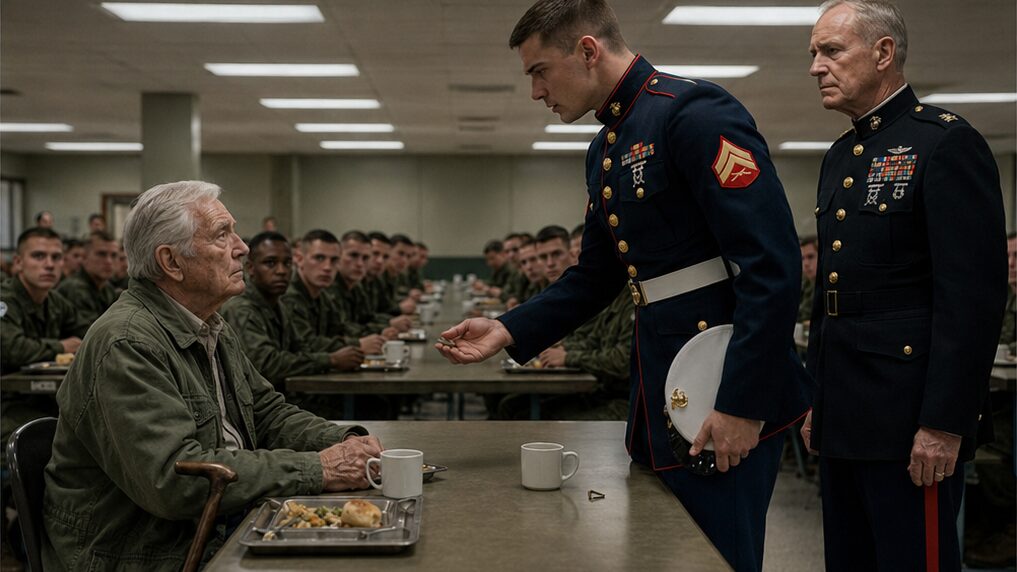
The Old Marine Kept One Bent Pin Beside His Coffee Until The Mess Hall Finally Understood Why
Chapter 1: The Bent Pin Beside The White Coffee Cup
Ronald Bennett reached the mess hall eleven minutes before lunch because the room was kinder before it filled.
The gate guard had looked at his visitor pass twice, then at Ronald’s face, then at the pass again. Not suspiciously, exactly. More like a young man trying to match a name to a body that had outlived the photograph in the system. Ronald had stood still while the scanner blinked, both hands resting on the black rubber grip of his cane, his green field jacket hanging loose from his shoulders.
“Here for the retirees’ briefing, sir?” the guard had asked.
“No,” Ronald said.
The guard waited, but Ronald did not give him more. After a moment the guard pointed him through.
Now Ronald stood just inside the mess hall entrance with the familiar smell pressing against him: coffee left too long on heat, metal trays warmed by steam, floor polish, eggs, detergent, wet wool from coats shaken off outside. The fluorescent lights hummed overhead with the same hard patience they had always had. The long tables were arranged in straight lines. Young Marines in service uniforms and camouflage sat in clusters, eating too fast, laughing too loudly, carrying fatigue and youth in the same shoulders.
Ronald took one tray.
The cafeteria worker behind the counter recognized him only after she saw his hands. Her eyes flicked down to the cane, then to the worn cuffs of his jacket, then back to his face.
“Coffee?” she asked.
“Yes, ma’am.”
“Black?”
“Yes, ma’am.”
She filled a white cup and set it on the tray. He chose toast he would not finish, eggs he had no appetite for, and a small orange because Nicholas had once said mess hall oranges tasted like they had been polished by mechanics.
Ronald did not smile at the memory. Smiling at it always felt like taking too much.
He carried the tray himself. His left hand held the edge, his right hand held the cane, and every step had to be negotiated in silence. The room did not stop for him. Boots crossed in front of him. A chair scraped backward too quickly. Someone laughed hard enough to slap a table. Ronald paused and let the sound pass.
He could have asked for help.
He did not.
The table he wanted sat in the second row from the windows, three tables from the coffee urn, far enough from the entrance that a man had to mean to reach it. One side faced the room. The other faced the wall where the light fell flat and pale. Ronald had sat there the first time because Nicholas had chosen it. Later, he sat there because no other place would hold the day correctly.
A young lance corporal at the far end of the table glanced up as Ronald approached. His eyes moved to the visitor pass clipped to Ronald’s jacket, then to the cane.
“Somebody sitting there?” Ronald asked.
The lance corporal shook his head and gathered his tray in a hurry. “No, sir. I mean—no. Go ahead.”
Ronald lowered himself onto the bench slowly, keeping the tray from sliding. His knees complained in a dry, private language. The cane leaned against the table. The cup trembled once, then steadied. He set the orange to the left, the toast to the right, and the coffee cup in front of the empty seat across from him.
Only then did he reach into the inside pocket of the green jacket.
The pin was wrapped in a square of soft cloth, blue once, gray now from years of handling. Ronald unfolded it carefully under the edge of the table, not because he was hiding it, but because some things deserved not to be snatched into the light. The brass had dulled. One side was bent slightly inward, as though it had been pressed beneath a boot heel or caught in a door. It was not impressive. It did not shine. It had no ribbon, no engraved citation, no glass case.
He placed it beside the white coffee cup.
For a moment, the room arranged itself around that small act. Noise became distance. The fluorescent hum lowered into the old engine note of memory. Ronald looked at the empty seat, not long enough for anyone else to notice, but long enough.
“Well,” he said under his breath, “I made it.”
A burst of laughter came from the next table.
Two junior Marines were leaning over their trays, talking with the careless confidence of men who had not yet had to measure what words could cost. One of them had a square jaw and a haircut sharp enough to look carved.
“I’m telling you,” he said, “every old guy with a field jacket thinks he’s got a story.”
His friend snorted. “Careful. Next one’ll say he trained the commandant.”
“They all do. Then they can’t find the exit.”
Ronald kept his eyes on the coffee cup.
The words did not wound cleanly. That would have been easier. They landed as part of the room: young voices, hard lights, plastic trays, the ordinary dismissal of old men who moved slowly through places built for speed. He lifted the cup in both hands, felt the heat settle into his fingers, and took a sip. The coffee was too bitter. It always was. Nicholas had once called it punishment with steam.
Ronald set the cup down before the tremor could show.
He could leave. He had done what he came to do. The pin had touched the table. The coffee had been poured. The empty seat had not been forgotten.
But leaving now would make the boys right in a way they would never understand. It would make the room too loud for memory. It would let a careless sentence decide the length of a promise.
So Ronald sat.
He took the napkin from under the fork and smoothed it with two fingers. His skin had thinned over the backs of his hands, veins raised like old map lines. He ate one corner of toast. Chewed. Swallowed. Let the mess hall continue around him.
A woman in a white supervisor’s shirt passed near his table carrying a clipboard. Catherine Walker. Ronald did not know her name yet, but he knew her walk. She had run the room for years with the quiet authority of someone who could spot a spill, a lie, or a fight before anyone else did. Her eyes touched the cup across from him and the pin beside it, just for a second. She did not stop. She never had.
That was one reason Ronald kept coming back.
Most people either asked too much or saw nothing at all. She saw enough to leave him be.
The lunch rush thickened. Marines entered in groups, some in camouflage, some in service uniforms, two in dress blues moving through the room like polished reminders of ceremony. The sight of dress blues still changed the air inside Ronald’s chest. Not with pride only. Pride was too simple a word. The uniform carried too many ghosts to be only one thing.
One of the Marines in dress blues stopped near the beverage station.
He was young, broad-shouldered, clean-shaven, his white cover tucked beneath his arm. Everything about him looked exact: collar, belt, brass, gloves folded with care. He scanned the room as if expecting someone to be out of regulation. His gaze passed over Ronald, moved on, then returned.
Ronald noticed because old men who had once survived by noticing did not stop noticing simply because others stopped seeing them.
The young Marine’s eyes fixed on the table.
Not on Ronald’s face.
On the pin.
Ronald placed one hand near it, not over it. A warning to himself, more than to anyone else.
The young Marine stepped away from the beverage station. A second Marine said something to him, but he did not answer. His polished shoes struck the floor in measured beats. Ronald could feel him approaching before his shadow touched the edge of the tray.
The young man stopped at the end of the table.
“Sir,” he said, but the word had no respect in it yet. It was only a form his training had placed in his mouth.
Ronald looked up.
The Marine’s nameplate read Carter.
His eyes were sharp, but not empty. That mattered, though Ronald did not yet know how much.
“Is that yours?” Benjamin Carter asked.
Ronald did not look down. “My coffee?”
A few Marines nearby went quiet.
Benjamin’s jaw tightened. “The pin.”
Ronald let the silence sit between them.
“Yes,” he said.
Benjamin Carter looked at the bent brass beside the white cup as if it had insulted him. Then he looked back at Ronald’s worn jacket, the visitor pass, the old hands, the cane leaning against the table.
The room kept eating, but attention had begun to gather.
Ronald felt it. Not like heat. Like weather.
Benjamin reached toward the pin.
Ronald’s fingers tightened once around the coffee cup.
Chapter 2: A Young Marine Held The Pin Too Close
Benjamin Carter picked up the pin before Ronald could decide whether stopping him would be worth what came next.
The brass looked smaller in the young Marine’s hand. Smaller and more exposed. Benjamin held it between thumb and forefinger, turning it toward the light as though the fluorescent glare could confess something Ronald had hidden.
“Do you know what this belongs to?” Benjamin asked.
His voice was not loud enough to be called shouting. That made it worse. It was controlled, clipped, sharpened for the benefit of every ear within three tables. A public correction disguised as a private question.
Ronald kept his hand around the coffee cup. The cup was warm. The table was cold beneath his wrist.
“I know what it is,” he said.
“That’s not what I asked.”
At the next table, forks slowed. A chair leg squealed and then stopped. Someone near the beverage station turned. The mess hall did not fall silent all at once. It lost sound in pieces.
Benjamin leaned closer. The blue of his uniform filled Ronald’s sight: brass buttons, white belt, exact seams, a young face arranged into certainty.
“This isn’t a souvenir,” Benjamin said. “You don’t just carry something like this around because it looks good on an old jacket.”
Ronald looked at him for a long moment.
The boy was angry. That was clear. But beneath it was something Ronald recognized from men too young to know what fear had made of them. Benjamin was not only challenging him. He was defending a wall inside himself, and Ronald had somehow put a hand on the wrong brick.
Ronald said, “Set it down.”
Benjamin’s eyes flickered. “Sir, I’m asking you a question.”
“No,” Ronald said quietly. “You’re asking the room.”
A junior Marine two tables away lowered his head. Another watched openly, mouth tight around a half-chewed bite. Catherine Walker had stopped near the tray return, clipboard lowered to her side.
Benjamin seemed to feel the audience and mistake it for strength.
“I’ve seen people walk on base with old jackets,” he said. “Old patches. Old stories. They think nobody’s going to ask. But some things mean something.”
Ronald’s thumb moved against the coffee cup handle. Once. Twice.
“I agree,” he said.
That answer threw Benjamin off for half a breath. Then he recovered and held the pin closer, too close, between Ronald’s face and the cup.
“Then tell me whose this is.”
The brass blurred slightly. Ronald could see the bent edge, the worn back, the tiny mark Nicholas had made by dropping it on the mess hall floor and stepping on it by accident. He could hear the old laugh that had followed, too embarrassed and too young.
“Guess it’s got character now,” Nicholas had said.
Ronald inhaled through his nose.
Benjamin’s hand was steady. Ronald’s was not. That, too, the room could see.
“Set it down,” Ronald said, “before you make it about you.”
The words did not rise. They did not cut. They landed softly enough that several Marines leaned in without meaning to.
Benjamin’s face changed color, not much, but enough. “Excuse me?”
Ronald looked past the pin to the young Marine’s eyes. “You heard me.”
For one second, the old Ronald moved inside the old body: not strong, not fast, not restored, but present. Benjamin saw it and disliked it.
“You don’t get to sit here with something you won’t explain,” Benjamin said.
Ronald’s gaze moved to the empty seat across from him. The coffee cup sat there untouched. A faint ring had formed beneath it.
“I don’t owe grief to strangers,” Ronald said.
The word grief reached farther than the accusation had. It went through the nearby tables like a dropped utensil.
Benjamin hesitated.
Then, because pride often rushes into the space where sense has paused, he said, “If it’s grief, then say the name.”
Ronald’s hand left the coffee cup.
Not quickly. Not dramatically. He placed both palms flat on the table, careful of the tray, careful of the napkin, careful not to become the thing Benjamin expected. His wedding ring had long ago thinned against his finger. His knuckles were swollen. A scar ran across the base of his thumb.
“Private Carter,” said a voice behind Benjamin.
Benjamin straightened as if someone had pulled a wire through his spine.
The voice had not been loud, but it carried the weight of rooms used to obeying it. Ronald did not turn right away. He watched Benjamin’s eyes move past him and widen just enough to betray surprise.
A senior Marine in dress uniform stood a few paces away. He was older than Benjamin by decades, though not as old as Ronald. His decorations were arranged with exact care. His face was lined but alert, and the authority in him did not need to lean over anyone to be felt.
Jeffrey Hayes took in the scene: Benjamin’s hand, the pin, Ronald’s tray, the untouched coffee, the nearby Marines pretending not to stare.
“Put it down,” Jeffrey said.
Benjamin’s fingers closed slightly around the pin. “Sir, I was only—”
“I did not ask what you were only doing.”
The room went still now.
Benjamin lowered his hand halfway, then seemed to remember that obeying too quickly would admit too much. “Sir, this item may not belong—”
Jeffrey stepped closer. His eyes moved from Benjamin to Ronald.
Recognition did not arrive on his face like shock. It came slowly, controlled and unwelcome, as if an old file had opened in the back of his mind and released dust.
“Mr. Bennett,” Jeffrey said.
Ronald inclined his head once. “Colonel.”
Benjamin’s hand opened.
The pin lay in his palm.
Jeffrey looked at it for one long second. Something in his jaw tightened.
“Private Carter,” he said, his voice lower now, “you are standing over the wrong man.”
No one moved.
Benjamin swallowed. His shoulders had lost their square certainty, though the uniform still held its shape. “Sir?”
Jeffrey did not answer him. He looked at Ronald again, and for a moment Ronald saw the question there. Not the public one. The private one. How much do you want said?
Ronald gave the smallest shake of his head.
Not here.
Not for this.
Jeffrey understood. Or understood enough.
He turned back to Benjamin. “Set the pin down beside the cup.”
Benjamin looked at the table, then at Ronald. His mouth opened, but whatever apology or defense tried to come out found no room in the air.
He placed the pin down.
Not where it had been. Too far from the cup. Too close to the tray edge. Ronald noticed but did not move it yet.
“Now step back,” Jeffrey said.
Benjamin stepped back.
The sound of that one polished shoe moving against the floor seemed louder than all the earlier laughter.
Catherine Walker stood by the tray return, her face tight with something like worry. The junior Marines at the next table stared at their food. One of them looked ashamed though he had said nothing.
Ronald reached for the pin. His fingers did not close around it at once. He nudged it gently back to its proper place beside the white cup.
Then he looked up at Benjamin.
The boy’s face was red. His eyes were lowered now, but Ronald did not mistake lowered eyes for understanding. Shame could bend a neck without changing a heart.
Jeffrey said, “Private Carter, you will remain available.”
“Yes, sir,” Benjamin said, barely above a whisper.
Ronald took the coffee cup in both hands. It was no longer hot.
He raised it because he needed something to do that was not shaking, not explaining, not remembering the way Nicholas had laughed with orange peel under his thumbnail and fear hidden in his jokes.
Benjamin still stood there, waiting for punishment or permission.
Ronald drank the cold coffee.
It tasted worse than usual.
Chapter 3: The Room Went Quiet Without Anyone Standing
Jeffrey Hayes could have made an example of Benjamin Carter right there.
Ronald saw it in the colonel’s posture. The room wanted it, too, though most of the young faces pretended they wanted nothing. They looked at trays, cups, phones turned facedown, the dull shine of the floor. But their attention leaned toward the table. Everyone was waiting for authority to become theater.
Ronald had seen that hunger before. Men loved justice best when it happened to someone else in public.
“Private Carter,” Jeffrey said, “you will apologize.”
Benjamin’s head lifted. His throat moved. He looked at Ronald but did not quite meet his eyes.
Ronald set the cup down.
“No,” he said.
The word was quiet, but Jeffrey heard it clearly. So did Benjamin. So did the nearest tables.
Jeffrey’s face did not change much. “Mr. Bennett—”
“No,” Ronald said again. “Not like this.”
Benjamin looked confused, then relieved, then ashamed of the relief. It all crossed his face too quickly for him to hide.
Ronald pushed the tray forward half an inch. The eggs had gone cold. The toast sat bitten at one corner. The orange remained whole.
“An apology given because a room is watching belongs to the room,” Ronald said.
Jeffrey’s gaze settled on him.
Ronald regretted saying that much as soon as it was out. Words invited more words. He had come to keep a promise, not teach a class. But silence had its own dangers. Silence could be mistaken for permission.
Catherine moved closer, not intruding, just near enough to catch anything that might fall.
Jeffrey turned to Benjamin. “Outside. Wait by the west corridor.”
“Yes, sir.”
Benjamin took one step, then stopped. His eyes went to the pin again. Ronald saw the boy wanting to say something, wanting to take something back, wanting perhaps to ask the question again in a different voice. But Jeffrey’s presence held him. He left without speaking.
The room followed him with its eyes until the swinging door sighed shut.
Sound returned poorly. A fork touched a plate. Someone coughed. A chair moved. The mess hall tried to become normal, but normal had been damaged.
Jeffrey remained beside the table.
“You should let me handle this,” he said quietly.
Ronald looked at the empty seat across from him. The white cup there had not been touched. The pin lay beside it, dull and bent, returned to its proper place but not to its former peace.
“You did,” Ronald said.
“Not fully.”
“No one handles anything fully in a cafeteria.”
A faint crease appeared at the corner of Jeffrey’s mouth, not quite amusement. He lowered himself onto the bench across from Ronald only after pausing for permission. Ronald did not give it aloud. He simply did not object.
The colonel sat carefully, leaving space between himself and the cup.
“I know your name,” Jeffrey said.
“A lot of people know names.”
“I know that one from a file.”
Ronald’s fingers moved toward the pin, then stopped. “Files are for cabinets.”
“And records.”
“And mistakes.”
Jeffrey absorbed that. Around them, young Marines made a clumsy show of eating. The table had become an island no one wanted to admit they were watching.
Jeffrey kept his voice low. “I won’t say anything you don’t want said.”
Ronald looked at him then. For the first time since Jeffrey had entered, the old man allowed weariness to show plainly.
“That would be a kindness,” he said.
“It may also be a problem.”
“Most kindness is.”
Jeffrey folded his hands on the table. His ring clicked softly against the surface. “Private Carter was wrong.”
“Yes.”
“He was disrespectful.”
“Yes.”
“He should be corrected.”
Ronald’s eyes moved to the door Benjamin had exited through. “Yes.”
“But not fed to the room.”
Jeffrey was silent.
Ronald picked up the orange. It felt too bright in his palm. Nicholas had once rolled one across this same table with two fingers and said he could tell the future by whether it stopped before falling. Ronald had told him not to be ridiculous. The orange had dropped anyway. Nicholas had laughed like falling fruit was proof of something.
Ronald put the orange back.
“I don’t want that boy’s shame used as entertainment,” he said.
“He made yours public.”
Ronald looked at the pin. “He tried.”
Jeffrey studied him, and Ronald disliked the feeling of being measured by a man trained to measure men.
“Mr. Bennett,” Jeffrey said, “why today?”
Ronald’s breath tightened.
The question was not cruel. That did not make it harmless.
Before Ronald could answer or refuse, Catherine stepped closer with the instinct of someone who had decided the table needed rescuing from itself.
“Colonel,” she said, “I can clear the tray whenever Mr. Bennett is ready.”
Ronald looked up. Her name tag read Walker. Catherine Walker. He filed it away with the countless small details his mind kept even when he wished it would let more go.
“Not yet,” he said.
“No hurry,” Catherine replied.
There was something in her voice. Not pity. Pity always leaned too close. This was recognition of a boundary.
Jeffrey glanced at her. “You know Mr. Bennett?”
Catherine hesitated. “Not properly.”
Ronald braced himself.
“He comes in once a year,” she said. “Same week. Usually same day, unless weather’s bad. Black coffee. Light food. Sits here.” Her eyes touched the white cup across from him. “Always sets a cup there first.”
Ronald looked down.
Jeffrey did not speak.
Catherine seemed to realize she had said more than she intended. “I’m sorry, Mr. Bennett.”
Ronald shook his head. “You didn’t take anything.”
The words steadied her, but not completely. She nodded once and stepped back.
Jeffrey’s expression had altered. The correction he wanted to make had become too small for what he had just learned.
Ronald gathered the cloth from his pocket and wrapped the pin. His hands were slow, and this time he did not try to hide the tremor. The room had already taken enough from him; it did not need his effort too.
Jeffrey began to rise. “Let me walk you out.”
“No.”
“Mr. Bennett—”
“I got in,” Ronald said. “I can get out.”
He slid the wrapped pin into his inside pocket. The empty cup remained across from him. He left it there while he stood, because some gestures could not be rushed without becoming lies.
His knees hurt. His hand found the cane. Catherine moved as if to help, then stopped herself.
That restraint, Ronald appreciated.
He lifted his tray, but Jeffrey reached for it.
Ronald held on.
For a moment both men had a hand near the tray, not touching each other, the question between them plain.
Ronald said, “Don’t make me smaller to make amends.”
Jeffrey let his hand fall.
Ronald carried the tray to the return window himself. The room parted more than it had when he entered. That, too, irritated him. Respect that arrived late often came dressed as fear.
At the tray return, Catherine took the tray without comment. The coffee cup across from him remained on the table until she went to fetch it.
Ronald walked toward the west corridor. Benjamin stood there in profile, rigid and pale, eyes fixed on the floor.
Ronald passed him.
Benjamin whispered, “Sir.”
Ronald stopped.
The boy did not look up. “I didn’t know.”
Ronald’s hand tightened on the cane.
“No,” Ronald said. “You didn’t.”
Then he kept walking.
Behind him, in the mess hall, Catherine picked up the untouched white cup from the empty seat and found a perfect ring of coffee beneath it, dark against the pale table, marking the place where no one had sat.
Chapter 4: The Same Seat On The Same Day
Catherine Walker had worked in the mess hall long enough to know which sounds mattered.
A dropped tray meant embarrassment if followed by laughter, trouble if followed by silence. A chair shoved back hard meant either someone was late or someone was angry. The coffee urn made a dull rattling noise before it failed, and the steam table hissed differently when the eggs were drying out.
She had heard Ronald Bennett leave.
Not his footsteps exactly. Those were soft, uneven, careful. What she heard was the room changing around him: conversations lowering without knowing why, chairs held still until he passed, a hush too late to be useful. It stayed after the corridor door closed behind him, lying over the tables like a damp towel.
By the time the lunch rush thinned, Catherine had cleared Ronald’s table herself.
The tray was ordinary. One bitten corner of toast. Eggs untouched. Orange unpeeled. Napkin folded once, then smoothed flat, as if someone had needed his hands to do something small and exact. The second coffee cup, the one across from his seat, had left a ring on the table.
Catherine held the cup longer than she needed to.
There were hundreds like it stacked behind the counter, thick white ceramic with chips along the rim. Nothing about this one mattered except where it had been placed and the fact that no one had drunk from it.
She wiped the table, but the ring had already darkened the sur
Chapter 7: An Apology Was Not Enough To Repair The Table
Benjamin Carter did not sit until Ronald told him to.
He stood at the edge of the chapel courtyard with his cover held against his side, his dress blues too exact for the uncertainty in his face. The afternoon light had softened the sharpness of his uniform. Without the mess hall watching, without the pin in his hand, he looked less like authority and more like a young man who had arrived too late to keep from breaking something.
Ronald stayed on the bench.
Colonel Hayes remained beside him, but said nothing. That was to his credit. Catherine Walker had appeared near the chapel walkway with the orange in a small paper bag. She stopped when she saw Benjamin, then placed the bag on the low brick wall and stepped back. No one asked why she had brought it. No one needed to.
Benjamin’s gaze moved once to the paper bag, then back to Ronald.
“Mr. Bennett,” he said.
Ronald looked at the cane between his knees. “Sit down, Private Carter.”
Benjamin hesitated only long enough to show that the instruction reached him. Then he lowered himself onto the far end of the bench, leaving more space than necessary. His knees aligned, hands resting flat on his thighs, shoulders fighting the habit of attention.
Ronald let him sit in silence.
The boy wanted to speak. Ronald could feel it in the small movements: breath gathered, jaw set, fingers pressing into wool. Apologies were like water behind a weak door. Once allowed through, they flooded everything and called the flooding cleansing.
Ronald had no interest in being washed over.
“You heard the name,” Ronald said.
Benjamin nodded. “Nicholas Reed.”
“Say it like he was a person.”
Benjamin’s eyes lifted.
Ronald waited.
“Nicholas Reed,” Benjamin said again, slower this time.
The difference was small. It was there.
Ronald reached into his jacket and took out the cloth bundle. Benjamin’s eyes followed the movement but did not lean toward it. That, too, was a beginning. Ronald unfolded the cloth and set the bent brass pin on his own palm.
“In the mess hall,” Ronald said, “you held this like evidence.”
Benjamin swallowed. “Yes, sir.”
“Don’t call me sir because you’re ashamed.”
Benjamin lowered his eyes. “Yes, Mr. Bennett.”
Ronald looked down at the pin. “Evidence proves something to strangers. This was never for strangers.”
Benjamin did not answer.
“He bent it by accident,” Ronald said. “Dropped it under the bench. Stepped on it before he saw where it landed. Thought his mother would be mad.”
The corner of Catherine’s mouth tightened from where she stood near the wall, as if the smallness of the memory had gotten past her defenses.
Ronald continued, “I told him to leave it bent. Told him it looked like it had gone somewhere with him.”
Benjamin’s breathing changed. Not dramatically. Just enough.
“He died with other things on him,” Ronald said. “Important things, maybe. Official things. This came back another way. His mother gave it to me because she did not want him kept only in a cabinet, or on a program, or in words read by somebody who never heard him laugh.”
He closed his fingers gently around the pin.
“I was asked to remember him somewhere ordinary.”
Benjamin’s face worked once, then steadied. “I’m sorry.”
Ronald looked at him.
The words had escaped too fast. Benjamin knew it. Color rose in his neck.
“I mean—” He stopped.
“No,” Ronald said. “Leave that one where it fell.”
Benjamin nodded, humiliated but listening.
Ronald leaned back against the bench. The chapel bricks held the day’s warmth. He could feel the tiredness in his spine, the old ache in his hands, the drag in his chest that always came after saying too much.
“You’re sorry because you were wrong,” Ronald said. “That’s simple. Painful, but simple.”
“Yes.”
“But I don’t need your sorrow as much as you need to understand the shape of what you did.”
Benjamin kept his eyes on Ronald now, though it cost him.
“You thought you were protecting honor,” Ronald said. “So you stood over an old man in a crowded room and demanded he earn the right to be left alone.”
Benjamin flinched.
Ronald let that stand.
Jeffrey shifted slightly, but did not interrupt.
“My father,” Benjamin said, then stopped as though unsure if he had any right to bring another wound into the conversation.
Ronald waited.
“My father wore things he didn’t earn,” Benjamin said. “Told stories. Let people think he’d served. I hated it. I hated watching people believe him, and I hated watching people laugh when they stopped believing him.”
Ronald looked at the pin in his hand.
“That explains the door you walked through,” he said. “Not what you did after you entered.”
Benjamin’s eyes shone but did not spill. “No.”
“Good.”
The wind moved along the courtyard. Somewhere past the chapel, a vehicle door shut. The base went on doing what bases did: moving bodies and orders from one place to another while old promises sat between men on benches.
Benjamin drew a breath. “I would like to apologize properly.”
“You can start by not asking me to make you clean.”
Benjamin’s mouth closed.
Ronald placed the pin on the bench between them. Benjamin did not touch it.
“Tomorrow morning,” Ronald said, “I’m going back to that table.”
Jeffrey turned slightly toward him, surprised.
“So soon?” Catherine asked before she could stop herself.
Ronald glanced at her. “The table didn’t do anything wrong.”
That almost brought a smile to her face. Almost.
Ronald looked at Benjamin again. “You want to repair something, you don’t begin with a speech.”
“No, Mr. Bennett.”
“You begin with the thing you damaged.”
Benjamin nodded once.
“You will not stand over me. You will not tell the room what you learned. You will not use Nicholas Reed’s name to make yourself look humbled.”
Benjamin’s face tightened at that, but he did not defend himself.
Ronald continued, “You will get two cups of coffee. Black. One for me, one for the empty seat. You will set them down and leave them alone.”
Benjamin listened as if each word were an order too quiet for anyone else to hear.
“If someone asks,” Ronald said, “you tell them the seat is taken.”
Catherine looked down.
Jeffrey’s eyes stayed on Ronald, but something in him softened.
Benjamin said, “Yes, Mr. Bennett.”
“That’s not the repair,” Ronald said.
Benjamin looked confused.
“That’s the beginning. The repair is what you do the next time you see someone old move slowly through a room and your first thought is that you know what he is.”
Benjamin took the words without looking away.
Ronald picked up the pin and folded it back into the cloth. His fingers fumbled once. Benjamin noticed, but did not reach to help. Ronald appreciated that more than he wanted to.
Jeffrey finally spoke. “Mr. Bennett, I can arrange the table in the morning.”
“No.”
Catherine said, “I can make sure no one bothers you.”
“No.”
Ronald stood slowly. The movement pulled at his knees and back. Benjamin rose halfway on instinct, then stopped himself and sat back down. Good, Ronald thought. Not because he wanted the boy still, but because reflex had met thought and thought had won.
Ronald steadied himself with the cane.
“I don’t need protection from a room,” he said. “I need the room to learn not to mistake quiet for absence.”
Benjamin stood then, carefully, leaving space.
Ronald took the paper bag from the wall. The orange inside gave softly under his fingers.
“Ms. Walker,” he said.
“Yes, Mr. Bennett.”
“Thank you for not throwing this out.”
“I wasn’t sure why it mattered.”
Ronald looked at the bag. “Most things don’t tell us before they do.”
Catherine nodded, and for once the practical set of her face did not hide the feeling beneath it.
Jeffrey walked with Ronald toward the west corridor but did not offer an arm. Benjamin followed several paces behind until they reached the mess hall entrance, now closed between meal periods. Through the glass, the long tables sat empty under fluorescent light.
The room looked harmless without people in it.
Ronald stopped outside the door.
Benjamin stopped behind him.
“You said you were sorry,” Ronald said without turning.
“Yes, Mr. Bennett.”
“Tomorrow, don’t be sorry first.”
Ronald looked through the glass at the table in the second row from the windows.
“Be useful,” he said.
Chapter 8: The Empty Chair Finally Had More Than Silence
The next morning, Ronald arrived while breakfast was still being set out.
The sky beyond the base buildings was pale and undecided. A damp chill clung to the sidewalks. He wore the same green jacket, buttoned against the wind, and carried the cane in his right hand. The wrapped pin rested inside his pocket where it had rested for years, but it did not feel quite as hidden.
At the mess hall entrance, the young gate guard from the day before was not there. Another guard checked Ronald’s pass, looked at his name, and said, “Good morning, Mr. Bennett.”
The words were ordinary.
Ronald was grateful for that.
Inside, the room smelled of coffee, toast, steam, and floor polish. The long tables waited under the hard lights. A few Marines already sat eating quickly, heads low over trays. The morning had not yet gathered enough noise to protect anyone from noticing anything.
Catherine Walker stood near the counter, speaking quietly to a cafeteria worker. When she saw Ronald, she did not hurry toward him. She only nodded once and turned to the urn.
That, too, was a kindness.
Benjamin Carter was already there.
Not at Ronald’s table. Not guarding it. Not making a show of waiting. He stood near the coffee station in dress blues, cover tucked under one arm, posture straight but not stiff in the old way. Two white cups sat on a small tray beside him.
Ronald saw the boy draw a breath when their eyes met.
Benjamin did not speak across the room.
He waited.
Ronald took his tray from the stack. The same cafeteria worker offered eggs, toast, and an orange. He accepted all three. When he reached the register, Catherine stepped forward with the coffee tray Benjamin had prepared.
“Private Carter asked if these should be separate from your tray,” she said.
Ronald looked at the two cups.
“Did he?”
“Yes.”
“And what did you tell him?”
“I told him I didn’t know.”
Ronald let the faintest breath of amusement pass through his nose. “That was safe.”
“I’m fond of safe when hot coffee is involved.”
He took his food tray. Benjamin picked up the coffee tray and followed, staying a step behind and to the side, not close enough to crowd, not far enough to pretend distance.
The table in the second row from the windows had not been marked, blocked, decorated, or guarded. It was simply empty.
Ronald approved.
He lowered himself onto the bench. The pain in his knees spoke sharply, then faded into the background. Benjamin remained standing until Ronald looked at him.
“Coffee,” Ronald said.
Benjamin stepped forward and set one cup in front of Ronald. His hand was careful but not theatrical. He placed the second cup across the table at the empty seat, not too far from the edge, not too near. Then he stepped back.
Ronald watched the cup settle.
A small ring began forming beneath it almost at once.
Benjamin said, “The seat is taken.”
No one had asked. Ronald understood then that the boy was practicing the sentence before the room tested him.
“Not to me,” Ronald said.
Benjamin’s face flushed. “No, Mr. Bennett.”
Ronald reached into his jacket and unfolded the cloth. The pin lay in his palm, the bent side catching the fluorescent light. He held it for a moment before setting it beside the cup across from him.
Not hidden under the table.
Not displayed in the center.
Beside the cup.
Several Marines nearby had noticed. They looked away when Ronald glanced in their direction, but not quickly enough to pretend they had seen nothing. Ronald found he did not mind as much today.
Jeffrey Hayes entered through the side door in service uniform rather than dress blues. That choice was not accidental. He carried no folder, no program, no ceremonial weight. He looked once at Ronald, once at Benjamin, then took a tray from the stack and joined the breakfast line.
Catherine moved through the room with her clipboard, making small corrections to small things. A salt shaker turned, a chair nudged inward, a spill wiped before it spread. Ordinary authority. Ronald had always trusted it more than speeches.
A young lance corporal approached with a tray, scanning for a seat. He stopped when he saw the empty place across from Ronald.
“Is someone sitting there?” he asked.
Benjamin opened his mouth, but Ronald lifted two fingers from his cup.
“I’ll answer this one,” Ronald said.
Benjamin closed his mouth.
Ronald looked at the lance corporal. “Yes.”
The young Marine’s eyes moved to the cup, the pin, Ronald’s face. Confusion flickered, then caution.
“Yes, sir,” he said, and moved to another seat.
Ronald took a sip of coffee. It was bitter and too hot. Better.
Benjamin stood near the end of the table, uncertain whether his usefulness had ended.
“Sit,” Ronald said.
Benjamin looked startled.
“Not there,” Ronald added, nodding to the space beside him rather than across from him.
Benjamin sat on the bench at Ronald’s side, leaving enough room for the cane.
For a while they ate without speaking. Ronald managed half the toast. Benjamin did not touch his food. Across the table, the empty cup steamed beside the pin.
The mess hall grew louder as breakfast filled. Conversations rose and fell. Boots moved. Trays slid. Yet around Ronald’s table there remained a small pocket of attention, not silence exactly, but care.
Jeffrey sat two tables away with his own coffee. He did not come over.
Catherine passed once and placed an orange beside the empty cup. Ronald looked up at her.
“For the seat,” she said.
Ronald’s throat tightened without warning.
He nodded.
Benjamin looked at the orange, then at Ronald. He seemed to understand enough not to ask.
After several minutes, Jeffrey rose and came to the table. He carried a small folded card, plain white, no insignia, no printed emblem. He set it near Ronald’s tray, not near the empty place.
“For your approval,” he said.
Ronald looked at him sharply.
Jeffrey held up one hand. “Nothing has been placed. Nothing will be placed unless you say so.”
Ronald unfolded the card.
Reserved for those who carried more than we can see.
He read it twice.
Benjamin stared at the table. Catherine had stopped near the end of the row, pretending to check her clipboard.
Ronald set the card down.
“No names,” he said.
Jeffrey nodded. “No names.”
“No date.”
“No date.”
“No ceremony.”
“No ceremony.”
Ronald looked across at the empty seat. Steam had thinned above the cup. The orange sat bright beside it. The pin looked small and battered and completely itself.
“This stays in a drawer,” Ronald said, touching the card. “You put it out only when someone needs the seat.”
Catherine looked up.
Jeffrey said, “Who decides that?”
Ronald picked up the pin, rubbed his thumb along the bent edge, and set it back down.
“The room will learn,” he said.
No one spoke.
It was not a perfect answer. Ronald knew that. Rooms did not learn all at once. People forgot. New boys arrived with old certainties. Old men came through doors and were mistaken for burdens, trespassers, problems to be moved aside. A card in a drawer would not cure that.
But it might slow one hand before it reached.
It might lower one voice.
It might teach one young Marine to sit before asking.
Benjamin’s voice came quietly from beside him. “Mr. Bennett.”
Ronald did not turn. “Yes.”
“I’m sorry.”
This time the words did not rush. They did not ask to be witnessed. They did not arrive carrying excuses behind them.
Ronald kept his eyes on the empty cup.
“I know,” he said.
Benjamin breathed out, not relieved exactly. More as if he had accepted that relief was not the point.
“I won’t forget his name,” Benjamin said.
Ronald looked at him then.
There were many things he could have said. That remembering once was easy. That names faded if not carried carefully. That Nicholas had been more than the worst thing that happened to him. That Benjamin should remember the laugh, too, though he had never heard it.
Instead Ronald said, “Then don’t use it carelessly.”
“No, Mr. Bennett.”
Ronald finished one more bite of toast. The room continued around them, not reverent, not transformed, but altered in small ways he could see because he had spent a lifetime noticing small things. A Marine at the next table lowered his voice when an older civilian worker passed. The lance corporal who had almost taken the empty seat came back with a cup of coffee and set it quietly at a different table for an elderly veteran Ronald did not know. Catherine saw it and did not comment. Jeffrey saw it and looked down into his own cup.
Benjamin remained seated.
That mattered.
When Ronald was ready to leave, he wrapped the pin in the worn cloth. For the first time in years, his fingers paused before covering it completely. He looked at the empty seat, the cooling coffee, the orange Catherine had placed there, the faint ring darkening beneath the cup.
He set the pin back down beside the cup.
Only for a minute.
No one moved.
The minute was not measured by a clock. It was measured by breath, by restraint, by all the words nobody tried to add.
Then Ronald picked up the pin, wrapped it, and placed it inside his jacket.
He stood with his cane. Benjamin did not rise until Ronald had steadied himself. When he did, he stood beside him rather than over him.
Catherine took the card and slid it into her clipboard.
Jeffrey picked up Ronald’s tray only after Ronald nodded permission.
At the tray return, Ronald kept the orange from the empty seat and put it in his pocket. Nicholas would have made a joke about stealing government fruit. The thought came with pain, but also with something gentler than pain.
At the door, Ronald looked back.
The table was already being cleared. The cup ring remained, dark and ordinary, holding its place until the cloth wiped it away.
Benjamin stood near the table, one hand resting lightly on the back of the bench, not guarding it, not claiming it, only remembering where not to stand.
Ronald stepped into the morning.
Behind him, the mess hall filled with the sound of trays, voices, coffee, and young men learning, slowly and imperfectly, that some empty seats were not empty at all.
The story has ended.