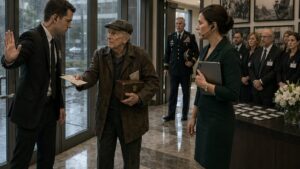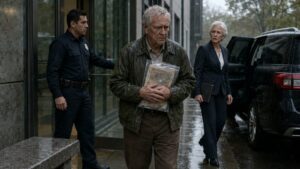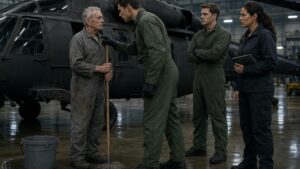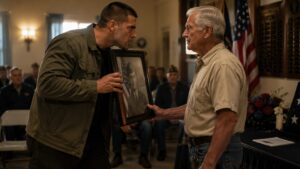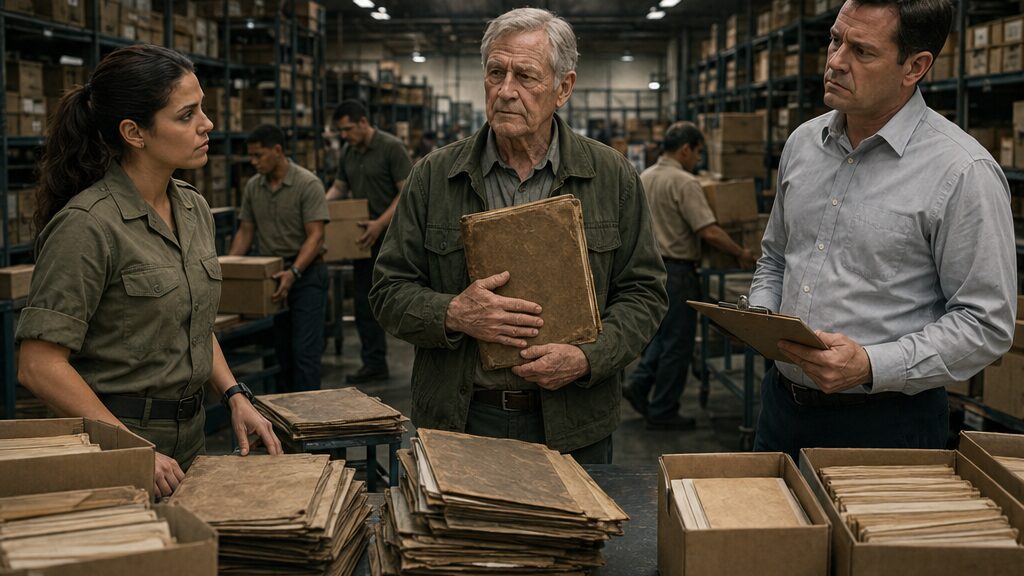
The Forgotten File Marked 3,200 Meters Was the Only Warning Nobody Took Seriously
Chapter 1: The Folder Nobody Wanted to Keep
The folder was already halfway inside the disposal box when Raymond Martin stopped walking.
Jessica Rodriguez noticed because he had been moving steadily all morning.
Not fast.
Not slow.
Just steady.
The kind of pace older people developed after they stopped trying to prove anything.
The archive facility stretched beneath fluorescent lights that hummed softly above rows of shelving. Metal cabinets lined the walls. Thousands of records waited inside boxes marked for scanning, storage, or destruction.
Jessica had spent six weeks there already.
Six weeks of inventory sheets.
Six weeks of labels.
Six weeks of paperwork that seemed older than everyone assigned to handle it.
Across the room, contractors stacked another cart with boxes headed for disposal review.
Raymond’s attention remained fixed on a single worn folder.
“Problem?” Jessica asked.
The veteran didn’t answer immediately.
He stepped closer.
The folder looked ordinary except for a faded red stamp across the front.
3,200-METER CONFIRMED.
Jessica had seen stranger labels during her assignment.
Most of them meant nothing.
Training records.
Equipment reports.
Outdated operation summaries.
The military generated paper the way trees generated leaves.
Raymond gently touched the edge of the folder.
Not possessively.
More like someone checking whether something was still where it belonged.
“That one shouldn’t be here,” he said.
Jessica glanced at the disposal sticker.
“It passed review.”
“Who reviewed it?”
She shrugged.
“Somebody upstairs.”
Raymond nodded once.
Then stepped back.
No argument.
No lecture.
No demand.
Just a nod.
That should have ended the conversation.
Instead, Jessica found herself looking at the file again.
The red stamp stood out against the faded cardboard.
3,200-METER CONFIRMED.
An oddly specific number.
“What is it?” she asked.
“A record.”
His answer felt intentionally incomplete.
“A shooting record?”
“Partly.”
Partly.
Not exactly helpful.
Jessica pulled the folder from the box.
The cardboard felt surprisingly heavy.
Inside were mission summaries, equipment evaluations, weather observations, and pages of handwritten notes.
Nothing immediately explained the number on the cover.
She flipped through several pages.
Most appeared decades old.
Some had sections blacked out.
Others carried classification markings that had long since expired.
Raymond remained silent beside her.
Watching.
Waiting.
Not pushing.
The behavior irritated her slightly.
If he knew something, why not say it?
Across the room Daniel Wright emerged from his office carrying a tablet.
Daniel managed the modernization project.
He was efficient.
Organized.
Always focused on deadlines.
“Anything slowing us down?” he asked.
Jessica held up the folder.
“Raymond thinks this shouldn’t be disposed.”
Daniel glanced briefly at the cover.
“Everything in that batch was approved.”
Raymond said nothing.
Daniel noticed the silence.
“Was there an issue?”
“No,” Raymond replied.
Jessica expected more.
There wasn’t more.
Daniel nodded.
“Then let’s keep moving.”
He disappeared toward another aisle.
The moment passed.
Work resumed.
Yet Jessica found herself unable to return the folder to the box.
The old veteran eventually walked away toward another section of shelving.
His posture remained straight despite his age.
Not military-perfect.
Just practiced.
As if decades of habit remained impossible to abandon.
Jessica opened the file again.
A yellowed report sat near the middle.
The document described observation conditions during a reconnaissance operation.
Weather.
Distance.
Wind.
Visibility.
Coordinates.
At the bottom someone had written a note by hand.
Not typed.
Written.
The ink had faded but remained legible.
Observation confirmed. Maintain separate storage.
No signature.
No explanation.
Jessica frowned.
Separate storage from what?
Why?
Another page referenced a mission index number.
She copied it onto a scrap of paper.
Then continued searching.
Several pages later she found a photograph.
Not a person.
A ridge line.
Mountains.
Nothing else.
Someone had circled a distant point near the horizon.
Again there was handwriting.
Do not merge.
Jessica looked around the room.
Most people ignored the archive’s contents completely.
Boxes moved.
Forms were checked.
Records became numbers.
No one cared what the papers actually said.
Maybe Raymond did.
She looked toward the far shelves.
The veteran was examining another stack of files.
Methodically.
Patiently.
Almost like he knew where everything belonged.
The thought surprised her.
He wasn’t an employee.
He volunteered three days a week.
That was all she knew.
An older veteran helping preserve records.
Nothing unusual.
Except for moments like this.
She slipped the file onto her desk instead of returning it to disposal.
An hour later Daniel walked past again.
His eyes landed on the folder.
“Still looking at that?”
“Just curious.”
“That’s dangerous in archives.”
Jessica smiled.
“How so?”
“You start opening one box and lose three hours.”
He wasn’t wrong.
She had already lost nearly one.
Daniel tapped the disposal sticker.
“If it’s approved, it’s approved.”
“Raymond seemed concerned.”
Daniel glanced toward the veteran.
“Raymond’s concerned about everything.”
Not cruel.
Just dismissive.
The way people spoke about older relatives who checked locks twice.
Jessica looked down at the file.
The red stamp felt strangely important now.
Not because she understood it.
Because nobody seemed interested in understanding it.
Late that afternoon the archive grew quieter.
Contractors left.
Technicians logged out.
The fluorescent hum became more noticeable.
Jessica carried the folder toward a shelving area where Raymond was reorganizing old binders.
She held it up.
“What exactly happened at 3,200 meters?”
The veteran studied the cover.
For a moment she thought he might answer.
Instead he looked at a page near the back.
His finger stopped beside a line of text.
A mission index reference.
“Check that number,” he said.
“Why?”
“Because it should have another entry.”
Jessica looked.
“There isn’t one.”
“I know.”
That answer landed differently.
Not because of what he said.
Because of how certain he sounded.
Jessica scanned the page again.
The index number ended abruptly.
No continuation.
No follow-up file.
Nothing.
“Maybe it was lost.”
“Maybe.”
“You don’t think so.”
“No.”
He returned the folder.
“Good night, Jessica.”
Then he walked away.
She watched him disappear down the aisle.
The folder felt heavier than before.
One missing entry.
One red stamp.
One veteran who seemed worried about a file everyone else wanted thrown away.
And one question she could not stop asking herself.
If the file was unimportant, why did Raymond already know something was missing?
Chapter 2: One Missing Line in the Index
Jessica arrived early the next morning.
The archive facility remained mostly empty.
The quiet suited her.
No forklifts.
No contractors.
No conversations bouncing between metal shelves.
Just rows of records waiting patiently in the dim light.
The 3,200-meter folder sat on her desk exactly where she had left it.
She opened it before turning on her computer.
The missing index number bothered her.
Not because missing records were unusual.
They happened constantly.
Boxes were relocated.
Files were misfiled.
Pages disappeared.
Entire collections sometimes vanished during base transfers.
What bothered her was Raymond’s certainty.
He hadn’t guessed.
He had known.
Jessica typed the reference number into the archive database.
Results appeared instantly.
One record.
The folder already sitting in front of her.
Nothing else.
She searched broader categories.
Nothing.
Different spellings.
Nothing.
Cross references.
Nothing.
A gap.
A clean gap.
As though something had been removed deliberately.
Footsteps echoed behind her.
Daniel arrived carrying coffee.
“You beat me here.”
“Couldn’t sleep.”
He looked at her monitor.
“Still chasing ghosts?”
“I’m checking an index issue.”
Daniel sighed.
“Jessica.”
“What?”
“These archives are seventy years of paperwork held together with hope.”
She laughed.
“That’s not reassuring.”
“It’s reality.”
He sat briefly on the corner of a desk.
“People always assume missing records mean conspiracy.”
“You don’t?”
“No.”
He sipped coffee.
“I think people lose things.”
Simple.
Reasonable.
Probably true most of the time.
Yet the explanation didn’t settle the discomfort.
After Daniel left, Jessica returned to the folder.
A loose page slid from the back.
She nearly missed it.
The sheet carried handwritten notes rather than official reports.
Wind adjustments.
Coordinates.
Distances.
Observations.
The writing was precise.
Controlled.
Almost mathematical.
Near the bottom another note appeared.
Cross-reference omitted. Archive separately.
Again.
Archive separately.
The same phrase.
Jessica stared at it.
Twice could not be coincidence.
By midmorning Raymond arrived.
He greeted the records clerk.
Helped move several boxes.
Then quietly resumed work.
Jessica approached him.
“You’ve seen this file before.”
Raymond continued sorting.
“Yes.”
“You knew something was missing.”
“Yes.”
The straightforward answer irritated her.
“You could just explain.”
He looked up.
His expression wasn’t stubborn.
It was tired.
“Would you believe me?”
Jessica hesitated.
That wasn’t the response she expected.
“I don’t know.”
Raymond nodded.
“That’s why.”
He returned to the shelf.
Conversation over.
Or so he thought.
Jessica pulled the folder from under her arm.
“What’s the missing operation?”
His eyes shifted toward the cover.
Only for a second.
Then away.
“I don’t remember the official name.”
“You remember something.”
A long silence followed.
Finally he spoke.
“There should be another report.”
“About what?”
“The reason that file exists.”
Jessica waited.
No further explanation came.
Nearby, Daniel called for inventory updates.
Forklifts beeped in distant aisles.
Life continued around them.
Raymond resumed stacking folders.
Steady.
Methodical.
The conversation might have ended there if Jessica hadn’t noticed something else.
A handwritten notation hidden near the bottom corner of the loose page.
Tiny.
Almost invisible.
The number wasn’t an operation code.
It was a shelf reference.
An old storage location.
One no longer used.
She copied it into her notebook.
Without mentioning it.
That afternoon curiosity defeated caution.
The abandoned storage section occupied a neglected wing beneath the archive facility.
Most shelves had been emptied years ago.
Dust covered everything.
Jessica followed the reference number through narrow aisles.
Eventually she reached a rusted cabinet.
The label matched.
Almost.
One digit differed.
Close enough to feel intentional.
The cabinet stood locked.
She checked inventory records.
No key assignment.
No active listing.
No explanation.
Only a note.
Transferred.
Transferred where?
A voice startled her.
“Found something?”
Susan Young stood behind her holding a tablet.
Jessica exhaled.
“You scared me.”
“Sorry.”
Susan studied the cabinet.
“Nobody comes down here.”
“I’m starting to understand why.”
Susan smiled faintly.
Unlike Daniel, Susan actually liked old records.
Military history fascinated her.
Jessica showed her the shelf reference.
Susan’s expression changed immediately.
“Where did you get this?”
“The 3,200-meter file.”
Susan became quiet.
“That’s interesting.”
“Why?”
The historian looked toward the cabinet.
“Because I’ve seen references to that designation before.”
Jessica felt a rush of anticipation.
“You know what it means?”
“No.”
Susan frowned.
“But every mention ends abruptly.”
“Ends how?”
“Like someone stopped writing.”
The answer sent a chill through Jessica.
Not because it proved anything.
Because it matched exactly what she had been finding.
Missing references.
Separate storage.
Incomplete records.
Dead ends.
As if an invisible hand had been guiding documents apart for decades.
Later that evening she returned upstairs.
Most personnel had gone home.
Only Raymond remained.
He sat at a table reviewing inventory sheets.
Jessica placed the notebook beside him.
“Old shelf reference.”
He read the number.
His face changed.
Barely.
Yet enough.
Enough to confirm she had found something important.
“You went looking.”
“Yes.”
Raymond closed the notebook.
“What was there?”
“A locked cabinet.”
The veteran leaned back slowly.
For the first time she saw genuine concern.
Not nostalgia.
Not curiosity.
Concern.
“What used to be in it?” she asked.
Raymond looked toward the distant shelves.
Far beyond them.
Far beyond the room itself.
Then he spoke quietly.
“It depends on who moved it.”
Jessica waited.
But once again he stopped.
One answer.
No more.
The same frustrating restraint.
Yet this time something else lingered beneath it.
Not reluctance.
Fear.
And as Raymond stared across the archive, Jessica realized a possibility she had not considered before.
Maybe the missing report wasn’t lost.
Maybe someone had made sure it stayed hidden.
Chapter 3: The Operation That Officially Never Happened
Three days later Jessica received her first formal denial.
The request itself had been simple.
Access records connected to the missing index reference.
Nothing classified.
Nothing extraordinary.
At least that was what she believed.
The response arrived electronically.
ACCESS RESTRICTED.
NO ACTIVE RECORD FOUND.
REQUEST CLOSED.
Jessica read it twice.
Then a third time.
The wording bothered her.
No active record found was not the same as record does not exist.
It implied something else.
Something buried.
She carried the notice directly to Susan.
The historian adjusted her glasses and read the screen.
“That’s unusual.”
“You keep saying that.”
“Because unusual things keep happening.”
Susan handed the tablet back.
“Inactive records are still records.”
“So why deny access?”
Susan thought for a moment.
“Sometimes archives inherit restrictions nobody understands anymore.”
“That’s comforting.”
“It shouldn’t be.”
The answer stayed with Jessica.
Later that afternoon she entered the records vault.
The vault sat deeper inside the facility than most personnel ever needed to go.
Heavy doors.
Controlled access.
Temperature regulation.
Shelves packed tightly with preserved military history.
A records clerk escorted her inside.
“You’ve got thirty minutes.”
“That’s all I need.”
It wasn’t.
But she nodded anyway.
The clerk left.
Jessica immediately searched for adjacent files connected to the 3,200-meter folder.
The vault felt different from the rest of the archive.
More deliberate.
As though every document carried weight.
Dustless shelves stretched into the distance.
Labels organized decades of memory.
She located a group of records from the same time period.
Several references matched.
Others didn’t.
One report described weather conditions identical to those found in Raymond’s folder.
Another listed personnel assignments.
A third referenced reconnaissance activity in the same mountain region shown in the photograph.
Yet none mentioned the operation itself.
The omission felt unnatural.
Like reading a book with every third chapter removed.
Jessica photographed notes and continued searching.
Eventually she found something stranger.
A duplicate report.
At least it appeared identical at first.
Same date.
Same region.
Same mission category.
But one sentence differed.
In the first version, a line ended abruptly.
In the second, the sentence continued.
Only four words had been added.
Observation verified independently.
Jessica stared.
Why maintain two versions?
Why alter one?
Why hide the other?
The discrepancy seemed minor.
Yet suddenly every missing page felt intentional.
Every gap felt designed.
A soft voice interrupted her thoughts.
“You found one.”
Raymond stood near the end of the aisle.
Jessica nearly dropped the file.
“How did you get in here?”
“I volunteer.”
“That’s not an answer.”
“No.”
He looked at the duplicate reports.
His expression carried no surprise.
Only resignation.
“You already knew.”
Raymond nodded.
Jessica held up both versions.
“Which one is real?”
“Both.”
“That makes no sense.”
“It will.”
Frustration surged.
“Everyone keeps talking like I already know the story.”
The veteran studied the papers.
“The story isn’t the problem.”
“What is?”
“The missing parts.”
His eyes moved to the altered sentence.
Observation verified independently.
For the first time, Raymond touched one of the documents.
Just one finger against the paper.
As if confirming it still existed.
“They left that in?”
Jessica stared.
“You know what it means.”
Raymond withdrew his hand.
“Yes.”
“Then tell me.”
Silence.
Not defiance.
Not secrecy.
Something heavier.
Finally he said, “Not yet.”
The answer should have made her angry.
Instead it made her uneasy.
Because Raymond looked like a man carrying something he wished he didn’t know.
The vault suddenly felt colder.
“What happened?” she asked softly.
The veteran looked past her toward rows of forgotten records.
“What happens to most things.”
“Which is?”
“People decide what should be remembered.”
Before she could respond, the records clerk returned.
“Time’s up.”
Jessica gathered her notes.
The duplicate reports.
The photographs.
The questions.
All of it.
As she prepared to leave, a sheet slipped from one of the folders.
A single page.
Old.
Yellowed.
Unnumbered.
She bent down and picked it up.
The document wasn’t a report.
It was a routing slip.
A transfer record.
Most of it had faded.
Only one handwritten sentence remained visible.
Move remaining material under revised designation.
No signature.
No destination.
No explanation.
Just another trail disappearing into darkness.
Outside the vault, Raymond waited while she secured the files.
Neither spoke immediately.
The hallway stretched quiet around them.
Finally Jessica held up the routing slip.
“You’ve seen this handwriting before.”
Raymond looked at it.
His jaw tightened slightly.
Enough to answer without words.
“You know who wrote it.”
A long pause followed.
Then Raymond gave the smallest nod.
Not confirmation.
Not denial.
Something in between.
Something far more troubling.
Because if he recognized the handwriting, then this mystery was no longer about forgotten paperwork.
It was about people.
People who had moved records.
Changed records.
Separated records.
And perhaps erased an operation so completely that it officially no longer existed.
As they walked toward the elevator, Jessica looked at the worn folder tucked beneath her arm.
3,200-METER CONFIRMED.
The file that should have been destroyed.
The file Raymond had noticed instantly.
The file connected to an operation nobody could find.
When the elevator doors opened, she turned toward him one last time.
“Who altered the archive?”
Raymond didn’t answer.
But for the first time, he looked genuinely afraid.
And that frightened her more than any missing file ever could.
Chapter 4: What Raymond Refused to Say
Raymond did not return to the archive the next day.
Jessica noticed immediately.
The absence felt strange.
For weeks she had barely paid attention to him.
Now every empty aisle seemed to point toward the missing veteran.
She spent the morning sorting records while repeatedly checking the entrance.
No Raymond.
No explanation.
Around noon she found Susan reviewing catalog updates in a side office.
“Have you heard from him?” Jessica asked.
Susan looked up.
“Raymond?”
Jessica nodded.
“No. Why?”
“He didn’t come in.”
Susan seemed mildly surprised.
“That’s unusual.”
The answer only deepened Jessica’s concern.
By late afternoon she found his volunteer contact information.
The address belonged to a modest retirement community near the edge of town.
She hesitated before driving there.
Then went anyway.
The complex was quiet.
Neatly maintained.
The kind of place where every resident knew which trees bloomed first each spring.
Raymond lived in a small single-story unit.
The curtains were open.
A pickup truck sat outside.
Not new.
Carefully maintained.
Jessica knocked.
Several seconds passed.
The door opened.
Raymond looked tired.
Not physically.
Emotionally.
As if he had spent the night arguing with memories.
“You found me.”
“I wasn’t hiding.”
“No.”
He stepped aside.
The apartment surprised her.
There were no military displays.
No framed medals.
No photographs covering the walls.
Just bookshelves.
Maps.
A worn recliner.
And stacks of folders arranged with the same precision she saw in the archive.
Another man sat at the kitchen table.
Gray-haired.
Broad-shouldered despite his age.
Paul Robinson.
Raymond introduced them quietly.
Paul shook her hand.
“So you’re the one digging.”
Jessica glanced between them.
“You knew I’d come?”
Paul laughed softly.
“No. We just knew somebody eventually would.”
That sentence lingered.
Eventually.
Not if.
Eventually.
Raymond poured coffee.
Nobody spoke for a moment.
The silence wasn’t uncomfortable.
It felt practiced.
Like both veterans understood the value of waiting before speaking.
Finally Jessica placed a copy of the routing slip on the table.
“I need answers.”
Neither man touched the paper.
Paul studied Raymond.
Raymond stared through the window.
“You think somebody altered the archive,” Jessica said.
“No,” Raymond replied.
The answer startled her.
“You don’t?”
“No.”
“Then what happened?”
Raymond folded his hands.
“People altered records.”
Jessica blinked.
“That’s exactly what I said.”
“No.”
His voice remained calm.
“The archive wasn’t changed later.”
He tapped the routing slip.
“This happened at the time.”
The distinction landed heavily.
Not corruption discovered decades afterward.
Deliberate decisions made during the original events.
“Why?”
Paul leaned back.
“Because some stories create problems.”
Jessica looked between them.
“What story?”
Neither answered immediately.
Outside, a lawn mower hummed somewhere across the community.
The ordinary sound felt strangely distant.
Finally Raymond stood.
He crossed the room toward a bookshelf.
From the highest shelf he retrieved a small notebook.
The cover was faded.
Edges worn smooth.
He set it carefully on the table.
Jessica expected him to open it.
He didn’t.
Instead he stared at it.
“That operation,” he said quietly, “officially doesn’t exist.”
She waited.
“The reports exist.”
“The photographs exist.”
“The personnel records exist.”
His expression tightened.
“But the operation doesn’t.”
“How is that possible?”
Paul gave a humorless smile.
“Paperwork.”
Raymond ignored him.
“We were told it was necessary.”
“We?”
The veteran looked away.
For the first time, Jessica saw the answer before he spoke.
“You were there.”
Raymond nodded.
The room became very still.
She thought about the folder.
The mountain photograph.
The duplicate reports.
The missing references.
Everything suddenly shifted.
Not because Raymond was some legendary figure.
Because he wasn’t investigating history.
He was living inside it.
“You wrote some of those notes.”
“Yes.”
“The handwriting.”
“Some of it.”
Jessica looked toward the notebook.
“What happened during the mission?”
Raymond’s eyes settled on the cover.
For several seconds she thought he might finally explain.
Instead he closed his eyes briefly.
A small movement.
Almost invisible.
Yet somehow filled with regret.
“We lost people,” he said.
The simplicity hurt more than details would have.
Paul stared into his coffee.
Neither veteran elaborated.
Neither needed to.
Jessica understood enough.
Not the events.
The weight.
The silence.
The reason the room felt full of things unsaid.
Eventually she asked, “What are you protecting?”
Raymond opened his eyes.
The question seemed to reach someplace old.
Very old.
Not anger.
Not fear.
Something closer to responsibility.
“I don’t know anymore.”
The answer surprised everyone.
Even him.
Paul studied his friend.
Jessica watched the realization settle across Raymond’s face.
For years he had known exactly why certain records remained hidden.
Now he seemed uncertain.
Time had changed the question.
Maybe the answer too.
When Jessica finally left, the sun was setting.
Raymond walked her to the truck.
Neither spoke for a while.
At the curb she turned.
“The handwriting on the routing slip.”
He nodded.
“You know who wrote it.”
“Yes.”
“Who?”
A long silence followed.
Then Raymond looked toward the horizon.
“A good man.”
Jessica frowned.
“That doesn’t tell me much.”
“No.”
His expression darkened slightly.
“That’s the problem.”
She drove away with more questions than answers.
But one truth had become impossible to ignore.
Raymond wasn’t protecting himself.
Whatever remained buried inside the archive, he believed he was protecting someone else.
And Jessica still had no idea why.
Chapter 5: The Detail Everyone Overlooked
The review board meeting lasted exactly nineteen minutes.
Daniel seemed proud of that.
Jessica found it unsettling.
Nineteen minutes to decide the future of thousands of records.
Nineteen minutes to determine what deserved preservation and what became digital summaries.
Nineteen minutes to reduce history into categories.
The conference room overlooked part of the archive facility.
Stacks of boxes waited below.
Among them sat the 3,200-meter folder.
Still unresolved.
Still unwanted.
Daniel stood beside a projection screen.
“Digitization is ahead of schedule.”
Several officials nodded.
Charts appeared.
Numbers.
Storage costs.
Efficiency targets.
Everything looked neat.
Orderly.
Manageable.
Then Jessica raised her hand.
Daniel immediately looked concerned.
“Yes?”
“I think we need to pause disposal on a specific collection.”
A few people exchanged glances.
“What collection?”
She placed the folder on the table.
The red stamp drew attention instantly.
3,200-METER CONFIRMED.
Daniel sighed.
“Jessica.”
“There are missing records connected to this.”
“Missing records are not unusual.”
Susan sat quietly at the far end of the table.
Watching.
Listening.
Waiting.
Jessica opened several copied documents.
Duplicate reports.
Handwritten references.
Transfer slips.
“These aren’t random gaps.”
Daniel folded his arms.
“What exactly are they?”
The honest answer frustrated her.
“I don’t know yet.”
A few expressions hardened immediately.
Lack of certainty weakened every argument.
Daniel seized it.
“Then we’re delaying a project because of speculation.”
Jessica looked toward Susan.
The historian finally spoke.
“There are enough discrepancies to justify review.”
Daniel frowned.
“Based on what?”
Susan slid several documents across the table.
“Independent references to a missing operation.”
The room became quieter.
Not convinced.
Interested.
Which was better.
One of the officials examined the papers.
“How many references?”
“More than twenty.”
The official looked up.
“That’s unusual.”
Jessica felt momentum shift slightly.
Daniel noticed too.
“Even if there was an omitted operation, that doesn’t justify halting disposal.”
Raymond entered the room before anyone could respond.
He wasn’t supposed to attend.
Volunteers had no role in review meetings.
Several people glanced toward him.
Daniel looked openly irritated.
“Can I help you?”
Raymond held a single sheet of paper.
Nothing more.
No folder.
No speech prepared.
No dramatic entrance.
He simply approached the table.
“I found something.”
Daniel exhaled slowly.
“Raymond—”
The veteran placed the page beside the folder.
Everyone leaned forward.
At first glance the document appeared insignificant.
Just another report.
Then Jessica noticed a handwritten notation in the margin.
Small.
Easy to miss.
Three words.
Cross-reference not removed.
Susan’s eyes widened immediately.
The historian grabbed the page.
“Where did you find this?”
“Wrong box.”
The answer sounded absurd.
Yet somehow entirely believable.
Susan examined the notation.
Then compared it against another document.
Same handwriting.
Same ink style.
Same period.
The room’s mood changed.
Not because they understood everything.
Because a pattern had become undeniable.
Daniel rubbed his forehead.
“All right.”
The concession sounded reluctant.
“What exactly does this prove?”
Raymond answered before anyone else.
“That someone intended certain records to remain connected.”
The room fell silent.
Jessica looked at him.
Not the words.
The certainty behind them.
He wasn’t guessing.
He wasn’t theorizing.
He was recognizing.
The difference mattered.
One official leaned back thoughtfully.
“Connected to what?”
Raymond remained quiet.
Too quiet.
The question lingered unanswered.
Eventually Daniel closed the folder.
“We’ll suspend disposal temporarily.”
Temporary.
Yet it felt like a victory.
Not because anyone believed Raymond.
Because evidence finally forced them to slow down.
As the meeting ended, Jessica walked beside Raymond toward the archive floor.
“You knew exactly where to look.”
“No.”
“You did.”
“No.”
He smiled faintly.
“I knew where people usually hide mistakes.”
The answer sounded simple.
But Jessica realized it wasn’t.
It came from decades of experience.
Years spent noticing details others ignored.
Years spent checking what nobody else checked.
Years spent understanding that important things often disappeared quietly.
They reached the shelving area.
Workers continued sorting records.
Life moved forward.
Yet Jessica found herself seeing the archive differently now.
Not as storage.
Not as paperwork.
As a map.
One built from choices.
Some honest.
Some not.
She looked at the 3,200-meter folder again.
The same red stamp.
The same worn edges.
The same mystery.
Except now it felt less like a relic.
And more like a warning.
A warning someone had tried very hard to preserve.
The question was no longer whether the missing records mattered.
The question was whether whatever they revealed still mattered now.
Chapter 6: The Truth Buried Beside the Record
The secured storage room existed on no current floor plan.
Jessica learned that from Susan.
The historian seemed almost offended by the omission.
“Every archive develops hidden corners,” she said.
“This one just happens to have more than most.”
The room sat behind a steel door at the end of a forgotten corridor.
No sign.
No active designation.
Only a lock that required authorization from three different departments.
It took nearly two weeks to obtain access.
By then the review board had suspended disposal across the entire collection.
Daniel was unhappy.
Susan was energized.
Jessica was exhausted.
And Raymond had grown quieter than ever.
Now the four of them stood outside the door.
The lock disengaged with a heavy mechanical click.
Nobody spoke.
Jessica pulled the door open.
Cool air drifted outward.
The room beyond looked untouched.
Shelves filled with sealed containers.
Dustless.
Organized.
Waiting.
Like someone expected them to be opened eventually.
Susan stepped inside first.
Her eyes widened.
“These were never transferred.”
Rows of archive boxes stretched across the room.
Every label referenced material connected to the same period.
The same mountain region.
The same missing operation.
Jessica looked at Raymond.
The veteran had stopped moving.
Not frozen.
Anchored.
As though the room itself held him in place.
Daniel broke the silence.
“You knew this was here.”
Raymond nodded once.
“Yes.”
No denial.
No evasion.
Just truth.
The admission hung heavily in the air.
Susan carefully removed the nearest box.
Inside sat reports.
Maps.
Photographs.
Original mission logs.
Not copies.
Originals.
The room filled with the sound of paper being opened.
History breathing again.
Jessica moved from box to box.
Every discovery connected another missing piece.
The operation had existed.
The personnel had existed.
The records had existed.
Nothing had been lost.
Everything had been hidden.
Then she found a familiar designation.
3,200-METER CONFIRMED.
Not one folder.
Several.
Each connected to the same mission sequence.
Each carrying handwritten annotations.
Each deliberately separated from public archives.
Jessica turned toward Raymond.
“You knew.”
“Yes.”
“All this time.”
“Yes.”
Daniel looked stunned.
“Why didn’t you tell anyone?”
The veteran studied the shelves.
His answer took time.
Not because he didn’t know it.
Because he did.
“The order came from people I trusted.”
Nobody interrupted.
“They believed the records would cause harm.”
“What kind of harm?” Jessica asked.
Raymond lifted one photograph.
The image showed a distant ridgeline.
The same ridgeline from the original file.
Only now additional markings appeared.
Observation points.
Routes.
Names.
People.
“We discovered something during that operation,” he said quietly.
The room became still.
Not with suspense.
With attention.
The kind rarely given to old men speaking softly.
“A reporting error.”
Jessica frowned.
“A reporting error?”
Raymond nodded.
“The official story blamed the wrong people.”
Silence followed.
Not dramatic.
Heavy.
The kind created when a simple truth suddenly changes everything.
“The mission report was wrong?” Susan asked.
“Yes.”
Daniel looked confused.
“Then why hide the correction?”
Raymond’s gaze remained fixed on the photograph.
“Because correcting it would have damaged careers.”
The answer felt smaller than Jessica expected.
And somehow worse.
No conspiracy.
No secret weapon.
No legendary revelation.
Just people protecting reputations.
People making decisions.
People choosing convenience over truth.
The most believable explanation of all.
Raymond carefully returned the photograph to its folder.
His hand lingered there.
“We were told history would sort itself out.”
Nobody spoke.
Because everyone in the room could see the irony.
History had not sorted itself out.
History had been placed inside a locked room.
And forgotten.
Jessica looked around the shelves.
Hundreds of boxes.
Decades of silence.
One decision multiplying across generations.
Then she noticed something else.
A separate envelope tucked behind the mission logs.
Addressed by hand.
Unopened.
The handwriting matched the routing slips.
The same unknown author.
The same “good man” Raymond had mentioned.
Jessica held it carefully.
“What is this?”
For the first time all day, genuine concern crossed Raymond’s face.
And Jessica realized the hidden room might not contain the final truth.
It might only be the beginning of it.
Chapter 7: What the File Was Really Protecting
The envelope remained sealed for two days.
Not because nobody wanted to open it.
Because everyone suddenly understood that opening it would end the mystery.
And endings carried consequences.
The command review assembled in a secure conference room overlooking the archive facility.
Unlike earlier meetings, nobody spoke about storage costs.
Nobody discussed schedules.
The conversation had moved beyond logistics.
Boxes of records sat stacked along one wall.
The worn folder marked 3,200-METER CONFIRMED rested at the center of the table.
Jessica found herself staring at it again.
The same folder that had almost been destroyed.
The same folder Raymond had noticed instantly.
The same folder that had quietly led them to an entire hidden archive.
Daniel entered carrying a thick binder.
Susan arrived moments later.
Raymond came last.
He looked older than he had weeks before.
Not weaker.
Just tired.
The kind of tired that followed difficult decisions.
The base commander took a seat at the head of the table.
“Let’s begin.”
The envelope was placed carefully in front of Raymond.
Nobody reached for it.
Nobody pressured him.
The room understood something Jessica had only recently learned.
Some truths belonged to the people who carried them.
Raymond looked at the envelope for a long time.
Then he opened it.
Inside was a handwritten letter.
Several pages.
The handwriting matched the routing slips.
Matched the annotations.
Matched the decisions that had separated records for decades.
The good man.
The one Raymond had never named.
The veteran unfolded the pages slowly.
His hands remained steady.
His voice did not.
Not at first.
Then he began reading.
The letter was not an order.
Not a cover-up.
Not a confession.
It was a warning.
Years earlier, after the operation, investigators had discovered that official reports blamed the failure of a critical observation mission on the wrong reconnaissance team.
The mistake had damaged careers.
Damaged reputations.
Damaged families.
Correcting it would have forced senior leadership to admit multiple errors.
The author believed the truth should eventually emerge.
But not immediately.
Not while people were still fighting over responsibility.
Not while careers remained active.
Not while the situation remained politically charged.
So the records had been separated.
Not destroyed.
Preserved.
Hidden.
Waiting.
The room remained silent as Raymond finished.
Nobody rushed to speak.
Because the letter changed everything and almost nothing.
There had been no villain.
No criminal conspiracy.
Only flawed people making flawed decisions.
The consequences had simply lasted longer than anyone expected.
Daniel finally broke the silence.
“So the files weren’t protecting the operation.”
Raymond shook his head.
“No.”
“The mission?”
“No.”
Jessica looked toward the veteran.
“What were they protecting?”
Raymond rested a hand on the folder.
The gesture felt oddly gentle.
“People.”
The answer settled over the room.
Not because it solved every question.
Because it made painful sense.
The records had been separated to protect reputations.
Then forgotten.
Then neglected.
Until eventually nobody remembered why they were hidden at all.
Susan carefully reviewed several mission reports.
The historian’s expression grew increasingly thoughtful.
“The corrected records should be restored.”
The commander nodded slowly.
“Agreed.”
Nobody objected.
Not even Daniel.
Yet another question remained.
Jessica saw it before anyone voiced it.
She looked toward Raymond.
“You knew the truth.”
The veteran met her gaze.
“Most of it.”
“You could have told us weeks ago.”
“Yes.”
The answer surprised nobody.
“Why didn’t you?”
Raymond looked down at the letter.
For a moment Jessica thought he might refuse to answer.
Instead he spoke quietly.
“Because I wasn’t sure what mattered anymore.”
The room became very still.
Not because of the words.
Because of the honesty.
“I knew what happened,” he continued.
“I knew why the records were separated.”
His eyes drifted toward the shelves visible through the conference room windows.
“But time changes things.”
Nobody interrupted.
“People die.”
“Organizations change.”
“Memories fade.”
He paused.
“And eventually you stop knowing whether you’re preserving history or preserving old wounds.”
Jessica understood then.
This had never been a mystery Raymond wanted solved.
It was a burden he no longer knew how to carry.
The commander folded his hands.
“What do you recommend?”
The question surprised everyone.
Especially Raymond.
For weeks he had been ignored.
Now the room waited for his answer.
Not because of rank.
Not because of reputation.
Because he understood the problem better than anyone else.
The veteran thought carefully.
Then answered.
“Restore the records.”
“All of them.”
Susan smiled faintly.
Daniel nodded.
The commander made a note.
Decision made.
Yet Jessica noticed Raymond wasn’t relieved.
Not entirely.
Something still remained unresolved.
The folder sat between them.
The red stamp seemed different now.
Less mysterious.
More human.
A reminder that records were never only paper.
They were choices.
Consequences.
People.
As the meeting ended, Jessica gathered documents beside Raymond.
She hesitated.
“Was the 3,200-meter confirmation really that important?”
The veteran looked at the folder.
Then smiled for the first time in days.
A small smile.
Private.
“It wasn’t the shot.”
“What was it?”
“The observation.”
Jessica frowned.
Raymond tapped a page inside the folder.
The same notation they had overlooked at the beginning.
Observation verified independently.
“The distance got everyone’s attention.”
His smile faded.
“But the observation changed everything.”
Jessica stared at the words.
Suddenly understanding.
The important detail had never been the achievement.
It had been the truth someone noticed because they bothered to look carefully.
Just like now.
Just like Raymond.
And for the first time since finding the file, Jessica knew exactly why he had noticed it the moment he saw it.
Chapter 8: The Last Annotation in Raymond’s Hand
The archive dedication room had once been a storage area.
Most visitors would never know that.
The walls had been repainted.
The shelving reorganized.
Display cases installed.
But Raymond remembered.
He remembered where every cabinet had stood.
Every corridor.
Every forgotten corner.
Memory had a way of preserving details long after buildings changed.
The restoration project took months.
Records were reclassified.
Missing materials returned to public collections.
Cross-references rebuilt.
Entire sections of military history became understandable again.
Not sensational.
Not dramatic.
Simply accurate.
Which mattered more.
On a quiet autumn morning, Raymond stood alone inside the dedication room.
Sunlight filtered through high windows.
Dust floated lazily through the beams.
The restored collection occupied an entire section of shelving nearby.
Not hidden.
Not locked away.
Available.
Visible.
Preserved.
Jessica entered carrying a small archive box.
“You got here before everyone.”
“I usually do.”
She laughed softly.
That was true.
The room felt peaceful.
Neither rushed to fill the silence.
Eventually Jessica placed the box on a table.
“I found something.”
Raymond raised an eyebrow.
“That sounds familiar.”
“It should.”
She opened the lid.
Inside rested the original 3,200-meter folder.
Carefully preserved.
Protected.
No longer headed toward disposal.
Raymond stared at it.
The sight stirred something difficult to describe.
Not pride.
Not nostalgia.
Something gentler.
Relief, perhaps.
Jessica sat beside him.
“I wanted to show you something.”
She removed a single page.
A handwritten annotation.
Small.
Almost invisible.
Found during restoration.
The handwriting belonged to Raymond.
Forty years younger.
The notation sat beside an observation report.
Only one sentence.
Check again before deciding.
Raymond stared at the words.
Then closed his eyes briefly.
He remembered writing them.
A habit.
Nothing more.
Or so he had thought.
Years spent verifying details.
Checking assumptions.
Looking twice.
The same habit that had made him notice the missing file.
The same habit that had uncovered the forgotten operation.
The same habit younger people once dismissed as stubbornness.
Jessica watched him quietly.
“You were right.”
Raymond smiled faintly.
“About what?”
“Looking twice.”
The veteran studied the annotation.
His younger handwriting seemed unfamiliar now.
Like correspondence from a stranger.
Yet the meaning remained.
Check again before deciding.
Simple.
Ordinary.
Useful.
The room door opened.
Susan entered carrying restoration records.
Daniel followed.
The modernization supervisor looked around at the completed archive and shook his head.
“I almost deleted half of this.”
“Almost,” Susan replied.
Daniel smiled.
“Fair.”
No speeches followed.
No ceremony.
No applause.
Just people standing among preserved history.
Doing their jobs.
Understanding a little more than they had before.
Jessica walked toward the restored collection.
A small display accompanied the files.
Nothing grand.
Just context.
Explanations.
Connections.
A path through complicated history.
One document sat displayed beneath protective glass.
The first page of the 3,200-meter file.
The famous stamp remained visible.
Visitors would notice it immediately.
Most would assume the distance mattered.
Many would ask about the achievement.
Some would learn the deeper story.
That seemed appropriate.
History rarely revealed its meaning all at once.
Raymond remained near the table.
His attention drifted toward the shelves.
Toward the records.
Toward the decades they represented.
For a moment he thought about the men who never saw this day.
The people whose names filled reports.
The people whose mistakes survived.
The people whose good intentions created unintended consequences.
None of them had been villains.
None had been perfect.
Just human.
Like everyone else.
Jessica returned carrying a pen.
She placed it beside him.
“One last thing.”
Raymond looked at her.
She pointed toward an archive ledger.
A new volume.
Designed to record restoration notes.
Future corrections.
Future discoveries.
Future questions.
The pages were mostly blank.
Waiting.
Jessica smiled.
“Would you make the first annotation?”
The request caught him off guard.
Not because it was important.
Because it wasn’t.
No pressure.
No expectation.
Just a small contribution.
A useful one.
The kind he preferred.
Raymond opened the ledger.
The paper felt crisp beneath his hand.
He thought briefly.
Then wrote.
Carefully.
Slowly.
The handwriting shook slightly with age.
But remained clear.
Check again before deciding.
He set down the pen.
Jessica read the sentence.
Then nodded.
Neither needed to explain it.
Outside the windows, the archive continued its ordinary work.
Boxes moved.
Records arrived.
Documents were cataloged.
History remained unfinished.
As it always would.
Raymond closed the ledger.
For the first time in a very long while, the burden felt lighter.
Not gone.
Just shared.
And sometimes that was enough.
The story has ended.