They Called His Engine Warning Outdated Until the Hangar Heard the Second Click
Chapter 1: The Old Mechanic Heard What the Screen Did Not
“We don’t diagnose modern engines by leaning on them and remembering the old days.”
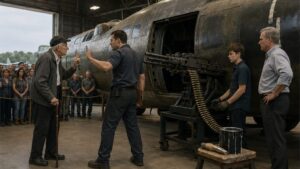
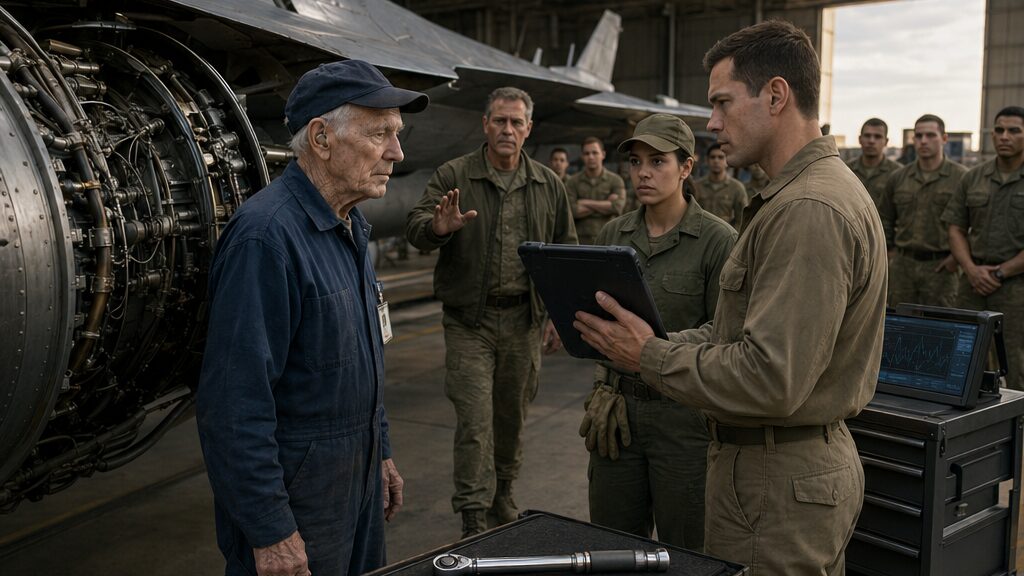
Technical Sergeant Steven Young said it loudly enough for the mechanics beneath the transport aircraft’s wing to hear. Several heads turned. One mechanic looked down at a parts tray. Another glanced at Thomas Moore, then quickly back at the open engine nacelle.
Thomas kept his hand against the cold gray housing.
The engine was shut down, its fan blades motionless, but the hangar still carried its own machinery: ventilation fans, rolling tool cabinets, compressed-air lines, distant metal striking metal. Beneath all that noise, Thomas had heard something smaller.
One clean metallic click.
Then, after a pause, another.
The second had been faint enough to feel through his fingers more than hear through his left ear.
Thomas removed his hand. “Rotate it again.”
Steven held a diagnostic tablet against his chest. His tan maintenance shirt was still sharply pressed despite three hours of troubleshooting. “No.”
“Same direction. Slow through the last fifteen degrees.”
“The vibration monitor flagged an intermittent sensor fault. We’re isolating the electrical side.”
“The sound came first.”
Steven’s mouth tightened. “You’ve been standing here for six minutes.”
“Long enough to hear the order of things.”
A few mechanics exchanged looks. Thomas saw the movement without turning his head. He knew the look. Young crews had worn different uniforms when he served, but the look had not changed: uncertainty shared sideways so no one had to admit it aloud.
Steven tapped the tablet. A jagged graph glowed across the screen. “The aircraft records vibration, then the sensor signal drops. That’s the discrepancy.”
“Does the vibration lead the sensor spike, or follow it?”
Steven’s thumb stopped above the display.
Thomas waited.
The exposed engine compartment smelled of hydraulic fluid, cleaning solvent, and warm metal left from the earlier run. It had been eleven years since he had stood this close to an operational aircraft. He had told himself he came only to deliver an envelope to the archive office. He had not planned to enter the hangar. He had not planned to touch anything.
Then he had heard the crew discussing an intermittent vibration.
Then he had heard the click.
Steven looked toward the diagnostics cart. “The recorded event is simultaneous.”
“Nothing mechanical is simultaneous.”
“It is at the resolution we use.”
“Then the resolution can’t answer the question.”
The nearest mechanic, a young woman with dark hair tucked beneath a cap, shifted toward the diagnostics cart. Her name tape read FLORES. She bent over the screen and moved two fingers apart, enlarging the timeline.
Steven noticed. “Airman Flores?”
“The timestamp intervals are twenty milliseconds,” she said. “Sergeant.”
“And?”
She hesitated. “And the spike and dropout fall inside the same interval.”
Steven’s gaze moved from her to Thomas. “That does not make his theory correct.”
“No,” Thomas said. “It means yours hasn’t answered mine.”
Silence opened around them.
Thomas wished immediately that he had phrased it differently. Not because it was untrue, but because truth delivered sharply could become another thing for a proud man to defend himself against.
Steven lowered the tablet. “Mr. Moore, you are here as a visitor.”
“I know.”
“You are not certified on this airframe.”
“I know.”
“Your last engine qualification expired before half this shift finished high school.”
A short breath of laughter came from somewhere behind the diagnostics cart. It died quickly.
Thomas looked toward the engine rather than toward the sound. The old embarrassment rose in him—not hot, not dramatic, but familiar. It was the same pressure that had kept him from calling the maintenance office for nearly a year. The same pressure that had let the envelope remain in his truck through three separate visits to the base gate.
He could leave.
That had always been his cleanest skill after retirement: knowing when he was no longer wanted and withdrawing before anyone had to say so twice.
Steven turned toward the crew. “Continue sensor isolation.”
A mechanic reached for the manual rotation bar.
Thomas heard Nancy’s voice, not as a ghost but as memory worn smooth from repetition.
You call it restraint when you’re afraid to ask twice.
He looked at the aircraft’s open nacelle. “Stop.”
The mechanic froze.
Steven turned slowly. “Excuse me?”
“The click came after the torque settled. If you rotate through it without marking position, you’ll lose where it happened.”
“We have electronic position data.”
“Then mark both.”
Steven stepped between Thomas and the engine. “You do not give instructions to my crew.”
Thomas felt every pair of eyes return to him. The right side of his face had begun to tighten, the way it did when he was tired and trying not to show it. He lowered his hand so no one would see the tremor in his fingers.
“I’m not trying to run your crew.”
“That is exactly what you’re doing.”
“I’m asking you not to erase a symptom before you understand it.”
Steven’s expression changed. The anger remained, but something underneath it sharpened—fear, perhaps, or the strain of someone who knew a deadline was moving closer.
A flight-line officer appeared at the edge of the maintenance bay. “Young, status?”
“Probable vibration-sensor failure. We’re confirming before replacement.”
“Departure is in under six hours. Medical team loads in four.”
“I’m aware.”
The officer nodded once and left.
Steven turned back to Thomas. “That aircraft is carrying a medical support team to meet a receiving window we cannot move. Every unnecessary delay costs someone else time.”
Thomas looked at the tablet, then at the torque wrench lying on a padded cart beneath the nacelle.
“I know what an unnecessary delay costs.”
Steven gave a brief, humorless smile. “Do you?”
Thomas almost answered.
He almost told him about engines opened on frozen ramps, crews waiting in darkness, aircraft that could not leave until one stubborn uncertainty had been chased to its source. He almost told him about the kind of mistake that survived because everyone in the room wanted the same answer.
Instead, he said, “Rotate it once by hand.”
“No.”
“One pass.”
“No.”
“Then at least compare the mechanical position to the signal sequence.”
Steven’s jaw flexed. “This is becoming an access-control issue.”
The words landed differently from the earlier mockery. They were official now.
Steven raised two fingers toward the hangar entrance. A security airman who had been speaking with the front-desk clerk looked over and began walking toward them.
Flores straightened from the diagnostic screen. “Sergeant, I could pull the raw—”
“Not now.”
Thomas stepped back from the engine. His heel caught slightly on the painted safety line, and for one humiliating second he had to steady himself against the tool cart.
No one laughed.
That was worse.
The security airman stopped several feet away. “Sir, I’m going to need you to come with me.”
Thomas nodded. “All right.”
He looked once more at the nacelle. The polished torque wrench lay beside Steven’s tablet—one tool built to feel resistance, the other built to record it. Neither was wrong. But neither had yet answered what came first.
Thomas turned toward the exit.
“Hold.”
The voice came from behind the assembled mechanics.
Senior Master Sergeant Robert King crossed the hangar floor in an olive maintenance jacket, his pace controlled but fast enough that people moved aside before he reached them. He took in the security airman, Steven’s rigid posture, Thomas’s visitor badge, and the open engine bay.
“What happened?”
Steven spoke first. “Unauthorized interference with an active discrepancy.”
Thomas said nothing.
Robert looked at him. “You’re Thomas Moore.”
It was not a question.
Thomas nodded once.
Robert’s eyes shifted to the engine. “What did you hear?”
Steven began, “Senior, we already—”
Robert raised one hand.
The gesture stopped the room.
Then he looked directly at Thomas.
“Repeat your question.”
Chapter 2: The Wrench Passed Into His Shaking Hand
Robert King picked up the torque wrench before Steven could object.
The tool was polished steel with a black adjustment grip, newer than any Thomas had used in service but balanced in the same familiar way. Robert held it across his palm for a moment, weighing not the metal but the decision attached to it.
Then he offered it to Thomas.
Steven stepped closer. “Senior, he is not current, and he is not authorized to perform maintenance.”
“He won’t perform maintenance.”
“You’re handing him a calibrated tool beside an open engine.”
“I’m allowing one supervised observation.”
“That distinction will not matter if something is damaged.”
Robert kept the wrench extended. “Then nothing gets damaged.”
Thomas looked at the tool.
The crew had formed a loose half circle around the nacelle. No one pretended to work now. Even the security airman remained near the safety line, uncertain whether the escort order still stood.
Thomas lifted his right hand.
The tremor began before his fingers closed around the wrench.
It was slight, but against polished steel every movement showed.
Steven saw it. So did everyone else.
Thomas nearly withdrew his hand. Robert did not pull the tool away or push it closer. He simply waited.
Thomas took it.
The weight settled into his palm, familiar enough to make the years between then and now briefly disappear. Then his wrist protested, and the present returned.
“Where?” Robert asked.
Thomas pointed toward an accessible fastener on the coupling support assembly. “Not to loosen. Not to tighten. Seat the head, hold steady pressure, and rotate the engine by hand.”
Steven shook his head. “The wrench is not an acoustic probe.”
“No,” Thomas said. “It’s a path.”
“For what?”
“Movement.”
Steven glanced at Robert. “This is what I meant. He is applying an old technique to an assembly with a digital vibration system designed specifically to detect—”
“Sergeant Young,” Robert said, “you have made your objection part of the record.”
Steven stopped.
Robert looked back at Thomas. “Proceed.”
A mechanic fitted the manual rotation bar. Flores moved to the diagnostic cart and brought up shaft position. Thomas stepped beneath the nacelle and raised the wrench.
His shoulder stopped halfway.
Pain caught deep beneath the joint, not sharp enough to make him cry out but firm enough to deny him the angle. He lowered the wrench, changed grip, and tried again.
The tremor worsened.
He could feel Steven watching him.
Thomas set his jaw and attempted to seat the socket on the fastener. It slipped against the metal.
A small sound came from the back of the group—a shoe shifting, nothing more. Still, heat climbed Thomas’s neck.
He had built his life around hands that obeyed him. Hands that could judge torque before a wrench clicked, find a dropped washer in darkness, read wear by touch through a glove.
Now the tool shook against the housing.
Robert took one step forward. “We can stop.”
“No.”
The answer came too quickly.
Thomas breathed through his nose. Pride wanted him to force the angle until his shoulder failed in front of them. Pride had always been clever enough to dress itself as discipline.
He looked toward Flores.
“Airman.”
She straightened. “Sir?”
“Your hands are steadier than mine.”
The admission altered the room more than the tremor had.
Thomas held out the wrench. “Seat it on that fastener. Keep light clockwise pressure. Don’t chase the handle if it moves.”
Flores glanced toward Steven.
He gave no permission.
Robert did. “Do it.”
She pulled on gloves and stepped beneath the nacelle. Thomas guided her wrist without touching it at first.
“Higher. There. Let the socket settle.”
She seated the wrench.
“Pressure?”
“Light.”
“Lighter.”
She eased back.
Thomas placed two fingers against the shaft of the wrench. His weathered hand rested above her gloved one, not controlling it, only feeling what passed through the metal.
“Rotate,” Robert ordered.
The mechanic at the bar began turning the engine.
The wrench moved almost imperceptibly with the assembly. Thomas watched the shaft-position marks advance on Flores’s screen.
“Slower,” he said.
The mechanic slowed.
Thomas closed his right eye. He tilted his head, presenting his better ear toward the housing. His hearing aid amplified too much of the hangar—the ventilation, a rolling cart, fabric moving—but through his fingertips came the cleaner information.
A tightening sensation.
Release.
Click.
“Stop.”
The engine halted.
Thomas kept his fingers in place.
“One,” he said.
Steven crossed his arms.
Thomas counted silently.
One second.
Two.
Three.
Tick.
Flores’s gloved hand twitched.
“You felt it,” Thomas said.
Her eyes widened. “Something moved.”
“Sound or movement?” Steven asked.
“I’m not sure.”
“That matters.”
“I know, Sergeant.”
Thomas looked at the shaft-position display. “Mark the angle.”
Flores entered the position.
Steven stepped to the diagnostic cart. “No vibration event. No sensor dropout. Nothing outside baseline.”
“It isn’t under load,” Thomas said.
“You claimed the sound itself indicated a dangerous condition.”
“I said it indicated movement after torque settled.”
“You said stop the rotation.”
“Because you hadn’t marked where it happened.”
Steven lifted the tablet so Robert could see. “There is no corresponding electronic anomaly.”
Thomas removed his fingers from the wrench. The tremor returned once his hand no longer had a task.
“Rotate back five degrees,” he said.
Steven gave a short laugh. “We got your demonstration.”
Thomas looked at Flores. “Did you?”
She studied the wrench, then the marked position. “I felt a rebound.”
“Mechanical play,” Steven said. “Normal within tolerance.”
“Then it should repeat predictably,” Thomas said.
Robert nodded to the mechanic at the rotation bar.
They backed the engine five degrees and approached the marked position again.
Click.
Thomas counted.
Nothing followed.
Steven exhaled through his nose.
Thomas kept waiting until five seconds passed.
“Again,” he said.
On the third pass, the first click came at the same position.
Three seconds later, the faint tick followed.
Flores looked at Thomas before anyone else.
“You heard that one?” he asked.
“Barely.”
“Where?”
“Through the wrench.”
Steven moved beside her and placed two fingers against the shaft. “Rotate it.”
They repeated the sequence.
No second tick.
Again.
Nothing.
The uncertainty returned stronger than before. Thomas could see it moving through the crew. The sound existed, but refused to perform on command. That made it dangerous or meaningless. There was no comfortable category between.
Steven removed his hand. “Intermittent looseness would show in the vibration trace.”
“Under the right condition.”
“We do not invent conditions to preserve a theory.”
Thomas lowered his gaze to the wrench. “No. We reproduce the condition that produced the symptom.”
“And what condition is that?”
Thomas did not answer immediately.
He knew part of it. Load, heat, torque settling across a surface that no longer met evenly. But he did not yet know whether this engine carried the same coupling design as the one in his memory. He did not know whether the sound came from the same failure or from something harmless that merely resembled it.
Saying too much would be guessing.
Saying too little would let them dismiss it.
“I need the assembly history,” he said. “Part changes, torque events, removals.”
Steven’s expression hardened again. “You need access to maintenance records you are not cleared to view.”
“Then you view them.”
“I already have.”
“Look for the pattern, not the component.”
“What pattern?”
“Work done near the coupling before the vibration began.”
Steven tapped the tablet several times, then turned it toward Robert.
“Manual rotation check completed forty-eight hours ago. Same procedure. No abnormal movement, no secondary sound, no discrepancy.”
The fault log showed a green completion mark.
Beneath it was the recorded name of the inspector.
Flores leaned closer. “It passed?”
Steven looked at Thomas. “Two days ago.”
Thomas stared at the entry.
If the check had been properly performed, then either the condition had developed quickly, or what he heard had nothing to do with the old failure at all.
The wrench felt heavier in his hand.
Steven took it back, carefully rather than triumphantly.
“This engine was manually inspected by certified personnel,” he said. “It passed.”
Around them, the mechanics began to move again, relieved to have a record more solid than an old man’s uncertain sound.
Thomas looked at the green check mark and wondered whether he had returned to warn them—or merely to hear the past repeating where it did not belong.
Chapter 3: The Sensor Failed, but the Sound Remained
The test bench displayed one word in a red box.
FAILED.
No one said anything for several seconds.
The vibration sensor sat clamped beneath a transparent shield, wires leading from its housing to the diagnostic console. A technician repeated the electrical sweep. The signal climbed smoothly, faltered, then dropped into static.
FAILED appeared again.
Steven stood with both hands on the edge of the bench. He did not look toward Thomas immediately. He verified the connector, requested a second lead, and ran the test a third time.
The result did not change.
“Intermittent internal fault,” the engine-shop chief said. “Signal loss under vibration. Replace the unit.”
Steven straightened. Only then did he turn.
Several mechanics turned with him.
Thomas stood near the back wall of the engine shop, his visitor badge resting crooked against his blue coveralls. The room smelled of solder, rubber insulation, and hot dust from electronic equipment. He had followed only because Robert asked him to see the bench result.
Now the result seemed to close the question.
Steven’s diagnosis had been right.
At least partly.
Robert looked at Thomas. “Thoughts?”
It would have been easy to protect himself.
He could have said a defective sensor did not explain the click. He could have pointed out that one confirmed fault did not exclude another. Both statements were true.
But truth used as armor could still become dishonesty.
Thomas stepped closer to the bench. “Sergeant Young found a real fault.”
Steven’s expression changed slightly.
Thomas nodded toward the failed sensor. “That unit cannot be trusted.”
The engine-shop chief began writing the replacement order.
A mechanic near the door shifted, perhaps disappointed that the old man had not produced a hidden correction. Thomas felt the room’s attention loosen. People returned to useful work.
Flores remained where she was.
Steven studied Thomas. “You agree the sensor caused the recorded discrepancy?”
“I agree it caused unreliable data.”
“That was the discrepancy.”
“That was one discrepancy.”
Robert raised an eyebrow. “And the sound?”
“I don’t know yet.”
The admission sat plainly between them.
Steven’s shoulders lowered by a fraction. “Then we replace the sensor and retest.”
“Yes.”
The answer surprised him.
“You’re not objecting?”
“Not to replacing a failed part.”
Steven glanced at the engine-shop chief, then back to Thomas. “But you still believe there is mechanical movement.”
“I believe Airman Flores felt something through the wrench. I heard something twice. That deserves an explanation.”
“Intermittent sensor noise can be transmitted through the housing.”
“Perhaps.”
“It can.”
Thomas nodded. “Then the sound should disappear when the failed sensor is removed.”
Steven looked as though he wanted to argue, but the proposition was too simple.
“Fine,” he said. “We’ll repeat manual rotation after removal.”
The replacement process began at once. The medical mission deadline had pulled every movement tight. Tools were signed out, connectors capped, serial numbers checked, and a new sensor brought from controlled storage.
Thomas watched Steven work.
The younger man did not rush with his hands, despite the urgency in his face. He verified each identifier twice. He required Flores to read the old serial number aloud before removal and the new one before installation. His precision was not performance. He knew his work.
That made the public insult harder to dismiss as simple arrogance. Steven had built confidence on competence, and Thomas’s interruption had challenged both in front of his crew.
Thomas understood the instinct.
Understanding did not excuse it.
The old sensor came free. Before the replacement was installed, Steven ordered a manual rotation.
Flores returned to the torque wrench. This time, Steven stood beside her and watched the shaft-position display himself.
They approached the marked angle.
Click.
Thomas waited.
No second sound.
Again.
Click.
Nothing followed.
Steven looked toward him but said nothing.
On the third pass, Thomas heard a faint metallic tick from somewhere inside the housing. It came too quickly this time, almost on top of the first sound.
“Stop,” he said.
Steven checked the display. “No abnormal trace.”
“The sensor is disconnected,” Flores said.
“All the more reason there would be no trace.”
Thomas moved closer, though he remained behind the marked boundary. “Did you feel movement?”
Flores flexed her fingers inside the glove. “I don’t know.”
Steven’s patience thinned. “You need to know before you call it a finding.”
“I said I don’t.”
“Then it isn’t one.”
Thomas saw her face close.
The same thing happened in shops everywhere: uncertainty was treated as weakness until people learned to hide it. Then hidden uncertainty became risk.
“Not knowing is a finding,” Thomas said. “It tells you what to test next.”
Steven turned. “And how many tests do we run for something no instrument detects and no one can reproduce reliably?”
“As many as the consequence justifies.”
“The consequence of delaying this aircraft is not theoretical.”
“Neither is releasing one with an unexplained mechanical sound.”
Robert stepped between them before the exchange hardened. “Enough. Install the new sensor. Full functional check. If it passes, we review all remaining observations before release.”
Steven nodded, though not willingly.
Thomas backed away.
During installation, he sat on a metal chair near the shop entrance. His shoulder had begun to ache from the failed reach beneath the nacelle. He pressed his palm against it and watched Flores route the new wiring under Steven’s supervision.
For several minutes, no one spoke to him.
That was how irrelevance arrived—not through insult, but through the resumption of work around you.
He considered leaving before the functional check. The envelope remained in his truck, still unopened by the archive office. Inside it was a maintenance card older than Steven, folded along lines softened by decades. Thomas had brought it because Nancy once told him that knowledge locked in a drawer was only another kind of fear.
He had not yet taken it out.
The new sensor passed bench verification. Steven signed the installation entry and ordered the aircraft prepared for retest.
“The discrepancy stays open until the run,” Robert said.
Steven nodded. “But the failed component explains the recorded event.”
Robert looked toward Thomas.
Thomas stood carefully. “It explains enough to test.”
Not enough to close, he thought, but he did not say it.
Steven gathered the records. “We’ll proceed without further visitor involvement.”
Robert did not contradict him.
Thomas accepted that. He had no authority there. He had offered an observation; they had found a failed part. Perhaps memory had supplied the rest.
He walked back through the hangar while the crew prepared the aircraft. At the exit, he stopped beside the cart where the torque wrench had been returned to its fitted case.
The lid was open.
He looked at the polished shaft, then closed the case without touching it.
“Mr. Moore.”
Flores had followed him.
Thomas turned.
She glanced behind her to make sure no one was within easy hearing. “When we rotated it after the sensor came out—”
“You weren’t sure.”
“I am now.”
Thomas waited.
She lowered her voice. “I felt the second click.”
“The fast one?”
“No. After that. Steven had already looked at the display.”
Thomas’s hand tightened around the folded edge of his visitor badge.
“How long after the first?”
“About three seconds.”
The same interval.
The same settling pause.
And the failed sensor had not even been connected.
Thomas looked past her toward the aircraft, where the replacement unit was already being wired into a system preparing to declare the engine healthy.
“Did you tell Sergeant Young?”
Flores’s silence answered first.
“He’s doing my evaluation next month,” she said. “And we already found the fault.”
Thomas looked at her until she met his eyes.
“No,” he said. “You found a fault.”
Behind them, the hangar loudspeaker announced the scheduled engine-run window.
Flores swallowed. “What makes a second click happen after the torque is already set?”
Thomas thought of the envelope in his truck.
Of an older engine.
Of a young mechanic on a concrete floor.
Of a maintenance note that had never traveled as far as it should have.
“I need to show you something,” he said.
Chapter 4: The Inspection Card He Never Turned In
Emma found Thomas sitting in his truck with the envelope torn open across the steering wheel.
The card inside was smaller than she expected, a rectangle of yellowed stock folded twice and softened at the creases. Pencil marks crowded the front in block letters. Two dark taps sounded when Thomas touched it with his forefinger.
Once.
Then again.
Emma stood outside the open driver’s door. “Is that about the coupling?”
Thomas did not answer.
Beyond the parking lot fence, the hangar doors stood open. A tow vehicle crossed the strip of visible concrete, dragging a maintenance cart toward the aircraft. The crew was already moving on without him.
Emma leaned closer, but not close enough to read the card. “You said you needed to show me something.”
“I said that before I remembered why I kept it.”
“Why did you?”
Thomas refolded the card.
The motion was careful, nearly ceremonial. Emma watched him slide it toward the envelope.
“If you put it away again,” she said, “the engine still makes the sound.”
He stopped.
She seemed surprised by her own boldness. Her gaze dropped to the pavement, then rose again.
Thomas looked at the maintenance card. Across the top, beneath a faded form number, he had written three words nearly forty years earlier:
POST-TORQUE SECONDARY MOVEMENT.
The phrase had once seemed precise. Now it looked like a warning that had spent too long waiting for someone to read it.
“This came from another engine,” he said.
“Same family?”
“An earlier series.”
“Same problem?”
“I don’t know.”
Emma folded her arms against the air-conditioned chill spilling from the cab. “But you think it could be.”
Thomas stared through the windshield. In the glass he could see his own reflection layered over the hangar: blue cap, lined face, visitor badge. He looked like a man observing a place he no longer belonged inside.
“An engine came back from overhaul with an intermittent vibration,” he said. “Nothing dramatic. The numbers moved, then settled. We found a sensor connection that wasn’t perfect, replaced it, and called the discrepancy corrected.”
Emma’s expression changed.
“That sounds familiar.”
“It should.”
“What happened?”
Thomas rubbed his thumb over the edge of the card.
“We heard a second movement during torque verification. Not every time. Only after the load shifted across the coupling face.”
“And you opened it?”
“Not soon enough.”
The words narrowed the air between them.
Emma waited.
Thomas could have stopped there. He had practiced stopping there for decades. A technical detail could be shared without the failure attached to it. A lesson could be presented cleanly, stripped of the person who had paid for it.
But Emma had already admitted her own silence.
So Thomas said, “A young mechanic was beneath the assembly when it shifted during a powered check. He survived. His shoulder never worked the same afterward.”
Emma looked toward the card.
“Were you in charge?”
“Yes.”
“Did you miss the sound?”
“No.”
That answer was harder than the others.
“I heard it,” Thomas said. “I let the sensor replacement count as an explanation because the schedule wanted one. After the injury, we reproduced the movement. The coupling face was fretting beneath a surface that looked serviceable.”
He unfolded the card again. A hand-drawn arc marked the rotational range. Beside it, a note instructed the mechanic to apply load, reach torque, then wait three seconds before observing rebound.
“We wrote an inspection step,” Thomas said. “It was supposed to go forward with the incident package.”
“Did it?”
“It went into a local binder.”
“Not the formal manual?”
“No.”
“Why not?”
Thomas’s fingers stiffened around the paper. “The engine series was being phased out. The investigation classified the injury under procedural positioning. The coupling damage was listed as contributory, not primary.”
“That isn’t what I asked.”
He looked at her.
Emma held his gaze despite the rank she did not have and the years between them.
“Why didn’t you push it?” she asked.
Thomas heard Nancy again, seated at their kitchen table years after his retirement, watching him place the same card into a drawer.
You keep waiting for someone to ask the exact right question.
“I told myself the report had gone where reports go,” he said. “I told myself the engineers knew more than I did. Mostly, I was tired of saying that I had heard it before someone got hurt.”
Emma’s eyes moved over the faded writing. “So you kept the card.”
“And did nothing useful with it.”
“That’s not the same as nothing.”
“It is to the person who never received it.”
The hangar loudspeaker crackled in the distance, announcing preparation for sensor installation verification.
Emma pointed to the card. “The part number won’t match.”
“No.”
“Steven will use that.”
“He should.”
She frowned. “You agree with him?”
“An old note for a different component is not proof.”
“Then what is it?”
“A reason to look.”
Thomas stepped out of the truck. His knees objected when he straightened. Emma pretended not to notice, which he appreciated less than he would have appreciated an offered hand.
They crossed to the records building beside the hangar. The archive office occupied a narrow room filled with terminals and sealed cabinets. A civilian clerk examined Thomas’s visitor authorization, then allowed Emma to search while he remained beyond the counter.
Emma entered the old coupling number.
No current match.
She searched supersession records. The number had been replaced twice, then absorbed into a larger assembly designation.
“Dead end,” she said.
“Open the engineering drawing reference.”
“That’s restricted.”
The clerk leaned toward the monitor. “I can display lineage data. No technical dimensions.”
Emma requested it.
A branching diagram appeared. The older coupling assembly split into several revised units, then converged under the transport engine’s current designation.
Thomas moved closer to the counter.
“Geometry note,” he said.
Emma opened a short metadata field.
COUPLING INTERFACE GEOMETRY RETAINED. MATERIAL AND COATING REVISED.
She read it twice.
“The part number changed,” she said, “but the mating geometry didn’t.”
The clerk looked from the screen to Thomas. “That enough for what you need?”
Thomas shook his head. “Enough to ask for an inspection.”
Emma photographed the lineage screen through the approved records function and attached it to a maintenance observation draft. Then she paused over the submit command.
“If I send this, Sergeant Young sees I withheld the click.”
“Yes.”
“He could write me up.”
“Yes.”
She looked at Thomas. “You could submit it.”
“No clearance.”
“You could ask Senior King.”
“I could.”
“But you want me to.”
Thomas considered denying it. The truth was less flattering.
He wanted her to do what he had failed to do: place uncertainty into the record while it could still matter.
“I want you to decide whether what you felt belongs in the record,” he said.
Emma stared at the screen, then pressed submit.
The observation entered the maintenance system under her name.
Her face went pale after it was done.
Thomas folded the card and placed it on the counter rather than returning it to his pocket.
“Scan this too,” he told the clerk.
The clerk positioned it beneath the document camera.
As the image appeared on the monitor, Thomas’s phone rang.
Robert King.
Thomas answered.
“The new sensor is installed,” Robert said. Behind his voice came the hollow noise of the hangar. “Functional check is clean.”
Thomas looked at Emma.
Robert continued, “The aircraft passed diagnostics. We’re preparing for the engine run now.”
Thomas gripped the counter.
“How long?”
“Fifteen minutes.”
The old card was still under the scanner when Thomas turned toward the door.
Chapter 5: A Clean Screen Became the Most Dangerous Answer
The vibration display turned green just as the medical mission coordinator said, “The receiving hospital cannot hold the operating window any longer.”
The words crossed the hangar control station without volume, but everyone heard them.
On the main screen, the newly installed sensor produced a smooth baseline. No dropout. No spike. No warning code. The engine diagram glowed with clean status indicators.
Steven stood beside the console with the installation record open. “New sensor verified. Wiring continuity good. Manual rotation within published limits.”
Thomas entered from the hangar floor with Emma behind him.
Steven saw the maintenance card in Thomas’s hand and looked at Emma’s face. His eyes narrowed before he checked his tablet.
“You entered an additional observation.”
“Yes, Sergeant.”
“After the component was removed.”
“Yes.”
“You failed to report it when it occurred.”
Emma swallowed. “I wasn’t certain then.”
“And now?”
“I’m certain I felt movement three seconds after the first click.”
Steven looked toward Thomas. “Because he showed you an old card?”
“Because the sensor wasn’t connected when it happened.”
The mission coordinator stepped closer. “Is there a new discrepancy or not?”
Robert answered before Steven could. “There is an unverified observation.”
“We already lost twenty minutes on an unverified observation.”
Thomas looked at Robert.
Robert met his eyes briefly, and Thomas understood. The earlier delay had not come from the sensor replacement. Robert had held the clearance after the confrontation, buying time without publicly saying why.
Steven pulled up the raw event data. “The original sensor failed bench testing. Replacement output is stable. The aircraft now meets every published requirement.”
Thomas placed the scanned card and lineage record beside the keyboard.
“Except the sound.”
Steven did not raise his voice. “The sound did not repeat during the final low-speed rotation.”
“That does not make it gone.”
“It makes it unconfirmed.”
“The old coupling did the same thing.”
“The old coupling is not this coupling.”
“The interface geometry was retained.”
“With different materials, different coating, different service history, and decades of design review.”
All true.
Thomas felt the familiar temptation to retreat into implication—to say only enough that someone else would have to choose. But the engine-run crew was already approaching the aircraft. The open hangar doors framed the transport like a decision nearly made.
“The failed sensor explains the bad signal,” Thomas said. “It does not explain movement through the wrench after the sensor was disconnected.”
Steven’s eyes flicked toward Emma.
She remained still.
Robert addressed Steven. “You reviewed the high-resolution sequence?”
A pause.
“Yes.”
“And?”
Steven turned the tablet so only Robert and Thomas could see. The event had been expanded beyond the standard maintenance display. Two markers sat less than a twentieth of a second apart.
“The mechanical vibration begins first,” Steven said quietly. “Approximately six milliseconds before signal instability.”
Thomas studied him. “You checked.”
“After you asked.”
“That matters.”
“It does not establish coupling failure. A degrading sensor can respond irregularly to normal vibration.”
Thomas nodded. “Also true.”
Steven looked irritated by the agreement.
The mission coordinator checked the clock. “Can the engine run safely?”
Steven looked toward the aircraft.
For the first time, Thomas saw not arrogance but the shape beneath it: a man holding responsibility in front of everyone who would later judge how he carried it.
Steven’s thumb moved across the tablet. “A controlled ground run is the approved next step.”
Robert asked, “Your recommendation?”
Steven hesitated.
Only for a breath.
“Proceed.”
He signed the engine-run recommendation.
Thomas watched the signature appear.
The aircraft was towed into the run bay. Crew members cleared the area, secured equipment, and established headset communications. Thomas remained in the control station behind reinforced glass. Emma took a position near the monitoring console with Steven.
At low power, the new sensor trace stayed smooth.
The engine’s sound filled the structure, more pressure than noise through the glass. Thomas watched the readouts while feeling the vibration in the floor.
“Stable,” Steven said over the intercom.
Power increased.
The screen remained green.
The mission coordinator released a breath. Robert did not.
Thomas searched the trace for something the display had not been built to emphasize. The numbers were clean. The trend lines held.
Perhaps the card belonged to another engine and another mistake.
Perhaps he had mistaken grief for pattern recognition.
Power returned to idle.
No alert appeared.
Steven removed one side of his headset. “No vibration event. No signal loss.”
The medical coordinator asked, “Can we close?”
Thomas looked toward Emma.
She was staring at the engine-position overlay.
“Not yet,” he said.
Steven’s face hardened. “On what basis?”
Thomas had none that the screen would accept.
The run crew began preparing for one final higher-load verification. Robert leaned toward Thomas.
“I can hold them for five more minutes,” he said under the engine noise. “After that, I need something concrete.”
Thomas glanced at the old card. The instruction required load across the coupling, then torque verification after settling. A normal run might produce the movement but not preserve it long enough to inspect.
“Can you capture phase timing between shaft position and vibration onset?” he asked.
Steven answered without turning. “Yes.”
“Then capture it at the highest approved ground-load point.”
“That is already part of the run.”
“Not at the resolution you showed me.”
Steven looked over.
Thomas said, “You checked once. Check again where the condition is strongest.”
For several seconds Steven said nothing. Then he adjusted the acquisition settings.
The engine rose in power.
The floor trembled beneath Thomas’s shoes. The green trace climbed within limits. Shaft position streamed across the secondary screen.
Emma pressed one side of her headset tighter to her ear.
Her body went rigid.
“There,” she said.
Steven looked at the data. “No alert.”
Emma raised her voice. “There—again.”
One second later, the vibration line jumped.
Not far. Not beyond the shutdown threshold.
But enough.
Robert’s hand came down on the abort control.
The engine spooled toward idle as the green display flashed amber.
Emma turned from the console, face drained of color.
“I heard the second click before the spike.”
Chapter 6: The Second Click Returned Under Power
“There—again” was still echoing through the headset when the vibration trace rose.
Robert stopped the run before the warning crossed the automatic threshold.
The engine wound down with a long metallic whine, its power bleeding into the reinforced walls. On the screen, the amber event marker remained fixed over a narrow rise in the graph.
Steven replayed the sequence once.
Then again.
Emma stood beside him, one hand still pressed against her headset.
“The sound was before that,” she said.
“How far before?” Robert asked.
“I don’t know. About a second.”
Steven enlarged the recording. “Audio isn’t synchronized to engineering time.”
“But shaft phase is,” Thomas said.
Steven opened another channel. The display filled with position data, vibration amplitude, and sensor output.
The mission coordinator appeared in the control-room doorway. “Was that an exceedance?”
“No,” Steven said.
“Then why did you abort?”
Robert answered. “Unexplained event.”
The coordinator’s frustration showed, but he kept his voice controlled. “The aircrew needs a release decision.”
“You’ll have one when we have one.”
After the engine cooled enough for approach, the crew returned to the nacelle. The second click did not occur during the first manual rotation.
Nor the second.
Steven stood at the diagnostics cart. “Whatever happened under power is gone.”
Thomas unfolded the old card on the padded tool surface.
“That is what the note predicts.”
Steven leaned over it. “It predicts a lot in very little handwriting.”
Thomas pointed to the lower margin. “Load must be carried through the interface before verification. After shutdown, the surface relaxes. Ordinary rotation may look normal.”
The words were faded but legible:
CONDITION MAY DISAPPEAR AFTER LOAD REMOVAL.
Steven read them twice.
“This is not an approved procedure.”
“No.”
“It has no engineering validation.”
“No.”
“It came from a different engine.”
“Yes.”
Each answer seemed to make him angrier.
“Then why are we treating it like authority?”
“We aren’t,” Thomas said. “We’re treating it like a description of what just happened.”
Steven straightened.
Emma fitted the torque wrench to the same accessible fastener. Thomas asked the rotation mechanic to approach the marked shaft angle slowly.
Click.
They waited.
Nothing.
Steven gestured toward the engine. “No rebound.”
“Apply controlled resistance to the shaft,” Thomas said.
Robert frowned. “Within published manual limits?”
“Yes. No more.”
The mechanic adjusted the rotation bar while another held counterpressure. Emma brought the wrench to torque.
Click.
Thomas counted.
One.
Two.
Three.
The pointer moved backward less than the width of a pencil line.
Tick.
Emma looked up. “It rebounded.”
Steven was already checking the position feed. “Again.”
They repeated it.
This time the movement was smaller, but visible.
Thomas’s pulse quickened. “Mark the angle before it relaxes.”
Emma made the mark.
Steven returned to the control room with the captured data. Thomas followed more slowly, his shoulder burning and his right hand trembling from the tension of holding it still.
At the console, Steven overlaid the high-load run with shaft-phase timing. He aligned the events, corrected for acquisition delay, and stared at the result.
“The phase shift begins before the sensor response,” he said.
“How far?” Robert asked.
“Eight milliseconds in the first event. Eleven in the second.”
The failed sensor had made the old data unreliable, but the new sensor had confirmed the order.
Movement first.
Signal second.
Thomas rested one hand on the back of a chair.
The room should have felt like vindication. Instead he saw the old maintenance bay in memory—the wrong one, decades earlier. A younger mechanic beneath an engine. A sound everyone had agreed was probably nothing because another fault had already been found.
Robert noticed his face. “Thomas?”
“There was an injury.”
No one spoke.
Thomas looked at the old card. “The first time I heard this pattern, we replaced a bad sensor too. Then we accepted the clean reading.”
Steven’s gaze dropped.
“A mechanic was positioned under the assembly during the next powered check,” Thomas continued. “The interface shifted. It did not separate, but the movement drove him into the support frame.”
Emma lowered the wrench.
Steven asked, “You were the lead?”
“Yes.”
“Did the investigation identify the coupling?”
“As contributory.”
“And this procedure?”
“Stayed local.”
“Because engineering rejected it?”
“Because I stopped pushing after the report closed.”
The admission left no place to stand above Steven.
Thomas had not mocked anyone, but he had made his own version of the same choice: allowing a partial explanation to become the final one because pressing further carried a cost.
The mission coordinator entered again. “Another aircraft can take the team tomorrow morning. That misses the receiving window tonight but preserves the mission. I need to know whether to initiate transfer.”
Robert looked at Steven. “Can we condemn the coupling from this data?”
“No,” Steven said. “We have an abnormal phase event. We do not have visual damage, dimensional failure, or an approved limit tied to this observation.”
“Can we clear it?”
Steven looked at Thomas before answering. “Not confidently.”
It was the first time he had said uncertainty aloud in front of the group.
Robert turned to Thomas. “What inspection would confirm it?”
Thomas pointed toward the coupling access area.
“Open the interface.”
The engine-shop chief shook his head. “That is not a quick look. We break torque, document position, remove the support hardware, and inspect the mating face. If nothing is there, we have created a major maintenance action on a serviceable engine.”
“And the access?” Robert asked.
“Tight. One person in the nacelle.”
Thomas knew what Robert was about to ask.
He looked into the open compartment. The required fastener sat beyond a narrow structural brace. Forty years ago, he could have reached it without thinking. Now his shoulder would not clear the angle, and his hand could not hold the tool steady enough for controlled removal.
“I can’t do it,” he said.
Steven’s expression shifted.
Thomas forced himself to continue. “My shoulder won’t reach. My hand won’t hold that line under load.”
No one rescued him from the statement.
He pointed to Emma. “She can.”
Emma glanced toward Steven.
“And Sergeant Young can capture phase and torque movement,” Thomas said. “I can tell them what sequence to use.”
Steven folded his arms. “A sequence that is not approved.”
“A sequence that must be documented as an engineering-assisted inspection before anyone touches the coupling.”
Robert said, “That takes authorization.”
“Yes.”
“And grounds the aircraft until inspection is complete.”
“Yes.”
The mission coordinator looked at the clock, then left to begin the transfer request.
Robert picked up the advisory form. “I need a written recommendation.”
The form offered three options: release, continued monitoring, or grounding pending inspection.
Robert placed it before Thomas. “You initiated the concern. Sign as technical adviser.”
Thomas read the language.
Continued monitoring would preserve options. It would also allow the aircraft to remain technically available while leadership considered the transfer. The wording was safe for everyone except the people who might fly it.
He took the pen, but did not sign.
“Open the coupling,” he said.
Robert’s eyes held his. “Without confirmed damage?”
“Without confirmed safety.”
“That is not the same standard.”
“No. It is the reason inspections exist.”
Steven looked at the green-and-amber trace, then at the old card.
Robert waited.
Thomas set the pen down.
“I will not put my name on monitoring,” he said. “Not after hearing the same order of events twice.”
The choice moved out of Thomas’s hands and into Robert’s.
If Robert released the aircraft, he would do it without Thomas’s signature. If he grounded it, the mission would transfer and the maintenance chain would answer for the delay.
Robert drew the form toward himself.
Then he marked the final box.
Grounded pending coupling inspection.
Chapter 7: He Could Not Reach the Bolt, So He Taught Them
Thomas looked into the open nacelle and measured the distance with his eyes before anyone offered him the wrench.
The coupling sat beyond a structural brace, half concealed by lines and support hardware. To reach the fastener, a mechanic had to turn one shoulder inward, extend an arm past the elbow, and keep the tool aligned while someone outside monitored the angle.
Forty years earlier, Thomas would have climbed in without thinking.
Now his shoulder had already answered for him.
“I can tell you where to put your hands,” he said. “Mine won’t make it in there anymore.”
No one contradicted him.
Emma stood beside the access platform in fresh gloves. Steven had positioned the diagnostic cart within sight of the nacelle and connected an independent angle sensor to the torque wrench. Two maintenance inspectors waited behind the marked boundary, one carrying the disassembly checklist and the other documenting every tool and seal.
Robert remained near the aircraft, grounding order clipped to a board beneath his arm.
The transferred medical team was already being moved to another aircraft. That decision had purchased time, but not comfort. If the inspection found nothing, the missed receiving window would remain real.
Steven opened the approved engineering assistance package. “We break torque only after recording installed position. No removal beyond the support hardware unless inspection criteria justify it.”
Thomas nodded. “And no forcing the fastener if it binds.”
“I know.”
Thomas met his eyes. “Then we agree.”
Steven looked away first, but not angrily.
Emma climbed onto the platform and eased herself into the nacelle. Only her boots and lower legs remained visible once she reached the coupling.
“Can you see the reference mark?” Thomas asked.
“Yes.”
“Describe it.”
“A white line across the fastener head and flange. Slightly offset.”
“How slight?”
Emma leaned closer. “Less than a millimeter.”
Steven checked the previous maintenance image. “Matches the recorded position.”
“Good,” Thomas said. “Seat the wrench.”
Metal touched metal inside the compartment.
“Seated.”
“Do not pull yet. Let your wrist settle behind the handle.”
Emma adjusted.
Steven watched the angle sensor. “Zeroed.”
Thomas stood beneath the nacelle, his right hand moving unconsciously through the sequence his body could no longer perform. Seat. Align. Load. Wait.
“Apply pressure until the wrench reaches the existing torque point,” he said. “No breakaway.”
Emma pulled.
The digital angle trace climbed.
Click.
“Hold,” Thomas said.
The whole group waited.
One second.
Two.
Three.
Nothing moved.
Steven studied the display. “No rebound.”
Thomas asked Emma to release and repeat the sequence.
Again the wrench clicked.
Again the angle held.
The inspectors exchanged a glance.
On the third attempt, the result remained clean.
Steven lowered the tablet. “We have reproduced the condition under manual counterload twice before. Now it is absent.”
“The assembly has cooled longer,” Thomas said.
“And the note says the condition may disappear.”
“Yes.”
“That makes it impossible to disprove.”
Thomas heard the accusation beneath the technical language.
“You’re right.”
Steven frowned.
“If a procedure only confirms itself when it works and excuses itself when it doesn’t,” Thomas continued, “it is not much of a procedure.”
Emma remained motionless inside the nacelle.
Robert asked, “What changes?”
Thomas looked at the old card clipped beside the modern checklist. The hand-drawn arc showed the mistake he had made years ago. They had applied load across the shaft, then removed it before checking final torque. The movement had appeared in the interval between conditions.
“We’re separating the steps,” he said.
Steven shook his head. “Engineering approved the sequence as submitted.”
“I submitted the sequence from memory.”
The admission cost him.
Thomas pointed toward the rotation bar. “The coupling has to carry load while she verifies the fastener. Not before. Not after.”
The engine-shop chief said, “That complicates tool control.”
“Yes.”
“It also increases the chance of side-loading the fastener.”
“Unless the resistance is kept below the manual limit.”
Steven studied the setup. “We can monitor shaft force.”
Robert looked at him. “Safe?”
“If everyone holds position exactly.”
Thomas waited for Steven to object.
Instead, Steven began assigning tasks.
The rotation mechanic took the bar. A second mechanic attached the load gauge. Emma reset the wrench. Steven positioned himself where he could see both the angle trace and the shaft-force display.
Thomas stood between them, unable to touch the assembly yet responsible for the order in which every hand moved.
“Take up resistance,” he said.
The load gauge climbed.
“Hold there.”
Emma seated the wrench.
“Pull slowly.”
The handle moved.
Click.
“Maintain shaft load,” Thomas said. “Emma, keep steady pressure. Do not chase the pointer.”
One second.
Two.
Three.
Tick.
The wrench pointer rebounded.
Emma inhaled sharply. “I saw it.”
Steven leaned toward his display. “Point eighteen degrees.”
“Mark it,” Thomas said.
Emma marked the fastener and flange.
“Again.”
They repeated the load.
The wrench reached torque, paused, and moved backward.
Point twenty-one degrees.
The same second click followed through the metal.
No one in the hangar mistook it for memory now.
Steven saved the trace. “We have repeatable post-torque movement under maintained shaft load.”
Robert asked, “Enough to continue disassembly?”
One inspector reviewed the engineering criteria. “Repeatable movement above point fifteen degrees authorizes interface inspection.”
The engine-shop chief gave the order.
Emma shifted deeper into the nacelle. She fitted the removal tool and began controlled breakaway.
The fastener turned a fraction, then stopped.
“Binding,” she said.
Steven checked the angle. “Back it out.”
“Don’t reverse against it,” Thomas said.
Steven looked at him. “If the threads are binding, continuing risks damage.”
“Agreed. But reverse it under the same side load and you may score the threads.”
The chief asked, “Alternative?”
Thomas traced a small circle in the air with one finger. “Release shaft load completely. Wait. Then apply a slight tightening motion—not enough to increase torque—just enough to let the threads center.”
Steven stared at the motion of Thomas’s finger.
“That is not in the card.”
“No.”
“Where did it come from?”
“Experience with a bad decision.”
The answer silenced him.
They released the shaft load. Emma waited.
“Now a breath clockwise,” Thomas said.
She moved the wrench barely enough to register.
The fastener settled with a soft metallic sound.
“Remove.”
This time it turned.
One full rotation.
Then another.
Emma passed the fastener out for inspection. Its threads were intact.
The first visible section of the coupling face looked clean.
Steven directed a light into the gap. “No fretting visible.”
The inspectors documented the surface.
More support hardware came off. The separation widened, exposing a pale ring of coating without discoloration.
Steven lowered his voice. “We have no damage indication.”
Thomas looked at the gap.
The old failure had hidden where the coupling carried load, not where the first opening allowed light. They would have to separate it farther, which meant more time, more hardware, and a greater chance of creating a discrepancy where none existed.
The engine-shop chief waited. “Continue?”
Thomas could feel the room leaning toward him again.
This was the point at which pride could become dangerous from the other direction. He had been dismissed, then partially confirmed. The desire to be completely right could push a man past evidence as easily as fear could stop him before it.
He closed his eyes for a moment and remembered the old coupling face.
Not the report.
The shape.
“Emma,” he said, “where is the witness mark relative to the shaft-load direction?”
She checked. “Opposite side.”
“Then we’re looking at the unloaded face.”
Steven’s gaze snapped to the diagram. “The damaged area would be behind the lower quadrant.”
“Yes.”
“That requires full controlled separation.”
“Yes.”
Robert asked, “Recommendation?”
Thomas looked at Steven.
Not because he needed permission, but because the next decision belonged to the team that would carry the consequences.
Steven studied the repeatable angle traces, then the clean visible surface.
“Continue,” he said.
The remaining hardware was removed. Emma and the engine-shop chief fitted the approved separation supports. Millimeter by millimeter, the coupling opened.
At first there was only clean coating.
Then Emma moved the inspection light toward the lower quadrant.
A dark crescent appeared beneath the surface that had looked intact.
No one spoke.
The mark ran across the load-bearing face, thin at one end and widening toward the center. Its edges were rough, powdered with oxidized material where the interface had shifted under pressure.
Fretting.
Steven leaned close enough that his shoulder touched Thomas’s.
Thomas did not smile.
He thought of the mechanic from decades earlier. Of Nancy asking why he kept the card. Of Emma pressing submit even though her evaluation was at risk.
The engine-shop chief photographed the damage beside a measurement scale.
One inspector read the finding into the record.
Steven remained beside the nacelle after everyone else began moving.
“You were right,” he said.
Thomas watched Emma pass the torque wrench out of the compartment.
“No,” he said. “We finally used the right test.”
Chapter 8: The Hangar Learned to Listen Before It Answered
The repaired aircraft departed two days later without Thomas watching it leave.
While the transport climbed beyond the runway, he sat at a workbench inside the hangar rewriting the inspection card.
The old card lay beneath a clear protective sleeve. Beside it, a new procedure draft filled three pages with diagrams, timing notes, sensor overlays, and warnings about load conditions. Steven’s recorded phase data occupied nearly as much space as Thomas’s manual sequence.
Thomas crossed out the phrase LISTEN FOR SECOND CLICK.
He replaced it with:
OBSERVE FOR POST-TORQUE MOVEMENT BY SOUND, TOOL REBOUND, OR PHASE SHIFT.
A person could miss a sound. An instrument could miss an interval. Neither should be asked to carry the whole truth alone.
Emma approached the bench. “It cleared the first checkpoint.”
Thomas nodded.
“You could have watched.”
“I’ve seen aircraft take off.”
She looked at the new draft. “Not that one.”
Thomas capped his pen. “Especially that one.”
The engineering review had determined that the coupling might have completed the medical flight without separating. It might also have continued fretting until the vibration worsened, damaging the interface beyond repair. No one could say exactly when risk would have become failure.
That uncertainty had bothered the mission coordinator more than a dramatic prediction would have.
It comforted Thomas.
The truth did not need to exaggerate itself to matter.
Steven entered carrying a binder. He had not spoken privately to Thomas since the damaged coupling was removed. In the intervening two days, he had worked through the repair, the delayed mission report, and the formal review of his engine-run recommendation.
He placed the binder on the bench.
“I owe you an apology.”
Emma began to step away.
Steven said, “You should hear it too.”
She remained.
He faced Thomas. “I mocked your method in front of the shift. I treated your age and your expired qualification as evidence that your observation had no value. Then I treated a failed sensor as permission to stop asking questions.”
Thomas waited.
Steven did not explain the deadline. He did not mention the receiving hospital, his evaluation, or the clean screen.
“I was responsible for that,” he said.
“Yes,” Thomas replied.
Steven accepted the answer.
Then he turned to Emma. “You reported an observation after initially withholding it. The delay will be addressed in training, not in your performance evaluation.”
Emma’s shoulders loosened, though only slightly.
“You should have spoken sooner,” Steven said.
“I know.”
“So should I.”
He opened the binder. Inside was the permanent procedure draft.
“I need you both to review it.”
Thomas turned the pages. Steven had included electronic phase comparison, sensor verification, manual load simulation, tool-angle rebound, and the requirement that uncertain sensory observations be entered into the maintenance record before component replacement closed the discrepancy.
The title credited the propulsion shop and diagnostics section.
Thomas looked at Steven. “Not my name?”
“I assumed you wouldn’t want it.”
“Good assumption.”
Steven pointed to the technical basis section. “Your old inspection card is listed as historical reference.”
“And the sensor data?”
“Primary confirming evidence.”
Thomas nodded. “Then it tells the truth.”
Robert called them into the debrief room that afternoon.
The maintenance shift filled the chairs, with additional personnel standing along the rear wall. Thomas took a seat near the door. He had no desire to be placed at the front, though Robert had reserved one there.
The review remained technical. No one applauded. The failed sensor was identified as a genuine fault. The coupling damage was identified as a separate condition. The premature engine-run recommendation was discussed without disguising who had signed it.
When a mechanic began describing Thomas as the man who had diagnosed the engine by sound, Thomas interrupted.
“No.”
The mechanic stopped.
“I recognized a pattern,” Thomas said. “Airman Flores confirmed movement. Sergeant Young proved the sequence in the data. Senior King grounded the aircraft. The shop opened the coupling.”
Robert leaned back in his chair. “That distinction goes into the final report.”
After the debrief, he asked Thomas to remain.
Robert closed the door. “There is an advisory position available through the heritage maintenance program.”
Thomas’s expression must have answered before he did.
“It is not ceremonial,” Robert said.
“It sounds ceremonial.”
“One office day each month. Shop access. Review of legacy failure records. Occasional instruction.”
“A title without authority.”
“Authority over active maintenance remains with active personnel.”
“Then call it what it is.”
Robert considered him. “Instructor.”
Thomas looked through the window into the hangar.
He imagined returning once a month. He imagined the awkwardness of asking someone to lift a tool he could no longer carry, of admitting when his hearing aid distorted a sound, of watching younger hands perform work his own could remember but not complete.
Leaving would be easier.
Nancy’s saved voicemail remained on his phone. He had listened to it in the parking lot the night the aircraft was grounded.
Give away what you keep locked in drawers, Thomas. Otherwise you’re not preserving it. You’re burying it.
“One day a month,” he said.
Robert nodded.
“No physical maintenance expectation.”
“Agreed.”
“And I choose what I know well enough to teach.”
“Agreed.”
Thomas held out his hand.
Robert shook it without ceremony.
Three weeks later, six mechanics stood around a training assembly in the engine bay. Emma held the same polished torque wrench Thomas had first seen beside Steven’s tablet.
Thomas stood outside the access frame, where he could see everyone’s hands.
“Seat it,” he told her.
Emma guided a trainee through the angle. The trainee pulled until the wrench clicked.
“There,” the trainee said.
Emma did not release the handle.
“Wait,” she said.
One second passed.
Then another.
A mechanic near the back began asking whether the absence of an immediate rebound meant the interface was stable.
Steven raised one hand.
The room stopped.
He looked toward Thomas.
“Let him finish.”
Thomas watched the trainee maintain steady pressure. On the third second, the pointer moved almost imperceptibly.
Tick.
The trainee’s eyes widened.
Thomas took the wrench from Emma, feeling its weight for only a moment before placing it back into her hands.
“Again,” he said. “This time, tell me what happened before you tell me what it means.”
Around the training assembly, the hangar grew quiet enough to listen.
The story has ended.