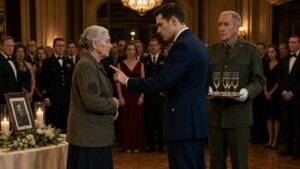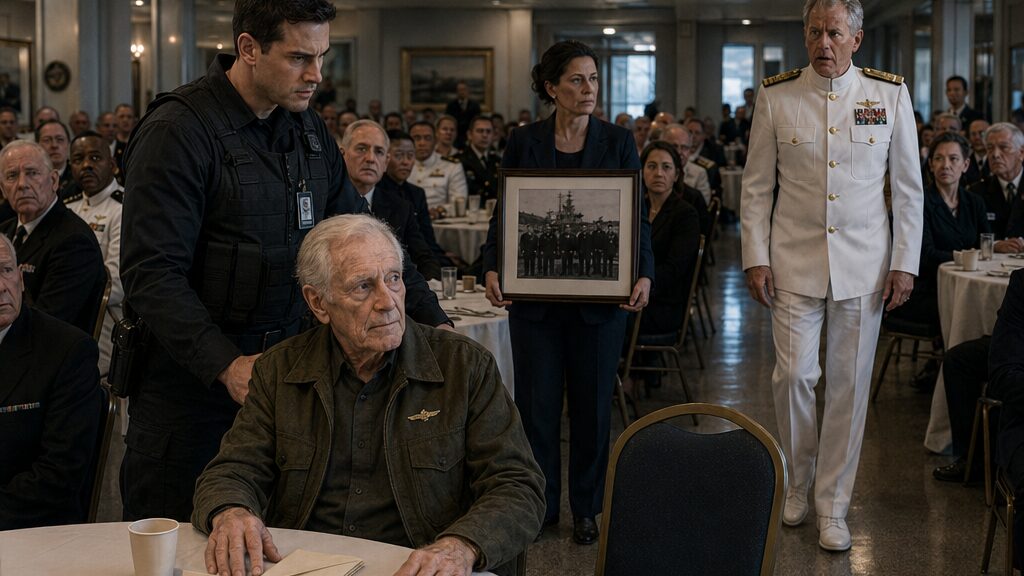
They Tried to Remove an Old Man From the Naval Mess Until the Admiral Spoke His Name
Chapter 1: The Man at the Wrong Table
Lieutenant Dennis Harris stopped Charles Anderson one step inside the naval dining facility.
“Where did you get that invitation?”
Charles looked down at the cream-colored card between his fingers. The corners had softened during the two-bus trip to the installation, and a faint crease ran through the gold anchor stamped at the top.
“It came in the mail,” he said.
Behind Dennis, the dining floor had been dressed for a ceremony without losing the hard geometry of a military mess. White cloths covered the central tables. Place cards stood in straight rows. Junior sailors carried water pitchers between visiting veterans, officers in dress uniforms, and family members wearing small memorial ribbons.
Charles could see the raised platform at the far end of the room. Something rectangular stood beneath a dark blue covering.
Dennis held out his hand.
Charles gave him the invitation.
The lieutenant was young enough to stand without appearing to think about it. His dark security vest lay flat over his uniform, every strap secured, every piece of equipment placed where training required it. Only the tightness around his mouth suggested the morning had already gone badly.
He examined the card, then scanned the code along its lower edge.
The handheld device gave a flat red pulse.
Dennis scanned it again.
The same sound.
“Do you have identification?”
Charles produced his driver’s license. Dennis compared the photograph to the face before him for longer than necessary.
The photograph was eight years old. Charles’s cheeks had hollowed since then. His white hair had thinned, and his left shoulder sat lower than his right beneath an olive field jacket polished by decades of wear. The jacket carried no name tape and no rank. Only a faded naval warfare pin showed beneath the collar when he removed his cap.
Dennis noticed it.
His gaze paused, then returned to the license.
“Charles Anderson,” he read. “Your invitation says C. Anderson.”
“That is usually how initials work.”
Dennis did not smile. “There’s no Charles Anderson on the accessible guest list.”
“Then perhaps the other list would be useful.”
“What other list?”
“The one with my name on it.”
A group of elderly men entered behind Charles, escorted by a command master chief. Dennis moved him aside so they could pass. One of the veterans glanced at Charles’s jacket, then at the security officer holding his invitation, but said nothing.
Dennis lowered his voice. “Sir, this is a restricted event. We had an access incident last month. Today’s attendance includes senior command and invited families. I can’t let someone through because he has a piece of paper that won’t scan.”
Charles looked past him toward the central memorial table.
He had not expected the place to feel smaller.
Thirty-four years earlier, the room had smelled of scorched wiring and seawater because half the ship’s ventilation had failed and sailors had eaten wherever the deck remained dry. This facility was newer, brighter, and safely ashore. Still, the clatter of trays struck the same metal note.
On the central table, a ceremony worker adjusted the place cards. Charles saw one turned sideways.
FRANK TAYLOR.
The name existed for only a second before the worker lifted the card and carried it toward a service station.
“May I go inside now?” Charles asked.
Dennis followed his gaze. “Not until this is verified.”
“The program begins soon.”
“Then whoever invited you should have entered your information correctly.”
Charles considered giving him George Walker’s private number.
He had written it on the back of an envelope in his jacket pocket, though he had never stored it in his telephone. George had insisted on sending a car. Charles had declined. George had offered an aide. Charles had declined that too.
No escort, no rank on the invitation, no announcement before he arrived.
At the time, those conditions had felt like humility. Now they felt dangerously close to concealment.
“Who invited you?” Dennis asked.
“A man who is occupied.”
“That’s not a name.”
“No.”
Dennis studied him. Charles recognized the look. It was the expression of an officer trying to decide whether patience was still professional or had become weakness.
A ceremony coordinator hurried toward them with a stack of matching invitations.
“Lieutenant, the admiral’s party is ten minutes out.”
Dennis held Charles’s card beside the coordinator’s stack. The paper, gold anchor, and embossed border matched exactly.
The coordinator frowned. “Where did that come from?”
“Mr. Anderson says it was mailed to him.”
“It looks official,” she said.
“It also doesn’t scan.”
She glanced at Charles, taking in the old jacket and worn shoes. “There were test copies.”
Charles noticed that the invitation in Dennis’s hand bore the same tiny printer’s mark as those in her stack.
Dennis noticed it too. His thumb covered the mark.
“Can you check the printed roster?” he asked.
“I’m seating families.”
“Then tell me whether there’s a C. Anderson.”
The coordinator shifted the cards to one arm and consulted a tablet. “No Charles. No C. Anderson among general attendees.”
Charles heard the distinction.
“Among general attendees,” he repeated.
She looked up.
Dennis did too.
Before either could answer, the worker at the service station dropped Frank’s place card into a shallow tray with used labels, tape strips, and folded seating drafts.
Charles took one step forward.
Dennis moved across his path.
“Sir.”
“That card belongs on the table.”
“What card?”
“Frank Taylor.”
The coordinator glanced toward the tray. “There was a seating revision.”
“Who revised it?”
“I don’t know. Public affairs, perhaps.”
“Put it back.”
The words came out more sharply than Charles intended.
Dennis’s posture changed. Not dramatically. His shoulders squared by less than an inch, but Charles saw the line harden between them.
“You are not authorized to alter this event,” Dennis said.
“I asked a question.”
“You gave an order.”
Charles looked at him, then at the discarded card.
Old habits survived in the voice long after rank had disappeared from the coat. That was his fault. He softened his tone.
“Then I am asking again. Why was Frank Taylor removed?”
The coordinator’s expression had become uneasy. “Lieutenant, I need to finish.”
Dennis handed the invitation back to Charles. “We’ll seat him at the side while I verify the name.”
“At the side,” Charles repeated.
“There are chairs near the wall.”
Charles folded the invitation once along its existing crease.
Dennis pointed to a small table beside the service doors, separated from the memorial seating by a row of portable stanchions.
“It’s temporary.”
Charles walked there without argument. Several diners watched him cross the floor. Their attention moved from his slow gait to the security officer following a few steps behind.
He sat with his back straight despite the ache under his left shoulder blade.
Dennis spoke quietly to one of the security sailors near the entrance. Charles could not hear every word over the movement of trays, but he heard enough.
“If command can’t confirm him in five minutes, arrange an escort to the outer gate.”
The sailor nodded.
Charles placed the folded invitation on the table.
Across the room, Frank Taylor’s name remained in the trash tray.
Chapter 2: The Invitation Nobody Wanted to Verify
“You’ll need to move again.”
The ceremony worker had returned with two women wearing gold family ribbons. She gestured toward Charles’s side table as though he were a tray someone had left in the wrong place.
“This is reserved for actual veterans’ families.”
Charles looked at the women. One appeared embarrassed. The other kept her eyes on the place settings.
“I was told to wait here,” he said.
“There are chairs in the corridor.”
Dennis appeared before the worker could repeat herself.
“He stays until I finish the check.”
The worker pressed her lips together. “The room is already behind schedule.”
“So is the verification.”
Dennis pulled out the chair opposite Charles and set a paper cup of water on the table.
It was not an apology, but it was not nothing.
Charles slid the cup closer without drinking. “Thank you.”
Dennis opened a secure tablet. “I’m going to ask again. Who invited you?”
“The installation commander.”
The lieutenant’s eyes lifted. “Vice Admiral Walker?”
“Yes.”
“You have his office number?”
“I have a private number.”
“Then call him.”
“He is about to enter a room prepared to honor men who are not all properly represented. I would rather not begin by making myself his emergency.”
Dennis leaned back. “You expect me to accept that Admiral Walker personally invited you, omitted your full name, gave you a nonstandard paper credential, and arranged no escort?”
“I requested the omissions.”
“Why?”
Charles looked toward the covered plaque.
“Because this day was not supposed to be about me.”
Dennis entered Charles’s full name into the database.
No public guest record appeared.
He tried a veterans’ registry. Nothing linked to the event. He searched archived invitation requests. The screen paused, then displayed a narrow amber bar.
ANDERSON, CHARLES — ASSOCIATED RECORD RESTRICTED.
Dennis touched the line.
ACCESS LEVEL INSUFFICIENT.
For the first time, uncertainty displaced irritation on his face.
Charles watched him read the message twice.
“That appears to be a record,” Charles said.
“It appears to be a restriction.”
“You might send it to someone whose access is sufficient.”
Dennis began composing the request.
A chime sounded from the dining floor. The ceremony coordinator announced that the admiral’s arrival had been delayed by seven minutes and asked guests to remain near their assigned tables.
Charles turned toward the memorial display. The blue covering had shifted, exposing one polished brass corner.
“What exactly is being dedicated?” he asked.
Dennis kept typing. “The Breakwater memorial exhibit.”
“I know the operation.”
“I assumed you might.”
Charles glanced at him. “Why?”
“The pin.”
Dennis indicated the faded device under Charles’s collar.
“What about it?”
“It’s an older surface warfare design.”
“Naval warfare qualification.”
“Whatever it is, it isn’t in current use.”
“Neither am I.”
Dennis’s jaw tightened. “Was it issued to you?”
Charles placed two fingers over the pin.
“No.”
That answer stopped the lieutenant’s hand above the tablet.
“Then whose is it?”
Charles did not respond.
Dennis’s expression settled into something colder. “Wearing another service member’s qualification insignia is not a small matter.”
“I know.”
“Did you buy it?”
“No.”
“Find it?”
“No.”
“Then explain.”
Charles looked toward the service station. Frank’s place card had disappeared beneath a stack of discarded paper.
“I am trying to.”
Dennis followed his gaze, but whatever connection Charles saw remained invisible to him.
The tablet chimed. A routing window opened for the restricted-record request. Dennis selected command administration, typed a short note, and paused before sending it.
Charles saw his eyes move back to the surname at the top of the screen.
Anderson.
Something changed.
It was not recognition in the ordinary sense. Dennis had not suddenly discovered who sat across from him. Instead, the name had opened a door in memory, and whatever stood behind it was unwelcome.
“Your father served,” Charles said.
Dennis looked up sharply.
“That’s not in my visible record.”
“No.”
“How did you know?”
“The way you said Breakwater.”
Dennis’s fingers closed around the tablet. “You don’t know anything about my father.”
“Probably less than I should.”
The lieutenant stared at him.
Around them, silverware clicked against plates. A group of junior sailors laughed near the far wall, then quieted when a chief looked their way. Charles noticed Dennis glance toward the entrance every few seconds.
“Last month,” Dennis said, “a man entered a command event using a copied contractor badge. He reached a restricted hallway before anyone stopped him. My section owns that failure now. There’s an inspection underway, and if another unauthorized person gets inside today, everyone will ask why I ignored the obvious signs.”
“What signs are obvious?”
“A code that does not scan. No name on the list. No escort. No verifiable contact. An insignia you admit is not yours.”
“And age.”
Dennis’s face remained still.
“And clothing,” Charles added.
“I did not say that.”
“You did not have to.”
For a moment, neither spoke.
Then Dennis pushed the cup of water nearer to Charles. The gesture was almost impatient.
“You look tired.”
“I am old. The conditions resemble each other.”
Dennis looked down at the unsent verification request.
“My father was twenty-two during Breakwater,” he said. “He came home with burns along one side and never entered a room without locating every exit.”
Charles’s hand tightened around the cup.
“What was his station?”
Dennis ignored the question. “He hated officers who turned disaster into speeches.”
“So did I.”
“No. You knew how to sound as if you did.”
The words carried more certainty than the evidence in front of him.
Charles searched the younger man’s face for some feature belonging to a sailor he might have known decades earlier. There were too many faces from that night—wet, bloodless, lit by emergency lamps. He could not attach Dennis to one.
“What did your father tell you?” Charles asked.
“That command sealed men below.”
The cup crackled softly in Charles’s grip.
Dennis heard it.
Before he could speak again, a security sailor approached. “Lieutenant, transport is standing by at the outer entrance.”
Dennis nodded.
The sailor left.
Charles glanced at the tablet. “You have not sent the request.”
Dennis looked at the amber restriction notice, then at the old man’s pin.
His thumb moved.
The routing window vanished.
Charles watched the screen return to the guest search page.
“Was that an accident?” he asked.
“No.”
Dennis locked the tablet.
Whatever had begun as caution was no longer only caution.
Chapter 3: The Pin Beneath the Worn Collar
Charles found Frank Taylor’s name beneath a strip of blue tape and a coffee-stained seating draft.
He lifted the card from the trash tray, smoothed its bent edge with his thumb, and carried it to the memorial table.
The room had filled while Dennis was occupied with the database. Visiting veterans stood behind chairs marked with unit names. Family members examined the photographs arranged beside the covered plaque. Junior sailors moved through the aisles collecting empty cups before the admiral arrived.
No one stopped Charles until he placed Frank’s card beside an empty chair.
The ceremony worker hurried over.
“That seat was removed from the arrangement.”
“The chair is still here.”
“The name was removed.”
“Yes,” Charles said. “I noticed.”
She reached for the card.
Charles laid his palm over it.
The worker looked toward Dennis.
He crossed the floor quickly, his vest and equipment giving his movement an urgency Charles could no longer match.
“Mr. Anderson,” Dennis said, “step away from the table.”
“I am seated.”
“You entered a restricted arrangement after being directed to wait.”
“I was directed to a table that someone needed for actual families.”
A few nearby conversations stopped.
Dennis lowered his voice. “You are interfering with an official ceremony.”
Charles looked at the empty chair. “So is whoever removed this name.”
“You do not decide the seating.”
“No. But someone did.”
Dennis’s eyes dropped to the place card beneath Charles’s hand.
“Frank Taylor,” he read.
The name affected him less visibly than Anderson had, but Charles saw a flicker of attention.
“Do you know who he was?” Charles asked.
“He’s listed among the Breakwater casualties.”
“He was more than a casualty.”
“So were all of them.”
“Yes.”
The answer seemed to disarm Dennis for half a second. Then he noticed the cluster of watching guests.
“Sir, stand up.”
Charles shifted his cup away from the edge of the table. “You can check the name again.”
“I did.”
“No. You stopped.”
Dennis’s expression hardened. “You are leaving.”
The ceremony coordinator approached with the dining-facility manager. Behind them, an archivist held a framed black-and-white photograph intended for the display.
“What is happening?” the manager asked.
Dennis kept his attention on Charles. “An unauthorized individual refuses to clear the memorial table.”
“I was invited,” Charles said.
The manager glanced at his worn coat and then at Dennis, as if the matter had already been settled by appearance.
“Lieutenant, remove him before the admiral enters.”
Charles felt the old anger then—not at the order, nor at the embarrassment of being discussed while sitting inches away, but at Frank’s card beneath his hand.
Frank had spent thirty-four years being easy to remove.
A sentence shortened in a report. A role absorbed into command language. A name placed on a card, then dropped into a tray when the table became crowded.
Dennis reached toward Charles’s shoulder.
Charles did not flinch. He only moved his cup farther aside, leaving no excuse for sudden motion or spilled water.
The archivist stepped closer.
“Wait.”
Dennis’s hand stopped before touching the jacket.
The archivist was staring at the pin beneath Charles’s collar.
“May I see that?”
“No,” Charles said.
“It’s an early qualification pattern.”
“I know what it is.”
The archivist lifted the framed photograph. It showed sailors gathered on a damaged deck after Operation Breakwater. Some wore bandages. Others stood barefoot or wrapped in blankets. Near the center, a younger Charles faced away from the camera, speaking to an enlisted man whose hand rested against his chest.
The photograph was too grainy to show much, but the insignia on the enlisted man’s shirt caught the light.
The same broad wings. The same worn central crest. The same slight bend along the left edge.
The archivist looked from the photograph to Charles.
“This pin,” she said quietly, “is in the archive image.”
Dennis turned toward the frame.
Charles kept his hand over Frank’s name.
The main entrance opened.
The command master chief called the room to attention.
Chairs scraped backward in a single uneven wave. Officers straightened. Conversations vanished. Vice Admiral George Walker entered in white dress uniform, accompanied by two aides and the public-affairs officer.
Charles remained seated.
Not from defiance. His legs had stiffened, and standing quickly would have required both hands. One hand was still covering Frank’s card.
Dennis stepped back from him, though only far enough to face the arriving party.
George acknowledged the room and began toward the platform. Then he saw the disturbance at the memorial table.
His pace slowed.
Charles watched recognition fail to arrive all at once.
First George noticed the security officer. Then the old olive jacket. Then the seated posture—left shoulder lower, head slightly angled as if listening through machinery. Finally, his eyes found the faded pin.
George stopped.
The aides nearly walked into him.
The room held its breath.
He approached the table without looking at Dennis or the manager. Up close, age showed beneath the authority: silver at the temples, a deep line beside the mouth, the careful control of someone seeing a memory step out of a photograph.
“Sir?” George said.
It was not loud, but the word traveled through the room.
Charles looked up.
“Hello, George.”
The vice admiral’s face changed. For an instant, he was no longer the ranking officer in the facility. He was a much younger man standing on a darkened deck, waiting for an order he did not want to hear.
“Why didn’t you call me?” George asked.
“You were busy.”
“I sent a car.”
“I declined it.”
“You also declined the aide, the escort, and apparently every method by which this could have been avoided.”
Charles glanced at Dennis’s suspended hand.
“Not every method.”
George turned at last.
“What happened?”
Dennis straightened. “Sir, this individual’s invitation failed verification. His name was absent from the public roster. He entered the memorial seating after being ordered to wait.”
“This individual?”
Dennis’s confidence faltered, but only briefly. “He would not identify his role.”
Charles said, “I identified my name.”
George looked at the folded invitation on the table. He picked it up, saw the initial, and closed his eyes for a moment.
“I approved this personally.”
The manager went pale.
George faced the room. “This is Rear Admiral Charles Anderson, United States Navy, retired. He commanded Operation Breakwater.”
A murmur moved through the diners and died almost immediately.
Dennis did not step back.
Instead, he looked at Charles with something harsher than embarrassment.
“That is Anderson?” he asked.
George’s voice cooled. “Lieutenant.”
Dennis’s hands tightened at his sides.
“My father was on that ship.”
Charles felt the weight of the pin against his chest.
Dennis pointed—not at the insignia, not at the invitation, but at the man wearing them.
“That is the man my father said left them below.”
Chapter 4: The Story Dennis Had Inherited
“Lieutenant Harris, surrender your access badge.”
George Walker held out his hand.
The order cut through the silence around the memorial table. Dennis felt every pair of eyes turn toward the black badge clipped above his vest. A minute earlier, he had been the officer controlling the room. Now the installation commander stood before him, and the old man he had nearly removed sat beneath the weight of a title Dennis had heard all his life.
Rear Admiral Charles Anderson.
Dennis reached for the badge.
“Leave it where it is,” Charles said.
George looked down at him. “Sir, he canceled a verification request, attempted to remove you from a command event, and—”
“And he has made an accusation.”
“This is not the place.”
“It became the place when you spoke my name in front of everyone.”
Charles lifted his hand from Frank Taylor’s card. The faint tremor Dennis had dismissed as age returned as the fingers curled against the tabletop.
“Let him state it properly.”
George’s expression tightened. He gestured toward the private serving room beside the dining floor.
Inside, stainless-steel counters reflected the bright overhead lights. Covered trays waited beneath heat lamps. Through the narrow service window, Dennis could see the audience settling uneasily into their seats while the command master chief delayed the program.
George closed the door.
“Badge,” he said again.
Dennis removed it and placed it on the counter.
Charles remained standing until a medical corpsman brought him a chair. He accepted it without thanks or complaint, then looked at Dennis.
“What was your father’s name?”
Dennis hesitated. “You wouldn’t remember him.”
“That was not my question.”
“He was a fire-control technician. Twenty-two years old. Third section.”
Charles’s face did not change, but his gaze shifted as though he were reading something written behind Dennis.
“Port auxiliary passage?” he asked.
Dennis’s breath caught.
“Yes.”
“Burns on the left arm?”
Dennis nodded once.
Charles looked down at the faded pin on his own jacket. “He reached the weather deck through the maintenance trunk.”
“My father said men were still alive when command sealed the compartment.”
George stepped between them. “Breakwater involved a cascading fire, loss of electrical control, and a breached fuel line. What your father understood from below deck was not the full tactical picture.”
“He understood a steel door closing.”
“Dennis,” George warned.
“No,” Charles said. “Let him finish.”
Dennis had imagined this moment in different forms since childhood. In some versions Anderson was smug, polished, surrounded by aides. In others he denied everything. Dennis had never imagined him in a worn jacket, seated in a serving room, looking less offended than tired.
“My father said the officers called it necessary,” Dennis continued. “He said necessary was the word they used when the people making the decision were on the other side of the bulkhead.”
Charles absorbed the sentence without protest.
“He was right about that much,” he said.
George turned sharply. “Sir.”
“He was right about where I stood.”
Dennis felt the anger he had carried harden into something less stable.
“You gave the order?”
“Yes.”
“With men inside?”
“Yes.”
The single word emptied the room of every defense Dennis had expected to fight.
George placed both hands on the counter. “That is not the whole account.”
“No,” Charles said. “But it is the part Lieutenant Harris asked about.”
Dennis stared at him. “How many?”
Charles did not answer immediately.
The heat lamps clicked as their thermostats cycled. Beyond the door came the muffled scrape of chairs.
“Enough,” Charles said.
“That is not a number.”
“No number would make your father’s memory simpler.”
Dennis stepped closer. “You think this is about simplicity?”
“I think you recognized my name before you canceled the verification request.”
Dennis went still.
George looked from him to the tablet attached to his vest. “You did what?”
Dennis could have denied it. The request log might already have recorded the cancellation, but he could have claimed a technical error or an incomplete submission.
Instead, he said, “I saw the restricted notation. Then I remembered the name.”
“And you stopped the check,” George said.
“Yes.”
“Why?”
Dennis looked at Charles.
“Because my father spent forty years waking up when doors shut. Because he kept a photograph of that ship folded in his desk and wrote Anderson across the back. Because every time the Navy called Breakwater a rescue, he said to remember the men the rescue left behind.”
George’s anger cooled into something more severe.
“You decided guilt before identity.”
“I decided caution.”
“You gave him water,” Charles said.
Dennis frowned.
“You could have removed me at the entrance. You did not. Part of you still wanted the rules to settle the matter.”
“And when they did not?”
“You settled it yourself.”
The accuracy of it felt worse than accusation.
Charles leaned back slightly, the effort of standing and crossing the room showing now in the grayness around his mouth.
“Your father’s anger was not baseless,” he said.
George’s head turned. “Charles.”
It was the first time he had used the name without title.
Charles looked at him. “We are past protecting me with ceremony.”
Dennis saw something pass between them—not agreement, but an old disagreement returning to its place.
A knock sounded.
Before George could answer, the door opened and the ceremony coordinator appeared.
“Admiral, Catherine Taylor has arrived. She says she was instructed to come directly to the memorial table.”
Charles closed his eyes.
The coordinator stepped aside.
A woman with silver threaded through her dark hair stood in the doorway holding a leather folder against her chest. Her gaze moved first to George, then to Dennis’s badge on the counter, and finally to Charles.
She recognized him immediately.
Not from rank. From letters.
Charles rose too quickly. The chair legs scraped.
“Catherine.”
She did not return the greeting.
“What order?” she asked.
No one answered.
Her eyes fixed on the pin at Charles’s collar.
“I heard you through the door,” she said. “You said you gave the order.”
Charles’s hand went to the pin but stopped short of touching it.
“Yes.”
Catherine’s grip tightened around the folder. “You wrote to me every year.”
“I know.”
“Birthdays. Christmas. The anniversary.”
“I know.”
“You told me my father stayed at his station. You told me he saved lives. You told me the Navy owed him more than it could repay.”
Each sentence brought her one step farther into the room.
“You wrote to me for thirty years,” she said, “and never once said you were the man who gave that order.”
Chapter 5: The Photograph With One Man Missing
Catherine found her father in the center of the photograph and nowhere in its caption.
The framed image rested on an easel in the heritage room beside the dining facility. Frank Taylor stood among smoke-stained sailors on the damaged deck, his face turned partly away, one hand pressed to the chest of his uniform.
Below the photograph, a brass strip read:
SURVIVORS OF OPERATION BREAKWATER WITH COMMANDER CHARLES ANDERSON.
No other name appeared.
“That is him,” Catherine said.
The archivist leaned closer. “Chief Taylor?”
Catherine pointed through the glass. “The man beside Charles.”
The archivist checked the printed catalog sheet. “The original notation identifies several personnel, but the display caption was shortened for space.”
“Of course it was.”
Charles stood several feet behind her. He had not tried to approach since they left the serving room.
George remained near the door, answering calls from aides who wanted to know whether the luncheon should proceed. Each time, he said only, “Hold the room.”
Dennis stood without his badge beside the archive alcove. No one had told him to leave, and Charles had made no request that he stay. His presence felt unfinished.
Catherine lifted the leather folder she had carried inside. It contained thirty annual letters, each returned to its envelope after reading. She had brought them because the invitation suggested the Navy planned to quote from family correspondence.
Now the letters felt like evidence of a different kind.
“You knew they had removed his name?” she asked Charles.
“Not until today.”
“You knew the official version centered you.”
“Yes.”
“And you let it.”
Charles looked at the photograph. “I signed an account that could be released.”
“That is not what I asked.”
“No.”
The answer was too bare to resist.
Catherine turned to George. “I want the full unclassified archive.”
George glanced toward the dining room. “There are families waiting, some of whom traveled across the country. We can suspend the dedication and review the wording afterward.”
“After you uncover it?”
“The plaque can be amended.”
“You want to unveil a lie because lunch is getting cold?”
The archivist lowered her eyes.
George’s shoulders stiffened. “I want to avoid turning incomplete records into accusations in front of people who do not yet have the facts.”
“Then get the facts.”
Charles spoke before George could answer.
“Open the archive.”
George looked at him. “You know portions remain protected.”
“I asked for what is unclassified.”
“And the ceremony?”
“Waits.”
The vice admiral studied the older man, perhaps measuring what remained of the officer who had once expected immediate obedience. Then he nodded to the archivist.
She unlocked a cabinet built into the wall and removed two gray document boxes. A third set of files appeared on the secure terminal.
Catherine stood behind her as she searched Frank Taylor’s service number.
Reports filled the screen: casualty summaries, damage-control diagrams, witness extracts, commendation recommendations. Frank appeared repeatedly, but always in fragments.
TAYLOR, F.—REMAINED IN AFFECTED SECTION.
TAYLOR—ASSISTED EVACUATION.
TAYLOR—PRESUMED LOST FOLLOWING SECONDARY FAILURE.
The words made him sound like a component that had stopped functioning.
“Where is his final transmission?” Charles asked.
The archivist searched the communications index.
One entry appeared:
BREAKWATER AUXILIARY CIRCUIT 4B—TAYLOR, F.—FINAL RECORDED TRANSMISSION.
Beside it was a notation: NOT INCLUDED IN PUBLIC CEREMONY PACKAGE.
Catherine leaned toward the screen. “Why?”
The archivist opened the access history. “The file was cleared for internal historical use six years ago, but not selected for today’s exhibit.”
“By whom?”
The archivist hesitated.
George answered. “Public affairs built the package from the approved command summary.”
“Whose summary?”
Silence.
Catherine turned to Charles.
He did not look away.
“Mine,” he said.
Something inside her shifted. Until then, she had been able to imagine Charles as another man trapped by classification, unable to tell her what regulations forbade.
But six years ago was not thirty-four years ago.
“You could have corrected it.”
“Yes.”
“You approved the version that named you.”
“I approved the version that omitted operational details.”
“And my father.”
“Yes.”
Dennis moved near the photograph. His attention had fixed on Frank’s chest.
“The pin,” he said.
Catherine looked from the image to Charles’s jacket.
In the photograph, the insignia was bright despite the smoke around it. On Charles, it had darkened almost to gray. The left wing carried the same small bend.
Catherine crossed the room.
“Is that his?”
Charles touched the pin at last.
“Yes.”
The word emerged quietly.
“How did you get it?”
Charles’s thumb passed over the bent edge. “He gave it to me.”
“When?”
“Before he went back.”
The archivist stopped typing.
Catherine felt every sentence in every annual letter rearrange itself.
You should know your father chose his duty when no order could have required more.
You should know that men are alive because he would not leave them.
You should know I remember.
Charles had written around the shape of the truth until the emptiness looked deliberate.
“He went back where?” she asked.
Charles’s gaze moved to the damaged-deck photograph.
“Below.”
“After you sealed the compartment?”
“Before the final closure.”
“Did you order him to go?”
“No.”
“Did you order him not to?”
“Yes.”
The answer startled George.
Charles continued before anyone could interrupt.
“He ignored me.”
Catherine searched his face for relief, for the small selfish satisfaction of being less responsible than she had believed.
There was none.
“Then why keep this?” she asked, touching the air near the pin but not the metal itself.
“Because he put it in my hand.”
“That is not a reason.”
“No.” Charles looked at her. “It is a burden.”
George’s aide appeared at the door. “Sir, the guests have been waiting forty minutes. The press liaison needs a decision.”
George checked the time.
“We delay the unveiling,” he said.
The aide lowered his voice. “The plaque is already being moved into position. The contractor has removed the wall braces.”
From the corridor came the sound of rolling equipment.
Catherine stepped past the aide.
Two workers were guiding the covered plaque toward the dining floor. Beneath the blue cloth, a polished edge caught the light. A small temporary card attached to the back carried the proposed dedication:
REAR ADMIRAL CHARLES ANDERSON—THE COMMAND THAT SAVED BREAKWATER.
Charles read it over her shoulder.
For years, Catherine had imagined that learning the full truth would produce a clean emotion. Anger. Grief. Gratitude. Something she could name and hold.
Instead, she felt only the pressure of all the missing words.
The workers began turning the plaque toward the dining-room doors.
Charles removed his cap.
His face looked older than it had at the entrance, but his voice no longer carried uncertainty.
“If they uncover that,” he said, “I will stop them.”
Chapter 6: The Ceremony Charles Refused to Accept
The blue covering began to slip before Charles had decided where to stand.
One corner fell from the plaque, revealing the first engraved words:
REAR ADMIRAL CHARLES—
A worker caught the cloth and pulled it back into place.
The dining room had waited long enough to become restless. Families whispered across tables. Officers checked watches and then pretended they had not. The public-affairs officer stood near the platform with a prepared introduction she had already shortened twice.
George stepped to the lectern.
Charles remained near the heritage-room doorway with Frank’s pin closed inside his palm. He had removed it from the jacket in the corridor. Without it, the cloth showed two tiny holes beneath his collar.
Catherine stood beside the memorial table. Dennis remained near the wall, stripped of his access badge but still wearing the rest of his security gear.
George adjusted the microphone.
“Thank you for your patience. Today’s program has encountered information that requires us to change what we intended to present.”
A stir moved through the room.
He looked toward Charles.
“For those who witnessed the confusion earlier, I owe you clarity. The gentleman who was questioned at this table is Rear Admiral Charles Anderson, retired, former commander of the naval task group involved in Operation Breakwater.”
Chairs moved back.
The response traveled unevenly at first—one officer rising, then a table of veterans, then sailors across the room following the example. Within seconds, nearly everyone stood.
Charles looked at the faces turned toward him.
An hour earlier, some of those same people had watched him be sent to the side without asking why. Now rank had given them permission to see him.
“Please sit,” he said.
The microphone did not carry his voice, but the nearest tables heard. The rest remained standing.
Charles walked to the lectern.
His knees hurt. The pin’s edges pressed into his palm. He stopped beside George rather than behind him.
“Ask them to sit.”
George leaned toward the microphone. “Please be seated.”
The room settled.
Charles looked at Dennis before addressing anyone else.
“What happened to me at the entrance was wrong,” he said. “It did not become wrong when Admiral Walker spoke my title.”
No one moved.
“The invitation should have been verified. The questions should have been asked without contempt. Lieutenant Harris made decisions for which he is responsible. So did others.”
The dining-facility manager lowered his gaze.
Charles continued. “But if the only lesson today is that an old man in a worn coat might secretly be an admiral, then we will have learned nothing useful. He should not need to be an admiral.”
George stepped slightly away from the lectern, leaving Charles the microphone.
Charles opened his hand.
The faded pin lay across his palm.
“This was Chief Frank Taylor’s.”
Catherine’s face remained still, but her eyes followed the metal.
“The plaque behind me credits my command with saving the ship during Operation Breakwater. That statement is incomplete. I know because I helped make it incomplete.”
The public-affairs officer looked toward George. He did not stop Charles.
Thirty-four years fell away not as a picture but as sensations Charles had never lost: emergency lamps pulsing red; seawater moving ankle-deep through a passage; the bitter taste of burned insulation; reports arriving faster than the chart could hold them.
He gave the room only what it needed.
“A fire reached the fuel-transfer spaces after a systems failure. We lost remote control of ventilation and several watertight doors. If the fire crossed the port auxiliary section, we risked losing the ship and everyone still aboard.”
He paused.
“There were sailors below the boundary.”
A woman at a family table covered her mouth.
“I ordered the compartment sealed.”
No one shifted now.
“I knew men remained inside. I also knew that if the boundary failed, hundreds more might not reach the weather deck.”
Dennis watched him without blinking.
Charles tightened his fingers around the pin.
“Chief Taylor supervised the withdrawal route. He reported that several injured sailors could not reach the main ladder. I ordered him to leave the section. He acknowledged the order.”
Catherine’s hands gripped the back of the empty chair.
“He then returned below.”
The words settled differently from the ones before them. Not absolution. Not condemnation. A fact carrying both.
“Frank opened an auxiliary maintenance trunk that command believed was blocked. Sailors climbed through it one at a time. Lieutenant Harris’s father was among them.”
Dennis’s head turned slightly, as though he had been struck by a sound only he could hear.
“Frank remained long enough to direct the last group. The final closure occurred before he reached the upper hatch.”
Charles looked at Catherine.
“I gave the order that made his time run out. He made the choice that allowed others to have time at all.”
Catherine’s jaw tightened. “And then you let them call it your rescue.”
Her voice reached the nearby tables without amplification.
Charles nodded.
“Yes.”
George moved forward. “The operation remained classified in significant part. The public summary—”
“Was mine to sign,” Charles said. “Classification limited details. It did not require vanity.”
George stopped.
Charles faced the room again.
“I told myself silence was humility. I told myself speaking would sound like an officer explaining why an enlisted man had died. Those things were partly true.”
He looked at the covered plaque.
“They were also useful excuses.”
The cloth shifted in the ventilation draft, tracing the raised letters beneath it.
“For years, I allowed a simpler story because it hurt less people at one time. It protected the institution from questions. It protected me from answering them. It did not protect Frank Taylor from being reduced to one line among casualties.”
The room’s silence had changed. Earlier, it had been the stunned quiet of status reversed. Now it held discomfort, grief, and attention without admiration’s easy warmth.
Charles stepped away from the lectern and approached the plaque.
He caught the edge of the blue cloth but did not pull it down.
“This cannot be dedicated today.”
The ceremony coordinator inhaled sharply.
George looked at him. “I agree.”
“No,” Charles said. “You agree now because I am standing here. The correction cannot depend on whether I survive long enough to object.”
He turned to Dennis.
“Lieutenant Harris canceled a verification request after recognizing my name. That was wrong. But his father’s anger carried a piece of truth the official account refused to carry. Do not use him as the only place to put today’s failure.”
Dennis’s face tightened.
Charles looked back at George. “Open the archive. Correct the plaque. Include the order, the cost, the disagreement, and the names.”
“All of them?” George asked.
“All available names. Those who died. Those who survived. Those who made decisions. Those who carried them out.”
“And the central dedication?”
Charles looked at the empty chair where Frank’s card had been restored.
“Not mine.”
He placed the pin on the table beside the card.
Catherine came forward.
For a moment Charles thought she might take it. Instead, she looked toward the archivist standing near the wall.
“The recording,” Catherine said.
The archivist held a small secured playback unit, already connected to the dining room’s sound system.
George’s expression changed. “Catherine, we have not reviewed the full audio.”
“I have waited thirty-four years for people to finish reviewing my father.”
She took the unit.
Charles felt the old reflex rise in him—the urge to delay, to gather context, to control the order in which painful facts entered a room.
That reflex had built the plaque.
He lowered his hand.
Catherine placed the playback unit on the memorial table. Her finger rested on the illuminated control.
The room waited.
Then she pressed it.
Chapter 7: The Name That Replaced His Own
Static cracked through the speakers.
Then Frank Taylor’s voice filled the dining room.
It was thinner than Catherine remembered from childhood and roughened by interference, but the cadence was unmistakable. He still clipped the ends of words when urgency outran breath.
“Auxiliary Four-B to control. Maintenance trunk is open. Sending them up now.”
A second voice answered beneath alarms and electrical hiss. The words were too distorted to understand.
Catherine pressed both hands against the memorial table.
For thirty-four years, she had relied on memory to preserve her father’s voice: the way he called from the driveway, the quiet tune he made while repairing a hinge, the patient firmness with which he corrected her when she lied. Memory had gradually polished those sounds until she no longer knew which details were true.
The recording had no polish.
Metal struck metal. Someone coughed. Frank shouted instructions to sailors whose names the archive had reduced to abbreviations.
“One at a time. Keep moving. Don’t stop in the trunk.”
Charles stood several feet from the playback unit. His face had gone still in the disciplined way Catherine recognized from his letters—the stillness of a man arranging words so they revealed as little of him as possible.
A command voice came through the speakers.
“Taylor, withdraw. Final boundary closes in ninety seconds.”
Catherine looked at Charles.
The younger voice was his.
Frank answered immediately. “Understood.”
For several seconds, the recording held only alarms and the scraping of bodies through a narrow passage.
Then Charles’s voice returned.
“Chief, report your position.”
“Two more at the lower access.”
“You were ordered out.”
“Yes, sir.”
“Then move.”
Frank gave a sound that might have been a laugh or a cough.
“Soon as they’re clear.”
Dennis stood rigid against the wall. At the mention of the lower access, his eyes moved toward the damage-control diagram displayed beside the covered plaque.
The archivist unfolded a copy of the evacuation map. She traced the auxiliary trunk with one finger, then checked the list of survivors.
Dennis stepped toward her.
“Port auxiliary passage,” he said. “My father was stationed there.”
The archivist scanned the page. “The survivors transferred from that section were routed through Four-B.”
Dennis stared at the line as if the paper had altered beneath his eyes.
“My father said he climbed through a maintenance shaft.”
“That was the trunk Chief Taylor opened,” the archivist said.
The recording crackled again.
A man shouted that the final sailor was inside the trunk.
Charles’s younger voice cut across the noise.
“Frank, now.”
The first name silenced the room more completely than any title had.
Frank answered after a pause.
“Can’t make the upper turn before closure.”
Charles said something lost beneath an impact.
Then, clearer: “We can hold it.”
“No, you can’t.”
“Chief—”
“Seal it when you have to.”
Catherine’s fingers dug into the tablecloth.
Frank’s breathing came heavily through the circuit.
“Get the living home, sir.”
The transmission ended in a burst of static.
No last declaration. No polished farewell. Only the fading alarm and a dead channel.
Catherine stopped the playback.
The silence afterward seemed to contain the shape of everyone who had listened.
Dennis removed his security vest. He set it carefully on a chair, as though its weight no longer belonged on his body.
“My father never said who opened the route,” he said.
Charles looked at him. “He may not have known.”
“He knew someone stayed behind.”
“Knowing and speaking are different things.”
Dennis flinched at the words.
“My father told the part he could live with,” he said.
“Yes.”
“And you told the part you could live with.”
Charles looked toward Catherine.
“Yes.”
The similarity did not excuse either man. It made the damage more human and therefore harder to dismiss.
George approached the memorial table. His dress uniform, so commanding when he entered, now seemed almost intrusive beside Frank’s plain voice.
“We will rebuild the exhibit,” he said. “Chief Taylor will be named as the man whose action made the evacuation possible.”
Catherine shook her head.
George stopped.
“You are not replacing one statue with another,” she said.
“No one suggested—”
“You were about to dedicate a plaque that made Charles the clean hero of a decision that killed people. Now you want to make my father the clean hero and pretend he acted alone.”
She pointed toward the diagram.
“Someone designed that trunk. Someone kept the circuit alive. Sailors carried the injured. Charles gave an order that saved the ship and trapped men below. My father disobeyed an order and saved others, but he also delayed until he could not leave.”
George listened without interrupting.
“The truth is not improved by changing which name gets the largest letters,” Catherine said.
Charles lowered his gaze.
“What should it say?” George asked.
“I don’t know yet.”
It was the first answer that seemed honest enough for the day.
The archivist brought a blank catalog worksheet. Catherine placed it beside Frank’s card.
“Include the command decision,” she said. “Include the objections recorded afterward. Include the names of the men in the sealed section and the men who came through Four-B. Include the people who maintained the route. Do not call it a rescue without stating what it cost.”
George nodded. “You will have access to the working draft.”
“So will the surviving families.”
“Yes.”
Dennis stepped closer to Charles.
“I canceled your verification because I wanted the name to be guilty.”
Charles studied him.
“You also treated me as if being powerless would make the treatment acceptable.”
Dennis swallowed. “Yes, sir.”
“Do not apologize to the rank.”
Dennis glanced toward the empty place at the table.
“I’m sorry for what I did to the man at the door.”
Charles accepted the sentence with a small nod, neither forgiving nor punishing him.
George picked up Dennis’s badge from where an aide had brought it from the serving room.
“The investigation into your conduct will continue,” he said. “But you will be part of correcting the access process.”
Dennis looked surprised.
Charles said, “A punishment no one learns from is only tidiness.”
George gave him a tired look. “You are not in command here.”
“No,” Charles said. “That may be why I can finally give useful advice.”
A faint breath of laughter moved through one table and disappeared before becoming relief.
Catherine looked down at the pin beside Frank’s name card.
She picked it up.
The metal was warmer than she expected from Charles’s hand. Its bent edge caught against her thumb.
He watched her without asking for it back.
“This does not belong in my jewelry box,” she said.
“No.”
“And it does not belong on your coat anymore.”
“No.”
She considered the photograph, the archive boxes, and the empty chair that had first been reserved, then erased, then offered to Charles.
Catherine placed the pin in the center of the seat.
“Leave this chair unclaimed,” she said. “Not for my father alone. For everyone the short version leaves out.”
Charles looked at the pin resting where no person sat.
For the first time that day, he did not try to hide what the sight cost him.
Chapter 8: The Same Coat Through the Gate
Several weeks later, Charles approached the same security gate carrying no invitation.
He wore the same olive jacket. Two small holes remained beneath the collar where Frank’s pin had rested for decades.
Ahead of him, an elderly visitor stood at the screening desk with a folder of medical papers and a veterans’ identification card that refused to scan. The man’s hands shook as he searched his pockets.
Dennis Harris stood behind the desk.
Charles slowed.
Dennis wore his access badge again, though a review notation remained visible on the duty roster behind him. He took the malfunctioning card, examined it, and did not look past the visitor toward the growing line.
“Take your time,” he said. “What name should I verify?”
The old man answered.
Dennis repeated the name without raising his voice, contacted the appropriate office, and offered the visitor a chair while the record was checked. He asked before touching the folder. When verification came through, he returned every paper in the order he had received it.
Only after the man passed inside did Dennis see Charles.
For a moment, they occupied the same positions as before: young officer behind the checkpoint, old man in worn clothes waiting to be judged.
Dennis straightened.
“Your name, sir?”
Charles understood the choice in the question.
“Charles Anderson.”
Dennis entered it into the revised verification system. A record appeared without rank on the first screen, followed by a contact route and authorization status.
“Reason for visit?”
“Memorial dedication.”
Dennis checked the entry.
“You are verified.”
No recognition performance followed. No announcement. Dennis simply moved the gate aside.
Charles remained where he was.
“You checked before deciding,” he said.
“That is the procedure now.”
“It should have been then.”
“Yes.”
Dennis glanced at the two holes beneath Charles’s collar. “The pin is inside.”
“Where it belongs.”
They walked toward the dining facility together but not as escort and honored guest. Dennis had duty at the event entrance; Charles had declined transportation again.
Inside, the room looked almost unchanged. The same tables stood beneath the same lights. Trays moved through the same service doors. Yet the memorial arrangement no longer pointed every chair toward a single name.
The covered plaque was gone.
In its place stood a long display organized around the damage-control diagram. Audio stations held testimony from surviving sailors, engineering personnel, medical teams, and families. One panel described the compartment-sealing order without softening its consequence. Another explained Frank’s decision to reopen the auxiliary route after being ordered to withdraw.
No sentence claimed that one man had saved the ship.
Beneath the original deck photograph, each identified sailor had been named.
Frank’s faded pin rested in a recessed case below his image.
At the center of the memorial table stood the empty chair.
Charles stopped several feet away.
Catherine was adjusting Frank’s place card beside the display. She saw him and did not smile immediately.
“You came,” she said.
“I said I would.”
“You said many things in letters.”
“That is true.”
She looked at the holes in his jacket.
“Does it feel lighter?”
“No.”
Her expression softened by a degree. “Good.”
He almost smiled.
Catherine handed him the revised catalog. It included an introduction written jointly by the archivist and representatives of the families. Charles’s name appeared where necessary: commander, decision-maker, approving authority for the old summary, witness to Frank’s last transmission.
It was neither accusation nor praise.
“You left in the part about the summary,” he said.
“You asked for the truth.”
“I did.”
“Were you expecting it to be comfortable?”
“No.”
Across the room, George Walker approached in dress uniform. He had removed several ceremonial elements from the program. There would be no long procession, no heroic introduction, and no unveiling.
“I saved you the central seat,” George said.
Charles looked at the empty chair.
“No.”
“There is another one beside it.”
“No.”
George followed his gaze. “You cannot stand through the entire program.”
“I can sit with the families.”
Catherine indicated a chair at the end of her table.
George accepted the decision without argument.
Before the program began, Dennis entered and spoke quietly to the command master chief. The two men examined a printed page titled Respectful Verification and Escalation. It required staff to distinguish suspicion from inconvenience, to route failed credentials for review, and to offer assistance without assuming confusion or fraud.
It was a small document.
Charles trusted small documents more than grand promises. They entered routines. They survived after speeches were forgotten.
The command master chief called the room to order.
No one was asked to stand for Charles.
George opened with a brief statement.
“This display does not offer a single hero because the event it records did not contain one simple act. It contains command, sacrifice, error, courage, disagreement, survival, and loss. Some truths arrived late. They remain our responsibility.”
He yielded the floor to the archivist.
She began reading the names of those who died in the sealed section.
After each name, a bell sounded once.
Catherine sat beside Charles. Her hands remained folded around the old bundle of letters. She had not forgiven him; he had stopped hoping that one honest day could purchase forgiveness for thirty-four silent years.
But she had asked him to help annotate the final transmission. They had met twice in the archive. A third meeting was scheduled.
That was not absolution.
It was more useful.
When Frank Taylor’s name was read, Catherine reached across the space between their chairs and rested two fingers on the sleeve of Charles’s worn coat.
Only for a moment.
Then the archivist continued with the names of those who survived through the auxiliary trunk, including Dennis’s father.
Dennis stood at the rear of the room. He bowed his head but did not leave his post.
Charles looked at the empty chair.
For years, he had believed guilt required disappearance. If he stayed out of photographs, declined ceremonies, and wore no rank, then perhaps he was refusing false honor.
But absence had not restored Frank’s name. Silence had not protected the dead. It had merely left the cleanest version uncontested.
When the final name was read, Charles rose quietly.
George noticed but did not stop the program.
Charles walked toward the exit alone. He passed the memorial without touching the glass. Frank’s pin remained beneath the photograph, its bent wing visible under the soft display light.
At the gate, Dennis opened the door.
“Admiral,” he said, then corrected himself. “Mr. Anderson.”
“Charles will do.”
Dennis nodded. “Charles.”
Outside, the afternoon light caught the worn shoulders of the olive coat. Charles continued along the walkway at his slow, uneven pace.
Behind him, the door remained open.
Inside the naval mess, another voice began reading the names again for those who had arrived late.
This time, no one was left out for lack of space.
The story has ended.