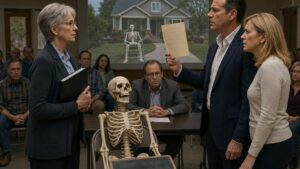
The Farm Outside the Line That Made the Board Read Its Own Map
Chapter 1: The Invoice in the Farm Mailbox
The envelope was wedged halfway into the mailbox like someone had tried to make sure John Mitchell could not miss it.
It was not addressed in the loose, friendly way people addressed things out here, with a first name and a rural route scribbled in ballpoint. This one had a printed label, a return address from Willow Creek Estates Homeowners Association, and the word NOTICE stamped in red across the front.
John stood beside the gravel road with one hand still on the mailbox door and looked past the envelope toward the old red barn. The barn leaned a little at the north corner, its paint faded down to a soft rust color where the sun had chewed on it for years. Three days earlier, he had unlocked the farmhouse with a key that felt too small for what it meant.
Now an HOA was sending him mail.
He tore the envelope open with his thumb.
The first page was a statement. The second was a compliance notice. The third had a payment schedule that made his eyes stop moving.
Amount due: $9,200.
John read the number twice. Then he read the name of the association again, slower, as if the letters might rearrange themselves into something that made sense.
Willow Creek Estates sat past the bend in the road, where the two-lane county strip widened into curbs, sidewalks, matching mailboxes, and houses with stone accents that all looked as if they had been approved by the same committee. John’s farm was not in Willow Creek. His father had said that a hundred times when they used to drive by it.
“See that line of sycamores?” his father would say, tapping two fingers against the truck window. “Subdivision stops there. Farm starts here. Always remember where the line is.”
John looked toward the sycamores now. Bare branches moved in the wind beyond the pasture fence. The land on this side felt different from the land beyond them, not better, not purer, just older. Fence posts instead of entrance monuments. A barn instead of a clubhouse. Gravel instead of landscaped medians.
He folded the invoice once, carefully, and unfolded it again. The notice said the amount represented unpaid dues, late fees, maintenance assessments, administrative penalties, and a pending compliance review. Pending compliance review meant nothing good. It meant people with clipboards looking for what they had already decided to find.
His phone buzzed in his pocket. The screen showed a number he did not know.
John let it ring.
He had done that too much lately, let unknown numbers pass into silence. Since the closing, every call seemed to come from someone needing a form, a signature, an account transfer, a confirmation. The title company. The electric cooperative. The insurance office. The bank representative who kept calling him “Mr. Mitchell” in a tone that made him feel older than thirty-two.
The phone stopped. A voicemail appeared.
John slipped the envelope under his arm and walked back down the drive. His boots crunched over gravel mixed with old bits of shell. At the barn door, he paused and looked again toward the road. A dark SUV had slowed near the mailbox.
It did not pass.
The vehicle turned into his driveway.
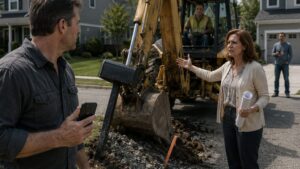
John watched it come toward him, dust lifting behind its tires in a thin pale ribbon. The SUV stopped twenty feet away. A woman stepped out holding a clipboard against her chest as if it were a badge. She wore a light jacket, neat shoes that were wrong for a farm driveway, and sunglasses pushed up into blonde hair cut just above her shoulders.
“John Mitchell?” she asked.
“Yes.”
“I’m Janet Campbell. Willow Creek Estates compliance committee.”
John did not move closer. “I guessed.”
Her eyes flicked to the papers under his arm. “Good. You received the statement.”
“I received something.”
Janet smiled, but it was the kind of smile that had already made room for refusal. “Then we can save some time. Your parcel is currently listed as delinquent. The board has been trying to clear several past-due accounts before the quarterly budget review.”
“My parcel?” John asked.
“The farm property.” She glanced at the barn, then back at him. “The account attached to this address.”
“This farm isn’t in your HOA.”
Janet looked down at her clipboard. “The account says otherwise.”
“The account is wrong.”
“That may be how it feels,” she said, still calm. “But our records show the property tied to Willow Creek’s service area. Dues and assessments are not optional once a parcel is included.”
John felt the old habit come over him, the one that made him go still instead of loud. People sometimes mistook it for calm. It was not calm. It was his body locking every door before anger could get out and make things worse.
“I closed on this property three days ago,” he said. “No one at closing mentioned an HOA.”
“That would be an issue between you and your title company.”
“No. If you’re billing me nine thousand two hundred dollars, that’s an issue between you and me.”
Janet’s mouth tightened, only for a second. Then the professional smile returned. “The balance includes charges that accrued before your purchase. We understand that new owners sometimes aren’t aware of inherited obligations.”
“Inherited from who?”
“The prior account holder.”
“The prior owner died two years ago. The farm went through an estate sale.”
“Again,” Janet said, “that’s why we encourage buyers to review all community obligations before closing.”
John looked past her to the road. A delivery driver had slowed near the driveway, watching enough to understand there was something to watch. John lowered his voice.
“I did review them. There aren’t any.”
Janet clicked her pen. “I’m going to mark that you dispute the balance.”
“You can mark that the property is outside your boundary.”
“I can’t mark that without board review.”
“Then review the boundary.”
“That is what Tuesday is for.”
John looked back at her. “Tuesday?”
“Our next board meeting. Because you have not responded to the notice or the phone call, your account will be placed on the open agenda.”
“You called me ten minutes ago.”
“I left a message.”
“One message.”
“And now I’m here.” She tapped the clipboard once with the pen. “I’m trying to keep this from becoming more formal than it needs to be.”
It already felt formal. It felt like the farm had not even had time to become his before someone else had brought a ruler to it.
John’s father had wanted the place for years. Not because it was profitable; no one bought a farm like this for profit unless they enjoyed disappointment. He had wanted it because his own father had worked its fields one summer, and because the barn had been the landmark by which he measured coming home. When the farm went up for sale, John had bought it with money saved slowly, borrowed carefully, and stretched until it hurt.
He had thought the hard part was over when he signed the closing papers.
Janet turned a page on her clipboard. “The board can authorize collection measures if the balance remains unresolved.”
“Collection measures,” John repeated.
“Late accounts affect everyone. Road maintenance, entrance lighting, common landscaping, reserves. Homeowners who pay on time expect the board to act.”
“I don’t use your roads.”
“You use this road.”
“This is a county road.”
“That can be discussed Tuesday.”
The wind pushed at the papers in John’s hand. He tightened his grip before the invoice could flap loose.
“Mrs. Campbell,” he said.
“Ms. Campbell.”
“Ms. Campbell. My farm is not in Willow Creek Estates.”
She studied him for a moment. The clipboard lowered slightly. For the first time, her certainty showed a seam.
“Then bring whatever you have,” she said. “Survey, deed, title packet. The board will hear your case Tuesday night at seven.”
“My case?”
“That’s how the agenda item will be listed.”
John looked down at the invoice again. The red stamp across the top no longer felt like ink. It felt like someone else’s hand laid flat against his door.
Janet stepped back toward her SUV. “Until then, I’ll mark you as nonresponsive with verbal dispute.”
“I’m standing right here responding.”
She opened the driver’s door. “Then respond with documentation.”
The SUV reversed in a neat curve, rolled down the drive, and turned toward the subdivision. Dust drifted over the mailbox after she left. John stood there until the sound of her engine disappeared past the sycamores.
Only then did he play the voicemail.
Janet’s recorded voice was even smoother than the one she had used in person. She identified herself, named the account, stated the amount due, and ended with a line that made John look back toward the barn.
“Failure to cooperate may result in board action regarding the property’s standing within Willow Creek Estates.”
John lowered the phone.
The farm stood quiet behind him, but the quiet had changed. The barn, the pasture, the house with its sagging porch and empty rooms were still his. On paper, he believed that. In his bones, he believed it.
But on Tuesday night, in a room full of people who already thought every property around here paid, he was going to have to prove where the line was.
Chapter 2: The Red Folder Comes to the Door
The missing page was the one John needed.
He had spread the closing packet across the kitchen table before breakfast, weighing down the corners with a coffee mug, a screwdriver, and the old brass key to the barn. Warranty deed. Seller disclosures. Tax certificate. Title commitment. Insurance binder. A pale copy of the plat map that looked as if it had been faxed through three different decades.
The page marked “Survey Attachment B” was not there.
John checked the folder again, then the envelope it had come in, then the floor under the table, though he knew paper did not vanish under a table by itself. The farmhouse kitchen smelled faintly of dust, old wood, and the coffee he had let go cold. Morning light came through the window over the sink and showed every scratch in the table’s surface.
His father would have laughed once and said, “The thing you need is always the thing nobody stapled.”
John did not laugh.
He set the invoice beside the title packet and called the title company. A representative put him on hold twice. Soft music played in his ear while he stared at the red barn through the kitchen window.
When she returned, her voice had shifted from customer-service bright to careful. “Mr. Mitchell, I do see a reference to an older survey in the commitment.”
“I have the reference. I don’t have the survey.”
“We may have received only a copy of the legal description for closing.”
“Why would an HOA send me a bill if there wasn’t an HOA disclosure?”
A pause. Keys clicked in the background.
“There was no recorded HOA declaration attached to your parcel in the county records we reviewed.”
“Then how did they get my address?”
Another pause, longer this time. “There is a note here that Willow Creek Estates sent a post-closing inquiry.”
John sat up straighter. “Post-closing?”
“Yes. Looks like the morning after recording. They requested confirmation of the buyer name for a mailing address associated with a boundary review.”
“A boundary review before or after they billed me?”
“I can’t speak to their timing.”
“But they contacted you.”
“They sent a notice. We did not alter the closing file based on it.”
John pressed his thumb against the edge of the table. “Where do I get the original survey?”
“If it was recorded with the original subdivision plat, the county records office should have it. You can request a certified copy.”
He wrote that down, though he would not forget it. County records. Original subdivision plat. Certified copy.
After the call, he stood in the kitchen listening to the refrigerator hum and the house settle around him. He had wanted this place because it was outside other people’s systems. Outside gate codes. Outside boards. Outside neighbors voting on what color someone’s fence could be.
Yet his first real morning as owner had become a search through papers proving he had not accidentally bought himself into a committee.
He carried the packet to the barn office, a small room built into the corner near the feed racks. The prior owner had left a metal desk, two filing cabinets, and a calendar from eight years ago with a tractor dealership logo across the top. John opened the drawers one by one. Rusted bolts. Twine. A cracked flashlight. Receipts for hay. A mouse-chewed envelope containing an old aerial photograph of the farm and the subdivision before its last phase of houses went in.
He held the photograph near the window.
The farm was clear in it. Barn, house, pasture, access road. Beyond the sycamores lay the subdivision’s first streets, still raw and pale from new construction. Someone had drawn a faint line in pencil along the trees.
John touched the line.
It was not proof. Not the kind a board would accept. But it was something his father had known by sight, now reduced to a soft gray mark on old paper.
A vehicle door closed outside.
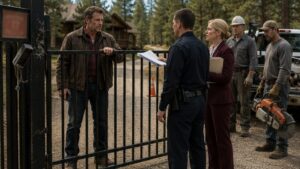
John looked through the barn opening and saw Janet Campbell walking up the driveway with a red folder tucked beneath her arm. Today she wore flats instead of the neat shoes from yesterday, as if she had learned enough about the gravel to adjust but not enough to stay away.
John stepped out before she reached the porch.
“I was about to leave,” he said.
“This will only take a minute.” Janet opened the red folder. “I wanted to provide a courtesy copy of the agenda.”
“You drove out here for that?”
“I was nearby.”
He doubted that. Willow Creek’s streets bent away from his farm in clean loops. No one was nearby unless they meant to be.
She handed him a page. Under “Open Session Items,” the third line read: Delinquent Property Enforcement Review — Farm Parcel / Mitchell Account.
“You made it public,” John said.
“It’s an open meeting.”
“You listed me as delinquent.”
“The account is delinquent.”
“The account shouldn’t exist.”
Janet’s eyes moved to the papers in his hand. “Then I assume you’ll bring documentation.”
“I’m getting it from the county.”
Something changed in her face. Not much. Enough.
“The county?”
“The original survey. Since your board apparently didn’t check it before sending me a bill.”
Janet closed the folder halfway. “Mr. Mitchell, I know this feels personal. It isn’t. The association has obligations. We have homeowners asking why certain properties benefit from proximity to Willow Creek without contributing to maintenance.”
“Proximity isn’t membership.”
“No, but service area can be more complicated than a fence line.”
“The line is exactly what matters.”
Her jaw tightened. “You bought property beside a managed community. There are shared concerns.”
“I bought a farm beside a subdivision.”
“And that subdivision has costs.”
“So do I.”
They stood in the driveway with ten feet between them and a whole argument neither of them wanted to shout. A pickup slowed on the county road. The driver looked, then kept going.
Janet lowered her voice. “You should understand what happens if the board feels you’re refusing to cooperate. They can authorize counsel. They can add administrative costs. They can notify your lender.”
John’s hand tightened around the agenda page. “My lender?”
“If there is an unresolved assessment claim, yes.”
“You don’t have a claim.”
“Then prove it.”
The words were not loud, but they landed harder than if she had raised her voice.
John almost told her to leave. He imagined himself saying it sharply enough that she would step back, sharply enough that anyone watching from the road would see exactly what she had come here to create: a new owner angry in his driveway, waving papers and refusing process.
So he folded the agenda once.
“I’ll be there Tuesday,” he said.
Janet nodded as if she had won something. “Seven o’clock. The clubhouse.”
She walked back to her SUV. The red folder flashed under her arm like a warning light.
That afternoon John drove toward town, but he got only as far as the subdivision entrance before a man near the mailbox kiosk lifted a hand for him to slow. He was about John’s age, maybe a few years older, wearing work pants and a faded polo. A child’s bike lay on its side near the curb behind him.
“You’re the guy at the farm, right?” the man asked.
John rested one hand on the wheel. “That depends who’s asking.”
“Patrick Green. I live on Briar Loop.” He glanced toward the farm road. “Look, I’m not trying to get in your business. But people are talking.”
“I bet.”
Patrick looked uncomfortable, but not enough to walk away. “Dues went up last year. Everybody’s stretched. If one property gets left off, the rest of us pick it up.”
“I’m not in your association.”
“That’s what I heard you said.”
“It’s also true.”
Patrick gave a small shrug. “Maybe. But every property around here pays something. That’s just how Willow Creek works.”
John looked past him toward the curved streets and trimmed lawns. He saw porch flags, basketball hoops, mulch beds, the kind of neighborhood where rules were sold as protection until they needed someone to enforce them.
“Not every property,” John said.
Patrick did not argue. He only looked toward the sycamores, then back at John’s truck.
“Well,” he said, “I guess Tuesday will clear it up.”
John drove on with the copied map on the passenger seat and the red-folder agenda folded in his pocket. The county records office would have to wait until morning. Tuesday would come first.
Behind him, at the edge of Willow Creek, Patrick Green stood by the mailbox kiosk and watched the farm truck disappear down the county road, carrying the question the whole neighborhood had already answered without seeing the line.
Chapter 3: Every Property Around Here Pays
John’s invoice was already on the table when he walked into the clubhouse.
It sat near the center, faceup, under the bright ceiling lights, with the red NOTICE stamp visible from the doorway. Beside it was Janet Campbell’s red folder, closed and squared with the edge of the table. The room smelled like carpet cleaner, coffee, and the faint plastic scent of folding chairs pulled from storage.
A dozen homeowners had gathered, more than John expected. Some sat with arms crossed. Some pretended to read the printed agenda. A few turned to look at him and then looked away with the quick embarrassment of people who had been discussing him before he arrived.
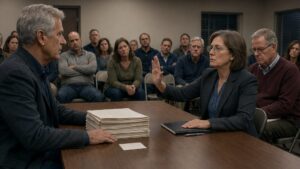
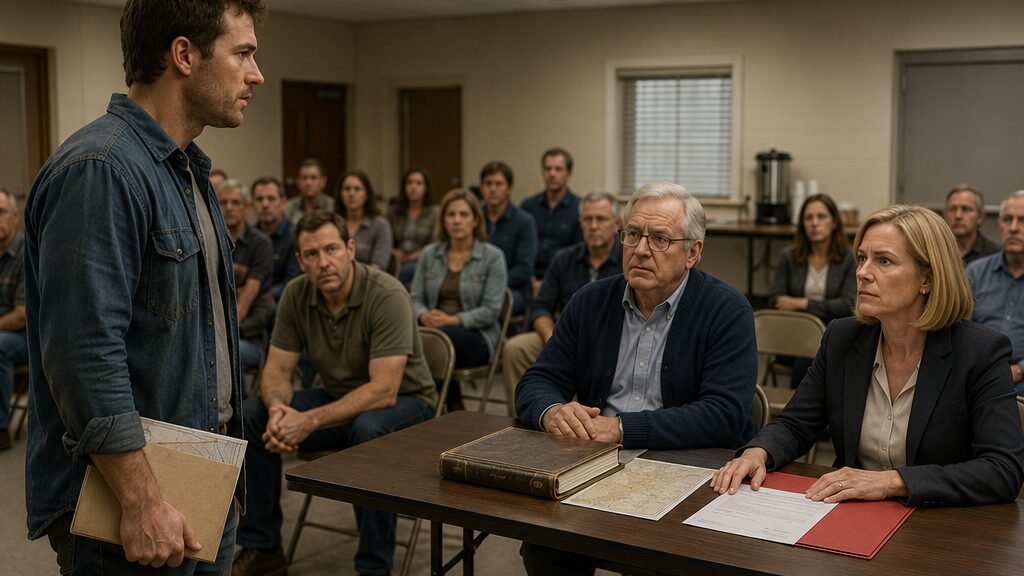
Janet sat at the front table with two other board members. Dennis White, the board president, occupied the center chair. He was older than John had expected, with silver hair, reading glasses low on his nose, and the tired posture of a man who had agreed to lead meetings because everyone else had been worse at it.
John took a seat in the second row. He laid his folder on his lap. Inside were the closing documents, the old aerial photograph from the barn office, and the pale copied plat with the faint line that was not enough but might be enough to slow them down.
It bothered him that he did not have the certified survey yet. It bothered him more that he had almost stayed home to wait for it.
Dennis tapped a gavel once, lightly. “We’ll call the Willow Creek Estates Homeowners Association board meeting to order.”
The first items passed quickly. Landscaping contract. Pool gate repair. Reserve fund update. John heard numbers and motions but did not hold them. Janet did not look at him until Dennis reached the third item under open session.
“Delinquent property enforcement review,” Dennis read. He paused. “Mitchell account.”
The room shifted.
Janet opened the red folder. “Thank you. The compliance committee is requesting board authorization to proceed with collection measures for an outstanding balance of nine thousand two hundred dollars associated with the farm parcel adjacent to the west boundary.”
John noticed the phrasing. Adjacent to the west boundary. Not inside. Not member parcel. Adjacent.
Dennis glanced at the invoice. “Mr. Mitchell is present?”
John stood. “I am.”
Janet continued before Dennis could invite him forward. “The account has accrued unpaid dues, late fees, and administrative penalties. The new owner has verbally disputed the balance but has not provided documentation sufficient to remove the parcel from the association’s service list.”
John felt eyes on him. Service list. It sounded softer than boundary. Softer than debt.
Dennis looked over his glasses. “Mr. Mitchell, would you like to respond?”
“Yes.” John picked up his folder and stepped to the end of the board table. “My farm is not part of Willow Creek Estates. It was not disclosed as part of any HOA at closing. There is no declaration attached to my parcel in the title commitment.”
Janet slid a paper from her folder. “The association’s parcel list includes the mailing address and identifies the property as benefiting from Willow Creek’s shared infrastructure.”
“What infrastructure?” John asked.
“Roadway access, lighting, drainage proximity, general neighborhood maintenance.”
“The road to my farm is a county road. I don’t use your pool, your entrance, or your landscaping.”
A murmur moved through the room.
Patrick Green sat in the back row, arms folded, face tight with the look of someone who did not enjoy being part of a crowd but did not intend to leave it either.
He spoke before Dennis could. “Every property around here pays.”
Several heads nodded.
John turned just enough to face him. “That doesn’t make my property yours.”
Patrick’s face colored. “Nobody said it was ours.”
“You’re asking me to pay like it is.”
Janet lifted a hand. “This is exactly why the board needs to act. We can’t have individual owners deciding which obligations apply to them after purchase.”
“I’m not an individual owner in your association.”
“Then where is your proof?” she asked.
The room went quiet.
John felt the folder in his hand, suddenly too thin. He did not have the certified survey. He had a title packet without the attachment he needed, an old photograph, and a copied plat with a faint line no one had to respect if they did not want to.
His father’s voice came back to him: Always remember where the line is.
But memory was not evidence.
John set his folder on the table and removed the copied plat. “This is from my closing packet. It references the original survey. I’m getting the certified copy from the county records office.”
Janet leaned slightly back. “So you don’t have it tonight.”
“I have enough to show there’s a boundary issue.”
“You have an unclear copy.”
Dennis reached for the page. “May I see it?”
John handed it to him.
Dennis studied the copy. One board member leaned over his shoulder. Janet did not. She kept her eyes on John, not the map.
Dennis frowned. “This is difficult to read.”
“Because it’s a copy,” Janet said. “And because the operative list used by the association is clearer.”
“Clearer doesn’t mean correct,” John said.
A homeowner near the aisle muttered, “Convenient.”
John turned toward the voice. He did not know which face had made it. That was the worst part of a room like this. Accusations could hide in the air.
His pulse pressed against his throat. He wanted to tell them what the farm had cost him. He wanted to tell them about the closing check, the bank loan, the years his father had driven by the red barn until sickness made him too tired to leave the house. He wanted to say he had not come here to steal anybody’s lighting or mulch or pool chairs.
Instead he looked at Dennis.
“Would you mind checking one map before you vote?” John asked.
Dennis blinked. “Which map?”
“The original neighborhood survey. The one your own boundary should come from.”
Janet closed her folder. “That is not necessary for tonight’s action. We can authorize collection pending further review.”
“No,” John said.
The single word carried farther than he intended. Several people looked up sharply.
John steadied his voice. “No. If you’re going to say I owe nine thousand two hundred dollars in an open meeting, then the boundary should be read in the open meeting.”
Dennis sat back. Something in his expression changed. Not agreement exactly. Recognition, maybe. Or discomfort at being asked to do what should have been done before the invoice was printed.
“Do we have the original survey in the board file?” he asked.
Janet’s hand moved to the red folder. “We have the current parcel list.”
“That wasn’t my question.”
A thin silence followed.
The HOA treasurer, seated at the far end, cleared his throat. “There’s an old plat binder in the cabinet. From the developer turnover.”
Dennis looked at Janet. “Please get it.”
Janet did not move for half a second. Then she stood, walked to a storage cabinet along the side wall, and unlocked it with a small key from her ring. The room watched her pull out a black binder with cracked edges and carry it back to the table.
Dennis opened it. Plastic sleeves rasped as he turned pages. His finger moved down labels, dates, signatures. John saw the old paper before Dennis removed it: yellowed, folded into quarters, with a crease worn deep through the middle.
The original survey map.
Dennis spread it across the table. It was larger than the copied plat and clearer even with age. Streets, lots, easements, drainage areas, boundary calls. Along the west edge, near the sycamore line, the boundary bent around the subdivision and stopped before John’s farm.
John did not breathe.
Janet looked down at the map but said nothing.
Dennis traced the line with one finger. “This is the Willow Creek boundary as recorded at developer turnover?”
The treasurer nodded. “Looks like it.”
“And the farm parcel is here?” Dennis asked.
John pointed without touching the paper. “That’s the barn. That’s the access road. The house sits here.”
Dennis followed the shape of the parcel. The room leaned toward the table without standing, the way people lean toward a thing they are afraid will make them wrong.
Janet said, “The service list was updated later.”
Dennis kept his eyes on the map. “Updated by whom?”
“That list has been used for years.”
“That is not an answer.”
Patrick stood halfway from his chair, then sat again. The homeowner who had muttered before stayed silent.
Dennis removed his glasses and rubbed the bridge of his nose. When he spoke, his voice was lower than it had been all evening.
“Hold on,” he said. “The farm appears to sit outside our boundary.”
No one moved.
John looked at the map, at the crease running along the line his father had pointed out from a truck window years before, then at the invoice lying beside Janet’s red folder.
“That’s exactly what I was trying to explain,” he said.
Dennis did not look up from the survey. Janet’s face had gone still, but not empty. There was something behind it now: calculation, embarrassment, maybe fear.
The gavel remained untouched beside Dennis’s hand. The collection motion had not been made. The vote had not happened. The room had shifted from judging John to studying the paper that should have been studied before he walked in.
Then Dennis turned one page back in the binder, checked the date on the survey, and said almost to himself, “If this is the original boundary, we have a problem.”
John heard the difference immediately.
Not you have a problem.
We have a problem.
Chapter 4: The Map Did Not End the Meeting
“The invoice can be paused,” Janet said.
She said it before anyone else had decided what the word meant. The survey still lay open across the board table, its yellowed paper held flat by Dennis White’s coffee mug at one corner and Janet’s red folder at another. The boundary line ran clean and stubborn past the subdivision lots, around the drainage easement, and stopped before it ever touched John’s farm.
Paused.
John looked from the map to the invoice. “Paused is not voided.”
Janet’s eyes came up. “We need time to review.”
“You had time before you billed me.”
A few chairs creaked. The homeowners who had leaned in toward the map now leaned back, as if the first clear answer had made the room less comfortable, not more. Patrick Green stood at the rear wall with his arms unfolded now, one hand gripping the back of a chair.
Dennis put his glasses back on. “Let’s keep this orderly.”
John nodded once. He had no interest in shouting. Shouting would let them remember his tone instead of the map.
“I’m asking for the invoice to be withdrawn,” he said. “And for the association record to show my farm outside the boundary.”
Janet touched the edge of the red folder. “That is premature.”
Dennis looked at her. “The map is not unclear.”
“The map is old.”
“It is the original survey.”
“And the parcel list has been used for years,” Janet said. “We can’t simply disregard operational records in the middle of a meeting because of one document.”
John almost laughed, but the sound would have come out wrong.
“One document?” he said. “It’s your boundary map.”
The treasurer shifted in his chair. “There may be budget implications.”
That was the first honest sentence John had heard since he walked in.
Dennis turned toward him. “Explain.”
The treasurer glanced at Janet before speaking. “The west-side service list was used when calculating assessments after the lighting upgrade. If the farm parcel was included in projections, removing it may affect prior assumptions.”
“Prior assumptions,” John said.
“No one is saying you owe if the boundary is wrong,” Dennis said.
Janet’s head turned sharply. “Dennis.”
He held up one hand. “But we do need to understand what list the management company and compliance committee were relying on.”
John watched the room absorb that. The dispute had changed shape. Five minutes earlier, he had been the man dodging dues. Now there was a second problem in the room, quieter and more dangerous: the board might have been using a list that did not match its own recorded boundary.
A homeowner near the aisle raised a hand. “Does that mean our dues are going up again?”
No one answered.
Janet closed the red folder, then opened it again, as if the act might restore order. “The farm benefits from Willow Creek’s presence. Its access road borders our west entrance. It receives spillover lighting. Drainage from that side is affected by our maintained swales. We cannot pretend the property is isolated.”
John kept his voice level. “You billed me for membership, not moonlight.”
A small sound passed through the room, half laugh, half breath. Janet’s cheeks colored.
Patrick looked down at the floor.
Dennis tapped the map with one finger. “Ms. Campbell, benefit is not the same as inclusion. Unless there is a maintenance agreement, recorded covenant, or easement obligation, we need to be careful.”
“Careful is what I’m asking for,” Janet said.
“No,” John said. “Careful was before the invoice. Careful was before my name went on an agenda as delinquent.”
That landed. He felt it land because he had not meant to say it so plainly. His whole life, he had trusted that if he kept his voice down, people would hear the facts better. But that had left space for Janet to call him nonresponsive, for a room of strangers to nod at his debt, for Patrick to say every property around here paid as if the sentence itself were proof.
Dennis removed the invoice from beneath the red folder and looked at it. “I will entertain a motion to suspend collection pending verification.”
John stepped forward. “No.”
Dennis paused. “Mr. Mitchell?”
“No suspension. If the board wants to verify, verify. But don’t keep a nine-thousand-dollar invoice hanging over me while you decide whether your own map counts.”
Janet’s pen clicked once. “You are not a member, by your own argument. You do not direct board procedure.”
“No,” John said. “But you put my name in your procedure. You put my farm in your procedure. You put a dollar amount beside it.”
The room was silent enough for John to hear the building’s air system turn on.
Dennis looked tired now in a different way. Not bored-tired. Cornered-tired.
“The board can withdraw the invoice without prejudice,” he said slowly. “Pending further review of the association boundary and parcel list.”
“What does without prejudice mean here?” John asked.
“It means the association is not waiving any rights if further documentation changes the analysis.”
“So you can send it again.”
“If there is a basis.”
“The basis is on the table.”
Dennis looked at the map again. His finger followed the old crease. “I understand your point.”
John waited.
Dennis did not finish.
That was when John understood the real answer: the board wanted the room quiet more than it wanted the record clean. They wanted to get out of this meeting with no collection vote, no admission, no line in the minutes that said the farm had never belonged. They wanted the appearance of fairness without the cost of correction.
Janet leaned toward Dennis and spoke low enough that John caught only pieces. “Executive session… potential exposure… counsel…”
Dennis’s mouth tightened.
John picked up his copied plat, but not the original. The original belonged to them, though they had treated it like an inconvenience. He looked at the homeowners. Some avoided him. Some studied the table. Patrick met his eyes for a second and then looked away.
“My father used to point out that line when we drove past,” John said. He had not planned to mention his father. The room did not need his grief. But the words came before he could lock them down. “He said the farm started where the subdivision stopped. I thought that was just something he remembered. Turns out your own file remembered it too.”
No one replied.
Dennis reached for a blank sheet of paper from the stack near the agenda. “The minutes will reflect that the original survey was reviewed.”
Janet said, “The minutes should reflect that no final determination was made.”
John looked at her. “You still can’t say it.”
She held his gaze. “I can say the board needs legal review before making boundary determinations in open session.”
“You made a billing determination in open session.”
Her fingers tightened around the pen.
Dennis wrote something on the blank sheet, then stopped. “We need to consult counsel before amending any member list.”
“The farm is on the member list?” John asked.
The treasurer answered before Janet could stop him. “On the service list. Not exactly the same.”
“Show me.”
The treasurer did not move.
Janet said, “Internal operating documents are not distributed to nonmembers.”
John looked at Dennis. “So I’m enough of a member to bill, but not enough to see the list you used to bill me.”
The quiet that followed had weight.
Dennis set down his pen. “We’re going to take this into closed executive session.”
Several homeowners objected at once, not loudly but with enough overlapping voices to make the room jump. A woman asked whether their dues would change. A man asked whether other parcels were wrong. Patrick said, “If his name was on an open agenda, shouldn’t the answer be open too?”
Janet gave him a sharp look.
Dennis lifted the gavel but did not strike it. “The board will recess open session. Mr. Mitchell, we’ll notify you of the next step.”
John looked at the invoice still lying on the table. “Am I leaving with that withdrawn?”
Dennis hesitated.
That hesitation told John more than the map had.
Janet slid the invoice into her red folder. “You are leaving with collection paused pending review.”
John stared at the folder until Janet closed it.
Outside, the parking lot lights hummed over a scatter of cars. John walked to his truck with the copied plat under one arm and the old aerial photograph in his folder. He had thought the map would end the meeting. He had imagined, foolishly, that once the line was visible, the rest would follow.
Behind him, through the clubhouse windows, he saw Dennis stand and gesture the board members closer. Janet remained seated, red folder in front of her, while the homeowners were asked to leave.
Patrick came out last. He stopped near John’s truck but did not step too close.
“I didn’t know about the map,” he said.
John opened his door. “Neither did they, apparently.”
Patrick glanced back at the clubhouse. “Or they did and didn’t want to.”
John looked at him then.
Before Patrick could say anything else, Dennis appeared at the clubhouse door. His face was pale in the light.
“Mr. Mitchell,” he called across the lot. “The board needs to go into closed executive session before we make any further statement.”
John stood beside his truck, the copied map bent in his hand, and understood that the line on the paper had not ended the fight. It had only shown him where the next one began.
Chapter 5: The County Copy With the Old Crease
Melissa Torres pulled the survey from an archive cabinet as if she already knew it would matter to someone.
The county records office was quieter than John expected. No dramatic stacks of disputed land claims, no rows of lawyers arguing at counters. Just beige walls, fluorescent lights, low voices, and a long service desk worn smooth where people had leaned on it for decades while asking the county to tell them what was true.
Melissa set a cardboard folder on the counter. “Original subdivision plat, Willow Creek Estates, phase one and west boundary amendments.”
John did not touch it yet. After the night before, he had learned to wait until someone official laid the paper flat.
“I need a certified copy of the boundary survey,” he said.
“That’s what this should contain.” She opened the folder and lifted a folded sheet with careful fingers. “Older plats can be delicate.”
The paper had the same yellowed tone as the one in the HOA binder. When she unfolded it, John saw the crease immediately. It ran down the western edge, near the same line Dennis had traced with his finger.
His chest tightened.
Melissa noticed. “You’ve seen a copy?”
“At the HOA meeting last night.”
Her expression did not change much, but her eyes sharpened. “That kind of meeting?”
“That kind.”
She turned the document so both of them could read it. “Here’s the recorded boundary. Here’s the drainage easement. Here’s the county road. The farm parcel you’re asking about sits outside this line.”
John rested both hands on the counter. “So I’m not crazy.”
“No,” Melissa said. “At least not about this.”
It was the first thing anyone in an office had said to him that sounded like a human being. He let out a breath he had not known he was holding.
“I need whatever version they can’t brush off,” he said.
“Certified copy with seal. I can print that.”
She moved to the copier behind her. While the machine warmed, John looked through the plastic sleeve that had held the original. There were index slips tucked behind it, small notes from later filings: drainage update, lighting easement near east entrance, road maintenance clarification, parcel inquiry.
That last one caught him.
“Parcel inquiry?” he asked.
Melissa turned. “Which one?”
He pointed through the clear sleeve.
She returned and slid the index slip out. “That may just be a request log.”
“Can I see it?”
She hesitated, not because she was hiding anything, but because clerks lived inside rules the way farmers lived inside weather.
“This is a public index,” she said. “The request details may be limited, but the log entry is visible.”
She placed it on the counter.
Six months earlier, Willow Creek Estates Compliance Committee had requested “boundary confirmation for west-adjacent farm parcel / service area review.”
John stared at the date.
Six months earlier. Before his closing. Before Janet’s driveway visit. Before the invoice with red letters.
“Who requested it?” he asked.
Melissa looked at the log more closely. “It lists a committee email. Not a person’s name.”
“Can I get a copy of that?”
“The log, yes. The email itself may be in correspondence records if it was retained.”
“I need that too.”
She gave him a look that was not unfriendly, only measured. “Mr. Mitchell, I can help you request public correspondence, but I can’t tell you what a private association did with information after asking for it.”
“I’m not asking you to.”
“You are asking because you think they knew.”
He looked at the crease in the map. “I think they asked.”
Melissa held his gaze for a moment, then turned to her computer. “There’s a difference. Sometimes people ask and never follow up. Sometimes they ask because they already have an answer they don’t like.”
The copier began to work, bright light moving beneath glass.
John’s phone buzzed. A voicemail notification from a number marked Willow Creek Estates. He did not play it. Not yet. He already knew what delay sounded like.
Melissa printed the certified copy on heavier paper and embossed the seal near the bottom. The raised stamp caught the light. She added the request log behind it.
“Do you want the correspondence request today?” she asked.
“Yes.”
“It may take a few minutes to locate.”
“I’ll wait.”
He sat on a wooden bench near a bulletin board covered in county notices. Zoning hearing. Tax deadline. Road closure. Lost dog flyer. Normal troubles, posted neatly.
His father had brought him to this building once when John was fifteen to renew a vehicle registration. John remembered being bored, restless, wanting to be anywhere else. His father had stood at the counter with a cracked leather wallet in his hand and said, “Paperwork is boring until somebody else’s paperwork takes what’s yours.”
John had rolled his eyes then.
He did not now.
Melissa returned with two printed pages. “There’s one responsive email in the public correspondence archive. The county survey technician answered the committee account.”
John stood.
She placed the pages on the counter but kept one hand resting lightly on them. “Read carefully. It does not say what they did after receiving it.”
The first page showed the original inquiry. The sender was a committee email address, but the signature line beneath the message read: Janet Campbell, Compliance Chair.
John felt his mouth go dry.
The message was politely phrased. The committee was “reviewing west service-area consistency” and requested confirmation whether the farm parcel adjacent to the sycamore boundary was “included within Willow Creek Estates as recorded.”
The second page held the county response.
Based on recorded subdivision plat and west boundary survey, the referenced farm parcel does not appear to fall within the Willow Creek Estates HOA boundary. Private service agreements, if any, would not be reflected in the subdivision plat.
John read it again.
Does not appear to fall within.
Six months before the invoice.
He heard Janet’s voice in the clubhouse: The service list has been used for years.
He heard her in the driveway: Then prove it.
Melissa watched him without interrupting.
“Can I get these certified?” he asked.
“The correspondence copies can be stamped as retrieved from county records, but the certification applies to the plat.”
“I’ll take both.”
She prepared the packet. John paid the fee with a card that suddenly felt too thin for how important the papers were. When she slid the receipt across the counter, she lowered her voice.
“Associations keep their own member records. The county does not amend those for them.”
“So if their list is wrong?”
“They have to correct it.”
“And if they don’t?”
Melissa’s face stayed neutral, but her words came carefully. “A private association cannot amend county records. But it can confuse its own members. It can send notices. It can create the impression that something is true inside its own process.”
John put the certified map and email copies into his folder. The raised seal pressed against his palm through the paper.
“What would you do?” he asked.
Melissa gave a small, rueful smile. “I work here. I don’t give advice.”
“Right.”
“But if I owned land,” she said, “I would want the record corrected wherever the mistake was being used.”
Outside, the county building steps were warm from the sun. John stood halfway down them and played the voicemail.
Dennis White’s voice came through, formal and strained. “Mr. Mitchell, this is Dennis White with Willow Creek Estates. The board is still reviewing the matter. For now, collection activity is paused. We request that you refrain from further discussion with homeowners until the association has completed its internal review.”
John looked down at the folder in his hand.
Further discussion with homeowners.
Not correction. Not apology. Not voided.
He opened the packet again, right there on the steps, and looked at Janet’s name under the email from six months ago. The line on the map was no longer just a boundary. It was a question someone had asked, received an answer to, and then buried beneath a red folder.
Chapter 6: What Janet Was Afraid to Admit
The email Janet had claimed did not exist arrived in John’s inbox at 6:12 on Friday morning.
It came from Dennis White, not Janet, with a subject line so careful it was almost meaningless: Follow-up Materials Regarding Boundary Review. John opened it at the kitchen table with the certified map beside his coffee and the farmhouse still dark around him.
Dennis’s message was brief. Attached were selected board communications related to the west-side service list. He wrote that the association was continuing internal review and that no final determination had been made.
John clicked the attachment.
There it was again, but this version had replies beneath it.
Janet’s committee email. The county survey technician’s answer. Then Janet forwarding the response to Dennis and the treasurer four months before John bought the farm.
Her note read: This may complicate the west service-area list. Recommend holding discussion until after budget review.
John sat back.
Not after legal review. Not after title clarification. After budget review.
The house made a settling sound in the wall behind him. Outside, the red barn was only a shadow against the paling sky. John read the thread again, slower. Dennis had replied, “Let’s not reopen boundary assumptions without counsel.” The treasurer had replied, “Removing projected west parcel revenue will widen shortfall.”
Janet’s final response was one sentence.
Understood. I will keep the parcel on the working list pending board direction.
Pending board direction had become a $9,200 invoice with his name on it.
By nine o’clock, John was parked along Briar Loop in Willow Creek Estates, looking at Janet Campbell’s house from the curb.
It was not grand. That surprised him, though he knew it should not have. It was a two-story house with neat shrubs, a small porch, and one missing shutter screw that made the right side hang slightly crooked. A stack of flattened cardboard sat by the garage. A child’s scooter lay near the walkway, though he had never thought of Janet as someone with children or groceries or crooked shutters.
He almost drove away.
That was his habit again, dressed up as restraint. Get the proof. Say nothing more than necessary. Let the papers do the work. But papers had been speaking for six months, and everyone who needed to listen had found a way not to.
John took the folder and walked to the porch.
Janet opened the door before he knocked twice. She had no clipboard, no jacket, no red folder in her arms. For a second she looked simply tired.
Then she saw him.
“You shouldn’t be here,” she said.
“I got the email thread.”
Her face closed. “Dennis should not have sent incomplete materials without counsel.”
“It was complete enough.”
“This is my home, Mr. Mitchell.”
“You came to mine.”
That stopped her.
A dog barked somewhere down the street. A car passed slowly behind him.
Janet stepped onto the porch and pulled the door nearly shut behind her. “Keep your voice down.”
“My voice is down.”
“What do you want?”
“I want to know why you billed me after the county told you the farm was outside the boundary.”
Her eyes flicked toward a front window, then back to him. “The county said it did not appear to fall within the boundary. That is not the same as a legal opinion.”
“You asked the county whether it was included. They answered.”
“There were other factors.”
“Like budget review.”
Color rose under her makeup. “You don’t understand what was happening.”
“Then explain it.”
She folded her arms, but without the clipboard, the gesture looked less like authority and more like a shield. “Last year the board approved lighting improvements and drainage maintenance based on projected assessments. We had three owners behind on dues. Two threatened not to pay if the board didn’t enforce uniformly. People were angry.”
“So you picked my farm.”
“No.” She looked toward the street again. “The farm had been on the service list before I became chair.”
“And when you learned it might be wrong, you kept it there.”
“I recommended waiting for counsel.”
“You recommended waiting until after budget review.”
Her mouth tightened. For the first time, she looked less certain than cornered.
“My husband lost his job that year,” she said quietly. “Our dues went up too. Everyone thinks board members sit around enjoying this. We don’t. I had people stopping me at the grocery store asking why their money covered neighbors who didn’t pay. The west side was a mess. The management company had old lists, old assumptions, no clean records. If I pulled that parcel out without a full board decision, they would say I was creating a shortfall.”
“So you sent the bill to me instead.”
“I sent the account notice after your purchase because the system generated a new owner review.”
“Systems don’t drive to farms with clipboards.”
Her face changed then, not with anger but with something close to shame. She looked down at the porch boards.
“No,” she said. “They don’t.”
John had expected denial. Maybe outrage. He had not expected this small admission, and it took some force from him.
Janet turned and opened the door a few inches. “Wait here.”
She came back with the red folder.
It looked different in her hands at home. Less like a weapon, more like something she had carried too long. She opened it on the porch rail and showed him a printed map with the wrong parcel line highlighted in yellow. The line did not follow the sycamores. It bulged west, swallowing the farm’s access point and touching the barn parcel.
“This was the working map,” she said. “It came from the management company years ago. Everyone used it.”
John stared at the yellow line. “It’s wrong.”
“I know that now.”
“You knew enough to ask.”
“I knew enough to worry.” She tapped the page. “But I also knew if I walked into that board meeting and said our list might be wrong, Dennis would ask counsel, counsel would ask for money, the treasurer would ask which project got cut, and half the neighborhood would say compliance failed again.”
“So you let me be the problem.”
Janet did not answer.
A woman walking a dog on the opposite sidewalk slowed just enough to see them, then continued. John felt the familiar pressure of being watched. Here, in front of Janet’s house, he could become exactly what people expected: the angry farm owner confronting a board member on her porch.
He lowered his voice further. “I’m not asking you to humiliate yourself.”
“You might not be. The room will.”
“You humiliated me first.”
She closed the red folder. “I know.”
The words were so quiet he almost missed them.
For a moment neither of them spoke. John looked past her at the neat hallway inside, at a pair of small sneakers near the stairs, at ordinary life continuing behind the person who had made his week feel like a public trial.
Janet straightened. The softer expression did not last.
“The board can correct this without naming the email,” she said. “We can void the invoice, update the internal list, and move on.”
“Move on for who?”
“For everyone.”
“For you.”
“For the neighborhood,” she said, sharper now. “For people who don’t have the luxury of making this a principle.”
John almost answered too fast. He caught himself.
“You think I have that luxury?”
“You bought a farm.”
“With a loan.”
“You own land outside the association and still use the same county road our residents use every day. If you push this, don’t assume the board won’t review access impacts.”
He stared at her. “Access impacts.”
“The road borders our entrance improvement area.”
“You know it’s county-maintained.”
“I know the board can ask questions.”
It was not a threat shouted across a table. It was worse because it came dressed as procedure.
John slipped the email copies back into his folder. “You’re still doing it.”
Janet’s face tightened again, but this time she did not deny it.
“I’m telling you how boards work,” she said.
“No,” John said. “You’re telling me how people hide behind them.”
He stepped off the porch. Halfway down the walkway, he stopped and turned back.
“If the board corrects the record publicly, I won’t make it personal.”
Janet held the red folder against her ribs. “And if they don’t?”
John looked toward the subdivision entrance, where the county road curved past the lights Janet kept mentioning as if they shone all the way into his deed.
“Then I’ll bring the county map, the email, and the road record to the next meeting,” he said. “And I’ll ask them to read all of it.”
Her expression shifted when he said road record. Just slightly. Enough to tell him she had not expected that piece yet.
He had not expected it either until she threatened the access road.
By the time John reached his truck, Janet was still on the porch. She did not call after him. She did not apologize again. She only watched him drive away with the red folder pressed flat against her chest, as if the wrong yellow line inside it had finally become too heavy to hold.
Chapter 7: The Vote Before the Boundary Line
Janet Campbell opened the next board meeting by offering John exactly enough of a victory to make silence look reasonable.
“The compliance committee moves to void the current invoice for the west-adjacent farm parcel,” she said, reading from a printed page, “without admission of boundary error and without prejudice to future review of service-area impacts.”
John stood at the back of the clubhouse with the certified county map in one hand and the access-road record in the other.
The room was fuller than the last time. Word had moved through Willow Creek the way it always did in neighborhoods built close enough for window light to overlap. People who had not cared about a farm invoice now cared about phrases like budget shortfall and boundary error. A few stood along the walls. Patrick Green sat near the aisle, looking at the board table instead of at John.
Dennis White sat in the center chair with his hands folded. He looked older than he had a week before.
Janet placed her motion on the table and kept her eyes on the paper. Her red folder sat beside her elbow, closed. The sight of it no longer made John angry in the same hot, immediate way. It made him alert.
“Motion has been made,” Dennis said. “Is there a second?”
The treasurer shifted. “Second, for discussion.”
John stepped forward before Dennis could move on. “May I speak before the board votes?”
Janet’s head lifted. “This is a board motion.”
“My name is the reason for the motion.”
Dennis looked at him for a long second, then nodded. “You may have three minutes.”
John walked to the front. Three minutes. Enough time to be dismissed if he rambled. Enough time to hide if he only handed them paper. He set the certified map on the board table and did not unfold it yet.
“I appreciate that the invoice is being voided,” he said. “But the motion still avoids saying why it was wrong.”
Janet’s face tightened. “It was issued based on the association’s working records.”
“Working records that conflict with the recorded boundary.”
A murmur moved through the room.
John unfolded the county-certified plat. The paper was cleaner than the HOA’s old copy, but the same western boundary line ran where it had always run. He placed it on the table and turned it toward Dennis.
“This is the recorded subdivision plat and west boundary survey from the county records office. Certified copy. It shows the farm outside Willow Creek Estates.”
Dennis looked at the seal, then at the line.
Janet said, “No one is disputing that there is a discrepancy.”
John looked at her. “You’re still calling the original boundary a discrepancy.”
A few homeowners shifted. Someone near the wall whispered, “That’s true.”
John pulled out the second document. “At my last conversation with Ms. Campbell, she said the board could review access impacts because my farm road borders the entrance improvement area.”
Janet’s lips parted slightly.
John held up the page. “So I checked that too. County road maintenance record. The access road to my farm is county-maintained from the bend through my driveway entrance. Willow Creek does not maintain it. Willow Creek does not control it.”
Dennis reached for the page.
John handed it to him.
The room went quiet while Dennis read. The treasurer leaned closer. Janet stayed still.
Patrick raised his hand from the aisle. “So if the farm isn’t in the boundary and the road is county maintained, why was he billed?”
No one answered quickly enough.
That silence did more than John could have done by accusing anyone. It showed the gap between the board’s confidence and its proof.
Dennis cleared his throat. “The association relied on a service-area list that appears to have been inaccurate.”
“Appears,” John said.
Dennis looked up.
John heard his father’s voice again, not as memory this time but as pressure. Land means responsibility. He had always thought that meant paying taxes, fixing fences, keeping promises to the dead. Now he understood it also meant not letting someone else’s wrong line sit in a file where it could be used again.
“I don’t want a quiet void,” John said. “I want the minutes to say the invoice was issued to a parcel outside the recorded HOA boundary. I want the internal list corrected. I want written notice that my farm is not a Willow Creek member parcel. And I want the board to notify homeowners that the west-side list was reviewed and corrected.”
Janet leaned forward. “That language creates liability.”
“No,” John said. “The mistake created liability. The language creates a record.”
A few heads turned toward Janet.
Her hand moved to the red folder. She opened it, removed the highlighted working map, and laid it beside John’s certified plat. The yellow line looked almost childish next to the recorded boundary, a thick bright claim drawn over land it did not own.
“This was the map the compliance committee received from the management company,” she said. “It was not drawn by me.”
“But you asked the county about it,” John said.
Dennis closed his eyes for a brief second.
Janet looked at him, and something passed between them: warning, regret, anger, fear. Then she turned back to John.
“I asked because I wanted to confirm the boundary before making a recommendation.”
“And when the county told you the farm did not appear to fall within the boundary?”
She did not answer.
Patrick stood. “The board knew?”
Dennis struck the gavel once, but softly. “Mr. Green, please.”
“No,” Patrick said, surprising even himself. “Last meeting I said every property around here pays. I said that because that’s what we were told. If the board had an email saying otherwise, why was he accused before anybody checked?”
The question hit the room harder because it did not come from John.
Janet’s face flushed. “No one accused him. The account was placed for review.”
“You called him delinquent on the agenda,” Patrick said.
John looked at him. Patrick did not look back. His eyes stayed on the board.
Dennis removed his glasses. “There was an inquiry,” he said. “There was not a full legal determination.”
John picked up the county response from his folder and placed it beside the map. “Then read what you had.”
Dennis did not move.
For a moment, John thought he would refuse. He thought the meeting would fold into procedure again, into counsel and closed session and future review. His fingers pressed against the edge of the table. He could feel himself nearing the line where restraint became surrender.
So he spoke before they could take the room away from him.
“When my father was sick, he made me drive him past this farm,” John said. “Every week if he could manage it. He didn’t talk much by then, but he always pointed to the sycamores. He said the subdivision stopped there. He said the farm was outside the line.”
The room stilled.
John kept his eyes on the map. It was easier than looking at all of them.
“I thought buying the farm was how I honored that. Just getting the deed. Keeping the barn standing. But if I walk out tonight with a private void and leave your wrong list in place, then the next person who owns that land gets the same envelope in the same mailbox. Maybe they pay it because they’re scared. Maybe they sell. Maybe they never know the line was there.”
He looked at Dennis.
“I’m not asking you to like me. I’m asking you to read your own record.”
Dennis stared at the papers for a long time.
Then he picked up the county email.
Janet’s hand tightened around her pen until her knuckles paled.
Dennis read aloud, his voice dry but clear. “Based on recorded subdivision plat and west boundary survey, the referenced farm parcel does not appear to fall within the Willow Creek Estates HOA boundary. Private service agreements, if any, would not be reflected in the subdivision plat.”
No one spoke.
The sentence was not dramatic. It had no anger in it. No accusation. But once spoken in the room, it changed the air. The thing Janet had kept in correspondence, the thing Dennis had not wanted to reopen, the thing the treasurer had counted around, now belonged to everyone who had heard it.
Dennis set the email down.
“The chair will entertain an amended motion,” he said.
Janet turned toward him. “Dennis.”
He did not look at her. “The amended motion should state that the invoice issued to John Mitchell for the west-adjacent farm parcel is void because the parcel is outside the recorded HOA boundary; that the service-area list will be corrected; that no collection action will be taken; and that notice of correction will be sent to members.”
The treasurer exhaled. “That may affect projections.”
“Then we will correct the projections,” Dennis said.
For the first time all night, Janet looked smaller than her folder.
“I’ll make the motion,” Patrick said from the aisle.
A few people turned. He swallowed, realizing too late that he was not on the board.
Dennis gave the faintest tired smile. “You’re not a director, Mr. Green.”
Patrick sat down, embarrassed but still upright. “Then somebody should.”
The treasurer looked at Janet, then at Dennis. Slowly, he said, “I move the amended language.”
Another board member seconded.
Dennis repeated the motion by name, each phrase careful enough to enter the minutes cleanly. John stood beside the table and watched the certified map lie under the fluorescent lights. The boundary line no longer looked faint or technical. It looked like the one honest thing in the room.
“All in favor?” Dennis asked.
Hands rose. Not quickly. Not proudly. But they rose.
Janet’s hand was last.
John saw the cost of it in her face. He did not enjoy it. That surprised him too.
The motion passed.
No one applauded. The room did not turn warm. Some homeowners looked relieved. Others looked irritated, already calculating what correction might mean for dues, reserves, lighting, the shared costs they had believed were settled.
Dennis gathered the papers into a neat stack and looked at John. “Mr. Mitchell, the association will provide written confirmation.”
John nodded. “Thank you.”
Janet closed the red folder, then opened it again and removed the wrong highlighted map. She folded it once, slowly, along the yellow line that had tried to take in the farm.
As John stepped back from the table, Dennis lifted the gavel and said, “The corrected motion will be entered into the minutes by name.”
John heard the words follow him all the way to the back of the room. They were not an apology. They were not friendship. But they were a public record, and for tonight, that was enough.
Chapter 8: A Farm Still Outside the Line
A new envelope waited in the same mailbox one week later.
John saw it from the driveway before he saw the return address. White envelope, printed label, clean fold. For half a second his body remembered the first one before his mind could stop it. His hand tightened on the truck door. The red barn stood behind him in the morning light, still leaning at the north corner, still needing paint, still his.
He walked to the mailbox and opened it.
Willow Creek Estates Homeowners Association.
This time there was no red stamp.
John carried the envelope to the barn before opening it. He did not know why. Maybe because the first invoice had made the farm feel exposed, and he wanted the answer to arrive somewhere that smelled like hay dust, old tools, and the work still waiting for him.
He slit the envelope with a utility knife and unfolded the pages on the metal desk in the barn office.
The first page was a formal notice.
The invoice issued to John Mitchell for the west-adjacent farm parcel has been voided in full.
The second page confirmed that Willow Creek Estates had corrected its internal service-area list to exclude the farm parcel from HOA membership and assessment records.
The third page was a copy of the board motion from the meeting minutes.
John read it once standing up. Then he sat in the old chair and read it again.
Void because the parcel is outside the recorded HOA boundary.
He had not known until that moment how much he needed the word because.
Not paused. Not pending. Not without prejudice. Because.
He set the papers beside the certified county map. For several minutes he did nothing else. The barn ticked softly around him as sunlight warmed the roof. Outside, a truck passed on the county road without slowing.
His phone buzzed.
A message from the title company representative said they had received the HOA correction notice and would add it to the supplemental closing file. A second message, from the bank representative, confirmed no assessment claim remained attached to the property.
John placed the phone facedown.
There it was: the practical end. The kind offices understood. File updated. Claim removed. Account cleared.
But the farm itself did not feel suddenly safe. It felt real, which was different. Real things could still be threatened. Real things needed fences checked and papers kept and people answered.
He took a clean copy of the survey map from the folder and laid it flat on the desk. With a pencil, he marked the boundary line along the sycamores. Not heavy. Not angry. Just dark enough that his own eye would find it without searching.
Then he wrote one word beside the farm parcel.
Outside.
A vehicle slowed near the driveway.
John looked through the barn opening and saw Patrick Green’s pickup pull to the side of the county road. Patrick got out carrying a small cardboard box. He hesitated near the mailbox, then walked up the drive without the confidence he had shown at the meeting.
John stepped out of the barn.
Patrick stopped a few feet away. “Morning.”
“Morning.”
“I’m not here from the board.”
“I didn’t think you were.”
Patrick looked relieved and uncomfortable at the same time. He held out the box. “My wife made too much zucchini bread. That sounds like an excuse because it is one. But the bread’s real.”
John looked at the box, then at him.
Patrick gave a short breath that might have been a laugh if it had more room. “I should’ve kept my mouth shut that first day.”
“You said what you thought was true.”
“I said what was convenient.” He glanced toward the sycamores. “Everybody complains about the board until the board points at somebody else. Then we all get real comfortable letting them.”
John took the box. It was warm through the cardboard.
“Thanks,” he said.
Patrick nodded, but did not leave right away. “Some folks are mad.”
“I figured.”
“They think correcting the list means dues might go up. Or that the board looks bad. Or both.”
John looked toward Willow Creek’s entrance lights, pale and useless in daylight. “Does it?”
“Maybe a little.” Patrick rubbed the back of his neck. “The board looking bad part, definitely.”
John almost smiled.
Patrick looked at the barn. “You fixing that corner?”
“Trying to.”
“I’ve got a post jack you can borrow. Not as an apology. Just neighbor stuff.”
John studied him. Patrick did not ask for forgiveness. He did not try to make the last week smaller than it had been. That made the offer easier to accept.
“I could use one,” John said.
Patrick nodded once. “I’ll bring it by Saturday.”
He turned to go, then stopped. “For what it’s worth, Dennis sent the notice to all members last night. Said the west-side list was corrected after review of recorded documents.”
“Did he say the farm was outside?”
“Yeah.” Patrick looked back. “He said it plain.”
That mattered more than John wanted to admit.
After Patrick left, two cars passed without slowing. A third slowed enough for the driver to look toward the barn and then away. Not everyone was going to like him. Not everyone would believe he had done anything but cost them money. The correction had not turned the neighborhood kind. It had only made the record honest.
John carried the zucchini bread inside and left it on the kitchen counter. Then he returned to the barn office with the corrected notice.
He found an empty folder in the metal desk, wrote FARM BOUNDARY across the tab, and placed inside the certified survey, the HOA correction notice, the voided invoice, the county road record, and the email thread. He paused before adding the first invoice, the one with the red stamp.
For a moment he considered throwing it away.
Instead he put it at the back.
Not because he wanted to remember Janet’s face or the meeting room or the way his own name had sounded when spoken like a problem. Because someday someone else might need to know how a wrong line could travel from an old list into a mailbox, and how long it could stay there if no one made a room read the map.
That afternoon, John walked the sycamore line.
The trees stood unevenly along the edge of the property, some thick enough that two men could not reach around them, others younger and thinner, grown up from dropped seed. The subdivision roofs showed through the branches in flashes: gray shingles, white trim, a backyard playset, the top of a patio umbrella. On his side, the pasture grass moved in slow waves.
At the far end of the line, he found one old fence post half-buried in weeds. He cleared around it with his boot. The post leaned but had not fallen.
John rested his hand on it.
His father had been right about the line. But his father had also been wrong, or maybe John had only heard the easier half. The line did not mean he owed nothing to anyone. It did not mean he could live untouched by neighbors, boards, budgets, misunderstandings, or fear. It meant he had to know what was his, and then speak when someone tried to redraw it for their convenience.
Near evening, he carried a ladder to the barn’s north corner. The wood was worse up close, soft around one brace and split near the old nail holes. It would take time. More money than he wanted. Help, probably, whether he liked asking for it or not.
He climbed down and looked back toward the mailbox.
It stood at the edge of the county road, ordinary again. Metal door. Red flag lowered. Dust on the post. No envelope waiting.
John went into the barn office and pinned the clean survey copy above the desk. The penciled boundary line was visible from the doorway. Beneath it, the farm parcel sat outside the subdivision, outside the yellow mistake, outside the red folder, outside the invoice that had tried to make him prove what the land had been saying all along.
The barn was still leaning.
The fence still needed work.
Some neighbors would still look away.
But the record was corrected, the line was marked, and the farm remained where it had always been.
Outside.
The story has ended.