When the HOA Sent an Excavator to Tear Out the Only Road Back to His Home
Chapter 1: The Excavator Was Already in the Mud
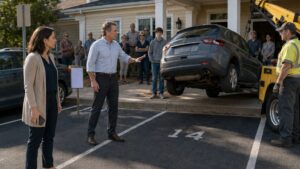
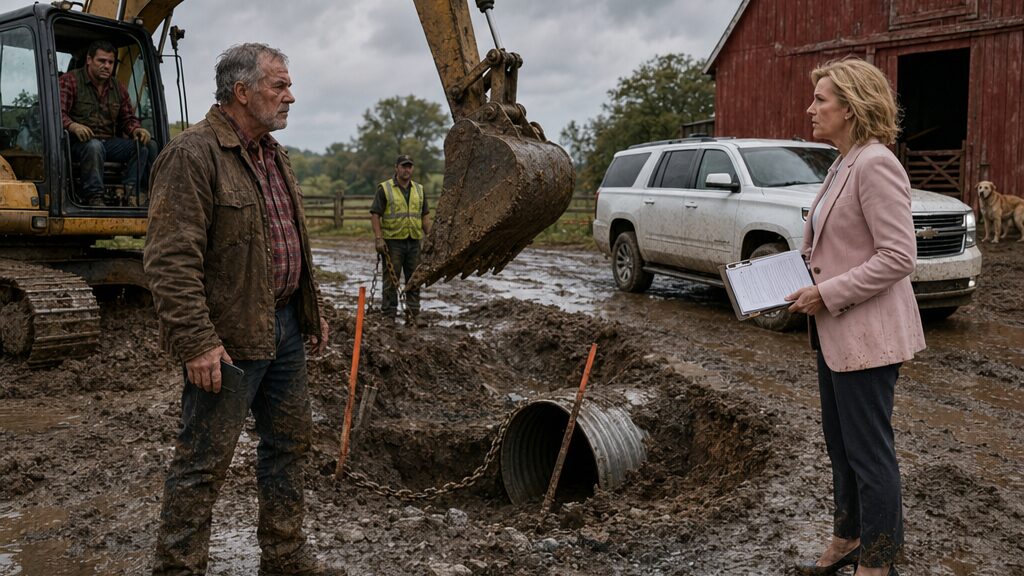
The excavator teeth were already scraping gravel out of John Miller’s lane when he came down from the porch with one boot unlaced.
The sound reached the house before the engine did—a hard metallic bite, then the grinding drag of stone across wet clay. John stopped halfway down the steps and looked past the red barn, past the old gatepost, to the bend where the lane dipped toward the drainage ditch.
Orange stakes leaned in the mud like warning flags.
Jason Flores sat high in the excavator cab, shoulders tight, one hand on the controls and the other lifted in a helpless half-wave. A crewman in a reflective vest stood beside the trench with a shovel he was not using. Another man was already hooking a chain around the temporary culvert pipe John had set the day before.
John did not shout. He put both feet on the ground, tied the loose boot with slow fingers, and walked into the mud.
“Jason,” he called.
The excavator bucket froze six inches above the gravel.
Jason pushed the cab door open. “John, I’m sorry. They told me to stop the installation and reverse what we started.”
“They?”
A white SUV sat at the driest patch of the lane, angled across the tire ruts as if it belonged there. Its front wheels had sunk just enough to leave brown water shining around the rubber. Beside it stood Rebecca Roberts in a pale pink blazer that had no business on a road like that. She held a clipboard against her chest and watched John approach like he was the one trespassing.
Behind her, John’s old dog stood near the barn doors, uneasy but quiet.
“Mr. Miller,” Rebecca said before he reached the trench. “You need to step away from the work area.”
John looked at the chain around the pipe. “That pipe is on my lane.”
“It is an unapproved exterior modification inside Stonebridge Rural Estates.”
“It’s a culvert.”
“It is still subject to approval.”
“It keeps the lane from washing out.”
Rebecca’s mouth tightened, not in anger exactly, but in the practiced way of someone refusing to be pulled into plain language. “Your application did not receive final approval.”
“My application sat on your desk for three weeks.”
“It was under review.”
“The ditch didn’t wait.”
One of the crewmen glanced from John to Rebecca. Jason’s hand remained on the excavator door. Nobody moved until Rebecca raised her clipboard.
“The board issued an emergency enforcement order this morning. You were notified.”
John looked toward the porch. No paper on the door. No envelope tucked by the mat. Just the house, the porch rail, the kitchen window, and a still shape behind the curtain that made his jaw set.
“When?” he asked.
Rebecca looked at the crewman, then back at John. “A notice was left.”
“When?”
“This morning.”
John turned his head toward the excavator. “Before or after Jason started tearing out my lane?”
“That characterization is not accurate.”
The chain clinked against the pipe as the crewman shifted his boot.
John took out his phone.
Rebecca’s eyes flicked to it. “You do not have permission to record HOA enforcement personnel.”
“I’m on my property.”
“You are obstructing authorized corrective action.”
John pressed the record button and held the phone low, aimed at the trench, not at her face. “Then say it again.”
Rebecca stepped closer, the heels of her shoes sinking slightly into the mud. “Mr. Miller, you installed this without final approval. The material does not match community road standards. The exposed pipe is visible from the common lane, and the board has concerns about drainage liability.”
“The pipe is visible because your crew dug it out.”
“It was never approved to be placed there.”
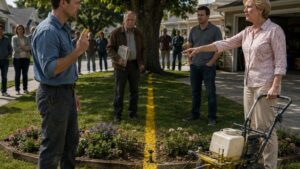
John pointed with the phone toward the ditch. “See that water? It runs off the upper lots, across my lane, and under that barn side. Last storm, it cut a foot-deep channel through here. Next storm, nobody gets up or down.”
“Then you should have waited for the board’s decision.”
He almost laughed, but the sound died before it left him. “Waited where?”
Rebecca ignored the question. She turned toward Jason. “Continue removal.”
Jason did not move.
“Jason,” she said, sharper now. “The association has contracted removal. You accepted the job.”
“I accepted a repair job from John,” Jason said. “Then I got your email telling me not to finish it.”
“And the revised order?”
Jason swallowed. “That came later.”
John angled the phone toward him. “When?”
Jason looked miserable. “About twenty minutes before I pulled in.”
Rebecca snapped, “This is not a deposition.”
“No,” John said. “It’s my road.”
“It is an association-governed exterior access lane.”
“It is the only road to my house.”
Rebecca’s eyes shifted briefly toward the porch. The curtain moved. She saw it. John saw her see it. Still, she did not ask who was inside.
She turned and pointed at the white SUV. “You parked here?”
John followed her finger to his old pickup, which sat beyond the trench, blocking the crew from backing a trailer closer to the pipe. He had left it there the night before when the gravel truck got stuck and the rain started. Now it stood between the crew and the half-built crossing like an old mule that had decided not to move.
“That’s my truck,” he said.
“It is preventing safe removal.”
“Good.”
“You cannot use a vehicle to interfere with enforcement.”
John looked at the bucket, the chain, the half-dug pipe, the orange stakes Jason had hammered into the wet ground yesterday afternoon. He thought of the water line on the barn siding. He thought of the delivery driver spinning tires in this same mud last month. He thought of the kitchen drawer where the sealed envelope still sat because Debra had asked him, once and firmly, not to attach it.
Rebecca lifted her chin. “Move it.”
John raised the phone just enough that the red recording dot glowed between them.
“Watch me,” he said.
For the first time, Rebecca lost a little of her polish. Color rose beneath her makeup. “Mr. Miller, I am advising you that refusal to comply will result in escalation.”
“Then escalate in writing.”
“The order is in writing.”
“Hand it to me.”
“It was posted.”
“Hand it to me.”
She held his gaze, then looked toward the crew as if numbers might help. The crew did not step forward. Jason stayed in the cab, one boot on the metal step, his face tight with the look of a man caught between a contract and a conscience.
Rebecca took her phone out.
John did not move from the muddy lane.
She made the call ten feet away but did not lower her voice enough. “Yes, this is Rebecca Roberts, president of the Stonebridge Rural Estates Association. We have a homeowner obstructing an authorized removal crew. Yes, he is refusing to move a vehicle and interfering with drainage compliance work.”
John kept recording the trench.
A gust came across the open field and carried the smell of wet clay, diesel, and the sour water in the ditch. The excavator idled. The bucket trembled slightly in the air.
Jason leaned down from the cab. “John, you want me to shut it off?”
“Leave it,” John said.
Rebecca turned back toward him. “Law enforcement is on the way.”
“Good.”
Her brows lifted. “You want the sheriff called?”
“I want someone here who knows the difference between an HOA notice and a court order.”
The crewman with the shovel looked away.
Rebecca crossed her arms over the clipboard. “You had every opportunity to avoid this. You chose to ignore process.”
John’s phone stayed steady, but his hand was not as calm as he wanted it to be. “Process doesn’t hold a road together.”
“You are not the only homeowner in this community.”
“No,” he said. “I’m just the one whose lane is washing out.”
At the porch, the curtain moved again. He did not look this time. If he looked, Rebecca would look again. If Rebecca looked too long, she would start asking questions John had promised not to answer.
The sheriff’s deputy arrived twelve minutes later, his patrol SUV crawling down the lane until the ruts forced him to stop behind Rebecca’s vehicle. He stepped out carefully, boots sinking at once, and took in the scene: excavator, chain, trench, white SUV, John’s pickup, Rebecca’s clipboard, John’s phone.
“Morning,” the deputy said, with the tired caution of a man who had expected a neighbor dispute and found a construction site.
Rebecca started first. “Deputy, this homeowner is obstructing an authorized HOA removal order.”
John said nothing.
The deputy looked at the bucket hanging over the pipe. “Is the machine active?”
“It was paused when he interfered,” Rebecca said.
John turned his phone slightly so the deputy could see the screen. “It was tearing out the crossing before anybody handed me a notice.”
The deputy’s gaze moved to the house, then back to the lane. “Is anyone inside depending on this road for access?”
John’s mouth went dry.
Rebecca looked at him.
The excavator engine kept idling over the silence.
Chapter 2: The Notice Said Violation, Not Emergency
“Authorized corrective action,” Rebecca said, and held the paper out as if those three words settled the matter.
John did not take it right away.
The deputy stood between them, not blocking either one, just making his body a quiet reminder that the mud already had enough machinery in it. The notice trembled slightly in Rebecca’s hand, though her voice did not.
John finally pinched the top corner and read without moving his lips.
Violation of exterior modification standards. Unapproved drainage alteration. Visible culvert installation. Failure to await final review. Corrective removal authorized by association authority.
No mention of emergency access. No mention of the washout. No mention of the three-week-old application packet, the photos, the diagram, the rain forecast, or Jason’s estimate showing the lane would fail if left open another storm.
“This says violation,” John said. “Not emergency.”
“It is an emergency enforcement action,” Rebecca replied.
“Emergency for who?”
“For the association’s liability exposure.”
John looked past her to the trench. Brown water seeped slowly along the torn edge where the bucket had scraped the gravel back. The pipe sat half exposed, like a bone pulled partway out of a wound.
The deputy held out a hand. “May I see that?”
Rebecca hesitated just long enough for John to notice. Then she gave it to him.
The deputy read the page, flipped it over, then looked at Rebecca. “This is an HOA notice.”
“Yes.”
“Do you have a court order?”
Rebecca’s posture stiffened. “The governing documents allow the association to cure violations at the owner’s expense.”
“That may be a civil matter. I’m asking whether you have a court order authorizing entry and removal today over the owner’s objection.”
“The crew is already contracted.”
“That’s not what I asked.”
For the first time that morning, the crewman with the shovel lowered it until the blade rested in the mud.
John folded his arms, then unfolded them, aware of the phone still in his right hand. His instinct was to push harder, to say what he had been saying for weeks in emails that came back with polite delays. Instead he turned toward the porch.
The kitchen curtain was still.
“Mr. Miller,” the deputy said, “do you have anything showing you requested approval?”
John nodded. “In the house.”
Rebecca cut in. “He submitted an incomplete request. No final approval was granted.”
“I asked him,” the deputy said.
John walked to the porch, boots sucking at the mud with each step. Inside, the house smelled faintly of coffee gone cold and the lemon cleaner Debra used when she wanted to feel in control of a day. She stood just inside the kitchen doorway, one hand on the back of a chair.
“Don’t,” she said.
“I’m getting the drainage folder.”
Her eyes moved beyond him, toward the yard. “Is she looking in here?”
“No.”
“She was.”
John went to the counter where the brown folder lay under a chipped coffee mug. Debra had written nothing on the tab. That had been her rule. No labels someone could read if the folder was left open. No medical words. No personal details.
He took the folder but left the sealed envelope in the drawer.
Debra saw him do it.
“John.”
“I won’t use it.”
Her fingers tightened on the chair. “That’s not what I asked.”
He waited.
Her voice dropped. “Don’t make me their reason.”
For a second the mud, the engine, Rebecca, all of it fell back behind the kitchen’s low hum. John looked at the drawer. He knew what was inside. A letter from Debra’s specialist, written in plain language, explaining why the lane needed to remain passable for deliveries, treatment equipment, and emergency transport. One page that said more than all his photos of mud.
One page she had refused to let him attach.
“I said I won’t,” he told her.
Debra nodded once, but her face did not ease.
Outside, Rebecca had moved closer to Jason’s excavator. She looked impatient, but not uncertain. That bothered John more than anger would have. Anger made mistakes. Certainty filed minutes.
He handed the folder to the deputy.
“Application dated three weeks ago,” John said. “Photos after the last rain. Jason’s estimate. Drainage sketch. Forecast printout. I emailed the packet and dropped a copy at the HOA office.”
Rebecca stepped forward. “And the committee responded that additional review was required.”
“After two weeks,” John said.
“Because the repair affects a visible approach lane.”
“It affects whether I have an approach lane.”
Jason climbed down from the excavator and wiped his hands on his jeans. “Deputy, I can say what I saw when he called me. The water’s cutting under the lane. If we don’t set that pipe and build up the crossing, the next hard rain could take the whole low section.”
Rebecca turned on him. “You are not the engineer of record.”
“No,” Jason said. “I’m the guy who pulled three stuck trucks out of here last spring.”
The deputy glanced at the folder. “Who sent you the removal order?”
Jason pulled his phone from his back pocket and opened an email. “HOA office. From Rebecca’s account. Stop installation. Begin removal of noncompliant material. Bill association for removal, owner to be assessed.”
John looked at him. “When?”
Jason’s jaw worked. “This morning. Six forty-two.”
John checked the porch post where no paper had been earlier. “And the notice?”
Rebecca answered before Jason could. “Posted after board authorization.”
The deputy looked at the paper again. “Time on this says seven fifteen.”
Jason looked down. “I was already here.”
Rebecca’s voice sharpened. “This is why we needed immediate action. He was moving forward despite review.”
“I was moving forward,” John said, “because water was already moving.”
The deputy handed the notice back to Rebecca. “I’m not going to make anyone continue removal today based on this alone. Not while the owner is objecting and there’s an access issue being claimed.”
Rebecca’s smile was brief and cold. “Claimed.”
John felt the word land where she aimed it.
The deputy turned to him. “That doesn’t mean you’re cleared. It means I’m not turning an HOA dispute into a police order. If there’s a safety issue, document it. If there’s a medical or access issue, document that too.”
John kept his eyes on the folder.
Rebecca heard the opening. “The association will convene an emergency board meeting this evening. Until then, no further work may occur. If Mr. Miller continues installation, daily fines will begin, and the association will pursue permanent removal.”
Jason said, “So I’m supposed to leave it half open?”
“You are supposed to cease work,” Rebecca said.
John looked at the trench. Half open was worse than unfinished. The gravel had been pulled back. The pipe was exposed. The mud around it was loose enough to slump if the rain came before night.
The deputy followed his gaze. “Can it be made safe without continuing the disputed work?”
Jason rubbed the back of his neck. “I can set cones. Maybe lay boards near the edge. But no, it won’t be stable.”
Rebecca said, “Temporary safety measures only. No continuation of installation.”
John wanted to tell her to walk up the lane in the next storm and say that again. Instead he closed the folder and held it against his side.
The crew shut down the excavator. The sudden quiet made the ditch sound louder. Water ticked through the torn gravel, patient and small.
Rebecca stepped close enough that only John and the deputy could hear. “Bring whatever paperwork you think helps you tonight. But understand this, Mr. Miller. The board will not reward unauthorized construction.”
John looked over her shoulder.
Debra stood at the kitchen window now. Not hidden. Not exactly visible either. Just there, her face pale behind the glass.
Rebecca noticed and turned.
John’s calm cracked so fast he almost stepped in front of her.
“Meeting’s at six,” Rebecca said.
When her SUV tried to back out, the rear tires spun twice before catching. Mud fanned behind the wheels and slapped the orange stake nearest the trench. She drove away without looking back.
The deputy lingered, watching John watch the house.
“You might want to gather anything that shows why this access matters,” he said.
John nodded.
When he stepped onto the porch, Debra had already moved away from the window. He found her in the kitchen doorway, her hand back on the chair.
“They saw me,” she said.
“Only for a second.”
“That’s enough in this place.”
He set the folder on the counter. The drawer with the sealed letter was inches from his hand.
Debra looked at it, then at him.
“Don’t make me their reason,” she said again, softer this time, and the softness made it harder to refuse her than anger ever could.
Chapter 3: The White SUV Blocked the Only Dry Ground
Rebecca’s white SUV sank deeper while she was trying to prove John had created a hazard.
The front wheels had dropped into the soft shoulder near the orange stakes, just enough that the vehicle tilted toward the trench. She stood outside it with her phone held high, photographing the mud, the exposed pipe, John’s pickup, Jason’s idled excavator, and the red barn beyond it. Every picture made the place look worse than it had before her crew arrived.
John watched from beside the porch steps with the brown folder under one arm.
Jason stood near the excavator, waiting for someone with authority to let him fix what authority had undone.
“Don’t say it,” John told him.
Jason glanced at the SUV and almost smiled. “Wasn’t going to.”
The ground gave another wet sigh under the vehicle’s front tire.
Rebecca lowered her phone and pointed toward the ruts. “This is exactly the kind of unmanaged work the association cannot permit.”
John looked at the tire sliding toward the place Jason had cleared for gravel staging. “That was the only dry ground left.”
“It was not marked as restricted.”
“The orange stakes are right there.”
“They mark your unauthorized trench.”
“They mark the drainage line you asked me to identify.”
Jason coughed once into his fist, not quite hiding it.
Rebecca ignored him and took another photo. “These images will be included in the emergency review.”
“Include the time you started removal,” John said.
“I will include the fact that you blocked safe access with your truck.”
“My truck is on my side of the lane.”
“It prevented the crew from staging correctly.”
“It prevented your crew from pulling out the pipe.”
“That is not helping your case.”
John looked down at the mud on his boots, thick up to the ankle. He had spent years measuring rain by what it did to this low place. First it darkened the dust. Then it filled the ruts. Then it ran sideways off the upper lots, carrying gravel and leaves and whatever else the hill let go of. Stonebridge called the lane rustic in its brochures. John called it honest. Water called it temporary.
Rebecca got back into her SUV and tried again. The tires spun, whining against wet clay. The vehicle lurched backward half a foot, then settled lower.
Jason took one step forward. “You want me to pull it out?”
Rebecca stared through the windshield.
John said nothing.
After a moment, she opened the door. “I will call a tow service.”
“Road’s restricted, remember?” Jason said.
Rebecca gave him a look that shut him up.
John’s phone buzzed. A message from the home health delivery service appeared on the cracked screen.
Access confirmation needed for tomorrow’s delivery. Driver noted prior difficulty. Please confirm lane stable for van entry.
He slipped the phone back into his pocket before Rebecca could see his face change.
Across the lane, Rebecca was already speaking into her phone. “Yes, this is Rebecca Roberts with Stonebridge Rural Estates. I need assistance with a vehicle stuck near a noncompliant drainage alteration.”
John walked toward the barn, where the dog had settled under the overhang. He needed a minute away from her voice. The dog lifted his head, and John scratched behind one ear with muddy fingers.
From the porch, Debra watched him but did not come out.
At the HOA office, two miles away in a converted model-home garage with stone veneer and a polished sign, Rebecca spread printed photos across the conference table that afternoon. Mud filled most of them. Mud made a useful argument. It blurred sequence. It hid the difference between damage caused by water and damage caused by removal.
Amanda Scott stood on the other side of the table, coat still on, reading each page before touching it.
“You started removal this morning?” Amanda asked.
“Corrective action,” Rebecca said.
“Before the full board reviewed his emergency request?”
“The president has authority to act when an owner creates immediate exposure.”
Amanda picked up one photo. It showed John standing between the excavator and the pipe, phone in hand. “This makes him look like he stopped a crew from tearing out his driveway.”
“He did.”
“After we sent the crew.”
Rebecca placed both hands on the table. “Amanda, last year we let a drainage alteration go unreviewed for forty-eight hours and ended up with a claim from the lower pasture owners. The association paid because no one wanted to be the bad guy. I am not repeating that.”
Amanda looked toward the wall where framed community maps hung in neat rows. “That claim was for water redirected onto another lot.”
“And this could become the same thing.”
“Did anyone inspect whether his culvert redirects water?”
“We were prevented from completing removal.”
“That’s not an inspection.”
Rebecca’s lips pressed thin. “The material does not match approved rural approach standards. The pipe is visible from the common lane. He began work without final approval.”
Amanda set the photo down. “I’m not saying he was right. I’m asking why we acted before confirming the access issue.”
Rebecca gathered the photos into a stack. “Because if we wait every time someone says emergency, the standards mean nothing.”
Amanda did not answer at once. When she did, her voice was quiet. “And if it actually is an emergency?”
Rebecca’s eyes shifted to the printed image of John in the mud. “Then he should have submitted a complete application.”
Back at the farm, the tow truck arrived late and had to park near the main road because its driver refused to bring the heavier vehicle into the softened lane. The driver walked down on foot, looked at Rebecca’s SUV, then at John’s half-open crossing.
“Not pulling from here,” the driver said.
Rebecca frowned. “Why not?”
“Because I’ll be next.”
Jason finally used his smaller equipment to free the SUV after Rebecca agreed, in writing, that he was not resuming repair work. He hooked a chain to the frame and eased the vehicle backward with the care of a surgeon. The tires came out with a sucking sound that left two deep scars in the only place where a delivery van might have turned around.
John filmed that too.
Rebecca saw him and stepped close. Mud marked the heel of one shoe and the hem of her pants. For the first time all day, she looked less polished than determined.
“You are building a record against yourself,” she said.
“No,” John said. “I’m building a record.”
“The access restriction will be posted until the board acts.”
“What restriction?”
She handed him a fresh page from her clipboard.
Temporary Access Limitation. Unapproved Work Zone. Vehicle Entry Discouraged Pending Safety Review.
John read it twice. “You’re warning vehicles not to use my lane because your crew tore it open.”
“Because the work zone is unsafe.”
“It was safe enough before you sent an excavator.”
“It was unapproved before we sent an excavator.”
He folded the page carefully. If he crumpled it, she would notice his hand shaking.
At the top of the hill, one of the unnamed neighbors had stopped to watch from the road. Others would hear by dinner. By the meeting, the story would have already become what Rebecca’s photos suggested: John Miller had dug up a common lane and then blocked enforcement when asked to comply.
His phone rang before he reached the porch.
He almost let it go. Then he saw the delivery service number and answered.
“This is the home health delivery driver assigned for tomorrow,” the driver said. “I’m looking at the access note on your account. We can’t bring the van down that lane unless the crossing is stabilized. If it’s still open or posted restricted, we’ll have to reschedule.”
John looked toward the kitchen window.
Debra was not there now.
“When?” he asked.
“Earliest reschedule would be next week.”
The wind moved across the trench and tipped one orange stake until it leaned toward the hole.
John closed his eyes for half a second, then opened them.
“Tomorrow’s not optional,” he said.
“I understand, sir. But my supervisor won’t send a van into an unstable access road.”
Behind him, Rebecca’s white SUV left slowly, its tires carrying John’s mud up the hill.
Chapter 4: The Letter John Would Not Attach
The sealed envelope was still in Debra’s drawer, untouched except for the crescent mark where John’s thumb had pressed too hard the last time he almost took it.
He stood in the dim kitchen with mud drying on his boots and the delivery driver’s warning still sitting on his phone. Reschedule. Next week. Supervisor won’t send the van. The words looked harmless on a screen, like any other scheduling problem, until he imagined the van stopping at the top of the lane while Debra waited inside for what could not wait.
From the hallway, Debra said, “You opened the drawer.”
John closed it without taking the envelope out. “I looked.”
“That’s worse.”
She came slowly into the kitchen, one hand touching the wall, not leaning exactly, just keeping contact with it. She had changed out of the cardigan she wore that morning, but the effort had left her pale around the mouth. John pretended not to notice because pretending was part of the old agreement. She pretended not to need help unless she asked. He pretended that letting her pretend did not cost them both.
“The delivery service called,” he said.
“I heard.”
“They won’t bring the van down unless the crossing is stable.”
“Then tell Rebecca that.”
“I did. In six different ways.”
Debra looked at the drawer. “Not the way that matters.”
The house was quiet enough for them to hear water ticking somewhere outside, not rain yet, just the ditch finding the fresh cut in the gravel. John set the brown folder on the table. The edges were soft from the morning’s mud. He opened it and spread out the same pieces he had already shown the deputy: photos, estimate, application, drainage sketch, printed forecast. All of it practical. All of it true. None of it enough.
Debra stood across from him, looking at the papers like they belonged to someone else’s trouble.
“You remember when we moved here?” she asked.
John did not answer. He knew the turn her voice had taken.
“You said we could disappear a little.”
“We did.”
“No. You disappeared.” Her smile was small and tired. “I got put on committees anyway. Welcome baskets. Garden days. Everybody asking why I left early, why I didn’t come to the potluck, why I used the side door at the meeting room. Then the questions got soft.”
He hated the soft questions more than the hard ones. Hard questions could be refused. Soft ones carried pity wrapped in manners.
Debra reached for the chair but did not sit. “When the specialist wrote that letter, I said it was for emergencies only.”
“This is an emergency.”
“No,” she said. “This is people.”
John looked down at the application form. His own handwriting filled the blank spaces in square, careful letters. Drainage stabilization. Gravel crossing. Culvert replacement. Emergency temporary access repair. He had written everything except the thing that turned a road into a lifeline.
“I promised,” he said.
“You also promised you’d keep the house reachable.”
The words landed harder because she did not raise her voice.
John pulled out a chair for her. She gave him a look, then sat because refusing would take more strength than accepting. He sat across from her, the sealed drawer between them like a third person at the table.
“I thought facts would be enough,” he said.
“They are facts.”
“They’re mud facts.”
“That’s what you call them?”
He almost smiled. “Photos. Maps. Pipes. Water direction. Things nobody can gossip about.”
Debra touched the edge of one photo. It showed the lane after the last storm, gravel scattered like bones across the ditch, tire ruts filled with brown water. “You don’t trust them with anything else.”
“No.”
“Neither do I.”
Outside, a truck passed on the upper road and slowed near the lane. Tires crunched on wet stone. Someone looking. Someone already knowing a version of the story.
Debra heard it too. Her eyes flicked to the window.
John’s phone buzzed again before either of them spoke. This time it was an email from the HOA office.
Notice of Fine and Emergency Hearing Confirmation.
He opened it. Rebecca’s language filled the screen with clean spacing and hard consequences. Daily fine beginning tomorrow morning. Permanent removal authorization pending board confirmation. Owner responsible for restoration costs. No further work permitted without written approval.
John handed the phone to Debra.
She read it once. Then again.
“Twenty-four hours,” she said.
“Less than that if the rain starts.”
Debra gave the phone back. Her fingers were cold when they brushed his.
For a while neither of them moved. The dog scratched at the back door, then settled. A low engine rumbled somewhere in the distance and faded. John looked at the drawer until the brass knob blurred.
Debra said, “I asked you not to make me their reason because I know what happens after people know.”
John’s throat tightened.
“They stop asking about the garden,” she continued. “They ask about symptoms. They tell stories about cousins. They lower their voices like I’m already halfway gone. I don’t want Rebecca Roberts standing in a meeting room reading my body into the minutes.”
“I won’t let her.”
“You can’t control what she does.”
“No,” he said. “But I can control what I give her.”
Debra studied him. “That’s what worries me.”
He looked up.
“You give people the least amount possible and expect them to understand the rest,” she said. “You did it with the board. You did it with Jason. You did it with the deputy. You do it with me sometimes.”
That last part hurt because it was not accusation. It was weathered fact.
John’s hands flattened on the table. The mud under his nails had dried into dark crescents. “I don’t know how to ask strangers to care.”
“You don’t have to ask them to care. You have to make them stop pretending there’s nobody at the end of that road.”
The drawer seemed louder when he finally opened it.
The envelope lay under a stack of appliance manuals and an old grocery list. Debra had tucked it there months ago, where it would be easy to find and easy not to see. John lifted it out and set it on the table without opening it.
Debra looked at her name typed across the front.
“You should know what it says,” she said.
“I know enough.”
“No. You know what you decided you could stand knowing.”
He did not argue.
She opened the envelope herself. The paper came out clean, white, official. Her specialist had written plainly, without drama: patient requires reliable vehicle access for scheduled home delivery of treatment supplies and for emergency transport; prolonged interruption of driveway access may create avoidable health and safety risks; reasonable accommodation recommended for all exterior access restrictions and repair approvals.
John read the words once and then looked away.
Debra slid the letter toward him. “It doesn’t say everything.”
“It says enough.”
“It says more than I wanted.”
He folded the letter back along its original crease, but his fingers hesitated before returning it to the envelope.
Debra reached across the table and put her hand over his. “Use it.”
John looked at her.
Her face was steady now, but not because it cost her nothing. He could see the price in the way she held her shoulders, in the way she had chosen a chair with its back to the window, in the way she refused to let her voice break.
“Use it,” she repeated. “But don’t let them turn me into a story.”
John closed his hand around the envelope, and for the first time that day, the thing he was most afraid of was not the mud giving way.
Chapter 5: The Board Called It Community Standards
Rebecca opened the emergency meeting with a photograph of John standing in front of the excavator.
His image filled the portable screen at the front of the community room: muddy boots planted wide, phone in one hand, red barn behind him, the bucket hanging over the exposed pipe. In the photo he looked larger than he felt and angrier than he had allowed himself to be.
Rebecca tapped the screen with the end of a pen. “This is the condition at the Miller property as of this morning.”
John sat in the second row with the brown folder on his knees and Debra’s sealed envelope inside it. He had not put it on the table. Not yet.
Around him, folding chairs creaked as neighbors leaned for a better look. A few whispered. Amanda Scott sat at the board table, her eyes moving not to John’s face in the photo, but to the bottom corner where the time stamp glowed faintly.
Rebecca continued, “The owner began unapproved drainage alteration within a visible approach lane. The association attempted corrective action. The owner obstructed the crew, refused to move a vehicle, and created an unsafe work zone that now limits access.”
John felt his jaw tighten at the order of the words. Began. Attempted. Obstructed. Created. It sounded tidy when she said it that way.
Amanda lifted one page from the packet in front of her. “Before we proceed, can we clarify the timeline?”
Rebecca paused. “The timeline is in your materials.”
“I’m asking because the removal notice is time-stamped seven fifteen.” Amanda looked toward the screen. “This photo says seven oh six.”
A small movement passed through the room.
Rebecca did not look at the screen. “The crew arrived to secure the site.”
John kept his hands folded over the folder. He had promised himself he would not interrupt unless he had to. He had also promised Debra he would not make a performance out of her need. The two promises sat uneasily together.
Amanda set down the packet. “The excavator bucket is over the pipe in this photo.”
“The owner was advancing unauthorized work.”
Jason, seated against the side wall in a clean shirt that still looked like it belonged near machinery, shifted but said nothing.
Rebecca turned to the room. “This is not about punishing a neighbor. It is about standards that protect every homeowner. We have procedures for drainage work for a reason. Unreviewed alterations can redirect water, damage adjoining lots, and expose the association to liability. We have been through that before.”
There it was—the old claim. John saw several neighbors nod. They remembered the lower pasture flooding, the argument over who had changed the slope, the assessment that followed. Rebecca knew exactly which fear to touch.
John opened his folder.
Rebecca saw the movement. “Mr. Miller will have an opportunity to speak.”
“I only need a minute.”
“The board will first complete its review.”
He looked at Amanda. Amanda did not rescue him. She only said, “Let him submit any documents now so we’re reviewing the full file.”
Rebecca’s expression cooled. “The file was incomplete at the time of enforcement.”
John stood.
The room quieted in the way rooms do when people expect anger and prepare to enjoy or judge it. John did not give them either. He walked to the board table, placed his drainage packet down first, then the estimate, then the photographs of the washed lane before the crew came.
Last, he laid the sealed envelope in front of Amanda, not Rebecca.
“This is a medical access letter,” he said. “It explains why the lane cannot be left unstable.”
The room changed without making a sound.
Rebecca reached for it. Amanda put one hand lightly on the envelope before Rebecca could take it.
“Is Mrs. Miller consenting to this being submitted?” Amanda asked.
“Yes,” John said.
“Does she consent to it being read aloud?”
“No.”
Rebecca’s eyes moved from the envelope to John. “If you are asking the association to consider medical necessity, the board must understand the basis.”
“The basis is in the letter,” John said. “Not for the room.”
A neighbor in the back murmured something. John did not turn around.
Amanda opened the envelope and read silently. Her expression shifted in small degrees: procedural attention first, then comprehension, then discomfort. She passed it to the other board members, but not to the room.
Rebecca waited until Amanda finished. “No one disputes that access is important. But medical preference does not override drainage liability.”
John heard the word preference and felt something old and hard move inside him.
He kept his voice low. “It’s not preference.”
“The association cannot approve unengineered work simply because the owner now provides additional context.”
“Now?” John said.
Rebecca held his gaze. “This was not part of your original submission.”
“No,” he admitted.
The admission felt like stepping into water.
Rebecca turned slightly toward the board. “That matters. The association acted on the file it had.”
Amanda looked at John. “Why wasn’t this attached?”
The room waited again. This time the waiting felt less hungry, more uncertain.
John looked at the envelope, then at the floor between his boots. He had tracked a small amount of dried mud onto the community room tile. A brown crescent had broken loose near the leg of the board table.
“Because my wife didn’t want her medical information becoming neighborhood business,” he said. “And because I thought the photos of a washed-out lane would be enough.”
Rebecca said nothing, but her pen tapped once against her folder.
Amanda glanced back at the projected photograph. “Rebecca, did the architectural committee ever complete visual impact review?”
“It was pending.”
“For three weeks?”
“We were waiting on additional drainage clarification.”
John opened his folder and pulled out the email chain. “I sent the clarification the same day you asked for it.”
Amanda took the papers. Rebecca looked at them as if they had appeared from under the table.
Amanda’s finger stopped on one email. “Rebecca, this message from you says ‘hold for visual impact review after next board agenda.’ That was ten days ago.”
“It required formal consideration.”
“But the emergency removal happened before formal consideration.”
Rebecca’s voice hardened. “Because he proceeded anyway.”
“After the hold?”
“After failing to receive approval.”
John saw the circle now. Rebecca had drawn it clean and tight: no approval because no review, no work because no approval, removal because work began without approval.
A board member asked, “Could temporary stabilization have been allowed pending review?”
Rebecca answered too quickly. “Not without establishing whether it redirected water.”
Jason finally stood from the side wall. “It follows the existing ditch. That’s why the stakes are there.”
Rebecca turned. “You were not recognized to speak.”
Amanda said, “Let him answer the technical question.”
Jason’s face reddened, but he kept his voice even. “John didn’t ask me to change the drainage. He asked me to keep the water under the lane instead of through it. Same flow. Pipe under, gravel over. Temporary until inspection.”
Rebecca looked down at her notes. “Temporary structures still require approval.”
John almost laughed at the tired perfection of it. Instead he looked at Amanda and saw the first real crack in the room’s certainty.
Then the clerk at the side table, who had been managing the meeting laptop, leaned toward Amanda and whispered. Amanda checked the screen in front of her.
“What is it?” Rebecca asked.
Amanda read silently, then looked up.
“The county drainage clerk responded to the inquiry I sent before the meeting,” she said.
Rebecca’s pen stopped moving.
Amanda turned the laptop slightly so the board could see. “According to the county map, the low section of the Miller lane sits inside an emergency drainage easement recorded before Stonebridge Rural Estates was formed.”
John felt the room tilt toward a new question.
Amanda looked at Rebecca, then at him.
“The clerk says emergency stabilization may be permitted when access is threatened,” she said. “And she attached the original easement.”
Chapter 6: The Easement Was Older Than the HOA
The county map put the HOA’s common appearance zone on one side of the line and John’s torn-open trench on the other.
A thin black boundary ran across the screen in the county drainage office, straight as a fact. The clerk zoomed in until the red barn appeared as a small rectangle, the lane a pale scar, the low ditch marked with an old easement number John had never noticed on any Stonebridge packet.
“There,” the clerk said, tapping the monitor. “This predates the association.”
John leaned closer. The printed map in his hand showed the same thing, but seeing it overlaid on the aerial image made his chest loosen for the first time since the excavator bucket scraped gravel from the lane.
Amanda stood beside him, coat buttoned wrong from having dressed in a hurry. Rebecca stood on the other side of the desk with her arms folded, her face controlled but color high.
The clerk turned to Rebecca. “Your association may have appearance standards for the roadway approach, but this easement reserves drainage maintenance rights. Emergency stabilization is not the same as permanent alteration.”
Rebecca’s jaw moved once before she spoke. “We are not trying to prevent maintenance. We are trying to prevent unreviewed owner work that could create downstream liability.”
“Then review it,” the clerk said, not unkindly. “But if access is threatened, stopping stabilization can create a different liability.”
John looked at the map again. The orange stakes Jason had placed matched the easement’s old line almost exactly. Not because John knew the number. Because water had known the path long before Stonebridge gave it a name.
Rebecca reached for the printed copy. “May I?”
The clerk handed her one.
Amanda said, “This should have been in the association records.”
“It may be,” Rebecca replied.
“Then why wasn’t it in the file?”
Rebecca’s eyes stayed on the paper. “Because the owner submitted the request as an exterior modification, not as easement maintenance.”
John let out a slow breath through his nose. Even now, she needed the distinction to stand between them and the hole in the road.
“I submitted it the way your form allowed,” he said.
“The form has categories.”
“None of them said ‘keep the only road from washing away before my wife’s delivery van arrives.’”
The clerk glanced up but did not comment.
Rebecca folded the map carefully, buying time. “The board can consider emergency stabilization under conditions. But the existing culvert material still may not meet association standards.”
Amanda turned toward her. “Then set a condition. Don’t tear it out.”
Rebecca’s phone buzzed. She looked at it, then away.
John saw enough of the screen to know it was from the HOA office. Messages. Neighbors. Photos. The story was already moving faster than the water.
Outside the county building, the sky had lowered into a sheet of pewter. John called Jason from the parking lot while Amanda and Rebecca stood several feet away, speaking in tense, low voices.
“Tell me good news,” Jason said.
“The easement lets us stabilize.”
“Written?”
“Printed.”
“Board approved?”
“Not yet.”
Jason was silent.
John looked toward Rebecca. “How long can the crossing hold?”
“With the pipe exposed and that gravel pulled back? Depends on rain. If it starts hard, not long.”
“I’m coming home.”
“John,” Jason said, “if I touch it without something in writing, Rebecca can come after my license through the association complaint. I can set equipment there. I can be ready. But I can’t restart on a handshake.”
John closed his eyes. “I know.”
When he hung up, Rebecca was waiting.
“The association is prepared to offer a resolution,” she said.
Amanda looked sharply at her. “Rebecca.”
Rebecca ignored the warning. “If you voluntarily remove the current pipe and return the lane to pre-work condition, the board will withdraw the fine while you resubmit under the correct easement maintenance category. We can schedule expedited review.”
John stared at her.
For a second he thought he had misheard. Then the words arranged themselves fully. Remove the pipe. Return the lane. Reapply. Wait again, only this time with the ditch open, the rain close, and Debra’s delivery van already uncertain.
“No,” he said.
Rebecca’s expression tightened. “It is a reasonable compromise.”
“It leaves the road failing.”
“It prevents unapproved material from becoming permanent.”
“The pipe is temporary.”
“That is your assertion.”
Amanda stepped closer. “Rebecca, the county just said emergency stabilization may be permitted.”
“May be. Under conditions.”
“Then let’s vote on conditions.”
“We need an engineer’s review.”
John looked at the sky. “Before morning?”
Rebecca followed his gaze, and something in her face shifted—not sympathy, exactly. Calculation, maybe. Fear.
“We have to be careful,” she said.
John nodded once. “That’s what I’m doing.”
He left them there and drove back toward the farm with the county map on the passenger seat. By the time he reached the Stonebridge entrance, the first drops struck the windshield. Not hard yet. Enough to darken the dust on the road. Enough to make every low place shine.
The access restriction notice Rebecca had posted stood at the top of his lane, laminated now in a plastic sleeve tied to a stake.
Vehicle Entry Discouraged Pending Safety Review.
John got out, pulled his phone, and photographed it with the rain beading on the plastic.
Then he walked down the lane.
The mud had changed since morning. It had lost its dull heaviness and taken on a wet gloss. Water was already gathering along the torn edge of the crossing, slipping under the exposed pipe where Jason’s bucket had loosened the bedding. One orange stake had fallen flat. Another leaned toward the ditch as if trying to point out the obvious.
Jason’s excavator sat where he had left it, engine off, bucket lowered now for safety. Jason stood under the barn overhang with his hood up.
“You get it?” he asked.
John held up the map.
Jason took it, studied it, and let out a low whistle. “That line is our stake line.”
“Close enough?”
“Close enough to make a person ask why nobody checked before sending a crew.”
John looked toward the house. Debra was not in the window, and that absence worried him more than seeing her would have.
His phone rang. Amanda.
“The board is convening remotely in twenty minutes,” she said, breathless, as if she was walking fast. “I’m pushing for emergency conditional approval with county inspection.”
“Rebecca?”
“She’s arguing voluntary removal and reapplication.”
“Of course she is.”
“John, listen to me. Do not restart work until the vote. If you do, she’ll say you ignored the process again.”
Water curled around the gravel at his feet.
“How long?”
“Twenty minutes.”
The sky answered with a heavier patter on the barn roof.
Jason watched the trench. “John,” he said quietly.
A brown stream had begun cutting a small channel around the half-removed crossing, not through the pipe, but beside it. The water found the loose soil and took it grain by grain, then clump by clump. It was not dramatic yet. That was the trouble with washouts. By the time they looked dramatic, the road was already gone.
John looked at the county map in Jason’s hand, then at the phone against his ear.
“Amanda,” he said, “tell them the road is failing while they vote.”
He hung up before she could answer.
Jason stepped closer. “What do you want me to do?”
John stood in the rain beside the trench Rebecca had called a violation and watched water begin to eat the road home.
Chapter 7: The Road Home Stayed Open
The half-removed culvert shifted before Jason touched the controls.
It was not a dramatic collapse. No crack, no crash, no one shouting. Just a slow dip at the upstream edge, a dark fold of mud giving way under the water’s steady pressure. The pipe settled an inch lower, and the stream that should have gone through it began sliding around it instead, eating at the side of the lane where Rebecca’s crew had scraped the gravel loose.
Jason saw it too.
“If that side cuts through,” he said, “you won’t get a car over it.”
John stood in the rain with the county map inside his jacket, his phone in one hand, Amanda’s remote meeting still open on speaker. Voices overlapped through the tiny speaker—Rebecca’s controlled, Amanda’s sharper than John had ever heard it, another board member asking whether they could vote without a full engineering report.
Water ran off the brim of John’s cap and down his neck.
Amanda’s voice came through. “We are not approving a permanent structure tonight. We are voting to allow emergency stabilization under county inspection, because the current condition was worsened by attempted removal.”
Rebecca answered, “The association cannot accept responsibility for owner-installed work.”
John looked at the exposed pipe. “You already accepted responsibility when you sent the crew.”
The phone went quiet for half a second.
Then Rebecca said, “Mr. Miller, are you on the call?”
“I’m standing where your crew left the lane open.”
Amanda said, “John, describe the condition.”
He lifted the phone and filmed the trench. “Water’s cutting around the pipe. The orange stake on the north side is down. Gravel is gone where the bucket scraped it. Jason is here with the machine, but he won’t restart without written approval because he’s the only person today still respecting your process.”
Jason looked at him, then away.
Another board member asked, “Is the house currently reachable?”
“For now,” John said. “Not for long.”
Rebecca’s voice came back smaller through the rain. “No one instructed the crew to create an unsafe condition.”
John turned the camera toward the bucket marks in the mud, then the ruts left by her white SUV. He did not mention her by name. He did not need to.
Amanda said, “I move to approve emergency stabilization of the Miller lane within the recorded drainage easement, using the existing temporary culvert placement, subject to county inspection and later board review for finish material.”
There was a silence on the call where everyone seemed to understand that the vote had arrived before anyone was ready to own it.
Rebecca said, “I object to the motion as premature.”
Amanda said, “Noted. I’m calling the vote.”
John lowered the phone. His hand was stiff from holding it in the rain. Jason stood beside the excavator, one foot on the track, waiting like a man listening for a starter pistol he did not trust.
The first vote came through faintly. Yes.
Then another. Yes, with county inspection.
Rebecca did not speak.
Amanda said, “Rebecca?”
Rain struck the phone screen hard enough that John wiped it with his sleeve.
Rebecca’s answer came after a long pause. “No.”
Amanda said, “My vote is yes. Motion carries.”
Jason closed his eyes for one second, then climbed into the excavator cab.
“Wait,” John said.
Jason froze.
John looked at the phone. “I need that in writing.”
Rebecca laughed once, not with humor. “The road is failing and now you want paperwork?”
John looked at the torn lane, the water, the house beyond the barn, the porch where Debra was not standing because he had asked her to stay away from the window. He thought of every form Rebecca had used as a wall, and every time he had thought silence was strength.
“Yes,” he said. “I want it in writing.”
Amanda answered before Rebecca could. “I’m sending the written authorization now. Emergency stabilization approved. County inspection required. No fines pending completion of inspection.”
“Removal order?” John asked.
A pause.
Amanda said, “Withdrawn pending inspection.”
“Say it in the email.”
“I will.”
The email arrived two minutes later. John opened it with wet fingers and read it twice before showing it to Jason.
Jason nodded once, started the machine, and the excavator came alive in the same mud where it had become a threat that morning.
This time the bucket did not tear. It lowered.
Jason moved carefully, shaving loose mud from the collapsed side, placing it where it would hold long enough for gravel. John worked at the edge with a shovel, not because Jason needed him to, but because standing back felt wrong. Water soaked his sleeves. Mud pulled at his boots. The dog barked once from the barn and then went quiet, as if he had decided the machine had changed sides.
At the top of the lane, Rebecca’s white SUV returned.
John saw it through the rain but did not stop working. She parked on firmer ground this time and walked down without the pink blazer. A dark raincoat covered her suit. In one hand she carried a folder sealed in a clear plastic sleeve.
Jason glanced toward her. “You want me to stop?”
“No,” John said.
Rebecca reached the trench and stood on the opposite side, careful to remain beyond the orange stakes.
“I brought the withdrawal notice,” she said.
John kept both hands on the shovel. “Amanda already sent it.”
“This is signed.”
He looked at her then.
Her hair had come loose at one temple. Mud marked one cuff. She did not look defeated. She looked like someone who had been forced to stand in the weather with the consequences of a decision that had sounded cleaner indoors.
“The association still requires inspection,” she said.
“I know.”
“And the visible finish will need to be addressed when conditions allow.”
“I know that too.”
Her mouth tightened. “I should have checked the easement before authorizing removal.”
John waited.
“I acted on the file I had,” she added.
There it was again, the narrow bridge she built for herself.
John could have burned it. He had the video, the time stamps, the tire ruts, the deputy’s report, the medical letter, the county map. He could have said every word the neighbors would repeat for years.
Instead he rested the shovel against his shoulder.
“The file had a house at the end of the lane,” he said.
Rebecca looked past him toward the porch. Debra was not there. For once, Rebecca did not search the windows.
“I understand that now,” she said.
John did not thank her.
She held out the signed withdrawal in its plastic sleeve. He stepped across a narrow plank Jason had placed over the ditch and took it. Their hands did not touch.
By late morning, the rain thinned. Jason set the culvert properly, packed stone around it, and built the crossing high enough for water to pass beneath instead of through the road. The county inspector arrived after noon, walked the orange stake line with the map in one hand, and gave Jason two practical corrections: more stone at the downstream edge, temporary silt control until the banks settled.
John agreed to both before anyone asked him to.
Amanda came in person after the vote, her shoes muddy by the time she reached him. “The fine is withdrawn,” she said. “The board minutes will say emergency stabilization approved under recorded easement.”
“Will they say removal started before notice?”
Amanda glanced at Rebecca, who stood near the SUV.
“Yes,” she said. “They will.”
That mattered more than John expected. Not because it punished anyone. Because it put the day in the right order.
Inside the house, Debra signed the accommodation form at the kitchen table while John stood beside her with mud on his knees and the withdrawal notice drying near the sink. She read every line before signing, especially the part that said disclosure limited to access-related accommodation review.
“They’ll still know enough,” she said.
“Yes.”
She looked up at him. “Can you stand that?”
He thought about the room of neighbors, the envelope in Amanda’s hand, the way his own silence had helped Rebecca make the wrong story official.
“I’ll learn,” he said.
Debra signed.
The delivery van arrived just before the light changed. It paused at the top of the lane, then came down slowly over the fresh gravel, tires crunching where the mud had swallowed everything that morning. John stood by the red barn with the dog against his leg and watched the van cross the culvert without sinking.
In the wet gravel below, the barn reflected in broken red pieces, wavering each time water slipped beneath the road instead of over it.
Debra opened the door before the driver knocked.
John stayed outside a moment longer, looking at the orange stakes, the tire ruts from Rebecca’s SUV, and the excavator tracks pressed deep beside the repaired crossing. The road home was not pretty. It was not finished.
But it held.
The story has ended.