The Cabins Were Sold Out Before He Learned The Contractor Had Never Owned The Shore
Chapter 1: The Shore Was Already Torn Open
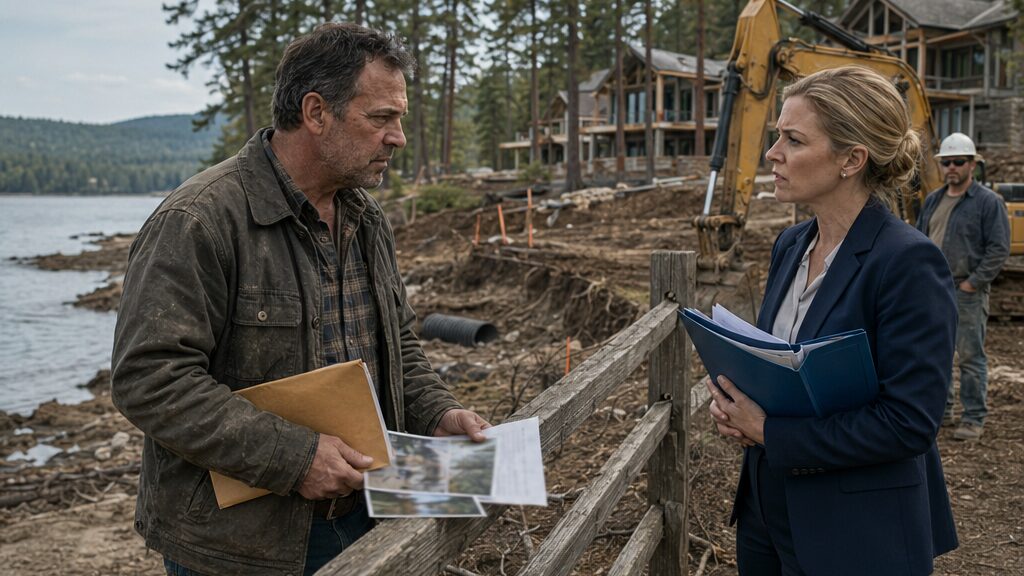
Pamela Mitchell stood in front of the excavator with a revised invoice clipped to a blue folder, asking for another twenty-eight thousand dollars while the shore behind George Martin still looked like somebody had taken a bite out of it.
The machine’s bucket hung above the bank, still and heavy, its teeth crusted with brown clay. Below it, George’s lakefront had been cut open in a raw crescent where Brandon Moore’s crew had started the retaining repair six weeks earlier and then stopped. The old grass was gone. The slope was stripped to exposed roots and damp soil. Orange stakes leaned at odd angles where a clean wall was supposed to be. The dock path ended at a drop-off George no longer trusted in the dark.
Pamela held the folder against her chest like it belonged there.
“Mr. Martin, I understand this is frustrating,” she said. “But Brandon can’t keep crews waiting without the adjustment being approved.”
George kept his hands on the top rail of the split fence. The wood was rough under his palms. He had built that fence after his father died, not to keep people out exactly, but to make the line clear. This side was the Martin shore. That side, uphill through the pines, had become Crestwood Shores, fourteen luxury cabins framed in fresh lumber and expensive promises.
“No,” George said.
Pamela blinked once, as if the word had landed wrong.
Behind her, two workers in hard hats looked away. One pretended to check a measuring tape. The excavator operator sat in the cab with the door open, one boot hanging out, waiting for somebody above his pay grade to decide what kind of morning this was going to be.
Pamela lowered the folder and unclipped the invoice. “The shoreline stabilization scope changed after excavation. You were informed that subsurface conditions required additional materials.”
“I was informed Brandon stopped answering his phone.”
“That’s not fair.”
George looked past her to the torn bank. A month ago, the lake had been high from spring runoff, licking at the exposed cut in the soil. He had laid tarps over the worst places himself, weighting them with cinder blocks in the rain. Brandon’s crew had promised to return Tuesday. Then Thursday. Then after Memorial Day. Then Brandon had sent one text about supplier delays and disappeared into silence.
George had paid him once to start. Paid him again after the excavation, because Brandon said materials had to be locked down before prices jumped.
The wall still did not exist.
Pamela took a step closer to the fence. Her navy blazer was clean enough to look unreal at the edge of all that mud. “Cabin closings are scheduled. Shore access was included in the development package. Every delay now creates damage for people who did nothing wrong.”
George’s jaw tightened.
There it was—the reason she had brought the folder instead of Brandon himself.
“Shore access,” he repeated.
“Yes.”
“My shore.”
Pamela’s expression tightened, but she did not retreat. “Your repair is integrated with the shared access plan Brandon discussed with you. The maintenance easement language has to be signed before the crews can complete both.”
George stared at her.
The lake behind him slapped softly against the dock posts. On the far side of the water, pines stood black-green and still under a pale sky. He had lived with that sound most of his life. The shore had belonged to his family before Crestwood Shores was a sign, before the cabins, before anybody thought to sell peace and quiet by the square foot.
“Brandon discussed repairing my bank,” George said. “Not giving your buyers my land.”
Pamela held out the invoice. “This is the revised cost to complete. Once you approve it, the access language will be finalized and the crew can get back to work.”
George did not take it.
Pamela’s fingers remained in the air for an awkward second before she pulled the paper back.
“You already have thirty-four thousand dollars of mine,” he said.
“That payment covered completed excavation and mobilization.”
“It covered a retaining wall.”
“The wall requires additional material.”
“Then show me the material.”
The workers behind Pamela became still.
George turned and walked toward the old green truck parked beside his shed. He heard Pamela call his name, crisp and irritated, but he did not answer. From the passenger seat he took a manila envelope with the edges softened from being handled too much. Inside were the things he had not wanted to show anyone: the original contract, the deposit receipt, the second payment receipt, and four printed photographs of his own damaged shore, each dated in black marker.
He came back slowly.
Pamela watched him with a look that said she had expected anger, maybe shouting, maybe a threat she could use. George gave her paper.
He laid the original contract across the fence rail, smoothing it flat with two fingers. Brandon Moore’s signature sat at the bottom in blue ink. Fixed-price shoreline stabilization. Includes excavation, drainage, retaining structure, stone backfill, final grading. Amount paid to date: thirty-four thousand dollars.
Then George took out a photograph.
“This was the day after excavation,” he said.
The photo showed the torn shore almost exactly as it looked now: raw dirt, exposed roots, orange stakes, no wall.
He placed another beside it. “One week later.”
Another. “Two weeks.”
Another. “Yesterday.”
He tapped the last photo once.
“Tell me what changed.”
Pamela looked down.
For the first time that morning, her face lost its rehearsed firmness. Only for a second. Then she pulled it back into place.
“Photographs don’t show ordering delays, Mr. Martin.”
“They show no wall.”
“The material schedule is Brandon’s department.”
“Then Brandon can come stand here and explain it.”
Pamela lifted her chin. “He asked me to handle this because the buyer timeline has become sensitive.”
“The buyer timeline is not my repair contract.”
“It is now connected.”
“No,” George said again, quieter this time. “That’s what you came here hoping I wouldn’t understand.”
A hard flash crossed Pamela’s face. Not guilt, not exactly. Fear, maybe. Or anger at being cornered in front of crew.
She opened her folder and drew out another document, thicker than the invoice. A line of highlighted language ran across the middle.
“If you refuse to approve the change order, Crestwood may have no choice but to protect its position. That could include filing a lien for unpaid adjustment costs and seeking delay damages for any closings affected by your obstruction.”
The word obstruction hit harder than George expected.
He had stayed quiet because he was ashamed. He had not told the cabin buyers who waved from the road that the man they saw as a stubborn old holdout had paid the same contractor they were trusting. He had not told the county clerk he had given Brandon a second check because Brandon had sounded so certain on the phone. He had told himself a private man handled private mistakes without making a display.
Pamela had built a different story in the silence.
George folded the photos back into the envelope, except for the last one. That one he left beside the contract.
“You tell Brandon,” he said, “I’m not signing anything that changes my shoreline, my access, or my rights.”
Pamela held his stare. “Then you understand the consequences may be formal.”
“I’m starting to hope they are.”
The excavator operator climbed down from the cab. The workers pretended not to listen and listened anyway.
Pamela closed the folder sharply. A loose sheet slipped halfway out before she caught it. For a moment, as she pressed it back into place, George saw the top corner.
Crestwood Shores Buyer Access Packet.
Below that, in smaller print, was a reference number.
George’s eyes locked on it.
CS-SR-1047.
The same number sat at the top of his repair contract, above Brandon Moore’s signature.
Pamela shoved the paper deeper into the folder, but she had seen him see it.
George did not reach for her folder. He did not raise his voice. He only put his finger on his own contract number, still lying on the fence rail between them.
“Why,” he asked, “is my repair job number in your cabin packet?”
Pamela’s mouth opened, then closed.
The excavator engine ticked as it cooled behind her.
Chapter 2: The Contract Number On The Sales Packet
George laid Pamela’s stolen glimpse beside his own contract before he took off his muddy boots.
The kitchen table had known bills, fishing reels, seed catalogs, his father’s old thermos, and once, many years ago, a birthday cake his mother had frosted unevenly because the power had gone out during a storm. Now it held everything George had been too embarrassed to organize: Brandon Moore’s contract, two receipts, bank printouts, four photographs, the revised invoice Pamela had left after claiming he would “need it for his records,” and a memory of the packet page she had tried to hide.
CS-SR-1047.
He wrote it on the back of an envelope before it could become one more thing he half remembered and doubted later.
The house was quiet except for the refrigerator kicking on and the soft chop of the lake outside. From this window, George could see the first cabin roofline through the trees. New cedar. Black trim. Big glass windows angled toward a view that existed because his family had left that stretch of shore untouched.
He unfolded the original contract again.
Crestwood Shoreline Contractors, LLC. Brandon Moore, owner/operator. Project: Martin shore stabilization and dock-path repair. Job number: CS-SR-1047.
He had read those words plenty of times. He had not understood how much he had not read.
George pulled Pamela’s revised invoice closer.
Additional stabilization material. Shared access integration. Easement coordination. Revised completion cost: $28,000 due before remobilization.
Shared access integration.
He circled the phrase so hard the pen tore the paper.
His phone buzzed on the counter. For half a second he thought it might be Brandon, but it was only a weather alert: rain expected late in the week. George turned the phone face down, then turned it back over almost immediately. That was another habit he had to stop—turning away from bad news and hoping it would become decent while he was not looking.
He opened his banking app with fingers that felt too large for the screen.
The first payment had cleared April 12. Twenty thousand dollars. The second had cleared May 3. Fourteen thousand. He remembered that day too clearly now. Brandon had stood right outside this kitchen window, one boot on the stone step, telling George the excavation exposed softer soil than expected.
“If I don’t order the retaining panels now, we lose two weeks,” Brandon had said. “You know how lake work gets when everybody starts booking for summer.”
George had known nothing except that his shore was open and the man in the company truck sounded like he did.
The bank record showed May 3, posted 10:41 a.m.
George looked at his photographs.
May 4: raw bank.
May 11: raw bank.
May 18: raw bank.
May 31: raw bank.
No panels. No stone. No drainage pipe except two short lengths left beside the fence, still wrapped in plastic.
A small, mean embarrassment rose through his chest. He had not been robbed in a dark alley. He had written the check at his own table. He had nodded when Brandon used words like mobilization and subsurface and seasonal pricing. He had let the man turn confusion into urgency.
George stood so abruptly the chair legs scraped.
He took the photos outside.
Down at the fence, the job site looked worse after paperwork. The torn bank was no longer just a mess; it was a ledger. Every cut in the earth had a line item. Every missing stone had a receipt somewhere, maybe with his name on it, maybe not.
He held the first photograph up beside the real bank.
Same exposed root.
He stepped closer and held up the second.
Same broken survey stake.
Third.
Same sheet of torn black fabric half-buried in the mud.
Fourth.
Same everything.
The only thing that had changed was how much he knew.
His phone buzzed again.
This time, the message was from Brandon Moore.
Pay the adjustment by Friday or I release the lien paperwork. You were told the original scope changed. Pamela has authority to handle signatures.
George read it twice.
His thumb hovered over the screen. The first reply that came to mind was short and hard and useless. He deleted it before sending. The second was longer, full of all the things he should have said weeks ago. He deleted that too.
Instead he typed: Send written basis for claimed adjustment, material receipts, delivery confirmation, and lien amount.
He stared at the sentence. It did not sound like him. Maybe that was good.
He sent it.
The reply did not come.
George went back to the kitchen and spread the papers into piles. Paid. Promised. Threatened. Unknown.
The paid pile was simple and humiliating.
The promised pile was longer than he expected: final grading, stone backfill, retaining structure, drainage, restoration of dock path. He had not invented those words. Brandon had signed them.
The threatened pile had Pamela’s invoice and Brandon’s text.
Unknown had only one thing: CS-SR-1047 in a buyer packet.
George opened a notebook his father had once used to track boat repairs. On the first clean page, he wrote a date and time. Then he wrote what happened that morning, beginning with Pamela standing in front of the excavator.
He stopped at the part where she said shore access was included.
The phrase looked worse in his handwriting.
He had spent weeks thinking the worst part was the money. Then he had thought the worst part was the torn bank. Now another possibility pressed at him: Brandon had not merely taken his money and failed to finish. Brandon may have used the unfinished job as something to sell.
George found Crestwood Shores online. The website loaded slowly over the old connection, then filled the screen with a sunset photo of the lake taken from an angle that seemed to be near his dock path. Fourteen Luxury Cabins. Private Shoreline Access. Limited Availability.
A red banner crossed the top.
Sold Out.
George clicked until he found a downloadable brochure. It showed glossy cabins, families on decks, a canoe pulled onto a clean pebbled shore. The map was stylized, soft around the edges, but the access path curved down along a line George knew too well.
His fence line.
He printed it.
The printer coughed and hummed, dragging the page out inch by inch. He stood over it like it might try to hide something.
When the map finished, he laid it beside his contract.
Crestwood Shoreline Contractors appeared in tiny print at the bottom of the maintenance section.
Not Crestwood Shores Development.
Not a property manager.
Brandon’s company.
George picked up the phone and called Brandon.
It rang four times, then went to voicemail.
He did not leave a message.
He called Pamela’s number from the invoice. She did not answer either.
That made him angrier than if she had.
For weeks, George had been the one waiting. Waiting on crews. Waiting on materials. Waiting on returned calls. Waiting for the shame in his stomach to turn into patience or sense. Now that he had begun asking questions on paper, everyone had become busy.
He took a picture of every page on the table. Contract. Receipts. Invoice. Photos. Website brochure. Job number.
Then he saved them into a folder on his phone named Shore.
The name seemed too small.
At 6:17 p.m., while the late light turned the torn bank orange, his phone rang from an unfamiliar number.
George answered but said nothing.
A woman’s voice came through tight and shaking. “Is this George Martin?”
“Yes.”
“This is Emma Williams. I bought Cabin Nine at Crestwood Shores.”
George looked out the window toward the new rooflines.
She did not wait for him to speak.
“I don’t know what game you’re playing with that shoreline,” she said, “but some of us put our savings into those cabins. Pamela says you’re blocking completed access unless they pay you off.”
George’s hand closed around the phone.
Emma’s voice broke, then hardened again. “So I want to know exactly how much you’re trying to get from us.”
Chapter 3: Sold Access To A Shore He Never Signed Away
George photographed the Crestwood Shores sign from the shoulder of the road while a pickup slowed behind him and the driver stared as if he were already trespassing on the story being told about him.
The sign was new enough to shine. Deep green background, gold lettering, a painted lake bright as glass.
Crestwood Shores
14 Luxury Cabins
Now Building
Sold Out
Below it, in smaller words, was the line that made George raise his phone and take three more pictures.
Private Shoreline Access Included.
A construction gate stood open beyond the sign. Through it, George could see framed cabins tucked between pines, stacks of lumber under tarps, workers moving with nail guns and coffee cups. Past them, down through the trees, his torn shoreline flashed in pieces—mud, orange stakes, the dull metal side of the excavator.
He had not called Emma Williams back.
Her accusation had sat in the house all night, louder than the refrigerator, louder than the lake. He had typed three possible messages and sent none. What could he say? That he was not trying to get money from buyers? That he had already lost money? That a contractor had made him look greedy before he could admit he had been foolish?
By morning, he knew silence had become part of Pamela’s argument.
So he went to the county office.
The permit counter occupied the back of a low brick building between the tax office and a hallway of framed inspection certificates. George took a number even though only one other person waited. A clerk behind the counter stamped papers without looking up.
When his number flashed, he stepped forward with the Crestwood brochure folded in his shirt pocket.
“I need to look at permit records for Crestwood Shores,” he said.
The clerk finally looked at him. “Which permit?”
“Anything involving shoreline access, stabilization, grading, or easement work near Martin parcel.”
She typed the words carefully. “Are you the applicant?”
“No.”
“Property owner?”
“For the shore parcel.”
Her fingers paused. She glanced at him again, this time with recognition that had not come from his face. “George Martin?”
He felt it then, the shape of the story arriving before him.
“Yes.”
The clerk’s professional politeness stiffened. “I can give you public records. I can’t interpret them.”
“I’m not asking you to.”
She printed a request form and slid it under the glass. He filled it in with block letters. Parcel number. Project name. Contractor name. He wrote Brandon Moore and Crestwood Shoreline Contractors with more force than necessary.
While the clerk went to retrieve the file, George stood beside a rack of county maps and looked at the floor. Someone had spilled coffee near the baseboard days ago, and the stain had dried into the tile grout. He kept his eyes there because he did not want to see whether anyone else in the office knew his name.
When the clerk returned, she carried a thin folder and a thicker digital printout.
“There are building permits for the cabins,” she said. “Road grading. Utility trenching. Stormwater plan. Then there’s a shoreline stabilization reference.”
“For my parcel?”
“It references adjacent private shoreline access.” She turned one page and tapped a line. “Existing private access agreement to be maintained by contractor.”
George leaned closer.
Existing private access agreement.
“Where’s the agreement?”
The clerk flipped the page. Then another. She checked the back of the folder as if paper could hide out of embarrassment.
“It’s referenced in the narrative,” she said. “I don’t see it attached.”
“I never signed one.”
The clerk did not answer.
“I said I never signed one.”
Her face shifted into the careful blankness of someone who has heard trouble become official. “Mr. Martin, I can only provide what’s in the file.”
“Who submitted it?”
She looked down. “Crestwood Shoreline Contractors submitted the stabilization narrative as part of the site coordination package.”
“Brandon Moore.”
“That’s the name listed.”
George’s throat felt dry. “Can I get copies?”
“Yes. There’s a fee.”
He paid it.
The printer began spitting pages behind the counter, each one sounding like a small door opening. George watched the stack grow. Site plan. Narrative. Reference to access. Contractor statement. No agreement.
No signature.
No permission.
The clerk slid the copies into a county envelope. “There may be additional documents with the development office, but this is what we have in permits.”
George took the envelope. “If a document is referenced but missing, does that matter?”
“I can’t advise you.”
“I’m not asking advice.”
She held his eyes for half a second. “People usually attach agreements they want the county to rely on.”
That was all she gave him.
It was enough to make the absence feel heavy.
Outside, George stood beside his truck and opened the folder on the hood. Wind lifted the top sheet. He flattened it with one hand and read the same line again.
Existing private access agreement to be maintained by contractor.
He took a picture.
Then another.
His phone buzzed with a message from Pamela.
Mr. Martin, I hope you reconsider before this affects innocent buyers. Several have been informed that your refusal is delaying completed access work.
He read completed twice.
Completed access work.
He looked at the county copy in his hand, then toward the distant road leading down to the lake.
Pamela was not merely pressuring him now. She was distributing a version.
George typed: Please send the signed access agreement you are referencing.
He waited.
The three dots appeared. Disappeared. Appeared again.
Pamela replied: Brandon has already explained the arrangement. Continued obstruction may increase your exposure.
No agreement.
George slipped the phone into his pocket, then drove to the far side of the permit office lot where shade from a maple tree crossed the pavement. He sat there longer than he needed to. Not because he did not know what to do next, but because every next step made the mistake more public.
He saw himself as Pamela must have described him: difficult, stubborn, maybe greedy. A man with land in front of other people’s dreams. A man refusing access because he could.
He also saw the shore after Brandon’s crew left, the way the rain had worked little channels into the cut bank. He saw his own hand signing the second check. He saw the job number on that hidden packet.
The knock on his driver’s window made him flinch.
A woman stood outside holding a glossy folder against her chest. Early forties, maybe. Sunglasses pushed up on her head. Her eyes were red at the rims, but her mouth was set like she had practiced being angry all the way across the parking lot.
George lowered the window.
“George Martin?” she asked.
He knew the voice before she said her name.
“Emma Williams.”
She stepped back as he opened the truck door. “Good. Then you can explain this to my face.”
“Not here.”
“Yes, here.” She pulled a page from her folder and unfolded it so sharply it cracked in the air. “Pamela said you’re claiming the access path is yours. But this is what we were given when we signed. This is part of the cabin package.”
She thrust the page toward him.
It was a map of Crestwood Shores, cleaner and brighter than the county plan. Cabin lots marked in soft brown. Walking paths in dotted green. A small icon of a dock near the water. And a line, thick and blue, drawn from the cabins down across the private strip of George’s shoreline.
Emma stabbed the page with one finger.
“That,” she said, “is the shore we paid for.”
George looked at the blue line lying across his land.
Then he looked at the bottom corner of the page.
Crestwood Shoreline Contractors, LLC.
Brandon Moore’s company had drawn the map.
Chapter 4: The Buyer Who Thought He Was The Villain
“That,” Emma Williams said, jabbing her finger at the blue line drawn through the map, “is the access we paid for.”
George looked past the paper in her hand to the actual shore below the county parking lot road. The cabins were not visible from here, but he could feel them behind the trees like a crowd leaning in. Emma stood close enough for him to see the indentation on her finger where a ring had been turned too many times. Her anger was real. So was the fear underneath it.
He took the page carefully, not because he wanted to accept her claim, but because if he grabbed it the way his temper wanted, she would only see the man Pamela had described.
“This line crosses my parcel,” he said.
Emma laughed once, sharp and unbelieving. “Your parcel. That’s what Pamela said you’d say.”
“What else did Pamela say?”
“That you agreed to a shared access path and then changed your mind when you realized the cabins sold out.” Her eyes flicked to his truck, his worn jacket, his muddy boots. “That you were trying to renegotiate.”
The word hit its mark. Renegotiate sounded cleaner than extort. More polite. Easier for buyers to repeat.
George handed the map back. “You need to see the shore.”
“I’ve seen the shore. That’s the problem.”
“No,” he said. “You’ve seen the brochure.”
She hesitated.
He could have left then. The old private reflex rose in him: let her believe what she wanted, let the county sort paper from paper, let Pamela’s story exhaust itself. But her page had Brandon’s company name in the corner. Emma was not just another angry stranger. She was carrying a piece George needed, and she had bought something that might not exist.
“Follow me if you want,” George said. “Or don’t.”
He drove back toward the lake without checking whether she followed. Halfway down the road, her car appeared in his mirror.
At the fence line, the site looked even uglier with someone else standing beside it. The raw bank dropped from the grass in a ragged cut. The two unused drainage pipes lay where they had lain for weeks. A plastic wrapper slapped softly against a survey stake. Across the property line, the Crestwood cabins rose clean and square among the pines, their windows still taped, their decks half-railed, their promise intact from a distance.
Emma got out slowly. She kept the buyer packet in one hand.
George opened the envelope he had brought from the truck and took out the first dated photograph.
“This was May fourth,” he said.
She did not move closer.
He set the photo on the fence rail and took out the next. “May eleventh.”
The next. “May eighteenth.”
The next. “May thirty-first.”
Emma’s eyes shifted from the photographs to the bank, back to the photographs, then to the bank again.
“It looks the same,” she said, but not like an accusation now.
“That’s what I asked Pamela to tell me.”
“She said they were waiting on your signature.”
“They were waiting on my money first. Then my signature.”
George pulled out the original contract and placed it beside the photographs. The breeze lifted one corner. Emma put her hand down to hold it without being asked.
For a few seconds neither spoke.
A hammer sounded from one of the cabins uphill. Three quick strikes, a pause, then two more. The normal sound of work made the abandoned shore feel more deliberate, as if labor existed everywhere except where George had paid for it.
Emma bent over the contract. “Thirty-four thousand?”
“Paid.”
“For this?”
“For what was supposed to be here.” George pointed to the empty cut where the retaining wall should have followed the curve of the water. “Drainage. Wall. Stone backfill. Grading. Dock path safe again.”
Her mouth tightened. “Pamela said the access work was complete except for legal obstruction.”
George almost smiled, but there was nothing funny in it. “Does that look complete?”
Emma did not answer. She opened her packet and took out the map again, then another page with bullet points and cabin features. Her hand moved down the list until she found the line she wanted. “Maintained private shoreline access, managed through Crestwood Shoreline Contractors.”
She read it aloud more quietly than she had accused him.
George looked at the company name. Brandon’s name was not on that page, but his shadow was.
“When did you sign?” he asked.
“Six weeks ago.”
George glanced toward the bank. “Before excavation started.”
“Yes.”
“Before there was anything to access.”
Emma folded the page halfway, then unfolded it again. Her anger had nowhere clean to go now. “I sold my house in town,” she said. “Not all the way. It’s under contract. My deposit here is not small, Mr. Martin.”
“I believe you.”
“I don’t need you to believe me. I need to know if I’m about to lose everything because two men had some private dispute over dirt.”
The old shame flared hot in George’s face.
“This is not two men having a dispute,” he said.
“No? Because from where I’m standing, I paid for a cabin with access, you say the access is yours, the contractor says you agreed, and Pamela says nobody can close until you stop blocking it.”
“I never signed access away.”
“Then why is it in my packet?”
George had no answer that would comfort either of them.
He picked up the May fourth photograph and held it beside the actual trench. “Because Brandon Moore took my repair and made it look like infrastructure. Because he had my job number, my shore, and my money. Maybe because he thought I’d be too embarrassed to fight him.”
Emma watched him then. Not the trench. Him.
There it was, the part George hated most. Saying it aloud made him smaller in his own ears. A grown man admitting he had paid ahead and waited and trusted words he did not understand.
Emma lowered the packet. “You didn’t report him?”
“I kept thinking he’d show up.”
“Why?”
George looked at the lake. A loon cut low across the water, its reflection broken by the ripples near the damaged bank.
“Because if he showed up, I hadn’t been taken,” he said.
Emma’s expression changed. Only slightly. Enough.
She stepped closer to the fence and took one of the photographs. She held it above the map, aligning the blue line on paper with the torn edge of the actual slope. The line looked absurd now, clean and confident over mud and missing work.
“This is the access,” she said, but the words had lost their certainty.
“This is my repair job.”
“And Brandon’s company is listed on both.”
“Yes.”
She touched the lower corner of her packet. “My deposit receipt has Crestwood Shores as seller, but the escrow contact line—” She stopped, flipping pages faster now. “I noticed it because it seemed odd, but Pamela said it was normal for contractor-managed developments.”
She found the receipt and held it out.
George read the line.
Escrow coordination: Crestwood Shoreline Contractors, LLC.
His stomach went colder than it had at the fence with Pamela.
“He handled your deposit?” George asked.
“Not directly. I wired it to the account they gave me. But this is the contact listed for release conditions.” She swallowed. “Brandon Moore’s office sent the confirmation.”
George looked uphill toward the cabins. Fourteen of them. Sold out.
Emma followed his gaze. “How many people has he done this to?”
“I don’t know.”
She put the receipt back into her folder as though it might burn her. “Another buyer sent me a version of this map when we were comparing lots. Hers didn’t look exactly like mine.”
George turned.
“What was different?”
“The access line. Mine runs straight down this way.” Emma pointed through the fence. “Hers curved farther east. Same shoreline, different path.”
“Can you get it?”
Emma held the folder tight against her chest again, but not like a weapon this time. More like something she feared losing.
“I can ask,” she said. “But if I do, I need to know you’re not going to use us just to get your money back.”
George looked at the torn-open bank, then at the cabins, then at the map in her hand.
“I’m trying to stop him from using all of us,” he said.
Emma stared at him for a long moment. Then she took out her phone and began scrolling through messages.
When she found what she was looking for, her face went pale.
“She still has it,” Emma said. “And there’s a third version.”
Chapter 5: The Materials That Never Reached The Lake
“The order number is real,” the material-yard clerk said, “but it didn’t go to your address.”
George stood at the counter with Brandon’s material list flattened beneath both hands. Through the warehouse door behind the clerk, forklifts beeped between stacks of retaining panels, drainage pipe, and wrapped pallets of stone. For the first time in weeks, George was looking at the things he had paid for close enough to touch.
The clerk tapped the screen. “CS-SR-1047. Retaining panels, geogrid, perforated drainage, washed stone. Ordered by Crestwood Shoreline Contractors.”
“That’s my job number.”
“I can’t speak to that.”
“Where was it delivered?”
The clerk glanced at the paper, then back to the monitor. He knew the answer and did not want to be in the middle of it. “Crestwood Lot Six staging area.”
George felt the words settle slowly, one on top of another.
“Not Martin parcel.”
“No.”
“Not my shoreline.”
“No, sir.”
“Can I get a copy of the delivery record?”
The clerk hesitated. “You’re not the account holder.”
George had expected that. He slid the contract across the counter and pointed to the material allowance Brandon had billed after the second payment. “I paid for the materials under this job number.”
The clerk looked at the contract, then at George’s face, then toward the office door. “I can print a customer-facing delivery confirmation without pricing. It’ll show date, order number, and delivery location.”
“That’s all I need.”
It was not all he needed. It was the next stone in the path.
The printer behind the counter hummed. George waited with his hands still on the material list. His nails had dirt under them from resetting the tarp over the shore that morning. Rain was forecast for Friday. The bank would not wait for a clean legal process.
The clerk handed him two pages. George folded them once and put them into the county envelope.
In the parking lot, he took pictures of the pages before he started the truck.
Delivered May 5. Crestwood Lot Six.
May 5.
The day after his second payment cleared.
He drove straight to Crestwood Shores and parked at the upper gate, not blocking it, not entering. Lot Six sat beyond a stand of pines, marked by a temporary sign. Workers were installing deck rails there. Near the framed cabin, partially hidden under a tarp, he saw the same brand of retaining panels listed on his invoice.
George took three photographs from the road.
A worker noticed and lifted both palms as if to ask what he was doing.
George got back into the truck.
His phone rang before he reached the county road.
Brandon Moore.
George let it ring twice, then hit record on the small call recorder app he had downloaded the night before. He hated that he had downloaded it. He hated more that he needed it.
“George,” Brandon said, voice warm and strained, as though they were old friends suffering a misunderstanding. “You’ve been making people nervous.”
“I asked for receipts.”
“You’re not a contractor. You’re looking at pieces of a process.”
“I’m looking at a delivery confirmation.”
A pause.
“What delivery confirmation?”
“The one for CS-SR-1047. Delivered to Lot Six.”
Brandon exhaled hard through his nose. “Materials get staged where the project needs them. That’s normal.”
“My project needed them at my shore.”
“Your shore is part of the coordinated stabilization zone.”
“No. My contract says Martin shore stabilization and dock-path repair.”
“That was the initial scope.”
“Signed fixed price.”
“Fixed price based on known conditions,” Brandon said, sharper now. “Then the bank opened differently than expected, and you refused to approve the adjustment.”
“You stopped work before the adjustment.”
“We paused work.”
“For four weeks?”
“Because you became difficult.”
George looked through the windshield at the lake road. His first instinct was to defend himself, to argue each word until Brandon admitted one true thing. He made himself stay quiet. Silence made Brandon fill space.
“You don’t understand how these developments work,” Brandon continued. “There are shared efficiencies. Materials, machines, labor. Your little section is tied into a larger project. That’s why Pamela is trying to keep this professional.”
“My little section is my property.”
“And it’s currently unsafe because you won’t approve completion.”
George’s hand tightened on the steering wheel.
Brandon softened his tone, which somehow made it worse. “Listen. Pay the adjustment. Sign the access coordination. I’ll get a crew back there. You’ll have your bank cleaned up before the rain, buyers can close, everybody moves on.”
“Access coordination means easement.”
“It means maintenance language.”
“Send the signed agreement you said already exists.”
Another pause.
“You’re making this bigger than it needs to be.”
“I think you already did that.”
The warmth vanished. “You keep interfering with my crews and buyer obligations, I file the lien. I have documented nonpayment on the adjustment.”
“I never approved the adjustment.”
“You benefited from the work.”
George looked at the printed delivery confirmation on the passenger seat.
“What work?”
Brandon did not answer.
George said, “The materials billed under my job number were used where the project needed them. That’s what you just said.”
“I said staged.”
“You said used.”
“Don’t play games with me.”
George stopped at the pullout above his property. From there he could see the torn bank below and, beyond it, the cabins rising clean on the hill. Two worlds joined by a lie thin enough to fit on a map line.
“I’m filing a complaint,” George said.
Brandon laughed once, not loudly. “With who? You think a board is going to untangle a private scope dispute before your shore washes out?”
The call went dead.
George saved the recording twice.
By the time he reached home, a white envelope had been tucked through the gap in his gate, held down by a smooth stone from his own driveway.
Notice of Intent to File Mechanic’s Lien.
The letterhead was Brandon’s company. The amount listed was twenty-eight thousand dollars plus administrative costs.
George read it standing at the gate while the torn shoreline waited behind him.
For the first time since the whole thing began, he did not feel confused.
He felt late.
He called the county licensing number from the back of the permit packet and left a message. Then he called the only legitimate shoreline contractor whose name two neighbors had mentioned without rolling their eyes: Matthew Lewis.
Matthew did not sound eager.
“I don’t step into disputes,” he said.
“I’m not asking you to finish another man’s argument. I’m asking you to tell me whether my shore is safe.”
“How open is it?”
George looked down the slope. “Open enough that I don’t walk near it after dark.”
Matthew was quiet for a moment. “I can come by tomorrow morning. Inspection only. Written notes cost extra.”
“I’ll pay.”
“If it’s legal trouble, I write what I see. I don’t write what you want.”
“That’s why I called.”
The next morning, Matthew Lewis arrived in a mud-splattered truck with no logo on the door and no polished folder in his hand. He wore work pants, a faded cap, and the expression of a man already regretting what he was about to see.
George met him at the fence.
Matthew did not shake hands right away. He looked at the bank, at the stakes, at the unused drainage pipe, at the cut where water had already started carving narrow channels through the soil.
Then he stepped carefully toward the trench.
“Stop,” Matthew said before George followed.
George froze.
Matthew pointed down at the edge near George’s boot. A thin crack ran through the grass, parallel to the drop.
“This wasn’t just left unfinished,” Matthew said. “This shore is less stable now than before they touched it.”
Chapter 6: The Second Contractor Would Not Touch It
Matthew Lewis stepped into the trench and immediately pointed back at George. “Stay off that edge unless you want the lake to take more than dirt.”
George stopped with one boot inches from the crack in the grass.
The warning was not dramatic. Matthew did not raise his voice. That made it worse. He moved like a man measuring consequences with each step, placing his boots on firmer patches, crouching to touch exposed soil, then standing to sight along the cut Brandon’s excavator had made.
The lake was calm beyond him. Too calm. A clean morning surface reflecting pines and half-built cabins while George’s bank sat opened and wrong.
Matthew took out his phone and began photographing without flourish.
“Who cut this?” he asked.
“Brandon Moore’s crew.”
“Permit?”
“County file references stabilization.”
“Show me.”
George handed him the copied permit narrative through the fence gap. Matthew wiped one hand on his pants before taking it. He read the first page, then the second, then looked back at the slope.
“This line here,” he said, tapping the paper, “says work remains within existing disturbed bank and dock-path repair zone.”
“That mean something?”
“It means they told the county they weren’t expanding disturbance.” Matthew pointed toward the exposed orange stake leaning near the lower bank. “That cut is beyond what I’d expect from this description.”
George felt the ground seem to shift beneath him even though he had not moved.
Matthew took another photograph, angling his phone so the stake, trench, and cabin slope beyond appeared in one frame. “You got a survey?”
“Old one.”
“Get the line marked again if this goes formal.”
“It is formal now.”
Matthew gave him a brief look. “Then make it cleaner, not louder.”
The sentence landed harder than advice should have. George had spent weeks being quiet for the wrong reasons. Now he had to learn not to replace silence with noise.
They walked the safer route down toward the dock path. Matthew stopped twice to photograph small details George had stopped seeing because they had become part of the daily ugliness: fabric torn under the mud, a drainage pipe pitched uphill instead of down, stone dumped loose where it could not hold anything. Each picture turned a piece of embarrassment into record.
At the bottom, Matthew crouched beside the exposed bank and pressed two fingers into the soil. It crumbled.
“If rain hits hard,” he said, “this washes. Maybe not all at once, but enough.”
“Can you fix it?”
Matthew stood slowly. “Not today.”
“I’m not asking today.”
“I’m telling you I won’t touch it until the prior work is documented and the permit status is clarified. If I start moving dirt, Brandon says I altered his work. County says someone changed conditions. You lose the clean line.”
George looked away toward the water. The clean line. Everyone had a line now except the shore itself.
“How much?” he asked.
“For inspection notes or repair?”
“Both.”
Matthew named two numbers. The first stung. The second made George look back at him.
“That’s more than Brandon’s adjustment.”
“Because Brandon’s adjustment is a number on paper,” Matthew said. “This is a damaged bank before rain season with access disputes and permit exposure. Cheap left already.”
George almost argued, not because Matthew was wrong, but because he had no room left for another expensive truth. He swallowed it.
“Write what you see,” he said.
Matthew nodded once. “I’ll send it tonight.”
As they climbed back toward the fence, Matthew asked, “You check his license?”
“Business is registered.”
“That’s not the same thing.”
George’s face must have shown enough, because Matthew pulled out his phone and opened the state licensing lookup. “What’s the exact company?”
“Crestwood Shoreline Contractors.”
Matthew typed. Waited. Scrolled.
His mouth pressed into a line.
“What?” George asked.
“They have a general contractor registration. Shoreline stabilization specialty expired last winter under a different qualifier.” He turned the phone so George could see. “If this is accurate, he wasn’t current for this work when he cut your bank.”
George stared at the screen until the words blurred.
Expired.
The word was small, official, and bloodless. It did not show the torn dirt or the second check or Pamela’s clean blazer. It did not show Brandon’s easy voice saying George was confused about standard change orders.
But it gave the confusion a shape.
George took a picture of Matthew’s screen with his own phone.
“Don’t rely on my lookup,” Matthew said. “Pull it from the board yourself.”
“I will.”
Matthew leaned against the fence and surveyed the site again. “You’re going to get pressure to settle fast.”
“I already did.”
“Before the rain?”
George nodded.
“Then they know the bank scares you.”
The phone in George’s pocket vibrated as if summoned.
Pamela.
He let it ring until it stopped. A message arrived a minute later.
Mr. Martin, attached is a settlement proposal intended to resolve outstanding concerns quickly. Offer expires tomorrow at 5:00 p.m. Given incoming weather, we encourage prompt review.
George opened the attachment with his thumb while Matthew loaded his tools.
Settlement and Access Coordination Agreement.
The first page offered a credit against the revised invoice and “priority remobilization.” The second page contained the language that made George’s ears go hot: owner releases all claims related to prior excavation, delay, material staging, and access coordination; owner agrees not to interfere with temporary or permanent shoreline access serving Crestwood Shores.
He read it twice to be certain he had not invented the insult.
Matthew came back when he saw George still standing.
“They offering money?” he asked.
“Not money. A discount on money they say I owe.”
Matthew’s expression did not change.
“And I waive damages,” George said. “And access objections.”
Matthew looked toward the torn bank. “That’s not a repair proposal. That’s a cleanup of their paper.”
The sky over the far ridge had begun to gather darker clouds, though the forecasted rain was still a day away. George could smell damp cedar and opened earth. He thought of the bank washing out, the dock path collapsing, the cost rising beyond anything he could recover. He thought of signing, getting crews back, stopping the immediate damage.
He also thought of Brandon’s materials at Lot Six.
Pamela’s message sat on the screen with its neat deadline.
Tomorrow. 5:00 p.m.
George scrolled to the end of the agreement. Signature lines waited there, blank and patient.
For one weak second, he understood exactly why Brandon’s way worked. Exhaust a man. Damage what he loves. Offer relief only through surrender. Make the wrong choice look like the practical one.
Matthew closed his tailgate. “Board appointment?”
“Tomorrow morning, if they call back.”
“Bring pictures. Bring dates. Bring the lien letter. Bring the offer.”
George nodded, but his eyes remained on the signature line.
At 5:00 p.m. the next day, the offer would expire. Two hours before that, he was supposed to sit in a county licensing office and make his private mistake official.
Pamela’s final line glowed at the bottom of the email.
Failure to sign may result in additional loss for all parties.
Chapter 7: He Brought The Photos Instead Of Signing
Brandon Moore placed the lien warning on the table before George had even pulled out a chair.
The paper slid across the conference room surface with a soft, confident scrape. Brandon sat back afterward, as if the document itself had taken the seat between them. He wore a clean gray jacket, no work dust on the cuffs, no mud on his boots. Pamela Mitchell sat to his right with a folder stacked squarely in front of her. The small claims mediator had not arrived yet, but Brandon had already begun.
George remained standing.
The licensing board intake worker had put them in a narrow room with a window facing the parking lot and a clock that seemed too loud. George could see his own reflection in the dark screen of a wall-mounted monitor: plaid shirt, tired eyes, county envelope tucked under one arm, a man who had almost stayed home.
Pamela looked at the settlement folder in George’s hand. “You still have time to make this practical.”
“Practical for who?”
“For everyone affected.”
Brandon smiled without warmth. “That’s what George isn’t understanding. This isn’t just about his bank anymore.”
George set his envelope on the table and sat down slowly. “That’s the first true thing you’ve said.”
Pamela’s eyes sharpened.
The mediator entered carrying a tablet and a paper cup of coffee. The licensing board intake worker followed, quiet and expressionless, and took a seat near the wall. No one introduced themselves with much ceremony. The room had the drained feeling of places where people came when they had already failed to settle things like neighbors.
The mediator looked at the lien notice, then at George. “Mr. Martin, you requested intake review connected to a contractor complaint and a possible mediation referral. Mr. Moore has submitted a notice regarding unpaid adjustment costs. We’re here today to clarify what can be documented.”
“Documented is fine,” George said.
Brandon leaned forward. “Then we can start with the fact that the original scope changed. Mr. Martin refused to approve necessary adjustment costs and interfered with access coordination tied to the broader Crestwood project.”
George opened his envelope.
Pamela said, “No one is trying to deny he had concerns. But the development is under pressure. Buyers were promised access based on coordination that Brandon believed was already understood.”
“Believed,” George said.
Pamela did not look at him.
The mediator held up a hand. “One at a time.”
Brandon tapped the lien notice. “My company performed excavation and mobilization. We exposed unsuitable conditions. We prepared additional materials. Then Mr. Martin refused to pay the adjustment.”
George took out the first photograph.
May 4.
He placed it in the center of the table.
Then the second.
May 11.
Then the third.
May 18.
Then the fourth.
May 31.
Each photograph showed the same torn bank, the same leaning stakes, the same missing wall. The room grew quieter with each date.
George laid the original contract beside them. Fixed-price shoreline stabilization. Brandon’s signature sat blue and sure at the bottom.
“I paid twenty thousand to start,” George said. “Fourteen thousand more after Mr. Moore told me materials needed to be ordered. The day after that second payment cleared, the materials under my job number were delivered to Lot Six at Crestwood Shores.”
Brandon’s eyes flicked to Pamela.
It was a quick look. George caught it anyway.
Pamela opened her folder. “Material staging within the project area was normal.”
George placed the delivery confirmation on top of the photographs. “Lot Six is not my property.”
Brandon gave a short laugh. “This is exactly what I mean. He doesn’t understand shared staging.”
The old shame rose again, hot and familiar. George felt it reach for his throat. He had not understood. That was true. He had let Brandon talk over him with smooth words and urgent deadlines. But not understanding then did not mean he had to stay confused now.
“I didn’t understand enough when I wrote the checks,” George said.
The sentence landed heavily because it was not defensive.
He looked at the mediator, not at Brandon. “I should have asked for receipts before I paid the second installment. I should have reported the missing crew sooner. I didn’t because I was embarrassed and because I kept thinking if he came back, then I hadn’t been fooled.”
Pamela’s gaze dropped to the table.
Brandon shifted in his chair. “Personal regret doesn’t change contract conditions.”
“No,” George said. “But it explains why you thought I’d sign that.”
He slid Pamela’s settlement proposal across the table.
The mediator read the first page. Then the second. Her eyebrows drew together at the release language.
Pamela straightened. “It was a broad resolution document meant to stop additional losses before weather damage.”
“It required him to waive prior excavation claims,” the mediator said.
“And to permit access,” George added. “Temporary or permanent shoreline access serving Crestwood Shores.”
Brandon leaned in. “Because that access was always part of the coordinated plan.”
George opened a second folder and took out Emma Williams’s buyer packet.
Pamela went still.
George did not look at her at first. He looked at the map. The clean blue line. The cabins. The cheerful little dock icon printed over a shore that, in real life, was raw mud and exposed roots.
“This was given to at least one buyer before I signed anything,” George said. “It shows access across my parcel. It lists Crestwood Shoreline Contractors in the maintenance language. I never signed an easement. The county file references an existing private access agreement, but no agreement is attached because there is none.”
The mediator looked at Pamela. “Is this your sales packet?”
Pamela’s fingers tightened around her pen. “It was a preliminary buyer exhibit.”
“Preliminary?” George asked.
“It was based on information provided by Brandon’s company.”
Brandon turned toward her. “Pamela.”
Her face flushed, but she continued. “We were told access coordination had been discussed and would be finalized.”
“Discussed,” George said. “Again.”
Pamela met his eyes then, and for the first time since the fence, he saw something other than polished pressure. Fear, yes. But also the look of a person realizing the ladder she had been holding might be leaning against air.
“I believed there was an agreement coming,” she said.
“But you told buyers I was obstructing completed access.”
Her jaw tightened. “Buyers were panicking.”
“So you gave them someone to blame.”
Pamela did not answer.
The intake worker finally spoke from the wall. “Mr. Martin, do you have the licensing lookup you referenced in your complaint?”
George took out the printout Matthew had told him to pull himself. General contractor registration active. Shoreline stabilization specialty qualifier expired before Brandon cut the bank.
Brandon’s expression hardened. “That’s administrative. Renewal delay. Happens all the time.”
“Were you licensed for the specific shoreline work on the start date?” the intake worker asked.
“My company was authorized to operate.”
“That is not what I asked.”
The room held its breath for the answer. Brandon did not give one.
George placed Matthew Lewis’s written assessment on the table next. The language was plain and worse for being plain: excavation beyond described repair zone; drainage incomplete; slope less stable than pre-work condition; immediate stabilization recommended before heavy rainfall.
Pamela touched the edge of the assessment, then pulled her hand back.
The mediator looked from one paper to the next. “Mr. Moore, do you have delivery proof showing the materials billed under Mr. Martin’s job number were delivered to his site or reserved for his site?”
Brandon reached into his folder.
For the first time that day, his movements were not smooth. He pulled out one invoice, then another, then a printed email. He spread them in front of him as if quantity could become proof.
“These show materials purchased,” he said.
The mediator waited.
Brandon tapped one page. “Panels, stone, drainage.”
“Delivery to Martin parcel?”
“They were staged within Crestwood.”
“To Martin parcel?”
Brandon’s mouth flattened. “The project is integrated.”
George leaned back, not because he felt victorious, but because he was suddenly tired all the way through his bones.
Pamela looked at Brandon. “Do we have a signed access agreement?”
Brandon turned on her. “You know how these things move. We had verbal understanding.”
“No,” George said.
His voice was low, but the room turned to him.
“No more verbal understanding. No more broad language. No more saying later that I agreed because I was too quiet to correct you.”
Brandon pushed the settlement proposal toward him. “I can still make this go away. I’ll credit fifteen thousand against the adjustment, get a crew out, stabilize the bank, and nobody spends the summer buried in complaints.”
George looked at the number. Fifteen thousand credited against money he did not owe. A repair crew before rain. An end to calls from strangers and envelopes at his gate.
Then he looked at the release line.
Withdraw complaint.
Permit access.
Waive damages.
He slid the proposal back.
“I’m not signing away the damage so you can call it a repair.”
Brandon’s face closed.
The mediator turned a page in her notes. “Mr. Moore, I’ll ask once more. Do you have delivery proof tying the materials to Mr. Martin’s site?”
Brandon stared at the spread of papers before him.
The clock on the wall clicked once.
Then again.
He did not produce anything.
Chapter 8: The Shoreline Held, But The Trust Did Not
The excavator was gone, but its tracks remained in the mud like a signature nobody wanted to claim.
George stood at the fence three weeks after the mediation and watched Matthew Lewis’s crew set the first correct shoreline supports into place. Not fast. Not pretty. Nothing about real repair looked like the brochure version of progress. It looked like bracing, measuring, checking grade twice, refusing to cover a mistake before knowing where it began.
The lake had risen after two days of rain, but the bank had held under the temporary stabilization Matthew installed the afternoon after the board intake. George had paid for that emergency work himself. He had stared at the invoice for ten full minutes before writing the check, not because he doubted Matthew, but because trust had become expensive in a way money could not measure.
Near the old gate, the Crestwood Shores sign still stood, though someone had removed the words Private Shoreline Access Included. The blank space looked almost louder than the promise had.
Pamela had not come back to the fence.
She had sent one email after the mediation, copied to the county, the licensing board intake worker, and someone from Crestwood’s office. It said buyer disclosures would be revised pending review of shoreline access representations. It did not apologize. It did not admit enough. But it put the change in writing, and George had learned to respect writing more than tone.
Brandon had withdrawn the lien notice without explanation.
That had not ended it. The licensing board had opened a formal review based on George’s complaint, Matthew’s assessment, the expired specialty qualifier, and the delivery records. The bond claim had returned part of George’s second payment, not all of it. The rest, the mediator warned, would take either persistence or more cost than it might recover.
George accepted the partial recovery because the bank needed saving before his pride did.
Still, every dollar he did not recover sat somewhere in him.
Matthew walked up from the shore carrying a level in one hand. “First line’s holding.”
George nodded. “Good.”
“You can walk the dock path once we finish the upper support. Not before.”
“I heard you the first four times.”
“Then I’ll say it a fifth if you step over that tape.”
George almost smiled.
A truck stopped on the road above the cabins. Emma Williams got out and stood beside it, looking down toward the lake. She had not been to the property since the mediation. That day, she had brought two additional buyer packet maps and one email chain where Pamela’s office described the access as “coordinated through Crestwood Shoreline Contractors.” Emma had not looked proud when she handed them over. She looked like someone proving her own mistake at the same time she proved someone else’s.
Now she came down the road slowly, stopping at the fence instead of opening the gate.
“Matthew said I could find you here,” she said.
“He talks too much.”
“No, he doesn’t.”
George rested his forearms on the rail. Emma looked past him at the supports going in, the fresh stone waiting under tarp, the scarred place where the bank had been cut and would now be held.
“It looks better,” she said.
“Not finished.”
“But better.”
George nodded.
Emma slipped a folded paper from her purse. “Crestwood sent revised disclosures. No guaranteed private shoreline access. Cabin closings delayed pending amended site plan.”
“That good for you?”
She looked toward the cabins. “My refund is delayed. They say because my financing and deposit were tied into construction milestones.” She gave a short, tired laugh. “There’s always another phrase.”
George knew those phrases now. Adjustment. Coordination. Staging. Administrative delay. Words that made ordinary people feel late to a conversation about their own money.
“I’m sorry,” he said.
Emma looked at him sharply, as if apology from him was the last thing she expected.
“You didn’t sell me the shore,” she said.
“No. But I let them make me look like the reason you were losing it.”
“You were ashamed.”
The word was clean in her mouth, not cruel.
George looked down at his hands on the fence. The same fence where he had laid the contract. The same rail that had held the photographs while Pamela stood with her folder and the excavator idled behind her. He had thought the worst part of shame was being seen. It turned out the worst part was what other people could build while he hid.
“I was,” he said.
Emma folded the disclosure again. “I was scared. That made me easy to steer.”
The crew below called for Matthew. He lifted one hand and went back down the slope, stepping around the marked crack as if it were still dangerous. Maybe it always would be, in some way.
Emma stayed a moment longer.
“Do you think they’ll do anything to Brandon?”
“The board?”
“Yes.”
“Something. Maybe not enough.”
“That sounds like everything lately.”
George watched two workers guide a support into place. The wood settled where the torn bank had been weakest. It did not erase the cut. It gave it a chance to stop widening.
“Enough for today is the shore not falling in,” he said.
Emma nodded. “For what it’s worth, I’m glad you didn’t sign.”
George looked at the blank strip on the Crestwood sign.
“So am I.”
By late afternoon, Matthew’s crew had the first section stabilized. George walked only where Matthew allowed, stopping at the edge of the safe path. The lake moved below him, quiet and indifferent. New stone followed the curve of the bank. Filter fabric lay tucked properly this time. The work did not look like a sales brochure. It looked like something meant to last.
On the fence rail, George placed the old contract one last time, not to prove anything, but to remember where proof had started. Beside it he set the first photograph from May fourth. Raw bank. Leaning stakes. No wall. No movement.
Then he picked both up and put them back in the envelope.
The folder would stay in the house. The complaint would stay open. The missing money would stay missing for a while, maybe longer. Crestwood would have to explain itself to buyers. Brandon would have to answer questions without the help of George’s silence.
None of that gave George back the spring.
None of it gave him back the easy trust of a man who believed a signed contract and a handshake meant the same thing.
At dusk, after Matthew’s crew left and Emma’s truck disappeared up the hill, George closed the gate. He slid the latch into place and looped the chain through, not tight, just clear. The private property sign hung straighter now because he had fixed the bent nail that morning.
Across the road, the cabins stood quiet behind the trees. Sold, delayed, changed.
George locked the gate, not to hide the shore from anyone, but to mark the line before another man tried to sell what was never his.
The story has ended.