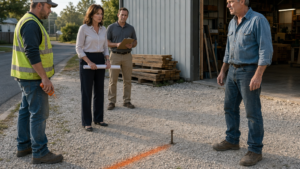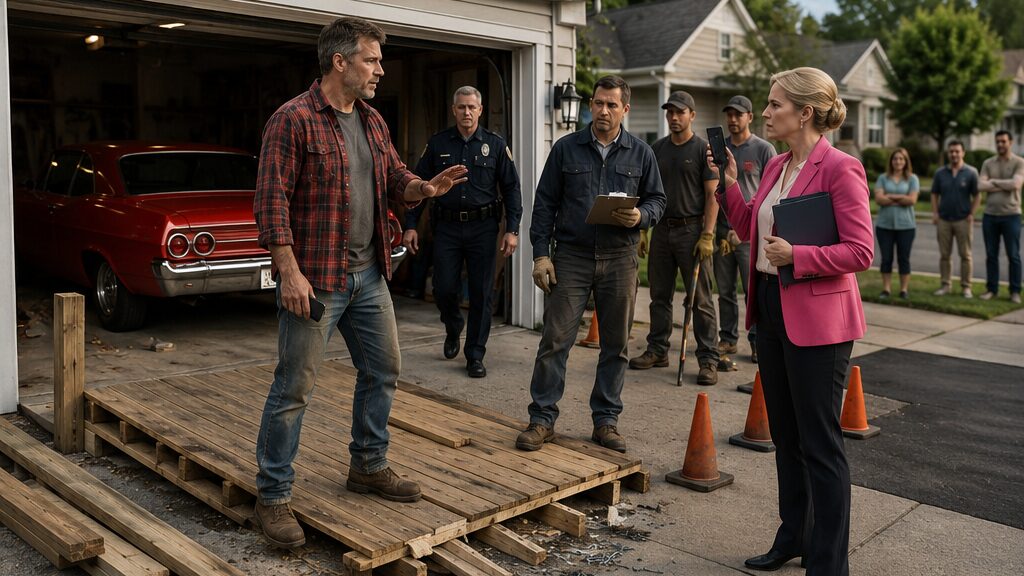
When The HOA Sent A Crew To Tear Out The Ramp Beside My Red Car
Chapter 1: The Crew Arrived Before The Notice
The saw was already biting into the first ramp post when Mark Walker stepped out of the garage.
For a second, he did not understand the sound. It was too sharp, too close, too wrong for a Monday morning that had started with coffee cooling beside the kitchen sink and Lisa asking whether the new handrail felt steady enough. Then the blade screamed through treated wood, and the board beneath the garage entry trembled.
“Hey,” Mark called.
The worker with the saw did not stop. Another man in work gloves was kneeling near the ramp, backing screws out of the side rail and dropping them into a plastic bucket. Two orange cones stood at the foot of the driveway as if the whole place had become a construction site without him being told.
Mark moved fast, crossing the garage past the red classic car he had spent three years bringing back to life one careful weekend at a time. The car’s hood was up, a cotton towel folded over the fender. Behind it, the open door into the house led to the short entry platform where Lisa could transfer from her chair to the ramp without trying to manage the front steps.
That ramp was not pretty. Mark knew that. It was solid, square, practical lumber with a temporary grip strip along the middle and a handrail he had sanded himself so Lisa would not catch her palm on a splinter. He had meant to paint it once the HOA approved the final design.
The man with the saw finally looked up when Mark stepped onto the driveway.
“Stop cutting,” Mark said.
The man lowered the saw but kept it running. “You need to talk to the supervisor.”
“I’m talking to whoever’s cutting into my house.”
“It’s not attached to the house.”
“It’s attached to the only safe way my wife gets through that door.”
The supervisor turned from the truck parked at the curb. He was tall, broad-shouldered, and carrying a clipboard like it weighed more than the saw. “Mr. Walker?”
Mark kept his body between the workers and the remaining ramp. “Who are you?”
“Benjamin Robinson. Robinson Property Services. We’ve been retained by the association to remove an unauthorized exterior structure.”
“You’ve been retained to remove my ramp.”
Benjamin looked at the clipboard. “The order says noncompliant garage access platform and exterior ramp, constructed without final approval.”
“Final approval is pending.”
“That’s between you and the association.”
“No. The second you put a saw to it, it became between you and me.”
A neighbor across the street had stopped with a trash bag in one hand. Another stood half-hidden behind a mailbox. Mark could feel the street waking around him, curtains parting, garage doors freezing halfway open. He lowered his voice because he could already hear Lisa’s words from the night before: Don’t make me the story, Mark.
“Show me the court order,” he said.
Benjamin blinked. “The HOA enforcement order is in the packet.”
“That’s not a court order.”
“It authorizes removal.”
“By who?”
Before Benjamin could answer, a woman’s voice cut across the driveway.
“By the Board of Directors of Cedar Ridge Estates.”
Angela Carter stepped from behind the truck in a bright pink blazer, hair pinned tight, sunglasses lifted to the top of her head. She held a folder under one arm and a phone in the other. She looked at the ramp as if it had insulted her personally.
Mark exhaled through his nose. “Angela.”
“Mr. Walker, you were notified.”
“No, I wasn’t. I walked out to a saw.”
“A notice was placed at your front door this morning.”
“This morning?” He pointed toward the worker, who still had one hand near the saw trigger. “When they were already here?”
Angela’s mouth tightened. “This structure has been in violation for over three weeks.”
“It’s an access ramp.”
“It is an unapproved exterior alteration visible from the street, built with nonconforming materials, extending into the driveway apron, and connected to an open garage being used for ongoing mechanical work.”
Mark glanced back at the red car. There it was—the thing she had been circling since the day she photographed his garage from the sidewalk. A half-restored car, a few boards stacked near the wall, a ramp leading to the house. To her, it all made one convenient picture.
“That car has nothing to do with the ramp.”
“It is all part of the same unapproved modification.”
“No. It isn’t.”
“Then you should have completed the accommodation process correctly.”
Mark felt the heat climb into his neck. “I submitted the paperwork.”
“You submitted an incomplete request.”
“I submitted what your office asked for.”
Angela opened her folder and removed a white sheet. “And you were advised that no construction could proceed until written approval.”
“My wife fell on that threshold.”
The words came out before he could stop them. The saw seemed louder even though it was off now. Across the street, the neighbor with the trash bag shifted his weight.
Angela’s eyes flicked toward the open garage, then back to Mark. “I’m sorry to hear that. But hardship does not exempt a homeowner from the governing documents.”
Mark took out his phone. His hand was steady, though he did not feel steady anywhere else. He opened the camera and began recording.
“Say that again,” he said.
Angela’s expression changed. Not fear. Calculation.
“Mr. Walker, if you interfere with this removal, you will be responsible for additional charges.”
“If you touch another board before I see a lawful order, I’ll document that too.”
Benjamin looked from Mark to Angela. “Ma’am?”
Angela drew herself up. “Continue.”
Mark stepped onto the remaining ramp, one boot planted on the top board, the other on the driveway. The worker with the drill stopped moving.
“Do not continue,” Mark said.
Angela raised her phone. “Then I’m calling the police.”
“For what?”
“For obstructing an authorized removal crew and creating a hostile situation.”
Mark almost laughed, but nothing about the workers, the ramp, or Lisa inside the house felt funny. “I’m standing on my own driveway.”
“You are preventing contracted workers from performing association enforcement.”
“You sent men onto my property to cut apart the way my wife gets into her home.”
Angela tapped her screen. Mark saw the bright flash of numbers before she lifted the phone to her ear. A moment later, when she turned slightly away, the screen faced him for half a second.
911 Calling.
The image of it settled cold in his stomach.
Benjamin lowered his clipboard. “Maybe we should pause until—”
“We are paused because he is in the way,” Angela said sharply, then into the phone: “Yes, I need police at Cedar Ridge Estates. A homeowner is interfering with an authorized enforcement action.”
Mark heard Lisa’s chair move inside the house.
He turned just enough to see the shadow of her in the doorway beyond the red car. She had not come out. She would not, not while half the street was watching.
“Lisa,” he called, softer. “Stay inside.”
Angela’s eyes sharpened at the name, like she had caught a missing piece.
Mark kept recording. His thumb was damp against the phone case.
Within minutes, the first patrol car turned into the street, lights flashing but no siren. The neighbors no longer pretended not to watch. One man stood openly at the edge of his lawn. Someone had a phone raised behind a window.
The officer who stepped out looked uncertain for only a moment. Then a second vehicle pulled behind him, and Charles Hall got out in uniform, one hand resting at his belt, his face already tightening as he took in the saw, the cones, the ramp, and Mark standing on the remaining boards.
“Mark?” Charles called.
Angela’s face shifted. Satisfaction cracked into confusion.
Mark lowered his recording phone but did not step off the ramp. “Morning, Charles.”
Charles walked up the driveway. “I thought we were looking at that alternator bracket.”
“It’s still on the workbench,” Mark said. “Along with breakfast, if the HOA doesn’t dismantle the doorway first.”
Angela straightened. “Chief Hall, I placed the call. This homeowner is obstructing a lawful association removal.”
Charles looked at her, then at Benjamin. “Is anyone threatening you?”
Benjamin shook his head. “No, sir.”
“Has anyone been assaulted?”
“No.”
“Has Mr. Walker entered anyone else’s property?”
Angela’s lips pressed together. “That is not the issue.”
“It’s the issue you called 911 about.”
She held out the folder. “The association has enforcement authority.”
Charles did not take it. “Maybe. Maybe not. That’s civil. What I’m seeing right now is a homeowner standing on his driveway while a crew cuts apart something attached to his entry.”
“It is unauthorized.”
“Then handle it through the proper process. Do not call emergency services to make your paperwork move faster.”
The street went quiet enough for Mark to hear the red car ticking softly as the morning sun warmed its hood.
Angela’s cheeks colored, but she recovered. “So you are refusing to enforce?”
“I’m refusing to turn a civil dispute into an arrest because you don’t like where he’s standing.”
Mark felt a small, dangerous wave of relief. It almost made him step down. Almost.
Charles turned to him. “Mark, I can tell them this isn’t a criminal matter. I cannot decide whether the HOA can fine you or pursue removal.”
“I know.”
Angela slid a new sheet from her folder and held it toward Mark. “Emergency violation notice. The board will consider permanent removal tonight at seven. Until then, any additional work will increase your penalties.”
Mark did not take it at first. The paper hung between them, white and flat and absurd against the raw cut in the ramp post.
Then Lisa’s voice came from inside the garage.
“Take it, Mark.”
He turned. She had moved into view beside the red car, one hand tight on the wheel of her chair, her face pale with anger she would not let the street have.
Mark took the notice.
Angela lowered her arm. “Seven o’clock. Bring whatever documentation you believe excuses this.”
Mark looked at the half-dismantled ramp, the board edges fresh and bright where the saw had opened them. He had thought the hard part was keeping Lisa safe enough until approval arrived.
Now he understood approval had never been waiting for him.
It had been moving against him.
Chapter 2: The Denial That Was Never Mailed
Mark found the stamped copy in a blue garage folder wedged behind a box of spare brake pads.
He pulled it free so quickly that old receipts slid across the workbench and fluttered onto the concrete. The top page was creased where he had folded it before driving to the HOA office three weeks earlier. At the bottom, in purple ink, was the Cedar Ridge Estates office stamp.
RECEIVED.
The date sat under it like a small accusation.
Mark stared at it until the letters blurred, then carried the folder into the kitchen. The emergency violation notice Angela had handed him lay beside Lisa’s medication list, a mug of cold tea, and the envelope from her physical therapist that he had never attached.
Lisa sat at the table with her chair angled away from the window. She saw the folder in his hand and knew.
“You found it,” she said.
“Stamped and dated.”
“Then they can’t say you didn’t apply.”
“They can say incomplete.” Mark placed the form on the table. “That word does a lot of work.”
Lisa looked at the papers without touching them. “You didn’t include the letter.”
“I know.”
“I told you I didn’t want it passed around.”
“And I listened.”
“You also wanted that.”
He looked away first. Outside, Benjamin’s crew had left the ramp jagged but standing, a kind of open wound at the garage entry. Charles had stayed long enough to make sure no one resumed cutting, then left Mark with one quiet warning: Get your paperwork straight before tonight. Civil boards like clean files more than true stories.
Mark hated that he was right.
He opened his laptop and searched his email for every message containing ramp, modification, accommodation, exterior, and approval. The HOA portal showed his submission as “pending review,” then “incomplete,” then nothing. No denial letter. No board notes. No request for more information beyond an automated line that said supporting documentation may be required.
“May,” Mark muttered. “Not must.”
Lisa watched him from the table. “Don’t build the whole argument on one word.”
“It’s their word.”
“It’s also your temper when you get scared.”
That landed harder than he wanted it to. He closed the laptop halfway, then opened it again because anger had somewhere to go when there were search boxes and timestamps.
By early afternoon, Mark had printed the portal screenshot, the stamped application, the contractor sketch, and a photograph of the ramp before the crew cut into it. He put the physical therapist’s sealed letter in the folder last. He still had not opened it since Lisa gave it to him.
“Take it,” Lisa said.
“I won’t hand it over unless you say so.”
“I am saying take it. I’m not saying read it out loud to a room full of people who pretend they’re worried about paint colors.”
Mark slid the envelope into the back pocket of the folder. “I can ask for a private accommodation review.”
“You can ask. Angela can say no in public.”
“She doesn’t get to decide everything.”
Lisa gave a short, humorless laugh. “She decided when the saw came.”
At the HOA office, the front desk was empty except for a bell, a sign-in sheet, and a framed notice about architectural harmony. Mark could see through the glass wall into a small conference room where Michelle Lewis sat with a laptop and a stack of binders. She looked up when he knocked on the frame.
“Mark,” she said, surprised enough that it sounded like guilt.
“I need the minutes from the meeting where my ramp was denied.”
Michelle closed the binder slowly. She was not dressed like Angela. No bright blazer, no sharp angles. Her sweater had sleeves pushed to the elbows, and a calculator sat near her coffee. “Board minutes are posted after approval.”
“Then show me the draft.”
“I can’t release unapproved minutes.”
“I’m not asking for a newsletter. I’m asking when the board voted to send a crew to my house.”
Michelle’s eyes moved to the folder under his arm. “Angela said your application was incomplete.”
“It was received.” He put the stamped copy on the table between them. “If incomplete means denied, show me where the board decided that. If incomplete means pending, explain why a removal crew showed up.”
Michelle did not touch the paper. “You should bring this tonight.”
“I’m bringing it now.”
“Mark—”
“No. They cut into the ramp this morning. My wife can’t use the front steps. That ramp was not decoration.”
Michelle’s jaw tightened, but not in anger. She glanced toward the hallway, then lowered her voice. “There was no full board vote on your ramp.”
The words changed the air in the room.
Mark leaned forward. “Say that again.”
“I said there was no full board vote.”
“Then who authorized removal?”
“I don’t know exactly.”
“You’re the treasurer.”
“I handle invoices, reserves, delinquencies. Compliance orders come through Angela’s committee first.” Michelle turned the laptop slightly away, more habit than secrecy. “Emergency enforcement can be initiated by the compliance chair if there’s a safety or liability concern.”
“The ramp is the safety fix.”
“Angela listed it as the hazard.”
Mark felt the old anger surge, but under it was something colder. Cleaner. “She called the thing that stopped my wife from falling the hazard.”
Michelle looked down. “The file says unapproved construction, driveway obstruction, possible commercial garage activity.”
“There is no commercial activity.”
“I’m telling you what it says.”
“The red car?”
She did not answer quickly enough.
Mark pressed his palm flat on the table. “Michelle.”
“There are photos in the file.”
“Of what?”
“Your garage open. The car. Lumber. Tools. The ramp.”
He almost smiled from disbelief. “I’m restoring my own car.”
“People complained about noise.”
“One person complained. Angela. Because I had the garage open on a Saturday.”
Michelle rubbed the side of her forehead. “I’m not defending the removal.”
“But you signed the check request?”
Her silence was the answer.
Mark picked up the stamped application and slid it back into the folder. “You paid a crew to remove something the board never voted on.”
“It was coded as emergency compliance.”
“By Angela.”
“Yes.”
There it was: a small payoff, smaller than justice but bigger than rumor. He had not ignored the process. The process had curved around him.
Michelle stood and shut the conference room door. “Listen to me. Tonight, they’re going to frame this as procedural. You built first, asked later, refused access, created a scene with police.”
“Angela called police.”
“They’ll say you escalated by standing in the work area.”
“I stood on my ramp.”
“They’ll say it was not approved.”
“I submitted an application.”
“With no medical documentation attached.”
Mark’s grip tightened on the folder.
Michelle saw it. “I’m not judging you. I’m telling you where the weak place is.”
“My wife has a right to privacy.”
“She does. But if you ask for an accommodation, the board will ask what is being accommodated.”
“Then they should have asked.”
“They should have.” Michelle’s voice softened. “But Angela is going to say she did.”
Mark looked toward the hallway. The walls were lined with photographs of flower beds, holiday lights, repaved sidewalks. Cedar Ridge loved proof when proof made the neighborhood look orderly.
“She never mailed a denial,” he said.
“I don’t think there was one.”
“Then what did she leave on my door this morning?”
“An enforcement notice. Not a denial.”
The distinction felt like a blade drawn slowly enough to admire.
Mark gathered his papers. “I want copies of anything in my file.”
“You need to submit a records request.”
He stared at her.
She opened a drawer, pulled out a blank form, and slid it across the table. “Use this. Email it too, so there’s a timestamp.”
“That’s your help?”
“That’s what I can do without getting removed from the finance committee before tonight.”
For the first time, Mark saw the fear under her carefulness. Michelle was not brave. Not yet. But she was not blind.
He took the form. “Why tell me about the photos?”
Michelle looked toward the closed door. “Because Angela printed them in color.”
“For the meeting?”
“For the screen.”
Mark felt his stomach drop.
Michelle’s voice lowered. “She’s going to make the red car the center of it. Not Lisa. Not the threshold. The car.”
Chapter 3: The Red Car Became Their Proof
Angela opened the board meeting with a photograph of Mark’s garage filling the screen.
The red car glowed under the fluorescent projector light, brighter than it looked in real life. Its hood was up. Tools lay on the workbench behind it. Two boards leaned against the wall. At the edge of the frame, the ramp appeared like an extension of the garage floor instead of what it was: a path from the house to the driveway.
Mark sat in the second row with the folder on his lap and Lisa’s sealed medical letter inside it. Lisa had not come. She had said she was not going to sit in a folding chair while strangers stared at her body and called it evidence.
The meeting room smelled like burnt coffee and carpet cleaner. Neighbors filled more seats than usual. People who had never attended a budget vote had come to see why police had been called that morning.
Angela stood beside the screen in her pink blazer, remote in hand.
“This is the unapproved alteration at 1149 Willow Bend,” she said. “As you can see, the ramp is part of a broader modification of the garage apron and entry point.”
Mark raised his hand. “It is not part of the car.”
Angela did not look at him. “You will have time to speak after the compliance summary.”
The board president, a role-only neighbor with reading glasses and a tired expression, tapped the table. “Let her finish, Mr. Walker.”
Mark sat back. The folder edge pressed into his palm.
Angela advanced to the next photo. This one showed the ramp from the sidewalk. The handrail was visible, along with the temporary grip strip and the raw edge where Mark had planned to add trim.
“Cedar Ridge standards require prior written approval for exterior structures visible from the street,” Angela continued. “The submitted request lacked required supporting documentation, final materials list, paint match, drainage plan, and clarification regarding garage use.”
A murmur went through the room at “garage use.”
Mark looked toward Michelle. She sat at the treasurer’s seat with a binder open, her pen still. She did not meet his eye.
Angela advanced another photo. The red car again. Closer this time. The old chrome bumper looked almost theatrical.
A man in the third row lifted his hand before public comment had opened. “Are we talking about an auto shop?”
“No,” Mark said.
Angela turned just enough to let the interruption live. “The association has received concerns about repeated open-garage mechanical activity, materials stored near the driveway, and noise.”
“One Saturday afternoon,” Mark said. “I changed a belt.”
“Mr. Walker,” the board president warned.
Mark swallowed the next sentence because he could feel it wanting to come out too hard.
Angela clicked to the next slide. It was a cropped image: ramp boards, lumber, the red car tire, the open garage, all flattened into one accusation.
“Whether or not commercial activity is occurring,” Angela said, “the visual impact and unauthorized construction are clear.”
There it was. Whether or not. A phrase that could accuse without proving.
Public comment opened after the compliance summary. Mark stood with his folder. He had planned to begin with the stamped application, then the lack of board vote, then the ramp’s location. Calm. Sequential. Clean.
But the room was already looking at the red car.
He placed the stamped application on the front table. “I submitted this three weeks ago. It was received by the office. I was never mailed a denial. I was never called before a removal crew came to my driveway.”
Angela folded her hands. “You were informed the request was incomplete.”
“By an automated portal line that said documentation may be required.”
“The burden is on the homeowner.”
“The burden is also on the board not to send a saw before it holds a vote.”
A few heads turned toward Michelle.
The board president leaned forward. “Mr. Walker, are you disputing that the ramp was built prior to final approval?”
“No.”
The room shifted. Mark felt it.
Angela did too. “Thank you.”
He turned toward the screen. “I built it because the garage entry is the only way into the house without stairs. The front entry has three steps. The side path slopes. The garage threshold is where the chair can pass safely if there’s a ramp.”
Angela lifted a sheet. “Again, no medical documentation was submitted with the original application.”
Mark’s hand moved to the folder pocket. He felt the sealed envelope there.
He could open it. He could end the question in the ugliest way possible, with Lisa’s diagnosis and physical therapy notes handed across a public table under fluorescent lights.
Instead, he said, “That documentation belongs to my wife. I requested an accommodation review. You never held one.”
Angela’s voice remained smooth. “We cannot review what is not provided.”
“You cannot destroy first and ask later.”
A neighbor near the back spoke up. “But if everybody builds whatever they want and says it’s medical, then what happens to the neighborhood?”
Mark turned.
The man looked uncomfortable, but he did not take it back. “I’m just saying. There have to be rules.”
“There are rules,” Mark said. “That’s why I applied.”
“You built it anyway.”
“My wife needed to get into the house.”
Angela seized the opening. “No one is unsympathetic, Mr. Walker. But homeowners cannot unilaterally construct exterior features and then demand retroactive approval by invoking private hardship.”
Private hardship.
The words struck him harder than the saw had.
Mark heard Lisa’s voice again: Don’t make me the story. Then Angela’s: invoking private hardship. As if Lisa were a tactic. As if the ramp were a trick.
His control slipped.
“You sent a crew to cut apart my wife’s way into her home, and you’re standing here talking about visual impact because my car was in the garage.”
Angela’s eyes hardened. “Please do not raise your voice.”
“I am raising the truth to the level of your pictures.”
The room went silent.
Mark knew immediately he had gone too far—not because he was wrong, but because Angela had wanted him angry. Angry made him look like the morning’s 911 call had been reasonable. Angry made him easier to file.
The board president cleared his throat. “Mr. Walker, we need to maintain decorum.”
Mark forced his hands open at his sides. “Fine. Look at the ramp location.”
He walked to the screen before anyone stopped him and pointed, not at the car, but at the door barely visible behind it.
“This is the interior entry. This line here is the path from the kitchen to the garage. The ramp begins there, not at the car bay. It doesn’t widen the driveway. It doesn’t service the vehicle. It runs from the house threshold to the driveway because the front steps are unsafe.”
Michelle finally looked up.
Angela crossed her arms. “That explanation was not provided in the required form.”
“It was in the sketch.”
“The sketch was not certified.”
“It’s a ramp, not a bridge.”
A few people shifted, one neighbor hiding a smile. Angela did not. “And still unapproved.”
The small payoff lasted only a breath: the photograph no longer looked as clean as it had. Mark had put the house door back into the picture. He had reminded the room that the ramp led somewhere human.
Then Angela placed another paper on the table.
“Given today’s obstruction, the compliance committee recommends the board schedule a second removal attempt after forty-eight hours unless the homeowner produces complete accommodation documentation, including medical necessity, final design, materials, drainage, color match, contractor insurance, and garage-use clarification.”
“Forty-eight hours?” Mark said.
The board president looked tired again. “That seems reasonable.”
“It took you three weeks not to review the first packet.”
Angela replied before anyone else could. “Then I suggest you use these two days carefully.”
Mark looked at Michelle. She glanced down at her binder, but her pen had stopped moving again.
The board voted to pause removal for forty-eight hours, not withdraw it. The difference mattered. Mark left the meeting with the ramp still wounded, the violation still alive, and Lisa’s sealed letter still unopened in his folder.
In the parking lot, his phone buzzed.
A message from Michelle appeared with no greeting.
Ask who took the curb measurements after resurfacing. Then check your driveway lip before you submit anything else.
Chapter 4: A Missing Measurement At The Curb
Mark was on his knees at the garage threshold before eight the next morning, watching the front wheel of Lisa’s chair catch in the same pale scrape mark it had left three weeks earlier.
The chair was empty. Lisa was still inside, because Mark had asked to test it without her weight in it and because she had looked at him long enough to make him understand that asking had cost him. He pushed the chair backward, then forward again. The wheel bumped, hesitated, and tilted toward the gap where Benjamin’s crew had cut away the outer rail.
His contractor stood at the edge of the driveway with a tape measure in one hand and a carpenter’s pencil behind one ear. He had built the ramp to Mark’s rough sketch, then warned him twice that the driveway pitch was stranger than it should be.
“Right there,” the contractor said, pointing to a dark crescent etched into the threshold plate. “That’s where it grabbed her.”
Mark bent closer. The mark was not deep, but once he saw it, he saw all of them: small arcs and black rubber smears, evidence of a wheel fighting the same bad angle over and over.
“I thought it was the old threshold,” Mark said.
“It’s partly that.” The contractor hooked the tape at the garage floor and walked it down the ramp line toward the driveway. “But this apron rises too hard before it drops. See this lip?”
Mark had seen the driveway every day for eleven years. He had shoveled it, washed oil spots off it, backed the red car over it, watched Lisa stand there with grocery bags before standing became something she rationed. But now, with the tape stretched over the concrete, the place looked altered, almost dishonest.
The contractor crouched and laid a level near the curb. The bubble slid.
“When did they resurface the street edge?” he asked.
“Last fall. HOA project. They did the whole row.”
“They raised this transition.”
Mark stared at the concrete seam where the driveway met the street. “Enough to matter?”
“For a chair? Enough to matter.” The contractor tapped the tape. “You didn’t build a ramp because you wanted a garage accessory. You built it because this became a bad crossing.”
The words should have helped. Instead they landed like another accusation—this one aimed at Mark. He should have measured sooner. He should have noticed before Lisa fell. He should have done more than improvise lumber and hope the paperwork caught up.
He took photos of the scrape marks, the level, the tape stretched across the lip. He took them from far away and close up, making sure the red car appeared in the background of one shot, not as evidence against him this time but as proof of the angle Angela had cropped out.
Lisa called from inside, “Are you still punishing the concrete?”
Mark looked toward the doorway. “The concrete may deserve it.”
She rolled into view but stopped before the missing rail. Her eyes went to the cut post, then to the chair he had been testing. She did not ask whether he had used hers. They both knew.
“The contractor thinks the resurfacing changed the apron,” Mark said.
“The HOA resurfacing?”
“Looks like it.”
Lisa’s face tightened. “So they fixed the neighborhood into a problem and then called your fix ugly.”
“Maybe.”
“Don’t say maybe if you already know.”
He looked down at the tape measure. “I know enough to check.”
The city office was a low brick building next to the library, the kind of place where every counter had a sign telling people which forms did not belong there. Mark took a number, waited under a wall clock that clicked too loudly, and carried his folder to the counter when the clerk called him forward.
“I need records for curb or driveway apron work on Willow Bend inside Cedar Ridge Estates,” he said.
The clerk glanced at the address. “Private association?”
“Yes.”
“Then the association likely coordinated it.”
“I need to know whether the city approved the work.”
She typed with the slow patience of someone who had survived years of angry residents. “Street edge, drainage, curb tie-in…” She paused. “There was a batch permit for resurfacing along Willow Bend and two connecting cul-de-sacs. Submitted by the association’s contractor.”
“Can I get the measurements?”
“Inspection sign-off, yes. Measurements, maybe not. Depends what was filed.”
“I need to know if the driveway lip changed.”
The clerk looked over the top of her glasses. “Is this about water runoff?”
“It’s about wheelchair access.”
That changed her posture, but not enough to make the computer move faster. She clicked through another screen. “The city signed off on drainage flow and road edge compliance. We don’t regulate every private driveway transition inside an HOA unless it violates code or creates a public right-of-way issue.”
“So if they raised my driveway lip just enough to make my wife’s chair catch, that’s not city jurisdiction?”
“Not unless you can show the work violated the approved plan or blocks required access.”
“It blocks her access.”
“To the public sidewalk?”
“To her home.”
The clerk’s mouth softened. “That may be an accommodation issue with the association, not a city enforcement issue.”
Mark felt the folder bending under his hand. “The association is the one trying to remove the accommodation.”
“I understand.”
But her voice said understanding and authority were not the same thing.
She printed the permit summary and slid it through the slot. The page listed Cedar Ridge Estates HOA as applicant, a contractor company as performer, and final inspection approved five months earlier. Near the bottom, under notes, was a line about field adjustment at several driveway transitions to correct drainage.
Mark tapped the sentence. “What does field adjustment mean?”
“It means the contractor changed something on site and the inspector accepted it.”
“Which driveways?”
“I’d need the field notes.”
“Can I request them?”
She handed him another form. “You can. It may take a few days.”
“I have forty-eight hours.”
The clerk glanced at the violation notice clipped inside his folder. She read only enough to understand the problem.
“I can’t promise anything official that fast,” she said. Then she lowered her voice. “But if you ask the association for the contractor’s closeout packet, they may already have photos.”
“They won’t give me anything.”
“Then ask in writing. Use the words reasonable accommodation and access barrier. People answer differently when those words are timestamped.”
Mark took the form. “Does that always work?”
“No,” she said. “But it makes silence heavier.”
Back home, he laid the permit summary on the kitchen table. Lisa read it once, then again.
“Field adjustment,” she said.
“It means they changed something at the driveway.”
“It means they changed something and didn’t tell us.”
Mark opened his laptop and drafted a records request to the HOA. He attached photos: the threshold scrape, the tape measure, the curb lip, the cut ramp post. He wrote reasonable accommodation twice, then deleted one because it looked like begging. Lisa noticed.
“Put it back,” she said.
“It sounds like I’m trying to scare them.”
“You are trying to make them read it correctly.”
He put it back.
When he hit send, the message whooshed away with less satisfaction than he wanted. A timestamp was not a ramp. A record request was not a rail under Lisa’s hand.
He was still standing over the laptop when a new email arrived from an address he did not recognize. No greeting. No signature. Just a forwarded thread.
The subject line read: Willow Bend curb complaint / Walker driveway.
At first, Mark thought it had come from Michelle. Then he saw her name buried in the forwarded chain but not as sender. Someone else had passed it along, probably from the board list, probably with second thoughts and no courage to attach a face.
He opened it.
Three weeks before the removal order, Angela had written to the resurfacing contractor and the board president.
Resident at 1149 claims mobility access issue at garage apron after project completion. Do not engage on causation. Compliance issue also developing re: unapproved ramp at same address. Need to avoid linking these matters until counsel/insurer advises.
Mark read it three times.
Lisa reached for the edge of the table. “What is it?”
He turned the laptop toward her.
She read slowly. Her face did not change, which was how he knew the words had gone deep.
“They knew,” she said.
Mark looked through the kitchen window at the wounded ramp and the red car beyond it, polished and useless beside the missing rail.
His phone buzzed before he could answer. A message from the HOA portal appeared at the top of the screen.
Records request received. Compliance chair reviewing responsive materials.
Angela was reviewing the request for records about what Angela had known.
Chapter 5: The Woman In Pink Almost Told The Truth
Angela came without the crew at four the next afternoon, but the orange cones arrived before she did.
Mark watched from the garage as a utility truck slowed at the curb, and a worker stepped out long enough to place two cones beside the driveway apron. No saw. No drill. No clipboard. Just the cones, bright and official-looking, marking the space where the ramp would be attacked again.
The truck drove away.
Lisa saw them from the kitchen doorway. “That’s not subtle.”
“No,” Mark said. “It’s a warning.”
Angela’s white SUV pulled up ten minutes later. She stepped out in the same pink blazer, though today it looked less like armor and more like something she had chosen because changing it would mean admitting yesterday had mattered. She carried a folder but no phone in her hand.
“I’d like to speak privately,” she said.
Mark stayed where he was, one hand resting on the cut rail. “You mean without neighbors filming?”
“I mean without escalating this further.”
“You called 911 on me.”
“And you forced a confrontation with a contracted crew.”
He almost answered too quickly. Then he saw the fatigue at the edge of her face, the faint crease under the foundation near her eyes. Angela Carter was not sorry. But she had slept badly.
That made him more careful, not less.
“What do you want?” he asked.
She looked past him into the garage. The red car sat under a soft cover now, its front end hidden, as if Mark could remove it from her argument by removing it from sight.
“The association is willing to consider an expedited review,” she said, “if you agree to temporary removal of the current structure.”
“No.”
“You haven’t heard the proposal.”
“I heard removal.”
“A replacement could be approved if it meets materials, color, drainage, and insurance conditions.”
“When?”
“After review.”
“How does Lisa get in and out during review?”
Angela’s jaw moved slightly. “There are portable solutions.”
“You mean the temporary aluminum ramps you rejected in your first email because they could shift?”
“I said they were not acceptable as a permanent installation.”
“They’re not acceptable for my wife either.”
Angela glanced toward the house, then lowered her voice. “Mr. Walker, you are not helping yourself by treating every condition as cruelty.”
Mark let that hang between them. A worker across the street pretending to water a lawn had stopped pretending.
“I sent a records request,” he said.
“I know.”
“You knew about the curb complaint before you sent the crew.”
Her eyes sharpened. “You should be careful with partial information.”
“That’s funny coming from the person who put a cropped picture of my garage on a screen.”
She looked away first. Only for a second, but he saw it.
“There are liability considerations,” she said.
“Whose liability?”
“The association cannot simply admit that approved work created an access issue without review.”
“My wife fell.”
“I am not disputing that.”
“You’re just making sure no one connects it to the concrete.”
Angela’s shoulders stiffened. “The insurer advised the board not to acknowledge causation.”
There it was, almost said like an accident. Not an apology. Not a confession. But the first true sound he had heard from her.
Mark kept still.
Angela seemed to hear her own words a moment too late. She closed the folder against her chest. “What I mean is, these matters have to be handled separately.”
“They’re not separate if the bad apron is why the ramp exists.”
“The ramp was built without approval.”
“Because the approval process sat on it.”
“Because your submission was incomplete.”
“Because I didn’t hand my wife’s medical letter to a committee that takes pictures of my garage from the sidewalk.”
Her expression changed then, not with anger exactly. With pressure finding a bruise.
“You think I enjoy this?” she asked.
“I think you enjoy being right.”
Angela looked toward the cones. “You don’t understand what happens when one exception becomes ten. Someone builds a deck too high and says it’s medical. Someone pours concrete across drainage and says it’s access. Someone blocks a neighbor’s view and says the board is heartless. Then insurance asks why we ignored our own rules.”
“Then you review the facts.”
“That takes documentation.”
“You never asked for the right documentation.”
“I asked for complete documentation.”
“You asked for paint colors.”
“Because if this goes forward, it still has to be safe and compliant.”
Mark stared at her, and for the first time he understood why she was dangerous. Not because she did not care at all. Because she cared in a way that turned every human need into a precedent file. Lisa was not Lisa to her. She was the first loose thread in a sweater Angela believed she had to keep from unraveling.
“I’ll submit the letter,” Mark said. “Under private accommodation review. Not public meeting. Not projector. Not neighborhood gossip.”
Angela breathed out slowly. “Temporary removal first.”
“No.”
“Mr. Walker—”
“No. You don’t get to make my wife lose access so the board can feel orderly while it thinks.”
Her eyes narrowed. “Then the emergency order remains in place.”
“There is no emergency except the one you’re creating.”
“The current structure is partially dismantled and unsafe.”
“Because your crew cut it.”
“And because you obstructed completion.”
Mark laughed once, not because it was funny but because the sentence was so perfectly built to erase the morning. “You send men to break a thing, then call it unsafe because it’s broken.”
Angela’s mouth tightened again. The tired human glimpse closed like a blind.
“I came here to give you a chance to resolve this quietly,” she said.
“You came here to get me to agree that removal happens before review. That way, when Lisa can’t leave the house, it’s not your decision. It’s procedure.”
She did not answer.
The silence was enough.
After she left, Mark stood between the cones until her SUV disappeared around the bend. Lisa rolled carefully to the garage threshold and stopped where the cut rail began.
“She almost said it,” Lisa said.
“She said enough.”
“She said insurer?”
“Yes.”
Lisa looked down at the ramp. “So now it’s not about whether I need it. It’s about whether needing it proves they caused something.”
Mark leaned against the rail. “I should’ve measured before I built.”
“You built because I was stuck.”
“I built fast because I was scared.”
“That is not the same as wrong.”
He wanted to believe her, but the folder on the workbench said otherwise. The incomplete application. The sealed letter. The missing details Angela had turned into weapons.
At dusk, Mark’s contractor called.
“You get a text meant for me?” Mark asked.
“No. Why?”
Mark was about to explain when his phone buzzed on the bench. A message appeared from Benjamin Robinson.
Removal resumes 8 a.m. Do not engage homeowner. Per A.C.
A second later, another message came.
Sorry. Wrong number.
Mark stared at the screen.
The contractor swore softly over the line. “Mark?”
He looked at the orange cones, glowing faintly in the driveway light, marking the place where the crew would return.
“Eight tomorrow,” Mark said.
Lisa was behind him, close enough to read the message. When he turned, she was not pale this time.
She was angry.
“Then tomorrow,” she said, “they can engage me.”
Chapter 6: When Compliance Meant No Way Home
Lisa’s front wheel stopped at the broken edge of the ramp while Benjamin’s crew stood six feet away with their tools unloaded.
No one moved.
The morning had the held-breath stillness of something already witnessed. A few neighbors stood in driveways with coffee mugs they had forgotten to drink from. Benjamin held his clipboard lower than before. Angela stood near the orange cones, phone in one hand, folder in the other, pink blazer buttoned tight.
Mark stood beside Lisa, recording.
The gap where the ramp rail had been removed looked worse with her chair in front of it. Without her, it had been damaged lumber. With her there, it was a missing sentence in the house.
Lisa tried once to roll forward. The small front wheel dipped, struck the raised edge, and turned sideways. Her hand tightened on the push rim. Mark’s body moved before he thought.
“Don’t,” she said.
He stopped.
Not because the wheel was safe. Because her voice told him the choice was hers now.
Angela stepped forward. “Mrs. Walker, for your safety, please move back from the work area.”
Lisa looked at her. “That’s what this is about?”
“Yes. The current structure is unsafe.”
“It was safe before your crew cut it.”
Benjamin shifted. One of the workers looked down at the drill in his hand.
Angela’s face held. “The structure was unauthorized and did not meet association standards.”
Lisa glanced at the cones, the stacked boards, the neighbors. “Standards got here early.”
Mark kept the phone steady. “Angela, before any work begins, state on record what authority you’re using.”
“The emergency compliance order remains active.”
“Despite the pending accommodation request?”
“Your accommodation request remains incomplete.”
Lisa reached into the bag on her lap and pulled out an envelope. Mark recognized it immediately. The physical therapist’s letter. The sealed flap had been opened.
His chest tightened.
“Lisa,” he said quietly.
She did not look at him. “Not now.”
Angela’s eyes went to the envelope, then to the phone in Mark’s hand. “Medical documentation should be submitted through the proper channel, not displayed in a driveway.”
“I agree,” Lisa said. “But yesterday you offered to remove the ramp first and review me later.”
Angela’s lips parted.
Mark saw the moment land. Not hard enough to end anything, but hard enough to change the shape of the scene.
“That is not what I said,” Angela replied.
Lisa held up the envelope. “You said temporary removal first. Expedited review after. I don’t need legal language to understand being trapped.”
“This discussion is becoming inappropriate.”
“So was sending men to my house with saws.”
A neighbor across the street lowered his coffee mug.
Angela turned to Benjamin. “Proceed with removal of the remaining unsafe sections.”
Benjamin did not move.
“Mr. Robinson,” she said.
He looked at Mark’s phone, then at Lisa’s chair, then at the broken edge where the wheel had caught. “Ma’am, I need clarification that we’re not blocking required access.”
Angela’s voice sharpened. “You have a signed work order.”
“I have an HOA work order.”
“That is sufficient.”
Benjamin’s face said he was no longer sure.
Mark stepped forward half a pace, then stopped himself. His anger wanted to fill the gap Benjamin had opened. His anger wanted to win. But Lisa was sitting at the broken ramp edge with the letter in her lap, and if Mark took over now, he would be doing the same thing he had done for weeks—protecting her so completely she disappeared.
He lowered his voice. “Lisa, you don’t have to read that here.”
“I’m not going to read it,” she said. “I’m going to say what it means.”
Angela checked the street, the watching neighbors, the worker with the drill, the phone in Mark’s hand. “Mrs. Walker, I am sympathetic, but the board cannot accept verbal statements in place of complete documentation.”
Lisa’s face stayed calm. “My left leg does not lift reliably. My balance changes without warning. The front steps are not safe. The garage entry became harder after the resurfacing. I fell there. That ramp is how I leave this house without Mark lifting me like furniture.”
Mark swallowed.
He had heard every piece of that before, privately, in fragments. Not like this. Not with Lisa’s voice steady and the street forced to hear the difference between privacy and shame.
Angela looked almost stricken for a second.
Then the folder came up again. “I am sorry for your situation. But if the ramp is needed, it still must be approved. The current structure does not meet final requirements.”
“Then approve what keeps me moving while you review the final version,” Lisa said.
“That is not how the process works.”
“No,” Lisa said. “That is how a wall works.”
Mark saw Michelle’s car turn onto the street.
It came in too fast, then braked hard behind Angela’s SUV. Michelle stepped out with a binder under one arm and papers in her hand, hair pulled back badly, as if she had done it at a red light.
“Stop,” she called.
Angela turned, anger flashing before she covered it. “Michelle, this is an active compliance action.”
“It’s also an active accommodation issue, and the board has not voted.”
Angela moved toward her. “The emergency order—”
“Was issued through compliance without full review.” Michelle held up the papers. “And I found the missing minutes from the resurfacing closeout meeting.”
Angela went still.
Mark felt Lisa’s hand find his. He held it lightly, afraid to tighten too much.
Michelle walked past Angela to the edge of the driveway. She looked at Lisa first, not the ramp, not the camera.
“I’m sorry,” she said.
Lisa did not answer.
Michelle turned to Benjamin. “Do not remove anything else.”
Angela’s voice dropped. “You do not have authority to countermand a compliance order.”
“As treasurer, I have authority to question association-funded work when exposure changes. And exposure just changed.”
“That is not a board vote.”
“No,” Michelle said. “Which is exactly the problem.”
She opened the binder and pulled out a printed email thread. Mark recognized the formatting from the anonymous forward.
“The insurer told us not to acknowledge causation,” Michelle said, “because we never completed the closeout review on the driveway transitions. The field adjustment notes were never attached to the homeowner files. That includes this driveway.”
Angela’s face hardened. “This is not the place.”
“It became the place when you sent a crew.”
The street went silent again, but not like Chapter 1’s silence. That silence had belonged to spectacle. This one belonged to a door opening inside the story.
Angela looked at the neighbors, then at Mark’s phone. “You are mischaracterizing confidential board communications.”
“I am characterizing enough to stop work until an emergency accommodation vote is held.”
“There is no scheduled vote.”
“Then schedule one.”
“The president is not here.”
“Call him.”
Angela’s composure thinned. “You are putting the association in a worse position.”
Michelle’s voice shook, but she did not step back. “No. We are in this position because we called an access issue a garage violation and hoped the pictures would make that easier.”
Mark looked at the red car under its cover. The false proof sat quietly in the garage, no longer bright on a screen, no longer the center of anything.
Angela’s phone buzzed in her hand. She looked down, then away, then back at Michelle. “The board will not be pressured by a driveway scene.”
Lisa spoke before Mark could.
“Neither will I.”
Angela looked at her.
Lisa pushed one wheel forward, not enough to cross the gap, only enough to make the chair touch the broken edge again. “I am not an exhibit. I am not your exception problem. I am not asking you to like the ramp. I am asking whether I can leave my house while you decide what color it should be.”
No one answered.
Mark wanted to say something, to add the measurements, the permit, the email, the letter. But for once, the right thing was not more proof from him.
Michelle closed the binder. “I am calling an emergency accommodation vote before any worker touches this ramp again.”
Angela stared at her. “You may regret making that demand in public.”
Michelle’s face went pale, but she took out her phone anyway. “Then put that in the minutes too.”
Chapter 7: The Ramp They Could Not Call A Violation
The removal order sat unsigned on the board table two days later, its blank signature line facing Mark like a dare.
Angela had placed it there herself. Not hidden in a folder, not softened under revised language. A single page with the old words still visible: emergency removal, unauthorized exterior structure, garage modification. Beside it lay Mark’s packet, thicker now, clipped with photographs, measurements, permit summaries, Lisa’s letter sealed in a smaller envelope marked Private Accommodation Review, and Charles Hall’s incident report from the 911 call.
Mark stood at the front of the meeting room, one hand resting on the folder, the other loose at his side. Lisa sat beside him, not behind him. That had been her decision.
Angela sat at the compliance seat with her blazer buttoned, her face composed. Michelle had the resurfacing binder open in front of her. The board president looked older than he had at the first meeting.
“We’re here,” he said, “to address the emergency accommodation request, the current violation status, and the temporary suspension of removal activity.”
Angela’s pen clicked once. “The compliance committee maintains that the original structure was installed without final approval.”
Mark did not argue. Not yet.
Michelle looked at him, then at Lisa. “And the record now shows the request was received before removal was initiated, no full board vote occurred before contractor dispatch, and the resurfacing closeout packet was incomplete.”
Angela’s jaw tightened. “Incomplete does not mean negligent.”
“No,” Michelle said. “But it does mean we should not have treated the homeowner’s ramp as a standalone violation while ignoring the access complaint tied to the same driveway.”
The room stayed quiet. Fewer neighbors had come this time, but the ones who had were listening differently. The red car was not on the screen. No cropped photo. No bright chrome made into suspicion. Instead, Mark’s measurement photo showed the driveway lip, the level, the scrape marks, and the broken ramp edge where Lisa’s wheel had stopped.
The board president turned to Mark. “Mr. Walker, do you want to speak?”
Mark looked at Lisa first.
She nodded once.
He opened the folder but did not remove the medical letter. “I built before final approval. I’m not pretending otherwise. I should have submitted a better packet, and I should have asked for a private accommodation review in writing instead of assuming people would understand from the sketch.”
Angela’s eyes lifted, alert to the admission.
Mark kept going before she could use it. “But I did submit before the crew came. I did explain the garage entry was the safe path. And when the board or committee had questions, nobody called me before sending workers to cut the ramp apart.”
He placed the stamped application on the table. Then the threshold photographs. Then the resurfacing permit summary.
“My wife does not need a symbol,” he said. “She needs a way through a door. This design can be improved. Paint it. Adjust the rail. Add drainage spacing. Require inspection. I’ll do those things. But removing access first and reviewing need later is not a process. It’s a lock.”
Lisa’s hand rested near the small envelope. She did not open it. She did not have to.
The board president picked up Charles’s report. “Chief Hall’s statement confirms there was no threat or criminal conduct when police were called.”
Angela looked down.
“He also notes,” the president continued, “that the removal crew had already begun work before the homeowner was handed notice.”
A flush crept up Angela’s neck. “I relied on the emergency authority granted to compliance.”
Michelle slid a page forward. “Which is what I’m moving to revise.”
Angela turned to her. “This meeting is not about committee restructuring.”
“It became about that when emergency authority was used to bypass accommodation review.”
The board president held up a hand before Angela could answer. “One motion at a time.”
Michelle straightened. “Then my first motion is to withdraw the violation related to the temporary ramp, halt all removal activity, and approve an accommodation pathway allowing immediate repair of the existing access with conditions: final materials review, exterior color match, drainage verification, contractor insurance, and inspection within thirty days.”
The room shifted.
Mark felt Lisa’s breath catch beside him.
Angela’s pen stopped clicking.
The board president asked, “Second?”
For one long second, no one spoke. Mark saw the old fear in Michelle’s face—the fear from the HOA office, the kind that knew what it cost to stand apart from a committee and put your name on the record.
Then another board member raised a hand. “Second.”
Angela leaned forward. “Before a vote, I want it noted that approving an after-the-fact structure creates precedent.”
Lisa spoke quietly. “So does cutting one down before asking why it was there.”
No one moved.
Angela looked at her, and for the first time since the saw had touched the ramp, she did not answer with a rule. She looked tired. Cornered, yes, but not empty. Mark could see the shape of what she had been protecting: authority, order, insurance language, her own certainty. None of it excused the cones or the phone call or the saw. But it explained why she had clung so hard to the wrong thing.
The vote passed four to one.
Angela was the one.
There was no applause. Mark was grateful for that. Applause would have made the room feel clean, and it was not clean. The ramp was still broken. Lisa had still been stopped at her own garage. The street had still watched.
The board president signed the withdrawal of violation first. Then he signed the conditional accommodation approval. The removal order remained on the table unsigned until Michelle reached over, folded it in half, and placed it under the minutes binder.
Angela stood. “I’ll comply with the board’s decision.”
Mark believed the sentence and did not mistake it for remorse.
At the door, as people began to leave, Angela stopped near Lisa. For a moment, Mark thought she would say the thing everyone expected. Sorry. I didn’t know. This went too far.
Instead, Angela said, “The final rail height still has to meet standard.”
Lisa looked up at her. “Then measure it before you judge it.”
Angela’s mouth tightened, but she gave a small nod and walked out.
The next morning, Benjamin Robinson returned with his crew.
He came without cones.
The red car sat uncovered in the garage, its paint catching the pale light. Mark had moved the tools off the workbench and stacked the new boards where the old ones had been. Benjamin stood at the foot of the ramp frame, work order in hand, quieter than before.
“Mrs. Walker,” he said when Lisa rolled into the garage doorway, “we’re going to put the first board back now. I’ll keep the path clear as long as I can.”
Lisa looked at him for a moment. “Thank you.”
Mark knelt beside the frame and held the first board steady while Benjamin drove the screws. The sound of the drill was still sharp, but this time it pulled the house back together instead of taking it apart.
By noon, the handrail was up. Not finished, not painted, not perfect. But solid. A temporary strip marked where the final grip surface would go. The drainage gap had been widened. The rail height was marked in pencil for inspection.
Lisa waited until everyone stepped back.
Mark reached for the handles of her chair out of habit.
She glanced over her shoulder. “Don’t.”
He let his hands fall.
She pushed once, then again. The front wheels crossed the garage threshold without catching. They rolled onto the rebuilt ramp, past the new rail, past the red car whose polished side reflected her movement in a curved streak of light.
At the bottom, she stopped on the driveway and turned her chair toward the house.
Mark stood at the top of the ramp, one hand on the rail he had not been able to protect by himself.
Lisa looked up at him. “It was never about the car.”
“No,” he said.
“It was never only about the ramp either.”
He came down slowly and stood beside her. Across the street, a neighbor lifted a hand, not cheering, not performing. Just a small acknowledgment before going back inside.
Mark looked at the open garage, the repaired boards, the folded removal order he had brought home and placed on the workbench under a wrench. He had wanted to keep Lisa’s struggle private by carrying more of it alone. Instead, he had almost let privacy become another locked door.
Lisa touched the new handrail. “Paint can wait until tomorrow.”
Mark nodded. “Tomorrow.”
She rolled forward along the driveway, sunlight catching the rail behind her, and for the first time in weeks, the house did not look like something deciding whether to let her leave.
The story has ended.