Where the Horn Breaks
Part I — The Thing in the Mud
By the time Elias Voss reached the river mouth, the mine was already staring back at them.
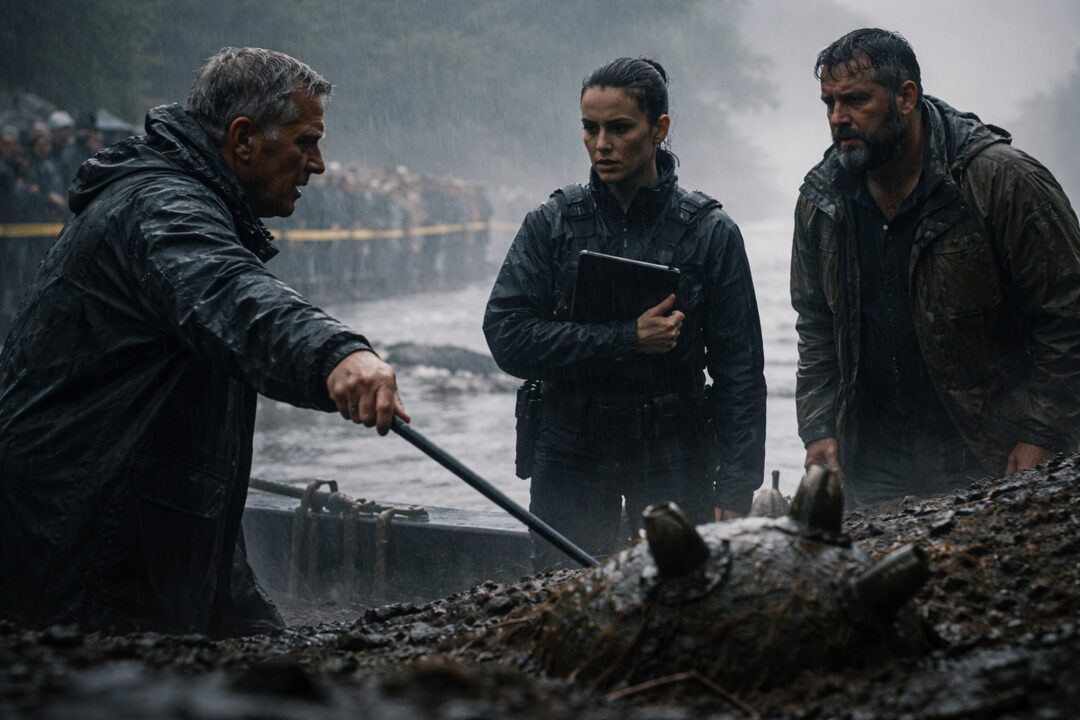
It hung half out of the mud beside the ferry chain, green with age and slick with weed, as large as a butchered ox’s torso. Black horns jutted from it at ugly angles. One had snapped near the base.
Everyone else saw wreckage.
Elias stopped so hard his bad leg nearly buckled.
“Back up,” he said.
The ferry operator, a broad man in a patched cap, looked at him with open irritation. “You haven’t even touched it.”
“That’s exactly why I’m still breathing.” Elias kept his eyes on the broken horn. “Back. Up.”
The man cursed under his breath but stepped away. The young officer beside him didn’t move at first. Lieutenant Mara Quinn stood with a tablet under one arm and rain darkening the shoulders of her shell jacket. She had the kind of posture that said she had spent years learning how not to show uncertainty in front of other people.
“Major Voss,” she said, precise even now, “I need an identification, not theater.”
Elias pointed his cane at the mine without taking his eyes off it. “And I need distance.”
The storm had ripped the estuary open in the night. The river was swollen, the reeds flattened, the sky the color of cold tin. The ferry landing behind them was shuttered, the crossing chain drawn taut between its posts, the morning queue of villagers held back at the top of the bank by two soldiers who kept glancing down as if they’d rather be anywhere else.
Mara finally stepped away from the mud. “Fine. Identify it.”
Elias took another look at the snapped horn. Not at the fracture itself. At the way the black casing around it had splintered inward, not outward. At the faint stain beneath it, almost invisible against the wet green shell.
He felt the old chill move through him. Not fear, exactly. Recognition. Fear came a second later.
“Moored contact mine,” he said. “Older pattern. Chemical horns.”
The ferry operator barked a humorless laugh. “Older pattern. So old junk. That’s what I said.”
“It is not junk.”
Mara keyed something into the tablet. “Is it live?”
Elias looked at her then. She was younger than his daughter would have been, if he’d ever had one, though the thought came to him only as a passing ghost. Early thirties. Hair yanked into a knot so tight it sharpened her face. Clean boots already ruined by the mud.
“Do you need the comforting answer,” he asked, “or the truthful one?”
Her jaw tightened. “I need the operational one.”
“The operational one is that nobody goes near it. Nobody taps it, pulls it, photographs it up close, or tries to tow it free.”
Behind them the ferry operator swore again. “That route is our road. If you close the crossing all day, the clinic on the far side gets nothing.”
Mara didn’t turn. “Name?”
“Tomas Rainer.”
She nodded, still watching Elias. “Mr. Rainer can wait. I can’t. Why?”
Elias pointed at the broken horn.
“That,” he said, “is why.”
Tomas squinted. “It’s broken. Doesn’t that make it less dangerous?”
For a second Elias said nothing. The river moved past them with the heavy sound of water that had not yet decided what it wanted to destroy.
Then he said, “Sometimes damage is the thing that wakes it up.”
That landed badly. He saw it in both their faces. Too vague for Mara. Too ominous for Tomas.
Mara folded her arms. “Explain.”
“Not yet.”
Her stare hardened. “You were called here because command said you know these devices better than anyone left on this coast. If you keep speaking in warnings, you become one more problem instead of the solution.”
It was a fair line. It struck because it was fair.
Elias hated fair lines.
He crouched, ignoring the pull in his leg, and studied the ground around the mine. Mud slumped in fresh ridges around the lower half of the sphere. Barnacles crusted the metal. Old tether scars. Not driftwood then. Not loose. Brought up from below.
“What time did it surface?” he asked.
Tomas answered. “I saw it first at dawn. I took the skiff out before the light was fully up.”
“You went near it?”
“I didn’t know what it was.”
“How near?”
Tomas spread his hands, impatient. “Near enough to know it wasn’t a log.”
Mara cut in. “Was there contact?”
“I don’t think so.”
Elias looked at him. “You don’t think, or you know?”
That hit home. Tomas’s mouth flattened.
“My line snagged on something under the water,” he said. “I thought it was storm debris. I cut loose and came back.”
Mara turned sharply. “You didn’t mention that.”
“You didn’t ask the right question.”
For the first time, she looked rattled.
Elias exhaled slowly through his nose. A line. Underwater. Anchor or tether. Maybe another object. Maybe the same one still held below. He glanced toward the reeds farther out and saw nothing but broken stalks and brown water, but the river kept secrets in plain sight.
“Lieutenant,” he said, “I need the entire strip cleared. No boats, no curious locals, no cameras.”
Mara’s radio crackled before she could answer. She lifted it. “Quinn.”
Static. Then a clipped voice from command asking for classification, risk tier, estimated delay to shipping.
She listened, eyes on the mine.
“We have a probable historical contact mine at the ferry channel,” she said. “Pending full assessment.”
There was a pause. Then: expedite.
Of course.
She lowered the radio. “I can clear the immediate bank. I cannot lock down the whole river mouth on probable.”
“It won’t care what wording you use.”
“Neither will the district if I trigger a panic and close two supply routes over debris.”
Tomas gave a sharp, ugly laugh. “There’s your answer, Major. To them it’s either old metal or paperwork.”
Mara’s expression did not change, but Elias saw the sting land. She turned to Tomas.
“If this crossing stays closed until night,” she said, “what exactly gets stranded?”
For the first time, the anger in Tomas’s face shifted into something harder.
“Medicine. A nurse. My daughter, for one.”
Mara blinked. “Your daughter?”
“She’s on the far bank with the clinic skiff. Diabetic. They sent for insulin from the district depot yesterday before the storm rolled in. The nurse is waiting there now with the cooler.”
The river seemed to grow louder.
Elias looked back at the mine. The broken horn gleamed wetly for half a second when the cloud cover shifted.
A simple question had brought him here. Is it dangerous?
Now there were too many others beneath it.
How dangerous.
To whom.
And how long before the wrong kind of contact finished what the break had begun.
He stood.
“Lieutenant,” he said. “You want your identification. Here it is. That horn may contain a glass acid vial. If the casing has cracked but the horn hasn’t fully crushed, the acid may already be moving where it shouldn’t. If it reaches the battery chamber, the firing train can come alive.”
Tomas stared. “From a broken spike?”
“From a broken horn,” Elias said. “That’s not decoration. It’s the first step.”
Mara’s gaze sharpened. “Can come alive.”
“Yes.”
She heard room in the word.
He heard a coffin opening.
And when she looked again at the mine, he knew from her face that she still believed this was a matter of probabilities.
He did not.
He had seen what happened when men tried to bargain with mechanisms built to end the argument.
Part II — What Wakes in Silence
They cleared the bank, but not cleanly.
Villagers gathered behind the taped perimeter, whispering and pointing through the rain. One man tried to film from his truck until a soldier ordered him back. Tomas paced at the landing as if stillness cost him blood. Mara moved between radio calls and rapid notes, building order out of a scene that wanted to become rumor.
Elias hated order that came before understanding.
He also knew it was all she had.
He studied the mine through field glasses from thirty meters back. The horns were not uniform. Four visible. One broken. One bent. The growth on the shell was old, but that meant nothing by itself. Old weapons killed just as well as new ones. Sometimes better, because people underestimated them.
Mara stepped beside him. “You said ‘older pattern.’ How old?”
“Old enough that anyone calling it harmless because of age should be removed from decision-making.”
“That’s not what I asked.”
“No.”
A muscle moved in her jaw. “I am trying to make choices with incomplete information.”
“So am I.”
“You’re withholding some.”
He lowered the glasses. “Because every person who hears half a mechanism starts building the safe version in their head.”
“Try me.”
He looked at her. Close up, she looked more tired than young. Rain had freed strands of dark hair near her temple. Her hands stayed steady on the tablet, but her shoulders were drawn high, as if she expected the day to keep getting worse and wanted her body ready before her mind caught up.
“All right,” he said. “The horn is hollow. Inside many designs like this, there’s a small glass vial. Acid. When the horn gets crushed against a hull or another hard surface, the vial breaks. The acid runs into a battery chamber. Battery wakes. Detonator gets power.”
She said nothing for a moment.
Then: “So if the horn’s broken—”
“It may already have done part of the work.”
“May.”
There it was again. Her favorite battlefield. The narrow ground between yes and no.
She lifted her radio. “Command needs a risk band.”
“Tell them red.”
“I need more than that.”
“Then tell them the truth. We’ve got a contact mine with possible partial activation adjacent to a civilian ferry chain.”
“That will shut the entire estuary.”
“That may save the people inside it.”
She didn’t answer. Instead she turned and called toward the reeds. “Drone feed?”
One of the soldiers jogged up with a portable screen. Grainy overhead footage showed the mine by the chain, the muddy bank, the crowd back on the road, and farther out—something dark and narrow buried at an angle in the reeds.
Mara pointed. “There. That shape was under water an hour ago.”
Elias took the screen from him. A length of metal. Curved or straight, hard to tell from above. Not another sphere. Not a clean second mine, then. But not nothing.
Tomas came up behind them. “That’s where my line caught.”
Elias turned. “Show me.”
Tomas pointed with a blunt, reddened finger. “Ten meters off the chain. Maybe twelve. Current was stronger then.”
Mara looked from the screen to Elias. “Another device?”
“Or the anchor assembly. Or the tether cable.”
“Would that make it safer?”
He kept staring at the image. “Only if you’re lucky.”
Tomas snorted. “I’ve known this river forty years. Luck lives somewhere else.”
Mara pressed two fingers to the bridge of her nose, then keyed her radio. “Command, be advised: secondary metallic signature in the reeds. Possible associated component. Recommend temporary closure extension.”
The reply came fast and cold. Define extension. Confirm certainty. Provide evidentiary imaging if recommending district-level closure.
Mara’s face changed very little, but Elias saw the humiliation in it. Not public. Worse. Institutional. The sound of someone higher up asking for certainty because they would never have to stand where she was standing.
She spoke evenly. “Imaging from close approach is not advised at this stage.”
The answer that came back was sharper.
Elias looked away. He had heard variations of that tone for most of his life. Men in dry rooms always wanted the dangerous thing to become legible before it became urgent. The world did not usually grant that order.
Tomas folded his arms. “You going to tell them my daughter can have a better risk band while she waits for insulin?”
Mara spun on him. “I am trying to keep your daughter from dying in an explosion.”
“And I’m trying to keep her from dying because all of you like waiting for permission.”
The line landed and hung there.
Elias almost spoke, then didn’t. Because Tomas was wrong in one direction and exactly right in another.
Mara drew a breath, mastered herself, and said, “Who’s with her?”
“Nurse Petra. Two deckhands from the clinic skiff.”
“How long can they wait?”
He shook his head. “Longer than they should have to.”
Not long enough, Elias thought.
The tide had turned. He could see it in the changed pull of the current around the mine’s exposed lower arc. Water licked at the shell with more insistence now. The ferry chain, stretched across its supports, gave a low metallic complaint every few seconds.
He crouched again with the glasses.
Something beneath the broken horn caught the light. Not rain. Not river water. Thicker. Darker.
His stomach tightened.
“Mara,” he said quietly.
She stepped beside him.
“See that stain?”
She took the glasses. Took too long to find the angle. Then she did, and he felt the shift in her body before she spoke.
“That wasn’t there before.”
“No.”
“Oil?”
“No.”
Her voice came lower. “Acid?”
“Could be seepage.”
“Could be.”
This time when she used the word, it sounded less like safety and more like a cliff edge.
He held out his hand for the glasses and she gave them back without looking away from the mine.
“Lieutenant,” he said, “it’s active enough for me.”
She was silent for three beats. Then she keyed the radio again.
“This is Quinn. Upgrade site status. Immediate civilian evacuation of both banks within blast radius. Suspend crossing until further notice.”
The response came so fast he knew someone had been waiting to refuse her.
Negative pending confirmation. Preserve site. Intelligence interest possible if markings intact.
She looked at Elias.
He already knew.
Old mine. Remote estuary. Smuggling route used at night. If the shell or serial remained legible, somebody in command would want to know whether this thing had slept here since a war fifty years gone or been moved last month by hands still alive.
Evidence.
He saw the calculation cross her face, and hated the people who had forced it there.
“What’s intelligence interest?” Tomas demanded.
She didn’t answer him.
Elias did. “They think it may matter who put it here.”
Tomas stared at him. “Are you telling me they want to keep it intact?”
“I’m telling you some people value information most when it belongs to the dead.”
Mara shot him a look. “That’s unfair.”
“Is it?”
She didn’t answer.
For a moment the only sound was the river and the taut grind of the ferry chain.
Then Tomas said, very flatly, “My kid doesn’t get to be part of a better report.”
That hit Mara harder than anything command had said.
Elias saw it. He also saw something else: she still hadn’t crossed. Still hadn’t chosen between obedience and judgment. She was buying time with procedure because procedure was the last structure standing under her feet.
The trouble was, the mine had begun to move.
Not much. A drag, almost. A small shift in how the current pressed against the exposed shell.
But Elias saw it.
And once he saw it, he knew they had left the phase of warning behind.
Part III — The Brother He Didn’t Name
They marked a closer observation point with stakes and tape and crawled the distance rather than walked it.
Mara insisted on coming. Elias wanted to argue and didn’t. Tomas came too until Mara ordered him back with a force that finally made rank visible. He stopped at the tape line, face black with resentment, and watched them go as if ready to ignore her the second he thought she was wrong.
Elias understood him. He had spent years being the man civilians hated on sight. The one who arrived late and spoke in distances and probabilities while they stared at homes, roads, children, boats, fields.
He had hated himself some days too.
At ten meters the mine no longer looked like a relic. It looked patient.
The barnacles on its upper side were cracked and dry from sudden exposure. Weed hung off one horn like hair. The broken one sat angled toward the ferry chain support, close enough now that Elias could feel the mathematics of disaster in his own skin.
He braced, leaned, and studied the fracture through a narrow inspection scope.
There.
A wet, dark line easing from beneath the horn base.
Not much. Not enough for the eye to trust at once. Enough for his body to know before his mind finished naming it.
He stood too fast. Pain flashed up his leg.
Mara grabbed his arm on instinct. “What is it?”
He shook her off, not roughly. “We go back.”
“Tell me first.”
“We go back now.”
Something in his voice did it. She moved.
When they were clear again, Tomas came at them immediately. “Well?”
Elias ignored him. His hands had gone cold.
Mara took one look at his face and said, “You saw seepage.”
“Yes.”
“How sure?”
He laughed once without humor. “Sure enough to remember the smell.”
That stopped her.
Rain ticked against her jacket. The crowd behind the line had gone quiet, sensing a change they couldn’t read.
“Tell me,” she said.
He looked at the mine. Then at the river. Then nowhere.
He had not planned to speak about Adrian. Not here. Not ever again if he could help it. But the day had narrowed. The lie of restraint was gone. What remained was speed, and speed did not have room for private ghosts.
“It was the gulf station clearance,” he said. “Twenty-three years ago. We were sweeping abandoned ordnance after the ceasefire. My brother was on the team.”
Mara said nothing.
“Mine looked dead,” Elias went on. “Horn crushed. Surface corroded. Someone called it spent. Someone said the mechanism would already have fired if it was going to.”
“Someone,” Mara repeated softly.
“I let someone else say it for me.”
The words came harder after that, but they came.
“Adrian moved in for the closer check. The horn had cracked, not fully crushed. Enough to start the chain. Not enough to finish it. He touched the frame with a probe. That last pressure was all it needed.”
Tomas had stopped pacing. Even he did not interrupt.
Elias looked down at his own hands.
“There wasn’t much left to identify. That’s the honest version.” He swallowed. “So when I tell you a damaged horn is not comfort, Lieutenant, understand this isn’t caution from age. I know exactly what ‘almost activated’ looks like.”
The silence after that was worse than questions.
Mara spoke first, and her voice had changed.
“You should have said this earlier.”
“Yes.”
“Why didn’t you?”
He met her eyes. “Because I’ve spent twenty-three years learning that the moment I say my brother died this way, half the room stops hearing the mechanism and starts hearing the grief.”
She held his gaze.
“And the other half?” she asked.
“The other half assumes grief makes a man unreliable.”
For a second she seemed about to say that wasn’t true. Then she didn’t insult either of them by lying.
Her radio buzzed again. She listened without answering, then lowered it.
“Command wants the shell markings preserved if at all possible,” she said. “They believe recent transfer can’t be ruled out.”
Tomas laughed in disbelief. “Of course they do.”
Mara snapped, “Do not mistake me for them.”
“Then stop sounding like them.”
She turned on him then, real anger showing through at last. “I am the one standing here while they ask for certainty from a warm office three districts away. I am the one who signs what happens next. So if you want me to choose against orders, give me more than outrage.”
Tomas took a step toward her. “My daughter is on the far bank.”
“And a live device is tied to your ferry landing.”
“That’s exactly why I’m standing here.”
The line cut through all of them.
Elias watched Mara absorb it. Not theatrically. Not with some sudden moral awakening. Just the slow, miserable settling of real stakes into a person who no longer gets to pretend there are clean versions of this day.
She looked back at the mine.
“How long?” she asked Elias.
“Before what?”
“Before possibility becomes inevitability.”
He stared at the current. Then at the ferry chain. Then at the half-seen dark length in the reeds.
“I don’t know yet.”
She almost smiled, but it was a bitter thing. “That’s the first honest answer anyone’s given me all morning.”
He nodded once. “Then here’s the second. Waiting does not make it calmer.”
Tomas pointed toward the reeds. “You still haven’t told me what that other piece is.”
Elias took the drone screen again, zoomed in, and looked until the image broke into grain.
“Not another sphere,” he said. “Probably anchor assembly. Cable too, maybe.”
“That’s good, isn’t it?” Tomas asked.
Elias did not answer immediately.
The river answered first. The mine shifted again, almost imperceptibly, but enough to make one of the visible horns change angle against the ferry support in the background.
His head snapped up.
“Damn.”
Mara turned. “What?”
He pointed. “Look at its orientation.”
She stared. Then looked at the drone image. Then back at the mine.
The dark shape in the reeds.
The drag line beneath the surface.
The current rising.
Understanding came over her face in stages, and Elias could see the exact second she reached the end of it.
“It isn’t free,” she said.
“No.”
“And if the anchor’s holding—”
“The tide can rotate the shell on the tether.”
Her eyes cut to the ferry chain support.
The cracked horn was not touching it yet.
But it was coming.
Tomas swore, soft and stunned. “So the river does it for us.”
“Yes,” Elias said. “That’s the problem.”
Everything reordered itself at once.
The second object was not relief.
The tether was not history.
The mine was not waiting for a boat to strike it.
The world itself was completing the contact.
Mara lifted the radio.
Then lowered it again.
“What happens if we wait for demolition?”
“How far out?”
“Best case? Ninety minutes.”
Elias looked at the current. Then at the horn. Then at the chain.
“Too late.”
She didn’t argue.
That frightened him more than if she had.
Part IV — The Order and the Choice
The plan was terrible, which was how Elias knew it was probably the only real one.
They gathered in the lee of the ferry shed while the rain slackened to a fine mist. Mara spread a sketched map over an upturned crate, though they all knew the ground well enough by then to have drawn it blind.
“The shell rotates with the tide,” she said. “If the tether holds, the cracked horn reaches the chain support.”
“Unless we change what it can hit,” Elias said.
Tomas leaned over the map. “You cut the chain.”
“Yes.”
“With what?”
“A hydraulic shackle cutter from the ferry rigging locker,” Tomas said before Elias could. “Old, but it still works.”
Mara looked up. “You have one?”
Tomas gave her a flat look. “I run a ferry. Things break.”
Elias pointed at the drawing. “We stabilize the mine with a line from the skiff to limit rotation. Not pull it. Not drag it. Just hold its angle long enough. Mara goes to the chain post. Cuts the shackle. Once the chain drops free, the horn loses the fixed point.”
“And then?” she asked.
“It swings clear with the current.”
“And then where does a live mine go?”
“Downriver,” Tomas said.
“No,” Elias said. “Downriver until it finds another hard thing.”
The silence after that was short and grim.
Mara straightened. “So we’re not saving everyone. We’re redirecting the blast.”
“We’re preventing one at the landing,” Elias said. “One we know will happen where people are standing.”
Her face tightened. “And if it drifts into a barge lane?”
“Then we warn the district boats now.”
That meant more radio, more official record, more evidence of acting before approval. He saw her calculate all of it.
Then the radio made the choice uglier.
Command came through clear this time. Preserve device if feasible. Avoid unauthorized neutralization. Additional intelligence team en route. Hold site.
Mara listened to the end.
“Copy,” she said.
Nothing in her voice betrayed anything.
When she lowered the radio, Tomas let out a breathless laugh. “There it is.”
She looked at the map for a long second.
Then she said, “My orders are to hold the site if feasible.”
Elias said nothing.
Tomas said, “And?”
She folded the map.
“It is no longer feasible.”
That should have felt like victory. It did not.
It felt like a young officer choosing the version of herself she would have to live with afterward.
Tomas went for the cutter.
Mara began ordering the soldiers to widen the bank clearance and radio downstream traffic. Her voice had changed again. Still controlled. But the control now came from decision, not delay.
Elias stood alone for half a minute, watching the mine through the gray light.
He could almost see Adrian there, not as he had looked dead, but alive and impatient, turning back over one shoulder with that lopsided grin that had always made him look younger than he was.
You think too long, Eli.
No, he thought. I stopped you too late.
Tomas came back with the cutter, a coil of river rope, and a life jacket that looked older than Mara.
“You’re wearing this,” he said, shoving it at Elias.
Elias glanced at it. “I’ve done worse.”
“That wasn’t a yes.”
Mara stepped in and took another jacket from the pile. “You too, Major.”
He almost refused on instinct. Then caught himself.
Not this time.
He put it on.
Tomas led them to the skiff, a low aluminum boat scarred from years of river work. Mara stared at it once and said, “This is your idea of stability?”
“It floats,” Tomas said.
“You say that like it’s enough.”
“Today it is.”
They pushed off into the current.
The river felt different from the waterline. Closer. Meaner. The mine loomed ahead beside the chain, a green-black bulk lifting and dipping with the pull of the tide. The cracked horn sat a little nearer the support than before.
Not much.
Enough.
Tomas killed the engine at Elias’s signal and let the current carry them broadside before correcting with small, practiced movements. Elias fed the rope through gloved hands, measuring distance by instinct. Mara knelt low in the bow with the cutter across her thighs, her face stripped now of everything but concentration.
The ferry chain sang under strain.
Elias got the line around a lower horn and fed the other end to Tomas. “Hold tension only. No jerk.”
“I know how ropes work.”
“This one is attached to an artillery shell with opinions.”
Tomas bared his teeth in something that might have been a smile if there’d been less death in the air.
Mara looked toward the chain shackle on the post. “How close do I need to get?”
“Close enough to cut clean,” Elias said.
“That’s not a distance.”
“Nothing useful is.”
He hated himself a little for saying it, because it was exactly the kind of veteran answer that made younger officers want to kill men like him.
But she only nodded once.
The mine rolled slightly.
The cracked horn moved.
“Now,” Elias said. “Move.”
Tomas edged the skiff toward the post. Mara rose into a crouch, grabbed the chain support with one hand, and swung herself onto the slick wooden platform beside it. The cutter looked too heavy for her until she set it, and then it looked like part of her.
Elias held the line. Every muscle in his shoulders burned. He could feel the mine trying to answer the tide.
“Faster,” Tomas said.
“Steady,” Elias snapped.
The horn was closer. A hand’s breadth. Less.
Mara positioned the cutter on the shackle pin.
It slipped.
For one vicious second she froze.
And Elias was no longer on the river.
He was twenty-three years back, watching Adrian hesitate over the probe, watching another man say maybe it’s already spent, maybe this is safe enough, maybe—
“Cut now!” Elias roared.
Mara looked up.
He saw the fraction of indecision in her face. The exact fatal measure of it.
“Not when you’re sure,” he shouted. “Now.”
She drove the cutter handles down with everything in her body.
The shackle gave.
The chain dropped with a violent metallic crash into the water.
The mine lurched.
For one impossible half second the cracked horn scraped the post anyway, a sound small enough to miss if you didn’t know what it meant.
Then the released chain whipped clear, Tomas hauled on the line, and the current seized the sphere sideways. It swung away from the landing, turned once like an animal changing its mind, and drifted downstream.
“Go!” Mara shouted, throwing herself back into the skiff.
Tomas hit the engine.
They had gone perhaps forty meters when the mine struck something beneath the surface.
The blast did not begin as sound.
It began as force.
Water rose in a black wall. Mud and weed and shattered spray slammed the skiff broadside. Elias lost the rope, lost the breath in his lungs, lost up and down for a violent second. Mara hit the floor plating shoulder-first. Tomas fought the wheel and failed and then succeeded just enough.
The sound came after, enormous and blunt, rolling through his bones.
Then there was only rain again.
And river.
And all three of them alive.
Part V — What the River Keeps
No one spoke for a long time after the explosion.
The soldiers came running down the bank when the skiff thudded against the landing. Villagers shouted from the road. Somebody was crying. Somebody else was laughing the way people do when death misses them by a margin too thin to respect.
Mara climbed out first, soaked to the skin, mud on one cheek, one hand bleeding from where the cutter handle had skinned it raw. She waved off the soldiers and asked for the downstream warning to be repeated twice more.
Her voice did not shake.
Elias sat on the edge of the skiff and let his leg remember its age. Tomas tied off the line with hands that trembled only when the knot was already done.
Then Tomas looked across the river.
“It’s open,” he said.
No one answered.
He laughed once, but it broke in the middle. “God help me, it’s open.”
By late afternoon, the crowd had thinned. The district launch arrived too late to matter and early enough to take credit if Mara let it. She didn’t.
Elias saw her in the ferry office at dusk, writing the report by hand before entering it digitally. The room smelled of wet timber and diesel and old paperwork. Her tablet lay dark beside her. She had chosen paper first for a reason.
He knocked once against the doorframe.
Without looking up, she said, “I’m making this survivable, not clean.”
He stepped inside. “For whom?”
She finally looked at him. Exhaustion had loosened her face into honesty.
“For everyone I can manage.”
On the paper he caught fragments.
Immediate threat to civilian crossing.
Field judgment exercised due to imminent contact risk.
Device integrity could not be preserved without unacceptable loss probability.
Technically true.
Not complete.
He said, “You don’t have to protect me.”
“I know.”
“Then why are you?”
She set down the pen.
“Because command asked me to hold a river still until it became easier to describe.” Her eyes stayed on his. “And because you were right before you were articulate, which is infuriating but not the same as wrong.”
A tired laugh escaped him.
She leaned back in the chair. “You should have trusted me sooner.”
“Yes.”
“You were not the only one hiding behind your habits today.”
He looked at the page again. “You’ll pay for this.”
“Probably.”
“Career-wise.”
“Probably.”
“And you’re doing it anyway.”
Mara flexed her scraped hand once, as if testing what it still belonged to. “There’s a difference between a report and a confession.”
He nodded. That was a soldier’s answer, though not always an honorable one. Today it might have been both.
When he stepped back outside, the river had gone iron-dark under the evening. Tomas was already loading the patched skiff with a fuel can, two lanterns, and an insulated cooler strapped down with rope.
“You shouldn’t be going out alone,” Elias said.
Tomas shrugged. “I’m not alone. The river’s with me.”
“That’s not as comforting as you think.”
“It wasn’t meant to be.”
For the first time all day, they shared something close to a smile.
Tomas tightened the last knot and said, quieter, “She’s thirteen.”
Elias looked at him.
“My girl. Hanna. She pretends she isn’t scared of anything. That’s how you know she’s terrified.” He glanced toward the far bank, where the first lamp had come on near the clinic road. “She’ll joke about this when I get there. Then she’ll cry after.”
Elias understood that too well. The body often made its truth known only after it was no longer useful.
“You got her time,” he said.
Tomas shook his head. “All of us did.”
Then he climbed into the skiff and pushed off into the darkening current, engine low, lantern swinging gold over the water.
Elias watched until the boat became a moving ember on the river.
Only then did he feel something hard inside his coat pocket.
He frowned, reached in, and found a shard no longer than a thumb joint.
Black. Brittle. Curved.
A piece of horn.
For a moment the world narrowed around it.
Not the river. Not the shed. Not the voices behind him. Just the shard sitting in his palm, harmless now in every way that mattered and dangerous in every way that remained.
A broken horn means safety, someone had said once.
Or maybe he had said it himself in a quieter form, by failing to contradict it fast enough.
He could not remember the exact sentence anymore. That was the cruelty of old guilt. The words blurred. The consequence did not.
He walked down to the waterline alone.
The mud sucked at his boots. The current moved heavy and dark, carrying weed, foam, fragments of storm. Somewhere downstream, fish had fled the blast or floated belly-up from it. Somewhere farther still, the story would already be changing in other people’s mouths.
Old mine.
Near miss.
Lucky.
None of those words were wrong. None of them were enough.
He opened his hand and looked again at the shard.
The horn had been a clue, then a threat, then a decision.
Now it was only what remained after understanding arrived too late for one man and just in time for three others.
Behind him, Mara came down the bank but did not come close. He could feel her there anyway.
“Did you finish it?” he asked.
“The report?” she said. “Enough.”
“Enough is doing a lot of work today.”
“Yes.”
They stood in silence.
Then Mara said, “You weren’t wrong to remember him.”
He looked at the water. “That’s not the same as being right in time.”
“No,” she said. “It isn’t.”
It was the best thing anyone could have said.
Not comfort. Not absolution. Just the shape of the wound, named correctly.
Elias closed his fingers around the shard once more, feeling how thin it was. How little pressure it had taken to begin everything.
Then he drew back his hand and let it go.
The black piece disappeared without a sound.
The river kept moving.
Somewhere in the dark ahead, Tomas’s lantern crossed toward the far bank where medicine was waiting and a girl was trying not to be afraid. Behind Elias, in a room that smelled of rain and diesel, a young officer had written the kind of truth institutions could survive. Between those two things stood the day itself—what it had nearly done, what it had cost, what it had spared.
Mara turned to go.
Elias stayed where he was a moment longer, listening to the current drag against the dropped chain below the surface.
He had spent years thinking the worst moment of his life remained open because he had never found the right sentence to close it.
But some things did not close.
They only changed what you did when the next horn cracked.
He looked once more into the dark water, then followed the path back up to the light.