When the HOA Cameras Crossed His Fence, Raymond Found the Boundary They Had Forgotten
Chapter 1: The Cameras Above Raymond’s Fence
The black lens moved while Raymond Miller was standing on his back porch.
It was only a few degrees of rotation, smooth and almost silent, but he saw it clearly. One moment the camera faced the rear corner of the homeowners association office. The next, its dark glass eye pointed across the top of his cedar fence.
Toward him.
Raymond lowered the coffee mug in his hand.
Behind his house, a narrow gravel strip separated his fence from the landscaped grounds of the HOA office. For eleven years, that strip had been mostly background to his life: somewhere he pulled weeds twice a summer, raked after heavy rain, and occasionally reminded contractors not to park.
This morning, two installers had planted a tall aluminum pole on the HOA side of it.
Three black cameras sat near the top.
Raymond stepped off the porch and crossed the lawn.
His backyard offered almost nothing worth watching. Two raised garden beds stood along the southern fence. Cedar mulch circled a row of shrubs. A rusted iron weather vane turned lazily above the small shed. Near the center of the yard, gray stones formed a ring around a fire pit he used more often for sitting beside than burning anything in.
He stopped beneath an oak tree and looked up.
The nearest camera was high enough to clear the fence by several feet.
“So much for perimeter security,” he muttered.
One installer was packing tools into a case. Raymond walked around through the side gate.
“Morning.”
The installer looked up. “Morning.”
“Those cameras fixed?”
“PTZ.”
“Meaning they turn.”
“Pan, tilt, zoom.”
Raymond glanced toward the pole. “How far?”
The man hesitated just enough to be useful.
“Depends on the programmed limits.”
“Who programs them?”
“Management company, usually. We install and commission.”
Raymond pointed toward his backyard. “That one can see over my fence.”
The installer followed his finger. “You’d have to ask the association about the final viewing zones.”
It was the kind of answer Raymond had heard from contractors his entire adult life. Accurate enough to avoid responsibility, empty enough to solve nothing.
“Were you given privacy masks?”
“I just install what’s on the work order.”
Raymond nodded once.
He did not argue with the man.
That was one of his rules. If someone clearly did not have the authority to fix a problem, wasting anger on them accomplished nothing.
He returned to his yard and tested the sight lines himself.
From the fire pit, he could see all three cameras.
From the garden beds, two.
From his porch chair, the largest camera sat almost directly above the fence line.
He moved closer to the house.
Still visible.
He stepped under the porch roof.
Only then did the lens disappear.
The irritation he had felt at first sharpened into something colder.
These were not cameras mounted low to watch doors, parking spaces, or the fountain. They had been raised high enough to look across the rear boundary.
Raymond took out his phone.
He photographed the cameras from the porch, the fire pit, and both garden beds. Then he walked to the back fence and photographed the pole itself.
Across the gravel strip stood the association office, a beige stucco building with broad west-facing windows. Trimmed boxwoods bordered its walkway. A small fountain splashed beneath a weathered copper fixture. Beyond it, twelve parking spaces had been freshly restriped earlier that summer.
Raymond had never liked the office being so close to his property, but proximity alone had never bothered him enough to fight over it.
A building was a building.
A camera was different.
At nine fifteen he called the property-management office.
A woman answered.
“This is Raymond Miller. I own the house directly behind the association office.”
“Yes, Mr. Miller.”
“Three cameras went up this morning. At least two appear capable of viewing my backyard.”
There was a pause accompanied by keyboard tapping.
“The new security system was approved by the board.”
“I didn’t ask whether you bought it. I’m asking whether it was approved to look over my fence.”
“The cameras are intended to monitor association property.”
“Then turning them away from my property shouldn’t be difficult.”
“I can submit your concern.”
“Can they be disabled until somebody checks the sight lines?”
“I don’t have authorization to disable security equipment.”
Raymond looked through his kitchen window toward the pole.
One camera turned again.
“Who does?”
“The board president or the security vendor, depending on the issue.”
“Then please contact one of them.”
“I can create a service request.”
Raymond closed his eyes for a moment.
“When is the board meeting?”
“Next Thursday.”
“That’s nine days from now.”
“Yes.”
“And the cameras are active now?”
Another pause.
“They were commissioned this morning.”
Raymond looked at the empty chair on his porch.
Active.
Not merely installed.
Active.
“Was notice sent to adjoining homeowners?”
“I don’t see a notice attached to the project.”
“Was the camera placement discussed at an open meeting?”
“I would have to review the minutes.”
“Please do.”
The woman promised someone would respond.
By noon, nobody had.
Raymond went outside again, this time carrying a six-foot garden stake. He placed it upright at the fence and sighted along its top toward the camera heads. He did not need surveying equipment to understand basic geometry.
Every unit cleared the fence.
One had an unobstructed angle toward the porch steps.
Another could see most of the garden.
The third covered the gravel strip but could rotate far enough that Raymond’s rear windows entered its potential field of view.
For the first time, the yard felt altered without anything inside it having changed.
He found himself noticing where he stood.
Where he left his coffee.
Whether a window curtain was open.
That annoyed him more than the cameras themselves.
At two thirty, an email arrived from property management.
The message said the cameras were installed as part of an approved security improvement and that concerns would be forwarded to the board.
Raymond read it twice.
No explanation of their angles.
No offer to turn them.
No indication anyone had checked what they could see.
He walked to the neighborhood bulletin case beside the association office. The latest meeting minutes were posted inside.
Landscaping.
Pool maintenance.
Insurance renewal.
Parking-lot resurfacing.
Nothing about cameras.
As he stood there, Sharon Davis came out of the office carrying a folder beneath one arm. Raymond knew her well enough to exchange greetings and poorly enough that neither of them ever lingered.
She saw him looking at the notices.
“Something you need?”
Raymond turned toward the pole.
“Apparently somebody decided I needed three cameras behind my house.”
Her expression tightened.
“They’re security cameras.”
“So I’ve been told.”
“They’re not there for you.”
“Then pointing them somewhere else should be easy.”
Sharon glanced toward the cameras, then back at him.
“I’m on my way to an appointment.”
“Who approved them?”
“The board approved the security project.”
“That wasn’t my question.”
For a second, neither moved.
Then Sharon adjusted the folder under her arm.
“Send your concern to management, Raymond.”
“I did.”
“Then we’ll review it.”
“When?”
“At the appropriate time.”
She walked toward her car.
Raymond watched her leave, more bothered by the phrase than he wanted to admit.
At the appropriate time.
He returned home and checked his email again.
Buried beneath the management company’s formal wording was a detail he had missed the first time.
The cameras had been activated at 8:42 that morning under administrative authorization.
The next scheduled board meeting was nine days away.
Raymond stared at the timestamp.
Someone had not merely ordered the cameras.
Someone had decided they should begin recording before the homeowners ever had a chance to discuss where they were pointed.
Chapter 2: The Reason Behind the New Surveillance
Sharon Davis laid three photographs on the conference table the next afternoon.
“You wanted to know why the cameras went up,” she said.
Raymond remained standing.
The first photograph showed the decorative fountain outside the HOA office with a broken fixture beside it. The second showed dark spray paint across the rear stucco wall. In the third, a bent parking sign lay across a landscaped bed.
The date stamps covered a six-week span.
Raymond picked up the third photograph.
“This happened here?”
“At night.”
“I didn’t hear about it.”
“Most residents didn’t.”
“That seems unusual for this board.”
Sharon ignored the remark.
She had asked him to come over after his second email, and Raymond had expected forms, policies, and a rehearsed explanation. He had not expected photographs of actual damage.
A fourth picture showed muddy footprints near the rear walkway.
“We’ve also had people cutting between the lots after midnight,” she said. “Elizabeth Taylor reported someone near her garage twice. We had a vehicle window damaged in the parking lot.”
Raymond placed the photograph down.
“So you have a security problem.”
“Yes.”
“That doesn’t answer why your security problem includes my porch.”
Sharon sat across from him.
“No one is monitoring your porch.”
“Have you seen the camera view?”
“They cover the association perimeter.”
“That wasn’t my question either.”
The door opened behind them.
Scott Walker entered with a calculator and a thin stack of invoices. Raymond knew him mostly by sight: a man who had spent years turning every board conversation into numbers.
Scott nodded at Raymond.
“Talking about the cameras?”
“We are,” Sharon said.
“Good. Because replacing mounts isn’t free.”
Raymond looked at him. “Nobody asked you to replace them. Turn them.”
“It isn’t that simple.”
“It usually is when something has a motor in it.”
Scott pulled out a chair.
“These cameras were positioned to cover the rear approach, parking lot, fountain and office entrances. If we change the angles, we create blind zones.”
Raymond folded his arms. “Then you bought the wrong layout.”
“We bought a system recommended by the vendor.”
“And the vendor inspected my side of the fence?”
Scott looked at Sharon.
That glance answered before either of them spoke.
Raymond noticed.
“Did anyone check the view from my property?”
Sharon leaned back.
“The contractor worked from our parcel.”
“Did anyone check?”
“No formal privacy-angle review was completed.”
There it was.
Not malice.
Not a secret plan to watch him.
Something almost more irritating: nobody had considered him important enough to check.
Raymond looked through the broad west-facing windows toward his fence. From inside the office, he could see the upper portion of the aluminum pole.
“You installed equipment high enough to look into somebody else’s yard without checking what it could see.”
“We installed equipment after six weeks of complaints about vandalism,” Sharon said. “Residents were asking why we weren’t doing anything.”
“So you did something quickly.”
“Yes.”
“And checking whether it watched private property slowed you down.”
Sharon’s mouth tightened.
“That’s not what I said.”
“It’s what happened.”
Scott pushed an invoice toward the center of the table.
“Moving one pole and reconfiguring the system could run several thousand dollars.”
Raymond did not touch the paper.
“That sounds like a planning problem.”
“It becomes an association expense.”
“And that sounds like an association problem.”
Scott gave a short laugh without humor.
“Everything is easy when somebody else pays for it.”
Raymond looked at him.
“My property isn’t a free part of your security system just because privacy is expensive.”
Silence settled over the room.
Then Sharon gathered the photographs.
“We’re not dismissing your concern.”
“The cameras are still on.”
“Because shutting down the perimeter coverage defeats the purpose of installing it.”
“So your answer is that my privacy can wait until your security is convenient.”
“My answer is that we have competing concerns.”
That was the first thing she had said that Raymond considered entirely true.
He disliked it.
It would have been easier if the vandalism were fake, the complaints invented, the board simply nosy. Then he could put everyone cleanly on one side of the line.
Instead there were broken fixtures, damaged property, muddy footprints and frightened neighbors.
Real problems.
Handled badly.
Raymond left without raising his voice.
Outside, two residents crossed behind the office toward the parking lot. Their shoes crunched over the gravel strip beside his fence.
Neither gave it a glance.
A maintenance worker rolled a cart over the same gravel a few minutes later.
Raymond stood at the edge of his lawn and watched the wheels cross.
The strip had always looked like common space. Even he rarely thought of it as anything more.
But it was not common space.
That evening, Elizabeth Taylor stopped while walking her dog.
“Heard you’re upset about the cameras.”
Raymond rested one hand on the fence gate.
“They can see into my yard.”
“They’re supposed to stop whoever keeps coming through here.”
“Both things can be true.”
Elizabeth looked toward the office.
“Somebody was outside my garage at one in the morning last month.”
“I didn’t know.”
“I didn’t put it on the neighborhood page. I didn’t want everybody turning it into a circus.”
Raymond nodded.
She tugged lightly on the leash.
“I’m not saying they should watch your house.”
“I know.”
“I’m saying I understand why Sharon wanted something done.”
That stayed with him after she left.
Inside, Raymond ate dinner at the kitchen counter while the setting sun reflected from the HOA’s west-facing windows.
For eleven years he had complained about small things: landscaping crews blocking his driveway, notices measured to the quarter inch, a drainage repair that left mud across his side yard. He had learned that arguing first usually meant somebody else quoted rules at him.
So he had developed a different habit.
He checked things.
Documents.
Property lines.
Dates.
He finished eating and went to the closet in the spare bedroom where he kept house records in labeled boxes.
Closing papers.
Tax assessments.
Survey.
Fence permit.
Utility records.
His hand stopped over the last folder.
When he bought the house, the closing agent had spent extra time explaining a narrow strip behind the rear fence.
Raymond had barely listened. Something about an easement used by the neighboring association property.
He remembered signing an acknowledgment.
He remembered a map.
Most of all, he remembered the gravel.
Raymond pulled the box onto the floor.
For the first time since the cameras appeared, his anger gave way to a different feeling.
Not relief.
Recognition.
He knew that strip had mattered before.
He just could not remember why.
Chapter 3: What Runs Under the Gravel
Raymond found his own signature near midnight.
The page was eleven years old, its fold lines soft from having been stored too long in a cardboard file box. His name sat beneath a paragraph titled Utility Access Easement, beside the date he had closed on the house.
He read the paragraph once.
Then again.
Then he unfolded the attached property sketch across his dining table.
A narrow hatched corridor followed the exact line of the gravel strip behind his fence.
Raymond placed a finger on it.
The corridor continued toward the HOA office.
He slept badly, though not because he was worried.
His mind had shifted into the state he knew too well: the point where anger became a project.
At eight the next morning, he was at the county records office.
The clerk pulled the recorded instrument after Raymond supplied his parcel number. The copy was clearer than his closing packet.
The original agreement granted access for underground electrical service crossing what was now his property. It allowed maintenance and repair within a specified corridor. It required reasonable restoration after excavation. Several provisions referred to renewal and continued access.
Raymond read every line slowly.
One phrase mattered more than the rest.
The current access term was approaching renewal.
He checked the date.
Weeks.
Not years.
Weeks.
He sat back.
For two days, the HOA had treated his rear boundary like a minor inconvenience. Now he was looking at a document suggesting that something far more important to them ran beneath it.
He asked the clerk whether the recorded file included utility drawings.
Another sheet appeared.
The line entered beneath the gravel strip, crossed toward the association parcel, then branched near the office.
Raymond did not know enough about electrical infrastructure to interpret every symbol, but he knew what a conduit line looked like.
On his way home, he stopped along the curb beside the HOA property.
The fountain was running.
The office lights were on.
A row of parking-lot fixtures stood above the pavement.
He looked down at the gravel.
Every ordinary stone seemed to have acquired weight overnight.
At home, Raymond spread the documents beside his old survey.
The line matched.
He went outside carrying a measuring tape and stood at one end of the strip.
Thirty-two feet from the oak.
Past the rear corner of his fence.
Toward the association office.
He paced it slowly.
A maintenance worker pushing a trash bin crossed in front of him.
“Morning.”
Raymond stepped aside.
“Morning.”
The worker continued without noticing that Raymond was staring at the ground beneath his wheels.
By noon, Raymond had enough information to understand the shape of the situation and not enough to trust his first interpretation.
The easement clearly existed.
The conduit clearly crossed his land.
The renewal language clearly mattered.
What was not clear was whether expiration meant what an angry homeowner might want it to mean.
He could not find any sentence giving him the right to disconnect service.
He could not find any sentence saying the HOA lost all access automatically.
Some clauses referred to continuation under agreed terms. Others referred to notice. One sentence was written densely enough that Raymond read it four times and remained uncertain.
That irritated him, but it also restrained him.
He had no intention of touching electrical infrastructure.
He was angry, not reckless.
Still, the agreement gave him something the board had failed to consider.
A deadline.
A negotiation.
A reason they might finally have to listen.
He called the property-management office, then stopped before the call connected.
Sharon’s voice from the day before returned to him.
Competing concerns.
Scott’s invoice.
Several thousand dollars.
Raymond disconnected.
He looked through the window toward the cameras.
The nearest unit rotated.
He could have called Sharon and told her everything.
Instead, he opened his laptop and searched for licensed electrical contractors.
That choice felt perfectly reasonable for about ten minutes.
He wanted information first. He wanted to know where equipment could legally be installed on his parcel, what kind of light spill would violate local nuisance standards, and whether the existing service corridor limited where he could place posts.
But another motive sat beneath those sensible questions.
Raymond wanted the HOA to experience intrusion.
Not metaphorically.
He wanted Sharon to walk into that pristine beige office, look through those broad west-facing windows, and understand what it felt like to have somebody else decide what crossed your boundary.
He called an electrician.
“I need a site consultation.”
“What kind of work?”
“Exterior lighting.”
“Security lighting?”
Raymond looked toward the black cameras.
“Something like that.”
The electrician arrived that afternoon.
Raymond showed him the rear property survey before mentioning the HOA dispute.
“I don’t want anything across this line,” Raymond said. “No wiring, no fixture, no post. Everything stays on my parcel.”
The electrician studied the map.
“What are you trying to light?”
Raymond pointed toward the rear boundary.
“The west side.”
The man followed his gesture to the association office.
“That building?”
“I want to know what can be done legally from my property.”
The electrician looked from Raymond to the office and then up at the cameras.
Understanding arrived slowly.
“Neighbor problem?”
“Association problem.”
“That usually means more paperwork.”
“I have paperwork.”
Raymond handed him the survey.
They walked the gravel strip.
The electrician identified the likely underground conduit path and recommended avoiding it entirely for any new post holes.
“So there is service under here?”
“Looks like it. I’d want utility marking before digging anything, but the drawings are pretty clear.”
“Serving that office?”
“According to this, yes.”
Raymond glanced toward the fountain.
“Parking lot too?”
“Could be downstream. I wouldn’t assume without tracing it.”
That answer disappointed him only because it was responsible.
“What happens if an easement like this expires?”
The electrician handed the papers back.
“That’s a lawyer question.”
“Fair enough.”
“Do not touch the conduit.”
“I wasn’t planning to.”
The man studied him.
“Good.”
After he left, Raymond stood alone on the gravel.
The cameras were still active.
The HOA office was still lit.
Nothing had actually changed.
And yet the balance of the dispute no longer felt the same.
Raymond now knew where their electricity crossed his land.
He knew the agreement was approaching a renewal point.
He also knew enough not to pretend the document gave him powers it might not give him.
That should have pushed him back toward Sharon.
Instead, his eyes settled on the office’s wide west-facing windows.
He imagined four beams of light hitting the glass after dark.
For the first time since Tuesday morning, he smiled.
Then he picked up his phone and called the electrician again.
Chapter 4: Four Lights Facing West
The flatbed arrived just after nine Thursday morning carrying four matte-black floodlights large enough to make Raymond’s backyard look like a construction site.
The delivery driver eased the truck beside the curb and checked the address twice.
“You sure these are going behind the house?”
Raymond looked at the fixtures strapped to the bed.
“I’m sure.”
The electrician arrived ten minutes later with a helper and a utility-marking confirmation in hand. He walked the gravel strip first, then the yard, checking distances against Raymond’s survey.
“We stay clear of this corridor,” he said, tapping the marked easement line with the toe of his boot. “And I’m not aiming anything until we verify spill and angle.”
“That’s why I hired you.”
The electrician looked toward the association office.
Its west-facing windows caught the morning sun. Beyond them, the fountain ran in its usual steady pattern.
“You want these for security,” he said.
Raymond met his eyes.
“I want them on my property, compliant with local code, and pointed where I tell you within those limits.”
The electrician waited a second, then nodded.
“Understood.”
By late morning, two steel posts were set near the rear edge of Raymond’s yard and two more along the gravel side. None crossed the property line. None interfered with the underground corridor.
The floodlights sat on the lawn in black housings, waiting to be mounted.
Raymond carried lumber scraps away from the work area when Sharon Davis appeared behind the HOA office.
She stopped at the gravel strip.
For once, she was the one staring over a boundary.
“What are those?”
Raymond set the scraps down.
“Exterior lights.”
“I can see that.”
He said nothing.
Sharon walked closer but remained on the association side.
“You’re installing four of them?”
“Yes.”
“For what purpose?”
Raymond looked up at the camera pole.
The largest lens was angled toward the rear perimeter.
“Security.”
Sharon’s jaw tightened.
“Raymond.”
“What?”
“You know what I’m asking.”
“And you knew what I was asking Tuesday.”
The electrician kept working, deliberately occupied with a bracket.
Sharon lowered her voice.
“If this is retaliation, you’re making the situation worse.”
“Then it’s fortunate I haven’t told you what it’s for.”
“Don’t play games.”
Raymond felt the old satisfaction rise before he could stop it.
Not rage.
Something cleaner and more dangerous.
Control.
“I emailed about those cameras before I ordered anything,” he said. “I asked for them to be turned until somebody checked the sight lines.”
“And I told you we were reviewing it.”
“They’re still active.”
“We have vandalism.”
“And I still have a backyard.”
Sharon looked past him toward the posts.
“How bright are those?”
Raymond glanced at the fixtures.
“Bright enough.”
She stared at him for another moment.
Then she turned and walked back toward the office.
He watched her go.
The electrician tightened a mounting bolt.
“You two always get along like that?”
“We usually manage not to talk.”
“Sometimes that’s cheaper.”
Raymond ignored the remark.
By three, all four fixtures were mounted.
The electrician ran the wiring, tested the breaker, and used a handheld meter to check light levels near Raymond’s property lines.
He made two adjustments.
“One more thing,” he said. “If these bother neighboring houses, they can still generate complaints even if the fixtures are technically on your side.”
“They won’t be aimed at houses.”
“Light reflects.”
“I know.”
The electrician looked at him.
“Do you?”
Raymond felt irritation flicker.
“I hired you to keep this legal.”
“I’m doing that.”
The man tightened one final adjustment.
“I’m also telling you legal and smart aren’t always the same thing.”
Raymond almost answered sharply.
Instead he looked toward the camera pole again.
“Test them after dark.”
The electrician packed his tools.
“That was the plan.”
At sunset, the association office was still occupied.
Raymond could see silhouettes moving behind the west-facing windows. Sharon’s car remained in the lot. So did Scott Walker’s.
The fountain lights came on automatically.
The parking-lot fixtures followed.
Raymond stood beside the switch mounted near his shed.
The electrician was ten feet away with the meter.
“Start with two,” he said.
Raymond flipped the first pair.
White light struck the stucco wall.
The west-facing windows flared.
Inside the office, a shadow moved abruptly.
The electrician checked his meter.
“Angle’s within what we discussed.”
Raymond flipped the other two.
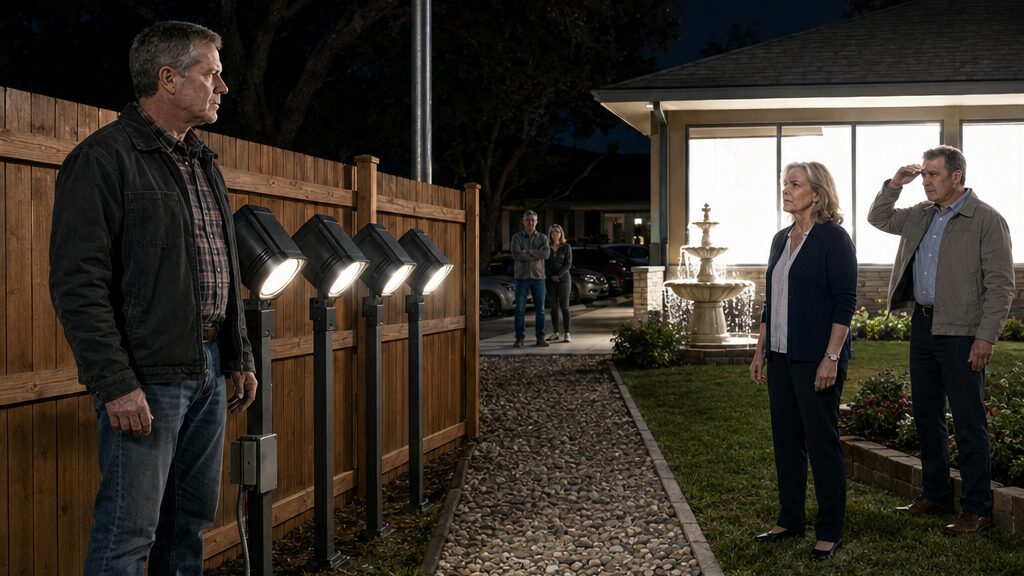
The entire rear face of the office changed.
The broad windows turned nearly white, reflecting so much light that the rooms behind them disappeared.
The fountain shimmered in the spill, every drop unnaturally sharp.
For one perfect second, Raymond felt exactly what he had expected.
Vindicated.
The HOA had put eyes above his fence.
Now they had light through their windows.
Nothing crossed the property line except illumination.
Nothing was damaged.
Nothing touched their building.
Scott appeared inside first, lifting a hand against the glare.
Then Sharon came to the glass.
Raymond could not see her expression clearly through the reflection.
That made the satisfaction stronger.
The electrician turned toward him.
“You’ve made your point.”
Raymond kept looking at the office.
“Have I?”
A car slowed at the end of the cul-de-sac.
Another followed.
A neighbor stepped onto a porch two houses down.
Then Raymond heard his phone buzz.
A message from property management.
Complaint received regarding excessive exterior lighting.
Another buzz followed less than a minute later.
A nearby resident asking whether something was wrong at the association office.
The electrician gave Raymond a look.
“I told you reflection travels.”
Raymond’s satisfaction thinned.
Across the lot, Sharon came outside.
She stood beneath the fountain light, shielded her eyes, and looked directly toward his yard.
Scott followed her and pointed at the floodlights.
Raymond could not hear what they said.
He did not need to.
The scene had become public.
That was not what he had told himself he wanted.
The electrician adjusted one fixture slightly downward.
“This helps.”
“Leave the others.”
The man hesitated.
“You’re the customer.”
Raymond stood alone after the electrician left.
The office windows still glowed white.
For the first time since Tuesday, the cameras no longer looked like the largest objects in the dispute.
The lights did.
At ten, Raymond switched them off.
The sudden darkness made the backyard feel smaller than it had before.
He went inside.
A formal email from the management company was already waiting. It cited a potential nuisance concern and asked him to preserve the current lighting configuration pending review.
Raymond almost laughed.
They had found procedure quickly when the discomfort reached them.
He shut the laptop.
The next morning, shortly after eight, someone knocked at his side gate.
Raymond looked through the kitchen window.
Sharon Davis stood on the other side of the gravel strip with a paper coffee cup in one hand.
No folder.
No violation notice.
No board member beside her.
She knocked again.
Chapter 5: What Sharon Chose Not to Say
“I knew the sight-line review wasn’t finished.”
Sharon said it before Raymond had fully opened the gate.
For several seconds, he did not answer.
The coffee in her hand steamed faintly in the cool morning air.
“What?”
“The cameras,” she said. “I knew the contractor hadn’t completed the privacy review.”
Raymond looked past her toward the association office.
The floodlights were off.
The cameras were not.
“You came over to tell me that?”
“I came over because if we do this through notices first, neither of us is going to like where it goes.”
Raymond opened the gate wider but did not invite her inside.
Sharon noticed.
She stepped back toward the gravel strip.
“Fine.”
“You knowingly put them up anyway.”
“I approved activation.”
“That sounds like a longer way of saying yes.”
Sharon took a breath.
“We had an insurance review scheduled. We had three incidents in six weeks. Residents were already saying the board ignored safety complaints. The vendor could install Tuesday or push us back nearly a month.”
“So you decided my fence was less important.”
“I decided we needed coverage.”
“You didn’t know what it covered.”
“I knew the general field.”
“That isn’t the same thing.”
“No.”
The answer came quickly enough to unsettle him.
Raymond had expected defense.
Maybe anger.
Not agreement.
Sharon looked toward the camera pole.
“I should have delayed activation until the masks were set.”
Raymond folded his arms.
“Then turn them off now.”
“We still have the security issue.”
“There it is.”
“I’m not pretending I handled this perfectly.”
“Perfectly?”
“No. I handled part of it badly.”
Raymond laughed once.
“My porch is not a rounding error.”
Sharon’s expression hardened.
“And four stadium lights pointed at our office are what? A mature dispute-resolution strategy?”
“They’re on my property.”
“So are a lot of things that can still create a nuisance.”
“They’re not watching you.”
“They lit every west-facing window in the building.”
“That bothered you?”
“Yes.”
“Good.”
The word landed harder than Raymond intended.
Sharon stared at him.
For a moment, neither spoke.
A maintenance cart rolled through the parking lot on the other side of the strip. Its tires clicked over a seam in the pavement.
Sharon lowered the coffee cup.
“That’s the part I was hoping wasn’t true.”
“What part?”
“That you wanted it to bother us more than you wanted the cameras fixed.”
Raymond felt his shoulders stiffen.
“That’s convenient coming from the person who left them running.”
“I’m not asking you to trust my motives.”
“No problem there.”
“I’m asking whether your actual goal is privacy.”
“It is.”
“Then turn the lights off while we correct the angles.”
Raymond looked up at the black camera heads.
“No.”
Sharon nodded once, as if confirming something to herself.
“All right.”
She reached into the pocket of her jacket and took out a folded sheet.
“There’s already a nuisance file open.”
Raymond did not take it.
“You said you didn’t come with a notice.”
“It isn’t a violation notice. It’s documentation from management. They received complaints last night.”
“From you?”
“One from Scott. Two from residents.”
That caught Raymond.
“Which residents?”
“I’m not giving you names.”
“They weren’t aimed at their houses.”
“Reflected light doesn’t care where you aimed it.”
The electrician’s warning returned immediately.
Legal and smart aren’t always the same thing.
Raymond kept his face neutral.
Sharon held out the paper again.
“This can stay informal while we work on the cameras. Or Scott can push for enforcement.”
“Is that supposed to scare me?”
“No.”
“Sounds like it.”
“It’s supposed to tell you this isn’t just you and me anymore.”
Raymond took the page.
The wording was dry, procedural, almost bland.
Complaint logged.
Exterior illumination.
Potential interference with neighboring enjoyment.
Board review pending.
No fine.
Not yet.
Raymond folded it along the existing crease.
“You said the cameras were rushed because of insurance.”
“Yes.”
“Why didn’t you tell me that Tuesday?”
Sharon looked toward the office.
“Because I thought you’d hear excuse instead of explanation.”
“You were right.”
“I also thought you’d object no matter where we put them.”
Raymond’s eyes narrowed.
“There it is.”
“I’m not proud of that.”
“But it affected your decision.”
“Yes.”
“So you decided not to ask because you assumed the answer.”
Sharon’s grip tightened on the coffee cup.
“We’ve had eleven years of conversations, Raymond. Drainage, contractor parking, landscaping access, fence setback. You don’t exactly approach the association assuming good faith.”
“And the association keeps giving me practice.”
“I’m not asking you to like us.”
“You approved cameras without telling me.”
“And you installed floodlights without telling me.”
“They’re on my property.”
“So is your fence. You still had to follow setback rules when you built it.”
Raymond started to answer, then stopped.
She had not proved equivalence.
But that was not the same as saying she had no point.
The gravel between them suddenly seemed narrower.
Sharon glanced down at it.
“What do you actually want?”
“The cameras out of my yard.”
“Anything else?”
“Written limits.”
“We can discuss that.”
“Not discuss. Adopt.”
She studied him.
“What kind of limits?”
“Privacy masking. Notice to adjoining owners. No equipment installed with a private sight line without review.”
“You’ve thought about this.”
Raymond looked toward the ground.
“Yes.”
“How much?”
He raised his eyes.
“Enough to find the utility easement.”
Sharon did not move.
The change in her face was slight but unmistakable.
The board-president expression disappeared.
“What easement?”
“The one under this gravel.”
She looked down.
Raymond could almost see her recalculating the strip beneath her shoes.
“The electrical service?”
“You know about it.”
“I know there’s a utility corridor.”
“The access agreement is approaching renewal.”
Sharon’s eyes returned to him.
“When?”
“Weeks.”
The coffee cup stopped halfway to her mouth.
Raymond felt the balance shift again, cleaner than it had under the floodlights.
This was not glare.
This was information.
Sharon spoke carefully.
“What are you planning to do with that?”
Raymond had imagined this moment several times.
He had imagined saying he would refuse renewal.
He had imagined telling her every light in the parking lot depended on his signature.
He had imagined watching the certainty leave her face.
Now that the moment was real, the words felt heavier.
“I haven’t decided.”
“That’s not reassuring.”
“It wasn’t meant to be.”
Sharon stepped back across the gravel strip.
“Then we need a board meeting before anybody makes assumptions about what that document does.”
Raymond folded the nuisance notice and put it in his pocket.
“That sounds appropriate.”
She looked at him for another second.
Then she turned toward the office.
Raymond watched her cross the gravel.
For eleven years, people had walked over that strip without noticing who owned it.
Sharon noticed now.
Chapter 6: The Meeting Where Nobody Had Clean Hands
“The easement does not give Mr. Miller a switch he can simply turn off.”
The HOA attorney said it before Raymond had finished sitting down.
The meeting room went quiet.
Raymond placed his folder on the table.
“I didn’t say it did.”
Scott Walker leaned back in his chair.
“You implied it.”
“I said the agreement is approaching renewal.”
“After lighting up the office like a stadium.”
Sharon looked at Scott.
“Let him finish.”
Raymond had been invited to a special board session the following week. The surveyor’s fresh markers were still visible outside, small stakes defining the gravel strip more precisely than Raymond had ever seen it in eleven years.
On the table sat printed photographs.
One showed the cameras above his fence.
Another showed the white glare across the west-facing office windows.
Placed side by side, they looked less like evidence of one person being right than evidence of two people refusing to step back.
The attorney adjusted his glasses.
“The current instrument establishes utility access and includes renewal language. It also contains continuation provisions that would have to be interpreted in context.”
Scott looked satisfied.
“So he can’t cut our power.”
Raymond turned toward him.
“I never threatened to.”
“You brought up the easement the morning after you installed those lights.”
“Yes.”
“Why?”
“Because nobody cared about boundaries until one of them became inconvenient to you.”
Scott opened his mouth.
Sharon raised a hand.
“Enough.”
The property-management representative pulled up a set of camera images on a laptop.
“We had the vendor export the current fields of view.”
The first image showed the rear parking lot.
The second covered the fountain and office walkway.
The third included the top of Raymond’s fence.
Then the operator switched to a wider frame.
Raymond’s porch steps appeared in the corner.
Elizabeth Taylor leaned forward from her seat along the wall.
“That’s his yard.”
The representative nodded.
“Yes.”
“Can it zoom farther?”
Another pause.
“Yes.”
“How far?”
The image enlarged.
The porch chair became visible.
Part of the garden bed entered frame.
Elizabeth sat back.
“I didn’t know that.”
Scott rubbed his forehead.
“That doesn’t mean anyone was using it to watch him.”
Raymond looked at him.
“That has never been the point.”
Elizabeth turned toward Sharon.
“When I complained about somebody by my garage, I wanted cameras on the common walkways.”
“That was the intent,” Sharon said.
“Well, that’s not the walkway.”
The room changed slightly.
Not dramatically.
Nobody gasped.
Nobody apologized.
But for the first time, Raymond was not the only person asking the privacy question.
The management representative clicked to another screen.
“The vendor says we can create permanent privacy masks in software and lower two viewing limits. One camera may need to be physically repositioned.”
Scott glanced at the estimated cost.
“Still thousands.”
“Less than moving the entire pole,” Sharon said.
“And we’re supposed to spend association money because he objected after installation?”
Elizabeth looked at him.
“Because the camera can zoom into his porch.”
Scott turned.
“We also have residents demanding better coverage after vandalism.”
“Then cover what belongs to us.”
The simplicity of it silenced him.
Raymond looked at Elizabeth.
A week earlier, she had defended the need for stronger security.
She still did.
That was why her support mattered.
The attorney moved to the easement documents.
“Now, on renewal. Mr. Miller is entitled to negotiate certain terms. That does not mean existing service automatically disappears if no agreement is signed on a particular date.”
Raymond nodded.
“That’s my understanding.”
Scott frowned.
“Your understanding now.”
“My understanding before I installed the lights.”
“Then what exactly were you trying to do?”
Raymond looked at the photographs.
He could have given the polished answer.
Demonstrate privacy intrusion.
Create urgency.
Establish leverage.
Instead he remembered Sharon standing at his gate.
You wanted it to bother us more than you wanted the cameras fixed.
“I was trying to make a point,” he said.
Scott gave a bitter laugh.
“Congratulations.”
Raymond kept looking at the photographs.
“And I made it badly.”
That stopped Scott more effectively than an argument would have.
Sharon watched Raymond but said nothing.
He continued.
“The cameras should never have been activated with that sight line. The lights should not have become everybody else’s problem.”
The room remained quiet.
“I’m not removing them tonight while the cameras still have access to my yard,” Raymond said. “But I’m not asking the board to believe I can cut electrical service either.”
The attorney gave a small nod.
Scott looked less pleased.
“So what do you want?”
Raymond opened his folder.
“Three things on surveillance.”
He placed one page on the table.
“Permanent privacy masking for adjoining private property.”
A second page.
“Advance notice when new exterior cameras are installed near a residential boundary.”
A third.
“Documented sight-line review before activation.”
Scott stared at the pages.
“You wrote policy language?”
“I wrote conditions.”
“For the cameras?”
“For the easement renewal.”
There it was.
Not a threat.
Not exactly.
But leverage made visible.
Scott pushed back from the table.
“That’s coercion.”
“No,” Raymond said. “Coercion would be me claiming I can shut off your service unless you obey me. I’m not saying that.”
“You’re tying unrelated issues together.”
“They’re not unrelated. Both concern what the association does across my property boundary.”
The attorney picked up the pages.
“These are negotiable terms, not necessarily enforceable as written.”
“Then negotiate them.”
Scott looked toward Sharon.
“We should litigate before we let a homeowner dictate surveillance policy through a utility agreement.”
Sharon’s face tightened.
“And spend how much?”
“That’s not the point.”
“Apparently money was the point when moving a camera cost several thousand.”
Scott said nothing.
The inconsistency hung there.
Raymond saw it.
So did everyone else.
The surveyor’s stakes were visible through the meeting-room window, small bright markers running along the gravel.
For the first time, the strip looked deliberate rather than forgotten.
Sharon picked up the proposed conditions.
“If we accept a revised policy, the lights come down?”
“When the camera changes are completed.”
“Not before?”
“No.”
“And you sign renewal?”
“If the access terms include notice before excavation, restoration standards, and defined entry procedures.”
The attorney looked at him.
“Those are more conventional easement terms.”
“They should have been there already.”
Sharon read the first page again.
Scott shook his head.
“We’re giving away operational control.”
“No,” Elizabeth said quietly. “We’re admitting we shouldn’t have operational control over somebody else’s backyard.”
Scott turned toward her.
“You were the one asking for cameras.”
“I’m still asking for cameras.”
She pointed at the image on the laptop.
“Just not his porch.”
Raymond felt something in the room settle.
Not victory.
Definition.
That was different.
He looked at Sharon.
“You asked what I wanted. That’s it.”
She tapped the stack of pages against the table.
“And if the board says no?”
Raymond looked toward the survey stakes outside.
A week earlier, he would have enjoyed the answer too much.
Now he chose it carefully.
“Then we keep negotiating.”
Scott stared at him.
“No threat?”
Raymond closed the folder.
“No threat.”
He slid the written conditions across the table until they stopped in front of Sharon.
“You wanted this handled through the board,” he said. “Now it is.”
Sharon rested one hand on the pages.
For the first time since the cameras went up, Raymond had given her something stronger than anger and less destructive than revenge.
A choice.
Whether she would take it was now hers.
Chapter 7: The Boundary They Finally Drew Together
The first camera came down before Raymond expected the board to keep its word.
He was standing on his back porch two weeks after the special meeting when a service truck pulled behind the HOA office. One worker climbed a ladder while another opened the control cabinet at the base of the aluminum pole.
Raymond set his coffee down.
The upper camera rotated once, stopped, and went dark.
Then the worker loosened its mount.
For nearly three weeks, Raymond had looked outside and seen that black lens above his fence.
Watching it descend felt stranger than he expected.
Not triumphant.
Quieter.
The worker carried the camera to the truck while a second unit was physically lowered and redirected toward the parking lot entrance. The third remained on the pole, but its movement stopped at a new programmed limit well before Raymond’s property entered view.
Sharon Davis appeared beside the office carrying a clipboard.
She saw Raymond watching.
“The privacy masks are active,” she called across the gravel strip.
Raymond came through his gate.
“You tested them?”
“Management did. The vendor did. Elizabeth did, apparently.”
That surprised him.
“Elizabeth?”
“She asked to see what the system could and couldn’t capture before she supported the policy.”
Raymond nodded.
That sounded like her.
Sharon held out the clipboard.
“Want to see?”
He crossed to the edge of the strip but stopped before stepping onto association property.
The display showed three camera views.
Parking spaces.
Office entrance.
Fountain and rear walkway.
Where Raymond’s backyard should have appeared, a solid privacy block covered the image.
He looked longer than necessary.
“That stays even if someone zooms?”
“It stays.”
“Administrator can’t remove it remotely?”
“Not without a logged policy exception and board authorization.”
Raymond looked at Sharon.
“You added that.”
“I learned something.”
He almost smiled.
“Careful. It could become a habit.”
She gave him the faintest look of irritation, but it passed.
“The surveillance policy passed four to one.”
“Scott?”
“Who else?”
Raymond glanced through the office window.
Scott Walker was visible inside, speaking with the property-management representative.
“He still thinks this is surrender?”
“He thinks every written restriction eventually becomes an expense.”
“He might be right.”
Sharon looked at him.
“That doesn’t mean the restriction is wrong.”
The sentence stayed between them for a moment.
Raymond understood that she was not speaking only about cameras.
The surveyor arrived later that morning.
Fresh stakes were placed along the gravel easement strip, replacing the temporary markers used during negotiations. The new map defined the utility corridor, access width, restoration obligations, and notice requirements before nonemergency excavation.
For eleven years, Raymond had treated the gravel as something between property and leftover space.
Now every foot had a description.
Sharon joined him beside the surveyor’s truck.
The HOA attorney had already reviewed the final easement language. Raymond had reviewed it with his own counsel. Nothing in it gave him control over the association’s electricity.
That had never truly been the point.
The new agreement guaranteed continued utility access while requiring reasonable notice before entry, restoration of disturbed ground, and limits on how contractors could use the strip.
Raymond held the signature page.
Sharon watched him.
“You can still walk away today.”
“So can you.”
“The board already authorized me to sign.”
“That must have hurt Scott.”
“It nearly killed the meeting.”
Raymond looked toward the office.
The west-facing windows were ordinary again.
No white glare.
No people shielding their faces.
His floodlights still stood behind him, dark in daylight.
For several days after the board approved the camera corrections, Raymond had considered delaying his signature.
Not because he needed anything else.
Because he could.
The thought had embarrassed him once he admitted it plainly.
He had spent three weeks furious that the board had used its authority without considering what crossed into his life. Keeping the easement unresolved after his privacy had been protected would have been the same impulse wearing different clothes.
Raymond signed.
Sharon took the pen after him.
Neither said anything for a few seconds.
The surveyor gathered the pages.
“That’s it.”
Something about those three words made the entire dispute feel unexpectedly small.
Not meaningless.
Just finite.
A utility corridor.
Three cameras.
Four lights.
Two signatures.
Enough stubbornness to turn all of it into a neighborhood crisis.
By afternoon, the electrician returned to Raymond’s property.
“You keeping any of them?” he asked, looking up at the four floodlights.
“One.”
“For security?”
Raymond nodded toward his shed.
“For actual security.”
The electrician smiled.
“Novel concept.”
They removed three fixtures and two posts. The remaining light was repositioned downward toward Raymond’s side gate and adjusted so its beam ended well inside his property.
Sharon came outside while the last tall post was being pulled.
She stood beside the fountain.
Raymond walked toward the fence.
“The office going to miss them?”
“The board voted unanimously that we could survive without stadium lighting.”
“Even Scott?”
“He called it unnecessary capital illumination.”
Raymond laughed despite himself.
That evening, Elizabeth stopped near his gate with her dog.
“I saw the cameras.”
“They’re fixed.”
“I checked.”
“So Sharon told me.”
Elizabeth looked toward the office.
“I still want them there.”
“I know.”
“I just didn’t know what they could see before.”
Raymond rested a hand on the gate.
“Neither did the people who approved them.”
She nodded.
“That’s probably the part that bothered me most.”
It bothered Raymond too, though not quite in the same way anymore.
The board had assumed the cameras were acceptable because the reason for installing them felt important.
Raymond had assumed the floodlights were acceptable because his reason felt important.
Neither had begun by asking where the effect of their decision landed.
After Elizabeth left, Raymond walked behind his fence with a steel rake.
The contractors had disturbed the gravel while removing equipment and marking the easement. Nothing serious. A few shallow tire tracks, displaced stones, footprints around the stakes.
He began smoothing it.
The rake teeth made parallel lines through the gray stone.
Halfway down the strip, Sharon came out of the office carrying her bag.
She stopped.
“You know the association is responsible for restoring that under the new agreement.”
“I know.”
“You could make us do it.”
Raymond continued raking.
“I could.”
Sharon watched him for a moment.
“Good night, Raymond.”
“Good night, Sharon.”
She walked to her car.
Raymond reached the last survey marker and turned back.
On one side of the gravel stood his cedar fence, his garden beds, his porch, and the single modest light above his gate.
On the other stood the beige HOA office, the fountain, the parking lot, and three cameras now facing only the property they were supposed to protect.
The gravel between them had not moved.
Its ownership had not changed.
What had changed was that everyone finally knew where it was.
Raymond pulled the rake across the final tire mark until the stones lay level again.
Then he lifted the rake, stepped back onto his own lawn, and left the boundary exactly where it belonged.
The story has ended.